Clients aren’t just asking where they rank on Google anymore. They’re asking, “Are we showing up in AI answers?” As AI Overviews, ChatGPT, Perplexity, and other LLM-powered tools become part of the discovery journey, visibility now extends beyond traditional SERPs.
For agencies, this creates a new problem: AI visibility is harder to explain, harder to prove, and dangerously easy to misreport without a clear system. Screenshots, anecdotal prompts, and one-off examples don’t scale, especially when you’re reporting across multiple clients or offering white-label services.
This post gives you a repeatable AI visibility reporting checklist designed specifically for agencies—one that works across clients, niches, and reporting formats while staying credible and defensible.
You can also download the full checklist as a free, reusable template to use in your own reporting workflows.
- Clients now care about AI visibility, not just Google rankings — they want to know if their brand shows up in ChatGPT, Google AI Overviews, and similar tools.
- AI visibility is harder to explain and easier to misreport, especially across multiple clients and white-label services.
- This guide provides a repeatable AI visibility reporting checklist built specifically for agencies.
- White-label AI visibility reports should keep the agency in control of the narrative, not expose tools or raw prompts.
- Multi-client reporting breaks without structure, leading to inconsistent metrics, mixed data, and lost trust.
- AI visibility reporting and auditing are not the same — audits diagnose problems, reporting proves progress over time.
- Strong AI visibility reports follow three layers: executive summary, evidence, and next steps.
- Clients care most about recommendations, accuracy, competitor context, and clear outcomes.
- The checklist helps agencies standardize account setup, query tracking, metrics, QA, and reporting cadence.
- A free downloadable checklist template is included to make AI visibility reporting easier to scale and reuse.
If you need a team to operationalize this checklist for clients, compare top AI SEO agencies to find partners who can execute and report consistently.
Key Definitions (Keep It Simple, Client-Friendly)
Before jumping into the checklist, it’s important to align on a few terms. These are often misunderstood—and when they are, reporting breaks fast.
What “White-Label” Means for AI Visibility Reports
White-label means the report looks and feels like it was built entirely by your agency, even if tools are used behind the scenes.
The client never sees the software, platform, or third-party system. They only see your brand and your interpretation of the data.
Common white-label AI visibility report formats include:
- Agency-branded PDFs
- Branded dashboards or portals
- Custom metric names that match your service language
- An agency-written commentary layer explaining what the data means
The goal isn’t to hide tools, it’s to keep ownership of the narrative.
What “Multi-Client” Means (and Why It Breaks Reporting)
Multi-client reporting means managing AI visibility data for many clients at the same time, each with separate brands, markets, and goals while using the same internal process.
This is where most agencies struggle.
Without structure, multi-client reporting leads to errors and inefficiencies which is a common problem as 58% of agencies report that preparing each client report manually can take 30–45 minutes or more, with nearly 20% spending 1–2 hours per report before automation. (AgencyAnalytics, 2023)
Multi-client reporting without structure can lead to:
- Client data getting mixed up
- Different metrics used for different clients
- Manual reports that don’t scale
- Confusion when clients compare reports month to month
If each client report is handled “a little differently,” consistency disappears—and trust follows.
This is why some agencies rely on tools like Wellows to isolate client data, lock query sets, and prevent cross-client visibility mix-ups at scale.
AI Visibility Reporting vs AI Visibility Auditing (Important Distinction)
These two are not the same and treating them as the same causes problems.
AI Visibility Auditing
- Diagnoses why a brand is or isn’t showing up in AI answers
- Identifies gaps, risks, and opportunities
- Leads to fixes and strategy changes
AI Visibility Reporting
- Shows where the brand appears (or doesn’t)
- Tracks changes over time
- Communicates outcomes in a client-ready format
In an agency retainer model:
- Audits are usually done at onboarding or during major strategy shifts
- Reporting happens monthly or quarterly to prove progress and impact
This checklist focuses on reporting, not audits. Because clients don’t just want insight. They want proof.
AI Visibility Reporting vs AI Visibility
What a “Good” AI Visibility Report Looks Like (Agency Standard)
A good AI visibility report doesn’t overwhelm the client with raw prompts or screenshots. It answers the questions they care about, shows proof, and clearly connects work to outcomes.
If a client can’t understand the report in five minutes, it’s not ready.
The 3 Layers of a Client-Ready Report
Every strong AI visibility report has three layers. Skip one, and the report falls apart.
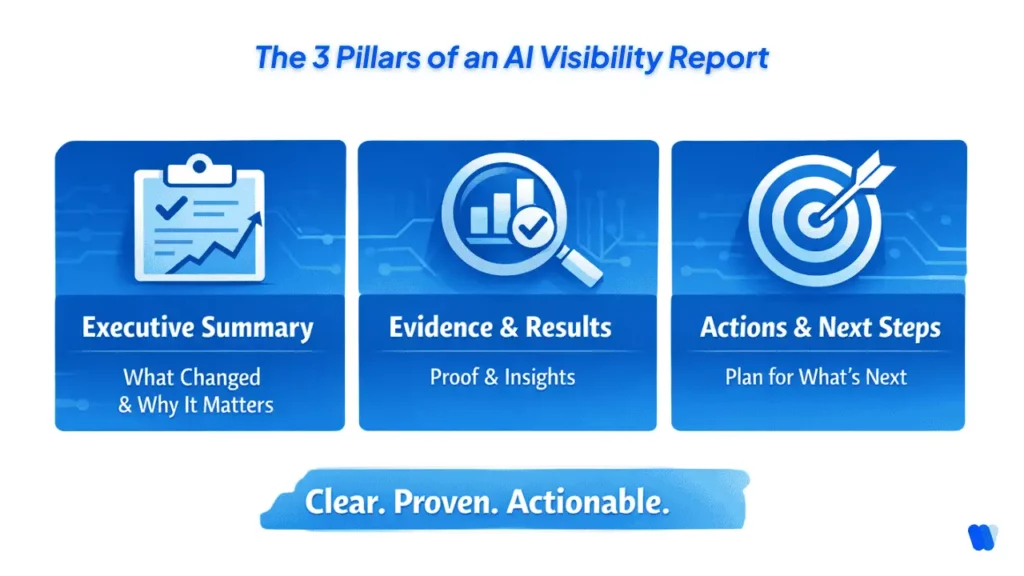
This is the first thing clients read. and sometimes the only thing.
It should clearly state:
- What changed since the last report
- Whether visibility improved, declined, or stayed flat
- Why that change matters to their brand or pipeline
- No prompts. No tools. Just outcomes in plain language.
Example:
“Your brand appeared in 4 new AI-generated answers related to pricing and comparisons, increasing recommendation visibility in buyer-stage queries.”
This is where you back up the summary with clear proof.
A good evidence section includes:
- The queries being tracked
- Where the brand was mentioned or recommended based on the sources AI systems choose to cite.
- How the mention appeared (brand name, product name, category reference)
- Comparisons against competitors or previous reports
- Clients don’t need everything, they need enough evidence to trust the result.
This section protects your value as an agency.
It answers one simple question:
“What are you doing next because of this data?”
Examples:
- Expanding coverage into new query types
- Fixing incorrect brand mentions
- Strengthening competitor comparison visibility
- Improving source signals AI tools rely on
If this section is missing, clients assume the report is passive, not strategic.
What Clients Expect (Even If They Don’t Say It)
Clients may not know how AI visibility works but they know what they want to hear. Especially as nearly 60% of U.S. adults say they already use AI tools to find answers or information, shaping how brands are evaluated. (AP news, 2025)
Every report is silently judged against these questions:
Did you know?
“Are we being recommended?”Not just listed—actually suggested as a solution.
Did you know?
“Are we mentioned correctly?”Brand name, product positioning, and use cases must be accurate.
Did you know?
“Are we gaining share vs competitors?”Clients don’t want visibility in isolation, they want context.
Did you know?
“What did you do this month that moved visibility?”This is the trust question. It ties effort to outcome.
A good AI visibility report doesn’t wait for these questions. It answers them before the client asks.
The AI Visibility Reporting Checklist (White-Label & Multi-Client)
This checklist is built to prevent reporting mistakes, protect client trust, and scale across accounts without chaos.
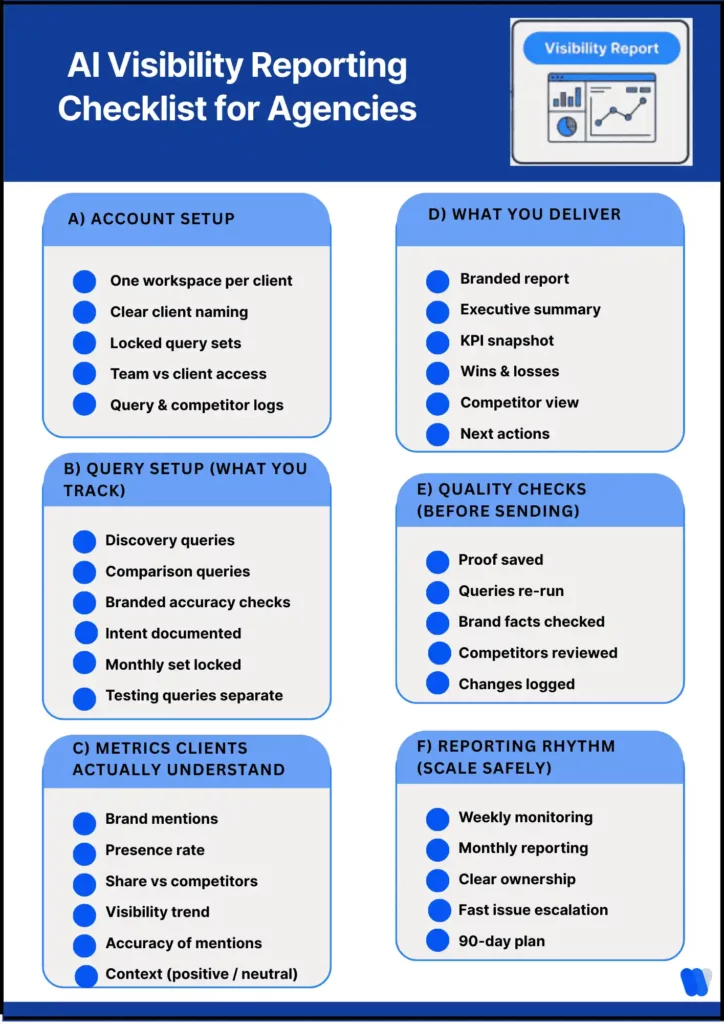
Your first job is keeping client data separate and safe.
- One workspace per client
- Clear naming (client name + market + region)
- Separate access for team and clients
- Track changes to queries and competitors
Avoidable disaster callout:
How agencies accidentally mix competitor and client visibility:
Shared workspaces, copy-pasted query sets, and renamed dashboards without access control. One screenshot in the wrong report is enough to break trust.
AI visibility only makes sense if you track the right questions.
- Discovery queries (non-branded) that reflect early-stage user intent rather than brand awareness alone.
- Comparison queries (“best”, “alternatives”)
- Branded accuracy queries
- Write down why each query exists
- Keep the main query list stable each month
- Use a separate test list for experiments
Pro tip:
Choose 30–60 queries per client by focusing on buying intent, comparison moments, and brand accuracy. More queries don’t mean better reporting—they usually mean noise.
Don’t overload reports. Focus on what answers real questions.
Core visibility
- Where the brand is mentioned
- How often it appears
- How it compares to competitors
- Month-to-month trend
Quality checks
- Is the mention direct or indirect?
- Is the brand described correctly?
- Is the context positive or neutral?
Business signals
- Any AI-driven traffic
- Increase in brand searches
- Signs of buyer or demo intent
Callout: What not to report
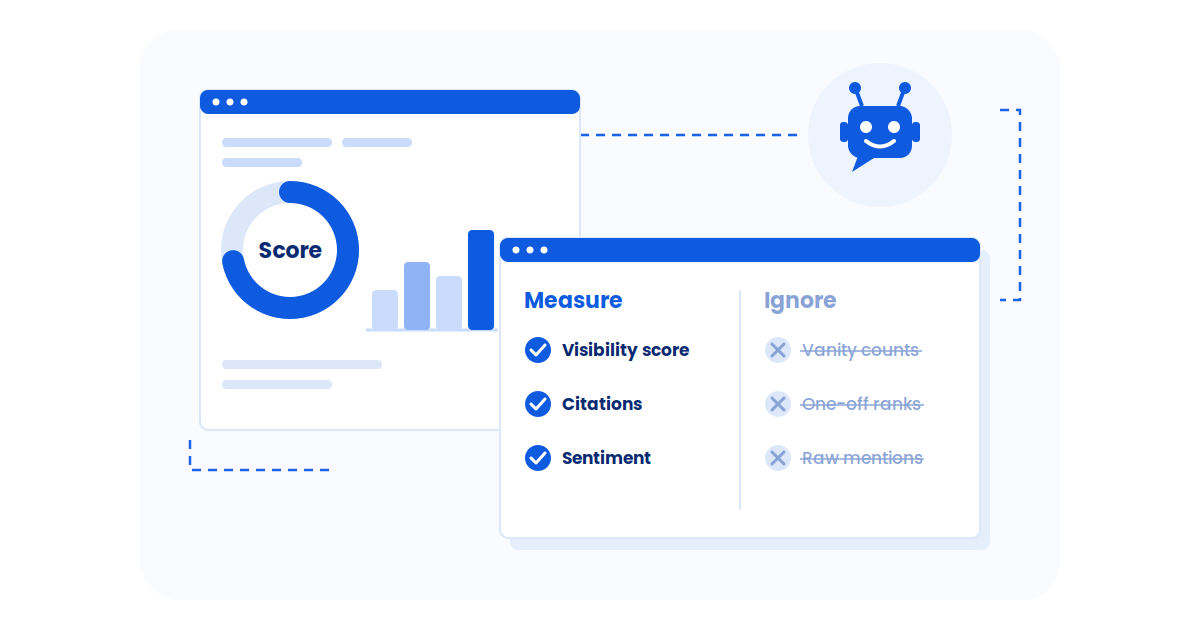
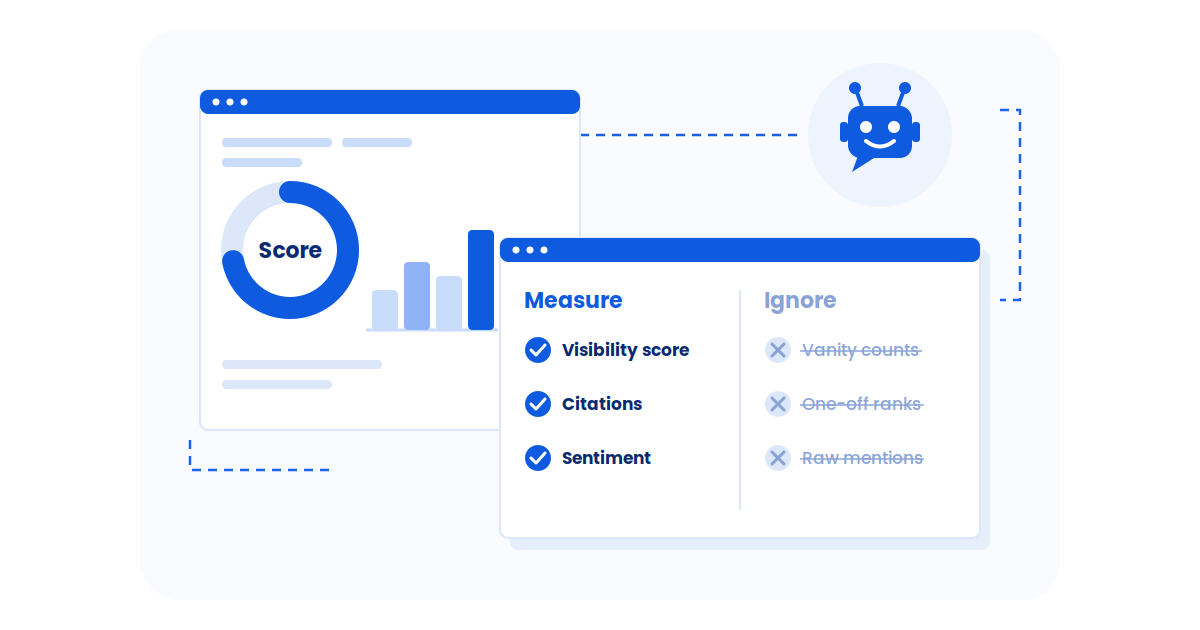
Avoid vanity metrics like total prompt counts, raw token data, or “AI score” numbers with no explanation. They confuse clients and weaken trust.
Clients should only see your agency, not your tools.
- Branded report (PDF or deck)
- Short executive summary
- Clear wins and gaps
- Competitor snapshot
- Next-month actions
Mini tip:
Rename metrics in client language.
“Presence Rate” → “How often your brand shows up in AI answers.”
Never ask clients to “trust us.”
- Save proof for key claims
- Re-run important queries to confirm results
- Manually check facts and brand accuracy
- Note what changed since last month
QA checklist table (example):
| Check | Status | Notes |
| Queries unchanged | ✅ | — |
| Citations verified | ✅ | 2 spot checks |
| Competitors reviewed | ⚠️ | One new entrant |
- Monitor weekly
- Report monthly
- Assign clear ownership
- Flag negative mentions fast
- Use a rolling 90-day plan so reports don’t feel repetitive
Download the AI Visibility Reporting Checklist (Free Template)
To make this easier to use in real agency workflows, we’ve turned this checklist into a downloadable template you can reuse across clients.
It’s designed for white-label reporting, multi-client teams, and monthly reporting workflows so you can stay consistent without rebuilding reports every time.
What the Downloadable Template Includes
AI Visibility Reporting checklist includes:
- A structured AI visibility reporting checklist
- Clear sections for account setup, queries, metrics, QA, and cadence
- Client-safe language (no tools or jargon)
- Ready to use for ChatGPT, Google AI Overviews, and Perplexity
Works as:
- Internal SOP
- Monthly reporting reference
- White-label reporting guide
Example White-Label Report Structure (Copy/Paste Template)
Use this structure for every client.
Only the data changes—never the format.
Did you know?
Executive Summary (Last 30 Days)
Overall AI visibility: ⬆ / ⬇ / → (brief reason)
- New AI mentions or recommendations gained: ___
- Visibility lost or changed: ___
- Competitor movement: who gained or dropped visibility
- What this means for your pipeline or demand
Did you know?
KPI Snapshot
| Metric | This Month | Last Month | Change |
|---|---|---|---|
| Presence rate | |||
| Total AI mentions | |||
| Share vs competitors | |||
| Accurate brand mentions |
Did you know?
Top Query Wins (Where You Gained Visibility)
Query:
- Where your brand appeared (platform)
- How it was mentioned or recommended
- Proof (screenshot or citation reference)
Repeat for top 3–5 wins only.
Did you know?
Lost Visibility (What Changed)
Query:
- What changed since last report
- Possible reason (content shift, competitor gain, source change)
- Risk level: low / medium / high
Did you know?
Competitor Movement
- Competitor gaining visibility: ___ (where and why)
- Competitor losing visibility: ___
- Net position vs last month: stronger / weaker / unchanged
Did you know?
Accuracy Issues Detected
- Incorrect pricing mention: fixed / in progress
- Feature or positioning error: fixed / in progress
- Brand naming issue: fixed / in progress
- Brand misrepresented positioning in AI answers: fixed / in progress
Actions taken to correct AI outputs:
- ______________________
- ______________________
- ______________________
Did you know?
Actions Completed This Month
- Improved visibility for: ___ queries
- Corrected brand accuracy in: ___ platforms
- Expanded coverage into: ___ topics
Did you know?
Next Month Plan (3–5 Actions)
- Strengthen visibility for ___ query group
- Address competitor pressure in ___ area
- Improve accuracy for ___ brand facts
- Test new queries related to ___
Did you know?
Appendix: Tracked Query Set
Discovery queries:
- _____________
- _____________
Comparison queries:
- _____________
- _____________
Branded accuracy queries:
- _____________
- _____________
Common Agency Mistakes (That Cause “Reporting Without Results”)
Many AI visibility reports look active but fail to prove real progress. These mistakes create false confidence, confuse clients, and slowly erode trust.
- Reporting only branded queries: Creates the illusion of success while hiding whether the brand is actually being discovered or recommended.
- Changing the query set every month: Removes any baseline, making month-over-month comparisons meaningless.
- No competitor context: Leaves clients unable to judge whether visibility gains actually matter.
- Overpromising causality (“we did X so AI did Y”): Sets expectations agencies can’t control and can’t reliably prove.
- No QA proof or evidence: Forces clients to “trust the report” instead of believing the results.
Which Tools are Best for AI visibility Reporting Checklist for Agencies?
To build an AI visibility reporting checklist that works across multiple AI search engines, agencies often rely on tools designed to track, verify, and compare brand presence inside AI-generated answers. Below are commonly used platforms that support AI visibility monitoring across systems like ChatGPT, Google AI Overviews, and Perplexity.
Wellows
Designed for agency and multi-client workflows, Wellows focuses on AI visibility monitoring and reporting across major AI answer engines. It supports query consistency, client data isolation, competitor context, and white-label reporting—making it suitable for repeatable, client-ready AI visibility reports.
LLMrefs
An AI search analytics and rank-tracking tool that monitors visibility across ChatGPT, Perplexity, Google AI Overviews, Gemini, and Claude. It connects SEO keywords to AI-generated answers, showing which brands and URLs are cited for each query.
Rankability’s AI Analyzer
Extends SEO content optimization into AI search by testing branded and commercial prompts across leading answer engines. It integrates with Rankability’s existing content optimization and keyword research workflows.
Peec AI
A GEO/LLMO analytics platform that tracks brand visibility across AI answer engines, including ChatGPT and Google AI Overviews. It supports branded vs. non-branded prompts, share-of-voice analysis, competitor comparisons, and data exports for reporting.
OtterlyAI
Provides insights into how Search Engine Visibility surface and cite key terms. It offers prompt and citation tracking along with dashboards that support content, SEO, and PR analysis.
Profound
An enterprise-grade AI visibility platform offering real-time citation tracking, conversation-level analysis, and advanced reporting across multiple AI answer engines.
These tools help agencies monitor AI visibility at scale, but the most effective reporting systems prioritize consistency, evidence, and client-safe outputs over raw prompt data or tool-specific metrics.
How Agencies Can Productize AI Visibility Reporting (Pricing + Positioning)
AI visibility reporting works best when it’s sold as a clear product, not a vague add-on, especially for agencies formalizing AI search reporting services. Simple bundles help clients understand value and help agencies scale delivery.
Common bundle structure:
- Lite: Monthly Reporting: One monthly AI visibility report covering brand presence, key queries, and competitor context. Best for clients who want awareness, not ongoing changes.
- Standard: Monitoring + Reporting: Weekly monitoring with a monthly report, including accuracy checks and competitor movement. Best for teams that want early signals and trend tracking.
- Pro: Visibility Management: Monitoring, reporting, accuracy fixes, content updates, and competitive strategy adjustments. Best for competitive markets where AI visibility impacts revenue.
White-label upsells agencies can add:
- Executive-ready reporting: Short summaries written for leadership and non-technical stakeholders.
- Board-ready dashboards: High-level trends and competitive positioning for quarterly or investor reviews.
Positioning tip:
Don’t sell this as “AI reports.” Sell it as visibility intelligence. Clients pay for clarity, confidence, and proof—not tools or prompts.
FAQs
Conclusion
AI visibility reporting is quickly becoming a client expectation, not an experiment. As brands show up in ChatGPT, Google AI Overviews, and other AI-driven answers, agencies need a clear way to explain what’s happening, prove progress, and avoid misreporting.
A strong AI visibility reporting checklist isn’t about chasing tools or screenshots. It’s about consistency, evidence, and clarity—especially when managing multiple clients or delivering white-label reports. When reporting is structured, clients understand the value, trust the data, and stay focused on outcomes instead of noise.
Agencies that treat AI visibility reporting as a repeatable system (not a one-off task) will be better positioned to retain clients, defend strategy decisions, and adapt as AI-driven discovery continues to evolve.