AI search engines are changing how people discover information. Instead of just scanning the top links on Google, users now get answers directly from tools like ChatGPT, Claude, and Gemini. Behind the scenes, these systems pull from content they consider reliable enough to cite. That’s where the idea of “citation-ready” content comes in—content that’s structured, trustworthy, and comprehensive enough to be referenced by AI.
For brands, this shift raises the stakes. Being citation-ready means more than ranking on a search results page—it means earning a place as an authoritative source inside the answers people actually read. Traditional SEO methods don’t fully cover this.
Increasingly, GEO (Generative Engine Optimization) is becoming just as important as SEO, since AI search rewards intent-driven, semantically rich, well-organized content that clearly signals expertise.
KIVA, the AI SEO Agent by Wellows, was built for this new reality. It helps teams uncover the right opportunities, organize content around user intent, and optimize for both search engines and AI models. In short, KIVA makes it easier to create content that shows up where it matters most—on SERPs and inside AI-generated answers.
What Does Citation-Ready Really Mean?
Being citation-ready means your content isn’t just optimized for search engines—it’s prepared to be trusted, referenced, and quoted by AI systems like ChatGPT, Claude, and Gemini. These models don’t pull in just any text; they look for signals that show your content is reliable, well-structured, and contextually rich.
Understanding user intent is a critical step in ensuring your content meets audience needs and becomes citation-ready.
Did you know?
In practice, that means:
- Clear intent alignment — your content answers the exact question a user is asking.
- Strong topical coverage — it goes beyond surface-level keywords to explore related concepts and subtopics.
- Trust signals — factual accuracy, credible references, and logical structure that give both readers and AI confidence.
- Relevance to current conversations — reflecting the kinds of language and themes people are actually discussing online.
When content checks these boxes, it becomes more than just another search result. It turns into a source AI engines want to cite, placing your brand inside the answers people read instead of hoping they click a link.
Why Citations Matter More Than Ever
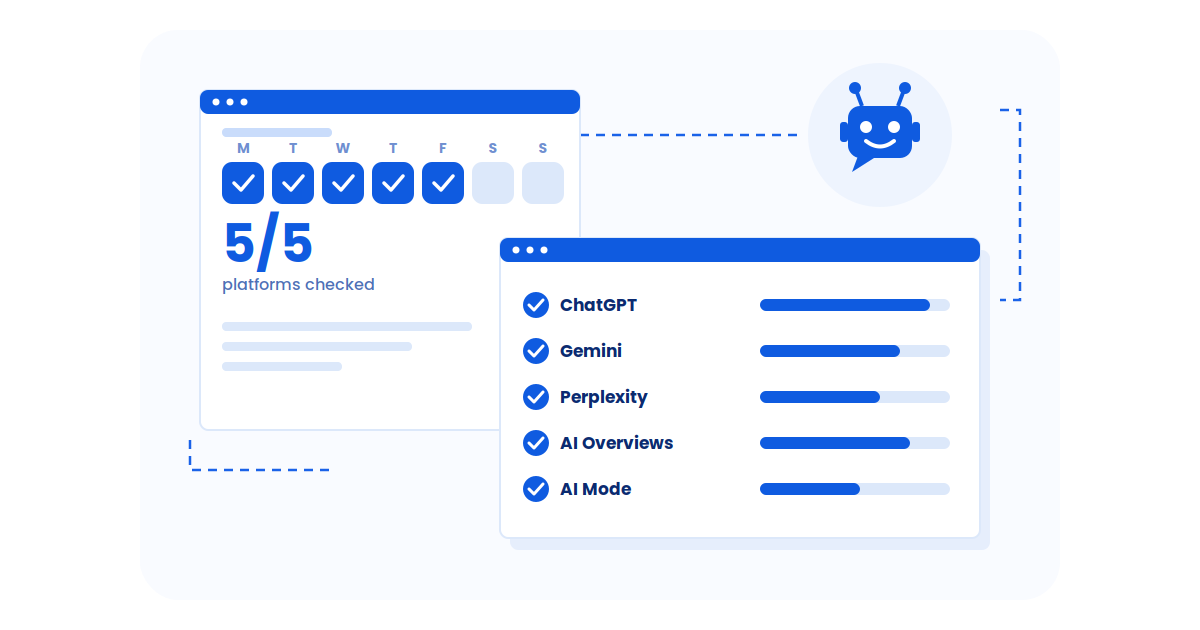
Search is no longer just about ranking on page one. With AI tools like ChatGPT, Claude, and Gemini shaping how people find answers, citations are becoming a new currency of trust, so agencies need an AI visibility reporting checklist for Agencies to report these wins clearly. When these systems pull your content into their responses, it signals credibility and puts your brand in front of readers who may never click a search result.
In fact, a recent survey found that 71.5% of people have used AI tools for search, though only 14% use them daily. This shows that AI search is already influencing discovery at scale—even if it hasn’t fully replaced traditional engines yet. (Digital Information World, 2025)
This shift changes the rules of visibility. Instead of competing only for blue links, brands now compete to be the source behind the answer—something that can only be evaluated through Brand Performance Metrics in AI Search.
In this new landscape, being cited isn’t just about exposure—it’s about authority. A citation from an AI model tells both users and algorithms that your content is reliable, comprehensive, and worth amplifying.
For businesses, that authority translates into real advantages: more brand recognition, greater reach in conversations happening outside your website, and a stronger perception of expertise in your industry.
In many cases, a single AI citation can put your content in front of thousands of users at once, bypassing the traditional funnel of impressions, clicks, and page visits.
Our ChatGPT Citations Report highlights how frequently brands are being surfaced in AI responses—and why positioning your content for these mentions is becoming essential.
How AI Search Engines Decide What to Cite
AI search engines may feel like black boxes, but their choices aren’t random. When tools like ChatGPT, Claude, or Gemini pull in content, they look for signs that a page is not only relevant but also trustworthy enough to stand as a reference — similar to how Perplexity evaluates pages when determining how to rank in Perplexity.
In other words, your content has to “prove” it deserves to be cited.
The Four Signals AI Search Engines Look For
1. Search intent alignment
The closer your content matches what a user is actually trying to find, the more likely it is to be trusted and referenced. That means going beyond surface-level keywords to understand the “why” behind the query.
KIVA’s User Intent Analysis feature helps pinpoint those needs, so your content delivers answers in the way both readers and AI models expect.
2. Semantic richness & topic authority
AI models thrive on context. Content that uses semantic depth—covering related phrases, “People Also Ask” questions, and long-tail variations—signals a stronger grasp of the subject.
Incorporating structured data also helps reinforce topical depth and clarity for both AI systems and search engines.
With semantic mapping, LSIs, and PAA insights, KIVA ensures your content isn’t just keyword-rich but topic-rich, giving AI engines more reasons to cite it as a comprehensive resource.
3. Real-world usage and discussion signals
Search engines and AI models increasingly weigh what people are actually talking about. Content that reflects live conversations happening on Reddit, LinkedIn, Quora, and other platforms feels timely and trustworthy.
KIVA’s Social Discussion Detector taps into these signals, letting you weave in the language, questions, and angles that make your content more relevant to both audiences and AI.
4. SERP alignment
Finally, AI models look at how high-performing pages are built: their structure, formatting, and the types of content that get cited most often.
Many of these align closely with modern generative engine visibility factors, which define how AI systems evaluate and surface content.
If your content reflects these patterns while adding unique insights, you’re better positioned for both rankings and citations.
KIVA’s SERP Visibility and competitor gap analysis reveal exactly what’s working, so you can close the gaps and align your content with proven citation-worthy formats.
How KIVA Enables Citation-Ready Content — Key Features Breakdown
Creating content that AI search engines are likely to cite requires more than good writing—it takes strategy, structure, and insight into how both search engines and language models evaluate authority.
How KIVA Makes Content Citation-Ready
KIVA is designed to make this process faster and more effective. Here’s how its key features contribute to citation-ready content:
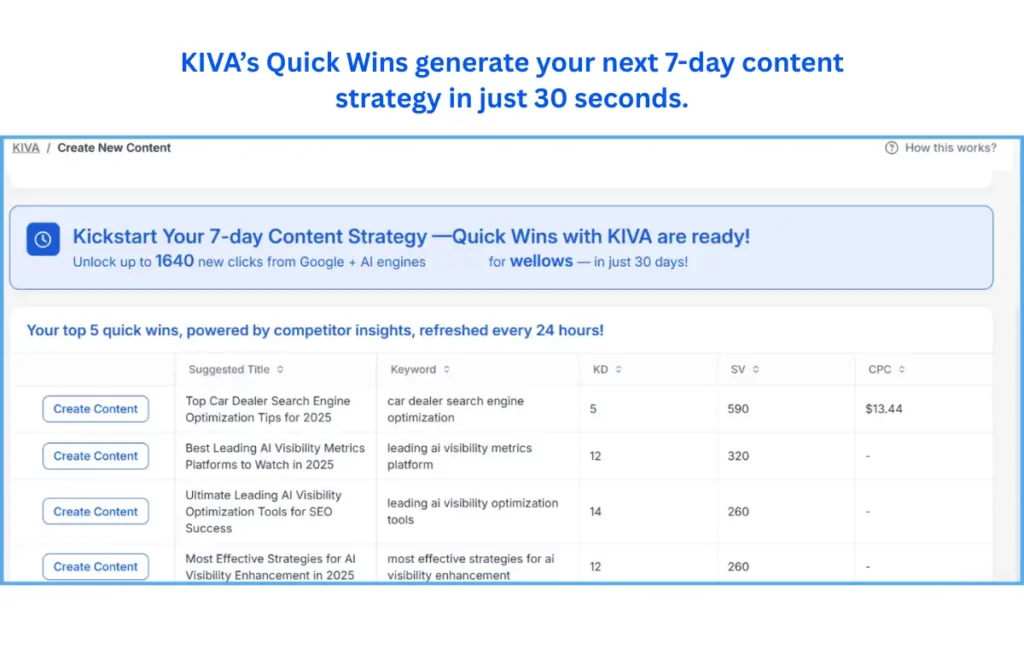
1. Quick Wins (7-day content strategy)
Citation-ready content often overlaps with what’s already being sought after and cited. KIVA’s Quick Wins feature helps you identify competitor gaps, high-volume keywords, and trending topics so you can create content that meets immediate demand. This shortens the path from planning to publishing while ensuring your material is aligned with what’s earning visibility.
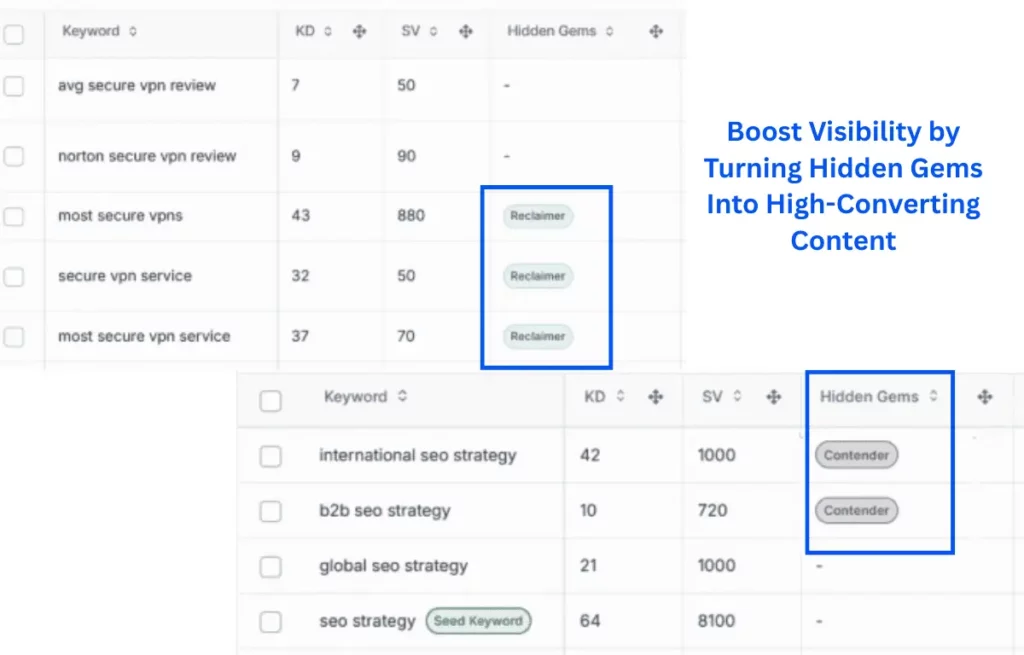
2. Hidden Gems
Some of the best citation opportunities come from overlooked spaces. Hidden Gems uncovers low-competition, high-potential keywords that others may be missing. By owning these niche topics, your content can become a go-to reference in areas where AI search engines need authoritative sources.
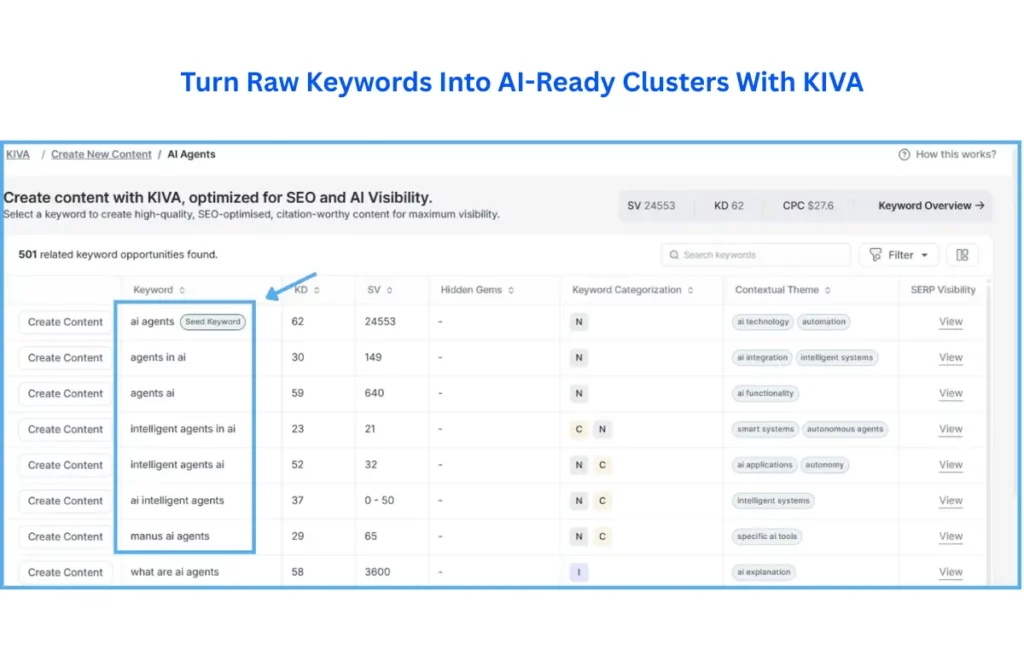
3. Keyword Clustering & Semantic Mapping
AI models prefer content that covers a topic from multiple angles. With keyword clustering and semantic mapping, KIVA groups related terms and concepts, helping you create pages that feel comprehensive rather than fragmented. The result: content that AIs perceive as authoritative and holistic, increasing the likelihood of being cited.
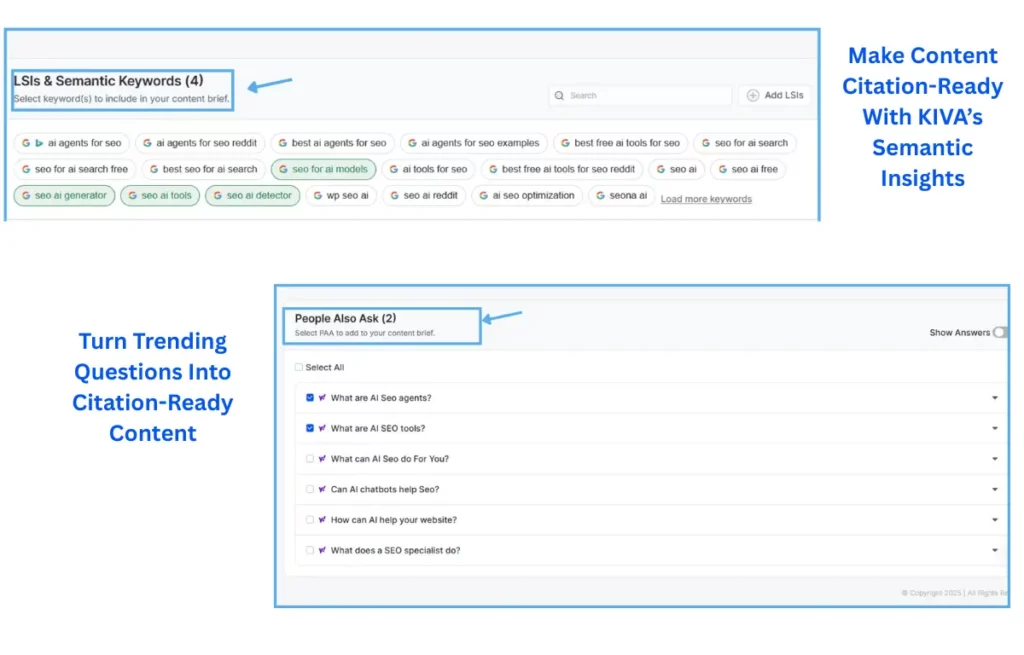
4. PAA & LSIs
Questions from Google’s People Also Ask and semantically related terms (LSIs) reflect what users are actively curious about. By building these into your content, you answer the exact questions AI tools are trained to pull from. This not only adds depth but also makes your material more “citation-friendly.”
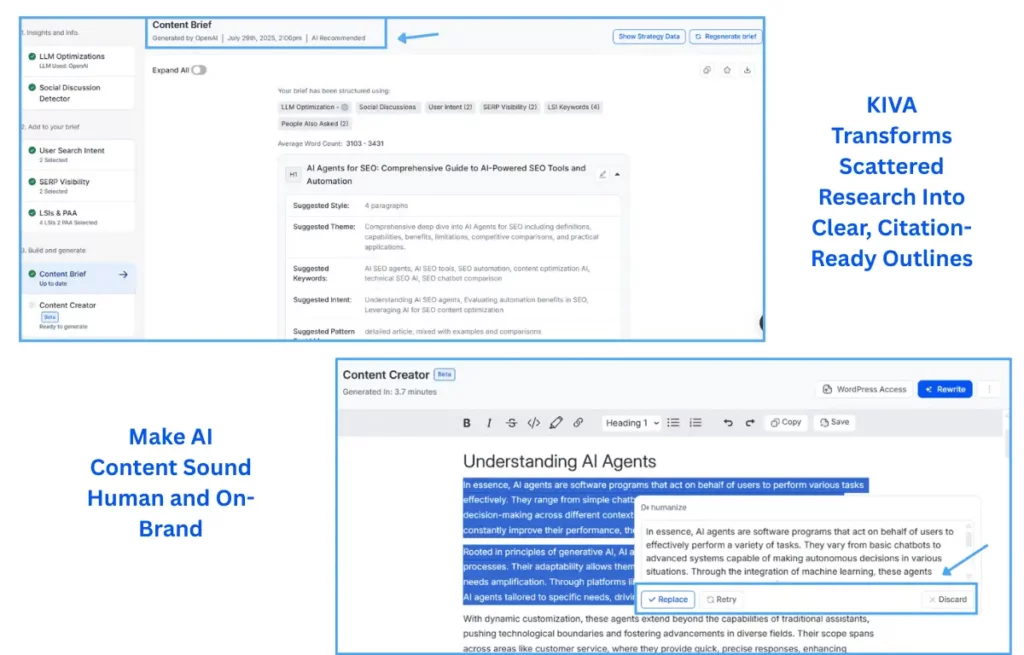
5. Content Brief + Creator + Humanize Tools
Being cited isn’t just about keywords—it’s about clarity and credibility. KIVA’s suite of briefing, creation, and humanizing tools ensures your content has proper headings, logical flow, and a tone that resonates with people and machines alike. Well-structured, readable, and accurate content signals trust, making it more likely to be referenced.
6. LLM Visibility / Query Pattern Analysis
The ultimate edge in AI search is knowing how large language models actually surface brands and sources. With LLM visibility and query pattern analysis, KIVA reveals the kinds of queries that trigger citations and shows where your competitors are appearing. This allows you to fine-tune your strategy so your brand is positioned to be selected by AI as a credible reference.
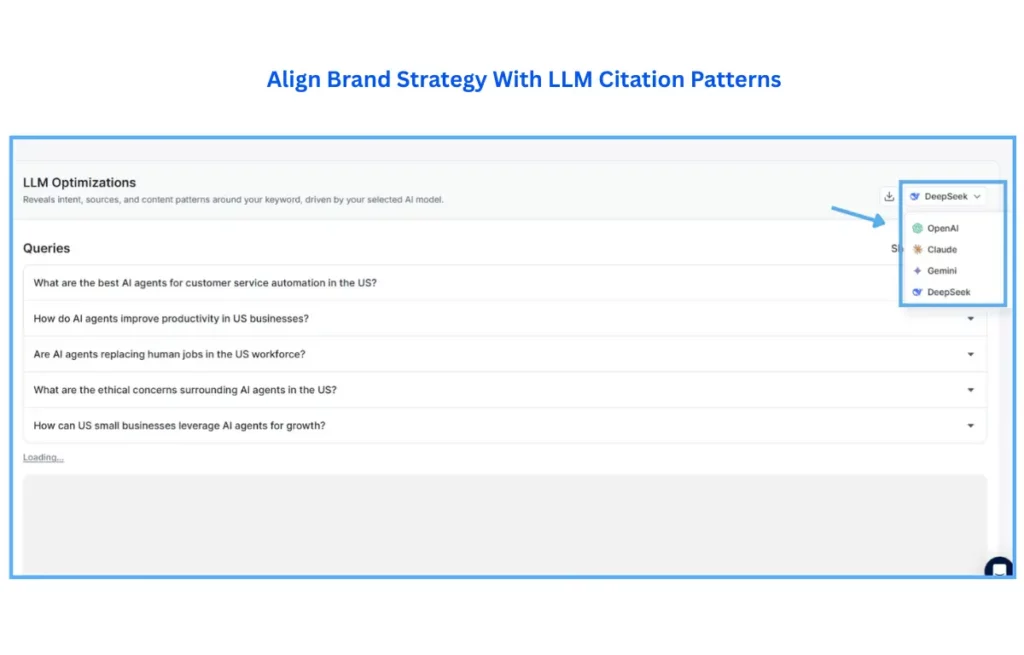
Tools like LLM pattern analysis can help uncover query patterns that increase your chance of being cited.
Best Practices for Creating Citation-Ready Content
AI search engines reward content that’s clear, trustworthy, and comprehensive. While tools can help with the process, the real impact comes from how you craft and structure your work.
Here are some best practices to make your content stand out as citation-worthy:
- Structure your content clearly: Use well-organized headings (H1, H2, H3) to break down topics into digestible sections. A logical structure not only improves readability but also makes it easier for AI models to parse and reference your content.
- Integrate user questions directly: Anticipate what your audience is asking and weave those questions into your content—either as subheadings or dedicated FAQ sections. Addressing real queries increases the likelihood of being cited in AI-generated answers.
- Expand with semantic depth: Go beyond primary keywords by covering related terms, subtopics, and variations. This semantic richness shows topical authority, making your content more comprehensive and harder for AI to ignore.
- Reflect real-world conversations: Incorporate insights from discussions happening on platforms like Reddit, LinkedIn, or industry forums. Mirroring the language and themes people are actively using makes your content feel more relevant and credible.
- Prioritize factual accuracy: Citation-ready content has to be built on trust. Support your points with credible data, expert opinions, and reliable sources. Fact-checking ensures your work stands out as authoritative.
- Maintain consistency in brand voice: Consistency builds recognition. A clear, reliable tone fosters trust with both readers and AI models, reinforcing your position as a dependable source worth citing.
The Challenges of Citation-Ready Content (and How to Solve Them)
While AI makes it easier to create citation-ready content, it’s important to recognize the limitations of AI-driven search and how to work around them.
Why Some Content Fails to Get Cited (and How to Fix It)
Frequent and positive mentions indicate that AI models recognize your brand as a credible source, increasing the likelihood of being recommended to users.
- Imperfect AI citations
Large language models are still evolving, and being cited by them doesn’t always mean the reference is perfectly accurate. That’s why human oversight is essential—fact-checking, reviewing context, and ensuring your content isn’t misrepresented. - Risk of generic content
Relying only on automated tools can sometimes lead to content that feels generic. To avoid this, layer in unique insights, original analysis, and proprietary data. These elements distinguish your work and increase its credibility as a citation source. - High competition
With more brands optimizing for AI visibility, many are targeting the same signals. This creates saturation—similar to what’s happening in the broader SEO vs GEO debate, where traditional tactics often fall short against generative search. - How to overcome these challenges
The key is customization. Use KIVA’s insights as a foundation, then enrich your content with primary sources, experiments, or expert commentary. This not only builds authority but also makes your content harder for AI models to ignore when selecting citations.
A recent study found that across eight major AI chatbots, only 26.5% of citations were fully correct—with many being partially accurate or even fabricated (arXiv, 2025).
That’s why human oversight is essential—fact-checking, reviewing context, and ensuring your content isn’t misrepresented.
FAQs
Conclusion
The rise of AI search engines marks a turning point in how content gains visibility. It’s no longer enough to chase rankings alone—your content needs to be citation-ready, built with the authority, clarity, and depth that tools like ChatGPT, Claude, and Gemini recognize as trustworthy.
By focusing on intent alignment, semantic richness, real-world relevance, and clear structure, you position your brand not just to appear in search results but to become part of the answers people actually read. That shift—from being found to being cited—is what sets apart the next generation of digital leaders.
Whether you’re refining existing content or planning new strategies, the path forward is clear: create material that earns trust, signals expertise, and delivers value that both humans and AI can’t ignore. In the evolving landscape of search, citation isn’t just a win—it’s the new standard for authority.