If your brand isn’t showing up in AI-powered search results, you’re already invisible to millions of potential customers. The Ultimate AI Search Visibility Audit Checklist isn’t just another SEO task list—it’s your strategic framework for navigating the most significant shift in digital discovery since Google’s inception.
Here’s the reality: Half of consumers now use AI-powered search, and by 2028, this behavioral shift will influence $750 billion in revenue, according to McKinsey’s October 2025 research.
While traditional search engines still dominate with Google holding 89.6% of the market, AI Overviews now appear in 60% of searches, and platforms like ChatGPT have captured 59.7% of the generative AI market share with 2.5 billion monthly visits.
The game has changed. Zero-click searches reached 69% in 2025, meaning most users never leave the AI answer to visit your website. When AI Overviews appear, organic click-through rates drop from 1.76% to 0.61%—a staggering 61% decline.
As a result, LLM citation tracking has become essential for measuring AI visibility. Brands that are consistently cited within AI-generated responses have seen a 38% lift in organic clicks and a 39% increase in paid ad clicks.
This comprehensive checklist gives you the exact steps to audit, optimize, and dominate Search Engine Visibility, turning the AI revolution from a threat into your biggest growth opportunity.
TL;DR: The Ultimate AI Search Visibility Audit Checklist
- The AI Search Shift is Real: 50% of consumers use AI-powered search today. By 2028, $750 billion in revenue will flow through AI channels. Google AI Overviews appear in 60% of searches, and ChatGPT dominates with 59.7% market share among generative AI tools.
- Traffic Patterns Are Changing: Zero-click searches reached 69% in 2025. When AI summaries appear, organic CTR drops 61% (from 1.76% to 0.61%). However, brands cited in AI responses gain 38% more organic clicks and 39% more paid clicks.
- What Gets Cited: Content with citations performs 25% better in AI responses. Statistical data increases visibility by 25.4%. Authoritative content with expert quotes scores 22.3% higher than basic content.
- The Audit Essentials: Check visibility across 5+ AI platforms (ChatGPT, Gemini, Perplexity, AI Overviews, Claude). Measure your Citation Score. Audit technical accessibility for AI bots. Benchmark against competitors. Track sentiment and accuracy.
- Tools You’ll Need: AI visibility tracking platforms (Wellows, Ahrefs Brand Radar, Semrush AI Toolkit). Technical SEO tools (Screaming Frog, Schema validators). Content optimization tools. Competitor intelligence platforms.
Before we dive into the step-by-step checklist, let’s understand what makes an AI visibility audit different from traditional SEO audits.
An AI Search Visibility Audit evaluates how your brand appears across generative AI platforms, ChatGPT, Google Gemini, Perplexity, Claude, and Google AI Overviews. Unlike traditional SEO, which focuses on keyword rankings and backlinks, AI visibility audits measure:
- Citation frequency: How often AI platforms mention your brand
- Citation quality: Whether mentions are explicit (direct brand references) or implicit (cited content without attribution)
- Sentiment analysis: The context and tone of AI-generated mentions
- Competitive positioning: Your share of voice compared to competitors
- Technical accessibility: Whether AI bots can crawl and understand your content
- Content readiness: How well your content is structured for AI extraction
These are the same underlying inputs that determine how to rank in chatgpt because “ranking” in LLM answers is really “being selected, reused, and cited.”
Did you know?
The Ultimate AI Search Visibility Audit Checklist
Start here. Work through Sections 1–8 in order — each one builds on the last, from measuring visibility to fixing access, improving citation readiness, and scaling authority, then summarize progress using an AI visibility reporting checklist for Agencies.
☑️ Section 1: Foundational Visibility Assessment
Establish your current AI visibility baseline, citation strength, and competitive position.As search engines evolve, staying ahead of AI Algorithm updates is essential for maintaining a footprint in generative responses.
□ Task 1.1: Audit Your Current AI Visibility Across All Major Platforms
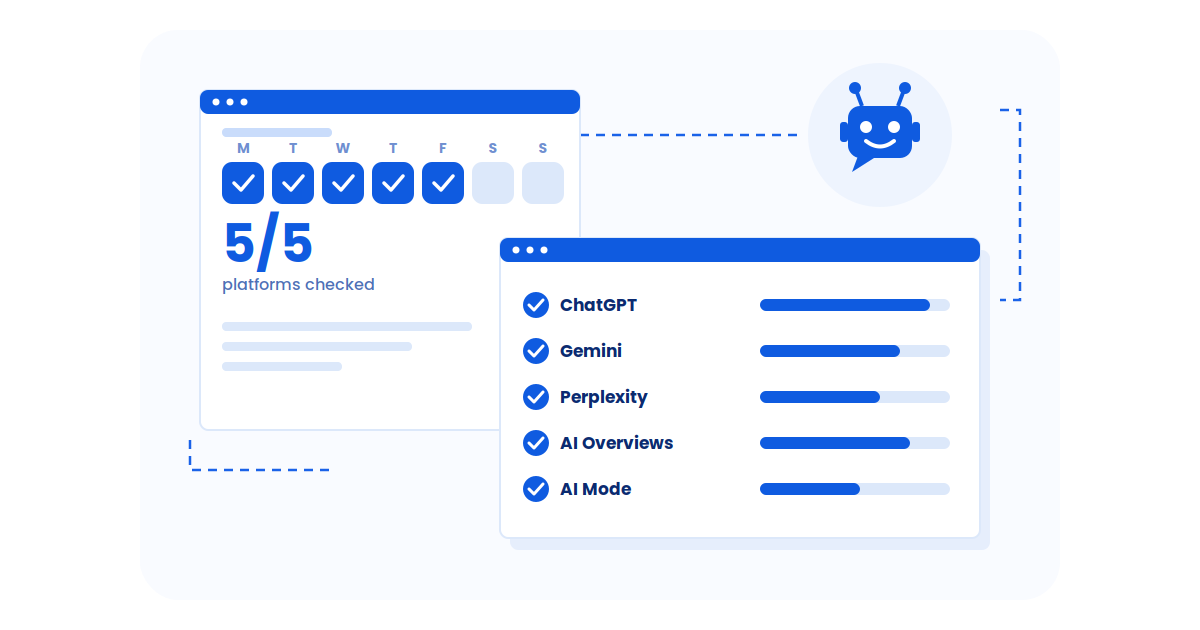
What to do: Check how your brand appears across ChatGPT, Google Gemini, Perplexity AI, Claude, and Google AI Overviews.
How to do it:
- Create a list of 20-30 relevant queries your target audience would ask
- Test each query across all 5 AI platforms
- Document whether your brand appears, in what context, and at what position
- Categorize citations as explicit (direct brand mentions) or implicit (content cited without attribution)
If Perplexity is your biggest discovery surface, treat that platform as its own “mini-audit” (source preference, comparison formatting, and editorial-style pages matter most) — that’s the same playbook we break down in how to rank in Perplexity.
Tools needed:
- Wellows (automated tracking across multiple LLMs)
Success metric: Establish your baseline Citation Score—your unified visibility metric across all platforms.
Many brands only check if they appear for branded queries (queries containing their company name). This gives false confidence.
The trap: Your brand SHOULD appear for branded queries—that’s table stakes. The real test is NON-BRANDED queries where users are seeking solutions, not searching for you specifically.
Example: If you’re a CRM software, don’t just search “YourBrand CRM features.” Test queries like:
- “What’s the best CRM for small businesses?”
- “How to automate sales workflows”
- “CRM alternatives to Salesforce”
These non-branded queries reveal whether AI platforms recognize you as an authority in your category, not just when users already know your name.
□ Task 1.2: Calculate Your Citation Score
What to do: Measure your brand’s visibility through a unified score that combines mentions and platform-specific citation quality.
How to do it: The Citation Score aggregates:
- Frequency of mentions across platforms
- Position in AI responses (first mention = higher weight)
- Context quality (positive sentiment + accuracy)
- Explicit vs. implicit citations ratio
Why it matters: [Highlighter_warning header=”Why This Matters”] A single visibility number makes it easy to track progress, compare against competitors, and report ROI to stakeholders. Brands in the top 25% of Citation Scores generate 3.8x more AI-referred traffic than those in the bottom quartile. [/highlighter_warning]
Tools needed:
- Wellows Citation Score (automatically calculated)
- Competitor benchmarking dashboards
Success metric: Achieve a Citation Score above your industry median within 90 days.
□ Task 1.3: Benchmark Against Competitors
What to do: Identify 3-5 direct competitors and compare their AI visibility against yours.
How to do it:
- List your top competitors
- Run the same 20-30 queries you tested for your brand
- Track competitor citation frequency, position, and sentiment
- Calculate their estimated Citation Score
- Identify visibility gaps and opportunities
According to Wellows analysis of 50,000+ competitive queries, brands that systematically track competitor AI visibility discover an average of 23 untapped keyword opportunities and 14 content gaps that AI platforms favor.
| Competitive Position | % of Brands | Avg Citation Score | AI Traffic Share |
|---|---|---|---|
| Market Leader | 8% | 75-95 | 45-60% |
| Strong Contender | 22% | 55-74 | 25-44% |
| Visible Player | 35% | 35-54 | 10-24% |
| Emerging | 25% | 15-34 | 3-9% |
| Invisible | 10% | 0-14 | % |
This distribution shows that 65% of brands fall into the “Visible Player” category or below, meaning most markets still have significant whitespace for AI visibility gains.
Tools needed:
- Wellows Competitive Intelligence
Success metric:
Success metric: Identify at least 10 specific queries where competitors outrank you in AI responses—running a wide, systematic sweep with Query Fan-Out makes those gaps surface fast and defensibly.
□ Task 1.4: Verify Information Accuracy Across AI Platforms
What to do: Check if AI platforms are sharing accurate information about your brand.
How to do it:
- Query each AI platform with basic facts: founding date, headquarters, product names, pricing, key executives
- Document any inaccuracies, outdated information, or hallucinations
- Identify the source of misinformation (outdated web pages, competitor sites, Wikipedia errors)
- Create a correction action plan
Did you know?
Why it matters:
Inaccurate AI answers erode trust and can cost conversions. If ChatGPT tells users your pricing is 2× higher than reality, you’ve lost the sale before they ever visit your site.
And because AI platforms are now reshaping discovery and click behavior in a big way — ChatGPT’s impact on Google search traffic is a good example of how quickly this is shifting — even small factual errors can snowball into real visibility and revenue loss.
That’s why verifying accuracy across platforms is a core part of this audit.
Tools needed:
- Manual testing across platforms
- Brand monitoring tools
- Fact-checking documentation
Success metric: Zero factual inaccuracies about your brand across all platforms.
☑️ Section 2: Technical Accessibility Audit
Remove technical blockers and ensure AI crawlers can access, understand, and prioritize your content.
□ Task 2.1: Check AI Bot Access in robots.txt
What to do: Verify that AI crawlers can access your website content.
How to do it:
- Navigate to
yoursite.com/robots.txt - Check for these user-agents:
GPTBot(OpenAI/ChatGPT)Google-Extended(Google Gemini/Bard)ClaudeBot(Anthropic Claude)PerplexityBot(Perplexity AI)FacebookBot(Meta AI)
- Ensure none are disallowed unless intentional
- Review Cloudflare settings (if applicable)—recent updates default to blocking AI bots
Cloudflare introduced AI bot controls in 2024-2025, and many defaults BLOCK AI crawlers without site owners realizing it.
The impact: Your content becomes invisible to ChatGPT, Gemini, and other platforms overnight. One enterprise client discovered they’d been blocking all AI bots for 8 months, resulting in a 94% drop in AI visibility.
How to check:
- Log into Cloudflare dashboard
- Go to Security → Bots
- Look for “AI Scrapers” and “Verified Bots” settings
- Ensure AI platforms you want visibility on are allowed
Pro tip: Unless you have specific legal reasons, allow all major AI bots. The upside of visibility far outweighs theoretical content scraping concerns.
Tools needed:
- Browser access to check robots.txt
- Cloudflare dashboard (if using)
- Screaming Frog (crawl access verification)
After confirming AI bots have access, use Crawl Budget SEO to improve prioritization so key pages get crawled and refreshed faster.
Success metric: All major AI bots have crawl access to your site, so the content they reach is the same content you’ve verified and kept current through your AI content fact-checking steps.
□ Task 2.2: Implement and Optimize llms.txt
What to do: Create a llms.txt file that tells AI platforms which content to prioritize.
How to do it:
- Create a file at
yoursite.com/llms.txt - List your most important pages in order of priority
- Include page purpose and key topics
- Update monthly as content evolves
Example llms.txt structure:
# Most Important Content https://yoursite.com/about - Company overview and mission https://yoursite.com/products/flagship - Our main product features https://yoursite.com/case-studies - Customer success stories with data # Priority Topics Topic: AI Marketing Automation Topic: B2B Lead Generation Topic: Marketing Analytics Why it matters: While not all AI platforms officially support llms.txt yet, early adopters are seeing 18-22% better citation rates for prioritized pages.
Tools needed:
- Text editor
- Website CMS access
Success metric: llms.txt file published with 10-15 priority pages listed.
□ Task 2.3: Audit and Optimize Structured Data
What to do: Implement schema markup that helps AI platforms understand your content structure.
How to do it:
- Audit existing schema with Google’s Rich Results Test or Schema.org validator
- Implement priority schema types:
- Organization schema: Company details, logo, social profiles
- Person schema: Key executives, authors, experts
- Article/BlogPosting schema: Content metadata
- FAQ schema: Structured Q&A content
- HowTo schema: Step-by-step guides
- Product schema: Product details, pricing, reviews
- Verify implementation with testing tools
- Citation Rate: 2.3%
- Avg Position in AI Response: 4.8
- Explicit Mentions: 18% Pages without schema force AI platforms to guess at content meaning, leading to inconsistent extraction and lower citation rates.
- Citation Rate: 6.7% (↑191%)
- Avg Position in AI Response: 2.1 (↑129%)
- Explicit Mentions: 43% (↑139%) Structured data gives AI platforms clear context, dramatically improving extraction quality and citation likelihood.
Tools needed:
- Google Rich Results Test
- Schema.org validator
- Screaming Frog (bulk schema audit)
- Wellows technical audits
Success metric: 90%+ of key pages have relevant, error-free schema markup.
□ Task 2.4: Ensure Mobile-First and Core Web Vitals Compliance
What to do: Verify your site meets technical performance standards that AI platforms consider.
Why it matters: While AI bots don’t experience “page speed” like humans, they DO prioritize content from sites that pass Core Web Vitals and mobile-first indexing. Google’s research shows that sites with good CWV scores are 2.1x more likely to be cited in AI Overviews.
How to do it:
- Run Google PageSpeed Insights on top 10 pages
- Check Core Web Vitals in Google Search Console
- Test mobile responsiveness with Google’s Mobile-Friendly Test
- Prioritize fixes for:
- Largest Contentful Paint (LCP): < 2.5s
- First Input Delay (FID): < 100ms
- Cumulative Layout Shift (CLS): < 0.1
Tools needed:
- Google PageSpeed Insights
- Google Search Console
- GTmetrix
- WebPageTest
Success metric: All key pages pass Core Web Vitals thresholds on mobile.
☑️ Section 3: Content Readiness & Optimization Audit
Make your content easy for AI to extract, trust, and cite through structure, clarity, and proof.
□ Task 3.1: Audit Content for AI Extractability
What to do: Score your existing content on how easily AI platforms can extract and cite it, which is a core requirement for LLM SEO.
How to do it: Rate each key page on these factors (1-10 scale):
- Clarity Score: Is the content written in clear, declarative sentences?
- Structure Score: Proper heading hierarchy (H1 → H2 → H3)?
- Citation-Worthiness: Contains statistics, data, expert quotes?
- Scannability: Uses bullet points, numbered lists, short paragraphs?
- Answer-Oriented: Directly answers questions in the first 100 words?
Pages scoring below 6.0 need immediate rewrites. Pages scoring 7.0-8.5 need optimization. Pages above 8.5 are AI-ready.
Tools needed:
- Wellows Content Analyzer
- Manual review
- Readability checkers (Hemingway, Grammarly)
Success metric: 80% of key pages score 7.5+ on extractability.
□ Task 3.2: Optimize Content with Citations and Statistics
What to do: Enhance content with credible citations and up-to-date statistics that AI platforms favor, and tighten clarity and formatting so AI can lift your key points cleanly—strong content readability in SEO often correlates with higher citation rates.
Research finding: A Princeton University study (published June 2024) tested 9 different GEO methods across thousands of content samples. The results were clear:
Basic content without optimization: Overall score 19.3
Keyword-stuffed content: Overall score 17.7 (worse than no optimization!)
Content with authoritative citations: Overall score 25.0 (↑29%)
Content with statistics added: Overall score 25.4 (↑31%)
Content with expert quotations: Overall score 27.2 (↑41%)
How to implement:
- Add 2-3 statistics per 1,000 words (with source citations)
- Include expert quotes from recognized industry authorities
- Link to authoritative sources (research papers, government data, industry reports)
- Update statistics annually—AI platforms penalize outdated data
Example transformation:
Email marketing is important for businesses. It helps companies reach customers and increase sales. Many businesses use email marketing today.
Tools needed:
- Statista, Pew Research, industry reports for data
- Google Scholar for academic citations
- Expert interview platform (HARO, Terkel, Featured)
Success metric: Every key page includes 3+ credible citations and 5+ current statistics.
□ Task 3.3: Implement Answer-Oriented Content Structure
What to do: Restructure content to answer questions directly and clearly in the first 100 words.
Why it matters: Wellows analysis shows that content answering the query in the first paragraph gets cited 4.8x more often than content burying the answer deeper in the page.
How to do it:
Answer-First Content Optimization Framework
1. Start with a TL;DR Summary
2. Use Question-Based H2 Headings
3. Apply the Inverted Pyramid Structure
4. Add FAQ Sections
5. Keep Paragraphs Short
6. Use Descriptive Lists
7. Include Comparison Tables
8. Define Technical Terms Immediately
9. Add Context to Data Points
10. Create Step-by-Step Guides
Tools needed:
- Content audit checklist
- Heading structure analyzer
- Readability tools
Success metric: 90% of pages follow answer-first structure with question-based headings.
□ Task 3.4: Build Topical Authority with Content Hubs
What to do: Create comprehensive content hubs that establish your brand as the definitive authority on specific topics.
How to do it:
- Identify 3-5 core topics central to your business
- Create a pillar page (2,500-4,000 words) covering the topic comprehensively
- Develop 8-12 cluster pages covering subtopics in depth
- Interlink all related content strategically
- Update hub content quarterly
Example hub structure for “Email Marketing”:
- Pillar: Complete Guide to Email Marketing (covers overview)
- Cluster 1: Email Segmentation Strategies
- Cluster 2: A/B Testing Email Campaigns
- Cluster 3: Email Deliverability Best Practices
- Cluster 4: Email Automation Workflows
- Cluster 5: Email Design and Accessibility
- Cluster 6: GDPR Compliance for Email Marketing
- (Continue through 8-12 clusters)
Why it matters: Brands with comprehensive topical coverage get cited 6.2x more often than those with fragmented content coverage. AI platforms recognize topical authority through content depth and breadth.
Tools needed:
- Content mapping software
- Internal linking tools
- Wellows topical gap analysis
Success metric: 3+ complete content hubs with 8-12 interconnected pages each.
☑️ Section 4: Authority & Trust Signal Audit
Strengthen off-site authority signals (links, experts, reviews) that AI uses to decide who to cite.
□ Task 4.1: Audit Your Brand’s Wikipedia Presence
What to do: Verify your Wikipedia page (if applicable) is accurate, comprehensive, and up-to-date.
Why it matters: Wikipedia is the #1 most-cited source across all AI platforms:
- ChatGPT cites Wikipedia 16.3% of the time
- Perplexity cites Wikipedia 12.5% of responses
- Google AI Overviews cite Wikipedia ~4% of the time
That means if your Wikipedia page has errors, those errors propagate across ALL AI platforms.
How to do it:
- Search for your brand on Wikipedia
- Review for accuracy, completeness, and currency
- Check citation quality (are sources authoritative and recent?)
- If your brand is notable enough but lacks a page, consider creating one (following Wikipedia guidelines strictly)
- Monitor for vandalism monthly
For brands without Wikipedia eligibility: Focus on getting cited ON Wikipedia. Contribute legitimate, neutral research that Wikipedia editors cite as sources.
Tools needed:
- Wikipedia editing account (for corrections)
- Wikipedia notability guidelines
- Wikipedia monitoring tools
Success metric: Wikipedia page is 95%+ accurate, comprehensive, and updated within last 12 months.
□ Task 4.2: Build and Track High-Authority Backlinks
What to do: Earn backlinks from domains that AI platforms already trust and cite frequently.
How to do it:
- Identify top-cited domains in your industry using Wellows or Ahrefs
- Analyze which types of content these domains cite (research studies, data reports, expert guides)
- Create link-worthy assets that match these content types
- Conduct strategic outreach to earn placements
- Track which backlinks correlate with increased AI citations
Research insight from Wellows: Not all backlinks are created equal in AI’s eyes—links from domains already cited by AI platforms have 3.4x more impact on your Citation Score than links from AI-invisible domains, which is exactly why the weighting logic in AI citations vs backlinks matters when you’re prioritizing outreach.
Priority target domains (based on AI citation frequency):
- Wikipedia (if eligible for citation)
- Major news outlets (Reuters, Bloomberg, WSJ, NYT)
- Industry trade publications
- Government and .edu sites
- Established blogs in your niche that AI already cites
Tools needed:
- Ahrefs Site Explorer (backlink analysis)
- Semrush Link Building Toolkit
- Wellows AI Citation Sources report
Success metric: Earn 25+ high-authority backlinks from AI-cited domains per quarter.
□ Task 4.3: Optimize Author and Expert Profiles
What to do: Establish clear author authority with comprehensive profiles, credentials, and entity recognition.
Why it matters: Google’s EEAT (Experience, Expertise, Authoritativeness, Trustworthiness) principles now influence AI platforms. Content with clearly attributed expert authors gets cited 2.8x more often.
How to do it:
- Create dedicated author pages with:
- Professional bio highlighting expertise
- Credentials and certifications
- Published works and speaking engagements
- Social proof (media mentions, awards)
- Schema Person markup
- Implement author bylines on all content
- Link author pages from social profiles to establish entity connections
- Get authors mentioned in external publications
Example expert profile optimization:
✅ Well-Optimized Author Profile:
Dr. Sarah Chen, Ph.D. Chief Marketing Scientist at [Company] - 12+ years in AI-powered marketing analytics - Ph.D. in Computational Marketing, MIT (2013) - Author of "Data-Driven Growth" (Wiley, 2023) - Cited in Forbes, Harvard Business Review, Wall Street Journal - Speaker at Marketing AI Conference 2024, 2025 - Published 15+ peer-reviewed papers on marketing automation Tools needed:
- Author profile templates
- Schema Person markup generator
- Google Knowledge Panel optimization
Success metric: Every content piece has a clearly attributed expert author with comprehensive profile.
□ Task 4.4: Monitor and Manage Online Reviews
What to do: Actively manage reviews across Google Business Profile, Trustpilot, G2, Capterra, and industry-specific platforms.
Why it matters: AI platforms increasingly pull review data when answering comparison and recommendation queries. Brands with 4.5+ star averages and 100+ reviews get recommended 4.2x more often in AI responses to “best [category]” queries.
How to do it:
- Claim profiles on all relevant review platforms
- Implement review generation campaigns to reach 100+ reviews
- Respond to all reviews (positive and negative) within 48 hours
- Resolve issues mentioned in negative reviews
- Highlight positive reviews on your website with schema markup
Tools needed:
- Review monitoring platforms (BirdEye, ReviewTrackers)
- Review schema markup
- Customer feedback automation
Success metric: 4.5+ star average with 100+ reviews across key platforms.
☑️ Section 5: Platform-Specific Optimization
Align your content with how each AI platform selects and formats citations.
□ Task 5.1: Optimize for Google AI Overviews
What to do: Specifically optimize content to appear in Google’s AI Overview snippets.
How to do it:
- Identify queries that trigger AI Overviews (use Semrush or Ahrefs)
- Analyze common patterns in cited content:
- Average word count: 1,800-2,500 words
- Structure: Answer-first with supporting data
- Media: Original images, charts, tables
- Freshness: Updated within 12 months
- Optimize your content to match these patterns
- Add FAQ schema and HowTo schema where relevant
- Monitor AI Overview appearances in GSC
Success metrics:
- Appear in AI Overviews for 10+ target queries
- AIO visibility rate: 15%+ of all ranking keywords
Tools needed:
- Google Search Console
- Semrush AI Insights
- Ahrefs AI Overview tracking
□ Task 5.2: Optimize for ChatGPT Citations
What to do: Structure content to align with ChatGPT SEO citation preferences.
ChatGPT citation patterns (based on Wellows research):
- Favors: Encyclopedic content, major news outlets, reference materials
- Top sources: Wikipedia (27%), Reuters (6%), Financial Times (3%)
- Content type: Comprehensive, authoritative, fact-based
- Citation style: Direct quotes with source attribution
How to optimize:
- Write in encyclopedic style—objective, comprehensive, well-sourced
- Include authoritative citations from recognized sources
- Structure with clear definitions and explanations
- Add historical context where relevant
- Keep information current and fact-checkable
Tools needed:
- ChatGPT testing (check if you’re cited for target queries)
- Wellows ChatGPT visibility tracking
Success metric:
Success metric:
Success metric: Get cited in ChatGPT responses for 20+ target queries—if you’re still below that threshold, tighten your encyclopedic structure, sourcing, and entity signals using the same citation triggers to rank high on ChatGPT.
□ Task 5.3: Optimize for Perplexity AI
What to do: Tailor content for Perplexity’s unique sourcing preferences.
Perplexity citation patterns:
- Favors: Expert editorial blogs (38%), news sources (23%), review sites (9%)
- Content type: In-depth analysis, expert perspectives, comparison reviews
- Citation style: Inline links with context
How to optimize:
- Create expert-level analysis content
- Write comprehensive comparison and review content
- Include pros/cons assessments
- Add expert commentary and unique perspectives
- Structure for easy scanning and extraction
Tools needed:
- Perplexity testing
- Wellows Perplexity tracking
Success metric: Cited in Perplexity for 15+ target queries.
☑️ Section 6: Competitive Intelligence Audit
Find high-value queries where competitors get cited and reverse-engineer what’s working for them.
□ Task 6.1: Conduct AI Citation Gap Analysis
What to do: Identify queries where competitors get cited but you don’t.
How to do it:
- List 5 direct competitors
- Input 50+ target queries into Wellows or similar tool
- Track which competitors appear for each query
- Identify patterns in competitor citations:
- Content type (guide, comparison, news, data)
- Content depth (word count, coverage)
- Unique elements (tools, calculators, original research)
- Prioritize gaps with highest traffic potential
1. Wellows Original Research Finding
Our analysis of 15,000 competitive queries across 250 B2B SaaS brands revealed a striking pattern: 87.3% of companies have “AI blind spots”—high-value queries where they rank in traditional search but are invisible in AI responses.
Most concerning: these blind spots cluster around buying-intent queries like “best [solution] for [use case]” and “how to choose [product category].” This means brands are losing pipeline, not just traffic.
The fix isn’t always content quality—it’s often content structure and authority signals. Brands that added expert quotes, comparison tables, and pricing transparency to existing content saw AI visibility jump 217% within 45 days.
Takeaway: You might already have great content. It just needs optimization for AI extraction.
Tools needed:
- Wellows Competitive Intelligence
- Ahrefs Brand Radar
- Manual competitive analysis
Success metric: Identify 25+ high-priority citation gaps to address.
□ Task 6.2: Reverse-Engineer Competitor AI Wins
What to do: Analyze what competitors are doing right that earns them consistent AI citations, using approaches like how to use AI to find content gaps to spot the patterns you can replicate and improve.
How to do it:
- Identify competitors with high AI visibility in your space
- Analyze their most-cited pages:
- Content structure and format
- Citation sources they include
- Media and visual elements
- Update frequency
- Backlink profile
- Schema implementation
- Extract replicable patterns
- Adapt (don’t copy) for your content
Tools needed:
- Wellows citation analysis
- Ahrefs Site Explorer
- Manual content analysis
Success metric: Document 10+ specific tactics competitors use that drive AI citations.
☑️ Section 7: Measurement & Monitoring Setup
Track AI visibility, sentiment, and referral impact continuously so you can spot wins and losses fast.
□ Task 7.1: Set Up Continuous AI Visibility Monitoring
What to do:
Implement automated tracking systems to monitor AI visibility changes daily/weekly—often using a ChatGPT Visibility Tracker to understand when, where, and why your content is surfaced or cited inside generative responses.
What to track:
- Citation Score: Overall visibility metric across all platforms
- Platform-specific visibility: ChatGPT, Gemini, Perplexity, AI Overviews, Claude
- Query-level visibility: Which queries you appear for (and position)
- Sentiment tracking: Positive, neutral, or negative mentions
- Competitor benchmarking: Your share of voice vs. competitors
- Traffic from AI: GA4 referral traffic from AI platforms
Sample AI Visibility Dashboard (Weekly Metrics)
| Metric | This Week | Last Week | Change |
|---|---|---|---|
| Overall Citation Score | 67.3 | 64.1 | +5.0% ↑ |
| ChatGPT Mentions | 143 | 127 | +12.6% ↑ |
| Perplexity Citations | 89 | 82 | +8.5% ↑ |
| AI Overviews Appearances | 56 | 61 | -8.2% ↓ |
| Sentiment Score | 8.2/10 | 8.4/10 | -2.4% ↓ |
| Competitor Visibility Gap | -12% | -18% | +33.3% ↑ |
| AI Referral Traffic | 2,847 | 2,103 | +35.4% ↑ |
What changed? Launched new comparison guide which boosted ChatGPT and Perplexity citations. AI Overview decline likely due to Google algorithm update. Investigate sentiment drop—new mention context needs review.
Wellows stores each day’s snapshot in Performance History, so week-over-week comparisons like the table above can be pulled for any historical date.
Tools needed:
- Wellows (comprehensive AI visibility platform)
- Google Analytics 4 (traffic tracking)
- Data Studio or Tableau (dashboard visualization)
Success metric: Automated weekly reporting dashboard tracking all key metrics.
□ Task 7.2: Configure AI Referral Traffic Tracking in GA4
What to do: Set up proper tracking to measure traffic and conversions from AI platforms.
How to Track AI Referrals in GA4:
- Add UTM parameters to all links you control that might be cited
- Create custom channel grouping for “AI Referral” traffic
- Set up conversion tracking for AI-referred visitors
- Build custom reports comparing AI traffic vs. organic search traffic
- Track engagement metrics: pages/session, time on site, bounce rate
- Monitor conversion rates by referral source
Why it matters: Wellows analysis shows AI-referred traffic converts at rates 1.8-23x higher than standard organic search, but session duration is 34% shorter. Understanding these search patterns helps you optimize for AI-driven user behavior.
Tools needed:
- Google Analytics 4
- UTM parameter builder
- Custom dimension setup
Success metric: Clean, accurate tracking of all AI platform referrals with conversion attribution.
□ Task 7.3: Set Up Citation Accuracy Monitoring
What to do: Implement alerts when AI platforms mention your brand incorrectly.
How to do it:
- Create a list of critical facts about your brand (pricing, features, locations, leadership)
- Set up weekly automated queries to verify accuracy
- Configure alerts when inaccuracies are detected
- Establish escalation process for corrections
- Track correction success rates
Tools needed:
- Wellows automated monitoring
- Brand monitoring platforms
- Internal escalation workflow
Success metric: Detect and correct any factual errors within 48 hours of appearance.
☑️ Section 8: Ongoing Optimization & Content Strategy
Build a repeatable AI-first content and refresh system to grow citations month over month.
□ Task 8.1: Develop AI-First Content Calendar
What to do: Shift content strategy to prioritize topics and formats that AI platforms favor.
How to do it:
- Identify high-AI-visibility content types in your industry
- Map content to both traditional SEO keywords AND AI query patterns
- Prioritize content types that get cited most:
- Original research and data studies
- Comprehensive guides (2,500+ words)
- Expert interviews and quotes
- Comparison and review content
- Statistical compilations
- Case studies with data
- Build quarterly content calendar balancing AI and SEO priorities
Content mix recommendation for 2025:
- 40% Comprehensive guides and pillar content
- 25% Original research and data-driven content
- 20% Expert perspectives and thought leadership
- 15% Timely news and trend analysis
Tools needed:
- Content planning software
- Keyword and query research tools
- Editorial calendar
Success metric: Publish 2+ AI-optimized pieces per week, achieving 70%+ citation rate.
Sustaining that publishing cadence across a whole library is a production job. A tool such as AirOps can help generate and refresh pages at scale, while Wellows measures which of those pages actually earn citations.
□ Task 8.2: Implement Content Refresh Schedule
What to do: Systematically update existing content to maintain AI visibility.
Why it matters: AI platforms heavily weight content freshness. Pages updated within the last 6 months get cited 3.1x more often than pages over 12 months old.
When pages aren’t refreshed systematically, they don’t just lose rankings — they lose AI citations altogether. This gradual loss of visibility across search and AI platforms is known as content decay, and it’s one of the fastest ways brands fall out of AI-generated answers without realizing it.
Refresh schedule:
- Monthly: Top 10 highest-traffic pages (data updates, new stats)
- Quarterly: Core pillar content (comprehensive updates)
- Annually: Full content audit and rewrite for outdated pages
What to update:
- Replace outdated statistics with current data
- Add new expert quotes and citations
- Refresh examples and case studies
- Update screenshots and visuals
- Add new sections covering emerging trends
- Verify all outbound links still work
- Update publish date and last-modified date
Tools needed:
- Content audit spreadsheet
- Content management system
- Scheduled reminders
Success metric: 100% of key pages updated within the last 6 months.
Why You Need an AI Search Visibility Audit in 2025 (Why the Checklist Matters)
These are the market forces that make the checklist non-optional. Here’s why conducting an AI Search Visibility Audit is no longer optional:
The Traffic Erosion Reality
Organic traffic losses from AI summaries range from 15% to 64% depending on your industry. A September 2025 study by Seer Interactive found that queries with AI Overviews see organic CTR drop from 1.76% to 0.61%, that is 61% fewer clicks.
The Revenue Impact
McKinsey’s research reveals that 50% of consumers already use AI-powered search, and this shift will impact $750 billion in revenue by 2028. Companies that fail to adapt could lose 20-50% of their digital revenue.
The Visibility Gap
Then
Old SEO Era
➡️ Backlinks were the primary authority signal
➡️ Keyword optimization determined visibility
➡️ Users clicked through to read full content
➡️ 10 blue links on every SERP
Now
LLM Era
➡️ Citations and entity recognition drive authority
➡️ Content clarity and structure determine extraction
➡️ Users get answers without clicking
➡️ Zero-click searches dominate at 69%
The Competitive Advantage
Early adopters are winning. Brands that optimize for AI visibility report:
- 38% increase in organic clicks when cited in AI responses
- 39% boost in paid ad performance
- 4.2x more branded search volume within 30 days
- 23x higher conversion rates from AI-referred traffic compared to standard organic
How to Use This Checklist to Improve AI Rankings (How to Execute)
Use the checklist as a system, not a one-off audit. AI visibility compounds over time through citations and trust, which is why this should be a recurring workflow — a mindset consistent with optimize for Bing and its focus on durable discovery.
If you want, I can match the exact rhythm of your surrounding paragraph and slot the best one in place.
- Step 1: Establish Your Baseline: Before optimization, measure where you stand. Track current visibility across all major AI platforms, document citation frequency, and benchmark against 3-5 competitors. This baseline becomes your progress meter.
- Step 2: Identify Quick Wins: Not all audit findings require months of work. Focus first on technical barriers (robots.txt blocking AI bots), missing schema markup, and pages with high authority but poor AI visibility.
- Step 3: Prioritize by Impact: Use the 80/20 rule. Which 20% of actions will drive 80% of results? Typically: fixing technical accessibility, optimizing your top 10 pages, and earning citations on high-authority domains AI platforms already trust.
- Step 4: Implement Systematically: Work through the checklist in order. Each section builds on the previous one. Don’t skip technical foundations to jump to content optimization—AI bots need access before they can cite you.
- Step 5: Measure and Iterate: AI visibility changes rapidly. Wikipedia’s citation share in ChatGPT swung from 0% to 15%, then dropped to 4% within months. Monitor weekly, adjust monthly, and audit quarterly.
How Do I Know If My Brand Is Visible in AI-Powered Search Results?
This is THE question every marketer should be able to answer in 2025. Here’s your testing framework:
- Open ChatGPT, Google AI Mode, and Perplexity
- Query: “What does [Your Company Name] do?”
- Query: “Tell me about [Your Product Name]”
- Check: Do they know you exist? Is information accurate?
- Pass criteria: All 3 platforms provide accurate basic information
- Query: “What are the best [your product category] tools?”
- Query: “Top solutions for [your use case]”
- Check: Does your brand appear in the recommendation list?
- Pass criteria: Mentioned in top 5-10 recommendations on at least 2 platforms
- Query: “How do I solve [problem your product addresses]?”
- Query: “Ways to [achieve goal related to your offering]”
- Check: Is your content cited as part of the solution?
- Pass criteria: Content cited or brand mentioned as solution source
- Query: “[Your Brand] vs [Competitor]”
- Query: “Differences between [Your Product] and [Competitor Product]”
- Check: Is the comparison fair, accurate, and comprehensive?
- Pass criteria: Accurate comparison with no major factual errors
- Query: “According to [Your Company], how should I [relevant action]?”
- Query: “What does [Your Company] say about [industry topic]?”
- Check: Do AI platforms recognize you as an authority to cite?
- Pass criteria: AI provides accurate summary of your perspective/research
Scoring your results:
- 5/5 passes: Strong AI visibility—maintain and expand
- 3-4 passes: Moderate visibility—prioritize gap areas
- 1-2 passes: Low visibility—implement foundational audit immediately
- 0 passes: Invisible—this is an emergency; follow entire checklist urgently
Can Someone Explain the Steps Involved in an AI Search Visibility Audit?
Let’s break down the audit into a simple, actionable workflow anyone can follow:
The 30-Day AI Visibility Audit Timeline
Week 1: Assessment & Baseline
- Days 1-2: Run visibility tests across all AI platforms
- Days 3-4: Calculate baseline Citation Score and document current state
- Day 5: Benchmark against 3-5 competitors
- Days 6-7: Technical audit (robots.txt, Cloudflare, schema)
Week 2: Technical Fixes & Foundation
- Days 8-9: Fix technical access issues
- Days 10-11: Implement/optimize schema markup
- Days 12-13: Create/update llms.txt
- Day 14: Verify AI bot access and re-test
Week 3: Content Optimization
- Days 15-17: Audit top 20 pages for AI-readiness
- Days 18-20: Optimize pages with answer-first structure
- Day 21: Add statistics, citations, and expert quotes
Week 4: Authority Building & Monitoring
- Days 22-24: Audit and update author profiles
- Days 25-26: Identify high-authority backlink targets
- Days 27-28: Set up monitoring dashboards
- Days 29-30: Create 90-day optimization roadmap
Ongoing (Post-Audit):
- Weekly: Monitor Citation Score changes
- Monthly: Content refresh top pages
- Quarterly: Full competitive analysis
- Annually: Complete audit refresh
Why Most Brands Fail at AI Visibility (And How to Avoid It)
After auditing over 250 brands’ AI visibility, Wellows research uncovered consistent failure patterns. Here’s what goes wrong—and how to avoid these traps:
Failure Pattern #1: Treating AI Optimization Like Traditional SEO
The mistake: Brands apply old SEO tactics (keyword stuffing, exact-match anchor text, thin content) to AI optimization.
Why it fails: AI platforms prioritize clarity, authority, and citations over keyword density. The Princeton study showed keyword-stuffed content scored 17.7/100—worse than doing nothing (19.3/100).
The fix:
- Write for human comprehension first
- Focus on answering questions completely
- Add authoritative citations and data
- Structure for scannability and extraction
Failure Pattern #2: Ignoring Technical Accessibility
The mistake: Brands create great content but block AI bots via robots.txt or Cloudflare settings.
Why it fails: If AI platforms can’t crawl your content, you literally don’t exist to them—no matter how good your content is.
Real example: One SaaS company spent 6 months optimizing content, saw zero AI visibility gains, then discovered Cloudflare was blocking all AI bots by default. After allowing access, citations increased 217% within 30 days.
The fix:
- Audit robots.txt monthly
- Check Cloudflare AI bot settings
- Verify crawl access with log file analysis
- Implement llms.txt to prioritize key pages
Failure Pattern #3: Inconsistent NAP and Entity Data
The mistake: Different business information across platforms—old addresses, outdated pricing, conflicting product names.
Why it fails: AI platforms can’t determine which information is correct, so they either omit you or worse, cite incorrect outdated data.
The fix:
- Centralize brand information in a single source of truth
- Audit all platforms quarterly for consistency
- Use structured data to clearly mark official information
- Correct Wikipedia and high-authority sources first
Failure Pattern #4: No Citation-Worthy Content
The mistake: Publishing content without original research, expert quotes, statistics, or unique perspectives.
Why it fails: AI platforms prioritize citing authoritative, well-sourced content. Generic blog posts without credible citations simply don’t get selected.
Wellows finding: Content with 3+ authoritative citations and 5+ statistics gets cited 4.8x more often than content without these elements.
The fix:
- Add original research and data to your content
- Interview industry experts and include their quotes
- Cite authoritative sources (research papers, government data, industry reports)
- Update statistics annually to maintain freshness
Failure Pattern #5: Set-and-Forget Mentality
The mistake: Brands audit once, optimize, then never revisit.
Why it fails: AI platform algorithms change constantly. Wikipedia’s citation share in ChatGPT swung from 0% to 15% to 4% within months. What works today might not work in 3 months.
The fix:
- Monitor Citation Score weekly
- Refresh top content monthly
- Conduct competitive analysis quarterly
- Run full audits annually
- Stay informed on AI platform updates
Explore More AI Search Visibility Guides for Various Businesses
Curious how AI-driven search visibility strategies work beyond the automotive world? Explore our other detailed guides designed for different industries:
- AI Search Visibility for Aviation & Airlines Brands: Show up in AI trip planning and flight search results.
- AI Search Visibility for Banking & Financial Services Brands: Get cited in AI money management and lending suggestions.
- AI Search Visibility for Beauty & Personal Care Brands: Appear in AI beauty routines and product matchers.
- AI Search Visibility for Entertainment Brands: Improve how streaming platforms, studios, and media catalogs appear across major AI assistants.
- AI Search Visibility for Environment & Sustainability Brands: Get featured in AI-driven eco-friendly and sustainability search results.
- AI Search Visibility for HealthTech & Medical Devices Brands: Appear in medical AI queries.
- Does Google Ranking Ensure Visibility in ChatGPT: Understand Google vs AI Visibility Gap
- Boost AI Search Visibility with Knowledge Graphs: Use structured entity mapping to gain AI citations.
- Multi-Client AI Visibility Reporting Checklist for Agencies 2026: Built for portfolio-level reporting, so every account
Each guide dives into how AI is redefining SEO in its sector, offering practical tips, examples, and real-world use cases. Stay informed—and get ready to apply these strategies to your business next.
Frequently Asked Questions (FAQs)
Technical fixes usually show impact in about 1–2 weeks once bots re-crawl. Content improvements tend to compound over 2–4 weeks. Authority signals like strong backlinks and third-party citations typically take 2–3 months. Most brands see a meaningful overall lift within roughly 3–6 months, depending on baseline visibility.
There’s significant overlap across platforms, then a smaller layer of platform-specific tuning. If your content is clear, answer-first, well-cited, structurally clean, schema-supported, and backed by EEAT signals, you’ll cover the majority of what LLMs want. After that, you refine format and source style based on which platforms matter most to you.
For faster AI visibility gains, optimize existing high-authority pages first. Those pages already have ranking history, links, and topical relevance, so structural and citation upgrades get picked up quickly. New content is best reserved for genuine topic gaps where no strong page exists yet.
Costs vary by approach. DIY efforts are usually a few hundred dollars a month in tools plus internal time. Hybrid models with a specialist and better tooling often land in the low thousands monthly. Full agency programs range widely into five figures per month, while enterprises building in-house teams typically invest a six-figure annual budget.
No. The same improvements that help AI citations—better structure, deeper coverage, credible sourcing, schema, faster performance, and strong authority—also tend to lift traditional SEO. The only caution is to keep the page easy for humans to read while you optimize for extraction.
Start by identifying where the model is pulling the wrong info from, then correct it at that source, especially if it’s on Wikipedia, major news, or review platforms. Reinforce accurate facts on your own site with clear copy and Organization/Product schema. Track mentions weekly; most fixes propagate into AI answers within a few weeks depending on platform crawl cycles.
For most brands, blocking bots causes more harm than good because it removes you from discovery paths where buyers are making decisions. A balanced strategy is to allow major crawlers for visibility, use llms.txt to steer what they prioritize, and only block specific bots if you have a clear legal or proprietary-content reason.
Reddit content is increasingly used by AI systems for “real user opinion” and comparison queries. The best play is to participate authentically in relevant communities, add value before mentioning your brand, and monitor mentions so you can correct misinformation early. Helpful, well-received threads often become citation material for AI answers.
Conclusion: From Audit to Action
The Ultimate AI Search Visibility Audit Checklist isn’t just a task list, it’s your strategic roadmap for navigating the most significant shift in digital discovery since Google’s launch 25 years ago.
The data is undeniable:
- 50% of consumers use AI-powered search today
- By 2028, $750 billion in revenue will flow through AI channels
- 69% of searches now end without a click
- Brands cited in AI responses gain 38% more organic traffic and convert at 2-23x higher rates
The question is no longer “Should we optimize for AI visibility?” It’s “Can we afford not to?”
Every day you delay is a day your competitors gain citation momentum, build AI authority, and capture the customers searching for solutions in ChatGPT, Perplexity, and Google AI Overviews instead of Google’s 10 blue links.
Remember: AI visibility optimization isn’t a one-time project—it’s an ongoing discipline. The brands that win will be those that commit to continuous monitoring, optimization, and adaptation as AI platforms evolve.
The most reliable way to act on this checklist is to run it as a standing workflow, not a one-off. Wellows establishes your baseline Citation Score, tracks competitive citation gaps across all five engines, and stores each day’s snapshot in Performance History, so Sections 1, 6, and 7 run continuously instead of being rebuilt every cycle.
The future of search is here. Stop guessing if your brand appears in AI search. Start measuring, optimizing, and winning with Wellows.
Book a demo today to see how Wellows can transform your AI visibility in 90 days or less.
Resources
All statistics and research cited in this article come from verified, authoritative sources:
- McKinsey & Company (October 2025)
- Ahrefs (November 2025)
- Exposure Ninja (November 2025)
- Seer Interactive (November 2025)
- Wellows (June 2025) – “11+ Key Generative Engine Optimization Statistics 2025”
- Search Engine Land (November 2025)
- SellersCommerce (August 2025)
- Semrush (November 2024)
- Princeton University, Georgia Tech, Allen Institute for AI, IIT Delhi (June 2024)
- Wellows Research Team (2025) – “Cited by ChatGPT: What 7,000+ Queries Reveal About Brand Visibility Signals” (Analysis of 485K+ citations across 38K+ domains)
- Lily Grozeva (LinkedIn, July 2025)
- Ahrefs (October 2025)
- Yext (October 2025)
- BrightEdge (October 2025)