Fact-checking AI content is essential to prevent misinformation and maintain trust in professional and public communication. Generative AI systems can produce fluent text that appears reliable but often includes fabricated or outdated details—commonly referred to as hallucinations.
In a 2024 peer-reviewed benchmark study (ACL, HaluEval 2.0), researchers measured hallucination rates of nearly 47% in open-domain responses, highlighting the scale of the challenge.
If left unchecked, these inaccuracies can erode credibility, mislead readers, and weaken SEO trust signals that search engines use to evaluate content quality. They may also conflict with Google’s E-E-A-T principles of experience, expertise, authority, and trust.
By incorporating AI content fact-checking—through systematic fact verification and knowledge base validation—into your workflow, you protect your brand reputation, ensure compliance with evolving SEO standards, and deliver content that is both accurate and trustworthy. This approach enables you to harness the efficiency of AI while maintaining full control over accuracy and integrity in competitive, information-driven industries.
What Is AI Content Fact Checking?
AI content fact checking is the process of verifying the accuracy, credibility, and reliability of AI-generated text before publishing.
It ensures that claims, statistics, and references are validated against a knowledge base of authoritative sources, reducing misinformation and aligning with Google’s E-E-A-T principles (experience, expertise, authority, trust).
By applying fact-checking workflows, teams maintain content integrity, protect reputation, align with E-E-A-T, and can detect SEO content decay sooner by keeping pages accurate and current.
AI-generated content often favors fluency over accuracy, making it vulnerable to subtle factual and contextual errors.
These mistakes are not always obvious but can mislead readers, erode trust, and weaken your brand’s perceived authority. Verifying AI-generated content ensures alignment with facts, regulatory standards, and audience expectations while avoiding unintended misinformation.
This applies equally to AI summaries, where losing nuance can undermine expertise—an issue addressed in how to use AI for summarizing articles through structured prompting and human review.
Search engines like Google reward content with strong E-E-A-T signals—experience, expertise, authority, and trust. Fact verification directly supports these SEO trust signals by ensuring accuracy and consistency across your content ecosystem.
As explored in the evolving relationship between AI and E-E-A-T, unchecked AI outputs often fall short of these standards, risking lower rankings, diminished visibility, and long-term credibility issues.
In industries where accuracy is critical, such as healthcare, finance, or public policy, fact-checking is no longer optional.
Your every claim and data point must be credible, relevant, and contextually sound to protect your reputation. Reliable, fact-checked content builds audience trust and clearly differentiates your organization from competitors.
Keeping that standard consistent across a site requires content optimization for AI visibility, especially when important claims need stronger context, clearer support, and better structural placement.
Key Risks of Unchecked AI Content
- Misinformation damaging your brand reputation
- Readers losing trust in your expertise or authority
- Search engine penalties for low‑quality or misleading content
- Legal or ethical consequences in regulated industries
- Amplification of bias or outdated information
5 Simple Steps to Fact-Check AI Content
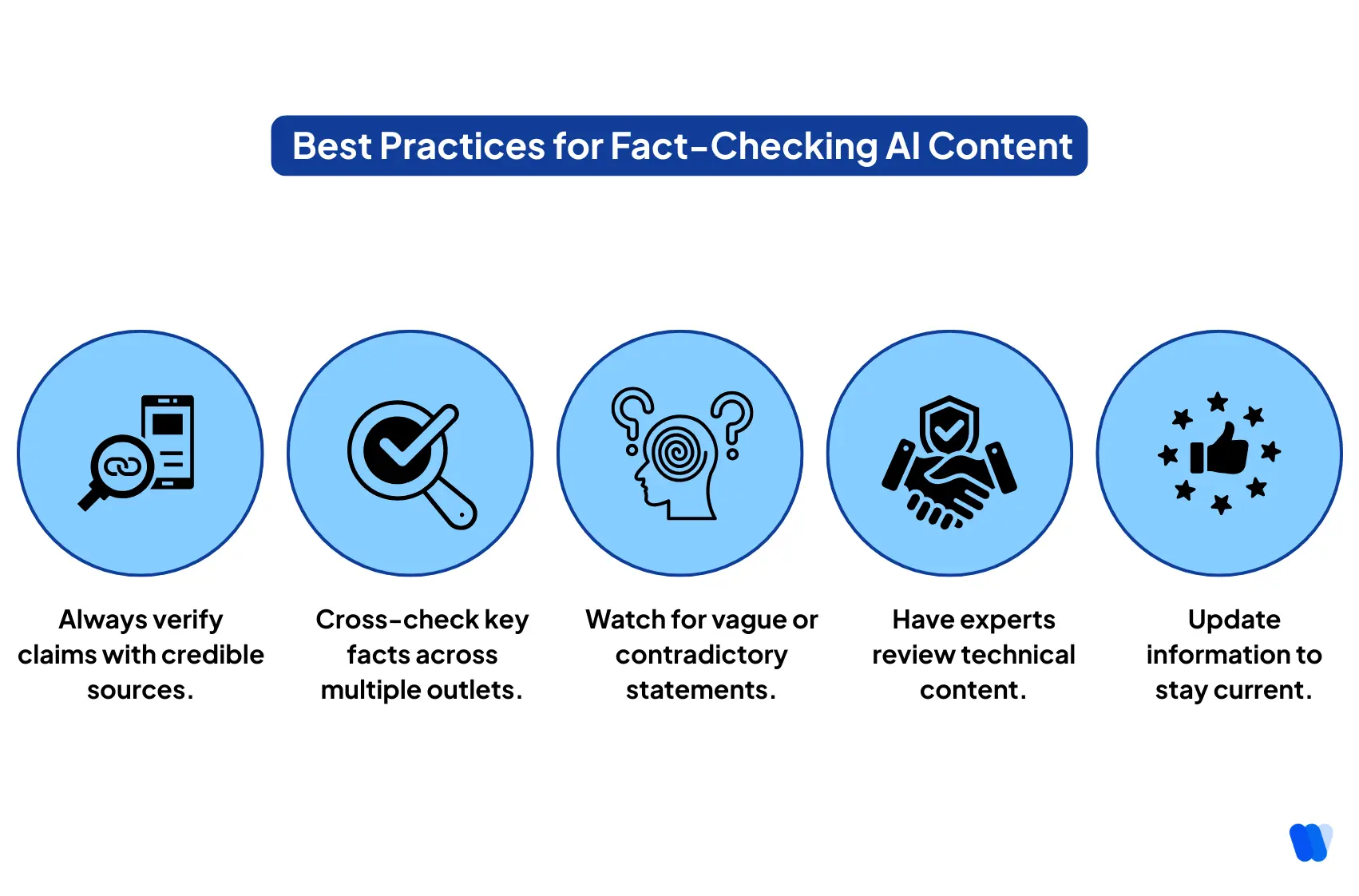
Fact-checking AI content is systematic and efficient when approached with a clear process. Below are five practical, actionable steps you can apply to any AI-generated text to ensure its accuracy and reliability.
1. Verify Sources and Attributions
AI models often generate citations or data points that do not exist. Begin with fact verification: confirm every source against authoritative databases, academic journals, or government publications.
This meticulous review is also a foundational component of AI Overviews Optimization, as Google’s generative summaries prioritize sources that demonstrate verifiable accuracy.
Any hallucinated or fabricated citations must be removed; do not assume that because it “sounds real,” it is accurate.
Cite the primary source in a liftable overview block near the top to increase your chances of being featured.
✔ Example: Look up URLs and publication names directly to confirm they exist and support the claim made.
2. Cross-Reference Key Facts
For each statistic, claim, or named event, cross-check it with at least two independent, credible sources. This step ensures context is preserved and any subtle inaccuracies are corrected before publishing.
✔ Example: Use resources like Reuters Fact Check or Google Fact Check Explorer for quick validation.
3. Identify Hallucinations and Ambiguities
Look for sections where the text provides overconfident yet vague statements or contradictory details. These “hallucinations” are common in AI output and should either be corrected with verified facts or removed entirely.
✔ Tip: Phrases like “according to experts” or “research shows” without naming the source are red flags.
4. Consult Subject Matter Experts
When producing specialized content, have a domain expert review the material. This ensures the content reflects current standards, uses correct terminology, and addresses nuances the AI might miss.
✔ Example: A healthcare whitepaper should always be vetted by a licensed medical professional before release.
5. Monitor and Update Regularly
Information changes over time. Establish a routine to revisit published AI-assisted content periodically. This helps you catch updates, correct outdated information, and maintain SEO and regulatory compliance, and prevent content decay as impressions, CTR, and rankings gradually decline when pages go stale.
✔ Tip: Set a calendar reminder to audit high-impact pages quarterly.
Applying Claim Extraction & Verification
Once you’ve built a fact-checking workflow, the next step is making it repeatable with the right resources:
Academic Databases
Use Google Scholar, AMiner, or Jurn to validate studies, statistics, and citations. These are your primary checks for accuracy.
Fact-Checking Organizations
Tap into trusted verifiers like FactCheck.org, Teyit.org, and Mimikama for quick confirmation of trending claims or questionable stories.
Library Guides
Universities like UMass Amherst and Baylor publish curated fact-checking resources that make it easier to train editorial teams on reliable methods.
Techniques That Work
Practice lateral reading (open multiple tabs and cross-reference claims across outlets) and check Wikipedia’s Talk pages to see how facts are debated and settled over time.
Pro Tip: Build a shared “verification stack” for your team so editors don’t waste time hunting sources. Over time, this cuts review cycles and strengthens authority signals across your content.
Understanding Obstacles in AI Content Fact Checking
AI content fact checking brings its own challenges that require awareness and adaptation. Recognizing these obstacles helps teams prepare effective strategies for maintaining accuracy and trust.
1. Incomplete or Fabricated Sources
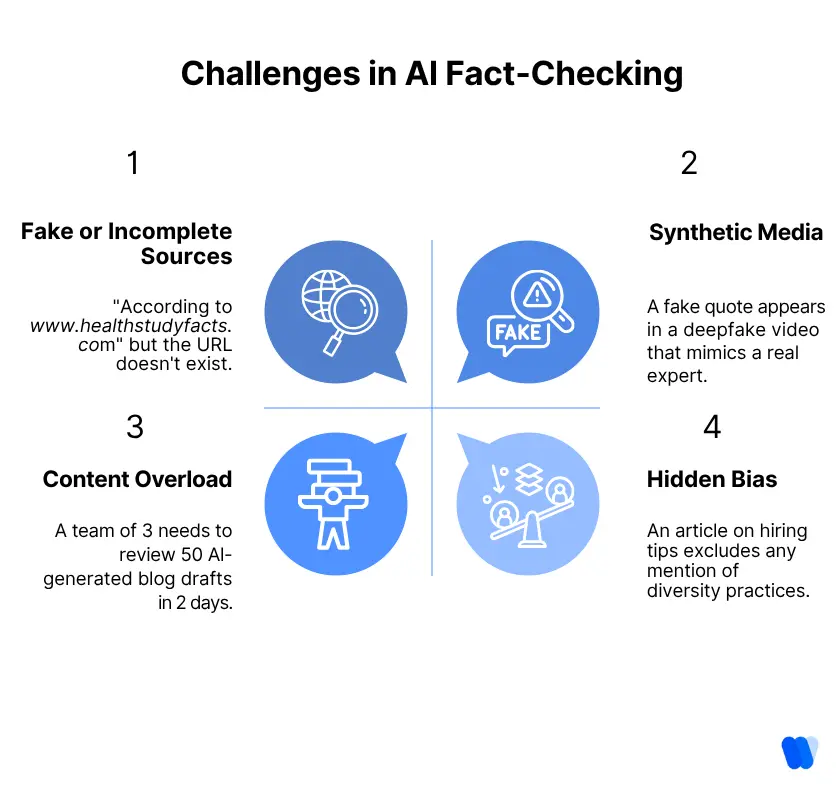
AI models frequently introduce hallucinations such as fabricated URLs or misquoted sources. Without structured knowledge base validation, these errors slip into drafts and erode trust. Detecting these requires manual verification and familiarity with authoritative databases. Without a methodical check, fabricated references can easily slip through unnoticed.2. Volume of Content
AI enables teams to generate vast amounts of content quickly. Reviewing each piece thoroughly can overwhelm workflows, especially in large organizations with limited editorial resources. Prioritizing high-impact content for deeper review mitigates this challenge.3. Detecting Subtle Bias
Bias in AI output may not always be obvious. It can manifest through word choice, framing, or omission of perspectives. Fact-checking must therefore include a review of tone, balance, and inclusivity alongside factual accuracy.4. Deepfakes and Synthetic Data
In multimedia settings, spotting what’s real and what’s AI-generated isn’t always easy. From images to voice clips, subtle fakes can slip through.That’s where reliable AI Content Detection becomes essential—helping teams catch what the eye might miss and stay ahead of misinformation.
Real-World Examples: AI’s Intentional and Unintentional Errors
AI-generated content mistakes fall into two categories: unintentional errors and deliberate misuse. Both carry significant risks for brands, organizations, and audiences. Reviewing real-world cases shows why vigilance is critical.
Unintentional Errors
Even when well-prompted, AI often generates content that seems plausible but is factually wrong.
- In 2023, CNET quietly corrected dozens of AI-written finance articles after readers discovered incorrect interest rate calculations and misleading loan advice.
- A university press release generated by AI incorrectly cited a medical study that did not exist, eroding the institution’s credibility.
These unintentional hallucinations highlight why fact verification workflows are necessary to strengthen SEO trust signals and protect long-term credibility.
Deliberate Misuse
Bad actors also exploit AI’s capabilities to intentionally spread falsehoods and manipulate public opinion.
- The Associated Press reported on networks of fake LinkedIn profiles, complete with AI-generated photos and bios, used to spread disinformation and gather intelligence.
- AI-crafted fake political statements, shared widely during elections, led to public confusion and mistrust in verified news sources.
Why These Examples Matter
- Unchecked errors can misinform and cause financial or reputational harm.
- Malicious misuse undermines public trust and amplifies false narratives.
- Both scenarios reinforce the necessity of proactive AI content fact-checking and humanizing AI output to preserve trust and authenticity — a process made easier with the free AI humanizer tool by Wellows.
Key Content Types That Require AI Fact-Checking
Many AI-generated content types demand thorough AI fact-checking to maintain accuracy and trust. Key scenarios include articles, chatbot responses, product reviews, social media posts, and political statements.
Professionals should always confirm this information against authoritative search results, verified data, and trusted digital assistants to make informed decisions.
1. Fact-Checking AI in Social Media Posts
Misinformation spreads quickly on social media, often amplified by AI-generated posts. To verify social media content, check dramatic claims against multiple reputable sources, such as established news outlets.
This crucial AI fact-checking step helps professionals identify and correct false narratives before they spread.
2. Identifying Common AI Patterns
Watch for these common signs of AI-generated text:
- Generic, overly formal language that lacks natural flow.
- Repetitive phrasing or predictable sentence structures.
- Emotional flatness or absence of specific, verifiable details.
Recognizing these patterns supports more effective AI content fact checking across formats.
3. Verifying AI Chatbot Responses
AI chatbots often provide incomplete, outdated, or misleading information presented confidently. Always cross-reference chatbot responses with trusted, up-to-date sources like academic journals, government publications, or official industry databases.
This diligence ensures your decisions are based on accurate information.
4. Comparing Against Expert Knowledge
For specialized or nuanced topics, validate AI-generated content against input from recognized subject matter experts.
AI often lacks context‑specific insights or fails to account for recent developments. Expert review adds a critical layer of verification, especially in technical and regulated fields.
5. Assessing Accuracy in AI-Generated Writing
When reviewing longer AI-generated content such as articles or reports, check carefully for “hallucinations” where facts are fabricated or misrepresented.
Confirm all claims and statistics using credible external sources. For AI‑generated summaries, always compare the output directly with the original document.
6. Checking Citations and References
When AI provides citations, follow these best practices:
- Verify the existence and relevance of all cited sources.
- Evaluate the credibility of each reference independently.
- Watch for content that lacks attribution altogether, which is a common red flag.
7. Detecting AI in Product and Business Reviews
AI-written reviews on retail sites and directories often appear generic, exaggerated, or overly positive.
To verify authenticity, cross-check reviews across multiple independent platforms and look for specific, experience‑based feedback. This ensures decisions are based on reliable insights rather than manipulated ratings.
8. Fact-Checking Political Statements with AI
Political claims demand careful validation since AI often misinterprets rhetorical nuance or reflects bias from its training data.
Use AI analysis as a starting point, but apply human oversight to ensure factual accuracy and proper context in this sensitive domain.
Best Tools for AI Fact-Checking
Many professionals rely on AI fact-checking tools and techniques to maintain content integrity. Key practices include reviewing citations, cross-checking facts, detecting hallucinations, and consulting experts. Using the right tools and methods ensures your content stays credible and trustworthy.
Using AI Content Fact Checking Tools
Specialized AI fact-checking platforms improve efficiency and accuracy. Below is a comparison of leading tools used in professional verification workflows.
| Tool | Primary Function | Update Frequency | Coverage | Cost | API | Best Use Case |
|---|---|---|---|---|---|---|
| Google Fact Check Explorer | Cross-checks claims against verified news databases. | Daily | News and media coverage | Free | No | Fast validation of trending claims |
| Snopes | Assesses viral stories, rumors, and popular myths. | Ongoing | Cultural, viral, and political topics | Free | No | Checking viral or widely shared claims |
| Reuters Fact Check | Provides verified assessments of trending claims and factual data points. | Daily | Global news & current events | Free | No | Reliable news and data verification |
| GPTZero | Detects AI-written text and flags potential hallucinations. | Ongoing | Textual content | Freemium / Paid | Yes | Screening drafts for AI signals |
| Grammarly Premium | Highlights uncited or unoriginal content through plagiarism checks. | Continuous | Academic and web sources | Paid | No | Checking originality and citation gaps |
| KIVA (Wellows) | Integrates AI content creation with built-in fact verification, knowledge base validation, and E-E-A-T alignment. | Continuous | SEO, content briefs, and SERP signals | Paid | Yes | Embedding fact-checking directly in SEO workflows |
A Smarter Way to Fact-Check: KIVA’s Integrated Approach
While traditional tools help verify individual claims and detect issues after drafting, modern workflows demand more efficiency. That’s where solutions like KIVA come in — an intelligent SEO automation platform designed to streamline your content operations.
KIVA combines SEO-driven tools through its AI content creation feature with built-in fact-checking, delivering a content score that evaluates accuracy, credibility, and SEO readiness immediately after generation.
This integrated approach allows you to spot factual weaknesses early, optimize drafts quickly, and maintain both trust and strengthen your SERP visibility feature without adding extra review steps.
For professionals managing high-volume content, KIVA offers a seamless way to embed fact-checking into your daily process, saving time while improving authority and performance.
- AI Hallucinations Are a Documented Risk:
A Time magazine analysis in 2024 revealed that leading language models produced misleading, biased, or fabricated answers even after extensive retraining efforts. (Time)
According to Vogue Business, these “hallucinations” create plausible-sounding but false narratives that undermine audience trust and brand integrity. (Vogue Business)
- Bias and Misinformation Can Damage Brands:
A comprehensive 2025 SpringerLink review (Saeidnia et al.) emphasizes that AI alone often fails to prevent misinformation—robust fact-checking and human review are essential to maintain content accuracy. (SpringerLink)
As FT reported, chatbots even display partiality, omitting controversial perspectives or amplifying certain narratives, which harms perceived impartiality. (Financial Times)
- Human Oversight Remains Essential: An arXiv preprint paper found that while AI-only fact-checking tools achieved nearly 72% accuracy on recent claims, they struggled with nuance and context.
Experts recommend a hybrid approach combining AI verification tools and professional human reviewers for critical or high-stakes content. (arXiv )
- SEO and Credibility Are at Stake: According to Draymor, verified content aligned with Google’s E-E-A-T principles (experience, expertise, authority, trust) performs better in search and helps maintain long-term visibility and credibility.
Brands that neglect fact-checking risk penalties, lower rankings, and eroded user trust. (Draymor)
Industry leaders and researchers agree: unchecked AI-generated content poses serious risks to accuracy, trust, and reputation.
Recent studies and media investigations have highlighted the urgency of integrating fact-checking into all AI-assisted workflows.
How Is AI Improving Content Accuracy?
AI is not just about producing content faster — it is also evolving to make content more accurate and reliable. Modern AI platforms include built-in verification features that highlight questionable claims, suggest credible sources, and cross-check facts against established databases. This reduces the chances of misinformation slipping into published work.
One key improvement is real-time validation. Advanced tools can compare AI-generated text with academic journals, government data, or trusted media outlets to confirm whether statistics, quotes, and references are valid. This helps writers detect fabricated citations or vague claims early in the process.
AI also improves accuracy through contextual awareness. Updated models are being trained to recognize nuance, tone, and domain-specific language, making them better at reflecting industry standards in areas like healthcare, finance, or education. Combined with human editorial review, this ensures that the final output is both factual and trustworthy.
Another advantage is continuous learning. AI systems adapt over time, incorporating feedback from fact-checking tools, user corrections, and subject matter experts. This iterative process gradually reduces “hallucinations” and increases the likelihood of accurate, up-to-date outputs.
When paired with human oversight, AI becomes a powerful ally for ensuring credibility. Teams that use AI for content generation while also leveraging its fact-checking and validation features can publish faster without sacrificing accuracy, authority, or compliance with Google’s E-E-A-T principles.
FAQs
Top tools include Google Fact Check Explorer, Snopes, Reuters Fact Check, GPTZero, and KIVA. They help verify claims and catch AI hallucinations.
AI can detect false or fabricated claims with ~70–75% accuracy. For high-stakes content, pairing it with human fact verification ensures compliance with E-E-A-T.
AI quickly scans large text sets and flags weak claims. It’s most effective as a first layer of review, followed by experts for nuanced topics.
No. AI speeds up checks but lacks context and judgment. Human oversight is essential for credibility and long-term trust.
AI supports teams by automating checks and flagging inconsistencies. This reduces manual work while improving workflow efficiency.
AI uses NLP and machine learning to extract statements and compare them against trusted knowledge bases for accuracy.
AI now offers real-time validation and better context awareness. It helps reduce hallucinations and improves reliability over time.
Final Thoughts: Accuracy is Your Competitive Edge
Fact verification eliminates hallucinations, validates knowledge bases, and strengthens SEO trust signals. Together, these practices support Google’s E-E-A-T framework and build lasting authority.
Across multiple studies, the consensus is clear: AI content fact checking is no longer optional. Proactively verifying AI output has become a competitive differentiator that protects reputation, earns trust, and aligns with evolving SEO standards.
By combining clear workflows, reliable tools, and expert oversight, professionals can confidently harness AI’s speed without compromising on credibility.
Moreover, verified, accurate content builds authority and ensures long-term visibility and engagement in competitive markets.
Treat fact-checking not as an afterthought, but as an integral part of modern content creation. Accuracy isn’t just expected — it’s your competitive edge.
Key Takeaways:
- Always verify AI-generated content for facts, brand tone, and context.
- Use trusted tools and subject matter experts to confirm accuracy.
- Regular audits keep your content current and trustworthy.
- Fact-checking supports E‑E‑A‑T and strengthens search performance.
- Accuracy builds lasting audience trust and brand authority.