AI can read a 3,000-word article faster than you can blink, but truly understanding it is a different story.
Most AI-generated summaries fail not because the technology is flawed, but because it’s often used without proper guidance. Context isn’t something AI automatically preserves; it’s something you must intentionally provide when creating AI content.
In this blog, you’ll learn how to use AI summarization tools the smart way—by setting the right prompts, defining intent, and preserving nuance—so your summaries don’t just shorten content, but accurately reflect the article’s message, meaning, and purpose.
- AI can summarize fast, but context is not automatic — it must be guided.
- Most poor summaries fail due to weak prompts, not bad AI tools.
- Extractive summaries copy text; abstractive summaries rewrite and need more context control.
- LLMs rely on patterns and prompts, not real understanding.
- AI summarizers can miss nuance, intent, and deeper meaning without guidance.
- Clear prompts matter more than the tool you choose.
- AI summarization saves time — employees spend ~30% of their day searching for information.
- 73% of employees say AI boosts productivity, especially for reading-heavy tasks.
- To avoid context loss: define intent, choose the right summary type, control length, and preserve structure.
- Human review is essential to check accuracy, tone, and missing insights.
- Used correctly, AI optimizes reading, not replaces it.
How AI Summarization Works (Brief Overview)
AI summarization isn’t just about cutting text down—it’s about deciding what matters and why. To understand how AI can summarize content without losing context, it helps to know the basics of how these systems work, where they succeed, and where they fall short.
Extractive vs. Abstractive Summarization
AI summarization generally falls into two categories: extractive and abstractive.
Extractive summarization pulls key sentences or phrases directly from the original text. While this approach is usually accurate, it often feels robotic and may miss the bigger picture.
Abstractive summarization, on the other hand, rewrites the content in new words—much like a human would. This allows for smoother, more natural summaries but also increases the risk of misinterpretation if context isn’t handled carefully.
How Large Language Models Understand Context
Large language models (LLMs) don’t “understand” content the way humans do, which is why a clear LLM content creation strategy matters. Instead, they analyze patterns, relationships between words, and the structure of ideas across large amounts of text.
By tracking how concepts relate to one another, LLMs can identify main themes, supporting points, and implied meaning. However, their understanding is probabilistic—not intentional—which means they rely heavily on the signals you give them through prompts.
Common Limitations of AI Summarizers
Despite their speed and efficiency, AI summarizers have clear limitations. They can overlook nuance, oversimplify complex arguments, or prioritize surface-level points over deeper insights.
Long-form content with subtle transitions, opinions, or domain-specific language is especially vulnerable to context loss if the AI isn’t guided properly.
Why Prompts Matter More Than Tools
The quality of an AI-generated summary depends more on how you ask than on the tool, making strong AI prompts for content marketing essential. A vague prompt leads to a shallow summary, while a well-structured prompt helps the AI identify intent, audience, and key takeaways. Ongoing prompt tracking helps you learn which prompt phrasings consistently produce the most accurate summaries.
By clearly defining what the summary should focus on—and what it should preserve—you give the AI the context it needs to produce summaries that are accurate, meaningful, and aligned with the original article.
Why Use AI to Summarize Articles?
Reading everything in full simply isn’t realistic anymore. From long-form research to in-depth blog posts and reports, content keeps growing—while attention and time shrink. According to stats, employees spend about 30% of their day searching for information, which AI summarization and smart tools can help reduce. (Knowtopia, 2025)
This is where AI summarization becomes less of a convenience and more of a necessity. When used correctly, it offers several clear advantages beyond just saving time.
Saves Time Without Sacrificing Key Insights
AI can process thousands of words in seconds, allowing you to grasp the core ideas of an article without reading every paragraph. Instead of skimming and potentially missing critical points, AI summaries help you focus on what truly matters—making information consumption faster and more efficient.
Improves Information Retention
Well-structured summaries reduce cognitive overload. They also improve understanding and content readability for SEO. By distilling complex content into clear, concise takeaways, AI helps readers understand and remember information more easily. This is especially useful for dense topics like research, technical documentation, or industry analysis.
Supports Better Decision-Making
When insights are presented clearly and without unnecessary noise, decision-making becomes easier. AI summaries allow professionals to quickly evaluate arguments, trends, and recommendations before deciding whether deeper reading is necessary.
Enhances Productivity Across Roles
From marketers and researchers to students and executives, AI summarization fits seamlessly into modern AI content marketing workflows. It helps teams review content faster, align on key points, and move forward without delays caused by lengthy reading tasks.
73% of employees report AI boosts productivity, according to a workplace study. (business.com, 2025)
Scales Content Consumption
As the volume of digital content continues to grow, AI makes it possible to keep up. Whether you’re monitoring multiple sources, analyzing competitor content, or reviewing reports regularly, AI summarization enables you to scale your reading capacity without burning out.
When used thoughtfully, AI doesn’t replace reading—it optimizes it. It acts as a smart filter, helping you spend your time where deeper understanding is actually needed.
How to Use AI for Summarizing Articles Without Losing Context
AI can generate a summary in seconds—but preserving context requires a deliberate process. The steps below show how to guide AI so your summaries remain accurate, meaningful, and aligned with the original article’s intent.
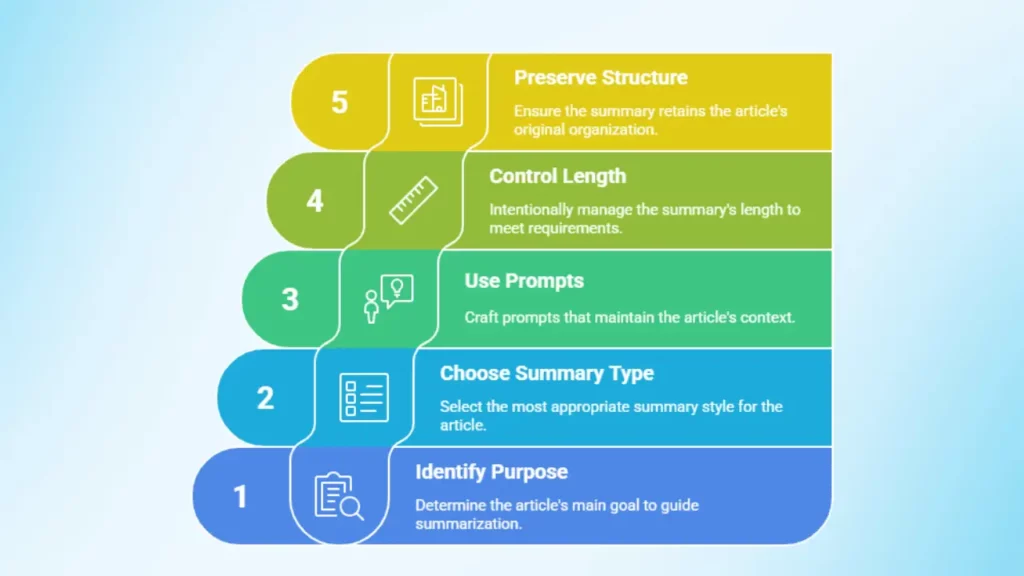
Before asking AI to summarize anything, identify why the article exists. Is it informational, persuasive, analytical, or narrative? Each purpose shapes how ideas are presented and what should be emphasized in a summary.
Understanding intent matters because AI prioritizes content differently depending on the task. A persuasive article, for example, requires preserving the author’s stance and reasoning, while an informational piece focuses more on facts and explanations. When intent is unclear, summaries often flatten nuance or misrepresent the message.
Not all summaries serve the same goal. Selecting the right format ensures clarity without unnecessary loss of detail.
- Bullet summaries work best for quick scanning, internal reviews, or note-taking.
- Paragraph summaries are better for storytelling, reports, or content sharing.
You should also decide between:
- Executive summaries, which highlight conclusions and key outcomes for decision-makers
- Detailed overviews, which retain context, logic, and supporting points
Using the wrong type can either overwhelm the reader or oversimplify important ideas.
The quality of an AI summary depends heavily on how you prompt it. Instead of vague commands like “summarize this,” guide the AI to retain essential context by explicitly asking it to preserve:
Key arguments
- Supporting evidence or examples
- The author’s stance or conclusions
Clear instructions help the AI focus on what matters and avoid common AI mistakes marketers should avoid.
Summary length directly impacts context. Over-compressing content can hurt clarity, especially when choosing between short-form vs long-form content.
- Word limits give precise control and are ideal when space is fixed
- Percentage-based summaries are useful when working with varying article lengths
Extreme compression—such as forcing a long article into a few sentences—almost always leads to context loss. Aim for balance rather than brevity alone.
Structure is context. When an article follows a logical progression, collapsing everything into a single block can distort meaning. Which is why chunk optimization for AI search improves clarity and meaning.
Ask the AI to:
- Maintain headings or sections
- Preserve the logical flow of ideas
- Summarize section by section instead of the entire article at once
This approach mirrors how humans process information and helps ensure that cause, effect, and emphasis remain intact.
Used thoughtfully, AI becomes more than a shortcut—it becomes a precision tool. By guiding intent, structure, and depth, you can create summaries that stay true to the original article while saving significant time.
Best Prompt Examples for Context-Aware AI Summarization
The fastest way to lose context is to give AI a vague prompt. The fastest way to preserve it is to be specific about what to summarize and how to do it. Below are short, scannable prompt examples you can reuse and adapt for different content types.
Prompt for Academic Articles
Summarize this academic article by clearly outlining the research objective, methodology, key findings, and conclusions. Preserve important terminology, cite major evidence or results, and avoid oversimplifying complex concepts.
Prompt for Long-Form Blog Posts
Summarize this blog post while retaining the main argument, supporting points, and the author’s perspective. Keep the logical flow intact and highlight actionable insights or takeaways.
Prompt for News Articles
Summarize this news article by focusing on the core event, key facts, and implications. Maintain neutrality, include essential context, and avoid adding interpretation or opinion.
Prompt for Technical or Research Papers
Create a concise but detailed summary of this technical paper, preserving problem statements, proposed solutions, methodologies, and outcomes. Maintain technical accuracy and avoid removing critical assumptions or limitations.
Pro Tip: Make Prompts Even Stronger
You can enhance any of the prompts above by adding:
- a word limit (e.g., “in 150 words”)
- a format preference (bullet points or paragraphs)
- an audience definition (e.g., non-technical readers, executives, students)
Well-crafted prompts don’t just shorten content—they protect meaning.
Best AI Tools for Summarizing Articles Without Losing Context
The effectiveness of an AI summary depends less on the tool itself and more on how you use it. Each tool excels in different scenarios, and understanding their strengths helps you preserve context instead of flattening meaning.
ChatGPT (Custom Prompting)
ChatGPT is one of the most flexible tools for context-aware summarization because it responds well to detailed, structured prompts. To use it effectively, define the article’s purpose, specify what should be preserved (arguments, evidence, tone), and control length and structure. Asking ChatGPT to summarize content section-by-section often yields more accurate and nuanced results than summarizing everything at once.
Best used for: blogs, reports, mixed-format content, and editorial summaries.
Claude (Long-Context Handling)
Claude is particularly strong at handling long documents without losing track of earlier sections. When summarizing with Claude, provide the full article and explicitly ask it to retain narrative flow or argumentative structure. It performs well when instructed to create layered summaries—such as a high-level overview followed by key supporting points.
Best used for: long-form articles, essays, and multi-section documents.
Notion AI
Notion AI works best when summarization is part of a broader workflow. Instead of pasting entire articles at once, break content into sections or pages and ask Notion AI to summarize each block. This method preserves logical flow and makes summaries easier to refine or expand later.
Best used for: internal notes, research compilation, and collaborative documentation.
Scholar-Focused Tools
Academic summarization tools are designed to retain structure, citations, and formal language. To get the best results, instruct these tools to focus on objectives, methodology, findings, and limitations rather than general conclusions. This approach ensures summaries remain faithful to the original research without unnecessary simplification.
Best used for: academic papers, peer-reviewed studies, and systematic reviews.
Browser-Based Summarizers
Browser extensions and web-based summarizers are useful for quick overviews, but context loss is common if used passively. To improve results, copy the article into a tool that allows custom instructions or refine the summary manually by prompting for missing details such as background or implications.
Best used for: quick scans, news reading, and early-stage research—not final summaries.
Choosing the right tool is only half the equation. Clear intent, structured input, and thoughtful prompts are what turn AI summarizers into reliable context-preserving assistants rather than shortcut generators.
Human Review: The Missing Step in AI Summarization
AI can summarize faster than any human, but speed doesn’t guarantee correctness. The most reliable summaries are never purely automated. Human review acts as the final filter that ensures meaning, nuance, and intent are fully preserved, especially when following AI content fact-checking steps.
What to Check During Human Review
A quick review doesn’t need to be time-consuming, but it should be intentional. Focus on these three areas:
- Accuracy: Verify that key facts, data points, and conclusions are correctly represented. Even small inaccuracies can change the meaning of a summary, particularly in news, research, or technical content.
- Missing Insights: AI often captures the “what” but misses the “why.” Check whether important arguments, implications, or examples have been removed during compression. If a takeaway feels incomplete, it probably is.
- Tone Alignment: Ensure the summary reflects the original tone—neutral, analytical, persuasive, or narrative. A mismatch in tone can unintentionally alter the author’s intent or credibility.
Minor edits such as reordering points, adding a clarifying sentence, or restoring a key insight, can dramatically improve a summary’s usefulness. These small adjustments bridge the gap between automated efficiency and human judgment, resulting in summaries that are both fast and trustworthy.
AI handles the heavy lifting, but human review ensures the final output actually makes sense.
Common Mistakes to Avoid When Using AI for Summarizing Articles
AI summarization is powerful, but only when used thoughtfully. Many context-related issues don’t come from the technology itself—they come from how it’s used. Avoiding the following mistakes can help you get clearer, more accurate, and more reliable summaries.
- Relying on one-click summaries: One-click summaries prioritize speed over understanding. Without guidance on intent, structure, or importance, AI often strips away nuance and delivers shallow or misleading results.
- Ignoring source credibility: AI summarizes content as it is—it doesn’t verify whether the source is accurate, biased, or outdated. Summarizing unreliable content simply compresses misinformation.
- Over-trusting AI output: Even high-quality summaries can contain subtle errors or misplaced emphasis. Treat AI output as a draft, not a finished product, and always apply a quick human review.
- Using summaries as replacements for reading: Summaries are meant to support understanding, not replace critical reading. Relying solely on summaries can lead to missed insights, misinterpretation, or oversimplified conclusions.
Used correctly, AI summarization enhances comprehension. Used carelessly, it reduces it.
FAQs
Final Thoughts
AI summarization is not about replacing understanding, it’s about accelerating it. When used with clear intent, thoughtful prompts, and light human oversight, AI becomes a powerful tool for navigating today’s overwhelming volume of content without losing meaning or nuance.
The difference between a shallow summary and a context-aware one doesn’t lie in the model or the tool, but in how intentionally you guide the process.
The most effective approach treats AI as a collaborator, not an autopilot. By defining purpose, preserving structure, controlling length, and reviewing outputs critically, you ensure summaries remain accurate reflections of the original article’s message and intent.
In a world where speed often competes with depth, mastering context-aware AI summarization allows you to have both—efficiency and understanding.