AI is changing how marketing content gets done, faster, more flexibly, and at scale. If you’re exploring how marketers use AI content in their workflow, you’ll see it’s not just about speeding up writing tasks.
It’s about rethinking how ideas are generated, how campaigns are structured, and how teams collaborate to deliver high-impact content more efficiently.
I’ve seen this shift take hold quickly, especially as agentic AI moves from experimental to essential in day-to-day execution.
In a recent HubSpot survey, over 55% of marketers use AI for content creation, and about 47% use AI for content research. This means writing and researching are top areas where AI is helping marketers daily.
Despite these advancements, AI still lacks the emotional depth, cultural understanding, and creative intuition that human marketers bring. Campaign ideas, brand storytelling, and authentic connections remain human-led, while AI accelerates the groundwork.
Moreover, marketers are integrating AI to generate topic ideas, conduct keyword research, repurpose assets, and even personalize copy across platforms.
This guide breaks down where AI adds the most value in the content pipeline from ideation to optimization, while also addressing best practices and real-world applications.
By the end of this post, you’ll have a clear view of:
- Which stages of content creation benefit most from AI assistance
- How to use AI tools without losing your voice or credibility
- What successful marketers are already doing today
How Should You Assess Your Current Workflow Before Adding AI?
Before bringing artificial intelligence (AI) into your content or business workflow, it’s crucial to understand how your current processes operate. A proper assessment helps pinpoint where AI can add real value, reduce friction, and ensure a seamless transition. Here’s a structured way to approach it:
Start by mapping out each step of your current workflows — who’s involved, which tools are used, and how tasks move from start to finish. Techniques like process mapping and team interviews help reveal inefficiencies and highlight where automation could make an impact. Analyze your workflows to locate repetitive, manual, or error-prone tasks. These bottlenecks often represent the best opportunities for AI to boost speed and accuracy while reducing human workload. AI systems thrive on high-quality data. Assess whether your data is accurate, current, and well-structured. Without clean data, even the most advanced AI solutions will struggle to deliver value. Collaborate with team members who will use or interact with AI tools. Their feedback ensures that implementation addresses real challenges and gains the necessary buy-in for long-term adoption. Review your tech stack to check whether it can support AI integration. Ensure compatibility, scalability, and data security are in place. If needed, plan system upgrades before deployment. Set specific, measurable goals — whether it’s reducing turnaround time, enhancing personalization, or improving decision-making accuracy. Clear objectives provide direction and measurable success benchmarks. AI adoption isn’t a one-time setup. Regularly track performance, gather feedback, and refine models as needs evolve. Continuous optimization keeps AI aligned with changing business goals and user expectations. Taking these steps before implementation ensures AI fits naturally into your workflow — supporting efficiency, consistency, and strategic growth from day one.1) Document Existing Processes
2) Identify Bottlenecks and Inefficiencies
3) Evaluate Data Quality and Availability
4) Engage Stakeholders for Feedback
5) Assess Technological Infrastructure
6) Define Clear Objectives for AI Integration
7) Plan for Continuous Monitoring and Optimization
How AI Is Changing Marketing Workflows
AI is no longer a tool marketers experiment with. It’s a system-level shift. Content workflows that once relied on manual inputs at every stage are now being redesigned to incorporate machine support, freeing time, reducing friction, and opening new possibilities for scale.
From Linear Pipelines to Modular, AI-Assisted Systems
Traditional content workflows follow a clear sequence:
research → write → edit → approve → publish.
But with AI integrated at multiple touchpoints, these steps become non-linear and adaptive.
For example:
- Ideation: AI gathers relevant topics based on real-time trend data
- Drafting: Marketers generate AI content briefs or complete drafts with language models
- Optimization: SEO elements like keywords, meta descriptions, or readability are fine-tuned instantly
- Repurposing: A single blog post is transformed into social snippets, email copy, or video scripts—all in minutes
This modular approach allows marketers to produce more with fewer bottlenecks and adapt faster to audience signals.
Cross-Functional Collaboration Gets Faster and Smarter
AI isn’t just impacting content teams. Product marketing, SEO, and performance teams also benefit from shared AI tooling.
Here’s how:
- SEO teams auto-generate content briefs with semantic analysis
- Product marketers use AI for consistent messaging across collateral
- Media buyers test creative variations using AI-generated copy at scale
Shared access to AI platforms improves alignment between teams and reduces the lag time between planning and execution.
What Risks Does Algorithmic Bias Create in AI Marketing?
While AI improves efficiency across teams, biased training data can lead to unfair or discriminatory targeting. For example, content recommendations may unintentionally exclude specific demographics. Marketers should actively audit AI outputs, diversify datasets, and combine human oversight with automated systems to ensure fairness and inclusivity.
How Do AI-Powered Chatbots Enhance Content Workflows?
Conversational AI tools such as chatbots go beyond automated replies. By using natural language processing, they interpret queries, preferences, and intent to deliver relevant answers or product suggestions. This boosts engagement and helps brands create personalized customer journeys, as highlighted by Salesforce research
This boosts engagement and helps brands create personalized customer journeys, as highlighted by Salesforce research. For teams refining chatbot responses to sound more natural and human, a free AI humanizer tool by Wellows can enhance tone and clarity effortlessly.
How Workflow Automation Platforms Use AI for Blog Content
AI isn’t just speeding up writing—it’s powering entire workflows that automate blog creation, optimization, and distribution. Workflow automation platforms now integrate AI modules and agents that connect tools, streamline tasks, and reduce manual overhead.
AI-Powered Blog Automation Modern platforms connect data sources (like spreadsheets or CMS systems) with AI writers to generate blog drafts, titles, and tags automatically. For marketers, this means content can move from raw data to ready-to-publish assets with minimal handoffs. Native AI Capabilities Instead of relying only on third-party integrations, many platforms now include built-in AI modules. These handle tasks like summarizing research, generating structured outlines, or analyzing text for tone and clarity. The result: faster workflows without extra tools. AI Agents and Adaptive Workflows Agentic AI takes this further by acting as “digital team members” that learn, adapt, and make real-time decisions. For example, an AI agent can draft a blog, analyze SEO gaps, and schedule it for publishing—all inside one system. Community-Driven Innovation Marketers are also sharing creative ways to combine automation with AI: automating Google search queries to feed blog ideation, setting triggers to repurpose published posts into social snippets, or even running outreach workflows alongside content creation.
The takeaway: AI-powered automation shifts blogging from a manual, linear task into a modular, adaptive system. Marketers can generate, optimize, and repurpose at scale—without sacrificing quality.
Where Does AI Fit in the Content Marketing Workflow?
Artificial Intelligence (AI) is revolutionizing content marketing by enhancing efficiency, personalization, and data-driven decision-making across every stage of the workflow. From research to performance analysis, AI enables marketers to plan smarter, create faster, and optimize better.
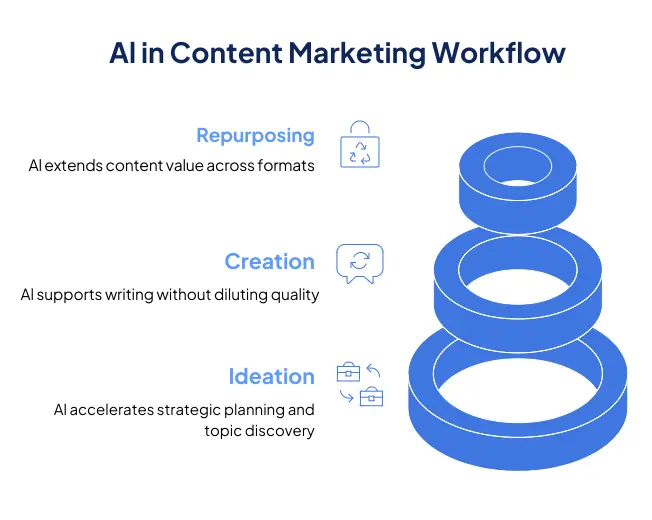
1) Research and Strategy
- Audience Analysis and Trend Prediction: AI tools analyze audience behavior, preferences, and emerging trends, helping marketers craft data-backed strategies that align with their target demographics.
- Content Ideation: By evaluating competitor content and market trends, AI recommends timely topics and formats — streamlining brainstorming and campaign planning.
2) Content Creation
- Automated Drafting: Natural Language Generation (NLG) tools assist in creating first drafts for blogs, articles, and social content, allowing teams to produce more while maintaining quality.
- Visual Content Generation: AI platforms convert written material into visuals and videos, enhancing storytelling and visual engagement across campaigns.
3) Personalization
- Dynamic Content Customization: AI personalizes messages in real time by analyzing user data and behavior patterns. This helps marketers deliver content that feels relevant, timely, and human.
- Predictive Targeting: Using machine learning, AI anticipates audience needs and suggests tailored content paths — a key driver behind more effective B2B content personalization strategies.
4) Optimization
- SEO Enhancement: AI evaluates on-page elements, keywords, and readability to improve visibility and SERP performance.
- Performance Analytics: Real-time analysis helps marketers identify what’s working, optimize weaker areas, and continuously refine campaigns.
5) Distribution
- Automated Scheduling: AI determines the best publishing times and automates content distribution across multiple platforms to maximize engagement.
- Cross-Channel Optimization: Content is automatically adjusted for tone, length, and style across each channel for consistent performance.
6) Performance Analysis
- Predictive Analytics: AI forecasts performance outcomes and user responses, helping marketers make proactive adjustments before trends shift.
- Continuous Optimization: Learning models adapt to audience feedback and engagement data, ensuring campaigns evolve with changing behaviors.
By integrating AI throughout the content lifecycle, marketers can work faster, personalize deeper, and make more strategic, data-driven decisions that elevate brand performance and user experience.
How Does AI Enhance SEO Strategies Within Content Marketing?
Artificial Intelligence (AI) is revolutionizing content marketing by enhancing Search Engine Optimization (SEO) strategies in several key areas:
1. Automated Content Creation and Optimization
AI tools generate blogs, product descriptions, and social posts that match audience intent. They analyze top-performing content to produce text aligned with trends and search behavior.
2. Advanced Keyword Research and SERP Analysis
AI enhances keyword research by understanding user intent and suggesting long-tail opportunities. It also reviews SERPs to identify content gaps and potential featured snippet placements.
3. Personalization at Scale
AI analyzes user data to deliver tailored content experiences. By predicting user interests, it helps brands increase engagement and drive conversions with highly relevant messaging.
4. Content Distribution and Engagement Measurement
AI ensures the right content reaches the right audience at the right time. It identifies effective distribution channels and measures engagement metrics like clicks, time on page, and interactions.
5. Adapting to AI-Driven Search Engines
With AI-powered search engines rising, optimization now focuses on Generative Engine Optimization (GEO). This approach emphasizes structured, conversational content aligned with user intent.
AI strengthens SEO by making content creation smarter, keyword strategies sharper, and audience connections deeper making AI search content optimization a natural next step for brands that want to stay visible in generative search.
What Are Examples of AI-Driven Content Marketing Workflows?
AI-driven content marketing workflows automate and optimize every stage of content production — from creation to distribution. Here are standout examples shaping the industry:
1. Content Creation and Personalization
- Automated Story Generation: The Washington Post’s Heliograf produces short, data-based news updates, freeing journalists for deeper analysis.
- Personalized Recommendations: Netflix analyzes viewing habits to deliver personalized trailers, emails, and suggestions that boost engagement.
2. Content Optimization and Distribution
- Email Campaign Optimization: Farfetch tests tone and subject line variations with AI to improve open and click-through rates.
- Localized Content: AI helps publishers scale local coverage by generating tailored posts for niche audiences.
3. Innovative Advertising Campaigns
- AI-Generated Visuals: BMW trained a model on 50,000 artworks to create AI-generated billboards blending art and automotive design.
- Virtual Influencers: Brands use generative AI to create virtual KOLs, making influencer marketing scalable and cost-effective.
4. Content Repurposing and Automation
- Automated Repurposing: Brands like JoyFizz adapt a single ad concept into multiple versions for different regions and events.
- Integrated Workflows: Teams automate research, drafting, SEO, and publishing — accelerating production while maintaining consistency.
AI workflows streamline how content is planned, created, and scaled — helping brands achieve faster delivery, better personalization, and measurable impact.
How Workflows and Team Roles Evolve with AI Content Adoption?
Adopting AI in content creation isn’t just about swapping tools — it requires rethinking how workflows run and how teams collaborate. To fully capture AI’s benefits, organizations need both structural adjustments and new roles.
Workflow Changes
- Pilot Projects: Start small by testing AI in low-risk areas of your workflow. This allows teams to measure impact, refine processes, and build confidence before scaling.
- Redesigned Workflows: AI works best when integrated into daily operations, not added on top. Rethinking processes ensures automation reduces friction rather than creating new silos.
- Human–AI Collaboration: Define clear handoff points where AI handles repetitive tasks and humans step in for strategic or creative oversight.
- Quality Control: Maintain human review at critical checkpoints. Even the most advanced systems need checks for accuracy, compliance, and brand consistency.
Evolving Team Roles
- AI-Specific Roles: Positions such as AI Workflow Orchestrators or AI Ethics Guardians are emerging to manage automation, optimize human-AI partnerships, and uphold responsible use.
- Upskilling Teams: Ongoing training helps employees understand AI tools, ethics, and best practices, ensuring adoption isn’t limited to specialists.
- Managerial Shift: Managers now focus less on task supervision and more on strategy, innovation, and building AI-ready teams.
- Cross-Functional Collaboration: Successful adoption often comes from blending perspectives — AI developers, marketers, and stakeholders co-create workflows to balance technical and human needs.
The takeaway: AI adoption in content isn’t just technical. It’s cultural and organizational. Workflows must adapt, and team roles must evolve, so AI becomes a partner — not a patch — in the creative process.
How Can AI Improve Content Personalization and Audience Targeting?
Artificial Intelligence (AI) is transforming how marketers understand and engage with audiences. By analyzing massive datasets, AI uncovers insights that enable hyper-personalized content and precise audience targeting — making every interaction more relevant and valuable.
1) Automated Audience Segmentation
AI analyzes browsing habits, purchase patterns, and engagement data to build dynamic audience segments. Instead of static personas, marketers gain real-time clusters of users that evolve with behavior — enabling sharper targeting and higher conversion potential.
2) Predictive Content Recommendations
AI goes beyond personalization by anticipating what users need next. Using predictive analytics, it recommends content or products before a user even searches for them, increasing engagement and satisfaction. This same approach drives deeper B2B content marketing personalization, helping brands deliver context-aware recommendations across buyer journeys.
3) Dynamic Ad Personalization
With AI, ad content can adapt in real time based on user context. Dynamic Creative Optimization (DCO) automatically modifies images, copy, or CTAs to match a user’s behavior, making campaigns more responsive and performance-driven.
4) Enhanced Customer Experience
AI-powered personalization ensures users see content that feels made for them. From website copy to email sequences, every message reflects user intent — improving trust, satisfaction, and long-term loyalty.
5) Continuous Optimization
AI systems continuously learn from audience feedback and behavior, refining personalization models over time. This loop ensures your targeting and content remain aligned with shifting interests, keeping campaigns relevant and effective.
By integrating AI into personalization and targeting strategies, marketers can move beyond demographics to deliver experiences that feel human — timely, adaptive, and deeply connected to user intent.
How Can Content Marketers Scale Blog Creation?
Scaling blog content isn’t just about writing more—it’s about producing the right content, informed by data, at a pace that meets campaign demands without compromising quality. The biggest challenge for many teams isn’t creativity—it’s clarity and consistency at scale.
That’s where KIVA by Wellows becomes a powerful advantage.
From Keyword Chaos to Strategy You Can Execute
Content marketers often start with spreadsheets full of keywords, but lack structure around what to write, when, and why. KIVA solves this by connecting directly to your Google Search Console account and turning raw keyword data into actionable insights.
KIVA automatically segments keywords into priority tiers:
- Gamechangers (high opportunity, low coverage)
- Reclaimers (ranked content losing traction)
- Contenders (mid-performance, ready for optimization)
- Explorers (emerging or long-tail opportunities)
This gives content teams clarity on what to create next—and why it matters.
Turn Strategy into Structured Outlines—Fast
Once keywords are prioritized, KIVA helps marketers move quickly into execution. Instead of manually drafting briefs or guessing what structure works, KIVA auto-generates optimized content outlines that include:
- Search intent and metadata
- Recommended H1/H2 hierarchy
- Ideal word count range
- Internal link targets
- SERP references for benchmarking
You choose the content type—whether it’s a How-To Guide, Comparison Article, or Product-Led Explainer—and KIVA adapts the structure accordingly.
This eliminates bottlenecks between strategy and writing so that teams can focus on quality and voice.
Generate First Drafts with Built-In Brand Alignment
With a complete brief in place, content marketers can generate first drafts using their preferred language model (OpenAI, Claude, Gemini, DeepSeek, or LLaMA).
KIVA supports brand consistency by letting teams define tone, voice, and persona settings upfront, making it easier to align AI content to brand voice from the start.
Instead of starting from scratch, writers begin with structured drafts aligned to the intended message, format, and search opportunity. This dramatically reduces time spent on rewrites or editorial rounds.
Monitor Performance and Refresh at the Right Time
Scaling content doesn’t end at publishing—it requires iteration. KIVA tracks content performance post-publication and alerts teams when specific articles begin to+
lose visibility or relevance due to content decay, allowing marketers to intervene before rankings, traffic, and engagement slip further.
Marketers can then:
- Re-prioritize content refreshes
- Identify keyword or SERP shifts
- Generate updated briefs based on new data
This ensures your growing content library doesn’t just expand—it improves.
Why Is Human Oversight Still Essential?
AI can draft faster, but it cannot replace human intuition, empathy, or contextual judgment. Marketers must review AI-generated work to maintain brand alignment, storytelling nuance, and ethical standards. As experts point out, authenticity and trust cannot be automated—they must come from human oversight
How Can Marketers Avoid Consumer Deception With AI Content?
AI makes it possible to create hyper-personalized messages, but this power can be misused for manipulation—such as generating fake reviews or misleading testimonials. Ethical marketing requires transparency. Instead of deceptive practices, brands should encourage genuine feedback and ensure AI is used to enhance—not exploit—customer relationships.
What Are the Common Myths About AI Content?
Despite its benefits, AI content is often misunderstood. Let’s clear up three widespread myths:
- “AI writes better than humans.”
AI can mimic writing, but it lacks the intuition, empathy, and originality that humans possess. It’s best used as a collaborator, not a replacement. So it’s better to understand what AI content is before starting to use it.
- “All AI content sounds robotic.”
Not necessarily. With proper prompts and editing, AI can match a wide range of brand voices, and you can always humanize your AI content as you like.
- “Using AI hurts SEO.”
Google does not penalize AI content per se. What it penalizes is low-quality, unhelpful, or duplicate content, regardless of who wrote it.
What Are Best Practices for Using AI Content Tools Without Losing Quality?
To maintain quality while using AI content tools, marketers must remain actively involved in shaping, editing, and reviewing every output. AI can accelerate production, but without clear human direction, it risks producing vague, misaligned, or unoriginal content.
Below are three key areas where best practices ensure AI supports your workflow without sacrificing standards.
How Do You Stay in Control While Using AI?
AI should never operate independently of human judgment. You must define the purpose of each task and guide the tool accordingly.
Actionable Best Practices:
- Start with structured prompts: Clearly define topic, audience, tone, and format
- Limit automation to early drafts: Avoid publishing AI output without editorial review
- Audit tone and structure regularly: Ensure coherence across your content portfolio
“Generate a blog outline for beginner marketers on AI-driven email campaigns. Keep tone friendly, informative, and brand-aligned.”
For more inspiration on how to guide your content with the right AI instructions, explore these Must-Try AI Prompts for Content Marketing Team.
How Do You Maintain a Consistent Brand Voice?
Maintaining brand identity requires you to proactively align AI-generated content with your existing guidelines.
Steps to Preserve Brand Voice:
- Feed AI tools with previous blog samples or style guides
- Use tone descriptors (e.g., “confident but approachable,” “technical yet accessible”)
- Document and reuse brand-aligned prompt structures
Product Spotlight: How KIVA Helps
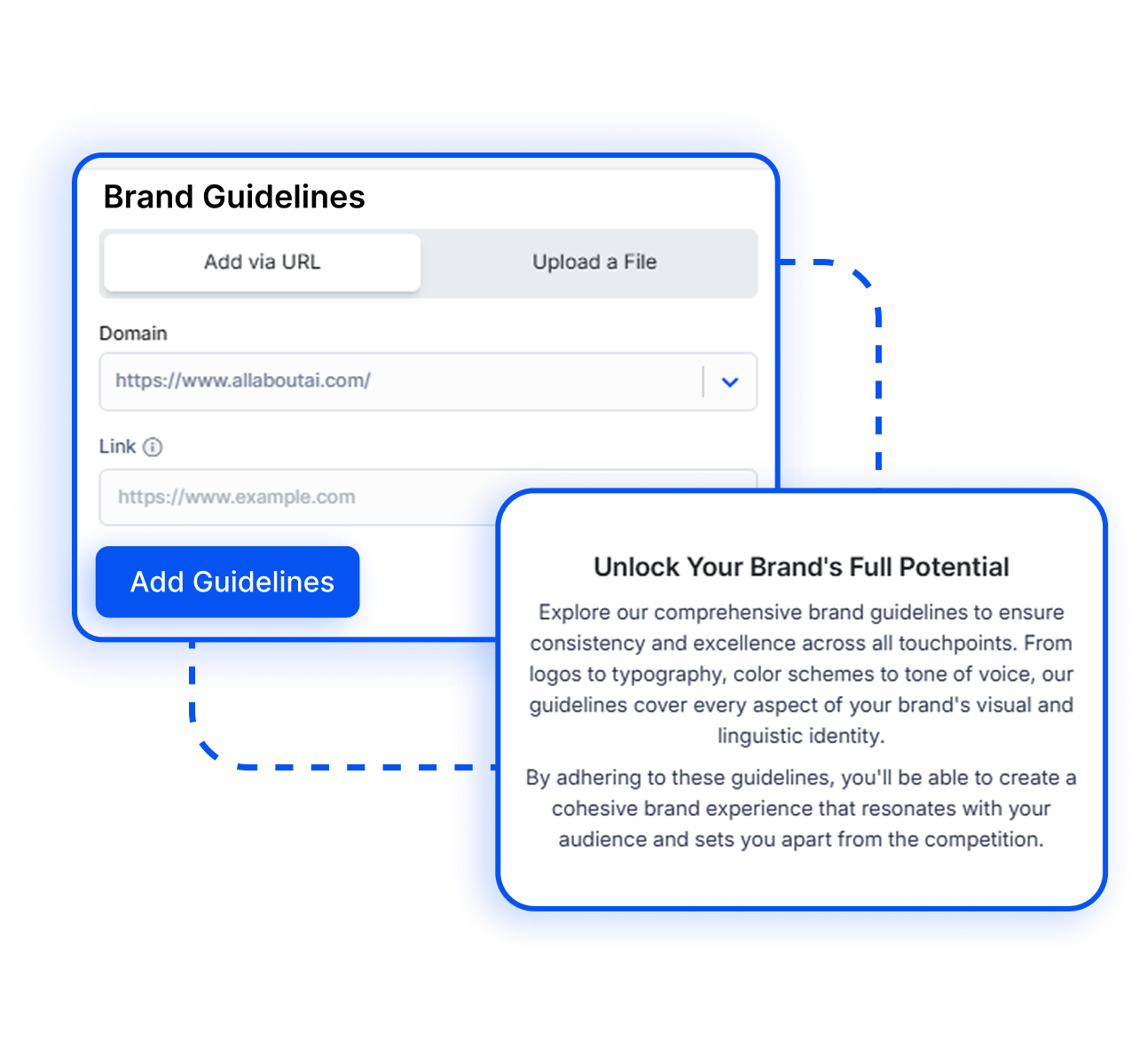
KIVA allows marketers to embed brand guidelines directly into the AI-assisted workflow. From tone-of-voice instructions to formatting rules, KIVA ensures each content outline and keyword plan aligns with your brand’s identity, automatically.
It also integrates with Google Search Console to keep content not only consistent but also optimized.
What Challenges Should You Expect When Using AI?
While AI creates efficiency, it also introduces risks. Marketers may lose control over brand tone or face data privacy concerns. To avoid this, companies should set clear review processes, use role-based permissions, and confirm that AI tools meet compliance standards. Building safeguards early ensures AI adoption strengthens, not undermines, your strategy
- Publishing unedited drafts containing factual inaccuracies or hallucinations
- Allowing inconsistent tone or structure across content pieces
- Using AI for sensitive content (e.g., testimonials, legal claims) without legal review
- Over-optimizing for SEO at the expense of clarity or usefulness
Even the best tools have limitations. Rushing or delegating too much to AI can lead to brand dilution, errors, or SEO penalties.
Avoid These Missteps:
How Do You Measure AI’s Impact on Your Workflow?
AI integration is only successful if it drives measurable outcomes. Metrics like content velocity, time saved per draft, SEO ranking improvements, and engagement uplift reveal whether AI is truly adding value. Teams that monitor results and refine their approach continuously see the biggest long-term gains. Treat AI adoption as an iterative process, not a one-time shift
How Does AI Create Enhanced User Experiences?
AI-driven personalization fosters meaningful customer interactions by tailoring content to individual preferences. When businesses deploy AI to adapt messaging, recommend content, or fine-tune tone, they see improved engagement, stronger conversions, and deeper loyalty. Enterprises already leverage these strategies to elevate satisfaction and build long-term trust.
How Does AI Simplify Complex Data With Visualization?
AI is also transforming how marketers communicate with data. Instead of raw reports, platforms now generate charts, infographics, and interactive visuals that make complex information easy to grasp. This not only improves clarity but also ensures that insights are retained and acted on by both internal teams and customers
Key Takeaways
- AI is streamlining how marketers plan, create, and optimize content.
- Writing, research, and repurposing are top AI use cases today.
- KIVA helps scale blog content through keyword insights, smart briefs, and performance tracking.
- Human oversight is essential—AI works best with clear direction and brand alignment.
- Quality, consistency, and usefulness still matter more than speed.
What Are the Best AI Tools for Optimizing Content Marketing Processes?
AI is reshaping how marketers plan, create, and optimize content—automating routine work, boosting creativity, and improving consistency.
- Predis.ai: Generates ad creatives, short videos, and social posts in minutes, with scheduling, auto-posting, and a content calendar.
- Adobe’s AI Agents: Personalize on-site experiences, manage chatbots, and surface recommendations by analyzing user behavior.
- Canva’s Magic Studio: Enables fast, professional visuals; Magic Switch and Magic Grab help repurpose or modify content instantly.
- HubSpot’s Content Hub: Unifies AI content creation, personalization, and publishing to deliver targeted messaging across the journey.
- Writesonic: Creates marketing copy for blogs, websites, and ads; identifies content gaps, improves SEO, and boosts performance.
What Are the Recent Developments in AI and Content Creation?
AI’s role in content marketing isn’t only about workflow efficiency—it’s also shaped by how platforms and industries adapt to new challenges. A recent update from YouTube illustrates this shift. The company expanded its AI likeness detection tool to all creators in the Partner Program, giving them the ability to flag deepfakes or unauthorized use of their image.
This move mirrors the impact of Content ID for copyright protection but now extends to personal identity. For marketers, this signals a future where protecting brand and creator authenticity becomes as important as scaling output.
FAQs
Final Thoughts
Understanding how marketers use AI content in their workflow is not just about staying current. It’s about redesigning how content is planned, created, and delivered at scale. AI is no longer a tool on the side it’s a collaborator that augments, not replaces, creativity.
The teams that succeed won’t just adopt AI, they’ll integrate it, train it, and partner with it strategically. The future belongs to marketers who treat AI not as a shortcut, but as an amplifier of quality, creativity, and results.
Read More Articles
- Content Marketing Agencies: A Complete Guide 2026
- Write Content for People First, Not Search Engines
- Long-Form vs. Short-Form Content
- How Small Brands personalized AI content
- How to use People Also Ask data
- Content readability in SEO
- Top Content Marketing Statistics to Know in 2025 (Including AI Trends)