I’ve seen AI tools speed up everything from writing blogs and emails to product descriptions and handling support chats. For small brands, that’s a huge help. But here’s the thing, fast doesn’t always mean better. Because too often, AI content sounds flat and disconnected.
People want to hear from brands that sound human. That’s why I started looking at how small brands personalized AI content without losing the efficiency that makes these tools worth using.
In this guide, I’ll be sharing what’s worked for me and other small business owners, real strategies, smart tools, and ways to make AI-generated content sound like it actually came from you. Whether you’re writing social posts or support replies, there’s a way to make it feel personal and credible.
Why Personal and Credible Content Matters
Whether you’re sending an email, writing a blog, or posting on social media, the end goal is connection. Content that lacks personality or reads like a copy-paste script can create distance between a brand and its audience.
Here’s what personal and credible content looks like:
| Personal Content | Credible Content |
|---|---|
| Speaks in a human tone | Uses verified facts and data |
| Includes specific experiences | Avoids exaggeration |
| Shows empathy or humor | Provides sources or examples |
| Matches your audience’s vibe | Aligns with user intent |
For small brands, the right blend helps build trust, and trust is what drives action. Understanding how AI and E-E-A-T intersect gives these teams a roadmap for creating content that feels credible, not automated.
The Common AI Trap: Content Without a Soul
AI is powerful, but left alone, it produces content that’s:
- Generic or formulaic
- Too formal or too casual
- Detached from brand voice
- Lacking first-hand experience
For small teams, it’s tempting to publish AI outputs as-is. But if you want your AI-generated content to stand out and connect, you’ll need to humanize your AI content before it goes live.
1. Social Media Content: Small Posts, Big Impact
AI in use:
Caption writing, content calendars, visual prompt ideas, and hashtag generation
Personalization risk:
Generic tone, off-brand phrasing, irrelevant references
How to Make It Personal and Credible:
● Inject brand voice manually:
Tools like ChatGPT and Jasper can generate captions, but always include your own tone guide or sample post before generating. e.g., “Use a witty, playful tone like Wendy’s Twitter account, but tailored for a Gen Z skincare brand.”
● Reference real events or products:
Prompt the AI with specific product names, customer reviews, or recent local events to make posts timely and grounded.
● Combine with user-generated content:
Use AI to frame real customer testimonials or photos—let the audience be the “personal” part, while AI helps with structure or phrasing.
● Create template-based structures:
For small teams, use AI to build reusable post templates (e.g., “Did You Know?” facts, customer shoutouts, weekly tips) that stay consistent in tone.
Tools to use:
- Predis.ai: Generates AI social media posts with visuals and hashtags.
- Lately.ai: Learns from your brand tone and repurposes long-form content into social posts.
- ChatGPT + Brand Voice Primer: Share 5–10 previous captions as examples, and ask for a tone-match.
2. Email Campaigns
AI in use:
Subject lines, promotional emails, onboarding sequences, reactivation flows
Personalization risk:
Sounds overly salesy or impersonal; lacks segmentation context
How to Make It Personal and Credible:
● Use segmentation data in prompts:
Let AI know who it’s talking to. Example: “Write an onboarding email for new customers who bought our organic pet shampoo.”
● Keep human sign-off and personalization tags:
Always end with a human name (real or role-based) and use first-name personalization fields in tools like Mailchimp or ConvertKit.
● Layer in founder/brand storytelling:
Include short founder notes or anecdotes in nurture sequences. These are often drafted best by humans or based on real quotes and then polished by AI.
● A/B test tone and structure:
Use AI to produce variations—one short and punchy, one narrative-heavy—and test what resonates best.
Tools to use:
- Copy.ai Email Templates: Useful for quick generation.
- Smartwriter.ai: Automates personalized cold emails using LinkedIn and company data.
- Flowrite: Turns bullet points into polished, human-like emails with style control.
3. Product Descriptions
AI in use:
Marketplace listings, ecommerce product pages, feature-benefit breakdowns
Personalization risk:
Too formulaic or stuffed with buzzwords
How to Make It Personal and Credible:
● Use customer reviews as input:
Feed real reviews into your prompt and ask the AI to reflect common buyer sentiments.
● Add real-world context:
Go beyond specs. Example: Instead of “waterproof material,” say “keeps your gear dry during rainy hikes in the Pacific Northwest.”
● Balance SEO with storytelling:
Use keywords, but wrap them in narratives (e.g., “Customers love how this jacket stays light even after getting soaked.”)
● Include founder notes for hero products:
Add a quote or a personal insight for flagship products to reinforce authenticity.
Tools to use:
- Copysmith: Designed for ecommerce brands; auto-generates descriptions optimized for Shopify, Amazon, etc.
- Hypotenuse.ai: Converts product specs into rich, on-brand descriptions.
- ChatGPT with your reviews: Prompt: “Write a 60-word product description using these 3 customer reviews.”
4. Video Scripts and Voiceovers
AI in use:
Scriptwriting for explainer videos, ad reels, YouTube intros/outros
Personalization risk:
Too generic or mechanically sounding
How to Make It Personal and Credible:
● Add brand language patterns:
Teach AI your catchphrases, intro lines, or CTAs.
● Use real team voices or anecdotes:
Even if AI helps with scripting, insert real quotes, bloopers, or team insights to create familiarity.
● Human editing is non-negotiable:
AI can get the structure right, but humans must review for tone, pacing, and flow, especially for spoken delivery.
● Use voice cloning sparingly: For consistency, some small brands use AI voice tools to clone founder voices (with consent), but it’s crucial to fine-tune inflection and tone.
Tools to use:
- Pictory and Synthesia: Generate videos with AI avatars and voiceovers.
- Descript’s Overdub: Create AI voiceovers in your voice.
- Lumen5: Transforms blog posts into simple video scripts with visuals.
5. Chatbots & Customer Support
AI in use:
FAQs, chatbot flows, help center replies, auto-responses
Personalization risk:
Cold, robotic replies that frustrate users
How to Make It Personal and Credible:
● Train AI on real customer service tone:
Provide past live chat transcripts to match the tone.
● Add empathetic templates:
Use phrases like “I understand that can be frustrating” or “Thanks for your patience”—you can generate these using AI, but review for appropriateness.
● Flag and route complex queries:
Ensure sensitive or edge-case topics are routed to a human. Don’t let AI guess.
● Use local spelling and slang:
For regional brands, AI should respond in the customer’s idiom—train it accordingly.
Tools to use:
- Tidio and Intercom: AI chatbots that support small business workflows with escalation paths.
- Ada and Botpress: Advanced options for integrating conversational AI with custom brand tone.
- ChatGPT API: Build your own flows if you’re technically inclined.
6. SEO Blog Content (Brief Overview)
This is where AI shines, but also where the risk of sounding bland is highest especially when content isn’t reviewed or refreshed over time, which can quietly lead to content decay and reduced search visibility.
How to fix AI drafts:
● Use strong prompts with structure:
Include your audience, purpose, and tone in the prompt. For Example: “Write a blog post for beginner plant parents, in a helpful, friendly voice.”
For more examples of effective prompt structuring, check out these Must-Try AI Prompts for Content Marketing Team.
● Insert your own stories or analogies:
These make even how-to posts feel unique.
● Don’t publish first drafts:
Use the AI draft as a base. Edit it like you would a team member’s writing.
Great combo tools:
- ChatGPT or Claude – For structured first drafts
- Grammarly – Tone and clarity checks
- Surfer SEO or Frase – Add keyword insights without fluff
For growing teams looking to strengthen content rankings, an AI search visibility platform for startups can further enhance performance tracking and keyword strategy by aligning content efforts with real search intent.
Plus:
- KIVA (AI SEO Agent) – Helps small brands identify high-value keywords, detect user intent, and generate tailored AI content briefs aligned with their tone and goals
As more writers look to scale production without sacrificing quality, many are building hybrid workflows that combine structure-first AI tools with editorial refinement.
Why More Content Writers Are Using AI Agents in Their Workflow offers a deeper look at how these agents, including KIVA, are shaping modern content operations.
How Can Small Businesses Use AI to Create Personalized Content?
Small businesses can harness the power of artificial intelligence (AI) to craft personalized content that resonates with their audience, strengthens customer relationships, and accelerates growth. Here’s how they can do it effectively:
1. AI-Powered Content Creation Tools
AI makes it easier for small businesses to create marketing materials, social posts, and ads that feel personal and engaging.
- KIVA by Wellows: KIVA helps small businesses automate SEO-driven content creation by combining keyword intelligence, LLM-based drafting, and real-time visibility tracking. It enables personalized blog and website content aligned with audience intent, helping brands stay visible across search and AI platforms.
- Predis.ai: An all-in-one content tool that generates ad creatives, e-commerce videos, UGC posts, and product visuals. With built-in scheduling, auto-posting, and a smart content calendar, it simplifies social media management for small teams.
- Jasper AI: Jasper learns your brand’s voice and tone to produce blog articles, emails, and ad copy that sound authentic. It integrates seamlessly with SurferSEO, Google Workspace, and Webflow, making it ideal for businesses scaling their marketing efforts.
2. AI-Driven Customer Interaction
AI chatbots and assistants enhance customer experience through real-time, personalized communication.
- Tidio: A customer service platform that merges AI chatbots with live chat support across websites, email, and social channels like Facebook and WhatsApp, ensuring quick, human-like responses.
- ChatSpot.ai (by HubSpot): A conversational AI assistant that automates responses, streamlines customer service, and integrates directly into HubSpot’s CRM for a seamless support experience.
3. AI-Enhanced Website and E-Commerce Solutions
From building websites to optimizing e-commerce experiences, AI tools help small businesses deliver personalized online journeys.
- Hostinger AI Website Builder: Creates fully functional websites through a simple questionnaire, automatically generating tailored designs, content, and images with SEO optimization.
- Shopify Magic: A built-in suite that automates e-commerce workflows, content creation, and customer messaging—helping small brands personalize product descriptions and emails at scale.
Want faster go-to-market pages? Many of the SaaS startups use AI to launch landing pages and product content without adding headcount.
4. AI for Personalized Marketing
AI tools allow small businesses to design visuals and campaigns that resonate deeply with their audience.
- Adobe Firefly: An AI image generator that enables the creation of visually compelling, brand-aligned graphics for marketing campaigns.
- Dynamic Yield: Delivers hyper-personalized product recommendations and content suggestions across websites, email, and mobile, adapting to each user’s behavior in real time.
5. AI for Business Planning
AI can also help small businesses plan and grow strategically.
- BizChat: An AI tool designed to help entrepreneurs craft business plans, learn on the go, and make data-driven decisions—ideal for small business owners with limited experience in planning.
Need strategic clarity? Tech startups use AI not just for execution, but also for product planning and market fit validation.
What AI Tools Are Available for Small Brands to Generate Personalized Content?
- KIVA by Wellows:
KIVA is an AI-powered SEO and content automation platform built for startups, small businesses, and marketing consultants. It blends keyword intelligence, content brief generation, and LLM-based writing to produce SEO-rich, personalized content at scale. KIVA also tracks visibility and user intent to ensure every article aligns with real audience behavior and search patterns.
- Predis.ai:
Predis.ai helps small and medium-sized brands create ad creatives, UGC videos, product visuals, and social media posts. With features like auto-posting, smart scheduling, and AI-powered content calendars, it simplifies daily marketing tasks while maintaining brand consistency.
- Jasper AI:
Jasper AI generates personalized and on-brand content by learning your tone, style, and voice. It supports blogs, ads, emails, and landing pages while integrating with tools like SurferSEO, Google Workspace, and Webflow for optimized performance.
- Ocoya:
Ocoya combines AI writing with a built-in design suite to help brands create, design, and schedule content from one platform. It’s ideal for small teams that need quick, automated social media posts with engaging visuals and captions.
- Canva:
Canva’s AI-powered design tools allow small businesses to produce professional graphics and social content effortlessly. Its Brand Kit ensures visual consistency, while AI text and layout suggestions make design creation fast and intuitive.
- ChatSpot.ai by HubSpot:
ChatSpot.ai automates customer interactions and marketing communications through conversational AI. Integrated with HubSpot’s CRM, it helps small businesses manage customer queries, personalize outreach, and streamline workflows efficiently.
How KIVA Supports SMEs in Content Creation
Small brands often operate without dedicated SEO teams, but that doesn’t mean they should compromise on quality, strategy, or consistency. KIVA, an AI SEO Agent, is designed with SMEs in mind, helping them scale content efforts that feel on-brand and perform well in search.
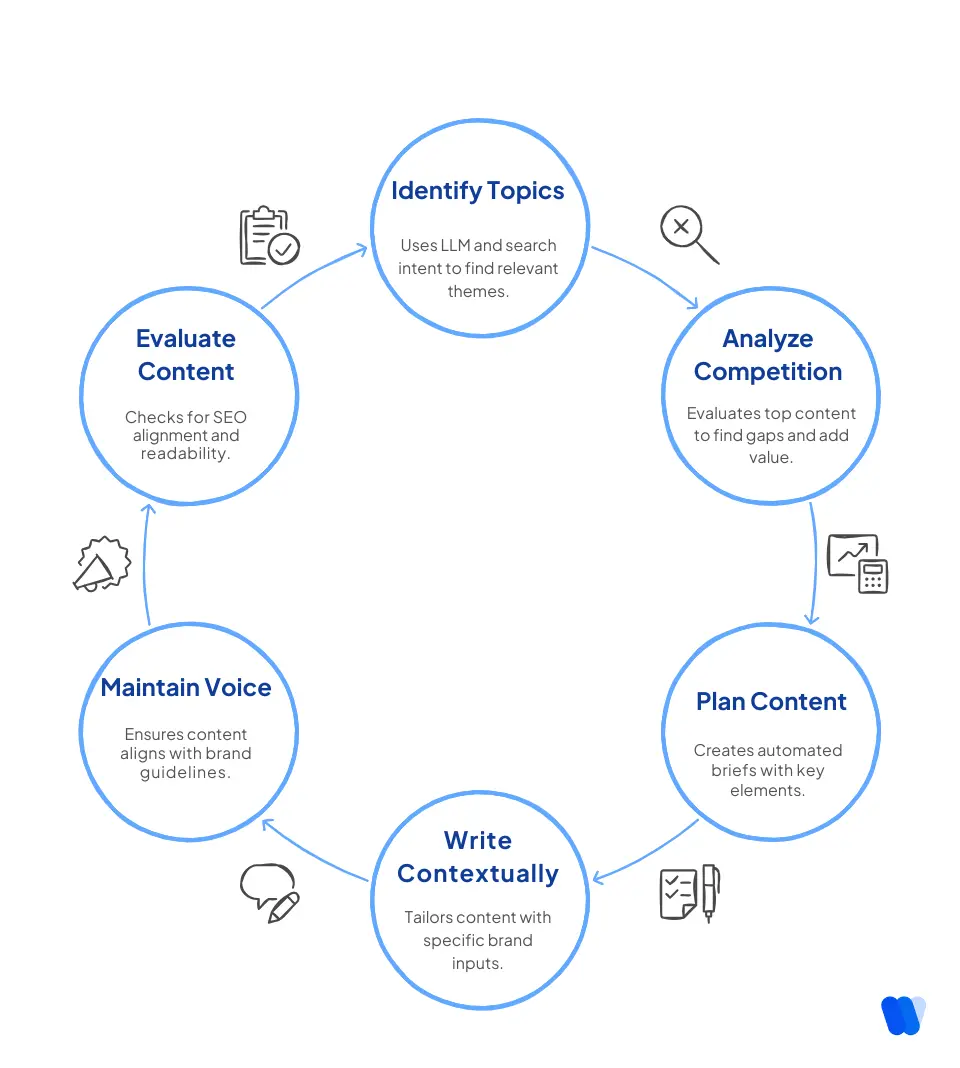
Here’s how KIVA supports small businesses at each stage of long form content creation:
- Finding the Right Topics
With LLM optimizations and user search intent detection, KIVA identifies what people are really looking for, going beyond basic keyword volume to highlight themes aligned with how users search and what they expect to find.
- Understanding the Competition
Through SERP visibility checks, KIVA evaluates top-ranking content to ensure your pieces aren’t just duplicating what’s already out there. Instead, it guides you to fill gaps and add value.
- Planning Smarter, Faster
Its automated content briefs map out key elements to cover, helping you stay focused and skip time-consuming outlines. The built-in LSI and People Also Ask integration adds semantic relevance, so your content answers more variations of search intent.
- Writing with Context
You can use the “Tell AI” feature to give KIVA specific inputs, like your product, audience insights, or campaign goals. This ensures the output isn’t generic—it’s grounded in what actually matters to your brand.
- Maintaining a Consistent Voice
Through brand guidelines input, you can embed your tone, style preferences, and dos and don’ts, so even AI-generated drafts sound like they came from your team, not a third-party copywriter.
- Evaluating Before You Publish
KIVA’s Content Scoring (Beta) highlights gaps in SEO alignment, keyword coverage, and readability, giving you a quick quality check before anything goes live.
Together, these features make KIVA a strategic partner, not just an assistant. For Startups juggling lean teams and limited time, KIVA helps streamline SEO blog content creation without sacrificing personalization or brand credibility.
Best Practice:
- Define brand tone clearly
- Add real stories and examples
- Use segmentation context in prompts
- Always human-edit AI content
- A/B test tone or layout
- Be transparent when appropriate
Why It Works:
- Keeps output consistent across content types
- Humanizes generic AI output
- Makes email and chatbot replies more relevant
- Prevents factual errors, adds warmth
- Helps you learn what resonates best
- Builds trust if AI use becomes noticeable
Examples of Small Brands Successfully Using AI for Personalized Content
Small brands are increasingly embracing artificial intelligence (AI) to craft personalized content that drives engagement, boosts conversions, and builds stronger relationships with their audiences. Here are some real-world examples of how small businesses are making AI work for them:
1. Boutique Retailer’s AI-Powered Ad Campaigns
A boutique fashion retailer used AI to analyze customer data and craft personalized ad campaigns for different audience segments. This approach led to a 20% increase in sales, a 15% higher click-through rate, and a 10% reduction in ad spend — resulting in a 25% rise in engagement and brand visibility.
2. E-Commerce Boutique’s Personalized Recommendations
An online boutique integrated an AI-powered recommendation engine that displayed products similar to those customers had viewed or purchased. Within three months, this boosted repeat purchases by 25% and increased average order value significantly.
3. Local Coffee Shop’s AI-Driven Loyalty Promotions
A small coffee shop implemented AI within its loyalty app to send personalized offers based on purchase patterns. Early-morning customers received breakfast coupons, while afternoon visitors were sent promotions for iced beverages, leading to higher daily engagement and sales.
4. Boutique Clothing Brand’s AI Retargeting Ads
A boutique fashion label adopted AI-powered retargeting ads that adapted to visitor browsing behavior. The personalized dynamic ads achieved a 200% ROI in just one month, effectively converting casual browsers into paying customers.
5. Pet Supply Store’s AI-Enhanced Email Marketing
“PetPals,” an online pet supply business, used an AI-driven email automation platform to segment its audience by behavior and purchase history. This led to a 35% higher open rate and a 25% increase in sales through customized product recommendations.
Benefits of AI-Driven Personalized Content for Small Brands
AI-driven personalized content gives small brands the power to connect more effectively with their audience, boost engagement, and strengthen their marketing results. Here are some of the top benefits:
1. Enhanced Customer Experience
AI helps small businesses analyze user behavior, preferences, and purchase patterns to create highly relevant content. Personalized recommendations and messaging make customers feel understood, leading to stronger relationships and improved satisfaction.
2. Increased Engagement and Conversion Rates
When content speaks directly to users’ interests, engagement naturally increases. Brands that use AI personalization often see higher page views, better click-through rates, and stronger conversions because their messaging matches audience intent.
3. Cost Efficiency
AI automates much of the content creation process, reducing the need for large marketing teams. Small businesses can create high-quality posts, blogs, and ads faster and at lower costs while maintaining consistent output.
4. Improved SEO and Search Visibility
AI tools analyze keywords, readability, and structure to help content perform better in search results. This leads to improved visibility, more organic traffic, and stronger online credibility for small businesses.
5. Consistent Brand Voice
AI models can learn your tone, vocabulary, and style—ensuring all communication aligns with your brand personality. This consistency helps small brands appear more professional and trustworthy across every platform.
6. Data-Driven Content Strategies
AI uses analytics to identify what content performs best and what audiences engage with most. These insights help brands refine their strategies, focus on what works, and make data-backed marketing decisions.
How Can Small Brands Implement AI for Personalized Marketing?
Implementing artificial intelligence (AI) in personalized marketing helps small brands enhance engagement, build stronger customer relationships, and drive measurable growth. Here’s how to integrate AI effectively into your marketing strategy:
1. Leverage AI-Powered Content Creation Tools
AI tools make it easier for small teams to create high-quality, personalized marketing content at scale.
- KIVA by Wellows: An AI-powered SEO and content automation platform that helps small brands generate personalized blogs, social posts, and landing pages using audience intent data. It ensures every piece of content aligns with search visibility and user behavior.
- Jasper AI: Specializes in creating personalized marketing copy, from product descriptions to blogs. Integrated with Surfer SEO, it helps businesses boost visibility and consistency.
- Canva Magic Studio: Uses AI to generate brand visuals, captions, and layouts that maintain design consistency without needing professional design skills.
2. Utilize AI for Customer Relationship Management (CRM)
AI-driven CRM systems help automate and personalize customer engagement.
- HubSpot’s AI Tools: Automate email writing, audience segmentation, and A/B testing to deliver personalized customer experiences.
- Salesforce Einstein: Offers predictive analytics and AI recommendations to optimize communication and tailor offers based on customer behavior.
3. Implement AI in Social Media Management
AI can analyze your audience’s behavior and help tailor content strategies for better engagement.
- Sprout Social: Uses AI to determine the best times to post, track engagement trends, and identify potential brand advocates.
4. Automate Customer Support with AI Chatbots
AI chatbots provide instant, personalized communication—reducing response times and improving customer experience.
- Chatfuel: Offers AI-driven chatbots for websites and social media that provide 24/7 customer support and automate responses to common questions.
5. Enhance Visual Content with AI Design Tools
AI-powered design tools allow small brands to create professional visuals that enhance their digital presence.
- Wix Logo Maker: Generates professional logo templates based on brand preferences, offering easy customization with intuitive editing tools.
6. Personalize Marketing Offers Using AI
AI can help create customized offers and recommendations by analyzing consumer data.
- SLM4Offer: A generative AI model that aligns customer personas with relevant offers, ensuring higher conversion and engagement rates.
7. Monitor and Optimize Campaigns with AI Analytics
AI-powered analytics refine campaigns with insights that guide smarter marketing decisions.
- Trellis: Continuously analyzes campaign performance, adjusts ad bids, and delivers data-driven insights to maximize ROI.
FAQs
Final Thoughts
AI tools are like interns, they can help with the heavy lifting, but they still need guidance. For small brands, the smartest approach is to blend automation with authenticity.
Here’s what works:
- Let AI handle structure and routine tasks.
- Add your personality, voice, and real-world experiences.
- Use real data like reviews, emails, or chats to ground the content.
- Always do a final human check (tone, facts, and feel all matter).
When used this way, AI doesn’t replace your voice. It helps amplify it, making your content more consistent, more scalable, and yes, still personal and credible.
Read More Articles