Tighter deadlines and rising expectations have made writing more demanding than ever. Today’s audiences expect timely, relevant, and well-researched content, and writers are under pressure to deliver without sacrificing quality.
To meet these demands, many writers are turning to AI agents as collaborative tools that enhance, rather than replace, their creative process.
These agents help streamline tasks such as structuring outlines, generating ideas, drafting initial versions, and even optimizing content for search engines.
As of 2025, a research by Siege Media shows that nearly 72% of content marketers use AI to outline content, 68% rely on it for ideation, and over 57% use it to draft full pieces.
This growing reliance on AI agents reflects their ability to save time, improve workflow efficiency, and help writers focus on what really matters — crafting engaging, high-quality stories for their audience.
What Are AI Agents for Content Writing?
AI Agents for Content Writing are intelligent software systems designed to automate, assist, or optimize the process of planning, generating, editing, and distributing written content.
Unlike simple AI writing tools, AI agents are often autonomous — meaning they can operate with minimal human input, learn from feedback, and adapt over time.
What Makes Them “Agents” (Not Just Tools)?
Traditional tools like Grammarly or a blog title generator require human initiation for every task.
In contrast, AI agents have:
- Autonomy: Can execute tasks end-to-end (e.g., writing a blog, optimizing it for SEO, and scheduling it).
- Memory: Remember brand tone, past performance, and content history.
- Goals: Are oriented around objectives (like increasing traffic or improving rankings).
- Adaptability: Learn from feedback (clicks, shares, SEO impact) and improve outputs over time.
To keep these autonomous outputs sounding human and aligned with your voice, you can refine drafts using a free AI humanizer tool by Wellows.
Capabilities of Content Writing AI Agents
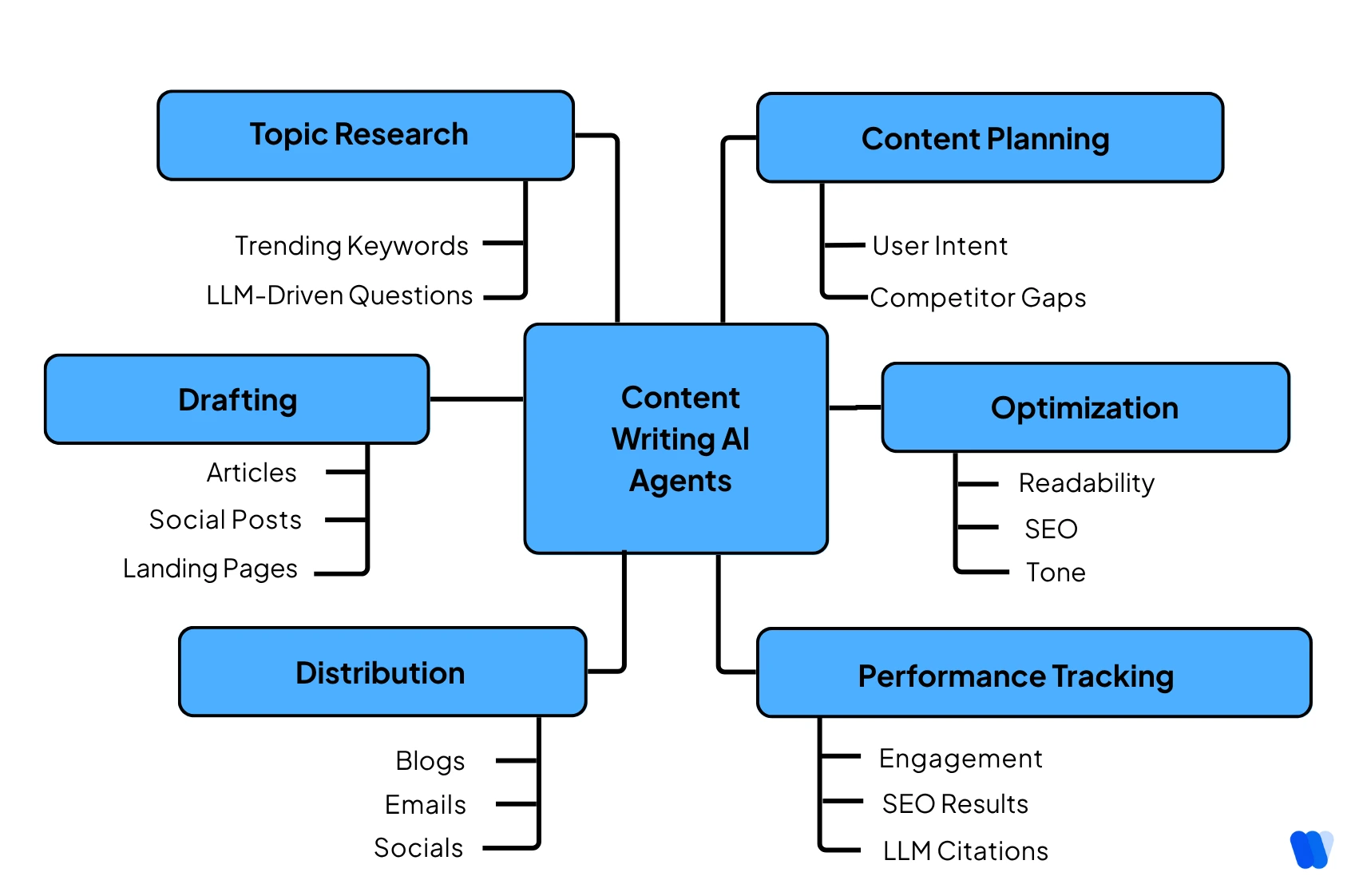
- Topic Research: Identify trending keywords and LLM-driven questions.
- Content Planning: Build outlines based on user intent and competitor gaps.
- Drafting: Write high-quality articles, social posts, landing pages, etc.
- Optimization: Enhance readability, SEO, tone, and LLM citation visibility.
- Distribution: Schedule and publish content across channels (blogs, emails, socials).
- Performance Tracking: Monitor engagement, SEO results, and LLM citations.
Example in Action
Let’s say you run a SaaS blog.
An AI agent might:
- Analyze your target keywords + ChatGPT and Claude query trends.
- Generate a full article optimized for LLMs and SERP.
- A/B test titles and meta descriptions.
- Publish to your CMS and repurpose the article into a LinkedIn post.
- Report back which channel drove the most traffic and what to tweak next.
To see how AI supports broader marketing goals beyond writing—like personalization, planning, and performance—read about the 7 ways AI improves B2B content marketing.
10 Reasons Why Writers Are Turning to AI Agents (And Why You Might Too)
As a writer, you know content creation isn’t always smooth sailing. Between tight deadlines, heavy research, and creative dry spells, it can feel overwhelming. That’s exactly why more and more content creators—from beginners to seasoned pros—are turning to AI agents.
Let’s explore 10 genuine reasons why writers everywhere are adopting these companions for AI content writing.
1. Overcoming Writer’s Block & Generating Ideas
AI agents provide fresh topic ideas, outlines, or starting paragraphs—helping writers break through blank-page paralysis. As noted in creative psychology commentary, AI can spark writer creativity without replacing it
2. Dramatically Faster Research & Drafting
These agents scan vast datasets—web sources, industry articles, competitor content—to summarize facts and draft near-publishable content in minutes, cutting hours from the writing cycle.
3. Consistent High Quality & Brand Voice
AI maintains uniform tone, style, grammar, and readability—even across multiple writers—enhancing credibility and trust in the brand’s voice.
4. Built‑In SEO & Readability Optimization
AI agents recommend keywords, headings, structuring, meta descriptions, and link-building cues—helping content perform better in search engines with less effort.
5. Audience & Competitive Insight
These tools analyze engagement trends, search queries, and competitors to guide topic ideas and formats that actually perform—turning data into actionable strategy.
6. Cost‑Efficiency & Content Scalability
AI agents enable small teams or solo writers to produce more high-quality content without proportional increases in headcount or cost.
7. Fast Editing, Fact‑Checking & Structural Polishing
From language fixes to structural clarity and SEO tagging, agents bundle multiple editing passes into one, automating tedious polishing tasks.
8. Real-Time Performance Feedback & Learning Loops
Many agent platforms track what content attracts views, engagement, and traffic—helping writers adjust tone, headlines, or formats based on empirical insight.
9. Multilingual Capability & Localization
AI agents can translate or recreate content in multiple languages while preserving quality and cultural context, reducing translation bottlenecks.
10. Creative Expansion & Experimentation Support
Writers benefit from AI-powered creativity boosters—branching out formats, trying new angles, and exploring voice variations without losing authenticity. Studies show AI increases novelty in story ideas by ~9%, especially for less naturally creative writers.
What’s the Best AI Agent for Writing SEO Content faster?
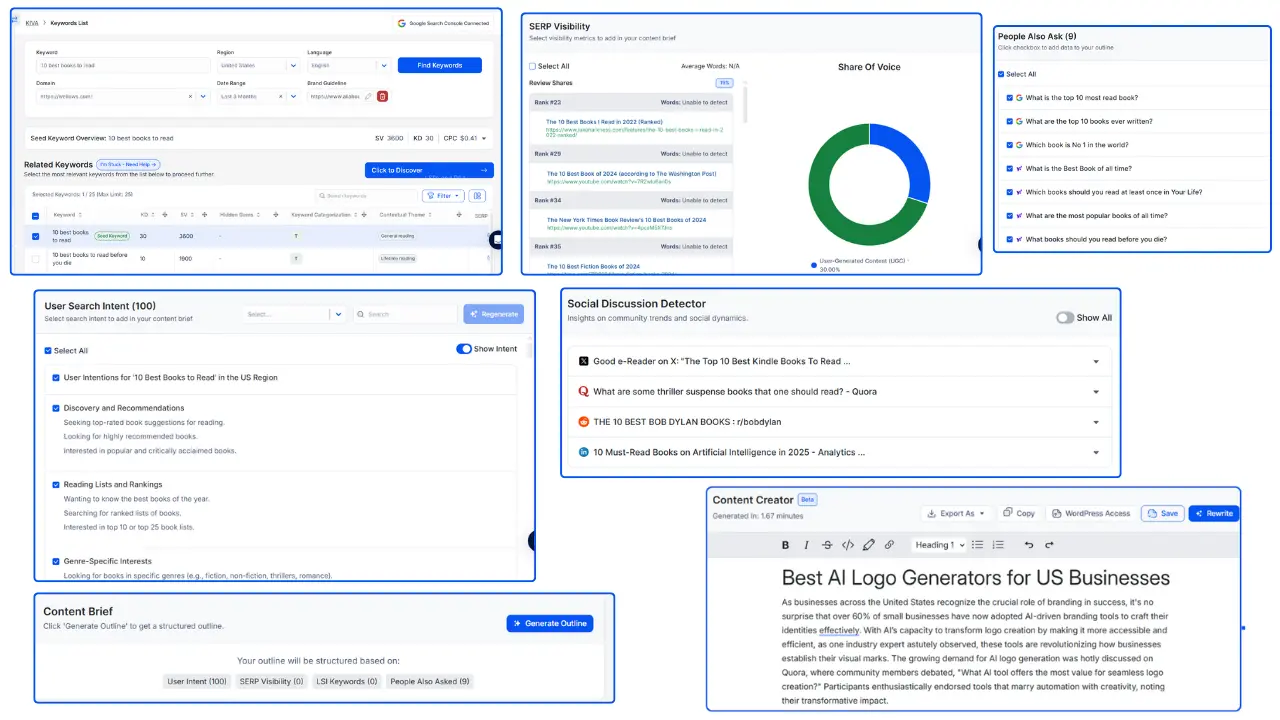
If you’re a writer juggling deadlines, SEO checklists, and brand tone consistency, KIVA might be exactly what you’re looking for.
KIVA is a versatile AI SEO Agent built that connects directly with platforms like Google Search Console and WordPress. It supports the entire content workflow — from search intent analysis and keyword clustering to outline generation, drafting, and even publishing.
But what makes KIVA stand out is how it automates SEO without compromising your unique voice. You can upload brand guidelines (tone, style, formatting rules), and KIVA will generate content that reflects your identity while optimizing for both traditional search engines and LLMs like ChatGPT, Gemini, Claude, and DeepSeek.
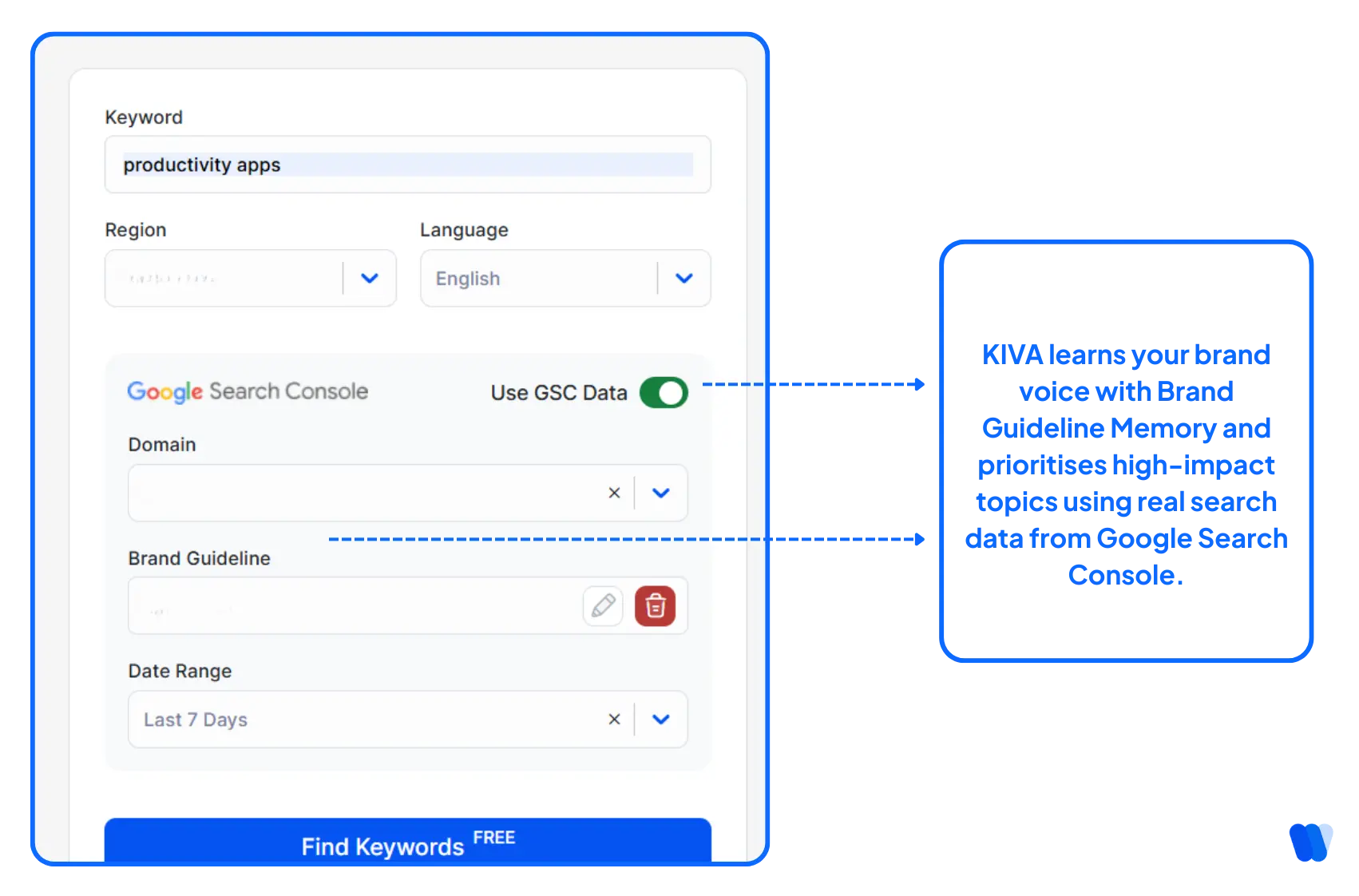
KIVA Features Writers Love:
- GSC-powered insights: Discover high-potential keywords pulled directly from your real search data.
- LLM visibility: KIVA guides query formation and formatting so your content is easier for LLMs to parse and serve in AI-driven results.
- SEO-optimized briefs and drafts: Generate fully structured outlines and full-length drafts in one click — no copy-paste required.
- Enforced brand tone: Upload brand documents or tone guidelines so KIVA writes content that sounds exactly like you, every time.
- Instant WordPress publishing: Skip the CMS copy-over. Publish your final piece to WordPress directly from KIVA’s dashboard.
With KIVA, you don’t just write faster — you write smarter, stay on-brand, and get content live with minimal effort.
Best AI Agents for Content Writing 2025
Here’s a comparison of the eight best AI agents for content writing in 2025, highlighting what each one does best.
| AI Agent | Best For |
| KIVA | AI SEO Agent, optimising content for both Google and LLMs like ChatGPT, Gemini, DeepSeek and Claude. |
| Jasper | Marketing copy and branded blog content |
| Writesonic | Fast drafts and social media posts |
| Copy.ai | Short-Form Content and Ad Campaigns |
| Frase | Research-driven, SEO-optimised articles |
| Anyword | Conversion-oriented ad copy and headlines |
| Taskade AI Writer | Collaborative writing and content planning for teams |
| ContentBot | Product descriptions and email marketing |
What Are the Pros & Cons of Using AI Agents for Content Writing?
Like any tool, AI agents for content writing come with both advantages and limitations. Here’s a balanced look at their pros and cons.
Pros
- Improved Productivity
AI agents handle repetitive tasks such as outlining, keyword research, and formatting, allowing writers to focus on creative work. - Faster Turnaround Time
Writers can produce drafts and optimize content more quickly, meeting tight deadlines without sacrificing quality. - Better SEO Performance
Many AI agents analyze search intent and suggest keywords or structural improvements that help content perform better in search engines. - Data-Driven Insights
By analyzing trends, audience behavior, and competitor content, AI agents help writers create more relevant, targeted pieces. - Consistency Across Content
AI tools help maintain tone, style, and quality across multiple pieces, which is especially valuable for brands with high content volumes. - Supports Creativity
By eliminating the burden of routine tasks, writers can spend more energy on storytelling and original ideas.
Cons
- Over-Reliance Risks
Writers who depend too heavily on AI risk losing their unique voice and creative edge. - Generic Suggestions
Some AI-generated drafts can feel formulaic or lack originality, requiring careful editing and human input. - Accuracy Issues
AI agents may generate incorrect or outdated information if not properly supervised and fact-checked. - SEO Over-Optimization
Excessive focus on keywords and structure can make content feel robotic or unnatural to readers. - Learning Curve
Writers need time to learn how to use AI tools effectively and integrate them into existing workflows. - Cost Considerations
Advanced AI agents with premium features often come with subscription fees, which may not suit every budget.
Read More Articles
- Content Marketing Agencies: A Complete Guide 2026
- Write Content for People First, Not Search Engines
- Top Content Marketing Statistics to Know in 2025 (Including AI Trends)
- LLM Content Creation Strategy
- How to Repurpose Content With AI
- How Small Brands personalized AI content
- 7 Ways AI Improves B2B Content Marketing
FAQs:
Writers use AI agents to save time and stay competitive in a fast-paced content world. They help with research, drafting, and SEO while letting writers focus on creativity. The result is better work in less time.
No, AI agents don’t replace writers. They assist by handling routine tasks and offering helpful suggestions. Writers still shape the story and bring the creative voice.
AI agents cut down time spent on outlines, keyword research, and edits by automating them. Writers can focus on ideas instead of repetitive work. That means meeting deadlines with less stress.
Yes, AI agents help writers align content with search intent and optimize for better visibility. They suggest keywords, structure, and readability improvements while keeping the content human-friendly.
Writers should check for ease of use, SEO features, integration with their workflow, and flexibility to match their tone. A good AI agent feels like part of your team.
Conclusion:
AI agents are changing how writers create by streamlining workflows, improving SEO, and helping them work more efficiently while preserving creativity.
Tools like KIVA show that writers can achieve both speed and originality to meet the high expectations of modern audiences.
These tools are not flawless and still require human oversight, but when used thoughtfully, their benefits far outweigh their limitations.
Writers who embrace AI agents strategically can deliver better work, faster, and remain competitive in an industry that evolves quickly.
Key Takeaways
- AI agents improve writing efficiency by automating routine tasks.
- They help generate data-driven ideas and optimize for SEO.
- Human oversight is essential to maintain originality and accuracy.
- Tools like KIVA integrate seamlessly into publishing workflows.
- Writers who use AI strategically can scale output without sacrificing quality.