Hard-to-read content frustrates users and sabotages SEO performance, with 2025 research showing 73% of users abandon pages within 10 seconds if readability is poor (Semrush, 2025).
Content clarity metrics improvement SEO extends beyond writing standards; it’s an essential piece of the on-page optimization puzzle. If users can’t digest what’s on your page, it doesn’t matter how perfectly you’ve placed your keywords or how fast your site loads.
Whether you’re optimizing for clients or building your own content hub, understanding the connection between SEO and readability helps you improve both rankings and user experience.
Let’s walk through how it works, how to measure it, and how to fix it efficiently.
What is Content Readability in SEO?
Content readability in SEO is the degree to which users can quickly understand your page, driven by sentence length, word choice, structure, and visual formatting. High readability reduces friction, improves engagement, and supports search intent fulfillment—key factors AI systems use when selecting content for AI Overviews optimization.
This is also where AI SEO comes in. In simple terms, what is AI SEO? It’s optimizing content so AI systems can extract, summarize, and cite it accurately—without losing meaning.
These foundations are often described as SEO readability of content or SEO-friendly content readability, both emphasizing clarity that serves users and search engines.
Content accessibility standards refer to how easy it is for someone to consume and understand your content. This includes the words you use, the length of your sentences, the layout of your paragraphs, and how clearly your ideas flow.
In SEO, readability helps:
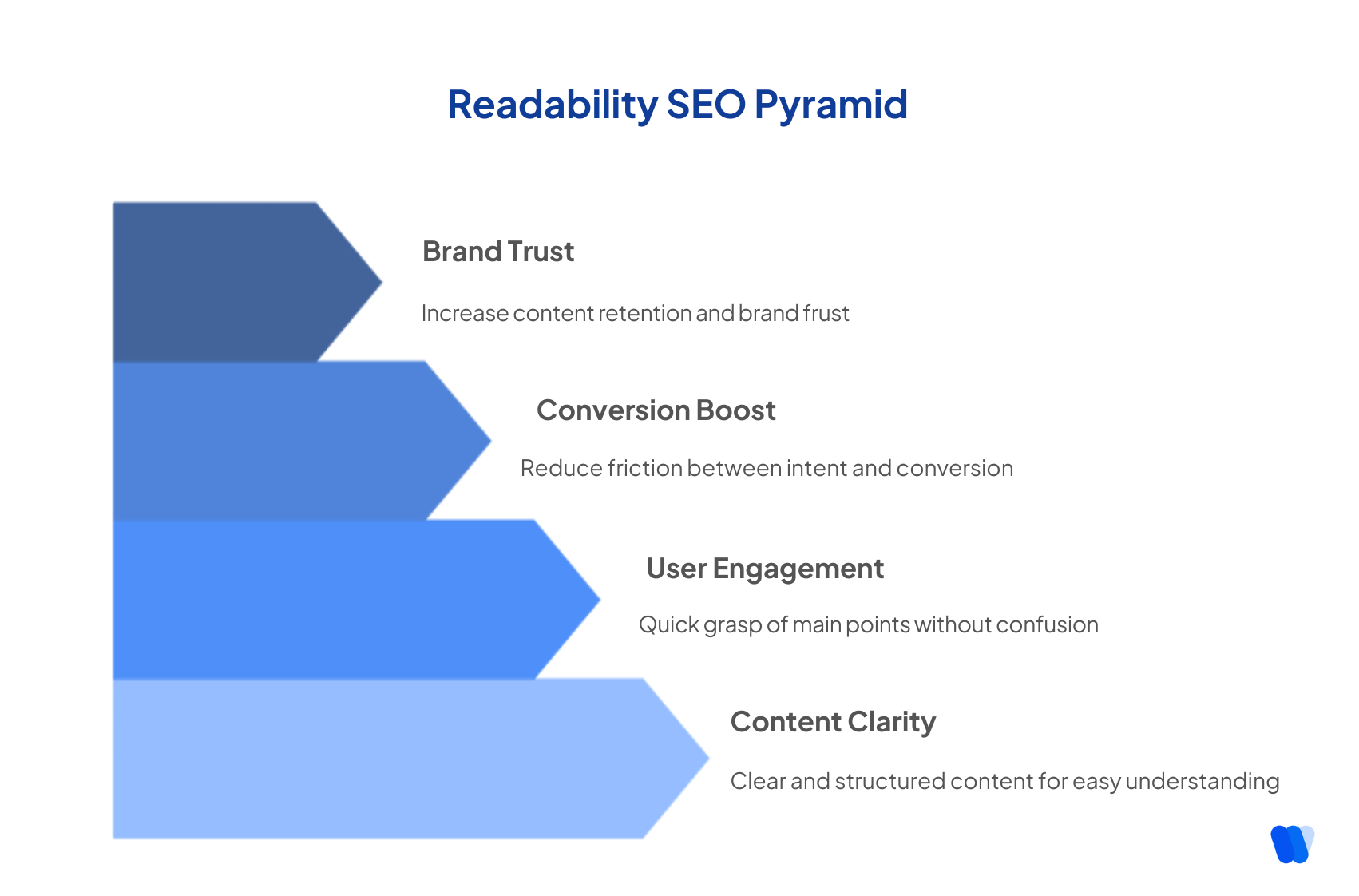
- Users quickly grasp the main points without confusion
- Reduce friction between intent and conversion
- Increase content retention and brand trust
“In short, readability SEO is about making your content clear, structured, and approachable, not only for search engines but for actual people. Understanding this foundation becomes crucial when examining how search algorithms actually process and evaluate content readability signals.
To further enhance readability, especially in AI-assisted drafts, tools like the free AI Humanizer tool by Wellows can help simplify sentence flow and improve clarity before final optimization.
Why Readability Influences Search Engine Rankings?

Is readability a ranking factor? Not directly, according to Google. But here’s what I do know:
● Clear, readable information resources enhance user experience and satisfy search intent faster.
● Well-structured posts (header tags, bullets, short paragraphs) improve scanability and parsing by search engines. The same applies to internal linking; here’s a practical baseline for how many internal links per page to use for SEO without hurting readability.
● Reading difficulty scores improve dwell time, reduce bounce rates, and boost engagement, all of which influence SEO rankings.
● Naturally embedded keywords in readable text help with semantic search and topic relevance.
● Google prefers web page copy with a reading level between Grade 6–9 for featured snippets and voice search responses.
● Readable content increases accessibility, making it more inclusive for a global and diverse audience.
Bottom line? Write for the user, and the search engines will follow. Other visibility issues, like content cannibalization, can also hold back rankings when multiple pages compete for the same keyword.
As SEO evolves into answer engine visibility, GEO KPIs, like AI citation rates, content snippet extraction, and format alignment, are becoming just as important as traditional rankings and click-through rates.
To see whether clearer writing is increasing citations, use the best AI visibility tools in 2026 to monitor AI Overviews inclusion and citation lift over time.
How Search Algorithms Process Content Readability Signals?
There’s a bit of a myth floating around that readability is a confirmed search engine ranking factor. While readability itself doesn’t directly affect SEO in terms of a measurable score impacting rankings, it plays a crucial role in user engagement. To better understand where readability fits, it helps to know what SERPs are and how they display content to users.
By focusing on readability content improvement for SEO, you enhance user experience, which results in better engagement metrics like longer dwell time, lower bounce rates, and more meaningful interactions.
These metrics are signals search engines use to assess the quality of your content, ultimately helping to improve search engine visibility over time and reducing the risk of content decay caused by declining CTR, impressions, and rankings when users don’t stick around.
“From an SEO point of view, readability itself isn’t a direct ranking factor. We don’t try to figure out the reading level of the text on a page.”
Google has also mentioned explicitly that it doesn’t use readability scores like Flesch Reading Ease as direct ranking signals. But here’s the catch—it doesn’t have to.
“If you write content that’s hard to understand, then it’s going to be harder for people to stay and read. Lower user engagement can indirectly affect your ranking over time.”
Search engines rely on indirect signals to evaluate whether your content truly satisfies the user:
- Dwell time: How long someone stays on the page
- Bounce rate: Whether they leave immediately
- Pogo-sticking: When someone clicks your result, doesn’t find it helpful, and clicks back to try another
“Ultimately, content readability impacts user experience, and user experience is a signal Google cares about. Indirectly, readability can influence ranking.”
Poorly structured or overly complex content quickly triggers these negative signals. Google’s BERT (Bidirectional Encoder Representations from Transformers) and MUM (Multitask Unified Model) algorithms, are designed to better understand natural language; clarity, context, and intent are now more crucial than ever.
“It’s not about making your content overly simplistic; it’s about matching the reading level of your content to your audience’s expectations and needs.”
In short, SEO and readability go hand in hand. If users can’t follow your content, search engines won’t prioritize it because it’s simply not serving the user’s intent effectively. These readability methods align with generative engine optimization. AI models prioritize clear content—reinforcing how to use AI for summarizing articles so summaries remain citation-worthy instead of overly compressed.
Pairing this with content research with AI helps you discover readability trends across SERPs and identify linguistic structures preferred by AI-driven ranking systems.
What Readability Metrics Drive SEO Success?
I’ve used multiple tools over the years, and while each offers slightly different features, the core readability signals remain consistent.
Here’s a breakdown of the main metrics you should care about:
| Metric | What It Measures | Ideal Range |
|---|---|---|
| Flesch Reading Ease | Sentence length + word syllables | 60–70 (general web) |
| Grade Level (Flesch-Kincaid) | U.S. school grades required to understand the content | 7th–9th grade |
| Average Sentence Length | Clarity through brevity | Under 20 words |
| Passive Voice Usage | More direct, engaging writing | Under 10% preferred |
| Subheading Frequency | Breaks up content into digestible parts | 1 per 300 words |
| Paragraph Length | Affects scannability, especially on mobile | 2–4 lines |
Most SEO readability checkers, such as Yoast, Screaming Frog, Sitebulb, and Semrush, include these metrics as part of their analysis.
Modern platform like an AI Search Visibility Platform for Startups also integrate these insights, helping content teams identify clarity issues, improve structure, and meet best practices without relying on guesswork.
So, how important is readability to SEO? It’s incredibly important. Digital text assets that are easy to read and navigate keeps users engaged, reducing bounce rates and encouraging them to spend more time on your page.
This user engagement, in turn, sends positive signals to search engines —and helps you detect SEO content decay early when those signals start to weaken.
By tracking SEO readability alongside other on-page factors and how to use AI to gind content gaps, SEO professionals can ensure each piece is both user-friendly and algorithm-aware.
Readability measurement connects to content performance analytics. Engagement metrics validate optimization decisions across search and AI platforms. When those signals are tracked consistently, AI SEO content optimization becomes a smarter way to turn readability data into practical on-page improvements.
While these readability metrics provide optimization targets, they work most effectively when integrated with broader technical SEO strategies.
How Readability Complements Technical SEO Elements?
You may wonder how readability SEO compares to traditional technical factors and broader Technical SEO Issues. The answer they work best together. Here’s a comparison:
| SEO Factor | Purpose | How SEO Readability Complements It |
|---|---|---|
| Page Speed | Delivers content quickly | Ensures content is easy to consume once delivered |
| Mobile-Friendliness | Responsive layout | Prevents large text blocks from harming UX |
| Crawlability | Allows Google to access content | Clear content structure aids understanding |
| Structured Data | Enhances how content appears in SERPs | Clear content improves engagement after the click |
So while structured data gets the click, SEO readability keeps the user engaged. A subtle but critical part of optimizing for rankings and relevance.
Why Content Structure Optimization Improves SEO Results?
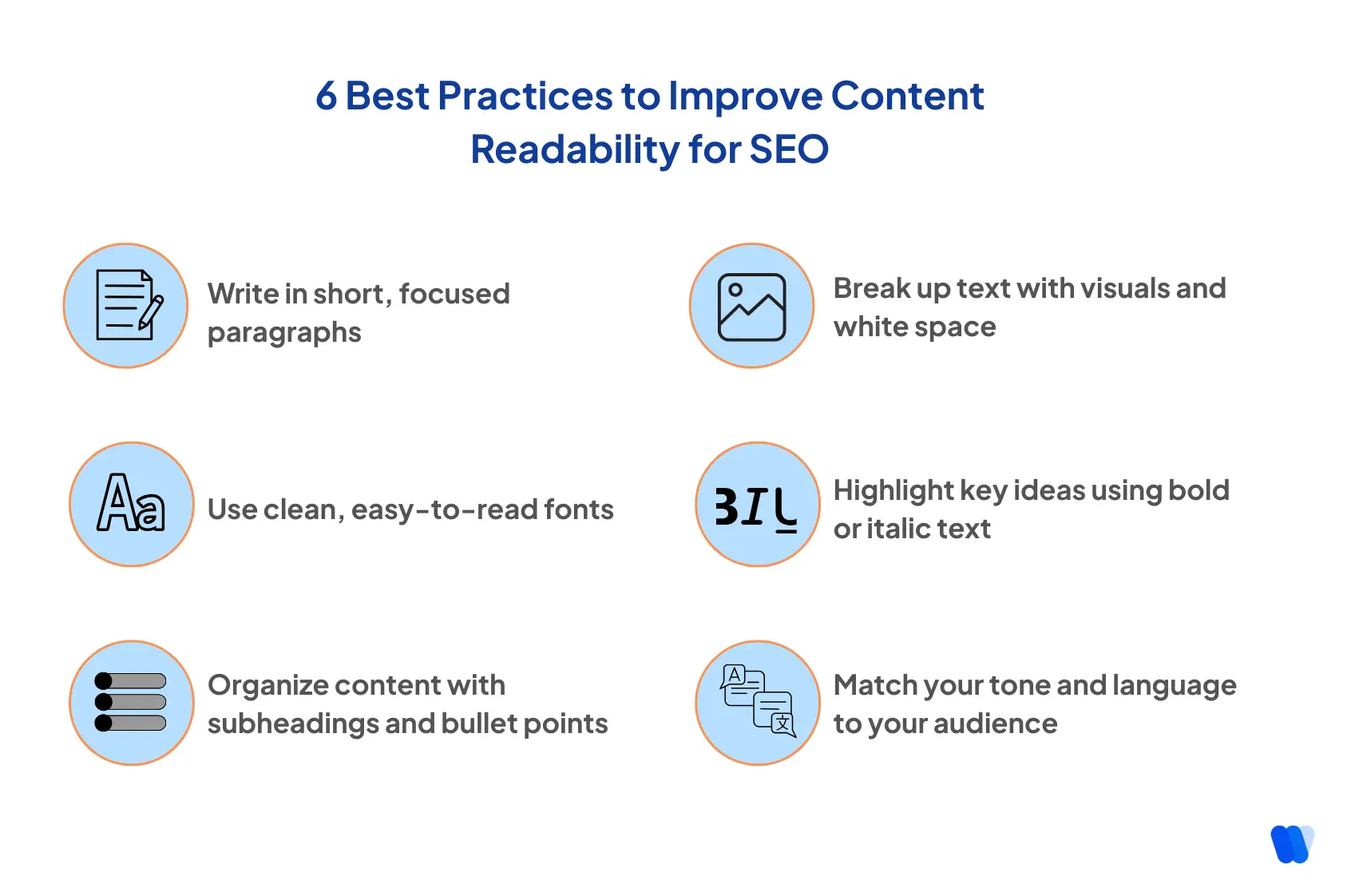
Improving readability in SEO doesn’t require rewriting everything. Here’s what I look for when doing a content pass, especially when aiming to increase SEO readability score without sacrificing substance:
Sentence Structure Controls Reading Flow
- Use short sentences—15–20 words max
- Keep paragraphs to 2–4 lines
- Mix up sentence lengths to improve rhythm
Word Selection Determines Content Clarity
- Prefer common words over jargon
- Avoid filler phrases and redundant modifiers
- Replace long words where simpler ones that work
Active Voice Construction Improves Engagement
- “We created the strategy” is clearer than “The strategy was created.”
Content Formatting Enhances Scannability
- Use subheadings to break content into sections
- Add bullet points or tables for clarity
- Highlight key takeaways or quotes
Platforms such as KIVA AI SEO Agent assist in structuring briefs with optimal heading density, paragraph length, and formatting suggestions to match both SEO and user experience standards.
Visual Design Elements Support Content Accessibility
- Use legible font sizes
- Maintain enough line spacing
- Avoid large walls of text, especially on mobile
These practices don’t just improve readability score, they make your content more effective across all stages of SEO and UX. A detailed blog posting checklist can help ensure structure, design, and SEO best practices are consistently applied.
If you’re scaling content across multiple formats or deadlines, here are 5 tips to triple content output using AI writing assistants that can help you produce high-quality drafts without compromising readability. These optimization strategies support comprehensive SEO workflows. Content clarity enhances both search visibility and AI comprehension.
FAQs
Break up long sentences, use active voice, and keep paragraphs short (2–4 lines). Add subheadings, bullet points, and visuals for scannability. Replace jargon with clear language to make content more accessible to both users and search engines.
Readable content reduces cognitive load, improves mobile scanning, and aligns with how modern search and AI systems measure usefulness. Clear content keeps users engaged longer, sending positive signals to search engines.
While not a direct ranking factor, readability improves engagement metrics like dwell time and bounce rate. Pages that are easier to read satisfy intent faster, making them more likely to appear in featured snippets and maintain strong visibility.
Use short sentences (15–20 words), simple vocabulary, and active voice. Structure content with headings, lists, and visuals. Keep paragraphs concise and ensure smooth flow from one idea to the next.
Content readability in SEO is the ease with which users can consume and understand a page. It covers sentence structure, vocabulary choice, formatting, and overall flow, ensuring content works for both readers and search engines.
Readability is commonly measured using metrics like Flesch Reading Ease, Flesch–Kincaid Grade Level, average sentence length, passive voice percentage, and subheading frequency. These metrics align with user comprehension and scannability.
Not as a standalone ranking factor. However, readability indirectly influences SEO through engagement signals—time on page, pogo-sticking, and bounce rates—that search engines use to assess content quality.
Read More Articles
If you’re focused on elevating your content game, here are some related reads:
- Content Marketing Agencies: A Complete Guide 2026
- Write Content for People First, Not Search Engines
- Understanding Readability Score in AI Content
- Top Content Marketing Statistics to Know in 2025
- What is AI content?
- LLM Content Creation Strategy
- What GEO Means for Future SEO Workflows
- Long-Form vs. Short-Form Content
Conclusion
It’s easy to overlook readability when you’re deep in sitemaps, meta tags, and Core Web Vitals. But in my experience, the content that performs best is the content that’s understood quickly, clearly, and confidently.
Optimizing for readability SEO doesn’t mean watering things down. It means respecting your reader’s time, aligning your message with their intent, and making your content accessible across devices and attention spans.
With AI tools for SEO, improving readability becomes part of your standard SEO process, not a separate task. That alignment is where SEO starts working smarter, not just harder.