Most people think SEO is just about ranking on Google.
But what if your audience isn’t searching from the same place as you?
Someone typing “best coffee near me” in New York will get very different results from someone searching the same thing in Karachi. That’s where GEO research matters — it’s about understanding where your audience is and what they care about locally.
Now combine that with SEO and a bit of AI, and you can uncover ideas, trends, and opportunities that normal keyword tools often miss.
I’ve been testing this process with KIVA— an AI SEO agent from Wellows, an AI search visibility platform that helps me go from raw data to ready content. What used to take me hours of searching, sorting, and guessing now takes minutes.
Let me show you the simple 4-step process I use for GEO + SEO content research with AI.
Step 1: Finding GEO Keywords and Topics
The first step is about understanding local search behavior. Most SEO tools focus on global data, but people in different cities or countries often search differently — even when they mean the same thing.
For example, in the U.S., people might search “AI writing tools,” while in India, they might say “best AI content generator.” Small changes like this can make a big difference.
How I usually start
1. Add place names to my seed keywords
I start by adding the name of a city, state, or country to my main keywords.
For example:
-
“SEO agency in Dubai”
-
“AI tools for small businesses in Canada”
-
“digital marketing courses Karachi”
This helps me see which topics actually matter in that location.
2. Check regional trends
I use Google Trends and set the region filter to find out what’s picking up locally. You’d be surprised how often certain keywords trend in one place but not another.
3. Look at real conversations
Forums like Reddit and Quora are great for seeing what people actually say. Locals often use different slang or phrasing that never appears in keyword tools.
4. Search for hidden, low-competition ideas
I like to find keywords that don’t have huge search volume but are easy to rank for. Those small, specific terms often bring better-quality traffic— and using AI makes it easier to find hidden content gaps that your competitors overlook.
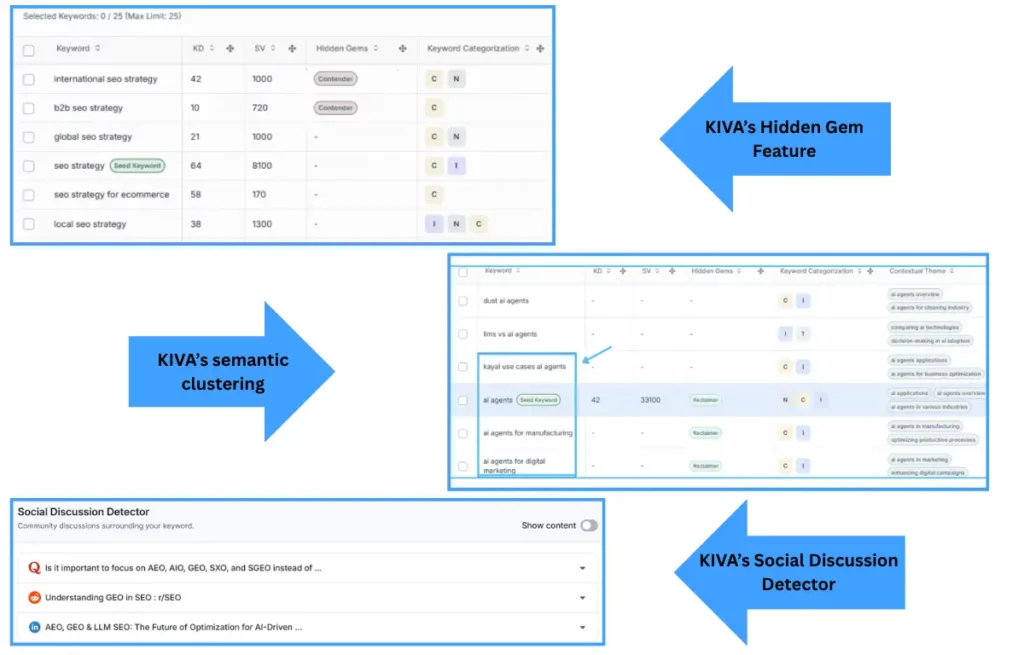
The Hidden Gems feature in KIVA does exactly what the name says — it scans my Google Search Console data and finds keywords that I already appear for but haven’t optimized yet.
It also groups related keywords automatically using semantic clustering, which means I can see what topics connect naturally instead of dealing with long lists of random words.
And when I want to know what people are saying online, I use KIVA’s Social Discussion Detector. It pulls insights from Reddit, Quora, and other platforms so I can spot patterns and questions people keep repeating — especially from specific regions.
By the end of this step, I usually have a clear list of topics that make sense for the audience I actually want to reach.
Step 2: Understanding Search Intent and Competition
Once I’ve got my keywords, I move on to understanding why people search them and what type of content already ranks.
Not every searcher wants the same thing. Some are looking for information, some want to buy, and others just want directions or contact details. Understanding this is key to building a stronger AI content marketing workflow that aligns with intent and audience goals.
Here’s how I usually break it down:
- Informational: “How does AI help with SEO?”
- Transactional: “Buy SEO tools online”
- Local: “SEO agency near me”
Knowing the intent helps me decide what kind of content to make. For instance, an informational query might need a blog post, while a local one needs a landing page with address details and a map.
What I look for on the SERP
Before creating anything, I search my main keywords on Google. Then I note what kind of results come up:
-
Are blogs dominating the first page?
-
Do I see listicles, videos, or guides?
-
Are there People Also Ask (PAA) boxes?
-
Which websites show up again and again?
Doing this manually for every keyword is tiring, but this is where AI comes in.
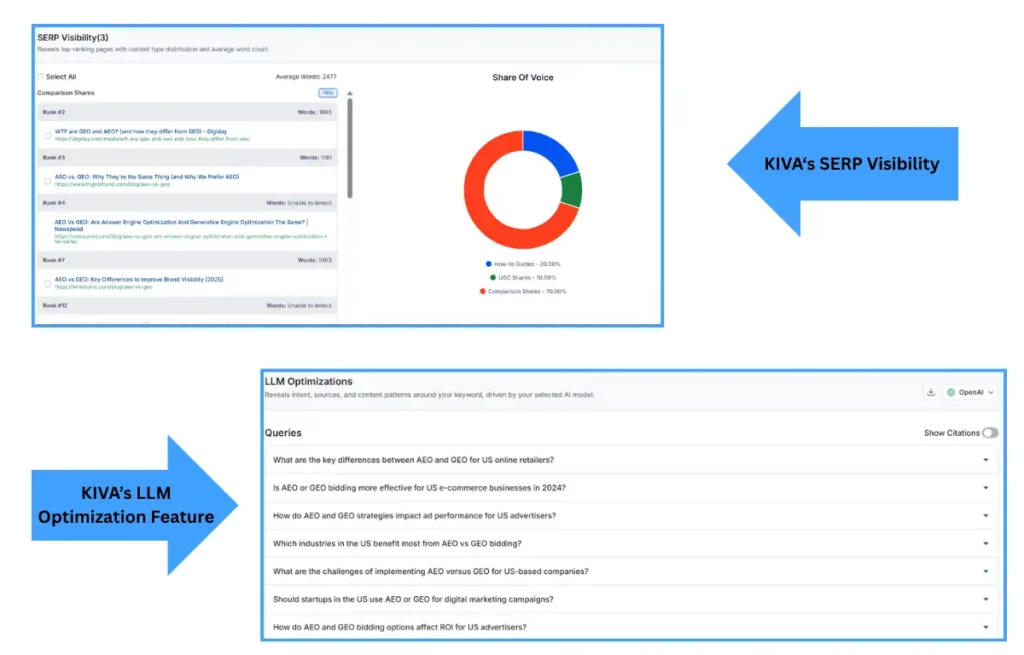
KIVA’s SERP Visibility feature saves me a lot of time. It shows which websites rank, how they structure their content, and what they’re doing right. It even breaks down page types — whether they’re blogs, eCommerce pages, or landing pages.
It also checks how AI chatbots like ChatGPT and Gemini interpret the same keyword. This is called LLM Visibility— a concept central to LLM content creation strategies, which help you understand how AI models perceive and prioritize online content. It helps me see which sites are being mentioned by AI tools and which ones aren’t.
That’s really important now. Because AI tools often pull answers from the top sites, knowing where your brand shows up (or doesn’t) tells you a lot about your online visibility beyond Google.
At this point, I usually have a good idea of:
- What people want when they search
- Which formats perform best
- Who my real competition is — both on search and AI tools
Step 3: Turning Research into a Content Plan
Now that I understand what people search and why, I move on to structuring the content.
A lot of writers skip this step and jump straight to drafting, but I’ve learned that a clear outline saves a ton of time later.
What goes into a good brief
When I prepare a content brief, I include:
- The main keyword and goal (traffic, sales, awareness, etc.)
- Suggested H1, H2, and H3 headings
- Related questions (from People Also Ask or Reddit)
- Semantic terms — related words search engines use to understand the topic
- Notes on tone and local focus
I often write the first draft of this brief myself, then use AI to refine it — especially for structure and related terms.
If you’re building one yourself, here’s a detailed guide on how to create an AI content brief that saves time while keeping your structure SEO-friendly.
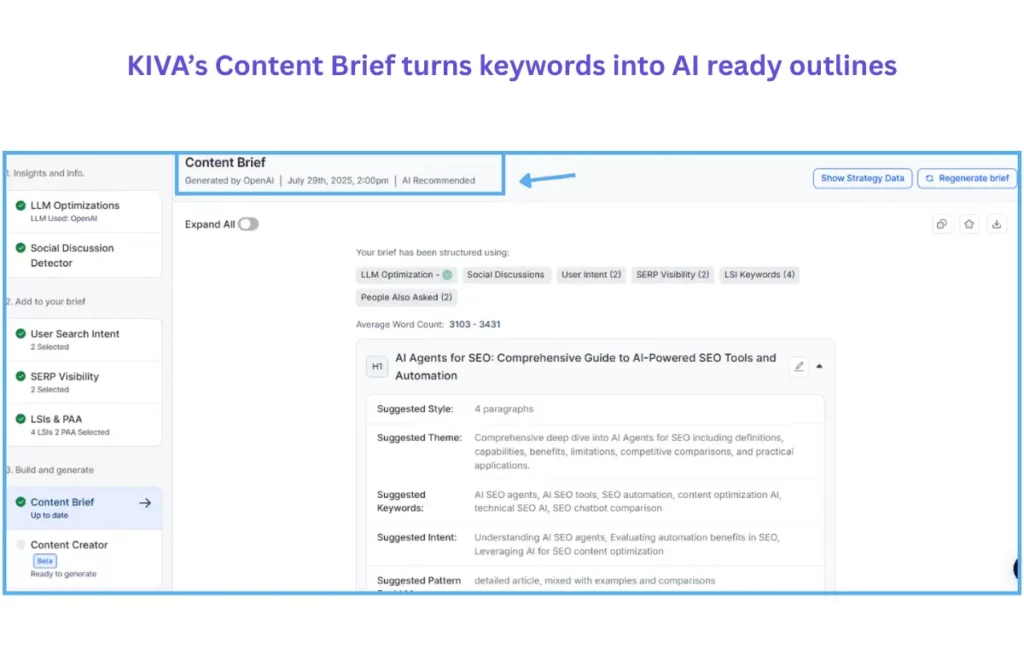
The Content Brief feature in KIVA does most of this automatically. It takes all the research — keywords, SERP data, LLM insights, and social trends — and creates a ready-to-use outline.
The best part is how detailed it gets. It includes headings, subtopics, recommended FAQs, and even notes on how top-ranking pages present information.
For me, this turns hours of research into minutes. Instead of switching between multiple tools, I get everything in one place — clean, practical, and backed by real data.
Once I approve the brief, I know exactly what to write and how to make it work for both SEO and readers.
Step 4: Writing, Editing, and Publishing
The last step is actually writing the content.
This is where AI can be helpful, but I never let it write the full article on its own. AI is good at structure and ideas, but you still need a human voice to make it sound real. Striking the right balance between AI vs. human writing keeps the content authentic and engaging.
My writing routine
-
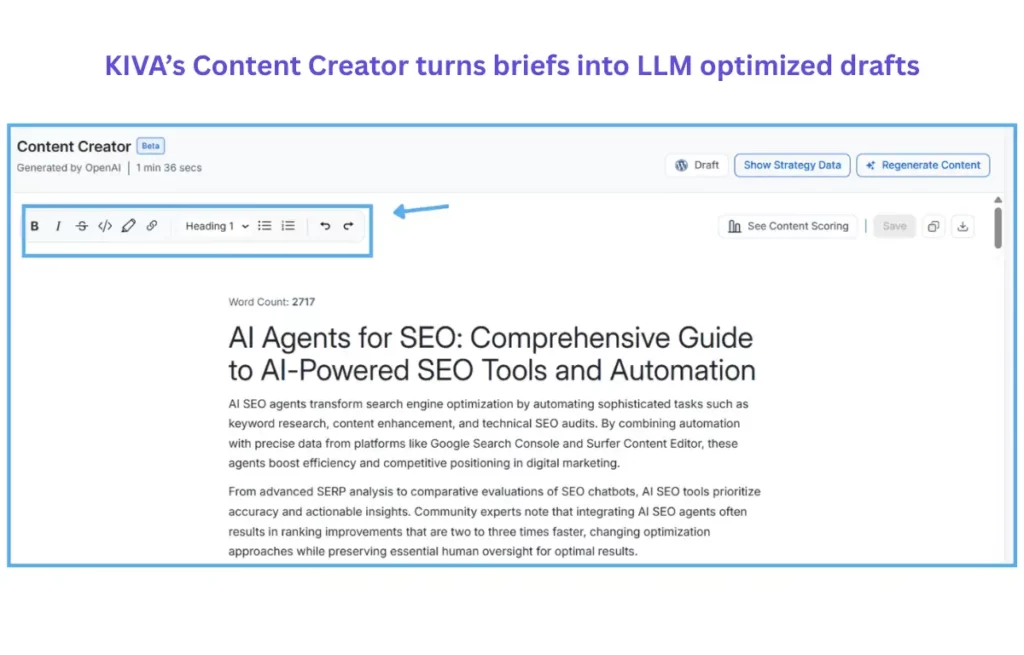
I open my KIVA brief and ask the AI to draft sections based on the headings.
-
Then I go through it line by line — rewriting, adding examples, and removing anything that sounds robotic.
-
I make sure the tone matches the audience and that the brand message stays consistent across versions — a principle I follow from aligning AI to brand voice. For local content, I mention real places, situations, or examples that people in that area relate to.
Checking and improving the draft
Once I have a complete draft, I check it for clarity and flow. AI tools can fix grammar, but I always read everything myself to make sure it sounds right.
Maintaining a strong content readability in SEO focus ensures the text is both easy to read and optimized for ranking.
KIVA’s Content Creator and Scoring tools are a big help here. They check SEO basics like headings, readability, and keyword balance without over-optimizing.
If a paragraph feels too stiff or too long, I use the “Tell AI” feature to quickly reword it. It’s like having a built-in editor that understands the tone I want.
Publishing and tracking results
When the content is ready, I can export it directly to WordPress through KIVA. From there, I track how it performs using Google Search Console.
If a post starts ranking in one region, I often use the same outline to make local versions for other cities. For example, if “AI tools in Dubai” does well, I’ll create “AI tools in Singapore” or “AI tools in London” using the same structure but localized examples.
This method works especially well when you repurpose content with AI to expand regional reach without starting from scratch.
That’s how I build regional content at scale — one solid framework, many local variations.
Putting It All Together
Here’s what the full process looks like:
| Step | Focus | What KIVA Does |
|---|---|---|
| 1 | Find GEO keywords | Hidden Gems, Keyword Clustering, Social Detector |
| 2 | Understand intent & SERPs | SERP Visibility, LLM Visibility |
| 3 | Create content plans | Content Brief, PAA, Semantic Terms |
| 4 | Write & optimize | Content Creator, Tell AI, Scoring, Export |
This workflow turns SEO research from guesswork into a repeatable, data-based routine. More importantly, it keeps your content relevant to both local audiences and modern AI tools.
Why GEO + SEO with AI Works
Search engines are getting smarter, but they still depend on relevance — and relevance often starts with location. AI takes that a step further by helping you see patterns humans miss: conversations, long-tail queries, and intent shifts across regions.
When you combine GEO data, SEO research, and AI insights, you don’t just rank better — you understand your audience better.
KIVA has helped me simplify this process. Instead of juggling five different tools, I now handle everything from keyword discovery to publishing in one dashboard. It’s faster, cleaner, and leaves me more time to actually write.
Final Thoughts
Good SEO today isn’t just about stuffing keywords or writing 2,000 words of fluff. It’s about knowing who’s searching, where they’re searching from, and what they expect to find.
AI doesn’t replace that — it simply makes it easier to connect the dots.
If you want to try this yourself, start small: pick one region, one main topic, and run it through the 4 steps — discover, analyze, plan, and write.
And if you want to make the process smoother, give KIVA a try. It’s built exactly for this kind of research — turning data into clear, actionable insights.
The goal isn’t just to get more traffic. It’s to create content that feels relevant wherever your audience is — and that’s what good GEO + SEO research with AI is all about.