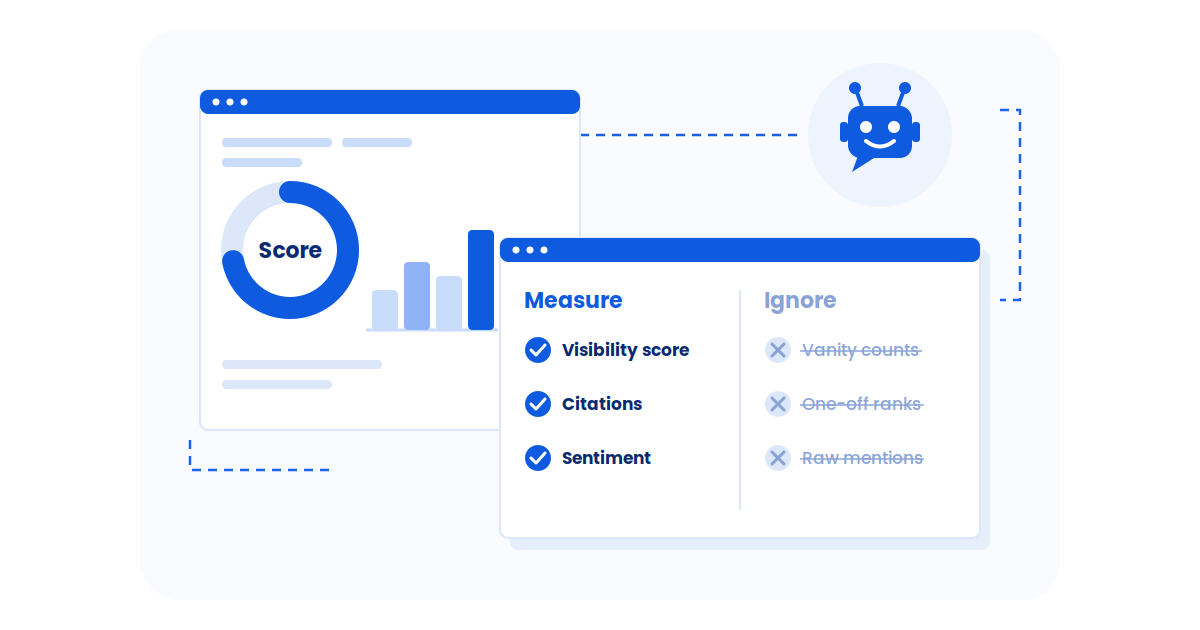
AI search visibility for aviation and airline brands is now shaping how travelers find and trust airlines. Instead of Google, people ask ChatGPT, Gemini, or Perplexity which airline offers the best comfort or flight deals.
Most airlines don’t know whether they appear in those AI answers. Traditional SEO can’t track citations inside LLM results — a gap that Generative Engine Optimization (GEO) helps bridge by structuring data for visibility inside AI-driven results.
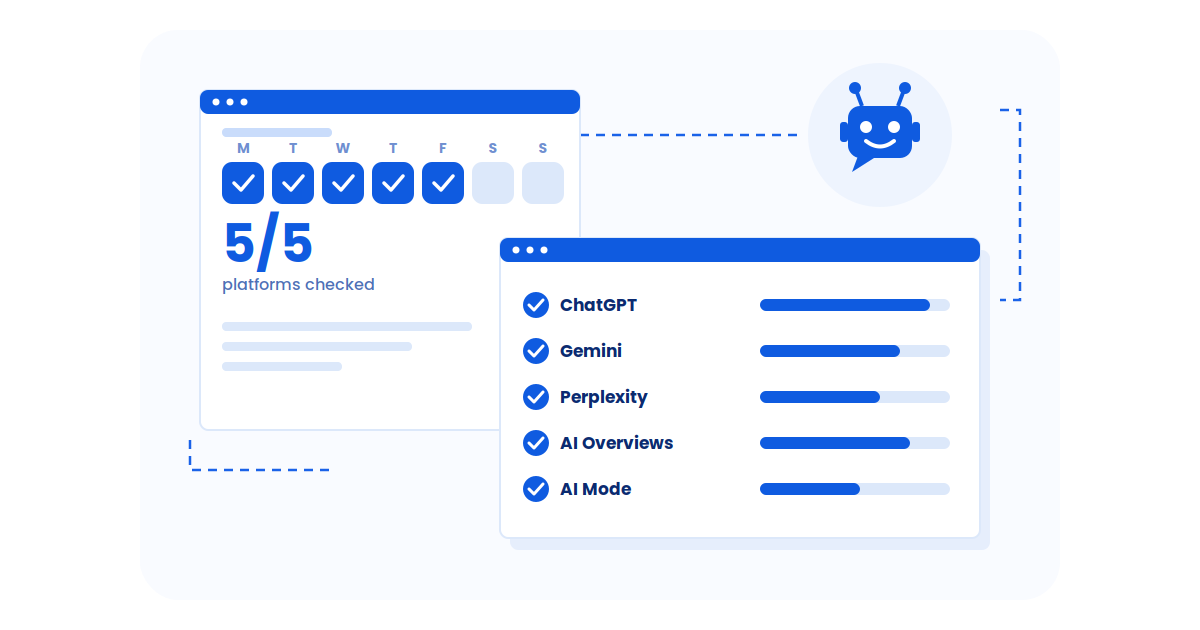
Wellows monitors where airline brands are mentioned across AI platforms, identifying both credited and uncredited mentions to show their true presence across generative engines.
Generative AI already influences how flights are researched and booked — about 40% of global travelers use AI for trip planning (Mindful Ecotourism, 2025). To understand how these patterns evolve, explore GEO statistics and trends shaping 2025’s visibility landscape.
If your brand isn’t part of AI answers, you’re invisible to tomorrow’s traveler.
What Is AI Search Visibility for Aviation & Airline Brands?
AI search visibility for aviation & airline brands shows how often and how prominently an airline appears in answers from ChatGPT, Google’s SGE, Bing Chat, or voice assistants. It’s the AI-era version of SEO visibility except instead of ranking links, it’s about being mentioned or cited in AI-generated responses.
As travelers now ask AI for flight options, airline reviews, or travel tips, appearing in those answers is as crucial as ranking on Google once was. This shift defines Generative Engine Optimization (GEO) optimizing airline content so AI systems can read, interpret, and recommend it.
In short, Search Engine Visibility ensures that when someone asks an AI, “Which airline is best for X?”, your brand confidently appears in the answer.
Current State of AI Search Visibility in Aviation
Market leaders dominate: Major U.S. carriers like United, Delta, and American account for over 60% of all airline mentions in AI-generated travel content, underscoring the visibility advantage of established brands with structured data and high domain authority (Wellows, 2025).
Regional and low-cost airlines lag behind: Emerging carriers show limited AI presence—most record under 10% citation share, reflecting weaker online coverage and fewer structured data integrations across LLMs.
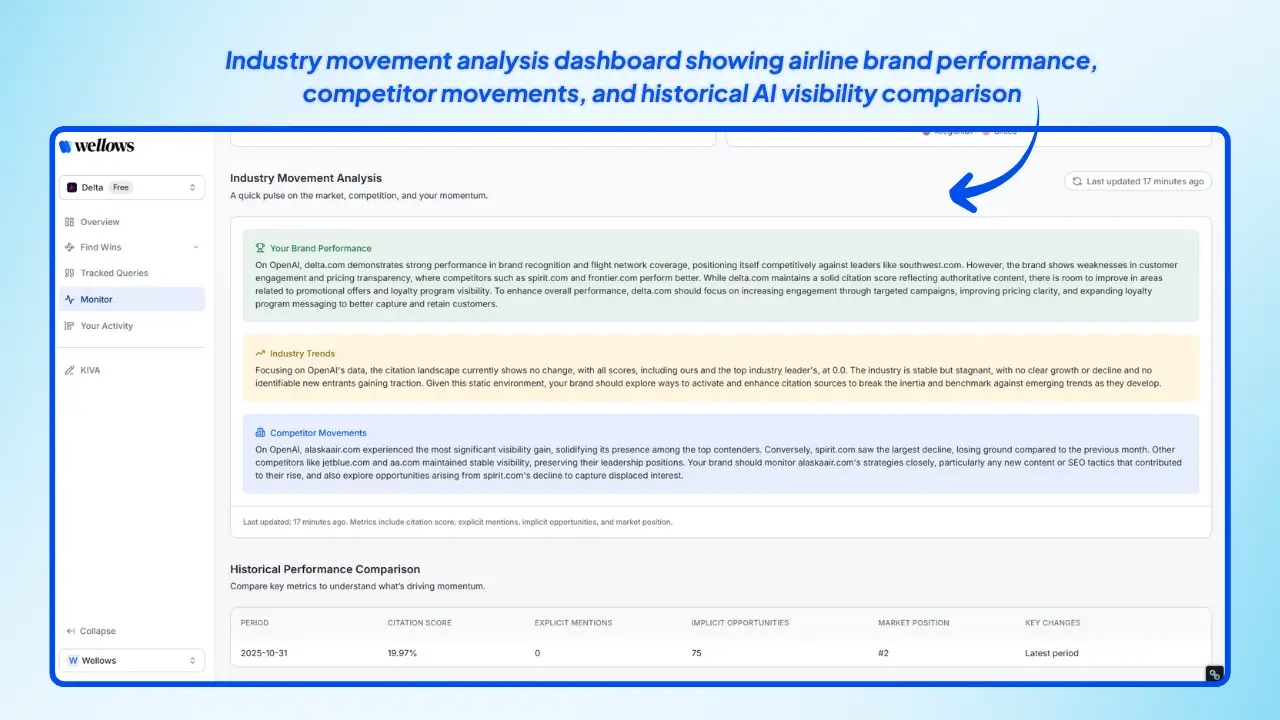
Category insight: Delta ranks second overall with a 19.97% citation score and 75 implicit citations, trailing only United Airlines (0.421). Sentiment trends remain largely neutral, with 25% positive and 9% negative tone across AI responses (Wellows, 2025).
💡 Insight: Airlines that maintain transparent service data, updated route information, and consistent brand communication secure stronger visibility in AI-driven travel queries.
How Can Aviation & Airline Brands Improve AI Search Visibility?
AI search is transforming how travelers find and compare flights. People now ask ChatGPT which airline offers the best safety record or use Google’s AI mode to compare in-flight features. To stay visible, aviation brands must adapt to these new discovery channels.
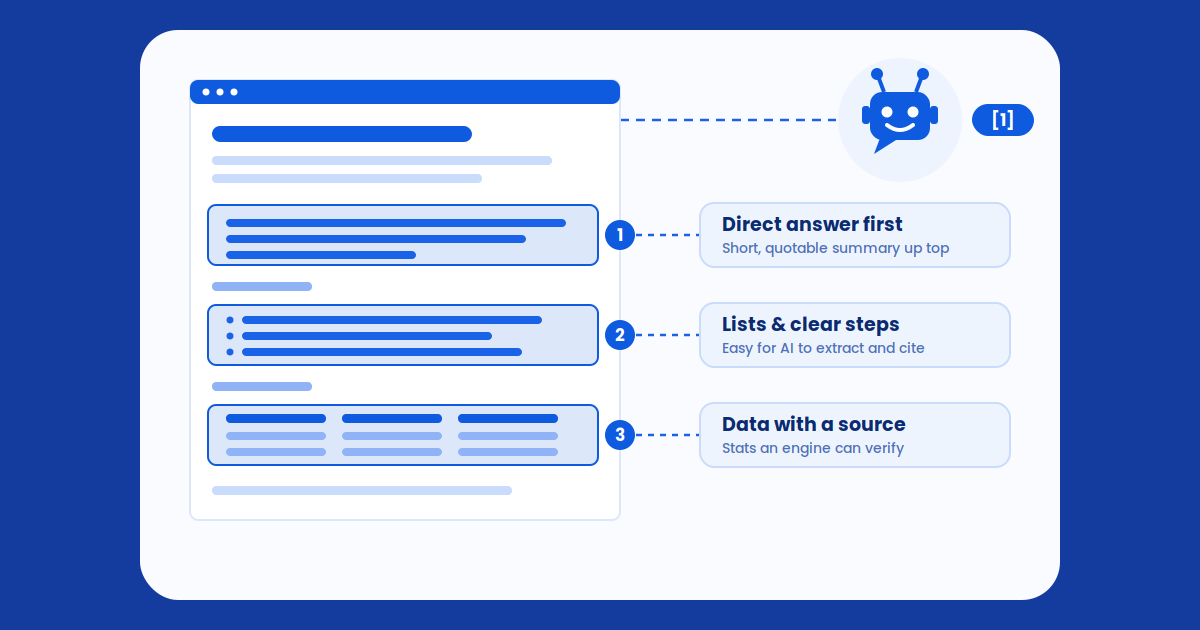
Use Generative Engine Optimization (GEO): Treat AI assistants as a search platform. GEO structures key data like fleet details, routes, and policies so AI systems can interpret and cite them accurately. Well-organized information improves your chances of being mentioned in AI-generated responses.
Add structured data: Apply schema markup for routes, pricing, and FAQs. Pages with clear structured data are 36% more likely to appear in AI summaries (VentureBeat, 2025). For airlines, schema ensures schedules, reviews, and amenities are machine-readable. See how structured data strengthens LLM visibility to improve AI citation accuracy.
Make listings smarter: Keep Google Business Profiles, Wikipedia entries, and directory data complete and consistent. AI tools rely on verified brand-managed details like NAP (Name, Address, Phone) (Yext, 2025). Updated public data reinforces trust and accuracy across generative engines.
Earn mentions from trusted sources: Recognition from IATA, Skytrax, or reputable travel publishers increases visibility. AI systems prioritize information from authoritative sources. A single expert mention can improve your AI visibility, and LLM citation tracking helps you measure its impact even without backlinks.
Create short, helpful videos: Produce quick explainer clips—like “How to upgrade seats” or “Top travel hacks.” YouTube visibility within AI summaries rose 25% since 2024 (BrightEdge, 2025). Visual and multimodal content improve how AI engines interpret video and image signals.
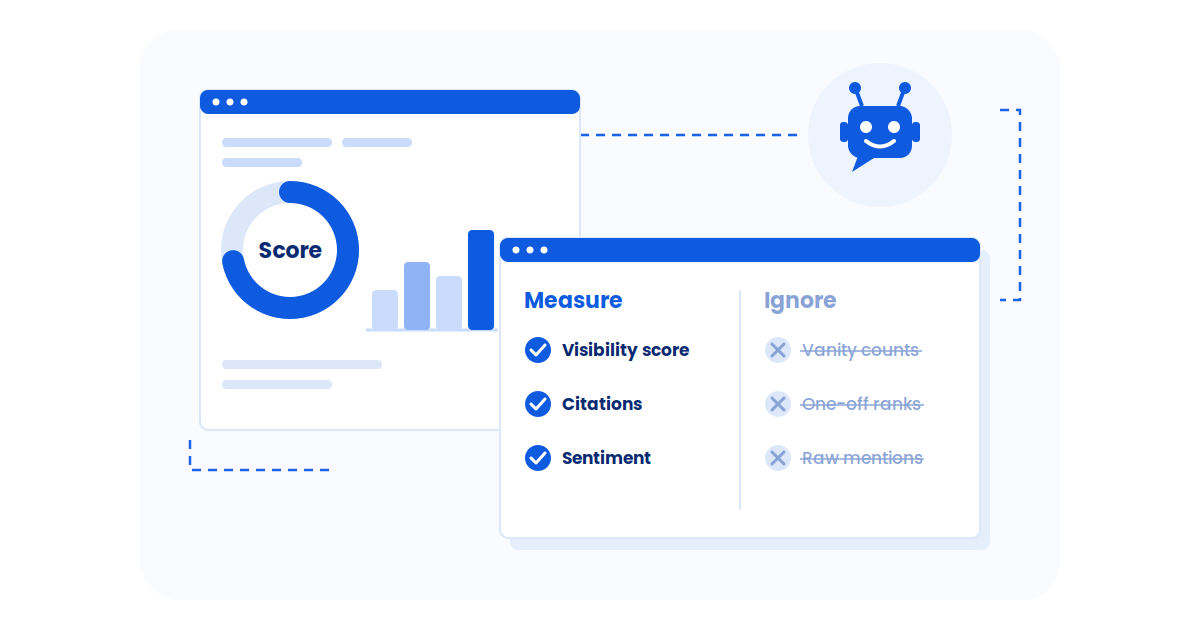
Track AI mentions: Use visibility tools to monitor where your airline appears in AI-generated answers. Identifying which queries feature your brand—or where competitors dominate—helps refine strategy. A quick AI visibility audit can reveal missed opportunities before they impact search share.
Match real AI queries: Identify the traveler prompts AIs respond to, such as “Which airline has the best legroom?” or “Best airline for families.” Crafting focused, intent-driven content improves your chances of being cited in AI recommendations.
Use AI-driven PR: Publish data-led stories and engage travel journalists. Positive coverage in authoritative outlets boosts both credibility and AI recognition. Pair your PR strategy with digital PR for AI visibility to convert mentions into lasting citations.
Compare and refine: Benchmark your visibility against competitors. If rivals lead for “best loyalty programs” or “on-time performance,” strengthen topic coverage and apply AI visibility enhancement techniques to close the gap.
Stay ahead of trends: Track how AI search evolves. If new updates emphasize sustainability or traveler reviews, integrate those topics early. Combining SEO insights with GEO–SEO synergy keeps your brand relevant as algorithms shift.
How Can Aviation & Airline Brands Use Wellows for AI-Driven Search Visibility?
Before building an AI visibility strategy, it’s important to know your current position. Using Wellows, I analyzed the aviation industry to see how major carriers perform across AI platforms. The test domain was delta.com a leading global airline to evaluate its presence in generative search results.
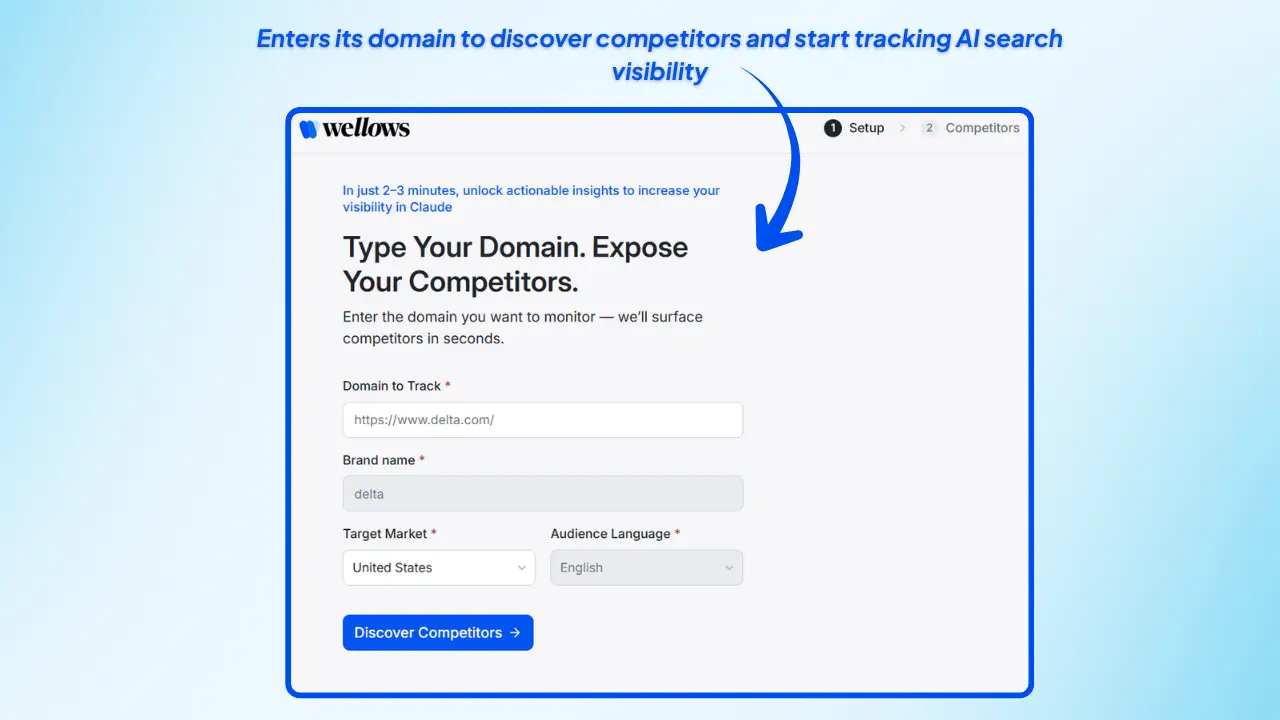
Enter Your Brand Domain: Adding delta.com to Wellows triggered an instant scan across ChatGPT, Claude, Perplexity, and Gemini. The platform identified 75 citations with a 19.97% citation score, ranking second overall behind United Airlines. It revealed where Delta appeared in AI answers and where it didn’t.
Brand Matching & Competitor Identification: Wellows automatically categorized Delta under Passenger Airlines and benchmarked it against competitors like United, American, Southwest, and Alaska. This mapping confirmed that AI visibility operates within industry-specific contexts, not in isolation.
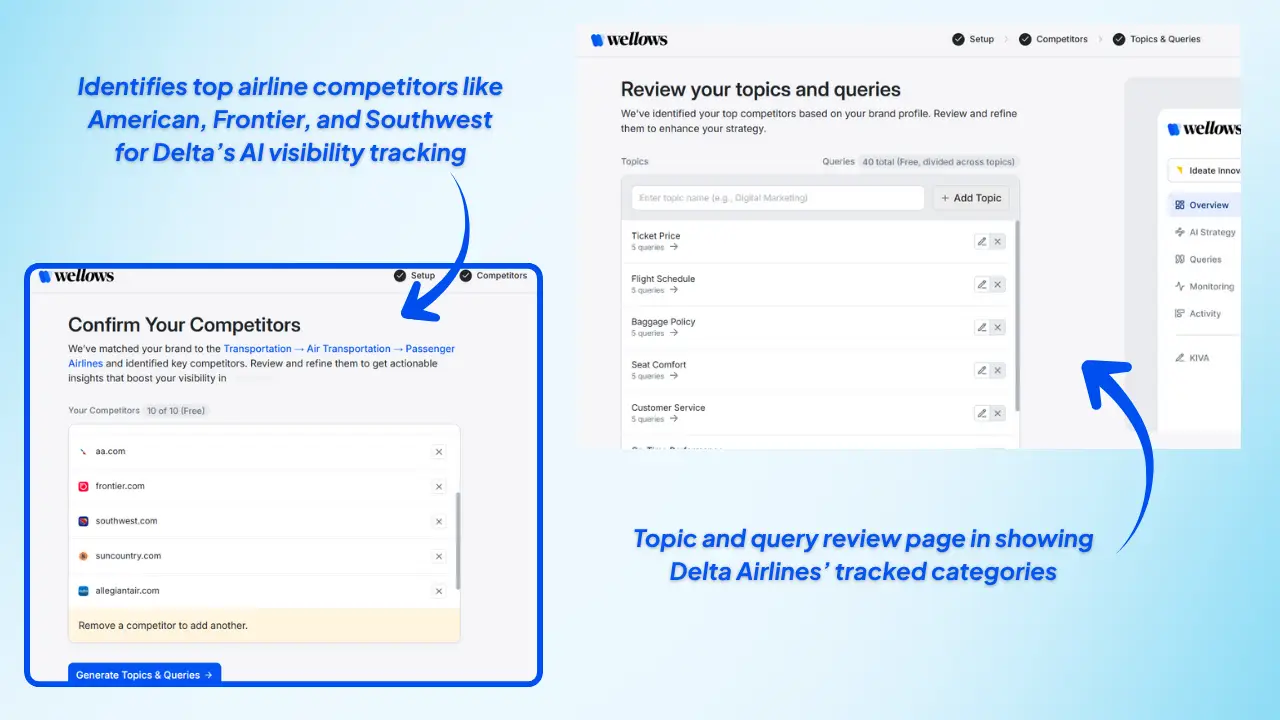
Review and Refine Competitors: Default tracking covered core topics flight schedules, baggage policy, seat comfort, and customer service. I added sustainability as a rising visibility theme. The recalibrated insights highlighted which airlines gained traction for eco-focused discussions.
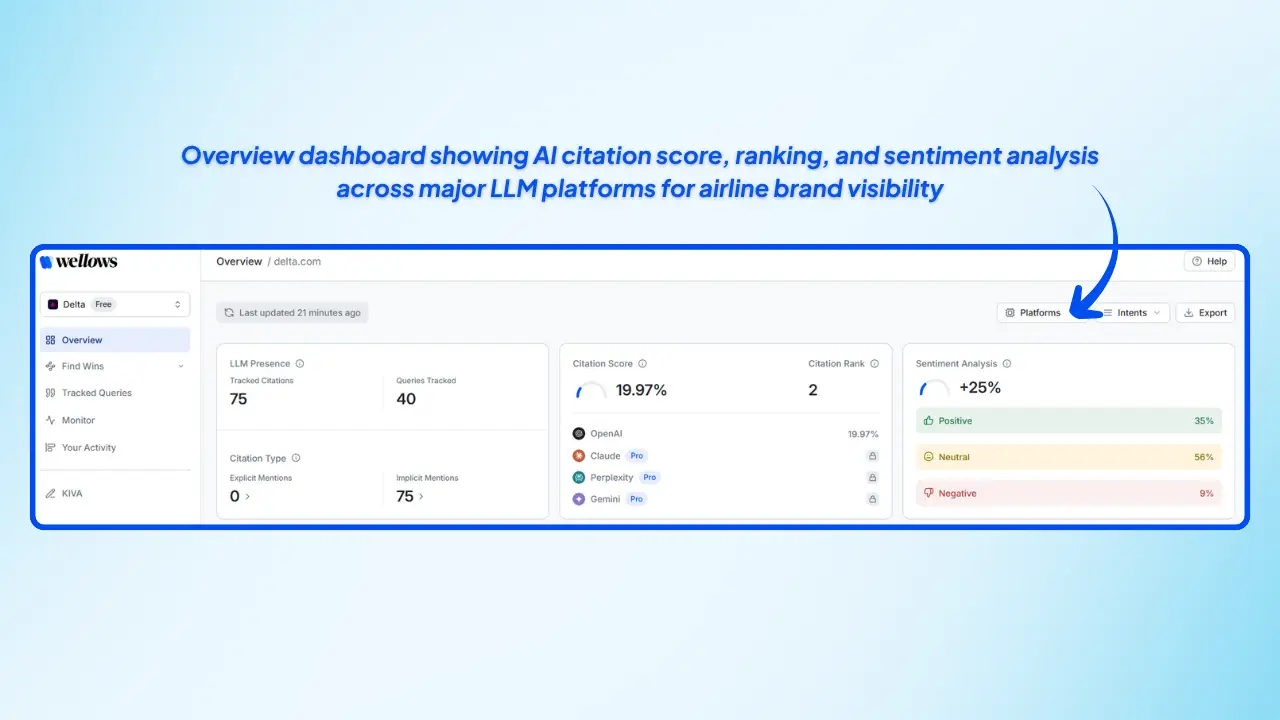
Explore Dashboard: The dashboard visualized citation performance. United scored slightly higher at ~21%, while Delta followed closely with strong positive sentiment (35%) and limited negative tone (9%). AI references reflected the brand’s reliability narrative and customer experience reputation.
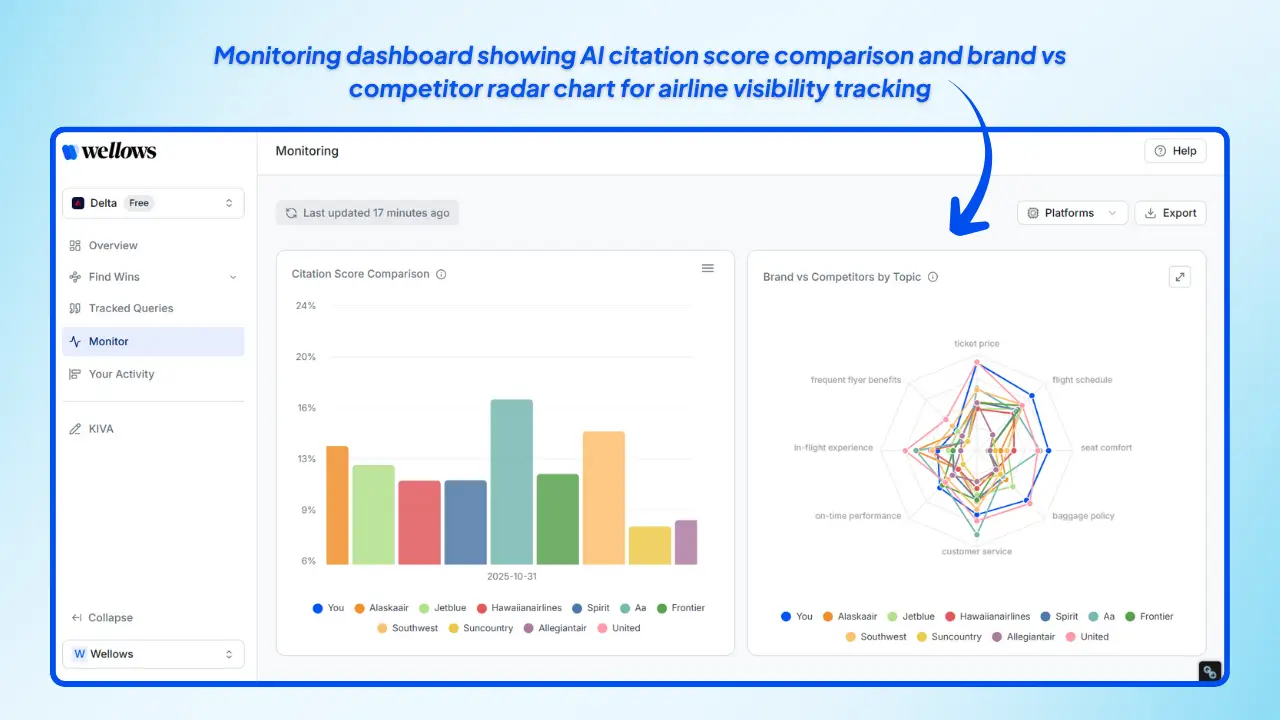
Check Explicit and Implicit Mentions: Wellows separated explicit citations where competitors were credited but Delta wasn’t from implicit mentions where Delta appeared without a link. Several unlinked references on government and travel sites emerged as actionable outreach targets.
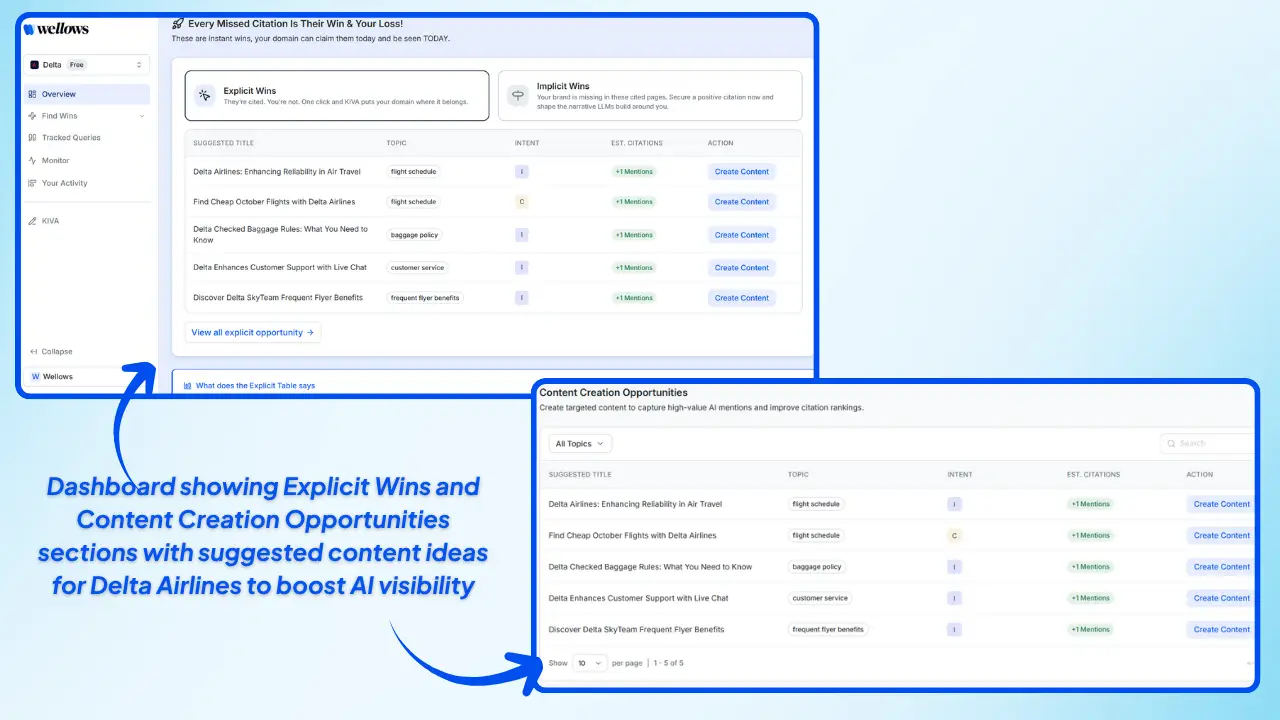
Analyze Competitive Insights: The radar visualization showed Delta leading in “on-time performance” and “customer service,” while trailing slightly in “flight deals.” No airline dominated “in-flight entertainment,” signaling an untapped opportunity for new content.
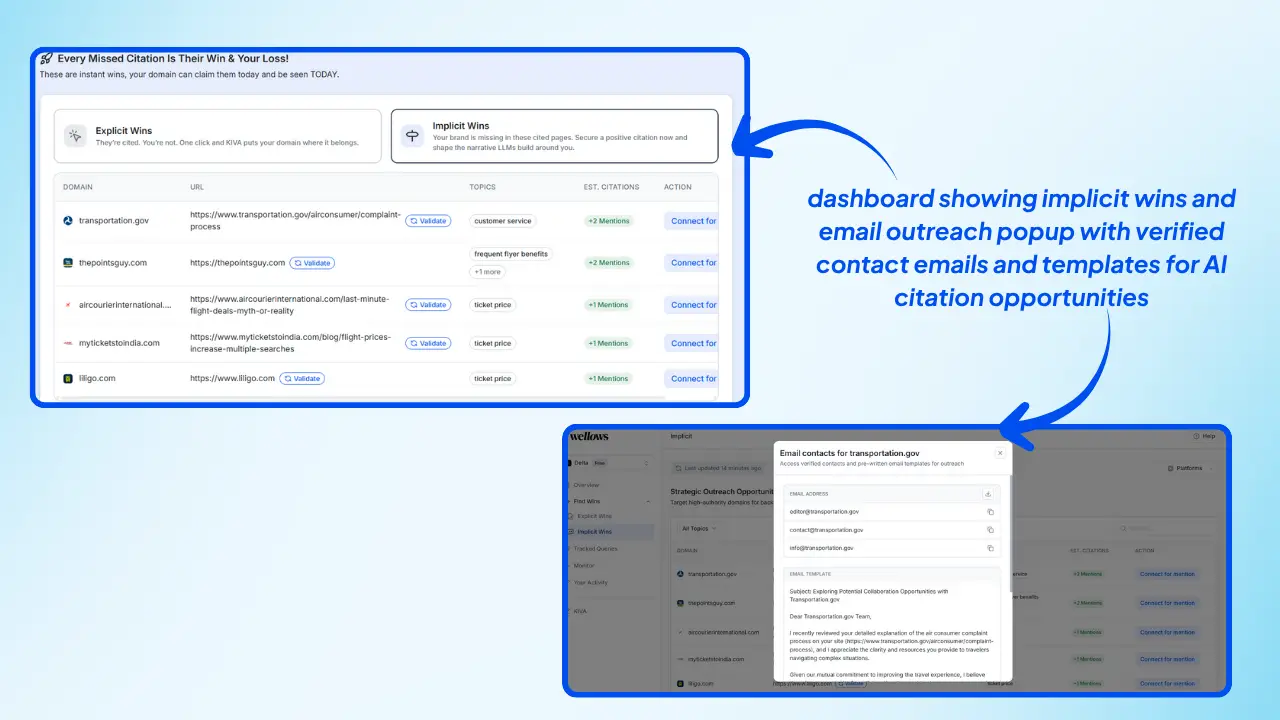
Review Top Cited Queries: Queries like “Which airline has the best seat comfort?” and “Why do flight schedules change so often?” drove most AI mentions. This revealed the exact topics shaping airline visibility in generative answers valuable data for content planning.
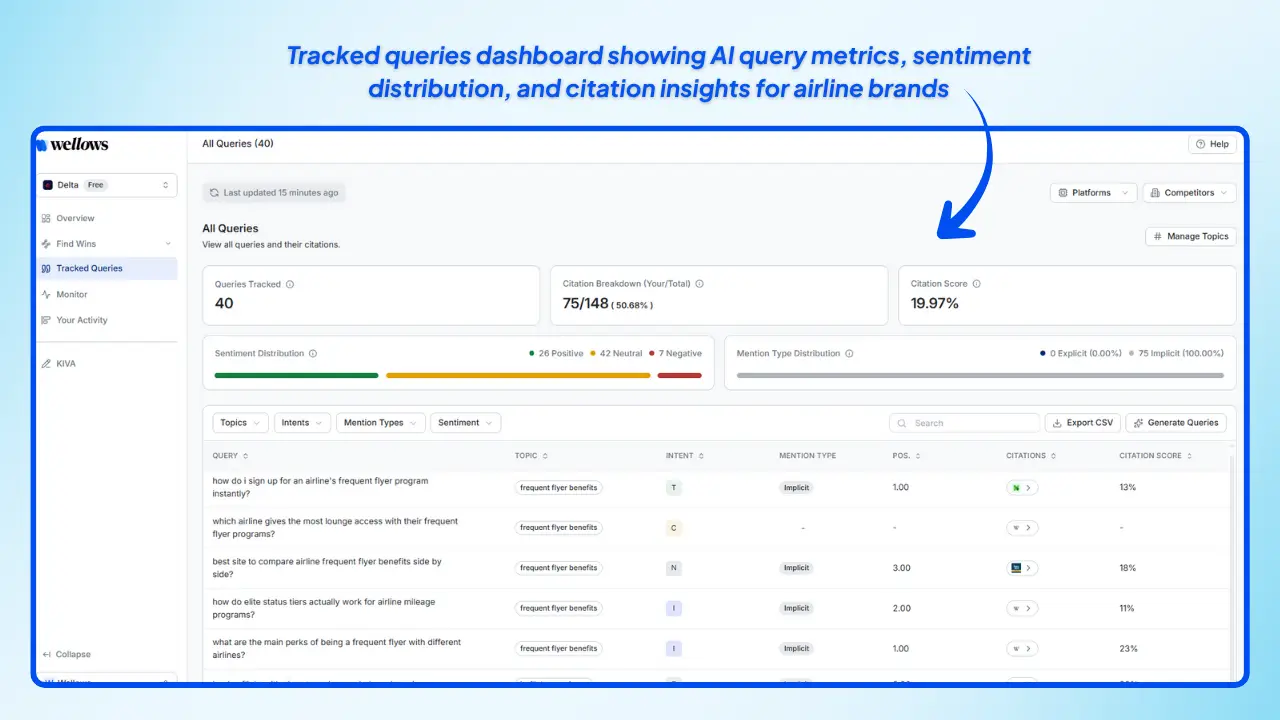
Monitor Performance Over Time: Trend analysis showed Delta maintaining around a 0.4 citation index, consistent with United. Visibility spikes aligned with PR campaigns, proving that earned media directly impacts AI mentions and tone distribution.
Ready for the next step? With one click, Wellows generates a complete visibility report showing your brand’s AI mentions, missed citations, sentiment shifts, and competitive position across major platforms.
Curious to see how your airline performs in ChatGPT, Gemini, Google AI Overview, and Perplexity?
To explore your AI visibility report and start improving your brand’s presence today.
10 Tips to Transform Your Strategy for Aviation & Airline Brands
To stand out in AI-driven search, aviation brands must evolve beyond traditional SEO. These 10 focused actions combine proven optimization with AI-ready strategy to boost discoverability across emerging generative platforms.
1. Define your niche: Clarify what your airline does best. A focused niche like regional routes, eco-friendly flying, or premium cabins helps AI identify your brand as an expert source for related travel queries.
2. Highlight unique strengths: Use data to showcase what sets you apart. Share proof of on-time performance or safety excellence. AI systems favor verifiable metrics when citing reliable brands.
3. Study AI-cited competitors: Track which blogs or news sites appear in AI answers. If rivals are cited for “best family airlines” or “sustainability in aviation,” create stronger, updated content covering those same topics.
4. Stay current with travel trends: Refresh content around seasonal travel, regulatory changes, or sustainability updates. AIs prioritize recency, especially for time-sensitive travel information.
5. Target conversion-ready queries: Focus on intent-driven topics like “best business class to Asia” or “flights with free Wi-Fi.” Structured, informative content helps your brand appear in answers that lead to bookings.
6. Build content ecosystems: Support flight pages with related blogs, FAQs, and visuals. Broader coverage across topics like family travel or rewards programs increases AI recognition and relevance.
7. Match the buyer journey: Create content for all stages from inspiration to booking. When AI aligns your content with user intent, your brand appears more consistently across diverse queries.
8. Maintain product visibility: Keep content about new cabins, loyalty tiers, or routes updated. Outdated or missing pages cause AI models to overlook your latest offerings.
9. Own branded questions: Publish official answers for topics like baggage fees or lounge access. Implement FAQ schema to ensure AIs pull verified data directly from your site.
10. Use quick visibility wins: Tools like Wellows identify where competitors are cited but you aren’t. Converting these implicit mentions into citations can raise AI visibility fast with minimal effort.
💡Pro Tip: The earlier you act on implicit wins, the faster your brand can outrank competitors in LLM-powered ecosystems.
How Can Aviation & Airline Brands Overcome Common Challenges in AI Search Visibility?
Even with strong strategies, airlines face distinct hurdles in optimizing for AI-driven visibility. These challenges resemble classic SEO issues but with new complexities unique to conversational AI and generative search.
| Challenge | Solution | Insight |
|---|---|---|
| Hard to measure AI visibility | Track mentions and citations across major AI platforms to quantify your brand’s presence. | Multi-platform tracking across ChatGPT, Gemini, Claude, and Perplexity provides measurable visibility metrics. |
| Poor alignment with traveler intent | Analyze AI-generated queries to shape content around informational, comparative, and transactional needs. | Intent categorization helps pinpoint where traveler questions aren’t yet answered by your content. |
| Competitors dominate citations | Benchmark citation share and close topic gaps where others appear more frequently. | Competitive tracking reveals citation rank Delta, for instance, ranked second, proving optimization narrows gaps fast. |
| Negative sentiment in AI answers | Detect tone early and use updated messaging or PR to counter negative narratives. | Sentiment analysis monitors tone and triggers workflows to maintain a positive brand image. |
➡️Summary: AI visibility challenges can be solved with consistent tracking, intent alignment, and proactive reputation management. With structured data and real-time insights, airlines gain control over how AI represents their brand and turn uncertainty into measurable visibility.
Why Choose Wellows for Your Aviation Brand?
Most SEO tools weren’t built for AI-driven search. While traditional platforms measure keywords and backlinks, they don’t capture how AI models cite or describe your brand. This visibility intelligence platform fills that gap by focusing on brand performance inside generative engines.
| Feature | Wellows | TryProfound | PromptWatch AI |
|---|---|---|---|
| AI Citation Tracking (ChatGPT, Gemini, Claude, Perplexity) | Yes Tracks brand mentions and citations across all four major LLMs. | Partial Primarily covers answer engines like ChatGPT and Bing. | Yes Covers multiple LLMs but with limited topic depth. |
| Implicit Citation Detection (Unlinked Mentions) | Yes Detects where brands appear in AI results without hyperlinks or credits. | No Focuses on explicit answer citations only. | No Tracks visible mentions, not implicit ones. |
| Visibility Score + Sentiment Fusion | Yes Combines citation count, tone, and authority into one AI Visibility Score. | Partial Offers visibility insights but lacks sentiment-weighted scoring. | Limited Provides surface-level visibility scores only. |
| Industry Benchmarking (Sector-Level Scan) | Yes Compares all brands in an industry (e.g., Aviation, Finance). | No Focuses on brand or domain-level tracking. | No Individual brand monitoring only. |
| Explicit vs Implicit Wins Dashboard | Yes Highlights missed citation opportunities and unlinked mentions automatically. | No Does not distinguish citation types. | No No actionable insights dashboard. |
| Query Intent Clustering (Informational, Comparative, Transactional) | Yes Groups AI queries by user intent to reveal optimization gaps. | No Tracks only raw prompt keywords. | Partial Basic categorization without intent mapping. |
| Real-Time Sentiment Tracking | Yes Monitors tone across all AI platforms and competitor mentions. | Yes Offers partial sentiment insights. | Limited Tone data for prompts only. |
| Visibility Playbooks & Instant Content Suggestions | Yes Suggests topics and titles to convert missed citations into new content. | No No built-in content recommendations. | No Lacks SEO or PR workflow tools. |
➡️Insight: Wellows uniquely merges AI visibility tracking, sentiment analytics, and action-ready playbooks turning every missed mention into a measurable growth opportunity.
Why Search Intent Matters in the Aviation Market
Most travelers now phrase queries conversationally, which requires brands to understand user intent inside generative engines to ensure their content precisely matches what passengers ask AI assistants.
Understanding search intent is essential for both SEO and AI visibility. Aligning your content with what travelers truly want ensures your brand appears in generative and traditional results alike.
Did you know?
Informational Intent: Travelers seek answers, not bookings. Queries like “Why do flight prices change?” require educational content — blogs, FAQs, or videos that explain topics simply. If someone asks “How does airline Wi-Fi work?”, your detailed post should be the one AI cites.
Navigational Intent: These users want your official page — e.g., “baggage policy” or “check-in.” Ensure titles are clear and schema is applied so AIs and search engines direct users to your verified content, not third-party sources.
Transactional Intent: Queries like “book flights to Paris” show buying intent. Prioritize fast-loading, mobile-optimized booking pages. Over 70% of travel traffic now comes from mobile (Navan, 2025), so speed and structure directly affect AI visibility.
Comparative Intent: Travelers often compare brands: “Which airline is safer?” or “Delta vs American Airlines first class.” Build transparent, data-backed comparison content. Media outlets and bloggers may cite it, improving both search and AI visibility.
💡 Insight: Matching user intent tells AI your content is useful and trustworthy. When you answer the “why” behind a traveler’s question, AI platforms naturally make your brand part of the answer.
Market Insights for Aviation & Airline Brands
Online research drives early decisions. 91% of travelers start without a preferred airline, asking broad questions like “who flies this route?” (Branchspace, 2025). Showing up in these discovery moments especially inside AI answers shapes brand preference.
Digital booking is mainstream. By 2023, 72% preferred booking online, while only 12% used traditional agents (Navan). As AI-guided booking flows expand, clean data and fast UX directly impact conversions.
Mobile & voice are surging. Mobile accounted for 70.5% of global online travel traffic in 2024 (Navan). Voice assistants reward concise, structured answers, so keep FAQs scannable and machine-readable.
Gen Z & Millennials lead adoption. Over half are comfortable with AI planning trips (Hospitality Upgrade), and 73% under 40 say influencers have swayed bookings (TravelAge West).
Video & social steer choices. 71% say video influenced a travel decision (Yahoo Finance), and Google’s AI increasingly cites YouTube content (BrightEdge, 2025). Ship short, useful clips for high-visibility queries.
Industry AI adoption is accelerating. Tourism AI usage is projected to reach 78% by end of 2025, with North America near 68%. Integrations with assistants and data partnerships will influence which brands AIs cite.
➡️Bottom line: Nearly half of travelers already trust AI to plan trips. Winning visibility in these channels now shapes tomorrow’s bookings.
Audience Insights for Aviation & Airline Brands
Different traveler segments ask different questions and AI reflects that diversity in its answers. Understanding your audiences helps shape both SEO and AI visibility strategies so your brand shows up when it matters most.
| Audience | Profile | What They Value Most | Content to Build |
|---|---|---|---|
| Frequent Flyers | Professionals with elite status or loyalty memberships. | Reliability, comfort, exclusive perks. | Highlight loyalty programs, business-class benefits, and real-time reliability stats. |
| Leisure Travelers | Families and vacationers researching getaways. | Deals, convenience, stress-free experiences. | Publish “Best time to fly” guides, destination spotlights, and family travel FAQs. |
| Corporate Clients | Enterprise travel planners booking for teams. | Flexibility, punctuality, integrated booking tools. | Create route-efficiency pages, B2B travel case studies, and partner dashboards. |
| Aviation Enthusiasts | Industry followers and aircraft hobbyists. | Fleet innovations, technology, sustainability. | Share aircraft deep-dives, engineering stories, and sustainability reports. |
| Regional Passengers | Frequent domestic or commuter flyers. | Affordability and punctuality. | Build local route guides and AI-friendly FAQs for common travel corridors. |
| First-Time Flyers | New travelers or those flying after years away. | Clarity, reassurance, easy guidance. | Post step-by-step check-in tutorials, airport walkthrough videos, and “Flying 101” FAQs. |
| Luxury & Premium Flyers | High-income travelers or executives seeking comfort. | Privacy, premium service, in-flight experience. | Feature cabin tours, premium lounges, and reviews of exclusive offerings. |
| Budget Travelers | Students, backpackers, or families seeking savings. | Low fares, transparency, simplicity. | Maintain low-fare calendars and comparison pages highlighting clear pricing. |
| Eco-Conscious Travelers | Millennials and Gen Z prioritizing sustainability. | Carbon efficiency, transparency, and social impact. | Create “Green Flying” pages detailing eco-friendly initiatives and carbon offset options. |
| Gen Z & Millennial Travelers | Digital natives planning trips through AI and social media. | Authenticity, personalization, mobile convenience. | Leverage TikTok, Instagram, and Reddit presence. Ensure mobile-first design and chatbot support. |
💡Insight: Each audience triggers unique AI queries from “best family airline” to “eco-friendly flights.” By tailoring content to their intent, your brand becomes the most relevant and cited answer across search and AI ecosystems.
What Are the Latest Trends in AI Search Visibility for Aviation & Airline Brands?
AI-generated comparisons now dominate pre-booking behavior. Travelers increasingly ask AIs for the best flights, schedules, and seat comfort options. Airlines with verified flight data and structured content consistently appear higher in these automated recommendations.
Multimedia content shapes visibility more than static text. AIs frequently reference user-generated sources like YouTube reviews, Reddit discussions, and live trackers such as Flightradar. Data-rich, visual, or interactive content now drives AI citations.
Structured data and transparency are decisive. Airlines publishing clear details on baggage rules, refund policies, and sustainability reports see stronger citation frequency. Clean schema markup remains a visibility multiplier across ChatGPT, Gemini, and Bing AI.
Sentiment drives discoverability. Brands with predominantly positive tone across reviews and media coverage achieve higher presence in LLM-generated answers. AI mirrors public trust positive perception directly boosts citation probability.
💡Insight: The winning formula for 2025 is clear structured data, credible storytelling, and sustained sentiment management. Authority and accuracy are no longer optional; they define which airlines AIs choose to recommend.
- AI Search Visibility for Automotive Brands: Be discovered in AI-powered car comparisons and purchase advice.
- AI Search Visibility for Banking & Financial Services Brands: Get cited in AI money management and lending suggestions.
- AI Search Visibility for Beauty & Personal Care Brands: Appear in AI beauty routines and product matchers.
- AI Search Visibility for Entertainment Brands: Improve how streaming platforms, studios, and media catalogs appear across major AI assistants.
- AI Search Visibility for Environment & Sustainability Brands: Get featured in AI-driven eco-friendly and sustainability search results.
- AI Search Visibility for HealthTech & Medical Devices Brands: Appear in medical AI queries.
- AI Search Visibility Audit Checklist: A practical framework to measure, fix, and grow your brand’s citations across major AI search platforms.
💡Insight: Every travel sector faces the same challenge if AI assistants can’t find or trust your data, you disappear from the new digital map. These guides help ensure your brand remains part of the conversation wherever travelers or partners ask AI for answers.
FAQs
Conclusion
The AI search visibility era has completely transformed how travelers discover and choose airlines. Traditional SEO is no longer enough when customers now ask ChatGPT, Gemini, or voice assistants for advice — only credible and structured brands appear in answers.
This new generation of visibility intelligence tools bridges that gap by showing exactly where your brand is mentioned, how often it’s cited, and the sentiment shaping your reputation. Real-time data replaces guesswork, helping marketing teams make confident, strategic decisions.
Airlines that act early will define the next wave of digital travel marketing. By combining structured data, authentic storytelling, and consistent monitoring, brands can lead both AI results and customer trust. Those who delay risk fading from the conversation entirely.
💡Insight: The future of AI search visibility for aviation brands is already here — and with the right AI visibility platform, your airline won’t just adapt to that future, it will help shape it.