Still spending hours tracking where your automotive brand shows up in AI search results? It’s time to change that with AI Search Visibility for Automotive Brands. Platforms like ChatGPT, Google’s SGE, and voice assistants now answer questions that once brought customers straight to you.
Did you know 58% of consumers now rely on AI for product and service recommendations? That’s a big jump from 25% in 2023 (Wellows ChatGPT Citations Report).
If your brand isn’t part of those AI-generated answers, you might be losing visibility without even knowing it. The issue? Traditional SEO tools can’t measure AI search visibility.
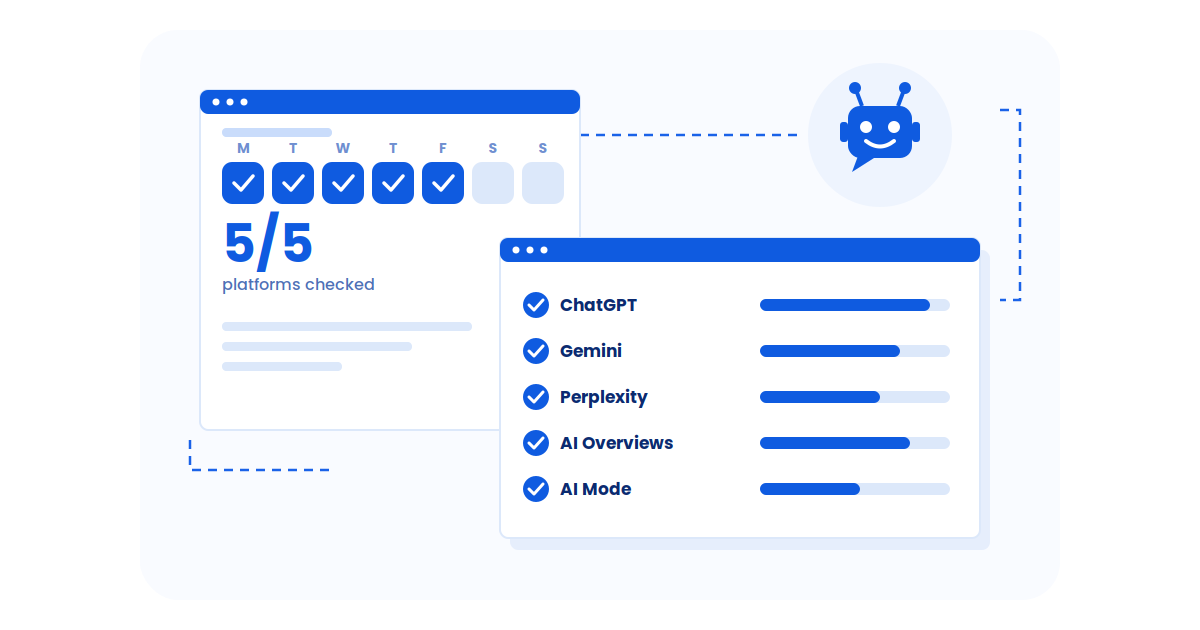
That’s where Wellows comes in. You can now track your brand’s mentions across ChatGPT, Claude, Perplexity, and Google’s Gemini—all in one smart dashboard.
See your Citation Score, find out where your competitors are appearing more often, and uncover those hidden implicit mentions where your brand is talked about but not credited.
With it, you’ll instantly know how visible your brand really is in AI-generated answers—and how to improve it.
Did you know?
Did You Know?
According to Wellows ChatGPT Citations Report, Generative AI usage is exploding—AI-driven search referrals surged 1,300% last holiday season. Gartner predicts traditional search volume will fall 25% by 2026 as AI and voice assistants take over. Staying visible in AI results is no longer optional—it’s essential for your brand’s success (Neil Patel).
AI-driven search referrals surged 1,300% last holiday season , and Gartner predicts a 25% drop in traditional search volume by 2026 as AI and voice assistants take over.
Want to stay ahead? Discover how automotive marketers can use AI visibility platforms like this to lead the way in the GenAI search era.
What Is AI Search Visibility for Automotive Brands?
Search Engine Visibility refers to how prominently an automotive brand appears within responses from AI-powered tools like ChatGPT, Claude, Gemini, and Perplexity.
As consumers increasingly rely on these platforms for car research, comparisons, and recommendations, visibility in LLM-generated answers is becoming just as crucial as traditional SEO rankings — marking the rise of Generative Engine Optimization (GEO).
Current State of AI Search Visibility in Automotive
- Market leaders dominate: Hyundai, Toyota, and Ford together make up 32% of all brand mentions in AI-generated content, highlighting a clear edge for established manufacturers (Knownful, 2025).
- EV startups face challenges: Emerging electric vehicle brands struggle for recognition—Rivian shows only 12.92% visibility, while Fisker and Canoo record 0%, revealing a steep visibility gap .
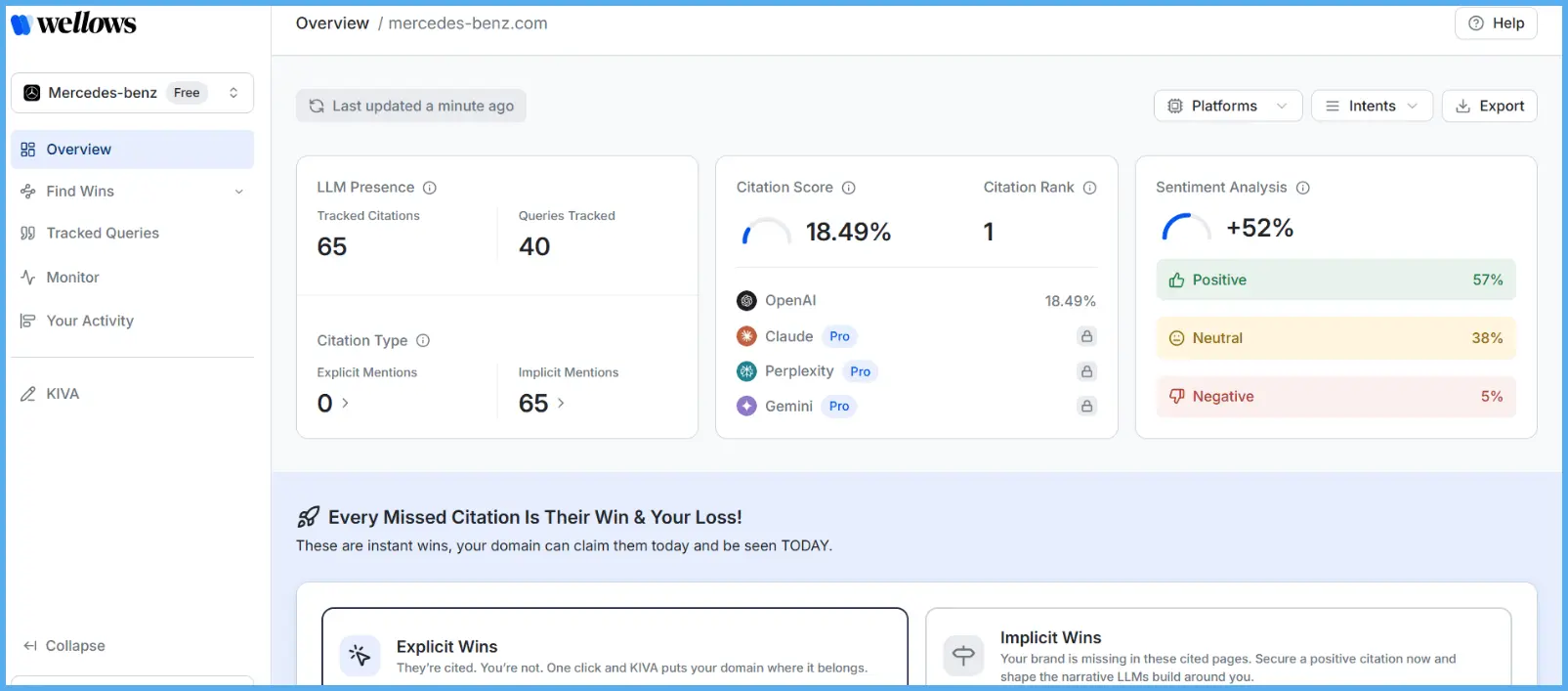
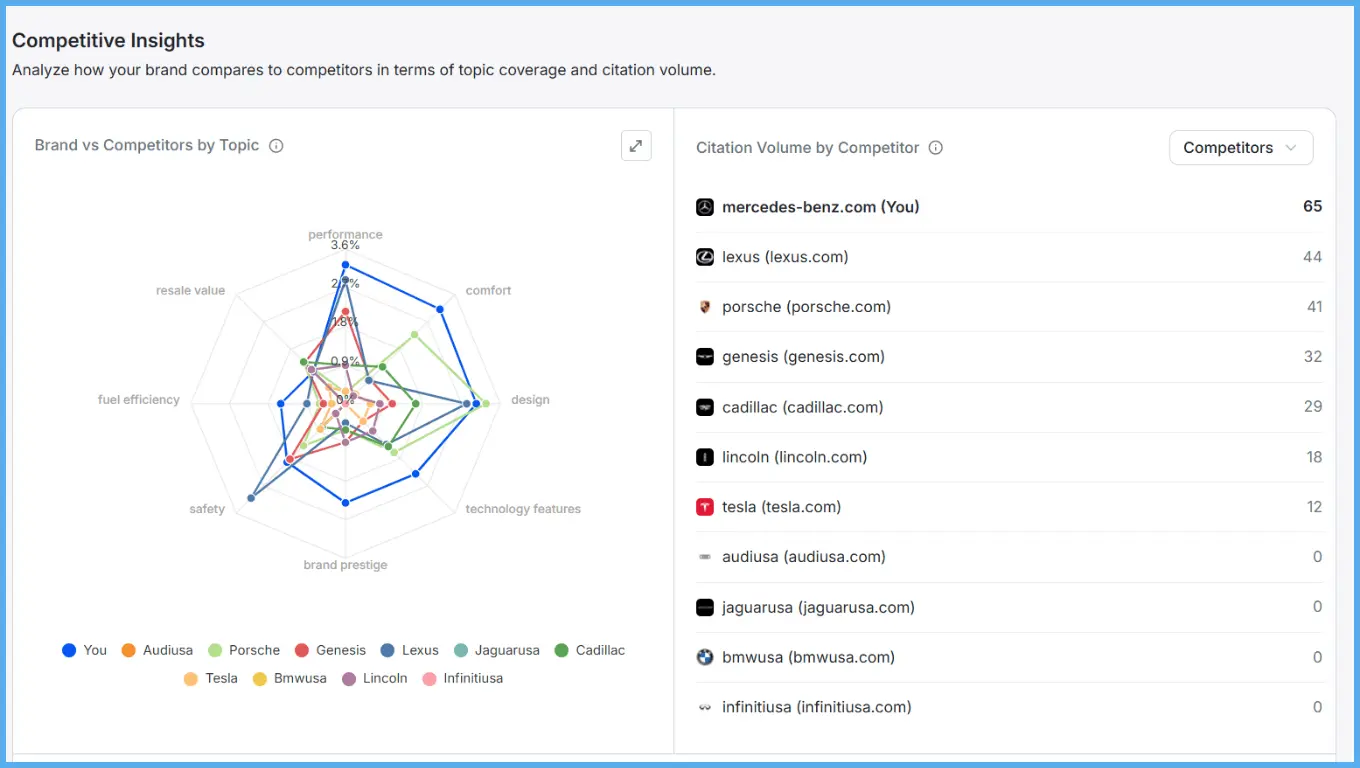
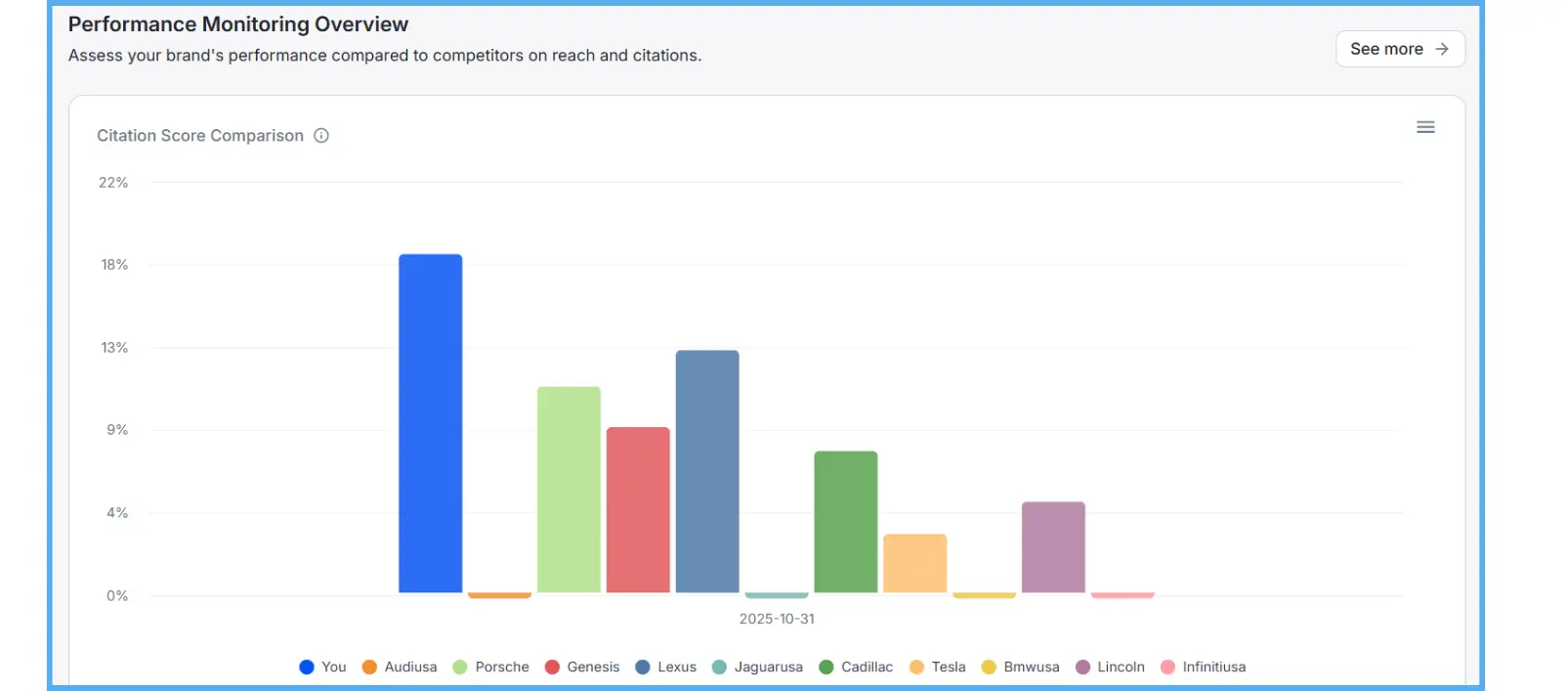
- Category insight: Mercedes-Benz leads with 65 implicit citations and a 18.49% citation score, outperforming Lexus (44) and Porsche (41), particularly in performance and comfort discussions (Wellows, 2025).
How Can Automotive Brands Improve AI Search Visibility?
AI search is changing how people discover cars — from asking ChatGPT about the best SUVs for families to checking Gemini for EV comparisons. To make sure your brand shows up in those answers, you need to understand how AI interprets and cites your content. Here’s how you can take the lead — with the right AI visibility insights.
- Use Generative Engine Optimization (GEO): GEO works like SEO but for AI platforms. It’s built around key Generative Engine Visibility factors that determine how AI tools read and cite your content. It ensures your brand data is structured and easy for AI systems to read, improving your chances of being cited in AI-generated answers.
- Add Structured Data: Implement schema markup so AI can understand your vehicle details, specs, and pricing. This makes your site easier for AI to interpret and recommend in relevant queries.
- Make Your Listings Smarter: Enrich product listings with detailed attributes. Complete and accurate content helps AI match your cars to the right questions, boosting visibility across multiple platforms.
- Earn Mentions from Trusted Sources: Getting cited by credible automotive or tech publications builds trust. AI models favor brands mentioned in high-quality, informative content.
- Create Short, Helpful Videos: Produce quick, informative clips such as “How our hybrid saves fuel” or “What makes our SUV safer.” These can boost visibility in both AI summaries and video-based search.
- Track What AI Says About You: Wellows helps you see where your brand is mentioned — and where it’s missing. It tracks citations, measures sentiment, and shows how you compare to competitors across leading AI platforms.
- Match Real AI Queries: Discover what people are actually asking AI, like “Which luxury cars offer the best value?” Then build content that directly answers those questions. Advanced visibility tools identify these patterns so you can act fast.
- Use AI to Personalize PR: Smart PR outreach — especially when guided by Digital PR strategies for AI visibility — helps your brand appear more often in trusted content sources, increasing the chances of being cited in AI-generated answers.
- Compare and Improve: The analytics dashboard shows which competitors are leading in AI visibility and which topics they dominate, giving you a clear path to close the gap.
- Stay Ahead of AI Trends: The platform keeps your strategy current by tracking how AI visibility shifts over time. You’ll see emerging topics, citation changes, and keyword trends — helping your brand stay ahead of algorithm updates.
In short, combining structured data, AI-ready content, and actionable visibility insights helps your brand stand out in AI search results. The goal is simple — when someone asks AI about your niche, your brand should be the answer.
How Can Automotive Brands Use Wellows for AI-Driven Search Visibility?
Before building your AI visibility strategy, define your brand’s focus. A luxury car brand might highlight “electric performance SUVs,” while an economy brand may focus on “affordable hybrid sedans.”
This approach aligns with the principles of Generative Engine Optimization (GEO) — optimizing content for how AI systems discover and present brand information.
I actually ran this experiment myself while testing visibility for leading automotive brands using Wellows — and the results were eye-opening. Established players like Mercedes-Benz consistently dominated AI-generated answers, not because of sheer search volume, but because their data was structured and frequently referenced by AI systems.
That’s when it clicked for me — visibility isn’t about appearing everywhere; it’s about showing up in the right AI answers where your audience is searching.
Each step below includes real examples using Mercedes-Benz to help you visualize the process. Here’s how to use it:
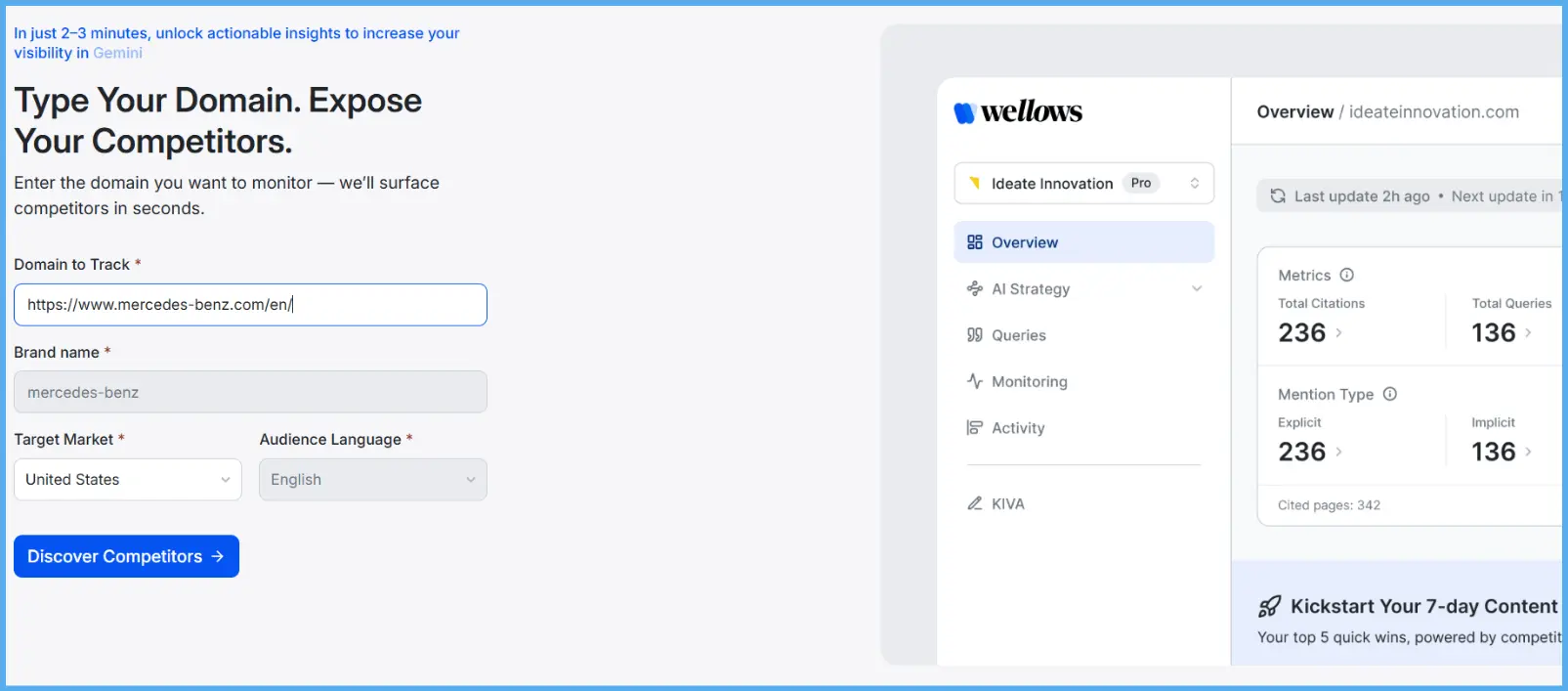
1. Enter Your Brand Domain
When I started, I added mercedes-benz.com as a test domain. The platform instantly scanned AI-generated answers across ChatGPT, Gemini, Claude, and Perplexity to identify where the brand was cited, mentioned, or missing. It was fascinating to see how even small data inconsistencies changed AI citation behavior.
2. Brand Matching & Competitor Identification
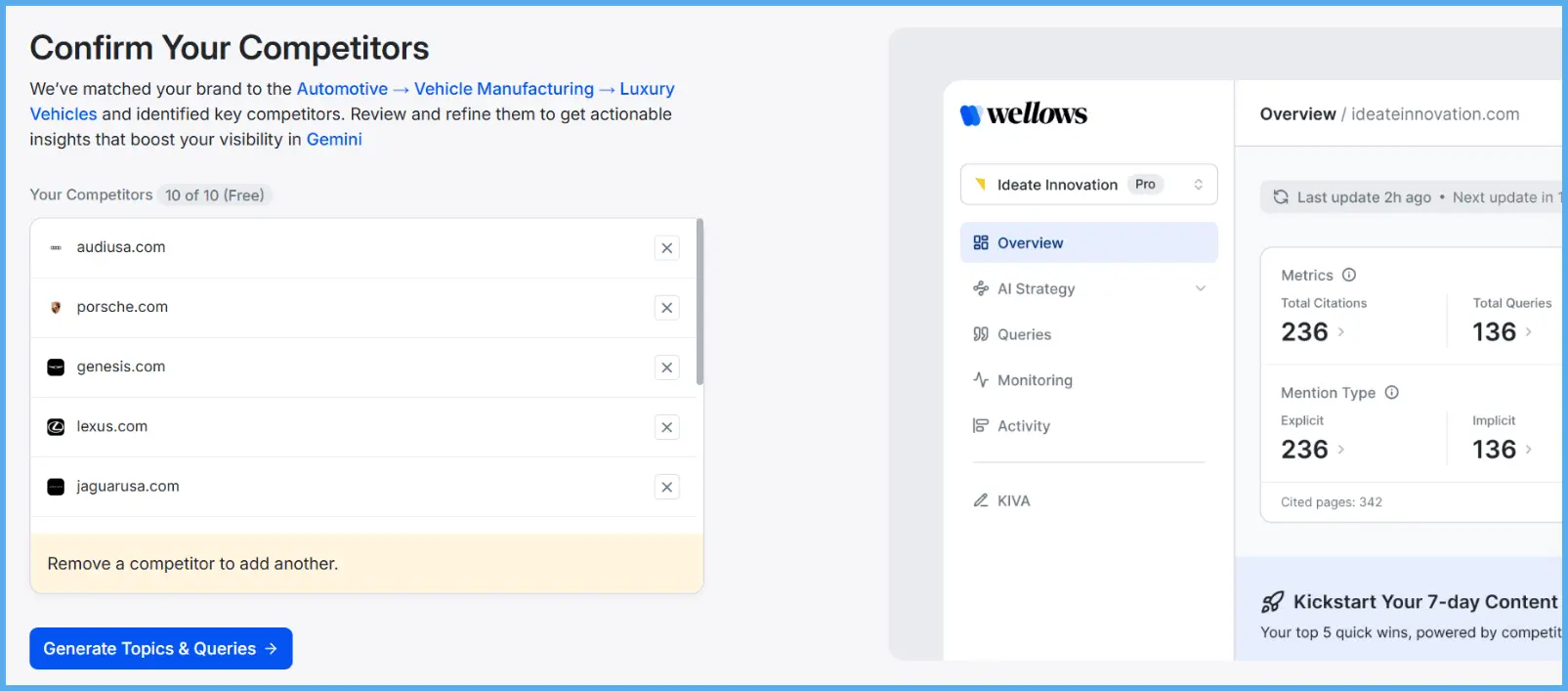
Once I entered the domain, the AI visibility system automatically categorized Mercedes-Benz under Automotive → Vehicle Manufacturing → Luxury Vehicles. It then mapped out competitors like Audi, Porsche, Genesis, Lexus, and Jaguar.
This automatic segmentation was a turning point — it showed how AI visibility is industry-aware and how precise classification can shape competitive benchmarking.
3. Review and Refine Competitors
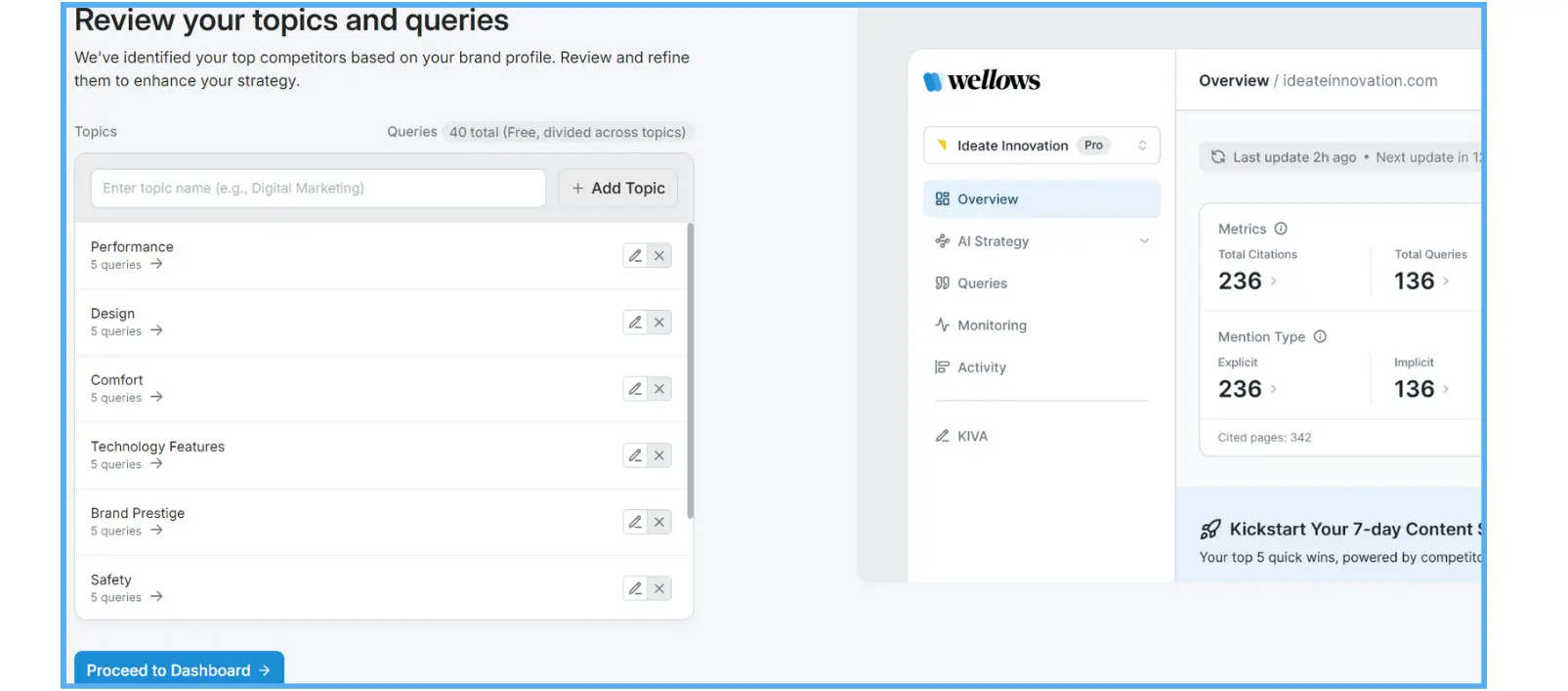
Next, I reviewed visibility topics like performance, design, comfort, and safety — areas where most AI platforms referenced automotive brands. I adjusted a few topics to reflect new electric-vehicle trends and immediately noticed how it refined the insights.
This step made me realize how flexible tracking should be when aligning to evolving AI interest signals.
4. Explore the Dashboard
Exploring the dashboard was where it all came together. I could instantly see LLM Presence, Citation Score, and Sentiment Analysis across ChatGPT, Claude, Perplexity, and Gemini.
For Mercedes-Benz, dashboard showed strong positive sentiment and high visibility — confirming that brand reputation and citation frequency often go hand-in-hand.
5. Check Explicit and Implicit Mentions
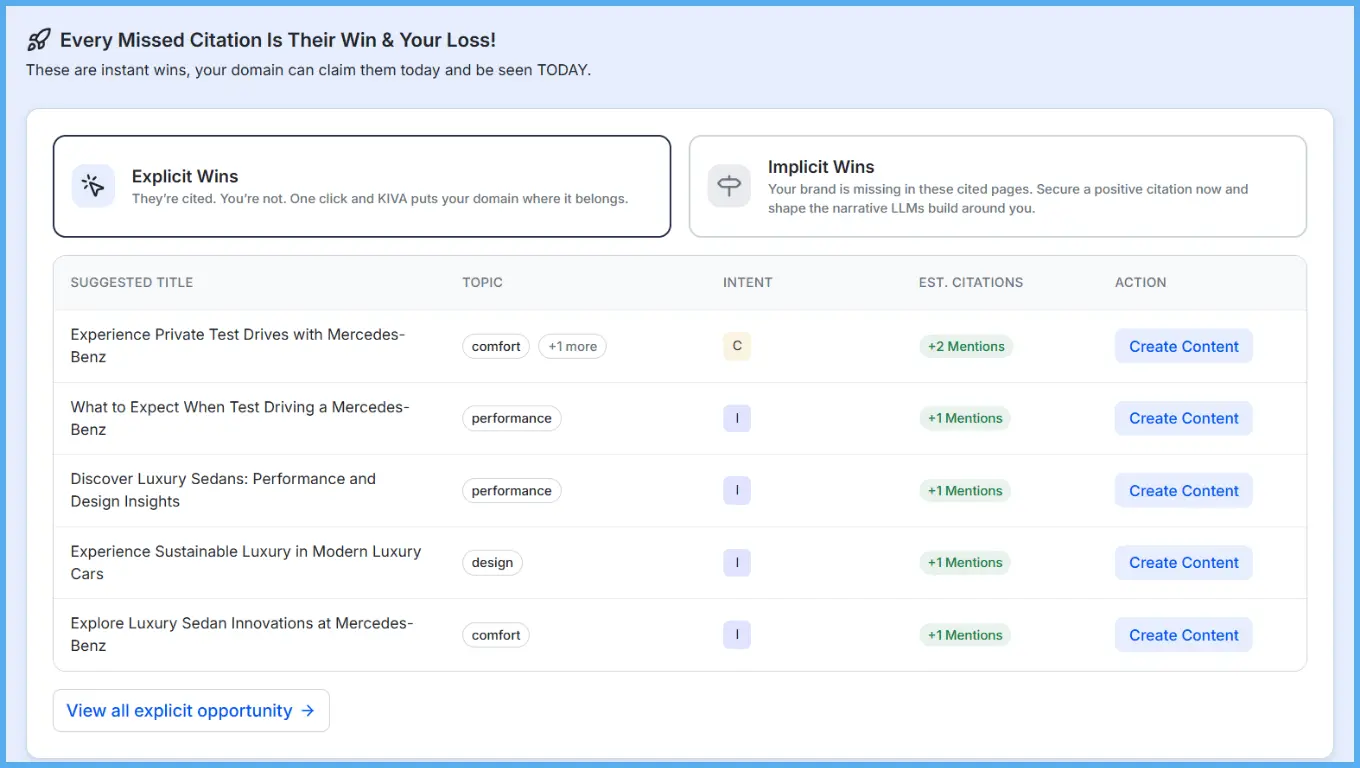
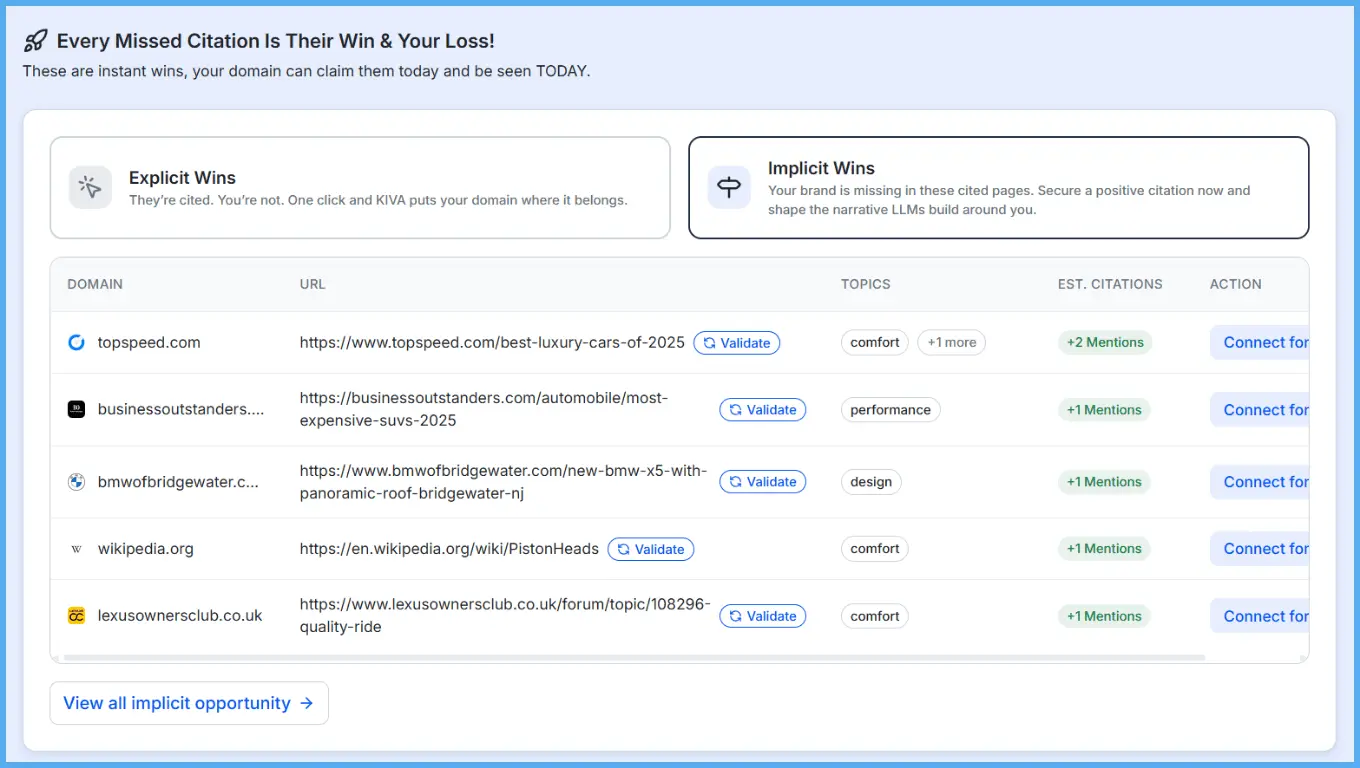
This was my favorite discovery. It separates Explicit Wins — where competitors are cited but your brand isn’t — from Implicit Wins, where your brand is mentioned without a link. Seeing those “uncredited mentions” opened up a new visibility opportunity.
I used the data to identify articles referencing Mercedes-Benz indirectly and converted them into linkable citations.
Here are two types of opportunities:
- Explicit Wins: The left panel shows Explicit Wins — pages where competitors are cited but your brand isn’t. You can click “Create Content” to claim those mentions instantly.
- Implicit Wins: The right panel shows Implicit Wins — where your brand is mentioned without a link, allowing you to turn that reference into a positive citation.
6. Analyze Competitive Insights
When I analyzed competitive insights, the radar chart instantly revealed how Mercedes-Benz performed against Lexus and Porsche. It mirrored how AI SEO agents analyze SERP visibility — except this time, it was across AI ecosystems.
The visualization made it clear that Mercedes-Benz led in “comfort” and “performance” mentions, confirming that AI recognizes the brand’s strengths similarly to consumers.
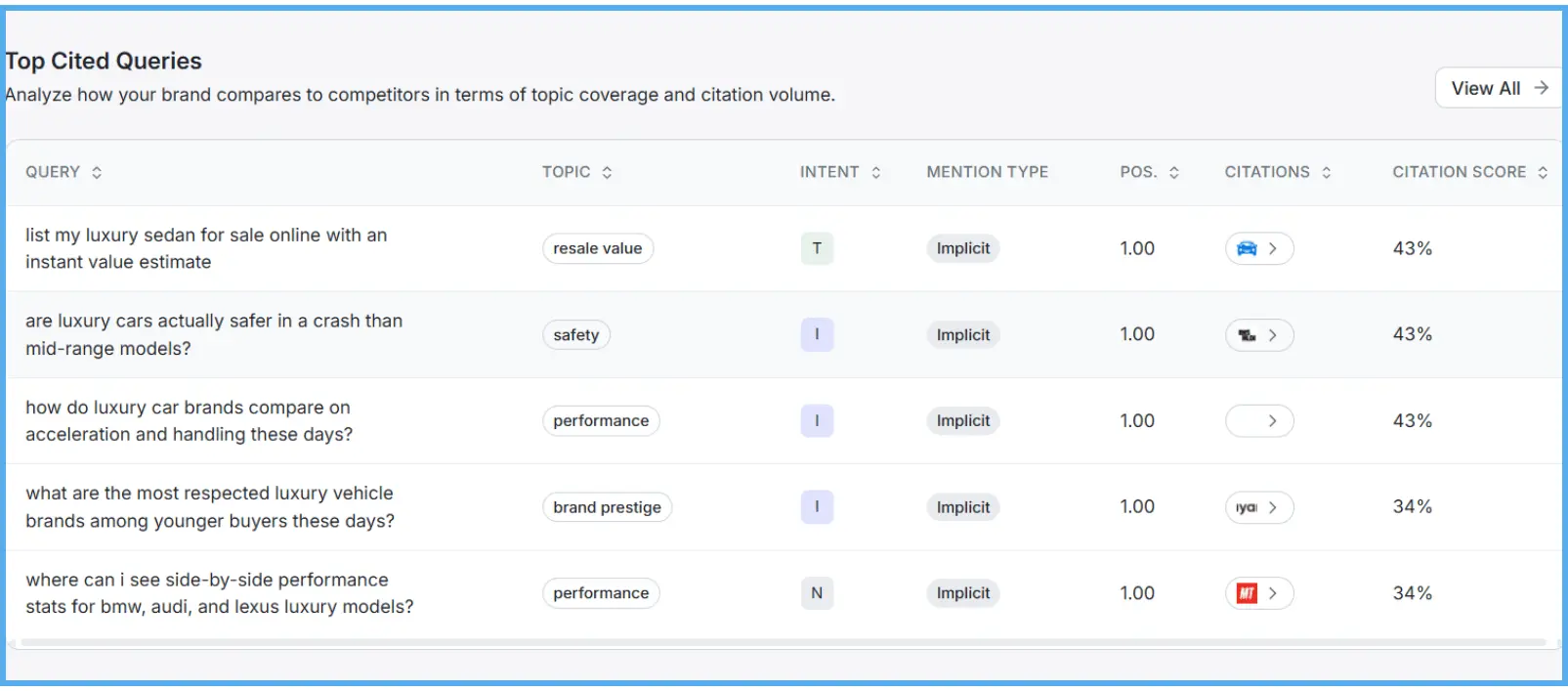
7. Review Top Cited Queries
This part was eye-opening. The platform highlighted the top AI queries that triggered Mercedes-Benz mentions — like “Which luxury cars offer the best resale value?” and “Are luxury cars safer than mid-range models?”
Seeing this data showed exactly what users ask AI and how visibility ties to intent-driven questions. It’s a reminder that every cited query is an opportunity to refine your content.
8. Monitor Performance Over Time
Finally, I tracked how brand citations evolved month over month. Mercedes-Benz maintained around 18% citation share, followed by Lexus, Genesis, and Cadillac. Watching those patterns change made me realize how dynamic AI visibility truly is — it’s not a one-time optimization; it’s an ongoing ecosystem.
Pro Tip: From my own scans, I’ve learned that running regular visibility checks — especially before launches or PR pushes — helps catch new citation opportunities faster and reveals where AI models start shifting focus.
Ready for the best part? With one click, the platform generates a complete visibility report — highlighting your brand’s AI mentions, missed citations, and opportunities to improve. All in minutes, not weeks.
Curious to see what AI is saying about your brand? Start Your 7 Day Trial to explore your automotive visibility dashboard and start boosting your presence today.
10 Tips to Transform Your Strategy for Automotive Brands
Want to make your automotive brand stand out in AI-driven search? These 10 tips blend classic SEO best practices with new-generation strategies like semantic analysis and user intent evaluation — helping your content stay visible in AI-generated answers.
10 Tips to Transform Your Automotive Strategy
1. Define Your Sub-Niche
2. Highlight Your USPs
3. Study Competitor Content
4. Stay Trend-Aligned
5. Target High-Value Queries
6. Build Supporting Content
7. Align with the Buyer Journey
8. Update Product-Specific Visibility
9. Optimize Branded Searches
10. Use Quick Wins with Wellows
How Can Automotive Brands Overcome Common Challenges in AI Search Visibility?
Even with a strong strategy, optimizing for AI-driven search comes with challenges. As seen in why websites still get ignored by search, visibility gaps often come from missing AI data signals.
Here’s how it helps automotive brands overcome them:
| Problem | Solution | Does Wellows Solve It? |
|---|---|---|
| Measuring AI Visibility It’s hard to know when or where your brand appears in AI answers. |
Use AI visibility tools to track mentions and citations across major LLMs. | Tracks citations, mentions, and visibility scores across ChatGPT, Gemini, and more. |
| Aligning with Search Intent Your content may not match user questions AI receives. |
Analyze AI query intent to balance informational, comparative, and transactional content. | Categorizes queries by intent and shows content gaps clearly. |
| Staying Ahead of Competitors Competitors often dominate AI citations first. |
Compare citation volume and topics, then enhance your coverage. | Identifies where competitors are cited and how you can surpass them. |
| Reducing Guesswork AI evolves fast — manual testing wastes time. |
Rely on real AI citation data, not assumptions. | Delivers clear, data-backed reports on what AI references most. |
In summary: We turns uncertainty into strategy — offering clarity, competitive insight, and measurable AI search visibility for your automotive brand.
Why Should You Choose Wellows for Your Automotive Brand?
With more AI visibility tools emerging, it’s crucial to pick one that truly elevates your AI search visibility for automotive brands. Recent insights into ChatGPT’s impact on Google Search visibility reveal how AI is redefining brand discovery.
Below is a quick, focused comparison between Wellows, SE Ranking, and Ubersuggest — three notable solutions shaping how brands appear in AI search results.
| Feature | Wellows | SE Ranking | Ubersuggest |
|---|---|---|---|
| Multi-Platform Tracking | Tracks ChatGPT, Claude, Gemini & Perplexity with unified visibility. | Covers Google AI & ChatGPT within its suite. | Partial ChatGPT tracking; Google SGE in beta. |
| Explicit vs. Implicit Mentions | Separates direct citations from indirect mentions. | Tracks appearance only, no mention type. | Shows mentions but lacks depth detail. |
| Citation Context | Displays query-level detail & competitor citations. | Limited source context for Google AI. | Lists mentions without query insights. |
| Sentiment & Topics | Analyzes tone & groups citations by topic. | Focuses only on visibility & rankings. | No sentiment or topic analysis. |
| Outreach Tools | Includes “Implicit Wins” with contact data for quick outreach. | Gap tracking only; manual follow-up needed. | No outreach or PR options. |
| Competitor Tracking | Fully customizable query & competitor setup. | Limited customization. | Basic automation, fewer controls. |
| Integration | Specialized for AI visibility; complements SEO tools. | Part of a broader SEO toolkit. | Integrated with general SEO features. |
| Pricing | Freemium with flexible monthly tiers. | Subscription-based mid-tier pricing. | Flat, low-cost plans for multiple sites. |
Wellows stands out as a specialized solution to improve AI search visibility for automotive brands. Its advanced citation tracking, sentiment analysis, and outreach features give deep control over how AI search algorithms rank and cite your content.
For full-suite users, SE Ranking offers balanced integration, while Ubersuggest delivers accessibility and value. The best choice depends on your goals — depth, versatility, or simplicity.
Did you know?
Did You Know?
Brands already ranking on Google’s first page appear in ChatGPT results over 60% of the time. Strong technical SEO and structured data for AI visibility (schema) remain vital foundations for AI search impact on brand reputation and sales.
Why Search Intent Matters in the Automotive Market
Understanding search intent is essential for any strategy aiming to improve AI search visibility. In the automotive space, intent defines how potential buyers interact with both traditional search and AI-driven answers. Matching content to these intents increases CTR, lowers bounce rates, and drives more qualified leads.
Informational Intent
Users seek general knowledge like “How do hybrid cars work?” or “Why are electric cars cheaper to maintain?” Provide educational blogs, how-to guides, and explainers that simplify complex topics. This builds authority and can earn your brand AI citations in top automotive queries.
Navigational Intent
These users look for specific brands or dealerships — “Toyota showroom near me” or “Tesla Model 3 official site.” Ensure your website and local SEO are optimized, and your structured data is accurate so AI assistants can direct users straight to you.
Transactional Intent
These are buyers ready to act: “Buy 2025 Honda Civic” or “Schedule Lexus test drive.” Create optimized landing pages with strong CTAs and structured product data to surface in AI search results and increase conversions.
Comparative Intent
These users are comparing models — “RAV4 vs CR-V” or “best EV 2025.” Create comparison charts, “best of” lists, and detailed reviews. Clear tables and schema markup help AI pull data directly from your pages, enhancing your AI search visibility and automotive sales.
When you align your content with user intent, you send strong signals to AI search algorithms that your content is relevant, trustworthy, and deserving of citations. This approach not only builds credibility but also strengthens your position among the top automotive brands in AI search results.
Market Insights for Automotive Brands
The car buying journey has shifted online — and AI now guides many of those decisions. To compete, automotive brands must build strong AI search visibility across research, discovery, and purchase stages.
- Online Research Dominates: Over 92% of buyers research cars online before visiting a dealer (Demand Local, 2024). On average, they spend 14+ hours comparing models and reviews (Invoca, 2024).
- Digital Car Buying Surges: The global online car market will reach $722.8B by 2030, up from $237.9B in 2020 (Allied Market Research, 2023). In the U.S., 50% of buyers have already purchased online, and 78% reported greater satisfaction than in-store buyers.
- Millennials & Gen Z Lead Demand: By 2025, Millennials will make up over 35% of new car buyers (Demand Local, 2024). These digital-first audiences trust AI answers, peer reviews, and transparent online content when deciding which brands to explore.
- Video & Social Shape Decisions: Nearly 70% of buyers say video content influences their choices (Demand Local, 2024), while YouTube “test drive” views have risen by 65% in two years (Invoca, 2024). Social media discussions further drive AI search impact on brand reputation.
- Local Still Converts: Around 75% of sales still close at dealerships, and “car dealership near me” searches are up by nearly 200% (Demand Local, 2024). Use structured data for AI visibility so maps and assistants can direct buyers to your nearest locations.
Digital car buying is booming, reshaping how consumers discover, compare, and purchase vehicles. This trend mirrors findings from pattern recognition in AI-generated answers, showing how structured and consistent data improves brand visibility.
By 2025, about one-third of all automotive sales will be influenced by online and AI-driven channels. Brands that adapt to AI search algorithms, leverage AI visibility tools, and align digital content with buyer intent will lead the next wave of automotive sales growth.
Audience Insights for Automotive Brands
Automotive audiences vary widely — from first-time buyers to adventure seekers. Knowing their intent helps shape content, SEO, and AI visibility strategies that drive engagement and sales.
| Audience | Profile | What Matters Most | How to Engage |
|---|---|---|---|
| First-Time Buyers | Gen Z or young professionals purchasing their first car. | Affordability, financing, reliability. | Publish “Beginner Car Guides” and add calculators or simple comparisons AI can cite. |
| Luxury & Performance | Affluent buyers seeking prestige and innovation. | Design, power, exclusivity. | Showcase awards, heritage, and use structured data for premium features. |
| EV & Hybrid Buyers | Eco-conscious, tech-oriented drivers. | Range, charging, incentives. | Build EV info hubs with FAQs and structured data for AI visibility. |
| Urban Commuters | City drivers wanting comfort and convenience. | Compact size, fuel economy, smart tech. | Optimize for “city driving” or “near me” searches. Promote driver-assist tools. |
| Tech Enthusiasts | Early adopters focused on AI and connectivity. | Smart features, updates, integrations. | Use FAQ schema for AI queries and highlight feature demos or updates. |
| Adventure & Off-Road | Outdoor enthusiasts valuing durability and freedom. | Towing, safety, rugged design. | Share real-life stories and spec comparisons that AI can surface in queries. |
| Budget & Used Buyers | Value-seeking families, students, or CPO shoppers. | Low cost, warranty, dependability. | Feature “Best Cars Under $20K” pages with pricing schema to boost AI search visibility. |
Each audience interacts differently. Use AI visibility tools like Wellows to see where your brand performs best in AI search results and adjust your strategy to reach every segment effectively.
What Are the Latest Trends in AI Search Visibility for Automotive Brands?
The field of AI search visibility for automotive brands is evolving quickly. With platforms like ChatGPT, Gemini, Claude, and Perplexity reshaping how users research vehicles and form opinions, visibility within AI-generated results has become a key metric for modern marketers.
1. Leading Brands Dominate
Recent research shows that brands like Hyundai, Toyota, and Ford account for nearly 32% of all brand mentions in LLM-generated content, reflecting a major visibility gap in favour of established players (Knownful, 2025).
2. Visibility Challenges for EV Startups
Emerging electric-vehicle brands continue to struggle for visibility. For example, According to Knownful (2025), Rivian’s visibility score is about 12.92%, while newer brands like Fisker and Canoo register 0% — revealing how difficult it is for startups to be cited in AI-driven search ecosystems .
3. Video and Community Platforms on the Rise
AI-generated answers are increasingly favouring multimedia and community-driven sources. For instance, According to GrowByData (2025), YouTube’s visibility grew by 171.8% and Reddit’s by 78.5%, indicating that video content and peer discussions are now major influences in AI Overviews.
4. Structured Product Content Gains Importance
AI systems are giving more weight to detailed, structured product data. Automotive retailers investing in enriched vehicle metadata and attribute content are improving discoverability in AI-generated answers.
To succeed in AI search today, you need to focus on brand authority, multimedia reach, and structured content. With those three pillars aligned, your brand is more likely to be cited when users ask AI about your category.
Explore More AI Search Visibility Guides for Various Businesses
Curious how AI-driven search visibility strategies work beyond the automotive world? Explore our other detailed guides designed for different industries:
- AI Search Visibility for Aviation & Airlines Brands: Show up in AI trip planning and flight search results.
- AI Search Visibility for Banking & Financial Services Brands: Get cited in AI money management and lending suggestions.
- AI Search Visibility for Beauty & Personal Care Brands: Appear in AI beauty routines and product matchers.
- AI Search Visibility for Entertainment Brands: Improve how streaming platforms, studios, and media catalogs appear across major AI assistants.
- AI Search Visibility for Environment & Sustainability Brands: Get featured in AI-driven eco-friendly and sustainability search results.
- AI Search Visibility for HealthTech & Medical Devices Brands: Appear in medical AI queries.
Each guide dives into how AI is redefining SEO in its sector, offering practical tips, examples, and real-world use cases. Stay informed—and get ready to apply these strategies to your business next.
FAQs
Conclusion
The era of AI search visibility for automotive brands is redefining how consumers discover and trust car companies. From my own analysis of AI-driven visibility patterns, I’ve seen how quickly the landscape is shifting — and how easy it is for even strong brands to disappear from AI answers if they don’t adapt.
That’s where Wellows comes in. It bridges the gap between SEO and AI visibility — tracking citations, analyzing queries, and revealing exactly where your brand stands across ChatGPT, Gemini, and Bing.
As someone who’s seen brands struggle to stay visible in AI-driven search, I can say one thing with certainty — the shift isn’t coming, it’s already here. The platform ensures your team focuses on strategy, not guesswork. The future of discovery is AI-powered — and with the right visibility tools, your brand doesn’t just adapt to it, it leads it.