The way people discover sustainable brands is changing fast. Instead of scrolling through search results, they now ask AI assistants like ChatGPT, Gemini, and Perplexity for instant, personalized answers.
Someone might ask,
“Which eco-friendly brands are truly sustainable?”or “What companies are actually reducing their carbon footprint?”
and AI delivers curated recommendations within seconds.
But here’s the challenge. Traditional SEO can’t track or influence what AIs say, which is why AI-enhanced search presence for sustainability brands is becoming essential.. Rankings and backlinks don’t reveal whether your brand is being mentioned, trusted, or ignored in AI-generated responses.
That’s where AI Search Visibility and Generative Engine Optimization (GEO) come in — the core of AI search optimization for environmental brands today. They ensure your environmental data (from carbon reports to ethical sourcing) is readable and credible to AI systems.
The Wellows AI Visibility Platform helps sustainability-focused organizations monitor where they appear across AI systems. In the AI era, being visible and trusted defines the future of sustainable discovery.
What Is AI Search Visibility for Environmental & Sustainability Brands?
Search Engine Visibility measures how often an environmental or sustainability brand appears in responses from AI systems like ChatGPT, Gemini, Bing Copilot, or Perplexity — essentially your AI-driven search visibility for eco-conscious companies. It reflects how visible, trusted, and relevant your brand is within AI-generated answers about green initiatives or eco-friendly products.
Unlike traditional SEO, which focuses on ranking web pages, AI visibility is about being mentioned or cited when users ask questions in natural, conversational language. Instead of showing links, AI summarizes trusted information — highlighting brands it recognizes as credible sources, improving online visibility for eco-friendly businesses without relying on traditional rankings.
when someone asks, “Which companies are carbon-neutral?” or “What brands lead in sustainable packaging?”, AI assistants may mention those backed by verified sustainability reports, transparent impact data, and strong digital credibility.
That’s why structured data and transparent reporting are vital. When your brand clearly communicates its carbon goals, sourcing ethics, and green certifications, AI systems can interpret and feature your information accurately, especially when that data is supported by strong structured data foundations.
In short, AI Search Visibility is about showing up when people ask — not just when they search. It ensures your brand is part of key AI-driven discussions like:
- “Best carbon-neutral companies”
- “Top brands fighting climate change”
- “Eco-friendly packaging innovators”
Green Company Visibility in Generative Search
Consumers now rely on AI tools like ChatGPT, Perplexity, and Google’s AI Overviews to learn about sustainable brands. To stay visible, green companies need more than SEO—they need Generative Engine Optimization (GEO).
Generative Engine Optimization (GEO) helps environmental and sustainability brands make their data easy for AI systems to understand, trust, and cite. In simple terms, environmental organization GEO optimization is about preparing your sustainability data so AI assistants can recognize it and confidently include your brand in climate-related answers.
For sustainability-focused organizations, GEO means structuring impact reports, climate goals, and certifications so AIs can read and reference them correctly. This ensures your brand appears when users ask questions about eco-friendly practices or climate leadership, strengthening your digital presence enhancement for sustainable brands.
Here are key steps to Improve Visibility in Generative Search
- Develop Structured Content: Create clear, well-organized sustainability content that AI systems can easily interpret and cite.
- Establish Authority and Credibility: Share evidence-backed insights and stay active in trusted sustainability circles to strengthen your expertise.
- Leverage Generative Search Visibility Platforms: Use platforms like GSV to improve how often AI tools surface your brand in generative search results.
- Monitor AI Mentions and Sentiment: Track how AI platforms reference your brand to understand visibility, tone, and areas needing improvement.
- Maintain Consistency Across Digital Channels: Keep your sustainability messaging consistent everywhere so AI models can clearly recognize and trust your brand.
Some eco-brands have already seen results. For example, Patagonia and The Nature Conservancy appear frequently in AI answers because their sustainability data is consistent, structured, and transparent. By applying GEO principles, your brand can earn the same recognition — not just from search engines, but from AI itself.
How to Get Cited in AI Climate Change Discussions
Being mentioned in AI-generated climate discussions depends heavily on credibility, transparency, and the quality of the information you publish.
Boost Your AI Citations in Climate Discussions
Here are practical ways sustainability brands and environmental organizations can improve their chances of being cited in AI answers about climate change:
1. Publish in Reputable Journals and Conferences
Share your climate research, sustainability reports, or environmental findings through respected journals and conferences. High-authority platforms focused on climate innovation or environmental science give your work stronger credibility signals. When these publications are recognized by AI systems, your brand is more likely to appear in climate-related answers.
2. Engage with Specialized Communities
Join communities that focus on climate science, environmental technology, and sustainable innovation. Participation in workshops, panel discussions, and collaborative groups increases brand visibility and builds associations that AI engines pick up when discussing climate solutions.
3. Contribute to Open-Access Datasets and Tools
Create or support open-access datasets, carbon tracking tools, or sustainability frameworks that others can use. These resources help researchers, journalists, and institutions reference your work — and AI models often rely on widely used datasets when building climate-related explanations.
4. Ensure Transparency in AI Usage
If you use AI tools to analyze climate data or generate sustainability insights, document that clearly in your reports. AI systems favor transparent sources, especially when environmental claims involve calculations, forecasting, or scientific modeling. Clear documentation reduces uncertainty and strengthens your credibility.
5. Collaborate Across Disciplines
Work with climate scientists, environmental NGOs, clean-tech experts, or universities. Interdisciplinary collaborations lead to more comprehensive and data-rich projects — the type of content AI assistants often prioritize when answering climate-focused questions
6. Present at Conferences and Workshops
Share your sustainability projects or climate progress at global and regional events. Presentations at climate action forums, environmental summits, or sustainability workshops create authoritative citations online that AI systems use to contextualize your role in climate topics.
7. Engage in Public Outreach
Write accessible summaries, publish blogs, or comment on climate news to make your insights more visible to broader audiences. Public-facing content strengthens your digital footprint, giving AI systems more sources to reference when discussing climate change and sustainable action.
Did you know?
💡 Insight: Even a single credible mention in a recognized climate report or environmental study can boost your AI citation visibility across multiple platforms, amplifying your brand’s authority in global sustainability conversations.
Sustainability Brand AI Search Visibility Guide
Enhancing your visibility inside AI-generated answers requires more than traditional SEO. You need to structure your sustainability data in a way that aligns with how AI models read, process, and cite information.
Here’s how environmental and sustainability brands can strengthen their presence across AI platforms:
1. Implement Structured Data and Schema Markup
AI systems rely on structured information to understand who you are and what your brand represents. Adding schema markup—such as Organization, Brand, SustainabilityReport, and AboutPage—helps make your identity, mission, and environmental impact easy for AI to verify.
When your sustainability claims are machine-readable, AI is far more likely to include your brand in climate or eco-related answers.
2. Maintain Consistent Brand Messaging
Consistency builds trust with both humans and AI. Make sure your brand descriptions, mission statements, and sustainability messages are aligned across your website, social channels, and partner platforms.
If your data appears fragmented or contradictory, AI may skip citing your brand entirely. Uniform messaging helps AI models clearly understand who you are and why you matter in sustainability conversations.
3. Build and Monitor Brand Authority
AI tools tend to highlight brands that show real expertise and credibility. You can build authority by:
- Staying active on key platforms where sustainability discussions happen.
- Publishing helpful, research-backed content that answers common eco-focused questions.
- Collaborating with respected environmental organizations or experts.
The stronger your presence across trustworthy channels, the more likely AI systems will consider your brand a credible source.
4. Optimize for Multimodal and Voice Search
AI is rapidly moving beyond text-only results. Voice assistants, image-based queries, and multimodal AI models are shaping how sustainability content is discovered.
Boost your visibility by:
- Adding descriptive filenames, captions, and alt text to all images and videos.
- Structuring content in a way that answers voice queries directly and concisely.
This makes your content accessible across more AI touchpoints, from smart speakers to visual searches.
5. Monitor and Adapt to AI Search Performance
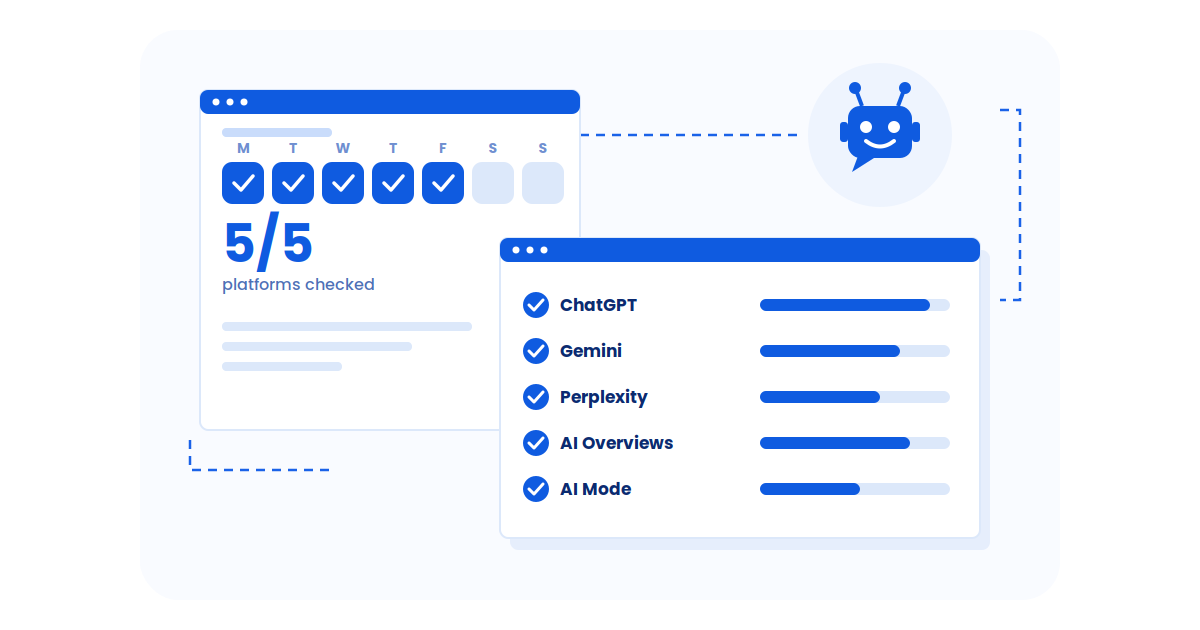
Traditional SEO tools don’t show how your brand appears in AI models like ChatGPT, Gemini, and Perplexity. Use specialized visibility platforms (like Wellows) to track how often your brand is mentioned — the most practical answer to what tools help eco-friendly brands increase search visibility?
- How often your brand is mentioned
- Whether the tone is positive or negative
- How you compare to other sustainability brands
Regular monitoring helps you understand where AI sees you—and where your visibility needs improvement.
6. Leverage AI-Specific Optimization Strategies
To earn consistent citations, you need content that AI can easily interpret and trust. Focus on:
- Generative Engine Optimization (GEO) to shape how AI platforms understand your sustainability data.
- Creating clear, factual, and well-structured content that can be directly referenced in climate and environmental answers.
These tactics help ensure your brand shows up accurately and consistently across AI-generated content.
How to Measure and Track AI Visibility for Sustainability Brands
Here’s how to track your brand’s visibility across major AI platforms in a simple, structured way.
Tracking AI Visibility for Sustainability Brands
1. Identify Relevant AI Platforms
Start by choosing the AI systems your audience uses most. For sustainability brands, this often includes ChatGPT, Gemini, Bing Copilot, and Perplexity. These platforms increasingly influence how people learn about climate action, eco-friendly products, and environmental organizations.
2. Develop a Set of Prompts
Create a list of realistic questions your audience might ask AI tools. These can be product-related, mission-driven, or climate-focused, such as:
- “Which brands are truly carbon-neutral?”
- “Best eco-friendly packaging companies?”
- “What organizations lead in climate innovation?”
Prompts like these help you understand whether AI recognizes and cites your brand.
3. Conduct AI Queries
Run your prompts through each selected AI platform and review the answers carefully. Note whether your brand appears, how it’s described, and whether the context aligns with your sustainability positioning. This helps you see how AI currently interprets your environmental impact.
4. Analyze Visibility Metrics
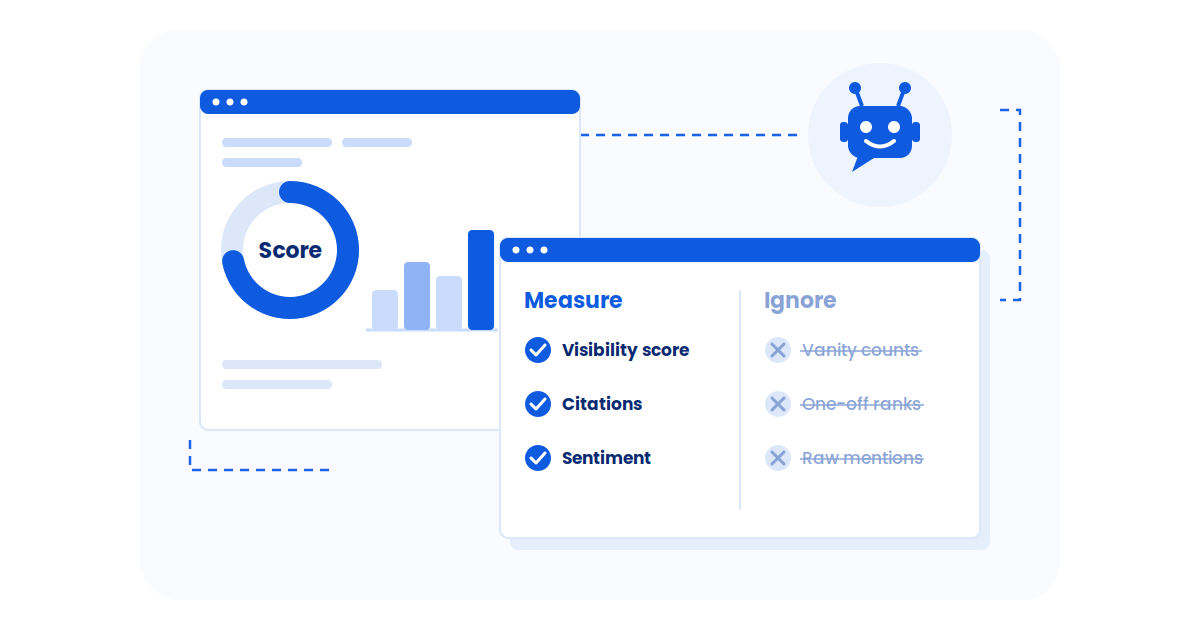
Track performance using simple but powerful metrics, such as:
- Brand Mention Rate: How often AIs mention your brand in relevant answers.
- Citation Rate: How often AIs reference your website or sustainability pages.
- Citation Accuracy: Whether AIs link to the right subpage or source.
Together, these metrics reveal your real visibility inside AI-generated results.
5. Benchmark Against Competitors
Compare your visibility scores with other sustainability leaders or direct competitors. This helps identify gaps, highlight new opportunities, and show where you can improve your environmental messaging to earn more AI citations.
Did you know?
💡 Pro Tip: Run AI visibility scans before and after every sustainability campaign to measure your brand’s impact. If your mentions increase in ChatGPT or Gemini, your environmental story is reaching the AI layer where future customers are listening.
Case Study: Tracking Tentree’s AI Visibility with Wellows
To see what this looks like in practice, here’s a real example using Tentree, a leading sustainable apparel brand known for planting ten trees per item sold.
Using the Wellows AI Visibility Platform, I analyzed how Tentree appears across major AI systems.
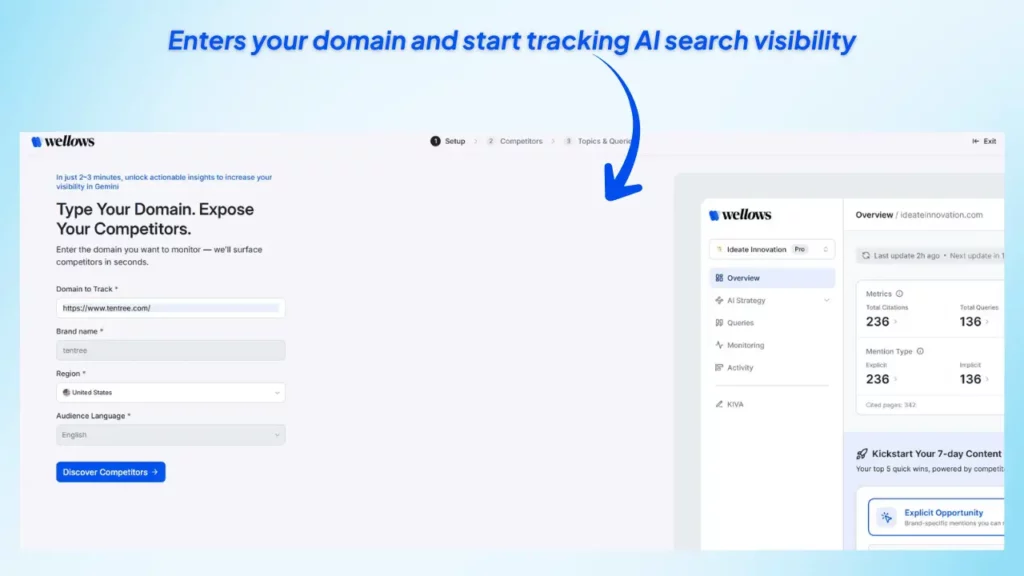
To start, I entered https://www.tentree.com/ into Wellows, set the region to United States, and selected English as the audience language. This setup tells Wellows to track AI search visibility for eco and sustainable brands in the USA and to find Tentree’s closest competitors in generative search.
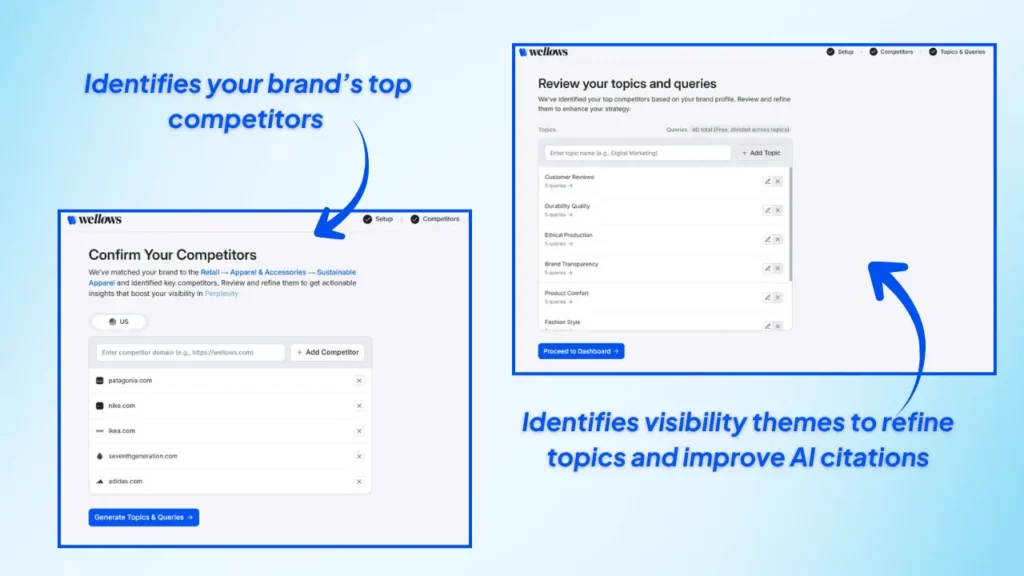
Tentree’s Competitors, Topics & AI Visibility Signals
Wellows automatically placed Tentree in the Sustainable Apparel category and identified competitors like Patagonia, Nike, IKEA, Seventh Generation, and Adidas for benchmark comparison.
It also surfaced Tentree’s core AI visibility themes — including customer reviews, durability, ethical production, brand transparency, and product comfort — highlighting the topics AI systems most frequently analyze when referencing sustainable apparel brands.
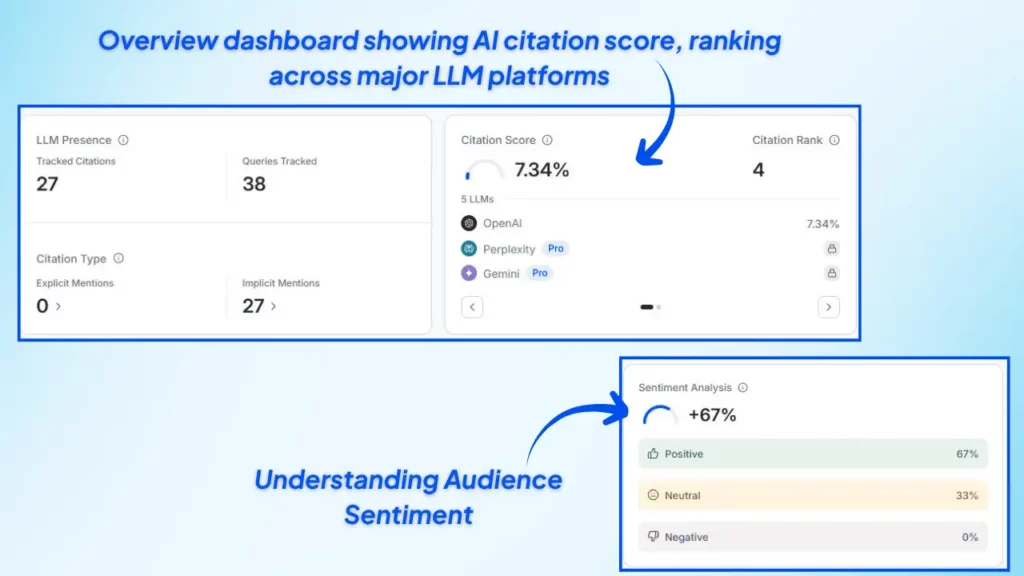
Tentree’s AI Presence & Sentiment Overview
Wellows showed that Tentree appeared in 27 AI-generated mentions across 38 tracked queries — all implicit, with no direct citations — giving it a 7.34% citation score and a #4 ranking.
Sentiment was strongly favorable, with 67% positive and 33% neutral mentions, indicating that AI systems perceive Tentree as a trusted, sustainability-aligned brand despite missing explicit, linkable citations.
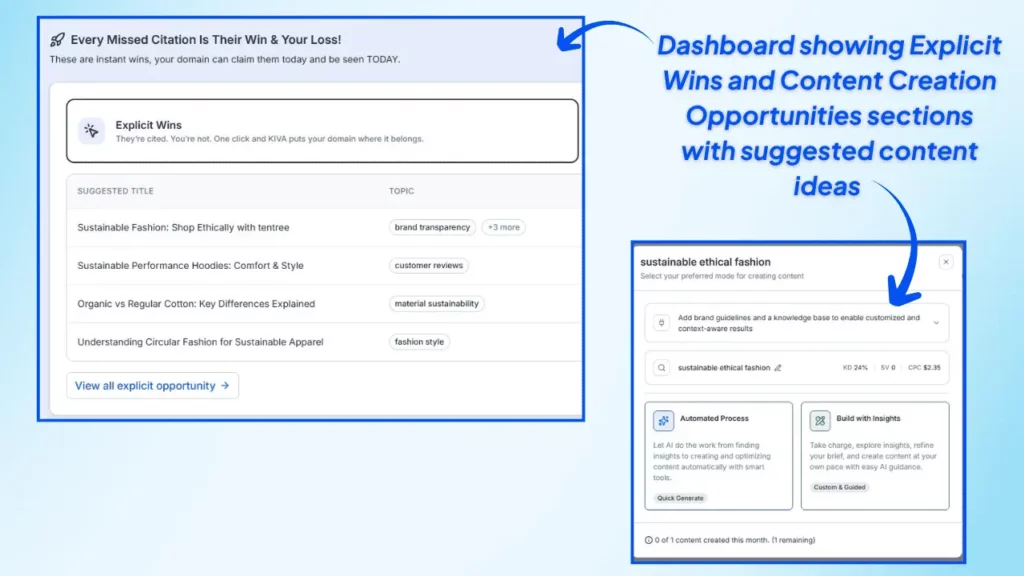
Tentree’s Fastest Path to More AI Citations
Tentree’s Explicit Wins inside Wellows—showing the exact topics where AI systems cite other sustainable brands but not Tentree—along with the instant content creation panel that suggests optimized topics like “sustainable ethical fashion.”
Together, these insights reveal how Tentree can immediately create targeted, AI-ready content to claim missed citations and strengthen its presence in generative search. Content applies the same structured content approach used in Chunk Optimization for AI Search.
Turn Implicit Wins into AI Citations with Built-In Outreach Tools
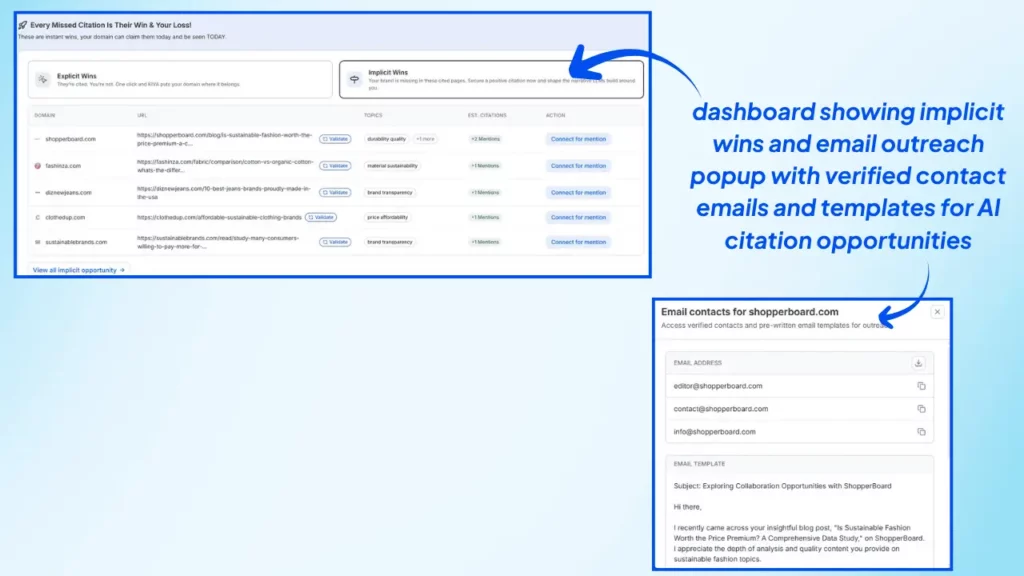
The Implicit Wins panel shows where Tentree is already being referenced by AI systems—but without a proper brand citation. These are high-value opportunities to secure new mentions.
Wellows goes a step further by pulling verified contact emails and auto-generated outreach templates for each citing domain, making it effortless to request proper attribution. With one click, you can contact editors, validate your sustainability claims, and turn unlinked references into explicit AI-visible citations that strengthen Tentree’s authority across generative platforms.
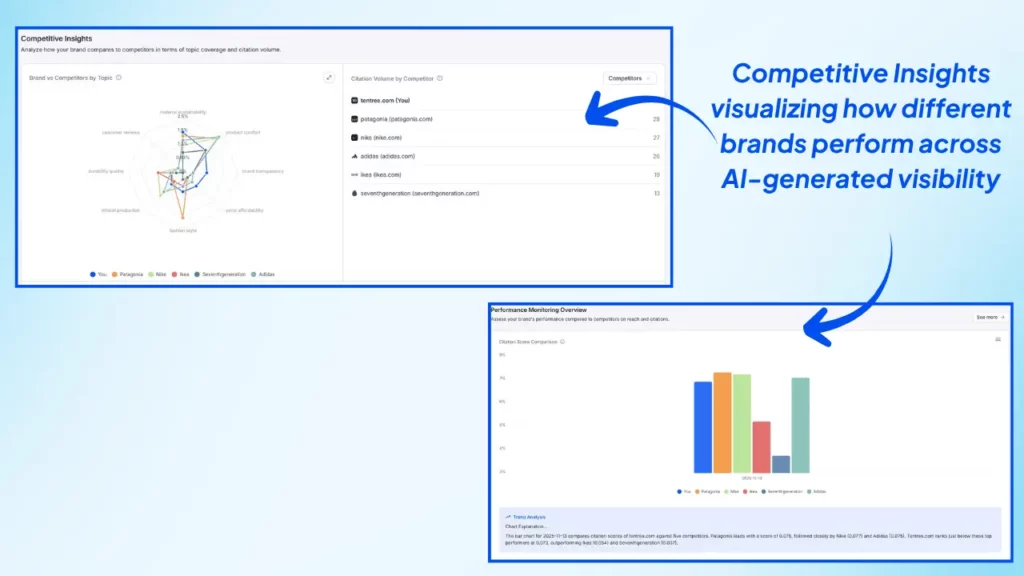
Competitive Insights at a Glance
The Competitive Insights panel shows Tentree holding 27 AI citations—closely aligned with Patagonia and Nike. The radar chart highlights where Tentree is strong (like material sustainability) and where rivals lead. This gives a quick snapshot of priority topics Tentree can strengthen to boost its generative AI visibility.
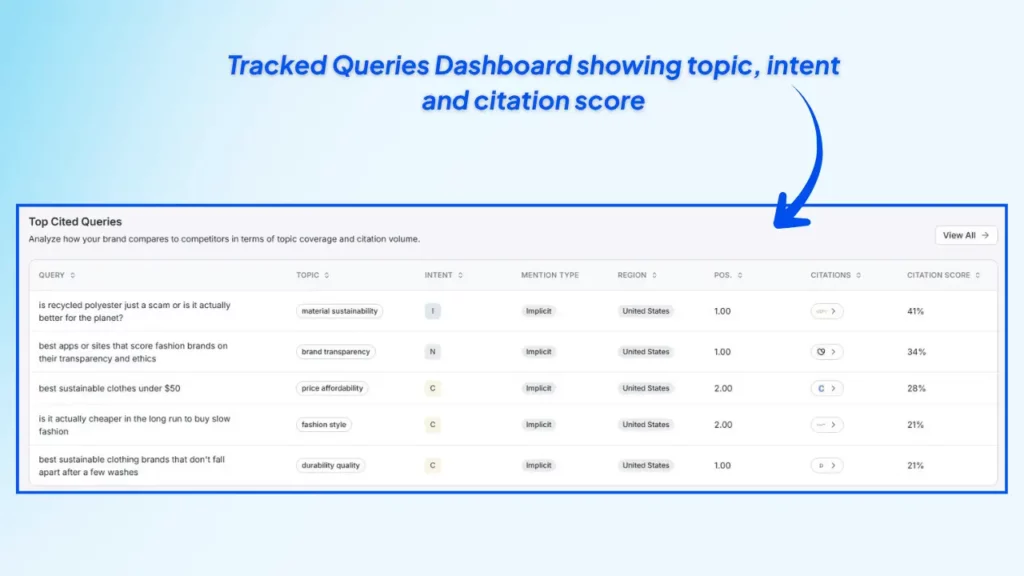
Top Cited Queries
The Top Cited Queries show where Tentree is already appearing implicitly across core topics like material sustainability, transparency, affordability, and durability. These insights reveal the exact AI questions driving Tentree’s visibility and highlight which topics to strengthen with targeted, AI-optimized content.
Eco-Friendly Brand AI Presence Strategies
Eco-friendly brands can use AI to strengthen their digital presence and support their sustainability goals. Here are a few key strategies to explore:
AI Strategies for Eco-Friendly Brand Visibility
- Personalized Sustainable Messaging:
AI tailors sustainability messages to individual preferences, recommending eco-friendly products and surfacing climate initiatives that match each customer’s values—showing exactly how AI can improve digital marketing for environmental brands.
- Green Influencer Marketing:
AI identifies influencers with genuine environmental credibility by analyzing audience reactions and long-term impact, helping brands build trust and avoid greenwashing.
- Circular Economy Marketing:
AI highlights opportunities around product reuse, recycling, and low-waste design, making it easier for brands to communicate circular practices and educate consumers.
- Supply Chain Transparency and Ethical Procurement:
AI tracks suppliers, monitors environmental compliance, and flags risks early. Blockchain-integrated systems add verifiable transparency to sustainability claims.
- Sustainable Consumer Engagement and Loyalty Programs:
AI powers green loyalty programs by recommending eco-friendly alternatives, creating sustainability challenges, and personalizing rewards to encourage better consumer habits.
- Energy-Efficient AI Operations in Marketing:
AI can minimize its own environmental footprint by selecting renewable-powered data centers, optimizing workloads, and reducing unnecessary processing.
- AI-Driven Content Creation:
AI generates sustainability-aligned content—from articles to social posts using methods similar to the workflows described in LLM Content Creation Strategy —helping brands maintain consistent environmental messaging with less time and effort.
- Green Certifications and Labels:
AI helps brands identify, manage, and communicate eco-certifications, making verified achievements clearer to consumers and strengthening credibility.
By using these AI-powered strategies, eco-friendly brands can strengthen their online presence, connect with their audience, and showcase their sustainability efforts.
Common Challenges and Solutions in AI Visibility for Environmental Brands
Building visibility in AI-driven search isn’t without its hurdles. Many environmental brands face issues similar to traditional SEO but with higher stakes, as AI systems rely on structured, trustworthy data to generate responses.
Here’s how to overcome the most common challenges:
| Challenge | Solution | Insight |
| Limited structured sustainability data | Apply schema markup and structured reporting to your sustainability pages and impact reports. | Enhances AI readability and helps AIs interpret your environmental data accurately. |
| Lack of citations from credible sources | Build partnerships with NGOs, academic institutions, and green media outlets to earn verified mentions. | Boosts trust signals and improves your chances of being cited by AI systems. |
| Outdated or inconsistent claims | Regularly update your ESG data, product impact metrics, and sustainability goals across all platforms. | Prevents misinformation and ensures AI pulls current, reliable information about your brand. |
| Negative sentiment mentions | Monitor tone using sentiment analysis tools and address inaccuracies quickly through verified updates or press statements. | Maintains AI trustworthiness and keeps your brand positioned positively in generative results. |
Did you know?
💡 Summary: Continuous tracking, structured updates, and transparent communication are key to sustaining AI visibility. When your data is consistent and credible, AI systems are far more likely to include — and trust — your environmental brand in their answers.
Future Trends in AI Search for Sustainability
AI is transforming how people compare and trust sustainable brands. Users increasingly ask generative engines questions like “Which brand has the lower carbon footprint?”, pushing AI to deliver quick, data-backed environmental comparisons.
Demand for eco-friendly products and conscious consumption continues to climb, according to a 2025 report of TheRoundup.org on environmentally-conscious consumer behavior.
Multimodal AI is also rising, blending text, video, and social content. A simple recycling tutorial or an eco-friendly product review can now influence AI-generated summaries, adding real community credibility.
Real-time sustainability dashboards are becoming another major trend. Brands that share live emissions, energy use, or progress updates give AI models reliable data to reference and promote.
Soon, AI agents will automatically scan certifications, carbon reports, and compliance documents to verify sustainability claims—making structured, honest reporting essential.
Discover how AI-driven visibility strategies apply across industries. Each guide offers actionable insights to strengthen brand authority in AI-generated answers within its niche.
- AI Search Visibility for Automotive Brands: Be recognized in AI-powered car research, comparisons, and buying advice.
- AI Search Visibility for Hospitality Brands: Understand how hotels and resorts can improve entity signals, GEO alignment, and citation consistency in AI-driven travel discovery.
- AI Search Visibility for Banking & Financial Services Brands: Get cited in AI money management, budgeting, and lending insights.
- AI Search Visibility for HealthTech & Medical Devices Brands: Appear in medical AI queries.
- AI Search Visibility for Consumer Electronics Brands: Guide covering metadata, spec clarity, and AI-optimized device visibility.
- AI Search Visibility Audit Checklist: A practical framework to measure, fix, and grow your brand’s citations across major AI search platforms.
FAQs
Conclusion: Building AI Trust Through Sustainability Transparency
AI is changing how people discover and trust sustainability brands. Being visible in search results isn’t enough anymore — your brand also needs to show up when AI assistants talk about climate leadership, green innovation, or eco-friendly products.
We’ve entered a new phase: from SEO to GEO to AI Visibility. Traditional SEO helps people find you. GEO helps AI understand you. Together, they make sure your sustainability story is seen, cited, and trusted across emerging AI platforms.
The key is transparency. When your environmental data, reports, and certifications are structured and easy to verify, AI systems recognize your brand as a credible source. That visibility builds lasting trust — both with consumers and the technology shaping their choices.
The Wellows AI Visibility Platform helps you see how often and where your brand appears in AI conversations — across ChatGPT, Gemini, Bing, and beyond — and highlights where you can grow stronger.
See where your brand appears in AI-driven climate conversations. Start Your 7-Day Trial