- Travel behavior has shifted dramatically. Expedia reports that 44% of U.S. travelers now use AI tools to plan trips.
- Booking.com found that 32% rely on AI to choose where to stay.
- Skift Research shows that 48% of Gen Z and Millennial travelers use AI recommendations when researching destinations.
- Phocuswright confirms that 1 in 3 hotel decisions is influenced by AI-generated suggestion.
Generative AI has become a primary discovery channel for accommodation research. Instead of browsing long SERP lists, travelers receive condensed recommendations from ChatGPT, Gemini, Perplexity, and Bing AI. Hotels with accurate entity signals, clean amenities, and consistent property data appear earlier in these AI-driven suggestions.
Wellows help uncover gaps that reduce visibility in AI results, such as missing citations, weak GEO alignment, and incomplete amenity information. Correcting these structural inconsistencies increases a hotel’s likelihood of appearing in AI-generated travel recommendations.
What Is AI Search Visibility for Hospitality Brands?
Search Engine Visibility for hospitality brands reflects how confidently LLMs identify a hotel, its amenities, its location, and its unique property attributes. Models read structured data, room details, amenity lists, and GEO signals to confirm which property belongs to your brand and how it compares to nearby or competing hotels.
LLMs validate information by checking amenity accuracy, location consistency, review patterns, and stable naming across external travel sources. Stronger signals increase hotel brand visibility in generative search and improve the likelihood of appearing when travelers ask how to get resorts mentioned in AI recommendations.
Clear taxonomies, aligned room categories, accurate metadata, and well-structured property pages reduce ambiguity for AI systems. When these signals align with LLM trust patterns, hotels gain stronger placement inside travel answers, destination comparisons, and early consideration flows that influence booking decisions.
Why Competitor Hotels Rank Higher in AI Results
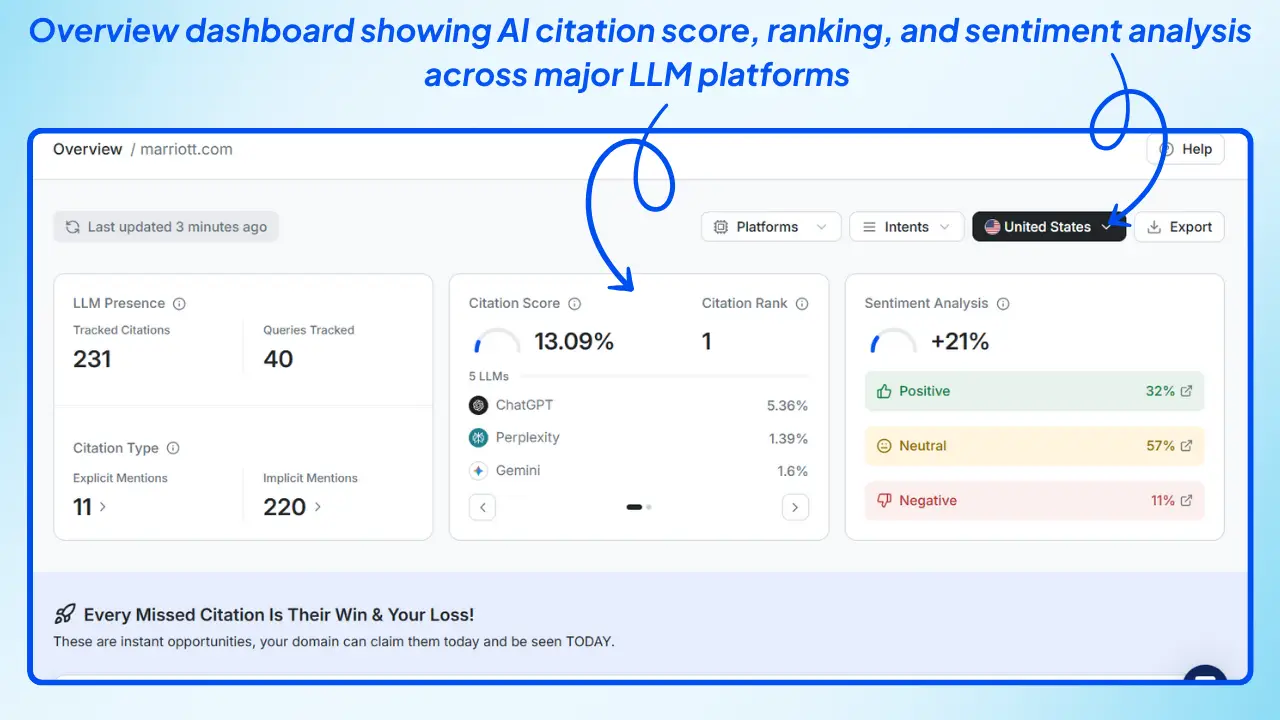
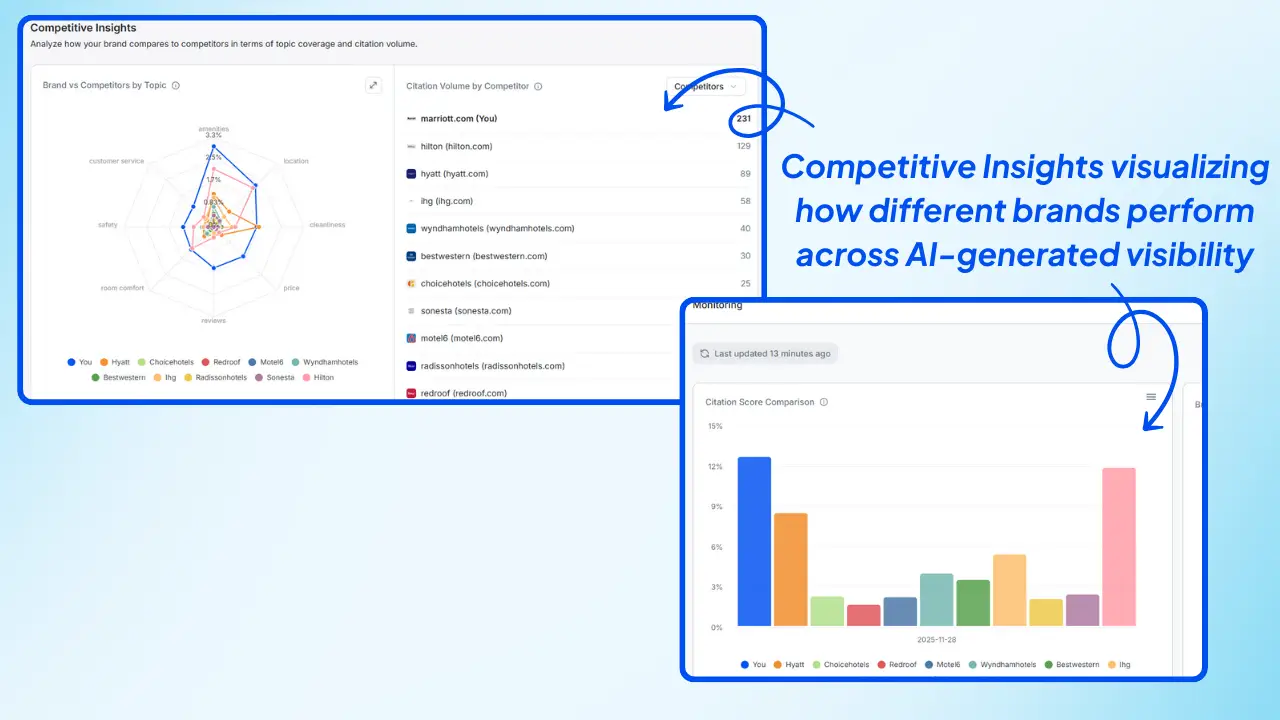
Wellows data reveals large visibility gaps across major hotel brands. Marriott leads with 224 citations from 40 tracked queries, significantly ahead of Hilton (125), Hyatt (87), and IHG (54). This shows how uneven LLM recognition has become across hospitality properties.
AI redistributes “brand authority” by prioritizing structured property data instead of traditional SEO signals. Marriott maintains stronger amenity accuracy, GEO clarity, and metadata consistency, which helps secure better placement while competitors lose ground due to incomplete room details, inconsistent location markers, or fragmented property descriptions.
Misattribution remains a core issue. Marriott recorded 10 explicit mentions but 214 implicit mentions, meaning AI often uses Marriott-aligned strengths but credits other hotels that display cleaner or more complete digital signals. Sentiment trends also influence ranking, with 23% positive, 61% neutral, and 8% negative shaping visibility inside generative travel answers.
| Metric | Value |
|---|---|
| Tracked Queries | 40 |
| Total Citations | 224 |
| Citation Score | 11.98% |
| Explicit Mentions | 10 |
| Implicit Mentions | 214 |
| Citation Rank | 1 |
| Top Competitors | Hilton 125, Hyatt 87, IHG 54, Wyndham 37, BestWestern 18, Choice 17, Motel6 17, Radisson 12, Sonesta 9, RedRoof 7 |
| Positive Sentiment | 23% |
| Neutral Sentiment | 61% |
| Negative Sentiment | 8% |
How AI Systems Recommend Hotels, Resorts & Destinations
AI models rank hotels by analyzing structured property data, room categories, amenity accuracy, GEO signals, and review consistency. Clear details on location, check-in policies, service quality, and guest experience reduce ambiguity, strengthening AI Search Visibility strategies for hospitality brands during competitive comparisons.
Models verify hotel identity through consistent naming, unified room descriptions, accurate amenity lists, and alignment across OTAs, maps, and travel directories. Hotels gain visibility faster when these sources match cleanly, signaling trust and reliability across multiple platforms.
Generative engines recommend properties more confidently when amenities, location details, and experience claims follow predictable structures. Wellows, an AI search visibility platform, identifies trust gaps in hotel data and helps teams apply AI tools for enhancing hotel search visibility with precision.
The Current State of AI Visibility for Hotels (2025)
AI engines reveal clear weaknesses across many hospitality brands. When travelers ask “what is AI search visibility for hotels?,” models look for structured amenities, location accuracy, and consistent property identity. Gaps in these areas lead to unstable or incomplete recommendations.
Did you know?
Did you know?
Did you know?
Did you know?
Did you know?
How to Get a Hotel or Resort Mentioned in AI Travel Recommendations
AI systems generate two types of visibility for hotels: direct mentions and indirect recognition. Both influence how frequently a property appears in generative travel answers across destinations and intents.
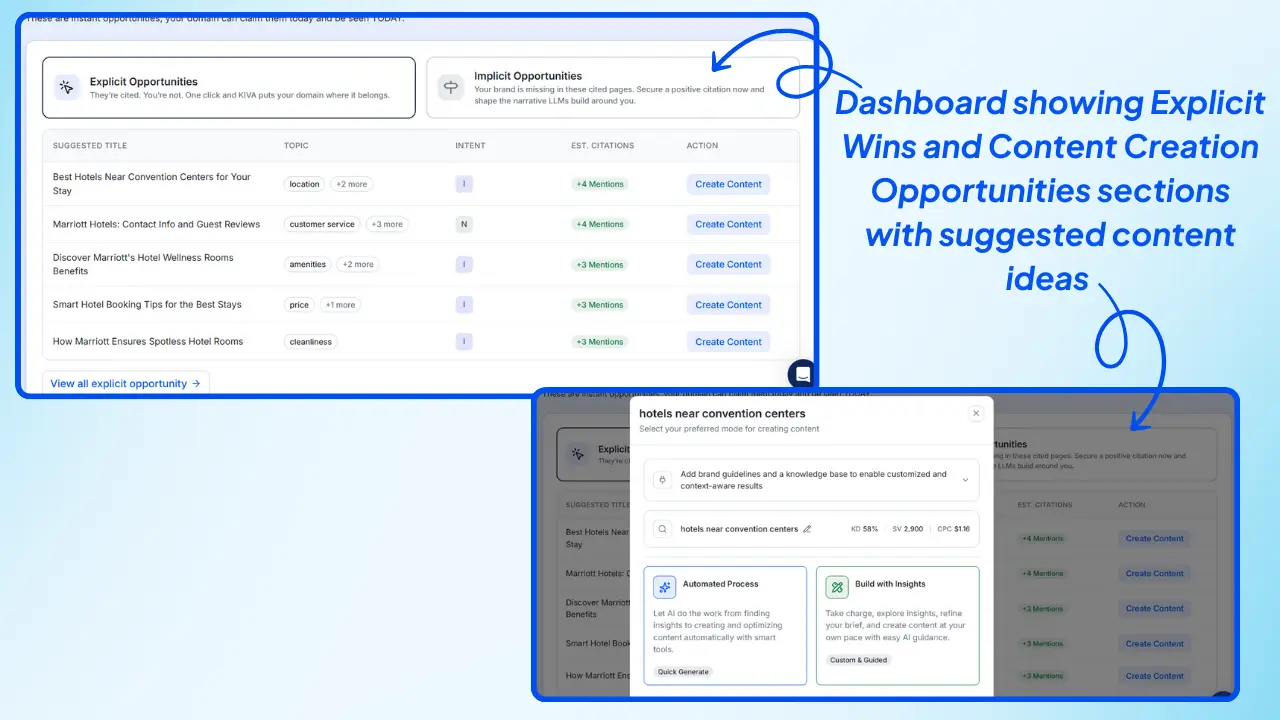 Wellows reveal missing elements such as outdated amenities, weak location signals, or inconsistent room details that prevent AI from selecting your property during these high-intent prompts.
This is common in competitive markets where many hotels share similar features. Wellows identifies these hidden opportunities and surfaces cases where your capabilities appear in AI answers but are attributed to another hotel, giving you a clear blueprint for improving room data, amenity accuracy, and GEO alignment.
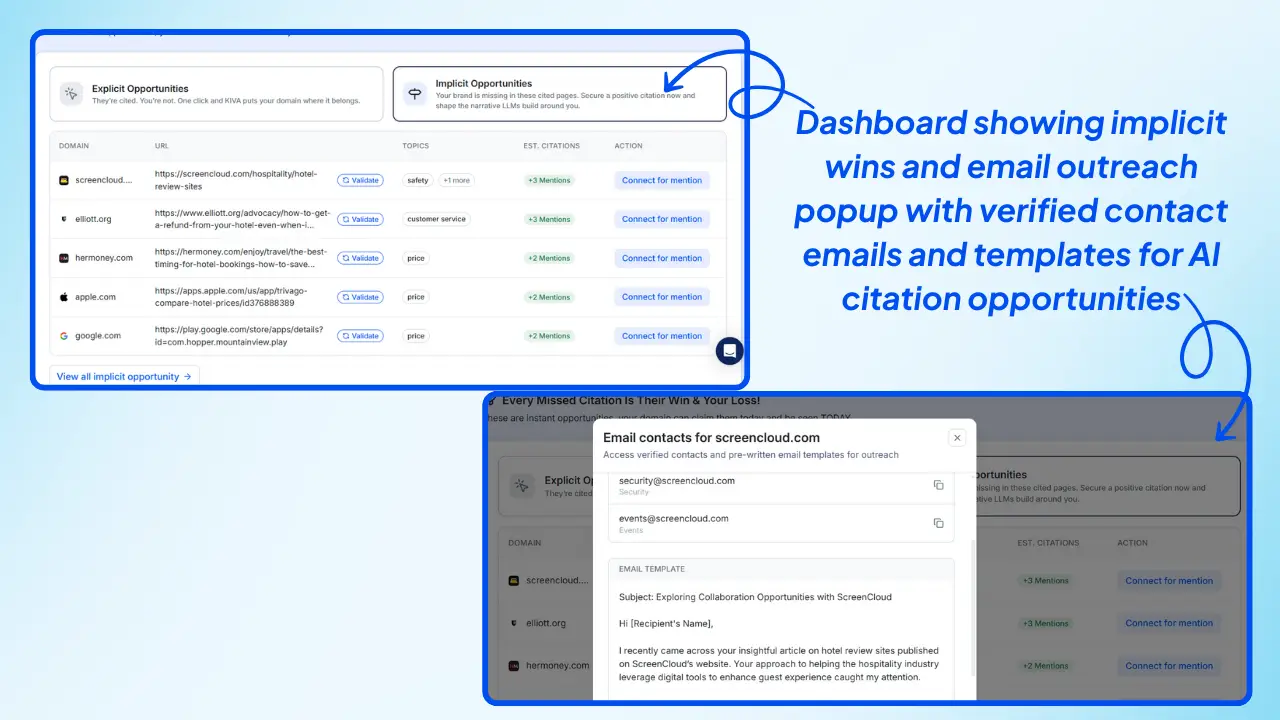
Hospitality SEO tactics using AI: Structured amenities, unified room descriptions, and consistent GEO data increase the likelihood of earning explicit placement across major LLM platforms.
AI search visibility techniques for resorts: Clear guest policies, service details, activity lists, and experience descriptions help AI match your property to traveler intents without shifting credit to competitors.
GEO Optimization Guide for Hospitality Companies
AI systems rely heavily on precise GEO signals when generating travel answers. Accurate location data, consistent map listings, and stable service radius information help models determine which hotels are relevant for “near me” and region-specific prompts.
Did you know?
- Exact address accuracy: AI checks for一致 mapping across OTAs, Google Maps, and first-party domains. Even minor inconsistencies reduce local visibility.
- Service radius clarity: Clear distance markers, neighborhood tags, and proximity to landmarks strengthen relevance for city- and district-level queries.
- Consistent entity listings: Unified NAP (name, address, phone) details prevent duplication and ensure LLMs treat all signals as one property.
- Localized content blocks: Structured sections describing nearby attractions, travel routes, and transport access help AI match your hotel to local-intent prompts.
- Regional authority alignment: Listings validated by tourism boards, convention centers, and event venues strengthen geographic trust inside AI answers.
How to Improve Hotel Chain Placement in AI Booking & Travel Searches
AI systems evaluate hotel chains differently from single properties. Chains perform best when every location maintains consistent data, unified room types, and synchronized amenities. Fragmented property details create uncertainty, reducing visibility in booking-intent prompts.
- Chain-wide room taxonomy: Standardized room names and amenities help AI compare locations without ambiguity.
- Cross-property metadata alignment: Consistent descriptions, policies, and service details strengthen brand identity across all listings.
- Brand hierarchy clarity: Clear parent–child relationships between brand, category, and location improve chain recognition.
- Centralized structured data: Uniform schema across every property boosts visibility for chain-level searches.
- Loyalty-driven signals: Clearly documented rewards, tiers, and benefits increase relevance for travel-intent queries.
AI Search Algorithms for Luxury, Boutique & Independent Hotels
LLMs differentiate hotel categories based on uniqueness, service level, and clarity of experience signals. Luxury, boutique, and independent hotels gain visibility when their distinct attributes are structured clearly.
Did you know?
- Luxury hotels: Detailed service descriptors, premium amenity clarity, and experience-driven language improve placement in high-intent luxury queries.
- Boutique hotels: Unique themes, design elements, and localized storytelling help AI map individuality across competitive markets.
- Independent hotels: Clear identity markers, accurate room descriptions, and strong GEO reinforcement offset the absence of chain-level authority.
- Experience signals: Curated activities, neighborhood immersion, and personalized services strengthen differentiation.
- Consistency across channels: Aligned descriptions across OTAs, maps, and first-party sites reduce ambiguity for model ranking.
How To Audit Hotels for AI Search Visibility?
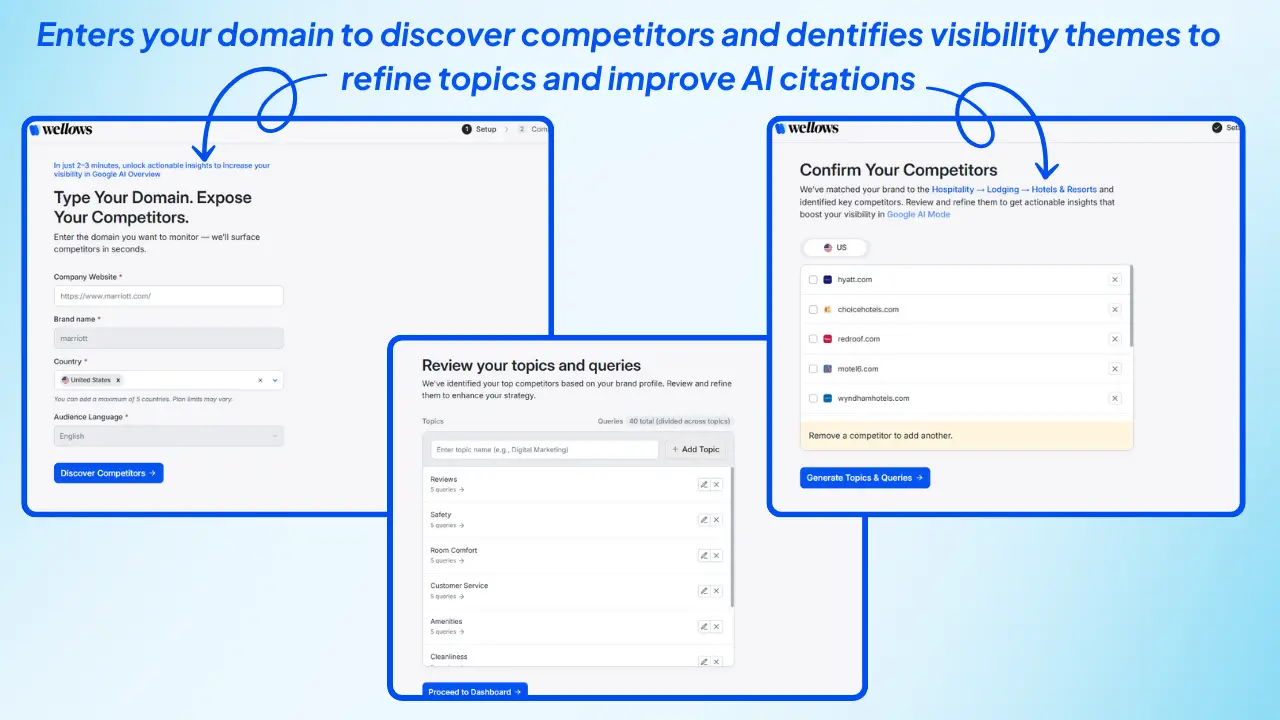
When I audit AI search visibility for hotels, I begin by adding the domain and property categories into the Wellows platform. This reveals how often AI systems mention the hotel when travelers compare amenities, evaluate locations, or look for properties that match their trip intent.
In Marriott’s example, Wellows scanned 40 queries and surfaced 224 citations across major LLMs. The platform converts these into an 11.98% Citation Score, showing how reliably models mention Marriott compared to Hilton, Hyatt, and IHG.
Next, I check how Wellows groups visibility themes. Marriott leads across amenities, room comfort, cleanliness, and service quality explaining why it ranks first in many travel-intent recommendations.
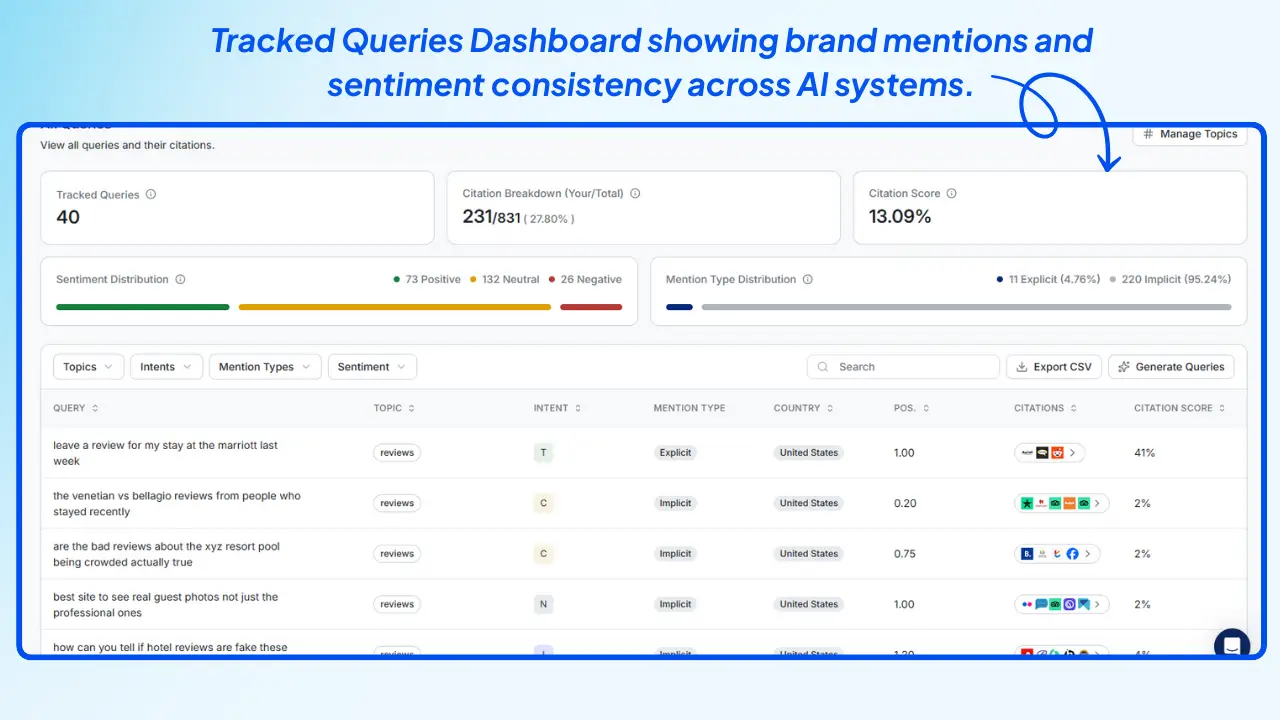
I then review explicit and implicit wins. Marriott shows 10 explicit and 214 implicit mentions, meaning AI often uses the brand’s strengths but credits competitors with cleaner structured data. These gaps translate into updates for room descriptions, amenity accuracy, and GEO signals.
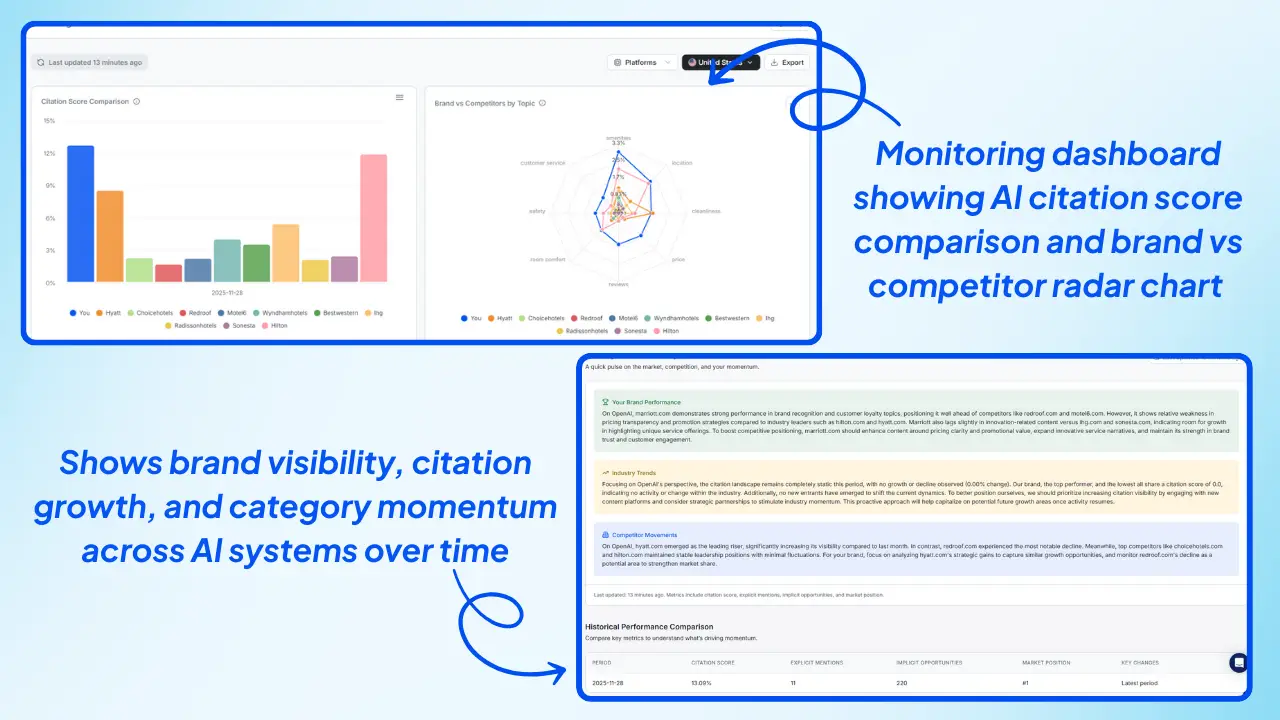
Wellows also highlights sentiment distribution: 23% positive, 61% neutral, 8% negative. These patterns show how LLMs summarize guest experience and help identify improvement areas for stronger AI placement in travel answers.
Wellows supports agencies managing multi-property hospitality portfolios and startup hotel brands that need clear entity signals from day one. The same AI visibility principles used across other sectors now apply directly to hotels, resorts, boutique properties, and vacation accommodations as travelers increasingly rely on generative systems for discovery.
How Reviews, UGC & Social Contributions Shape AI Hotel Recommendations
AI systems rely heavily on guest-generated content to understand real visitor experience. Review consistency, sentiment distribution, and credible narrative patterns influence how models judge service quality, cleanliness, staff interaction, and overall satisfaction.
Did you know?
Did you know?
Did you know?
Did you know?
Did you know?
Creating AI-Liftable Content for Hotels (Zero-Click Travel Answers)
LLMs reuse structured information directly in their answers, so hotels must format content in ways that AI can extract safely and accurately. Clear, predictable blocks reduce model uncertainty and increase visibility in zero-click travel recommendations.
Roadmap to Enhance AI Search Visibility for Hotels
A structured plan helps hotels improve their entity clarity, GEO accuracy, and competitive placement across LLM platforms in a predictable, measurable way.
Did you know?
- Fix inconsistent amenities, room descriptions, and property metadata.
- Update structured data, FAQs, and location signals.
- Audit sentiment and remove outdated or unclear narratives.
Did you know?
Weeks 4–8: Build Visibility
- Create AI-liftable content blocks for rooms, amenities, and itineraries.
- Improve GEO accuracy and align map listings.
- Strengthen review volume and social engagement patterns.
Did you know?
Weeks 8–12: Expand Competitive Position
- Address implicit-win gaps revealed by Wellows.
- Optimize cross-property consistency for chains or groups.
- Monitor visibility trends and refine content based on LLM outputs.
Discover how AI Search Visibility shapes discovery across major sectors. These guides explain how organisations strengthen citations, entity clarity, and sentiment inside AI-generated answers.
- AI Search Visibility for Education & EdTech Brands: Increase citation accuracy for institutions, programs, and credential information.
- AI Search Visibility for Human Resources & Recruiting Brands: Improve recognition in ATS, staffing, and hiring-intent AI queries.
- AI Search Visibility for Consumer Electronics Brands: Guide covering metadata, spec clarity, and AI-optimized device visibility.
- AI Search Visibility for Entertainment Brands: Enhance citations in zero-click recommendations and viewer-intent queries.
- AI Search Visibility for Fashion & Apparel Brands: Improve product-level clarity, sizing consistency, and trend relevance inside generative search.
- AI Search Visibility for Home Improvement Brands: Get cited in AI renovation advice and product recommendations.
Insight: Across all industries, organisations that control their metadata, structured signals, and third-party accuracy gain stronger placement in generative answers and outperform competitors inside AI-driven discovery flows.
FAQs – About AI Search Visibility for Hotels
Conclusion: The New AI-Driven Discovery Landscape for Hospitality
AI has become the primary gateway for travel discovery. Instead of browsing long search results, travelers now rely on instant recommendations from ChatGPT, Gemini, Perplexity, and Bing AI. Hotels that maintain structured data, accurate amenities, and strong GEO signals consistently appear earlier in these AI-generated answers.
As LLMs shape traveler intent and booking behavior, AI search visibility becomes a core competitive advantage. Hospitality brands that strengthen their entity clarity, publish AI-liftable content, and monitor citation trends will outperform rivals in the next wave of digital discovery. Visibility now depends on how confidently AI can verify your hotel long before a traveler reaches the booking page.