Homeowners today are turning to AI tools for advice on renovations, décor choices, and product recommendations. Instead of browsing through multiple websites, they ask tools like ChatGPT, Google Gemini, and Copilot for quick, clear guidance.
These AI tools don’t show long lists of links. They give direct suggestions often naming specific brands and products. If your brand isn’t included in those answers, you lose visibility long before a customer reaches a store or search engine results page.
This shift is part of a new era called Search Engine Visibility, where being recommended by AI matters as much as, or even more than, ranking on Google. For home improvement brands, learning how to appear in these AI generated answers is now essential.
AI search is also changing how home improvement brands improve their search rankings, because optimization now involves teaching AI models how to understand and recommend your products.
Many DIY brands are now asking an important question: “How do we get our tools and materials mentioned in AI answers?” As homeowners rely more on AI for repair tips, product suggestions, and project guidance, it’s crucial that AI systems recognize your products and understand when to recommend them.
This means your brand needs clear, detailed information online, strong authority signals, and consistent visibility across platforms where AI models gather their knowledge. When these pieces are in place, AI tools are more likely to include your products in their recommendations.
What does AI Search Visibility mean for Home Improvement Brands?
AI search visibility refers to how often a brand appears, gets mentioned, or gets recommended inside AI generated answers. These answers come from tools like ChatGPT, Google Gemini, Copilot, and AI-powered shopping assistants used by retailers.
This definition helps explain what AI search visibility means for home improvement brands, especially those trying to appear in top-of-funnel queries like tool comparisons and renovation material suggestions.
When homeowners ask these tools for advice on flooring, lighting, appliances, décor, outdoor products, or renovation materials, the AI decides which brands to highlight. This decision is based on how well the AI understands your products, your reputation, and the information available about your brand across the web.
That’s why technologies involved in AI search visibility, such as machine learning, knowledge graphs, and structured data, are becoming critical for home brands.
For home improvement brands, AI search visibility is becoming just as important as traditional SEO. Even if your website ranks well on Google, you can still be completely left out of AI answers. This means fewer people learn about your brand during the early stages of their buying journey.
Improving AI search visibility helps your products show up when people ask:
- what materials are best for different rooms
- which products last longer
- what brands are trusted for specific home needs
- which items look best for certain design styles
As AI tools become the main place homeowners turn to for recommendations, brands that focus on AI visibility will reach more customers, build stronger trust, and stay competitive in a fast-changing market.
This shift highlights the benefits of AI in search visibility for home brands, helping them stand out earlier in the customer journey.
Hardware Store Visibility in Generative AI
Generative AI is changing how customers find and interact with hardware stores. With more people turning to AI tools for product advice and store suggestions, hardware retailers need to stay visible and use AI to improve their service and operations.
1. Enhanced Marketing and Promotions
- Content Creation: GenAI tools can quickly create product descriptions, ads, and social posts, helping hardware stores maintain consistent marketing with less effort.
- Lower Marketing Costs: AI reduces the need for external agencies by generating images and promotional content in-house, lowering overall marketing expenses.
2. Improved Customer Service
- AI Chatbots: Chatbots provide instant answers about products, store hours, and availability, improving response times and customer satisfaction.
- Personalized Product Suggestions: AI recommends tools and materials based on customer behavior, making shopping easier and more relevant.
3. Efficient Inventory Management
- Predicting Demand: AI forecasts what items will sell based on trends and past data, helping avoid shortages or overstock.
- Smart Reordering: AI can automate restocking by placing orders when inventory is low, reducing manual oversight.
4. Personalized Customer Experiences
- AI Shopping Assistants: Virtual assistants guide customers through product choices and DIY questions, offering helpful support anytime.
- Customized Loyalty Programs: AI analyzes buying habits to create personalized rewards and offers that match customer interests.
5. Data-Driven Decision Making
- Understanding Sales Trends: AI identifies which products are performing well, helping stores make smarter purchasing and promotion decisions.
- Better Customer Insights: By analyzing feedback and browsing behavior, AI shows what customers want, allowing more targeted marketing and better product displays.
By using generative AI across these areas, hardware stores can increase their visibility in AI-driven search results, improve daily operations, deliver better customer experiences, and make smarter business decisions.
Improving Contractor Supply Visibility in AI Search
Improving visibility for contractor supply businesses in AI-powered search means using smart technology to better understand, monitor, and manage supply operations. These approaches help suppliers stay organized, reduce delays, and ensure materials are available when needed.
1. Implement AI-Powered Tracking Systems
AI combined with tools like IoT sensors, RFID labels, and GPS makes it possible to follow materials and equipment throughout the supply chain. With real-time updates, contractors can quickly spot issues (such as misplaced shipments or damaged items) and take action before they affect a project.
2. Leverage Predictive Analytics
Machine learning can examine patterns in past and live data to predict supply problems early. Whether it’s a late shipment or a transportation bottleneck, predictive analytics helps teams prepare backup plans so projects stay on schedule.
3. Integrate AI with Blockchain Technology
Using blockchain alongside AI creates a secure and transparent record of every transaction or movement in the supply chain. This improves traceability, reduces errors, and builds trust among contractors, suppliers, and manufacturers by ensuring everyone sees accurate information.
4. Utilize Knowledge Graphs and Large Language Models (LLMs)
Knowledge graphs help map all relationships within a supply chain, suppliers, materials, delivery timelines, and more. When paired with LLMs, these systems can pull insights from many data sources, making it easier to understand complex supply networks and identify what needs attention.
5. Adopt AI-Driven Supplier Discovery Tools
AI tools can scan large datasets to help contractors find reliable suppliers that meet specific requirements, such as safety standards, product quality, or delivery capacity. This speeds up the search process and ensures the chosen suppliers align with project needs.
6. Enhance Collaboration with AI-Powered Platforms
AI-enabled collaboration systems make communication smoother across teams, contractors, suppliers, logistics partners, and more. Real-time updates help everyone stay aligned, solve problems quicker, and maintain clear visibility across all stages of the supply chain.
By using these AI-driven methods, contractor supply companies can improve transparency, reduce risks, strengthen coordination, and ultimately achieve smoother, more dependable project outcomes.
Why AI Search Visibility Matters for Home Improvement Brands
AI search is reshaping how homeowners discover products and services. Understanding why visibility matters helps brands stay competitive as AI becomes a primary decision-making tool.
People want quick and reliable answers. They prefer one clear suggestion instead of 10 links.
AI is becoming the first stop for:
- renovation planning
- material selection
- product comparisons
- maintenance advice
Google’s AI Overviews often answer users’ questions without sending them to websites.
This means your brand must appear inside the AI answer, not just in traditional search rankings.
If AI tools consistently recommend the same brands, those brands will naturally win more customers.
Brands that optimize early will dominate AI-driven discovery.
How AI Understands Home Improvement Brands
AI tools rely on four main sources to decide whether to recommend your brand:
1. Clear brand information (Entity)
AI must understand:
- what you sell
- the materials you use
- ideal use cases
- customer types
- what makes your products better
If your brand identity is unclear, AI will choose competitors with stronger signals.
2. Detailed product information
Home improvement decisions depend heavily on product details.
AI needs complete data, such as:
- dimensions
- materials
- safety ratings
- installation steps
- maintenance needs
- certifications
- energy efficiency
- durability details
The more detailed your product info, the easier it is for AI to trust and recommend it.
3. Helpful and practical content
AI favors content that solves real homeowner problems, such as:
- “laminate vs. hardwood flooring”
- “how to choose outdoor lighting”
- “best paint for bathrooms”
- “how to install peel-and-stick tiles”
If your content is thin or overly sales-focused, AI will ignore it.
4. Mentions from other websites
AI learns from:
- YouTube reviews
- DIY blogs
- Pinterest posts
- Reddit home improvement discussions
- Interior design articles
- Tool review channels
These third-party mentions help AI understand your brand’s reliability and reputation.
Home Improvement Brand AI Search Strategies
As AI tools become a major source of information for homeowners, home improvement brands must adjust how they present and share content online. The strategies below can help your brand stand out in AI-generated answers and recommendations.
1. Develop High-Quality, Relevant Content
Create content that clearly shows your knowledge of home improvement materials, tools, and services. Your articles, guides, and product pages should offer practical, helpful information that homeowners can trust. AI tools look for content that is accurate, easy to understand, and written by knowledgeable brands. Strong, original content makes it more likely that AI systems will surface your brand in their answers.
2. Optimize for Local SEO
AI search tools often personalize results based on location. Make sure your website speaks to local homeowners by including city names, service areas, and community-specific details. Partnering with local contractors, designers, or retailers can also boost your authority in your region. The more locally relevant your content is, the better AI tools can match your brand to nearby customers.
3. Implement Structured Data and FAQ Sections
Structured data helps AI systems read and interpret your website more accurately. It allows search tools to understand your products, prices, availability, reviews, and more. Adding clear FAQ sections on your pages also helps AI pull your answers into its responses. Keep your FAQs short, straightforward, and focused on the questions homeowners frequently ask.
4. Publish Original Research and Data
AI platforms value brands that bring new information to the industry. You can stand out by sharing your own findings, such as survey results, trend reports, material performance tests, or consumer insights. When your brand becomes a source of original data, AI tools are more likely to reference your content when generating answers for users.
5. Enhance Off-Page Authority
Your reputation outside your website also shapes your AI visibility. Make sure your brand appears in trusted places such as home improvement directories, review platforms, industry associations, and guest articles. When reputable websites mention your brand, it strengthens your credibility and makes it easier for AI systems to view you as a reliable option.
6. Leverage AI-Powered Lead Generation
AI-driven lead generation tools can help you create targeted pages for specific services and locations. These pages attract homeowners who are ready to buy, without relying heavily on ads. By covering a wide range of service types and local areas, you increase your chances of being discovered in AI-powered searches.
7. Monitor and Adapt to AI Search Trends
AI search is constantly evolving, so your content cannot stay static. Review your pages regularly to keep information accurate and updated. Pay attention to new topics homeowners are asking about such as energy-efficient upgrades, sustainable materials, or smart home features and add content that addresses those interests. Staying current helps your brand remain visible as AI search behavior changes.
By applying these strategies, home improvement brands can strengthen their presence in AI search results, reach more homeowners, and stay competitive in a landscape where AI plays a growing role in buying decisions.
DIY Brand GEO Optimization Techniques
Optimizing your DIY brand for local visibility is key to attracting nearby customers. Here are clear, practical techniques to strengthen your presence in local search and generative AI results.
1. Claim and Optimize Your Google Business Profile (GBP)
- Make sure your profile has the correct name, address, phone number, hours, and business details.
- Add updated photos and share posts regularly to keep your listing active and appealing.
2. Ensure NAP Consistency Across Online Directories
- List your DIY brand on credible local directories and ensure your name, address, and phone number match everywhere.
- Check your listings from time to time to fix outdated or incorrect information.
3. Encourage and Manage Customer Reviews
- Ask happy customers to leave reviews on Google and other platforms.
- Reply to all feedback and thank people for positive comments and respond politely to concerns.
4. Create Locally Relevant Content
- Write blogs or record videos about topics that matter to your local community, such as local building styles or seasonal home projects in your area.
- Use local references to show your connection to the neighborhood.
5. Build Local Backlinks
- Partner with local businesses for events, collaborations, or shared content to earn backlinks.
- Supporting local events or charities can also help you gain mentions on community websites.
6. Utilize Local Keywords
- Include location-based phrases in your meta titles, headers, and page content.
- Add your city or service area where it fits naturally to increase local visibility.
7. Optimize for Mobile and Voice Search
- Make sure your website loads well on mobile devices since many local searches happen on phones.
- Add a helpful FAQ with natural-language questions to improve your chances of appearing in voice search results.
8. Engage on Social Media
- Post regularly on platforms your audience uses and interact with local followers.
- Share updates, DIY tips, and local projects to build a strong community presence.
9. Implement Local Business Schema Markup
- Add structured data to your website so search engines can understand your business details better.
- Highlight key information such as hours, reviews, and location to enhance search visibility.
10. Monitor and Analyze Your Local SEO Performance
- Track your results using tools like Google Analytics and Search Console to see what’s working.
- Review your online listings to ensure all information remains accurate.
By following these techniques, you can improve your DIY brand’s visibility in local search, attract more customers in your area, and build trust within your community.
AI Search Performance Overview for Home Improvement Companies
To understand how leading home improvement brands perform across major AI systems, we ran a full AI visibility scan using the Wellows platform. For this analysis, we selected Home Depot, one of the largest and most recognized home improvement retailers in the United States.
By tracking homedepot.com, we uncovered how often Home Depot appears in AI-generated answers, which competitors show up alongside it, and where new visibility opportunities exist for retail, DIY, and hardware brands looking to strengthen their presence in AI search.
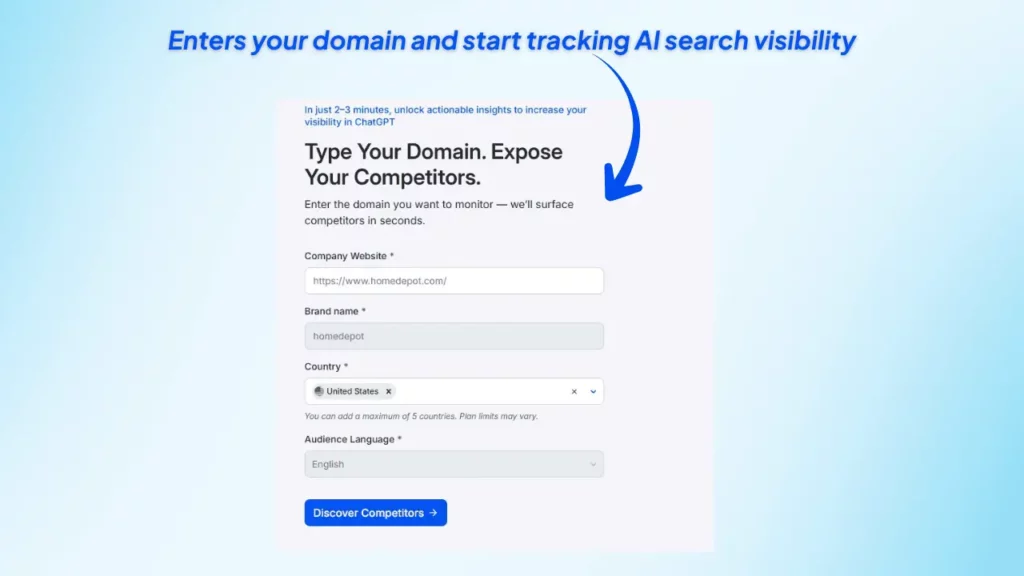
Home Depot’s Competitors, AI Visibility Signals & Core Themes
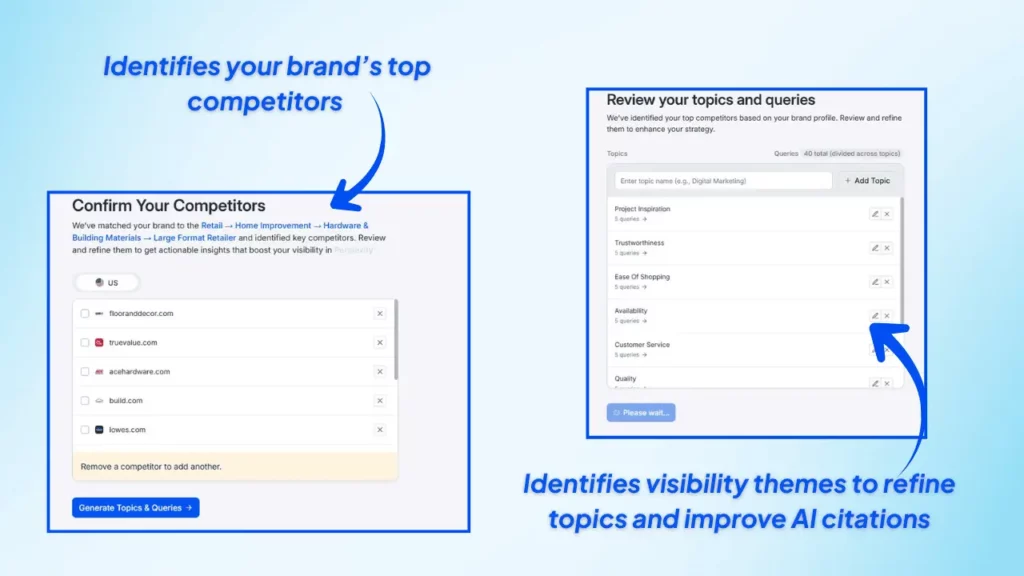
Wellows identified Home Depot’s main competitors: Floor & Decor, True Value, Ace Hardware, Build.com, and Lowe’s showing how AI compares the brand within the home improvement market. These insights reveal where Home Depot stands in generative search and where visibility gaps may exist.
The platform also surfaced core AI visibility themes, including Project Inspiration, Trustworthiness, Ease of Shopping, Availability, Customer Service, and Product Quality. These topics show what homeowners look for when asking AI tools for recommendations and where Home Depot appears most often across AI-generated answers.
Home Depot’s AI Citations & Sentiment Overview
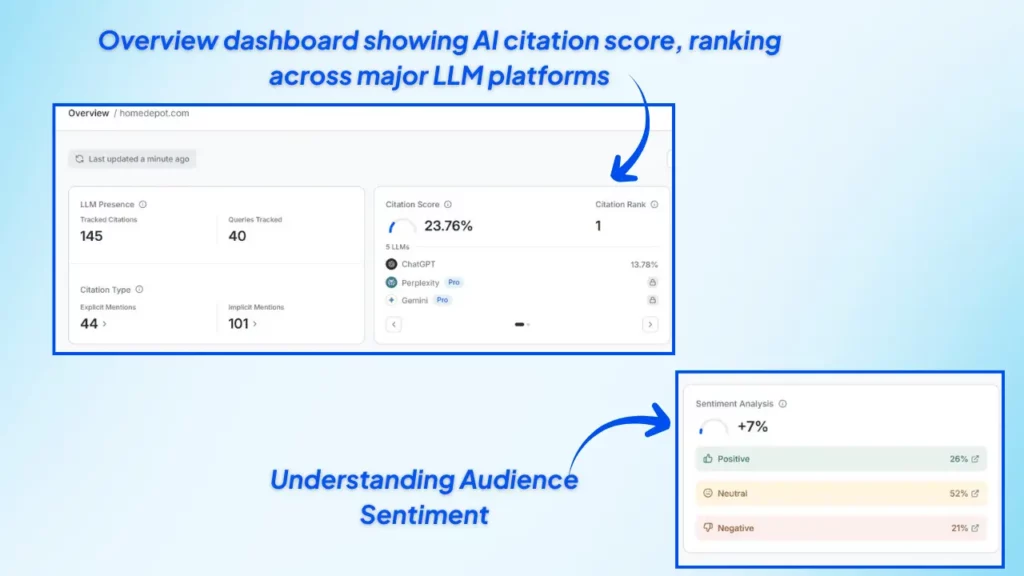
Home Depot appears in 145 AI citations across 40 queries, with 44 explicit and 101 implicit mentions, giving it a 23.76% citation score and the top ranking among home improvement retailers. This strong presence shows solid brand recognition, with room to convert more implicit mentions into credited citations.
Sentiment is generally stable, with 26% positive, 52% neutral, and 21% negative mentions. AI systems view the brand as reliable overall, though improving product clarity and service messaging can help strengthen future sentiment.
Home Depot’s Fastest Path to Earning Explicit AI Citations
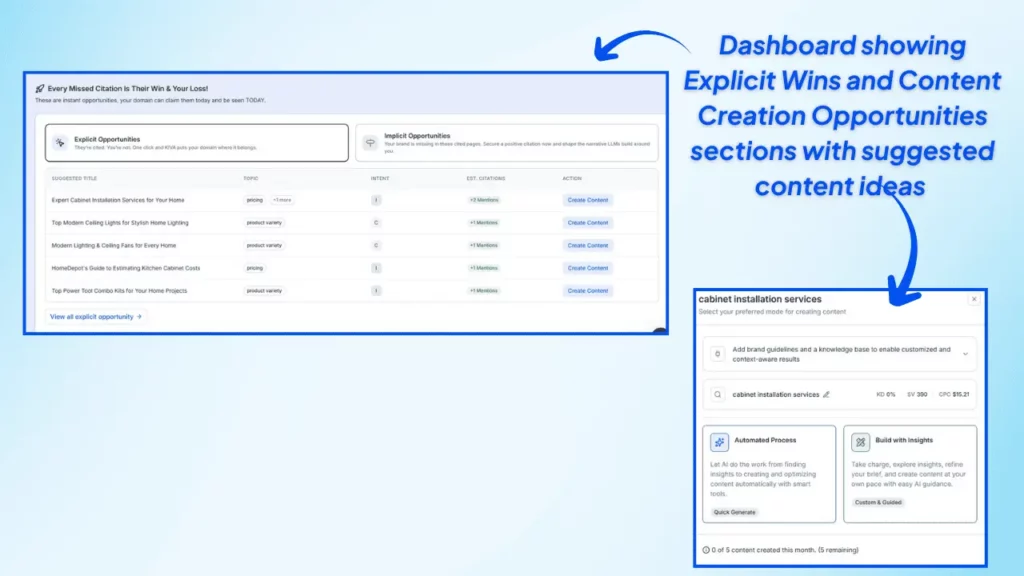
Wellows surfaced several Explicit Opportunities where AI tools discuss topics like lighting, cabinet installation, and tool kits but don’t cite Home Depot yet. Creating content for these themes can quickly add +1 to +2 new citations across major AI systems.
The platform suggests pages such as cabinet installation services and modern ceiling lights, offering clear guidance on where visibility can improve fast. Home Depot can generate these pages using two creation modes:
- Automated Process: AI generates optimized content instantly.
- Build with Insights: teams refine briefs using data-backed suggestions.
These quick wins help Home Depot turn missing mentions into verified citations and strengthen its AI search presence.
Convert Implicit Mentions into Verified AI Citations
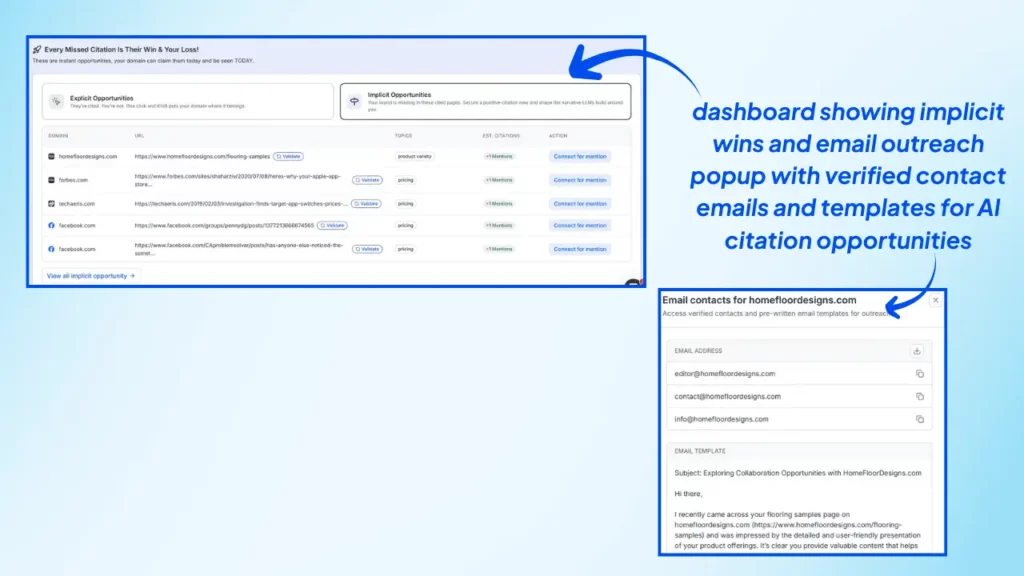
Wellows also surfaced several Implicit Opportunities where Home Depot is mentioned indirectly in AI responses but not formally cited. These pages (from sources like HomeFloorDesigns, Forbes, Techaeris, and community groups) reference topics such as pricing and product variety but do not credit the brand.
Each opportunity includes an estimated +1 citation gain, making them quick wins for strengthening AI visibility.
To help secure these citations, Wellows provides:
- Verified editor and contact emails for each domain
- Ready-to-send outreach templates written for quick clarification and citation requests
With a single message, Home Depot can confirm product details, request attribution, and convert uncredited mentions into official, AI-recognized citations. This improves authority across LLM platforms and supports stronger search presence over time.
Top AI Queries Driving Home Depot’s Visibility
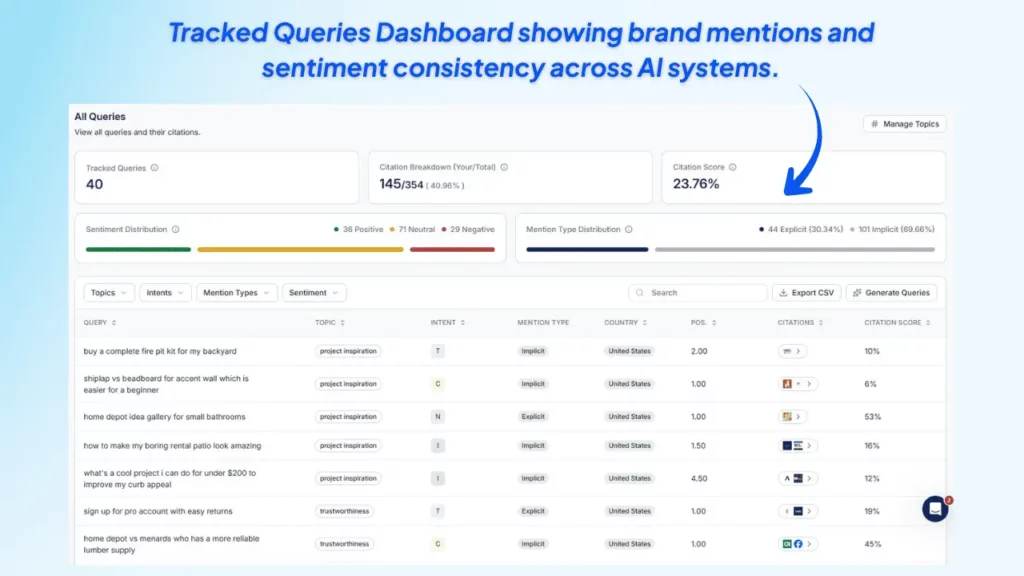
Home Depot appears in 145 citations across 40 tracked queries, with most activity coming from project inspiration and product comparison searches. Queries like buying fire pit kits, choosing accent wall materials, improving patios, or comparing lumber reliability often trigger AI mentions of the brand.
Both explicit and implicit citations contribute to Home Depot’s 23.76% visibility score, showing strong presence in DIY planning and trust-related queries while highlighting areas where additional optimization can boost future mentions.
Competitive Insights
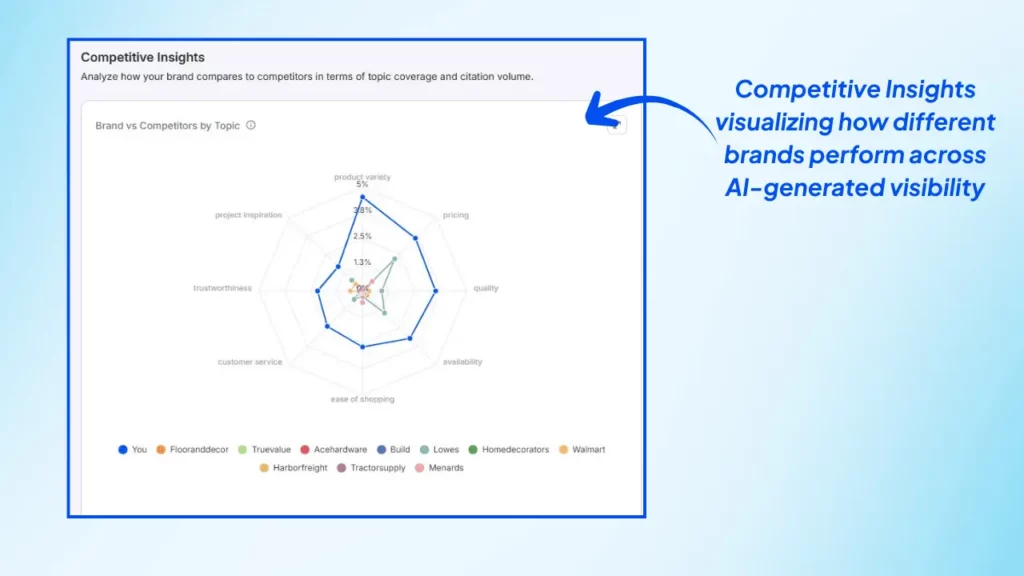
Home Depot leads the home improvement market in AI visibility, earning 145 citations far ahead of competitors like Lowe’s (40), Walmart (12), and Menards (12). The radar chart shows Home Depot outperforming rivals across key themes such as product variety, pricing, quality, availability, customer service, and ease of shopping.
While competitors show small pockets of strength, none match Home Depot’s broad coverage across these topics. This clear advantage highlights where the brand already dominates in generative search and where continued optimization can help maintain its lead.
Monitoring Performance Over Time
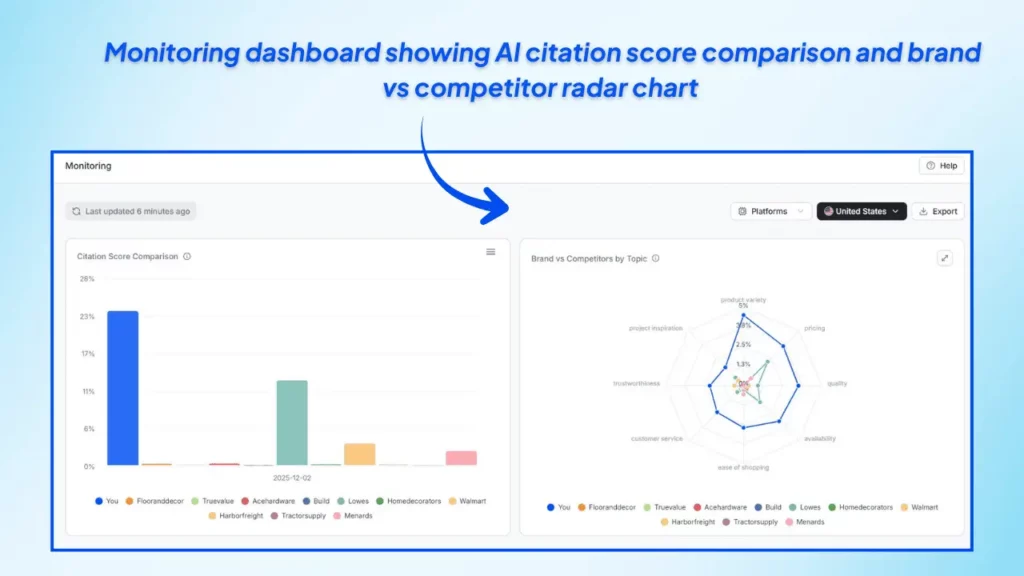
The monitoring dashboard shows Home Depot maintaining a strong lead in AI visibility, far outperforming competitors like Lowe’s, Walmart, and Menards in citation score. Its consistent dominance across key topics product variety, pricing, quality, customer service, and availability illustrates how reliably AI systems reference the brand.
These steady patterns confirm that Home Depot’s brand signals continue to resonate across major AI platforms, while highlighting areas where continued optimization can reinforce its leadership.
AI search is quickly becoming a major influence on how homeowners discover brands, compare products, and make purchase decisions. Companies that strengthen their AI visibility today will stay ahead of competitors and remain top-of-mind in every step of the customer journey.
Discover how AI-driven visibility strategies apply across industries. Each guide offers actionable insights to strengthen brand authority in AI-generated answers within its niche.
- AI Search Visibility for Hospitality Brands: Understand how hotels and resorts can improve entity signals, GEO alignment, and citation consistency in AI-driven travel discovery.
- AI Search Visibility for Environmental & Sustainability Brands: Appear in sustainability queries.
- AI Search Visibility for Industrial Manufacturing Brands: Appear in AI-driven equipment research, comparisons, and supplier selection.
- AI Search Visibility for Energy Brands: Get cited in AI answers about energy solutions, efficiency, and sustainability.
- AI Search Visibility for Internet Service Provider Brands: Be recognized in AI recommendations for broadband, coverage, and service comparisons.
FAQs
Final Thoughts
AI is changing how people shop for home improvement products.
Instead of searching through many websites, homeowners now rely on short, clear answers from AI tools.
To stay visible, a home improvement brand must:
- explain products clearly
- share complete specifications
- publish useful content
- earn mentions across the web
- monitor how AI tools talk about them
Brands that act now will gain a strong advantage as AI becomes the main tool for product research and decision-making.