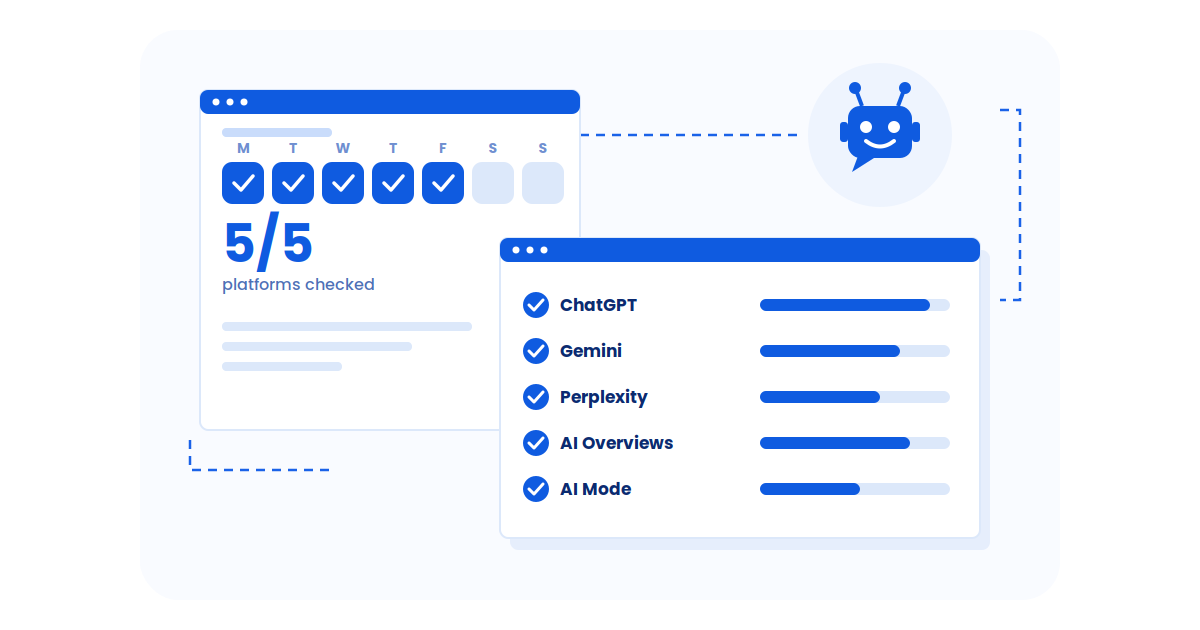
Across major AI assistants, queries like “best internet providers in my area” or “top ISPs for remote work” now return curated recommendations, not long lists of links. These answers are shaped by how well each ISP is represented, referenced, and understood across the web.
This new search environment rewards brands that provide clear service information, strong reputation signals, and helpful content. ISPs that adapt early will benefit from increased visibility in AI-generated answers. A trend already visible in the AI search performance of major US internet service providers, where brands with clearer service data consistently surface ahead of those with weaker documentation.
ISP AI Search Visibility Optimization
“AI search visibility” refers to how often and how prominently your ISP brand appears inside AI-powered search engines, shaping overall ISP brand visibility in AI-driven results and influencing which providers users consider first.
Unlike traditional SEO which focuses on ranking in search-engine result pages, AI search outputs tend to give concise, authoritative answers. That means if your ISP isn’t “on the radar” for these AI tools, you might never show up, even if your website ranks high in classic search.
For an ISP brand, Search Engine Visibility means being mentioned when users ask questions such as:
- “Which internet service providers in Karachi offer 100 Mbps fiber?”
- “What are reliable ISPs for home broadband in Lahore?”
- “How to choose a good ISP for a small office?”
- “What’s the difference between DSL, fiber and wireless ISPs in terms of speed and reliability?”
If AI tools recommend your brand or include you in a comparison, you’re effectively reaching potential customers at the very start of their decision-making journey.
Why AI Search Visibility Matters for ISP Brands
AI assistants are quickly becoming a primary way people compare internet providers, and the brands they recognize first often shape the user’s shortlist. This shift makes AI visibility an essential part of how ISPs stay competitive and discoverable.
Supporting this shift, a recent survey shows that 83% of users now prefer AI-powered search tools over traditional search engines because they deliver faster, more cohesive answers—making inclusion in AI-generated responses critical for ISP brands (Innovating with AI survey, reported via GlobeNewswire)
- Zero-click, fast answers are rising. Many users now prefer quick, direct answers from AI assistants instead of combing through multiple websites. When a tool gives one or two recommendations (rather than a list of 10 links), being included is critical.
- New competition dynamics: Traditional SEO ranking isn’t enough. If your competitors already have their brand and service info structured for AI visibility, they’re more likely to get chosen regardless of your old SEO strength.
- Greater trust via AI “citations”: When AI summarizers source and cite third-party trusted data (e.g. reviews, independent articles, comparison reports), users often view those brands as more credible. For ISPs, that trust can be decisive. People want reliability, coverage maps, pricing transparency.
- First-mover advantage: AI-driven search is still new terrain. ISPs that optimize early for AI visibility may secure long-term visibility before the space becomes crowded.
How AI Learns & Recognizes ISP Brands
AI assistants evaluate potential brand recommendations based on several signals:
- Clear brand identity and business details: AI needs to understand what services you offer (fiber, DSL, wireless), service regions, speed plans, pricing, customer segments, unique features (e.g. 24/7 support, static IP, bundled packages).
- Detailed content about services: Broadband plans, coverage maps, installation processes, FAQs, comparison guides (fiber vs DSL vs wireless), customer support policies. The more info available, the more AI can justify recommending you.
- Useful and problem-solving content: Users often ask “which ISP is best for X” or “how to choose an ISP for Y.” If your content helps answer those questions (e.g. “Best ISP for heavy streaming,” “Budget-friendly broadband options,” “Business vs home plans”), AI is more likely to surface you.
- Signals from across the web (authority & reputation): Reviews on third-party sites, articles comparing ISPs, user forum discussions. When external sources reference your brand with good feedback, AI interprets that as credibility.
Telecom ISP Visibility in Generative AI
For telecom operators, visibility in generative AI has become closely tied to how well their broader service ecosystem is represented online.
Unlike standalone ISPs, telecom brands are evaluated across multiple layers mobile networks, broadband infrastructure, 5G availability, regional coverage, and bundled services.
Generative AI tools reference publicly available signals such as performance benchmarks, regulatory data, and coverage reports. The same signals they use when evaluating large US providers like Comcast, AT&T, and Verizon, whose AI search visibility is often shaped by the depth and consistency of their documented network capabilities.
When this information is clear and easy to interpret, AI systems are more likely to surface a telecom provider in recommendations, comparisons, and consumer-facing answers.
How to Get Broadband Service Mentioned in AI Results
Here are recommended tactics for ISPs to improve their chances of appearing in AI-generated search/results:
1. Produce comprehensive, high-value content
- Write detailed guides: how broadband works, fiber vs DSL vs wireless, what plan fits what need (gaming, streaming, remote work), etc.
- Create FAQ pages answering common queries (e.g. “Is fiber available in Karachi ZA23?”, “What is the installation cost?”, “Does this plan support static IP?”).
- Maintain blog or resource section covering topics: service updates, speed/coverage maps, infrastructure rollouts, maintenance tips, customer support guidance.
2. Structure data properly. Leverage schema, metadata & service details
- Use structured data markup (e.g. Organization, Service, Offer, Location) so AI tools can parse your offerings more easily.
- Clearly list service areas, plan details (speeds, limits, prices), comparison tables, and features.
3. Build external credibility (off-site authority & earned media)
- Get listed or reviewed on trustworthy third-party review sites, ISP comparison portals, tech blogs or local media outlets.
- Encourage happy customers to leave reviews online (forums, social media, local review sites).
- Contribute expert articles, customer case studies, or insights (e.g. “Broadband growth in Karachi 2025”) to industry publications or community forums.
4. Answer user questions via conversational, helpful content
- Create content aimed at natural-language queries: “Which ISP is best for remote work in Islamabad?”, “How to choose between fiber and DSL?”, “What to know before switching ISPs?” — this aligns with how people phrase questions to AI.
- Consider launching a Q&A / knowledge base or even a chatbot to address real-world customer queries.
5. Monitor AI-based visibility and adapt over time
- Periodically test how generative-AI tools respond to typical queries about ISPs in your region (plans, speed, reliability, comparisons). See if your brand shows up, and if the information is correct.
- Track changes in user behavior and topics — e.g. rising interest in fixed-wireless, 5G home broadband, price-vs-speed comparisons — and produce content accordingly.
- Update old content (plans, pricing, coverage) frequently — outdated info hurts credibility and reduces chances of being surfaced.
GEO Optimization Best Practices for ISP AI Search Visibility
AI assistants rely heavily on geographic signals when recommending internet providers. Queries like “best ISP in Lahore” or “fiber internet in DHA Karachi” trigger localized evaluations — meaning AI models check which brands have the clearest, most structured location data and strongest presence in that region.
GEO best practices
To help AI correctly associate your brand with the areas you serve, implement the following GEO best practices:
1. Create Location-Specific Service Pages
Develop dedicated pages for each city, region, or neighborhood you cover. These pages should include:
- Available plans
- Speed tiers
- Installation timelines
- Local pricing
- Area-specific FAQs
This helps AI map your services to real geographic demand.
2. Use “ServiceArea” Schema & Location Markup
Add structured data for:
- Cities
- Postal codes
- Coverage zones
- Fiber availability
Clean GEO markup makes it easier for AI models to confirm where you operate.
3. Maintain Accurate Coverage Maps
Interactive or static maps showing:
- Exact service boundaries
- Fiber vs DSL vs wireless availability
- Planned expansions
AI tools often pull location cues from these maps.
4. Publish Region-Focused Content
Examples:
- “Best Internet Options for Remote Work in Islamabad”
- “What to Know About Fiber Installation in Karachi”
- “Internet Speed Trends in Multan 2025”
This type of content directly matches the way users phrase location-based questions.
5. Strengthen Local Authority Signals
AI rewards brands with proven presence in local ecosystems. Build credibility through:
- Local reviews
- Community guides
- Listings on regional comparison sites
- Partnerships with neighborhood associations or local publications
These signals validate your brand for city-specific queries.
Fiber Internet Companies: How to Strengthen AI Search Presence
AI assistants treat fiber internet providers differently from DSL or wireless brands because users often ask fiber-specific questions.
To improve AI presence, fiber companies should:
1. Highlight Fiber Advantages Clearly in Content
AI looks for repeated, consistent signals about:
- Low latency
- High upload speeds
- Stability for streaming/gaming
- Scalability
2. Add Schema for Fiber Availability
Use structured data to specify:
- Fiber-only service areas
- Exact coverage zones
- Speeds (symmetrical/asymmetrical)
3. Publish Fiber-Focused Guides
Examples:
- “Fiber vs Cable: Which Is Best for Remote Work?”
- “How Fiber Installation Works: Step-by-Step Guide”
- “Why Gamers Prefer Fiber Internet”
4. Keep Fiber Expansion Updates Public
AI models reward brands that publish factual updates such as:
- New fiber rollouts
- Upgrades to GPON/XGSPON
- Infrastructure investments
5. Strengthen Third-Party Validation
Fiber providers get more AI visibility when external sites confirm:
- Actual fiber availability
- Reliability metrics
- Speed test performance
ISP brand visibility in AI Search Engines
To understand how an internet service provider (ISP) appears across today’s major AI search engines, I started by setting up Xfinity inside the Wellows AI Visibility Platform. The process begins by entering the brand’s domain.
This simple setup step tells Wellows to map how AI systems interpret ISP-related queries in the United States and to automatically identify Xfinity’s closest competitors in generative search.

Competitors, Topics & AI Visibility Signals

Once the domain was added, Wellows automatically placed the brand in the Internet Service Providers category and surfaced key competitors like Frontier, Verizon, Cox, CenturyLink, and Spectrum.
It also highlighted the core themes AI systems use when evaluating ISP brands — including bundled services, installation processes, contract terms, data caps, network reliability, and customer support. These topics become the foundation for improving AI search visibility and earning more citations.
AI Presence, Citation Score & Sentiment Overview

The overview dashboard reveals how Xfinity performs across major AI platforms, showing 166 total citations across 40 tracked queries. With a 9.61% citation score and a #1 ranking, the brand holds a strong position in generative search.
Wellows also breaks down explicit and implicit mentions to show where visibility is coming from. Sentiment analysis adds another layer of insight, highlighting how AI systems interpret audience perception—46% positive, 44% neutral, and 10% negative—helping the brand understand how its messaging and service reputation are reflected in AI-generated answers.
Explicit Wins & AI-Ready Content Opportunities

The Explicit Wins panel highlights the topics where competitors are being cited in AI search—but the Xfinity is not—revealing clear opportunities to earn new visibility.
Wellows suggests optimized content ideas such as installation guides, customer service improvements, and data plan comparisons, each tied to estimated citation gains. With built-in content creation tools, the brand can instantly generate AI-aligned articles or build customized briefs, making it easier to produce targeted content that fills citation gaps and strengthens authority across generative platforms.
Implicit Wins & Outreach for Missing Mentions

The Implicit Wins panel reveals pages where competitors are referenced but the Xfinity is not—highlighting missed opportunities to appear in content that influences AI systems.
Wellows lists each domain, the associated topic, and the estimated impact of securing a mention. With built-in outreach tools, the brand can access verified contact emails and prewritten templates, making it easy to request inclusion and convert these missed opportunities into new citations across AI platforms.
Competitive Insights & Topic-Level Visibility
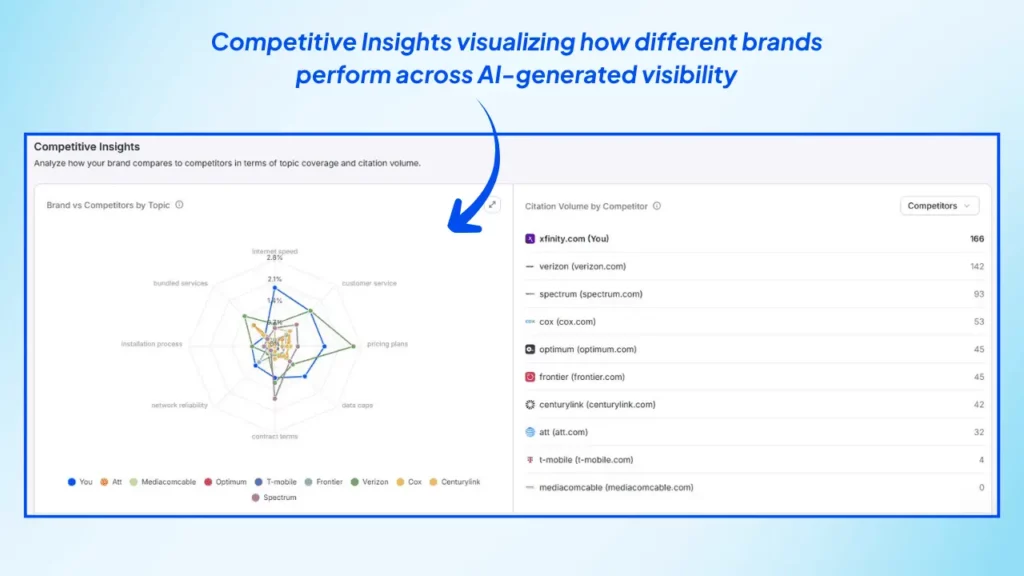
The Competitive Insights dashboard visualizes how the Xfinity stacks up against other major providers across key AI-analyzed topics. The radar chart highlights strengths—such as performance in internet speed and customer service—while revealing areas where competitors gain more citations.
Alongside this, the citation volume breakdown shows how often each brand appears across AI-generated answers, giving a clear picture of who leads the conversation and where strategic improvements can drive stronger AI visibility.
Tracked Queries & Topic-Level Citation Insights

The Tracked Queries dashboard provides a detailed view of how the brand appears across 40 AI-analyzed queries, breaking down sentiment, intent, and citation type.
With 166 citations and a 9.61% citation score, Xfinity can quickly see which topics—such as bundled services or installation processes—drive the most visibility. The table also highlights whether mentions are explicit or implicit, helping the brand understand where AI systems recognize it directly versus indirectly, and where citation improvements can make the greatest impact.
Monitoring AI Visibility Trends Over Time
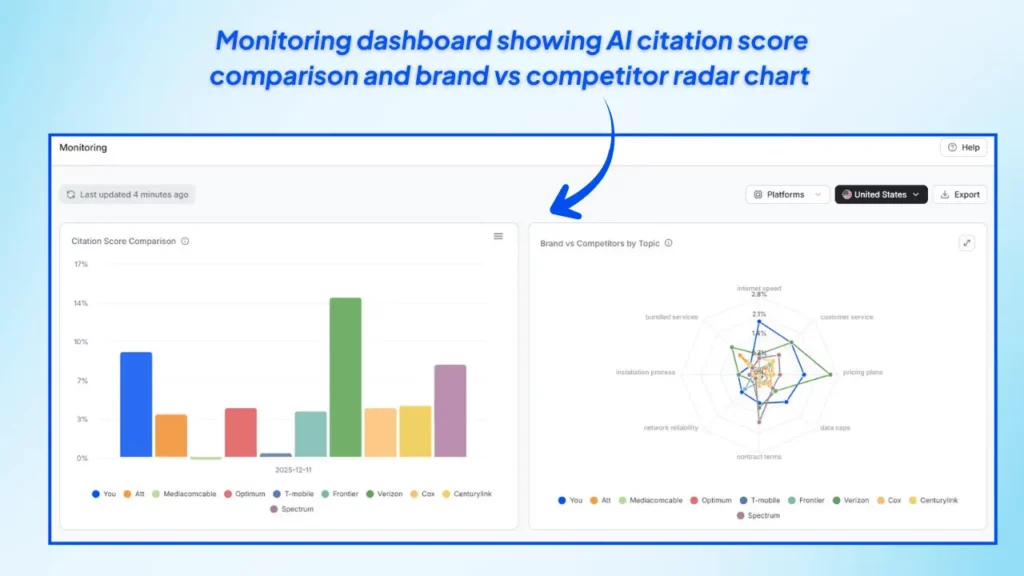
The Monitoring dashboard tracks how the brand’s citation score evolves compared to major competitors, making it easy to spot shifts in AI visibility.
The bar chart highlights which providers are gaining or losing traction across AI platforms, while the radar chart breaks these trends down by topic. This gives Xfinity a clear, real-time view of where it leads, where it lags, and which content or service areas offer the greatest opportunity to strengthen its AI search presence.
Wellows gives ISP brands a clear, data-driven view of how they appear across AI search engines — from competitors and topics to citations, sentiment, and visibility trends.
With insights into explicit and implicit opportunities, plus built-in content and outreach tools, Xfinity can quickly identify where it’s missing in AI-generated answers and take action to close those gaps. In a market where consumer decisions increasingly start with AI, Wellows ensures ISP brands stay visible, competitive, and strategically positioned where it matters most.
What ISP Brands Should Watch Out For (Risks & Challenges)
- AI systems often favor brands with strong external legitimacy. New or small ISPs may struggle unless they build trust signals externally.
- Overly promotional or thin content (salesy pages without real value) is unlikely to be picked up; AI tends to reward genuine, informative content.
- Because generative-AI search results are dynamic and context-sensitive, visibility can fluctuate depending on how users phrase their queries. What works today might not work tomorrow without ongoing maintenance.
- Overreliance on AI visibility should not replace traditional SEO/website optimization entirely. Both can work in a complementary way.
Discover how AI-driven visibility strategies apply across industries. Each guide offers actionable insights to strengthen brand authority in AI-generated answers within its niche.
- AI Search Visibility for Industrial Manufacturing Brands: Appear in AI-driven equipment research, comparisons, and supplier selection.
- AI Search Visibility for Home Improvement Brands: Get recommended in AI searches for renovations, materials, and home services.
- AI Search Visibility for Energy Brands: Get cited in AI answers about energy solutions, efficiency, and sustainability.
FAQs
- Structured, clear service information on your site
- Detailed content that answers user questions
- Third-party references from reviews or comparisons
- Strong reputation signals from authoritative sources
Better signals increase the chances that AI will reference your ISP.
Final Thoughts
As more people turn to AI assistants for quick guidance, whether they’re comparing broadband plans, checking service availability, or evaluating ISPs for home/business use, the stakes for visibility are shifting. ISPs that build a strong presence in AI-powered search and recommendation ecosystems can gain a major edge: clients reaching them not through ads or directory listings, but via trusted, conversational answers.
Given how competitive the internet-service market is, especially in places with many providers and varying service quality, being visible to AI can become a powerful form of trust and discovery. For ISPs willing to invest in structured, helpful content, transparent service info, and online reputation, the payoff could be meaningful.