AEO vs GEO is no longer a theoretical debate. It’s the practical difference between earning direct answers on Google (AEO) and earning citations inside generative AI tools (GEO).
Search has split into two layers: the classic SERP, where Google rewards pages that answer fast and cleanly, and the AI layer, where models summarize multiple sources and choose which brands to reference.
AEO grew from featured snippets and voice search. GEO (Generative Engine Optimization) emerged with AI Overviews and LLM-based discovery.
Did you know?
Search is collapsing into fewer clicks and more instant answers. In 2025, studies tracking Google AI Overviews found noticeable CTR losses for traditional rankings, including a 34.5% drop on position-one results when AI summaries appear (Search Engine Land, 2025).
This shift changes what “visibility” means. You don’t just need to rank. You need content that’s structured clearly enough to be lifted as the answer, credible enough to be cited as the source, and free from Technical SEO Issues that can prevent search engines and AI systems from accessing or trusting it.
If you’re a SaaS team, agency, founder, or content marketer, this guide shows what to prioritize first, when AEO is the faster lever, when GEO is the bigger lever, and how to combine both so you get surfaced in SERPs and cited in AI answers.
TL;DR: Key Takeaways on AEO vs GEO
- What AEO Means: AEO helps you win direct answers on Google, like featured snippets, People Also Ask, and voice results. It relies on short, extractable, answer-first writing.
- What GEO Means: GEO helps you get cited in generative AI like ChatGPT, Claude, Gemini, and Perplexity. It rewards depth, freshness, and trust.
- Why This Matters in 2026: AI Overviews are cutting classic organic clicks. A 2025 Authoritas study found CTR drops can reach 80% on queries where AI summaries appear (Authoritas, 2025). If you’re not optimized for answers and citations, visibility slips fast.
- Which One To Prioritize First: Prioritize AEO if your ICP starts on Google. Prioritize GEO if they research in AI chat tools and citations drive trust and conversion.
- Best Strategy (Use Both): Combine them. AEO gets you surfaced on SERPs, GEO gets you chosen in AI answers. Start with Q&A structure and structured data, then add deeper proof and coverage.
AEO vs GEO: The One-Page Summary
If you’ve spent the last six months reading mixed definitions of either term, this comparison sorts them out: what each does, how the winning content actually looks side by side, and which to lead with based on where your buyers research.
| AEO | GEO | |
|---|---|---|
| Stands for | Answer Engine Optimization | Generative Engine Optimization |
| Optimizes for | Google’s direct answers: snippets, People Also Ask, voice | LLM citations (ChatGPT, Claude, Gemini, Perplexity) + Google AI Overviews |
| Content unit | The page, with an extractable answer block | The passage, chunked and recombined inside a longer answer |
| Winning format | Definition + bullets + FAQ schema | Semantic depth, named sources, fresh updates, comparison sections |
| Typical length | Short answer up top, then 800 to 1,500 words | 2,000+ words with topical coverage |
| Measurement | Position zero share, PAA appearances, voice answer share | Citation count and share of voice across engines |
| Lead with it when | Your buyers start on Google | Your buyers research inside chat |
| Wellows feature that supports it | AI Overview visibility check, Citation Score per page | Cross-engine citation tracking, implicit and explicit citations across all 5 engines |
The actual rule: AEO gets you surfaced, GEO gets you chosen. Most SaaS teams need both within twelve months. The question isn’t which one to pick. It’s which one moves first based on where your traffic and your pipeline are actually coming from.
AEO vs GEO: Understanding the Core Concepts
Before comparing AEO and GEO side by side, it helps to understand what each really means. Both strategies aim to make content score more accessible to AI-driven systems, but they approach the goal differently. Let’s break them down one by one.
What is AEO? (Answer Engine Optimization)
Answer Engine Optimization (AEO)
Answer Engine Optimization (AEO) is the practice of structuring content so it delivers direct, concise answers to user queries across search assistants, voice devices, and AI-driven interfaces.

The idea emerged around 2015, when voice search and featured snippets started shaping how people consumed information. Instead of clicking through to read an article, users increasingly relied on instant, spoken, or on-screen answers from platforms like Google Assistant, Siri, or Alexa.
At its core, AEO is about anticipating the exact questions your audience asks and presenting the answers in a clear, structured, and accessible format.
- Structured Q&A and Schema Markup: Implementing FAQ and HowTo schema helps search engines recognize direct answers and improves eligibility for featured snippets.
- Featured Snippets and Zero-Click Interactions: AEO content is designed to appear in “position zero,” where answers are displayed directly in search results without clicks.
- Voice Search Optimization: Content is written in a conversational tone to match how people ask questions aloud, making it more discoverable via assistants like Siri, Alexa, and Google Assistant.
- Clear Formatting and Concise Summaries: TL;DR sections, short paragraphs, and scannable layouts ensure that answers are quickly understood by both users and search engines.
What is GEO? (Generative Engine Optimization)
Generative Engine Optimization (GEO)
Generative Engine Optimization (GEO) is the process of creating and structuring content so it can be understood, synthesized, and cited by generative AI models such as large language models (LLMs).

While AEO focuses on producing short, direct answers for voice assistants or featured snippets, GEO responds to a new search reality. AI-driven engines like Google’s Search Generative Experience (SGE), ChatGPT, or Bing Copilot aggregate and reframe information into conversational summaries.
In other words, GEO is about ensuring your content isn’t just visible to humans. It’s machine-readable, semantically comprehensive, and credible enough to be chosen as a source by AI systems. If you want a quick benchmark of the tools driving this shift, see our list of best AI search engines.
Because these systems favor clarity and natural language, it also helps to refine AI-assisted drafts so they don’t sound robotic before publishing. A quick pass through the free AI humanizer tool by Wellows makes your content smoother, more human, and easier for LLMs to quote confidently.
- Semantically Rich Content: GEO requires covering a topic with depth and breadth. That means including synonyms, related concepts, and contextual details so LLMs can accurately interpret and connect your content.
- Authority and Trust Signals (E-E-A-T): Generative engines are more likely to pull from trusted sources. Pages with strong author credentials, reputable citations, and institutional references stand out.
- LLM-Friendly Structure: Content should be organized with clear headings, logical flow, and structured formatting. This makes it easier for AI systems to parse and extract accurate insights.
- Adaptation to New Interfaces: GEO optimization considers how content appears in AI-driven summaries, chatbots, and generative search features like Google SGE. Well-optimized content increases the chance of being referenced or quoted in these new environments.
AEO vs GEO: Similarities and Differences
When we put AEO (Answer Engine Optimization) and GEO (Generative Engine Optimization) side by side, both share the same underlying goal: making content more usable by AI-driven engines. Yet the way each achieves this goal, and the platforms they serve, sets them apart.
AEO vs GEO
Similarities
- AI Usability — Both approaches improve how machines consume and present content, whether through snippets, voice responses, or generative summaries.
- Structure, Clarity, and Credibility — Clean formatting, trustworthy sources, and logical flow are non-negotiables in both AEO and GEO.
- Overlapping Tactics — Tools like schema markup (FAQ, HowTo), Q&A formatting, and authoritative citations play a role in both strategies.
AEO vs GEO
Differences
- Primary Interfaces — AEO mainly targets voice assistants and featured snippets. GEO optimizes for generative chat interfaces, AI Overviews (SGE), and large-scale summaries, positioning it closer to the dynamics of SEO vs GEO in modern search ecosystems.
- Depth vs Conciseness — AEO prioritizes brevity and direct answers, often designed for zero-click searches. GEO requires richer context and broader topic coverage to ensure LLMs can synthesize meaningful responses. That’s exactly what LLM SEO focuses on.
- Terminology and Motivations — AEO grew out of the need to rank for position zero in traditional SERPs. GEO emerged as a response to evolving search modes and the branding shift toward generative AI.
Why AEO Vs GEO Matters In 2026
The difference between AEO and GEO reflects a major shift in how people search and consume content. Search is no longer just about clicking blue links.
According to research, over 60% of Google searches in 2024 ended without a click, showing how much users rely on instant answers. (Sparktoro, 2024)
At the same time, AI Overviews like Google’s SGE are synthesizing content into conversational summaries. Users also expect interactive results from chat-based tools such as Bing Copilot and ChatGPT, where dialogue replaces static search pages.
This shift means visibility is no longer only about rankings. Many wonder which is better, AEO or GEO. The truth is they serve complementary roles, especially when considering the generative engine visibility factors that now influence how content is surfaced.
AEO ensures your content appears in snippets and voice responses. GEO improves chances of being cited in AI-generated summaries.
The risks of neglecting AEO or GEO are clear. Missed traffic as AI answers dominate. Brand invisibility when competitors are cited instead. Credibility loss if your brand isn’t represented in trusted AI outputs.
What Our Own Search Console Data Showed Us
Between March and June 2025, before we shipped the AEO and GEO tracking that would become Wellows, our own site picked up 6,612 impressions on question-format queries (“what is X,” “how does X work”) and 1,255 impressions on comparison queries (“X vs Y,” “difference between X and Y”). Both categories combined drove zero clicks. Average position: 75 and 90, respectively.
The takeaway that pushed us to build Wellows: demand existed on both AEO surfaces (questions) and GEO surfaces (comparisons). Visibility didn’t. The gap between “the engine is showing us” and “anyone is clicking” is the problem AEO and GEO actually solve.
Can AEO and GEO Tools Compare AI Responses Across Models Side by Side?
Yes, but the depth varies sharply. Most early GEO tools track citation appearance in one or two engines, usually ChatGPT and Perplexity. Cross-engine, side-by-side comparison across all five major engines (ChatGPT, Gemini, Perplexity, Google AI Overviews, Google AI Mode) is what separates a monitoring tool from a citation acquisition system.
This is the question we get asked most often by buyers evaluating GEO tools. The category is splitting along it. There’s a real difference between watching one engine and being able to compare what every engine cites for the same prompt at the same time.
Side-by-side comparison should mean four things in practice:
- The same prompt run across every engine: So you can see which engines cite your brand for a given query and which cite competitors. Single-engine tools can’t show you this.
- Explicit and implicit citations both tracked: Explicit = linked mention. Implicit = brand named without a link. Implicit citations drive category recall, but most tools ignore them.
- The brand, the URL, and the sentiment: three fields, not one: A neutral citation is worth less than a recommendation. Tools that only count mentions miss this.
- Cross-engine share of voice: Your share vs the top 3 competitors per engine, so you can see which engines you’re winning and losing.
This is the gap that pushed us to build Wellows. Every team we talked to could see that citations were happening somewhere across the five engines, but nobody could compare them side by side or tell which engine was citing competitors instead. AEO and GEO produce different citation patterns. You can’t decide which to prioritize without watching them in the same dashboard.
AEO vs GEO Tools: Effectiveness, Pricing, and Audience Fit
The GEO tool category is splitting along two axes. The first is which engines a tool covers: one vs all five. The second is what the tool does after measurement: passive monitoring vs actionable recommendations. Here’s how the options compare:
| Capability | Cheap monitoring tools | Mid-tier GEO tools | Wellows |
|---|---|---|---|
| Engines covered | 1 (usually ChatGPT) | 2–3 engines | All 5: ChatGPT, Gemini, Perplexity, AI Overviews, AI Mode |
| Explicit citations tracked | Yes | Yes | Yes |
| Implicit citations tracked | No | Sometimes | Yes |
| Prompts tracked per month | 40–100 | 100–500 | 40–1,000 by tier |
| Side-by-side cross-engine view | No | Partial | Yes |
| Actionable fix recommendations | No | No | Yes |
| Outreach for citation acquisition | No | No | Yes |
| Pricing range | $20–50/mo flat | $200–500/mo per seat | $37–497 per domain/mo |
| Best for | Solo creators monitoring one brand | In-house teams with one domain | Agencies, multi-client teams, brands needing measurement and action |
Which AEO/GEO Tool Tier Fits Your Stage
- Startups and freelancers: Lite-tier tools with one engine and a small prompt budget cover the basics. Most show monitoring data without telling you what to fix. Wellows Lite ($37/domain/mo) covers ChatGPT with 40 prompts and includes the actionable recommendations layer. That’s the differentiator at the entry tier.
- In-house SaaS teams: You need at least two engines. ChatGPT + AI Overviews is the minimum useful pair because they cover most B2B research behavior. Most mid-tier GEO tools cover this. Few add implicit citation tracking, which is where category recall lives.
- Agencies and multi-client teams: You need all five engines, multi-domain support, and the outreach layer most tools don’t have. This is where category-leading platforms differentiate.
- Enterprise brands: Reporting, sentiment analysis, and competitor benchmarking move from nice-to-have to required. Verify the tool tracks both explicit and implicit citations. Enterprise recall is built on implicit mentions more than explicit ones.
Should I Use AEO for Google Featured Snippets Or GEO for ChatGPT Citations?
Use both, but prioritize based on where you want to win first. AEO and GEO aren’t competing benchmarking strategies. They’re two layers of modern search visibility, aimed at different answer engines.
When AEO should be your priority (Google snippets + voice answers)
If your main goal is to appear in Google’s featured snippets, People Also Ask boxes, or voice results, AEO comes first. These systems reward content that is:
- Answer-first and compact: one clear takeaway per paragraph.
- Structured like Q&A: headings match real questions.
- Snippet-extractable: bullets, short lists, definitions.
- Schema-supported: FAQ, HowTo, Article markup.
Think of AEO as: “Help Google show my answer directly on the SERP.”
When GEO should be your priority (ChatGPT / Gemini / Perplexity citations)
If your main goal is to get cited in generative AI answers, GEO becomes the bigger lever. LLMs prefer content that is:
- Fresh: visibly updated within the last 6–12 months.
- Semantically rich: covers the topic and related subtopics.
- Chunk-friendly: 100–300 token blocks with one idea each.
- Credibility-heavy: stats, expert quotes, real examples.
- Decision-oriented: comparisons, pros/cons, deal-breaker FAQs.
Think of GEO as: “Make my content easy for AI to chunk, trust, and cite.”
The 2026 play: AEO gets you surfaced, GEO gets you chosen
Here’s the simplest way to remember the distinction:
Did you know?
- AEO = quick-answer visibility (snippets, voice, zero-click SERPs).
- GEO = citation visibility (AI summaries, chat recommendations).
AEO helps you show up first. GEO helps you stay in the AI conversation and get recommended.
How to apply both without creating extra work
Start with AEO structure, then layer GEO depth:
Did you know?
- Answer-first headings + direct one-line answers (AEO).
- FAQs for fan-out questions (AEO → GEO overlap).
- Freshness cues + deeper coverage + proof (GEO).
- Niche comparisons and deal-breaker sections (GEO).
This hybrid approach maximizes your chances of winning featured snippets and earning ChatGPT-style citations.
When is AEO More Effective Than GEO for SaaS Companies?
AEO is more effective than GEO for SaaS when your fastest growth lever is Google SERP visibility for high-intent, question-based searches. If users still discover and compare tools through Google, AEO wins the first click.
AEO more effective than GEO for SaaS companies?
You're targeting question keywords that trigger snippets
You rank top 7–10 but CTR is weak
Your product must be clear in a 5-second SERP scan
You need quick wins before deeper AI visibility work
Your ICP still starts research on Google
Simple rule
Can I Combine AEO And GEO Strategies To Maximize Visibility Across Platforms?
Yes. Combining AEO and GEO is the smartest way to stay visible across Google snippets, voice assistants, and AI tools like ChatGPT, Gemini, and Perplexity. AEO helps you win direct answers on Google. GEO helps you get cited and recommended inside generative results. Because their tactics overlap, you can optimize once and benefit everywhere.
How to Optimize for AEO + GEO Together
Tactics common to both (do these first):
- Use structured data (FAQ, HowTo, Article) so engines can extract answers cleanly.
- Write answer-first content: give the direct answer before explaining, and keep one idea per paragraph.
- Back up claims with credible citations, data, and clear authorship to increase trust and retrieval.
Tactics that lean more AEO (Google snippets + voice):
- Match natural spoken queries with a conversational, Q&A tone.
- Optimize key sections for featured snippets using bullets, tables, and one-sentence definitions.
- Add FAQ blocks + FAQ schema for who/what/how/which queries that trigger zero-click answers.
Tactics that lean more GEO (LLM citations + recommendations):
- Expand coverage with depth + breadth so the AI can synthesize a full answer from your page.
- Use semantic variation (synonyms, entities, related subtopics) to help LLMs connect your content to fan-out queries.
- Maintain freshness with visible update dates and current examples so generative engines prefer your page.
- Monitor AI citations and refine the passages that get pulled most often.
AEO vs GEO Examples: How the Same Topic Gets Written for Each
The clearest way to see the difference: take a single query and write the opening passage for it twice. Once optimized for AEO, once for GEO. Here’s “what is a SaaS go-to-market plan” written both ways.
A SaaS go-to-market plan is a structured launch strategy covering target buyer, positioning, pricing, distribution channels, and the first 90 days of sales motion. It typically includes five components: ICP definition, channel selection, pricing strategy, sales playbook, and launch metrics.
A SaaS go-to-market plan typically combines five components: ICP definition, channel selection, pricing strategy, sales playbook, and launch metrics. The specific combination shifts by category. Bottom-up products (developer tools, content platforms) lean on self-serve channels and usage-based pricing. Sales-led products (enterprise software, vertical SaaS) emphasize the playbook and field motion. According to OpenView’s 2024 SaaS benchmarks, product-led companies launch with a median of 2 channels; sales-led companies launch with a median of 4. The plan that works for one rarely works for the other.
The AEO version wins on Google because the opener is definition-first, lists components in a single scannable sentence, and reads cleanly when lifted into a featured snippet. Voice assistants can speak the second sentence in eight seconds.
The GEO version gets cited in ChatGPT because the same five components are unpacked with context (category splits), proof (named benchmark source), and a synthesis claim the LLM can lift into a longer answer. Twice the length, and meaningfully higher cite-ability.
The same five components live in both versions. AEO compresses them for a quick answer. GEO unpacks them for a synthesizable passage. Most pages should contain both: the AEO version up top for the snippet, the GEO version expanded below for the citation.
Can AEO and GEO Strategies Cannibalize Traditional SEO Efforts?
No, but they can if executed badly. The risk isn’t strategic. AEO and GEO build on traditional SEO foundations like crawlability, schema, and internal linking. The risk is operational: teams stretched across three optimization disciplines often pull resources from the SEO work that’s still driving most of their traffic.
The teams we see struggle aren’t the ones doing all three. They’re the ones treating them as separate workstreams with separate calendars and separate KPIs. Run AEO and GEO improvements through the same content briefs that power your SEO calendar. The 80% of your traffic that still comes from traditional Google rankings doesn’t disappear just because AI Overviews launched.
The integration that works: one brief per page that specifies the AEO answer block, the GEO depth requirements, and the traditional SEO ranking factors. Three optimization layers, one workflow.
AEO Vs GEO Mini Use Cases For SaaS (With Real Results)
AEO and GEO feel abstract until you see what winning looks like. Here are three short SaaS scenarios showing when each strategy pays off, with verified proof where data is available, and clear guidance on how Wellows supports both.
- Use Case 1: Increasing ChatGPT Citations With GEO First (Wellows Case):
- Situation: Your buyers research inside ChatGPT, Claude, Gemini, or Perplexity, so being cited and recommended matters more than raw Google clicks.
- What works: GEO upgrades that add depth, semantic coverage, and proof early, then keep passages tight and retrievable.
- Result: The Wellows ChatGPT Citations Report documents measurable citation behavior across generative engines and shows that structured, answer-first, proof-backed pages are consistently selected as sources.
- What we learned building this: “Implicit Wins” — pages cited without a link — were the most under-tracked metric across every customer dashboard we audited. So we built that tracking in by default. Wellows shows you the trend, highlights the near-misses, and points to the sections worth expanding.
- Use Case 2: Recovering Google Clicks With AEO First:
- Situation: A SaaS post ranks on page one, but clicks fall because AI Overviews and competitor titles reduce CTR.
- What works: AEO-style refresh. Stronger title with intent + freshness, first-paragraph direct answer, snippet-ready bullets, and compact FAQs.
- Verified context: When AI Overviews appear, traditional organic results can lose a large share of clicks, with some queries seeing drops up to 80% (Authoritas, 2025). AEO fixes are the fastest way to win back the first click.
- What we built for this: AEO recovery happens fast or not at all. Wellows flags CTR drops in GSC, suggests title and intro upgrades, and tracks recovery so the page actually moves before the next algorithm shift.
- Use Case 3: Winning Both SERP Answers And AI Recommendations:
- Situation: You want Google discovery traffic and also want to be cited later in AI answers.
- What works: Start with AEO structure (clear H2 questions + one-sentence answers + FAQs), then layer GEO value (deeper coverage, proof, and freshness).
- Result: This hybrid approach matches how modern search works. AEO gets you surfaced in SERPs first, GEO keeps you in the AI recommendation layer.
- How Wellows helps: Wellows runs both loops in one workflow, so you capture SERP visibility early and grow citations continuously without splitting your process.
Simple takeaway: Use AEO for fast click and snippet recovery on Google. Use GEO for long-term citations and recommendations inside AI tools. The reason we run both loops inside one Wellows workflow: splitting them is what makes most teams’ tracking stall.
KPIs for AEO and GEO (Reference Table)
Most teams measure AEO and GEO with the same KPI dashboard they used for traditional SEO. That’s a problem: the new surfaces produce different signals. Here’s the metrics map we use with Wellows customers to separate AEO outcomes, GEO outcomes, and input signals that drive both.
| KPI | What it tracks | How to measure | Target benchmark |
|---|---|---|---|
| Featured snippet share | AEO outcome on Google | GSC search appearance filter or third-party snippet tracking | 5–10% of target queries by month 6 |
| People Also Ask appearances | AEO outcome on Google | Manual SERP check or rank tracker with PAA detection | 15+ unique queries by month 3 |
| Voice answer share | AEO outcome (voice assistants) | Sample 20 voice queries monthly | Trend-based, varies by category |
| Citation count per engine | GEO outcome (LLMs) | Wellows or comparable citation tracker, engine-by-engine | Set baseline month 1, improve quarterly |
| Share of voice in AI engines | GEO outcome (competitive) | Cross-engine SoV vs top 3 competitors | 15–25% in category by month 6 |
| Implicit citation rate | GEO outcome (recall) | Wellows implicit citation tracking | Baseline first, improve quarterly |
| Cited URL freshness | GEO input signal | Date of last meaningful update on cited pages | Updated within 6 months |
| Schema coverage | AEO + GEO input signal | Schema validator + crawl audit | 100% of priority pages |
Treat AEO KPIs as leading indicators of fast traffic recovery. Treat GEO KPIs as leading indicators of category recall. Reporting them separately keeps the strategy legible to stakeholders who only care about clicks (AEO) vs stakeholders who care about pipeline (GEO).
Measuring Success: Metrics & KPIs
Measuring performance for AEO and GEO goes beyond traditional SEO. For Content Marketing Agencies and in-house teams, it’s not just about rankings anymore. It’s about whether your content is being surfaced, cited, and trusted across different search experiences.
Traditional SEO metrics still matter:
- Organic traffic growth
- Keyword rankings and visibility
- Bounce rate and engagement signals
AEO-specific metrics help track quick-answer visibility:
- Presence in featured snippets or “position zero”
- Appearances in voice search results through assistants like Siri or Alexa
- Share of zero-click searches where your content delivers the answer instantly
AI tools use GEO-specific metrics to determine your content’s value, often tracked with a ChatGPT Visibility Tracker to understand when, where, and how your pages are cited or summarized inside generative answers.
- Frequency of citations in AI-generated responses
- Brand mentions across generative engines like Google SGE or Bing Copilot
- How often your content is summarized or quoted by AI tools in conversational search experiences
Challenges & Considerations for AEO and GEO
Both AEO and GEO open up new opportunities for visibility. They also come with real challenges that content creators and marketers must navigate carefully. Ignoring these can limit performance or even harm credibility.
Challenges
- Ambiguity in terminology — Overlapping definitions create confusion across the industry about whether AEO and GEO are distinct or interchangeable. Pick your team’s working definitions and use them consistently in briefs.
- Measuring visibility in generative AI — Current analytics tools don’t provide clear tracking, making it hard to know how often content is cited or summarized.
- Content accuracy risk — AI summaries may misinterpret or mis-cite your content, leading to misinformation tied to your brand. The fix is structural: clean entity definitions, consistent facts across related pages, schema where it counts.
- Keeping content up to date — AI search and algorithms evolve rapidly, requiring frequent updates to maintain visibility. Build a freshness audit into your content calendar, not a separate workstream.
- Balancing depth with conciseness — AEO favors short, direct answers. GEO demands context and detail. Most pages need both, structured as answer-up-top + depth-below.
Future Outlook for AEO and GEO in 2026
The future of search will not be about choosing between AEO, GEO, or SEO. It will be about how these strategies evolve together, with greater emphasis on combining SEO and GEO into unified optimization strategies.
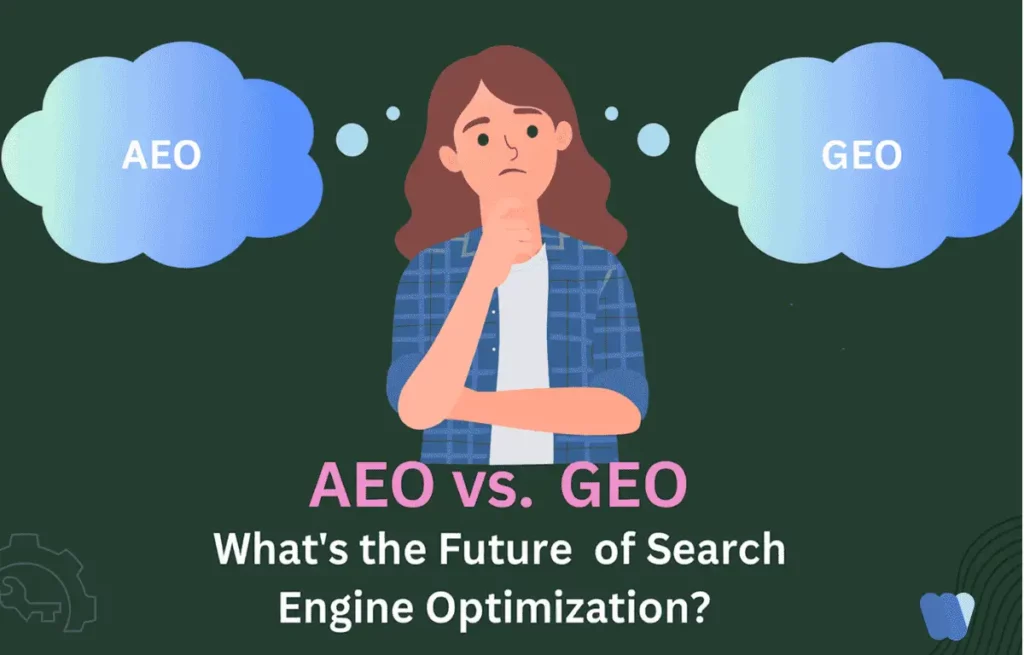
Traditional SEO will remain the backbone, but AEO will keep driving visibility in quick-answer formats, while GEO will define how content is surfaced in AI-driven summaries and conversational interfaces.
We may also see the rise of new acronyms and frameworks as technology advances. Terms like LLMO (Large Language Model Optimization) or CAIO (Conversational AI Optimization) are already being discussed. These could become part of the standard toolkit as generative AI becomes the primary way people access information.
What Changes in the Next 12 Months
Three shifts we’re watching between now and mid-2027:
Did you know?
- AI Overviews will likely cite fewer sources per query. Through 2025, citation counts per AIO answer trended lower. If that continues, the consolation prize of “cited but not first” is going away.
- Schema importance will spike before it relaxes. Google’s structured-data emphasis tends to climb before each AI surface launch, then settle. With AI Mode rolling out broadly through 2026, schema is high-leverage right now, even though it’ll matter less by late 2027.
- Implicit citations will become the harder metric. As LLM responses get longer, mentions without visible links are increasing. They drive recall but not clicks, and most visibility tools don’t track them. This is where Wellows differentiates. Implicit citation tracking is built into the core product.
To prepare, businesses and content creators should start building processes, skills, and infrastructure today. That means training teams to write semantically rich, answer-first content, adopting structured data across all pages, monitoring AI-driven citations, and investing in tools that track performance in generative search.
The bottom line: those who adapt early will shape how their brand is represented in the next era of search. Not just on results pages, but in the conversations and summaries that define user experiences.
FAQs
Conclusion
AEO and GEO represent two sides of the same coin. Both are designed to make your content more accessible to AI-driven systems, but they do it in different ways.
AEO focuses on concise, answer-first content for snippets and voice search. GEO emphasizes depth, credibility, and semantic richness so generative AI models can synthesize and cite your work.
That’s why any fair comparison between AEO and GEO shouldn’t frame them as rivals, but as two strategies that work best together. They overlap in structure and clarity, yet diverge in execution, making it essential to understand and apply both.
The key takeaway is simple: optimize your content for clarity, credibility, structure, and semantic depth. That means using schema markup, writing in a Q&A style, supporting claims with authoritative sources, and updating content regularly to stay relevant in fast-changing search environments.
The next step is concrete. Pull GSC for your top 20 pages. Check positions 4–10 (those are AEO opportunities ready to recover). Then run the same URLs through a cross-engine citation check and see which engines are citing you and which competitors are filling the gap. The pages that lose on both surfaces are where the rewrites pay off fastest.