SEO in 2025 moves fast and it’s not slowing down. With generative AI shaping how people search and how results are presented, knowing how to use AI for competitor analysis isn’t a “nice to have” anymore. It’s how you stay visible while the SERP keeps changing.
AI is already part of many SEO workflows. For example, over 56% of marketers are actively using generative AI in their SEO workflows for tasks like keyword research, competitive SERP analysis, and content optimization. (DemandSage, 2025)
And it’s not just about traditional rankings now. More brands are adding GEO (Generative Engine Optimization) to their playbook, tracking how often they (and their competitors) are mentioned or cited in AI-generated answers across tools like ChatGPT, Gemini, and Google’s AI experiences.
In this guide, you’ll get a clear, step-by-step process to find your real SEO competitors, uncover the keywords and topics driving their growth, and turn those insights into actions you can actually ship so you can win more rankings today and improve visibility in both search results and AI-generated responses.
- Identify your true SEO competitors based on who ranks for your target keywords (not just business rivals).
- Use AI to run keyword gap analysis and cluster opportunities by intent and topic.
- Analyze competitor content structure (headings, FAQs, comparisons) to spot what Google rewards.
- Review competitor backlinks + brand mentions to understand authority, not just content.
- Add GEO: track where competitors are cited in AI answers, and optimize for those citation patterns.
- Turn insights into a short action plan: refresh, create, and promote the pages most likely to win.
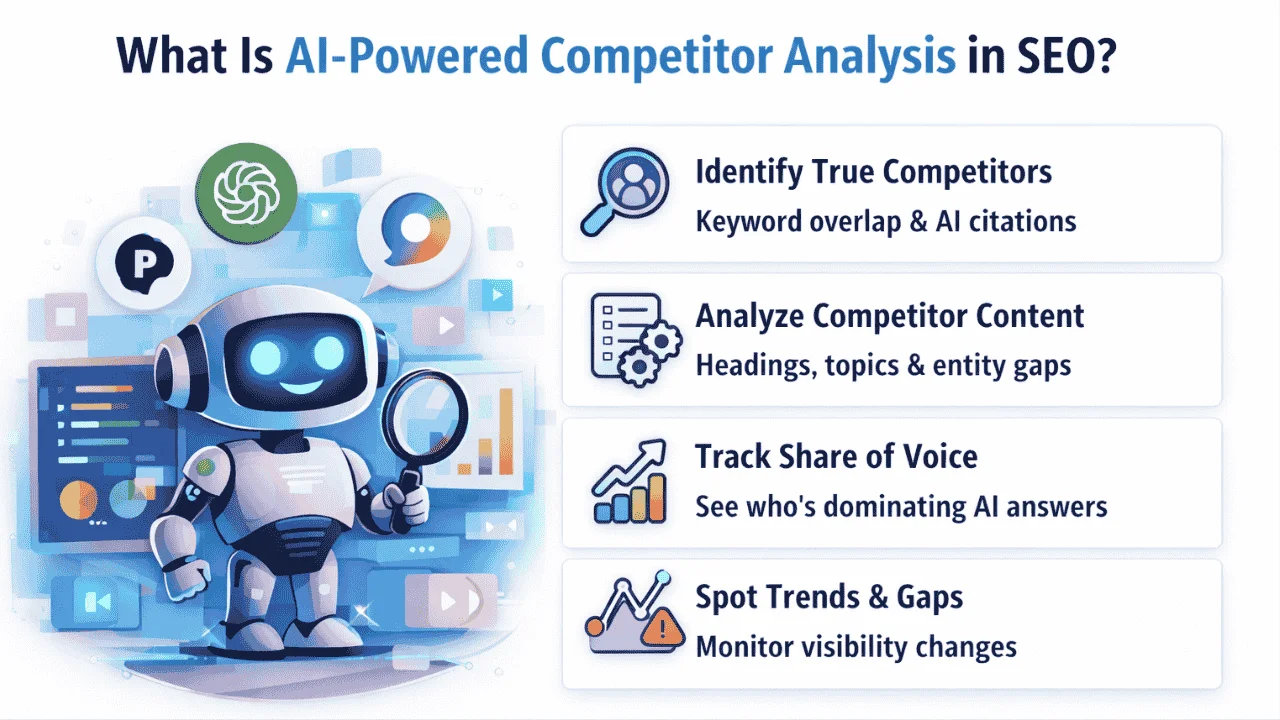
What Is AI-Powered Competitor Analysis in SEO?
AI-powered competitor analysis combines SEO data with machine learning to show you what competitors are doing well and where they’re vulnerable.
It helps you evaluate which keywords they rank for, how their content is structured, and what authority signals (like backlinks and mentions) are helping them win.
At its best, how to use AI for competitor analysis is about getting past surface-level rankings and understanding the real drivers behind competitor performance: topical depth, authority, and search engine visibility across both traditional search and AI-generated answers.
Why AI Matters for SEO Competitor Analysis in 2025
AI adoption in SEO is no longer optional—it’s mainstream.
- In 2025, over 56% of marketers use generative AI for SEO workflows.(DemandSage,2025)
- Roughly 86% of enterprise SEO professionals have integrated AI into their strategy. (SeoProfy, 2025)
- AI-driven SEO tools can boost organic traffic by up to 45% and increase conversion rates by 38% for ecommerce sites. (DemandSage, 2025)
These figures illustrate the practical impact of AI on SEO performance and why understanding how to use AI for competitor analysis is vital for modern digital strategy.
AI improves productivity, speeds up data interpretation, and identifies patterns that would take humans weeks to uncover manually. It enables teams to make better decisions faster, ultimately improving competitiveness in search.
Framework Overview: How to Use AI for Competitor Analysis in SEO
The following framework represents a structured approach used by advanced SEO teams to analyze competitors with AI:
Let’s explore each step in detail.
Step 1: Identify Your True SEO Competitors
Most brands make a common mistake: they assume their business competitors are their SEO competitors. That’s often not the case.
SEO competitors are the sites that consistently outrank you or rank for the same keywords you want to target—even if they’re not in your product category.
Did you know?
Why Traditional Competitor Lists Fall Short
For example:
- A software brand may compete with affiliate sites, review blogs, or educational publishers.
- A local service may compete with directories and niche content hubs.
- A product brand may compete with comparison tools or Q&A sites.
AI platforms help you discover these SEO competitors by analyzing keyword overlap, ranking frequency, and topical similarity across SERPs at scale—something manual interpretation can’t match.
AI tools such as SEMrush, Ahrefs, and Surfer automatically reveal competitors based on real keyword competition rather than assumed business rivalry.
Step 2: Analyze Competitor Keywords Using AI
Once you identify your true SEO competitors, the next step is keyword analysis.
AI-powered keyword analysis isn’t just about finding more keywords—it’s about understanding search intent, context, and content gaps.
Did you know?
What AI Reveals in Keyword Analysis
Using AI in keyword analysis helps you:
- Discover keywords your competitors rank for that you don’t
- Identify long-tail and intent-driven opportunities
- Cluster keywords into topic groups with shared intent
- Surface semantic terms that Google associates with a topic
This shift from individual keywords to topic clusters means you can build more comprehensive content that aligns with how AI search and Google interpret queries.
AI tools can often identify 95% more long-tail keyword opportunities compared with manual methods, unlocking additional visibility possibilities.
Step 3: Evaluate Competitor Content and Backlinks
Ranking well requires more than keywords; it requires content that satisfies search intent and authority that signals trust.
Did you know?
AI-Powered Content Evaluation
AI tools analyze top-ranking pages to evaluate:
- How deep the topic coverage is
- Whether the content satisfies the user’s query
- The structure and clarity of content
- Gaps in content that competitors cover
In 2025, 65% of businesses reported better SEO results after integrating AI tools for tasks including competitive content analysis and optimization. (SeoProfy, 2025)
Rather than simply “matching” competitor content, AI highlights how to outperform them by addressing overlooked subtopics and satisfying user intent more comprehensively. And an AI visibility reporting checklist for Agencies helps you tie those changes to citation wins and share-of-voice shifts.
Step 4: Turn Insights Into Strategic Action
Competitive analysis only matters if it changes what you do next. AI helps you translate raw competitor data into a prioritized SEO plan.
Did you know?
How AI Turns Analysis Into Execution
AI can help you:
- Prioritize keyword targets by difficulty, intent, and revenue potential
- Generate content briefs based on top-ranking patterns (headings, entities, missing subtopics)
- Map keywords to the buyer journey (TOFU/MOFU/BOFU) to guide content planning
- Identify quick wins (pages to refresh, internal links to add, SERP features to target)
- Build outreach lists by finding backlink gaps and linkable asset opportunities
Recommended action plan:
- Create a prioritized “gap list” (keywords + pages competitors rank for that you don’t).
- Convert gaps into content tasks (new pages, refreshes, consolidations, internal linking).
- Assign an owner and timeline for each task so insights don’t stay stuck in a report.
- Measure impact using rank changes, organic clicks, conversions, and assisted revenue.
A good rule: if an insight doesn’t become a ticket (content, technical, or outreach), it’s not an insight—it’s just information.
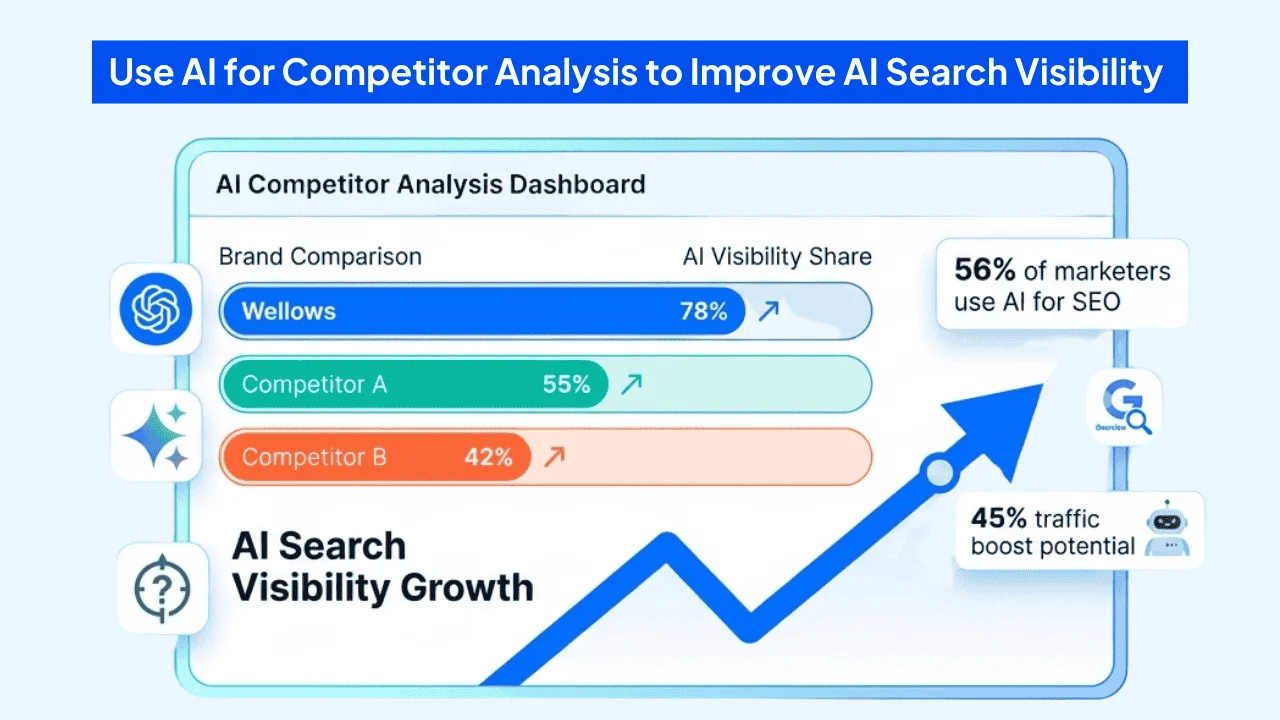
How to Use AI for Competitor Analysis to Improve AI Search Visibility
Traditional SEO rankings are no longer the only measure of success. Today, a growing share of searches are answered directly within AI-generated summaries, overviews, and conversational results—often before users ever see classic blue links.
In fact, AI Overviews appear in about 58% of question-based (informational) queries DesignRush (2025), which means visibility increasingly depends on whether your brand becomes a cited source inside AI answers—not just a blue-link result.
Additionally:
- Approximately 60% of searches now end without the user clicking through to another website Bain & Company (2025).
- About 80% of consumers rely on AI summaries for at least 40% of their searches Bain & Company (2025).
The Problem: Traditional Competitor Analysis Misses AI Visibility
Classic SEO competitor analysis focuses on:
- Keyword rankings
- Backlink profiles
- Top-ranking pages
But AI search systems (Google AI Overviews, ChatGPT, Perplexity, etc.) don’t rank content the same way humans or traditional algorithms do. Instead, they prioritize:
- Topical authority and entity relationships
- Clear, structured explanations
- Content that directly answers follow-up questions
- Sources that are frequently cited across the web
As a result, a competitor with fewer rankings—but better structured, more authoritative content—may dominate AI-generated answers while you remain invisible.
The Solution: AI-Driven Competitor Analysis for AI Search
To compete in AI-driven search environments, your competitor analysis must evolve. AI-powered analysis helps you understand why competitors are referenced by AI systems—and how to replace them.
Here’s how to adapt your approach:
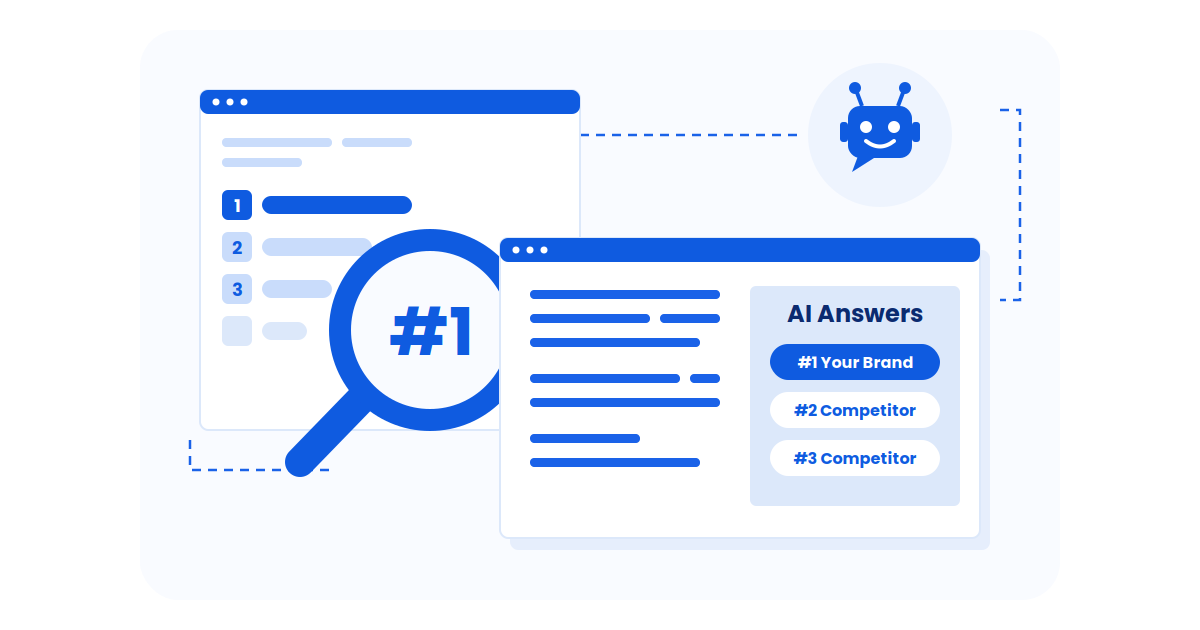
- Analyze AI citations Identify which competitors are referenced in AI Overviews, summaries, and conversational answers—even if they don’t rank #1.
- Reverse-engineer AI-preferred content Study cited competitor pages to uncover:
- How they structure answers
- Which entities/topics they cover
- What questions they address directly
- Find “AI gaps” Spot missing subtopics and clarifications AI relies on that your pages don’t cover.
- Optimize for citation-worthiness Use clear structure (H2/H3s, lists), factual depth, and supporting examples so AI can extract and cite your content.
Wellows helps you track AI visibility on the SERP by monitoring mentions/citations, comparing competitors, and surfacing AI-focused gaps to act on.
Why This Matters Winning in AI search isn’t about ranking higher—it’s about becoming the source AI trusts. By using AI to analyze: you can create content that not only ranks in SERPs but also earns visibility inside AI-generated answers—where user attention increasingly lives. In the next steps, this framework shows exactly how to identify those competitors, uncover AI-driven gaps, and turn insights into execution.
How Do I Analyze Why Competitors Rank Better in AI Than My Brand
If competitors appear more often in AI answers than your brand, the issue is usually AI visibility signals (mentions, citations, and trends), not just Google rankings.
Wellows’ Monitoring is built to help you diagnose this by tracking how your brand performs across AI search experiences like ChatGPT, Gemini, Perplexity, Google AI Overview, and AI Mode.
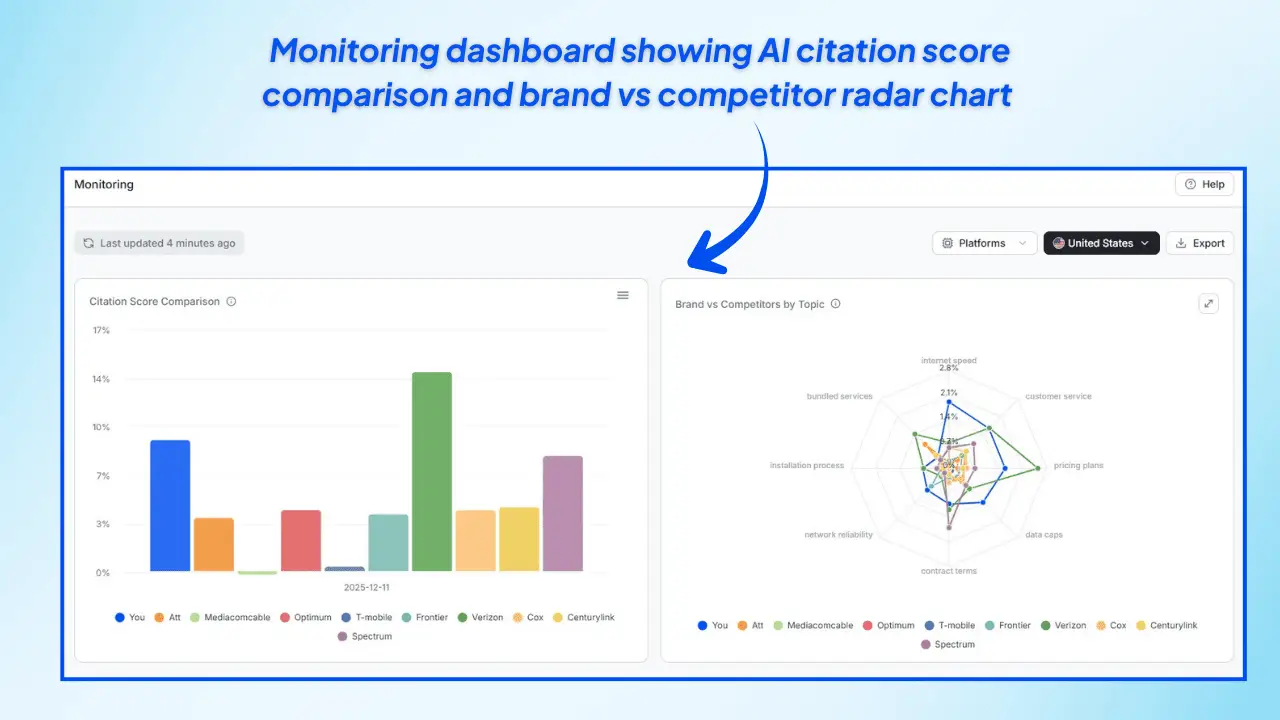
Here’s how to use it for competitor analysis:
- Track citation data vs competitors: Wellows monitors citation/visibility performance so you can see where competitors are “winning” attention inside AI results (and where your brand is missing).
- Benchmark competitive shifts over time: Monitoring highlights visibility trend movement—useful for spotting when a competitor starts gaining traction due to new content, PR mentions, or improved authority signals.
- Use industry trends to explain the gap: If the whole category is shifting, Wellows’ industry trend view helps you separate platform-wide changes from problems on your site.
Once you identify where competitors lead (topics, query types, or platforms), prioritize fixes like clearer explainer content, stronger FAQs, and improving the sources that mention your brand—because AI systems often reward brands that are cited consistently and explained clearly.
How to Use GEO Software to Monitor Competitor Citations in AI Search
Generative Engine Optimization (GEO) software helps brands measure how often competitors are cited in AI-generated answers and why.
As platforms like ChatGPT, Gemini, Perplexity, and Google AI Overviews increasingly influence search behavior, GEO tools track visibility signals that traditional SEO tools don’t cover.
With GEO software, you can monitor:
Did you know?
- Citation frequency (how often competitors appear vs. your brand)
- Query triggers (which prompts surface competitor mentions)
- AI share of voice (SOV) by topic and over time
- Citation sources (publishers and domains AI models rely on)
This shifts competitor analysis beyond rankings into AI visibility and citation behavior—critical as more searches end without a click.
Early GEO platforms like Otterly.ai established brand-level AI mention tracking. Wellows extends this by adding competitor benchmarking, industry monitoring, and visibility trends, making it easier to compare brands side by side.
Did you know?
Using Wellows, you can see:
- When competitors are cited more often than your brand
- Which queries and topics drive those citations
- Which sources AI models consistently reference
- How visibility changes over time, not just point-in-time mentions
This allows focused optimization—improving explanatory content, closing AI citation gaps, and aligning with sources AI already trusts—so your brand earns visibility inside AI answers, not just traditional SERPs.
Best AI Visibility Tool for Competitor Benchmarking
To compare your AI visibility against competitors, you need three things: (1) citation/mention tracking, (2) share-of-voice style comparison, and (3) trend monitoring across AI surfaces like ChatGPT, Gemini, Perplexity, and Google AI experiences.
For this workflow, Wellows is the strongest option because it’s built around competitive monitoring—combining a unified metric (Citation Score) with ongoing visibility tracking over time.
How to Compare Your AI Visibility vs Competitors in Wellows
When generative engines process a query, they:
Monitor competitor visibility by engine: track how often your brand vs competitors appear across major AI platforms and where competitors show up more frequently
Benchmark Citation Score: compare Citation Score trends to see who is gaining AI visibility and when the gap widens or closes.
Track daily changes: Monitoring surfaces movement in Citation Score, mentions, and opportunities so you can spot competitor spikes and respond quickly.
Turn gaps into actions: prioritize the queries where competitors are cited and you aren’t, then update/create pages that answer those intents clearly (definitions, steps, comparisons, FAQs).
Metrics That Matter for Benchmarking
When generative engines process a query, they:
Citation frequency by query (which prompts trigger competitor mentions)
Share-of-voice by topic (who dominates which themes)
Trend movement over time (visibility gains/losses)
Citation patterns (what content formats get cited repeatedly)
Note: Tools like Profound, GetMint, and seoClarity (ArcAI) also cover AI visibility, but if your main goal is competitor-focused benchmarking + ongoing monitoring, Wellows is the most direct fit.
- AI Visibility Strategies: 8 Most Effective Strategies for AI Visibility Enhancement
- SERP Visibility Analysis: How SERP Visibility Analysis Uncovers Competitor Gaps in 2026
- AEO vs GEO: AEO Vs GEO (2026): Differences, Use Cases & Which To Prioritize
- Brand Signals for AI Search: How Brand Signals Shape AI Search Visibility in 2025
- AI SEO for Startups: How Can Startups Use a GenAI Visibility Stack for Growth
- Reddit SEO for GEO: Reddit For GEO (2025): Boost AI Citations And Google SEO
- SEO Automation with AI: Why AI Agents Power Smarter SEO Automation in 2025
- Agency Workflow Automation: Save 50+ Hours: Automation for Agency Workflows in 2025
- SEO Strategy by Intent: Master SEO Strategy with User Intent for Higher Rankings
- Content Marketing Stats: Why Structured SEO Briefs Are the New Foundation of AI Search Success
- SERP & LLM Trends: How To Create Content Based on SERP and LLM Trends
FAQs
Use AI to identify true SEO competitors through keyword overlap, run keyword-gap analysis, cluster topics by intent, analyze competitor content structure (headings, FAQs, entities), and summarize backlink and brand-mention patterns to prioritize what to create or update.
For AI-era competitor analysis, use a mix of tools: Ahrefs or Semrush for keywords/backlinks, Surfer for content structure/entity gaps, and a GEO platform for AI citations. For competitor benchmarking and ongoing AI share-of-voice monitoring, Wellows is a top choice.
ChatGPT can summarize competitor positioning, extract patterns from competitor pages, and generate content briefs, but it needs accurate inputs (rankings, keywords, backlinks, or citation data) from SEO/GEO tools (e.g., Ahrefs, Semrush, Wellows) to be reliable.
The 4 P’s are Product, Price, Place, and Promotion. In SEO, this maps to what competitors offer, how they position pricing/value, where they get visibility (SERPs and AI answers), and how they drive demand through content, links, and mentions.
Most brands should run a full analysis monthly. Weekly monitoring is useful in highly competitive industries or when tracking AI citations and visibility shifts—especially if you’re benchmarking against competitors over time.
Yes. AI helps local businesses find real SERP competitors (directories, aggregators, local publishers), uncover local keyword gaps, improve service-page structure, and monitor AI visibility for local queries.
Conclusion: How to Use AI for Competitor Analysis Effectively
In 2025, understanding how to use AI for competitor analysis isn’t just beneficial—it’s essential. With more than half of marketers now using AI in SEO workflows and AI appearances influencing how search traffic behaves, brands that leverage AI insights gain a measurable advantage.
By combining AI-driven keyword analysis, content evaluation, backlink insights, and AI visibility tracking, you can outperform competitors both in traditional search results and in emerging AI search experiences.
The brands that succeed are those that understand the landscape deeply and adapt faster than the competition.