You planned, you optimized, you published, and still, no clicks?
Most Startup SEO teams spend weeks building strategies. But if you’re not aligning with an SEO approach focusing on user intent through a user-centric SEO strategy, even great content can get ignored.
In 2025, search behavior is faster, noisier, and more fragmented. AI Overviews, Reddit answers, and TikTok tutorials often appear before websites. That’s why your search engine optimization strategy, considering user intent, needs to match what people want and where they’re discovering it.
Wellows helps you align your SEO strategy with user purpose, enabling a user-focused SEO strategy that captures what people are really looking for in just a few minutes.
It pulls signals from live search queries, analyzes how people interact with content on the SERP, and tracks discussions across Reddit, LinkedIn, Quora, and more. Instead of hours of manual research, you get instant insight into what your audience wants, so you can plan smarter and publish faster.
What Is User Intent in SEO?
User intent, often referred to as search intent, is the underlying reason or objective a person has when they type a query into a search engine.
In SEO, understanding user intent is highly valuable because it allows content creators to craft material that matches what people are truly looking for.
Doing so not only improves search visibility but also increases relevance, satisfaction, and overall user engagement.
There are four main categories of user intent:
- Informational Intent: Here, the user is looking to gather knowledge or find an answer to a specific question. For example, searching “how does a slow juicer work” shows a clear need for information.
- Navigational Intent: In this case, the user wants to reach a particular site or page directly. A query like “Facebook login” indicates they already know where they want to go.
- Transactional Intent: This type shows that the user is ready to take action, usually making a purchase. For example, a search such as “buy Vita Extract slow juicer” reflects a strong buying intent.
- Commercial Intent: Here the user is in research mode before purchasing. A query like “best slow juicer” suggests they’re comparing options to make an informed decision.
When content is aligned with these intent types, SEO professionals can make their websites more useful and effective.
The result is stronger visibility in search results, better audience engagement, and higher chances of conversions.
How Can I Identify User Intent for Specific Keywords?
Pinpointing user intent helps you create content that matches what searchers actually want—boosting relevance, engagement, and rankings. Use this quick framework:
1) Know the Core Intent Types
Begin by anchoring your strategy to the four core intent types below—then map formats and CTAs to each.
- Informational — learning or answers.
- Navigational — finding a specific site/page.
- Transactional — taking an action (buy, sign up).
- Commercial Investigation — comparing options before purchase.
2) Read Keyword Modifiers
Scan the query’s modifiers—they usually telegraph intent at a glance.
- Informational: “how to”, “guide”, “what is”
- Navigational: brand/product names (e.g., “Wellows login”)
- Transactional: “buy”, “price”, “coupon”, “order”
- Commercial Investigation: “best”, “top”, “vs”, “reviews”
Example: “best smartphones 2025” → Commercial Investigation.
3) Inspect the SERP
Confirm intent in the live SERP—the layout reveals what Google expects to rank.
- Informational: guides, tutorials, People Also Ask
- Navigational: official sites, brand social profiles
- Transactional: product/category pages, shopping carousels
- Commercial Investigation: comparisons, review hubs
4) Use Research Tools
Leverage Google Keyword Planner, Ahrefs, SEMrush, and Search Console to see volumes, related queries, and (when available) intent tags and click behavior.
5) Map to the User Journey
Align keywords to funnel stages (learn → compare → decide) and match content formats accordingly (guide → comparison → product page).
6) Mine Your Own Data
- On-site search: reveals what visitors expect to find.
- Analytics: review bounce rate, time on page, and paths to validate intent fit.
7) Listen to the Market
Scan Reddit, Quora, LinkedIn, and niche forums to capture real phrasing, objections, and decision criteria—great signals for intent and copy.
Bottom line: combine modifiers, SERP patterns, tool data, and real user language to classify intent quickly—then build pages that match task, tone, and stage.
How Does User Intent Impact SEO Strategies?
User intent—the purpose behind what someone types into a search bar—plays a central role in shaping strong SEO strategies. When businesses identify and align with this intent, they can boost search visibility, engage users more effectively, and drive meaningful conversions.
Impact on SEO Strategies
Implementing User Intent in SEO
By keeping user intent at the core, businesses can design SEO strategies that not only rank higher but also deliver genuine value to their audience—leading to stronger engagement, better trust, and long-term growth.
Common mistakes in addressing user intent in SEO
Addressing user intent is the backbone of modern SEO. When your content aligns with what people are truly searching for, engagement improves and rankings follow. Yet, many strategies still stumble because of a few recurring mistakes:
Publishing content that doesn’t match the searcher’s real goal often drives visitors away. For example, pushing a sales-heavy landing page when the user is simply looking for a “how-to” guide results in high bounce rates and missed opportunities.
Trying to force keywords into every sentence disrupts readability and can harm credibility. Search engines now penalize this tactic, preferring natural, intent-focused language instead.
With mobile searches dominating, a site that isn’t mobile-friendly risks alienating users and losing visibility. Poor responsiveness directly undermines SEO performance.
Focusing on churning out large volumes of posts without depth usually backfires. Shallow, repetitive content rarely satisfies intent, leaving users unengaged and search engines unimpressed.
Internal links aren’t just for navigation—they help distribute authority and guide users through a logical journey. Skipping this step weakens both user experience and SEO impact.
Metrics like bounce rate, scroll depth, and time on page reveal whether your content truly fits the intent behind a query. Ignoring these signals makes it difficult to refine strategy and improve user satisfaction.
Avoid these pitfalls by centering your strategy on real user goals, publishing high-quality content, optimizing for mobile, and building a thoughtful linking structure. When paired with regular monitoring of engagement data, these practices ensure your SEO isn’t just keyword-driven—but intent-driven.
How Do I Measure the Success of Aligning Content with User Intent?
Measuring whether your content truly matches user intent comes down to tracking key performance indicators (KPIs) that reflect both search engine visibility and audience engagement. These metrics reveal if your pages are attracting the right visitors, answering their needs, and driving meaningful actions.
- Organic Traffic
An increase in organic visitors from search engines is a clear sign that your content is being surfaced for the right queries. When your content matches intent, search algorithms reward it with higher visibility, resulting in steady traffic growth. - Click-Through Rate (CTR)
CTR shows how compelling your title and meta description are in relation to user intent. A higher CTR means searchers see your result and believe it will answer their specific need—so they click. - Bounce Rate
If visitors land on your page and quickly leave, the content likely didn’t meet their intent. A lower bounce rate signals that users find the page relevant and worth exploring further. - Time on Page
The more time users spend with your content, the stronger the alignment with their search intent. Longer dwell time indicates they’re consuming the information or solutions you provide. - Conversion Rate
Ultimately, intent-driven content should guide users toward action—whether that’s filling out a form, downloading a resource, or completing a purchase. Higher conversion rates prove that your content satisfies intent and drives business outcomes. - Pages per Session
When visitors explore multiple pages in a session, it shows your content is relevant and well-linked to related needs. This behavior indicates you’re supporting broader user journeys, not just one-off queries. - Keyword Rankings
If your target keywords rise in the SERPs, it reflects search engines’ recognition that your content is well-matched to what users are actually searching for. - Backlinks and Social Shares
When others cite or share your content, it’s a strong signal of relevance and authority. Backlinks and shares amplify reach while showing that your content resonates with broader audiences.
Regularly monitoring these metrics lets you see how well your content aligns with intent, while also highlighting gaps. By refining pages based on these signals, you can continually improve relevance, deepen engagement, and increase conversions—turning intent alignment into measurable SEO impact.
User intent turns keyword lists into actionable plans—it tells you what the searcher is trying to do so you can target, format, and prioritize content that actually converts.What Role Does User Intent Play in Keyword Research?
Quick Workflow
How Does an SEO Strategy with User Intent Improve Visibility and Engagement?
An SEO plan focusing on user intent improves visibility by aligning your content with the real goals users have, whether they’re trying to learn, compare, or decide.
According to 2024 search behavior studies, 40+% of pages with the SEO strategy with user purchase intent stage, like showing pricing pages to users still researching.. This disconnect reduces visibility in search features and AI answers, where systems prioritize task-relevant content, not just keyword alignment.
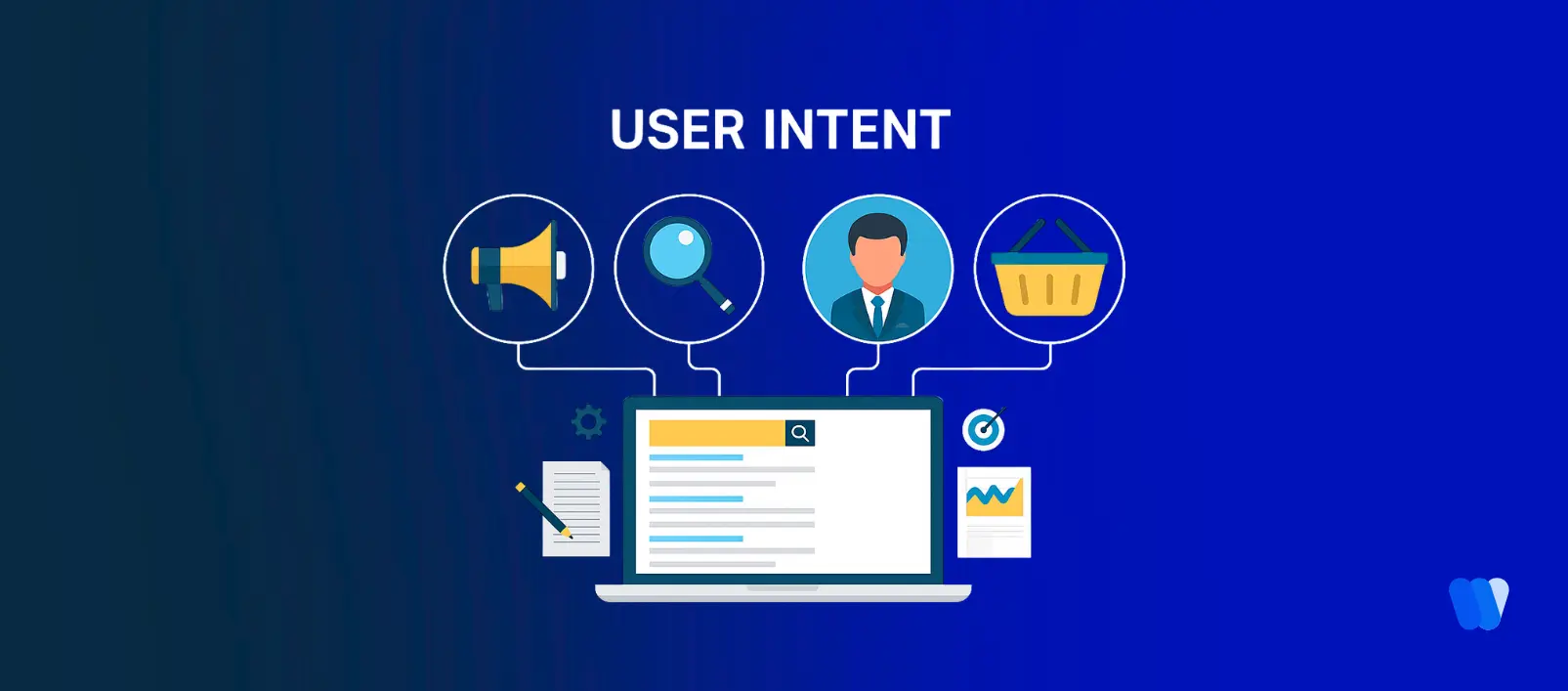
Instead of targeting keywords in isolation, you create content mapped to task categories: learn something, compare options, solve a problem, or make a purchase.
Search engines now prioritize usefulness over keywords alone. Content that answers a user’s true goal—whether to learn, compare, or buy—earns higher SERP visibility.
By aligning content with user intent, you attract visitors who are genuinely interested in your offerings, leading to higher engagement and a greater likelihood of conversion.
This makes the benefits of AI SEO Agents even more critical, as they help map every page directly to user satisfaction signals.
Pages now rank based not just on what they contain, but on how clearly they answer the implied question or solve the user’s task.
Why Do Most Content Plans Still Miss the Mark on Intent?
Most content plans fail because they focus on keyword metrics instead of actual user goals or task completion —another reason marketers are replacing spreadsheets and SOPs with AI agents to shift from static metrics to adaptive workflows.
SEO strategies often rely heavily on keyword metrics like search volume or CPC rather than task-based behavior signals. This leads to content mismatches, such as:
- Blogs are trying to sell instead of educate
- Landing pages that push CTAs too early
- Feature pages ranking for informational user intent queries.
Create Content Aligned with User Intent
Each search intent requires a matching content type:
- Informational → tutorials, guides, FAQs
- Navigational → brand pages, login portals
- Commercial Investigation → reviews, case studies, comparisons
- Transactional → optimized product pages with strong CTAs
This prevents mismatches (like showing demos to early-stage learners) and ensures your content flows naturally through the funnel.
These mismatches result in lower engagement, higher bounce rates, and invisible pages in SERPs, even when keyword targeting seems correct.
To see how lean teams are adapting their SEO to overcome this, check out our guide on how startups use a GenAI visibility stack for growth.
How Has Google’s Interpretation of User Intent Changed Since 2023?
Google’s interpretation of search intent evolved because its LLMs now assess whether content satisfies a task, not just matches keywords.
Social signals shape AI-driven rankings because they reflect how real users phrase questions, express pain points, and engage with platforms like Reddit or LinkedIn—insights that Autonomous marketing platform using SERP visibility surface to help brands stay visible in AI-generated answers.
Powered by LLMs, the Helpful Content System interprets the user’s goal behind a query, the overall tone, and whether the content is complete. The system also evaluates the intent stage—covering informational, navigational, and transactional journeys.
To succeed, brands must adopt an SEO strategy targeting navigational intent that complements informational education and transactional conversion.
This is particularly true for an SEO strategy with user intent for content creators.
- The user’s goal behind a query
- The intent stage (informational, transactional, post-purchase)
- Whether the content matches tone, structure, and completeness
This shift requires SEO teams to go beyond keyword optimization and build structured, human-first content that feels natural, trustworthy, and aligned with specific goals.
Future-Proof Against Algorithm Shifts
Search algorithms will keep evolving, but intent doesn’t change. By aligning content with user goals, your SEO remains resilient through every update. Instead of chasing ranking hacks, you consistently meet what Google now rewards: usefulness and user satisfaction.
How Do Social Signals Influence SEO and Intent Recognition Today?
As user behavior evolves, search engines are increasingly influenced by how users phrase questions, express frustration, or seek recommendations across social platforms.
Where Do Users Really Begin Their Research Journeys Now?
Search engines are no longer the first stop. Research often begins with:
- Reddit posts asking for peer recommendations
- TikTok tutorials explaining use cases
- YouTube videos comparing tools
- LinkedIn threads surfacing product pain points
Think SEO is still about keywords? Think again.
Google’s own 2024 research shows that 40% of young users (18–30) initiate product research on platforms like YouTube or TikTok. That means users arrive at your content already informed and influenced by social narratives.
Why Do Search Engines and LLMs Factor in Social Sentiment and Discourse?
Modern AI systems are trained on:
- Reddit and Quora discussions
- LinkedIn comment threads
- Viral conversations on X
These platforms reveal:
- How users phrase questions naturally
- What pain points do they repeat
- What language is emotionally charged or neutral
When your content echoes this language, it’s more likely to be selected for featured snippets, AI-generated summaries, and voice assistant answers.
What Are the Common Failures in Matching SEO Content to Real Intent?
Common SEO failures occur when content doesn’t match the user’s goal, even if the page ranks for the right keyword.
Many SEO strategies fail because they target popular keywords but ignore what the user actually wants to achieve. This leads to irrelevant formats, poor engagement, and missed conversion opportunities.
When SEO Ignores Searcher Intent
1. Content targets keywords, not goals
SEO often focuses on keywords instead of user purpose. As a result, pages may appear for the right terms, but fail to answer the right question. Users leave because the content doesn’t help them move forward in their journey.
2. Content format doesn't match funnel stage
Mismatch examples include:
- Awareness users shown product demos
- Users seeking comparisons are shown sales pitches
- Learners are getting feature pages instead of explainers
This misalignment creates friction, leading to higher bounce and lower retention.
3. Overreliance on keyword volume
Keyword volume tells you what’s popular, not what’s actionable. For example:
- “AI SEO tool” is vague
- “Wellows SEO workflows” signals comparison
- “Wellows for freelancers” shows a solution-seeking intent
When tools ignore this nuance, your strategy misfires. And when paired with Reddit for GEO insights—like how real users phrase “best tools for freelancers” in Reddit threads—you gain not just keywords, but the conversational context LLMs prefer to surface.
4. Ignoring intent modifiers
Terms like “best for beginners” or “vs [competitor]” reveal the decision stage. Content that ignores them serves generic answers, missing the mark on engagement and conversion.
5. Misplaced CTAs and funnel confusion
Matching intent at every stage increases conversions. When users see the right content at the right time, they move naturally from awareness to action.
What Happens When Content Format Doesn’t Match User Stage?
When content aligns with user intent, visitors immediately recognize its relevance—leading to longer sessions and deeper engagement.
Content aligned with user intent creates a smoother experience. Visitors stay longer, bounce less, and signal to search engines that your site delivers value.
This becomes especially critical when building an SEO strategy with user intent for e-commerce sites, where purchase journeys are intent-driven.
- Awareness-stage users shown product demos
- Mid-funnel comparisons forced into sales copy
- People looking for definitions land on feature matrices
These disconnects drive users away.
Even technically accurate content fails when the format doesn’t match the goal.
Why Is Keyword Volume Alone an Incomplete Metric?
Intent-based targeting goes beyond volume. By focusing on “why” people search, you attract qualified visitors with long-tail, actionable queries.
Consider the difference:
- “AI SEO tool” = ambiguous
- “Wellows SEO workflows” = comparison intent
- “Wellows for freelancers” = solution-focused query
Keyword tools surface what’s popular. Wellows surfaces what’s purposeful.
Conduct Intent-Focused Keyword Research
Keyword volume shows what’s popular — but intent research tools uncover why people search. Use these alongside Wellows classifiers:
-
Google Keyword Planner → search volumes & competitiveness
-
SEMrush → keyword difficulty & related terms
-
Ahrefs → competitor keyword analysis
-
AnswerThePublic → phrasing & common user questions
These tools, when paired with intent classification, help you target search goals, not just traffic numbers.
Why Misreading Intent Breaks SEO Flow and Kills Conversions?
Misreading search intent leads to high bounce rates because users are served the wrong content type for their decision stage, like pushing demos to research queries.
- Writing “ultimate guides” for users ready to purchase
- Building demo CTAs into educational articles
- Ignoring modifier terms like “best for beginners,” which indicate comparison or solution-seeking intent
This kind of misalignment not only fails to convert but can also reduce engagement signals that search engines rely on for ranking decisions. It can also skew campaign performance and confuse analytics.
Implement Intent-Based Internal Linking
Don’t let users hit dead ends. Instead, build pathways that mirror the buyer journey:
- Link guides (informational) → comparisons (commercial)
- Connect comparison posts → transactional product pages
- Cross-link transactional pages → supporting FAQs or case studies
How Can You Align SEO Content With Actual Search Goals In Minutes?
You can align SEO content faster by using tools that automatically classify user intent and real-world phrasing, so you’re not guessing what a query actually means.
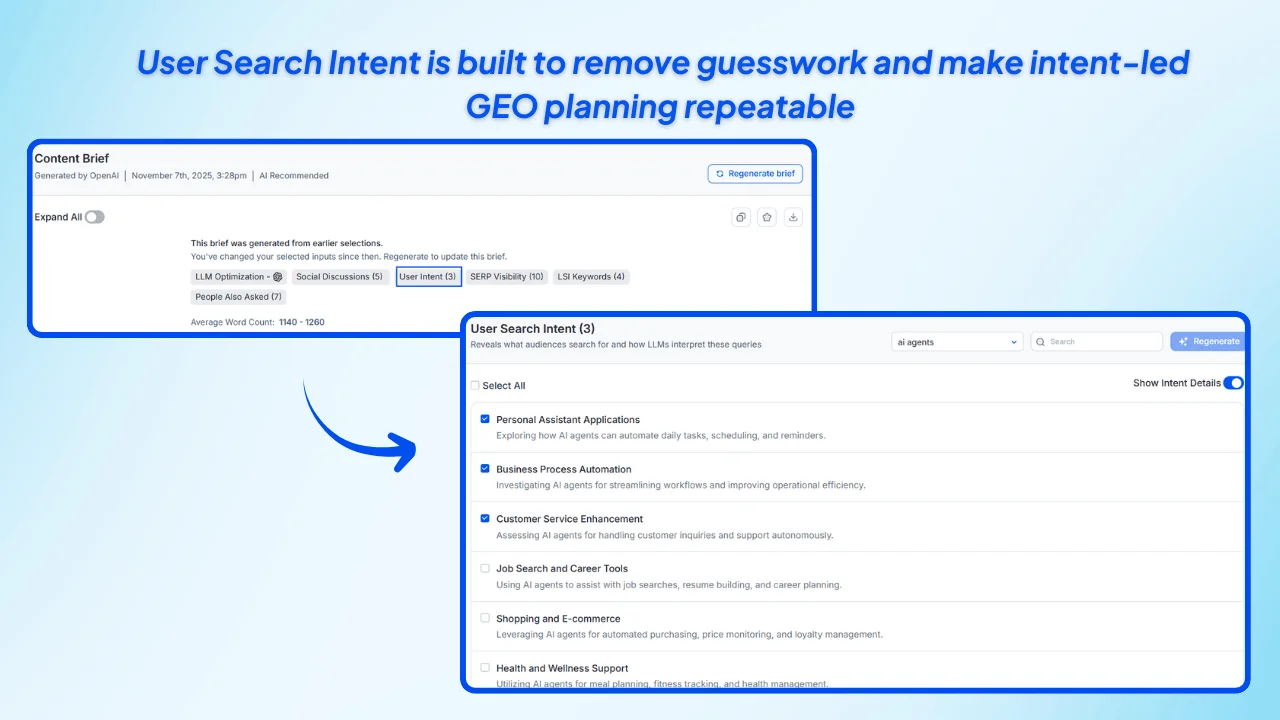
Intent-aware systems make this simple. Wellows User Intent Analysis pulls intent patterns from live SERPs and community language, then translates them into clear content direction you can ship right away.
Challenges In Integrating User Intent
Intent isn’t static. It shifts by audience, platform, and even tone, so the same keyword can mean different things in different contexts. The key is using fresh behavioral signals to narrow intent quickly, then validating the output with your own market knowledge. When those two align, your content matches real search goals without slow manual analysis.
How Does Wellows Decode Real User Intent Behind Every Query?
Wellows helps social media marketing agencies understand intent at scale by tracking how people actually search across Google and AI engines, then grouping those queries by goal. Instead of guessing what a keyword “means,” you see whether people are trying to learn, compare options, solve a problem, or buy something.
- Intent-based query grouping: Wellows clusters searches into clear intent buckets (informational, navigational, commercial, transactional) so you know the real goal behind the phrasing.
- Pattern + phrasing discovery: It surfaces repeated search behavior patterns and conversational modifiers (“best,” “how to,” “near me,” etc.) that signal what users want next.
- Cross-engine visibility context: Because Wellows is built to track visibility in both classic search and LLM search, intent is interpreted in the same environment where rankings and citations happen.
The result is a labeled view of motivation, so briefs and updates are based on real search goals, not assumptions.
What Do Wellows’ Intent Signals Reveal That Keyword Tools Miss?
Traditional keyword tools mostly show volume and broad categories. Wellows goes deeper by showing how intent shifts across phrasing and stages, so you can map content to what users expect to see.
- Educational intent: queries that indicate learning (e.g., “what is…”, “how does…”).
- Comparison intent: searches that signal evaluation (“vs”, “best”, “top”, “alternative”).
- Problem-solving intent: phrasing that implies a fix or outcome (“how to improve…”, “why is…”, “steps to…”).
- Purchase-ready intent: commercial/transactional searches tied to selecting or buying.
This makes funnel mapping cleaner, CTAs more accurate, and prevents you from writing content for the wrong stage.
How Does This Improve Content Focus And SERP Match Rates?
When content is built from intent-clustered queries, it matches the format and depth users (and SERPs) reward. Wellows frames this as aligning content to observed behavior patterns, then choosing the right structure to fit that intent.
- Less content waste: fewer off-intent articles that never rank or get cited.
- Clearer structure: guides, FAQs, comparisons, or how-tos chosen based on what the intent demands.
- Better engagement signals: tighter match to expectations reduces pogo-sticking and bounce.
- Higher AI citation odds: contextual relevance and intent alignment are core visibility factors in generative engines.
In short: intent-aligned briefs make your pages feel like the “right answer” to both humans and AI systems.
How Can You Use Social Discussion Signals To Shape Content That Resonates?
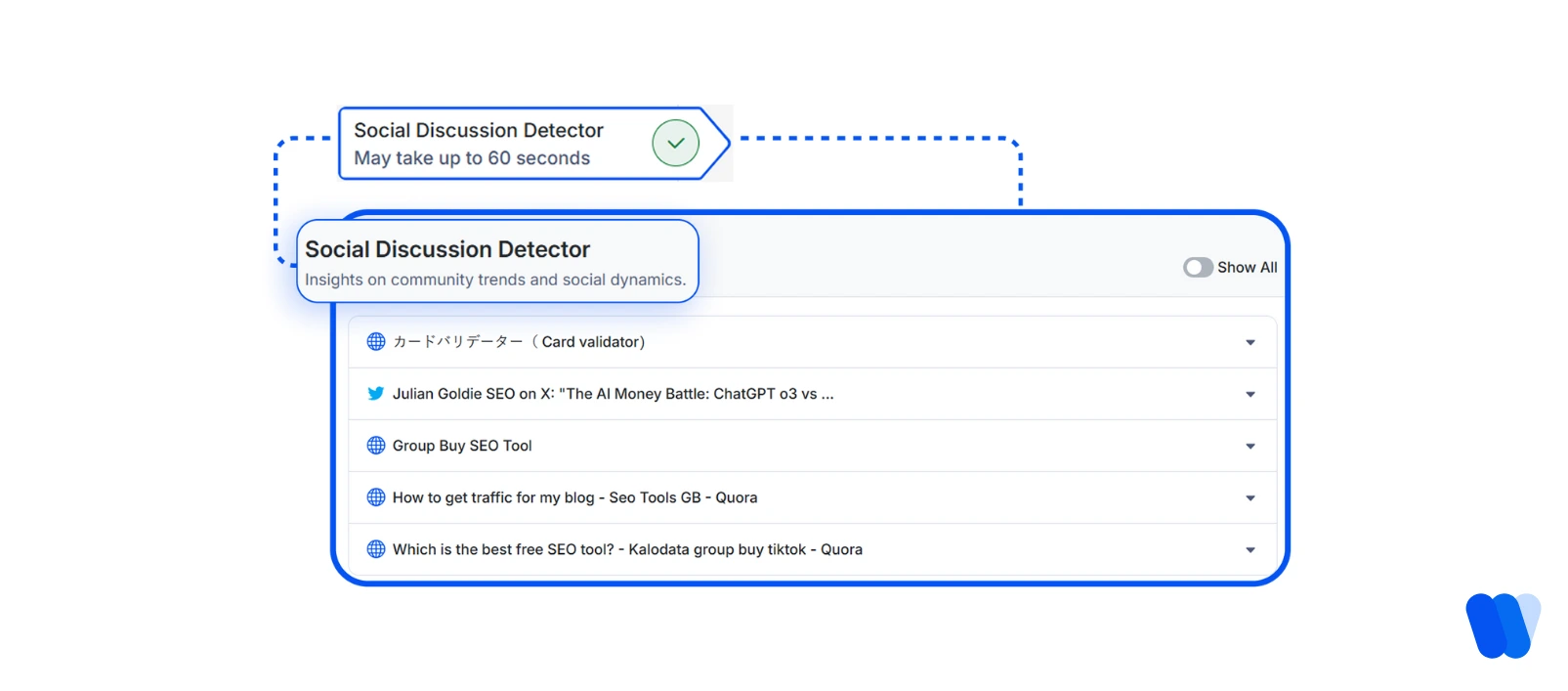
Social Discussion Detector pulls real-time audience language and sentiment into your briefs. That means your content is shaped by how people actually talk about a topic—not just how they search for it.
How Does It Surface Real Conversations From Reddit, X, LinkedIn, And Quora?
The detector analyzes live discussion signals across the platforms where real objections and phrasing trends form, including:
- Reddit threads tied to your topic clusters
- Quora questions with strong engagement
- X posts shaping conversational phrasing
- LinkedIn discussions revealing professional pain points
Instead of copying posts, the system distills them into usable inputs—common wording, sentiment cues, and the real angles people care about.
What Does That Mean For Briefs And Strategy?
You gain:
- Real-world language that matches audience emotion
- More natural tone from the first draft
- Built-in objection handling, because the brief already reflects what people worry about
Result: writers start closer to “publish-ready,” and editors spend less time fixing tone or missing context.
How Does This Translate Into More Human And LLM-Visible Content?
- Pages mirror how people actually speak and ask questions
- LLMs see clearer contextual relevance and lived-experience signals
- Google and AI engines are more likely to lift your passages because they align with real intent + phrasing patterns
Off-site discussion signals (like community threads and independent mentions) are strongly reflected in what LLMs trust and cite, so feeding that language into your content improves selection odds.
What Does An Intent-Aligned, Socially Informed SEO Workflow Look Like?
An intent-aligned workflow starts from real search behavior plus real discussion behavior, then turns both into a brief that matches what users want and how they phrase it. You’re not guessing tone or format—you’re responding to observed demand.
Every input—from query intent to live community phrasing—becomes actionable structure:
- Upload or pull keyword data → group by intent
- Extract social phrasing → identify pain points and narrative gaps
- Generate brief → aligned to format, funnel stage, and tone
- Write faster → because the brief already matches audience reality
How Do The Two Features Work Together In Practice?
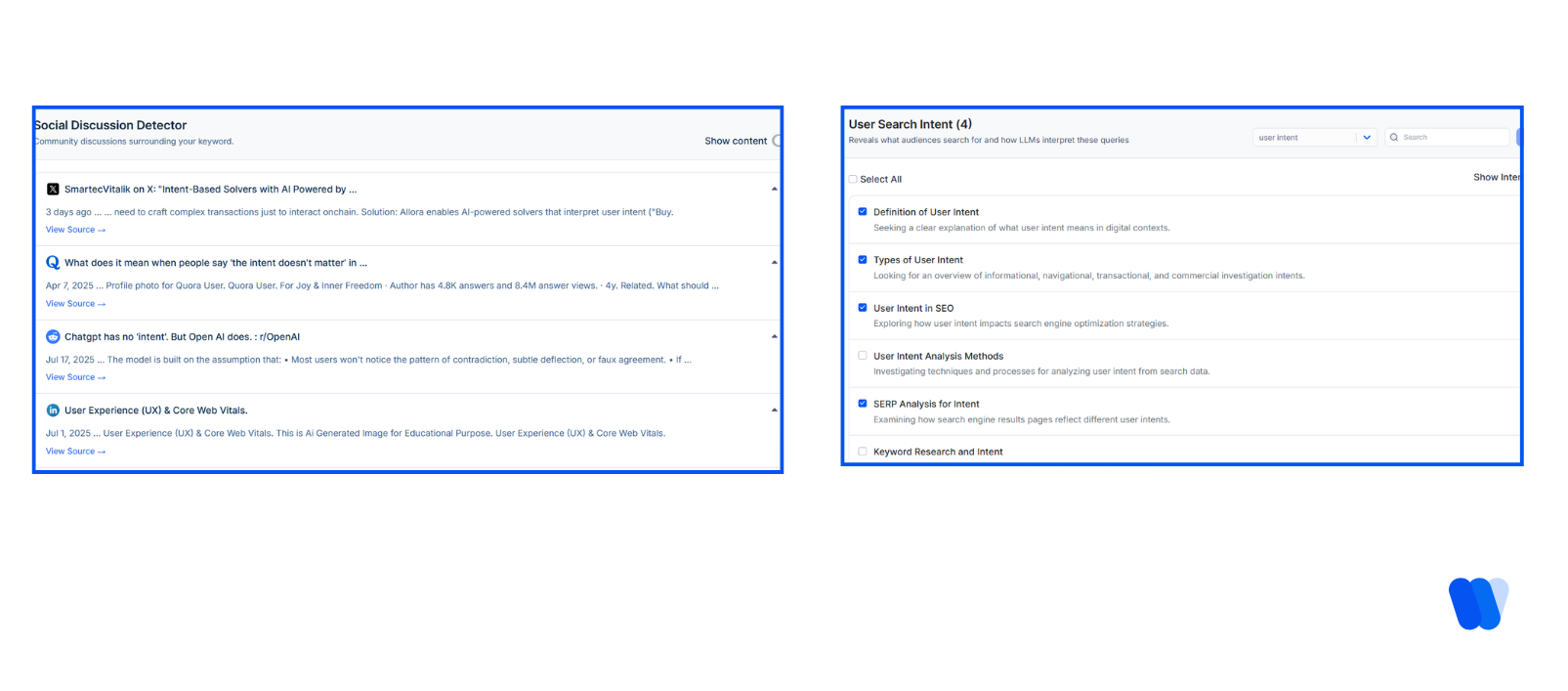
Both features run in one flow:
- You bring in keyword/topic inputs
- The system clusters and labels them by intent
- It pulls live discussion signals from social sources
- It outputs a brief tailored to intent, format, and human phrasing
You get briefs that match both what people search for and how they actually talk about the problem.
Why Should Intent and Emotion Drive Every SEO Brief in 2025?
SEO is now defined by how well your content solves user problems.
It’s about clarity, motivation, and authenticity.
How Can You Future-Proof SEO Without Guesswork?
You can’t optimize for every algorithm shift, but you can build around the constants: intent, tone, and clarity.
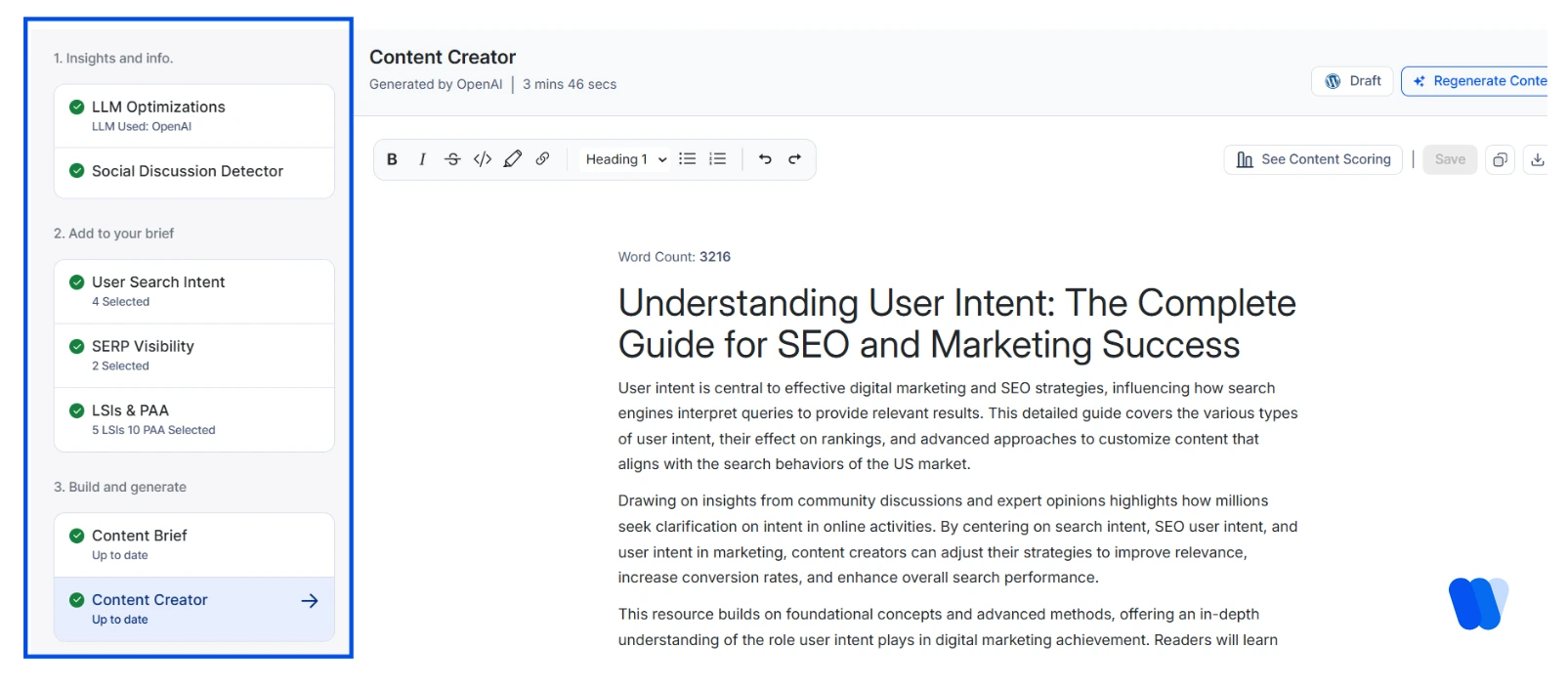
Wellows helps future-proof your SEO by:
- Classifying search goals as they evolve
- Detecting social discussion changes in real time
- Guiding writers according to SERP
Instead of chasing what’s changing, you focus on what matters to your audience.
Read More Articles
- How to Build Topical Authority in SEO Without Spending Thousands on Tools
- Search Behavior Patterns in SEO: Turning Insights Into Winning Content Ideas
- How Can Startups Use a GenAI Visibility Stack for Growth
- How Can Marketers Build a Competitor-Driven Strategy
- How Can Solo Marketers Use an SEO Agent
- Key Challenges Freelancers Face Without AI Agents in SEO
- How To Cut Blog Research Time
- Benefits of AI SEO Agents
- How to Optimize SEO with AI Topic Clusters for Better Visibility in 2026
- How to Humanize AI Content for SEO
- How to Use AI for Competitor Analysis
FAQs:
Conclusion
SEO today is about more than visibility; it’s about usefulness, tone, and task alignment. An SEO strategy addressing user needs makes this possible. Users don’t just search, they express curiosity, compare opinions, and follow real-world conversations.
By combining Wellows’ User Intent Analysis with the Social Discussion Detector, marketers unlock a faster, smarter, more resonant content strategy that isn’t based on guesswork or outdated metrics.
This isn’t a trend, it’s a fundamental shift in how people discover and evaluate content. And Wellows is designed to help you adapt in minutes, not months.