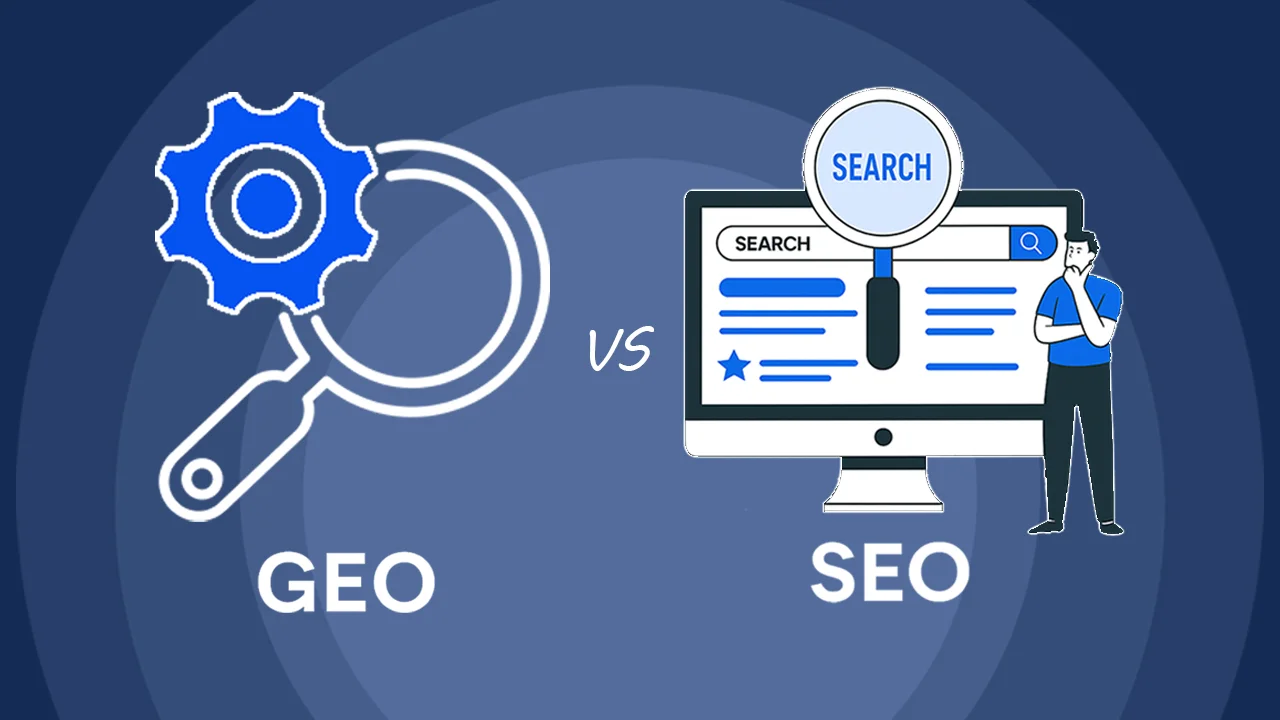
Search in 2025 is evolving at a pace few marketers anticipated. Two years ago, SEO was still largely defined by optimizing for Google’s blue links.
Today, it’s about appearing across multiple channels from traditional SERPs to AI-driven conversational engines like ChatGPT, Gemini, and Claude. Users are no longer satisfied with scrolling through ten results pages. They expect direct, accurate, and context-aware answers.
This shift has opened new possibilities for businesses and agencies. Traditional AI SEO tools remain highly effective for task-specific optimization, and when combined with AI-driven visibility strategies, they help teams achieve faster execution with smaller budgets.
That’s why the benefits of AI SEO agents in 2025 have become impossible to ignore. Unlike conventional tools, these systems go beyond automation analyzing SERPs, identifying hidden opportunities, clustering keywords, generating content briefs, and even tracking visibility across large language models (LLMs).
The question is no longer “Should you use an AI SEO approach?” but “How quickly can you integrate one into your workflow before competitors outpace you?”
Let’s break down the seven biggest benefits of using an SEO AI agent in 2025, with a focus on practical applications, KIVA’s unique role, and why this technology is reshaping the SEO landscape.
How do AI SEO agents differ from traditional SEO tools and practices?
AI SEO agents and traditional SEO tools differ significantly in how they approach website optimization for search engines. Below is a comparison outlining the main distinctions:
| Aspect | Traditional SEO Tools | AI SEO Agents |
|---|---|---|
| Data Analysis | Provide raw data and charts that need manual interpretation. | Automatically analyze data and generate actionable insights. |
| Content Creation | Give keyword suggestions and guidelines; content writing is handled manually. | Create, rewrite, and optimize content on their own. |
| Technical SEO | Highlight issues such as broken links or indexing errors, but fixes are done manually. | Detect and resolve technical SEO issues without human intervention. |
| Link Building | Involves manual outreach and building relationships for backlinks. | Automates link prospecting and outreach efforts. |
| Performance Monitoring | Require manual tracking and reporting of performance metrics. | Continuously track performance and provide real-time reports. |
| Adaptability | Adjust strategies only after algorithm changes are noticed. | Adapt instantly to algorithm updates with real-time adjustments. |
| Scalability | Scaling campaigns needs more people and resources. | Easily scalable with little to no additional resources required. |
| Cost Efficiency | More costly due to labor-heavy and time-consuming processes. | Reduces long-term costs with automation and efficiency. |
What are the benefits of using AI for SEO?
Integrating artificial intelligence (AI) into search engine optimization (SEO) strategies offers numerous advantages that can significantly enhance a website’s performance and visibility. Key benefits include:
Did you know?
- Enhanced Efficiency and AutomationAI automates repetitive SEO tasks such as keyword research, content optimization, and technical audits. This reduces manual effort and allows SEO professionals to focus more on strategic planning and creativity.
- Advanced Data Analysis and InsightsAI can process vast amounts of data quickly, uncovering trends and patterns that guide SEO strategies. This makes it easier to make informed decisions and adjust campaigns in response to evolving search behaviors and algorithms.
- Improved Content OptimizationAI helps in creating and refining content by analyzing readability, relevance, and keyword placement. It provides actionable suggestions that enhance user engagement and align content with search engine requirements.
- Personalization of User ExperienceBy examining user preferences and behavior, AI enables websites to deliver tailored content and recommendations. This level of personalization increases user satisfaction, engagement, and conversion rates.
- Predictive Analytics for Proactive StrategyAI-powered tools can anticipate algorithm changes and forecast SEO trends. With this foresight, businesses can proactively update their strategies and stay ahead of competitors.
- Technical SEO OptimizationAI automates technical SEO processes such as identifying broken links, checking site performance, and optimizing architecture. This ensures websites are technically strong and easily accessible to search engine crawlers.
- Enhanced Link Building and AnalysisAI identifies new link-building opportunities and evaluates backlink quality. This makes it easier to develop effective strategies for acquiring authoritative backlinks that boost rankings.
AI doesn’t replace SEO professionals; it amplifies them. It handles repetitive groundwork like clustering, tracking, and reporting, allowing marketers to focus on creativity, storytelling, and strategy—while achieving faster execution, stronger visibility, and better results.
What Are the Benefits of AI SEO Agents for Keyword Research and Clustering
Keyword clustering has always been considered the foundation of SEO strategy. Yet, anyone who has managed large campaigns knows the pain of digging through endless spreadsheets, filtering irrelevant terms, and trying to manually connect semantic relationships—a key reason marketers are replacing spreadsheets and SOPs with AI agents to streamline keyword workflows.
Traditional tools give you raw keyword lists but rarely organize them in a way that aligns with Google’s shift toward topical authority.
For example, KIVA — an AI SEO Agent by Wellows — takes a semantic approach. Instead of only pulling keyword volumes, it automatically groups related terms by search intent, context, and meaning.

Like, targeting “AI content Marketing” with traditional tools may return thousands of disconnected keywords. KIVA clusters them into content-ready themes like:
-
AI tools for content creation
-
Best AI content marketing strategies
-
AI-driven SEO vs traditional SEO
-
How AI improves content personalization
With this approach, you no longer create scattered pages for each keyword. Instead, you build pillar content hubs, comprehensive pages that cover full themes and strengthen topical authority.
The practical benefit? Instead of spending 10–12 hours per week on keyword sorting, AI SEO strategies reduce this process to minutes, freeing you to focus on execution.
Did you know?
By letting AI do the heavy lifting, SEOs gain not only time but strategic clarity, ensuring every piece of content maps to meaningful user intent.
It’s why the hottest AI startups are designing for both: optimizing content that not only ranks in Google, but also earns citations in generative AI platforms like ChatGPT and Gemini.
Ready to see the benefits of an AI SEO Agent in action? and unlock automation, clustering, and dual visibility no credit card needed.
How Do AI SEO Agents Improve Keyword Research and Analysis?
AI SEO agents transform keyword research and analysis by using advanced machine learning to process massive datasets, uncover hidden opportunities, and deliver actionable insights faster than traditional methods. Here’s how they elevate the process:
- Smarter Keyword Discovery
AI agents scan search data at scale to identify keywords most relevant to your audience and industry. This ensures that your content aligns with search intent, improves topical authority, and drives sustainable organic traffic. - Automated Long-Tail Keyword Expansion
Instead of manually filtering terms, AI agents surface long-tail variations that are less competitive yet highly conversion-focused. This not only saves hours of manual effort but also helps capture niche audiences that competitors often overlook. - Deeper Competitive Insights
By analyzing competitor rankings, backlink profiles, and content strategies, AI SEO agents reveal gaps and untapped opportunities. This allows marketers to refine campaigns with precision and stay ahead in highly competitive niches. - Contextual and Intent-Based Grouping
Through natural language processing (NLP), AI recognizes the meaning and intent behind queries—whether users are researching, comparing, or ready to buy. This semantic clustering creates more relevant content hubs that map directly to customer journeys. - Real-Time Trend Monitoring
With search behavior constantly evolving, AI-powered insights provide up-to-the-minute updates on emerging trends. This agility allows businesses to pivot strategies quickly and maintain visibility where users are searching today.
How SEO AI Agents Improve Visibility in SERPs and AI Platforms
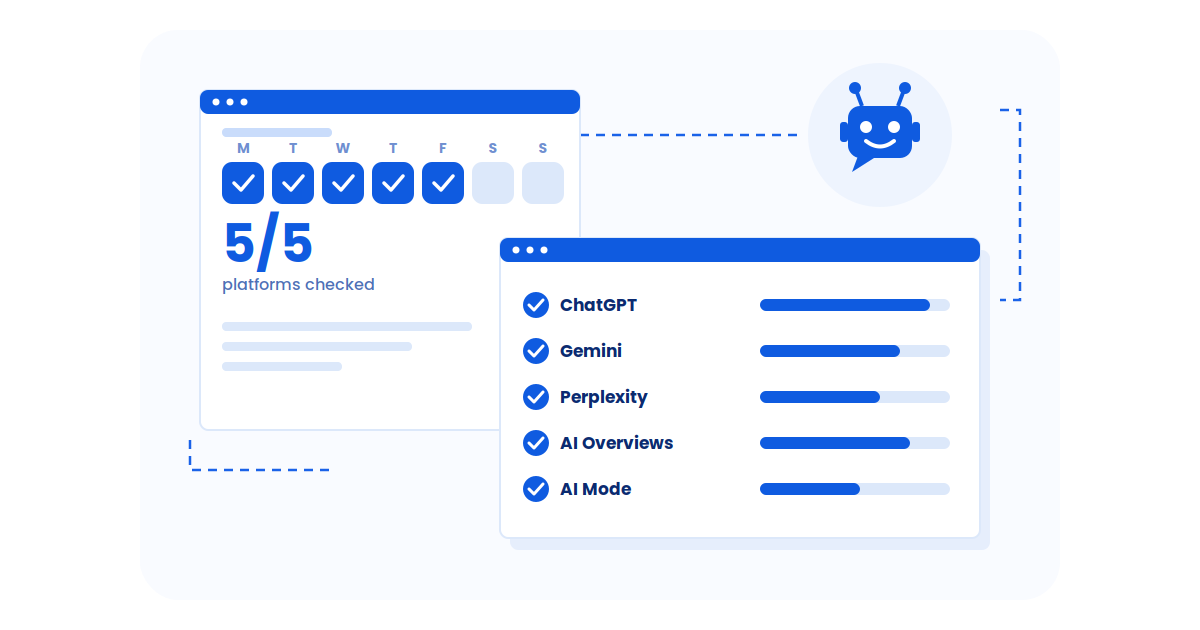
Five years ago, visibility meant ranking on Google’s first page. In 2025, that definition has expanded. Users increasingly consult AI-driven assistants like ChatGPT, Gemini, Claude, and Perplexity for answers.
These platforms don’t present ten blue links; they generate direct responses, often citing only one or two sources. That means if your brand isn’t included in those outputs, you effectively don’t exist in that user’s search journey.
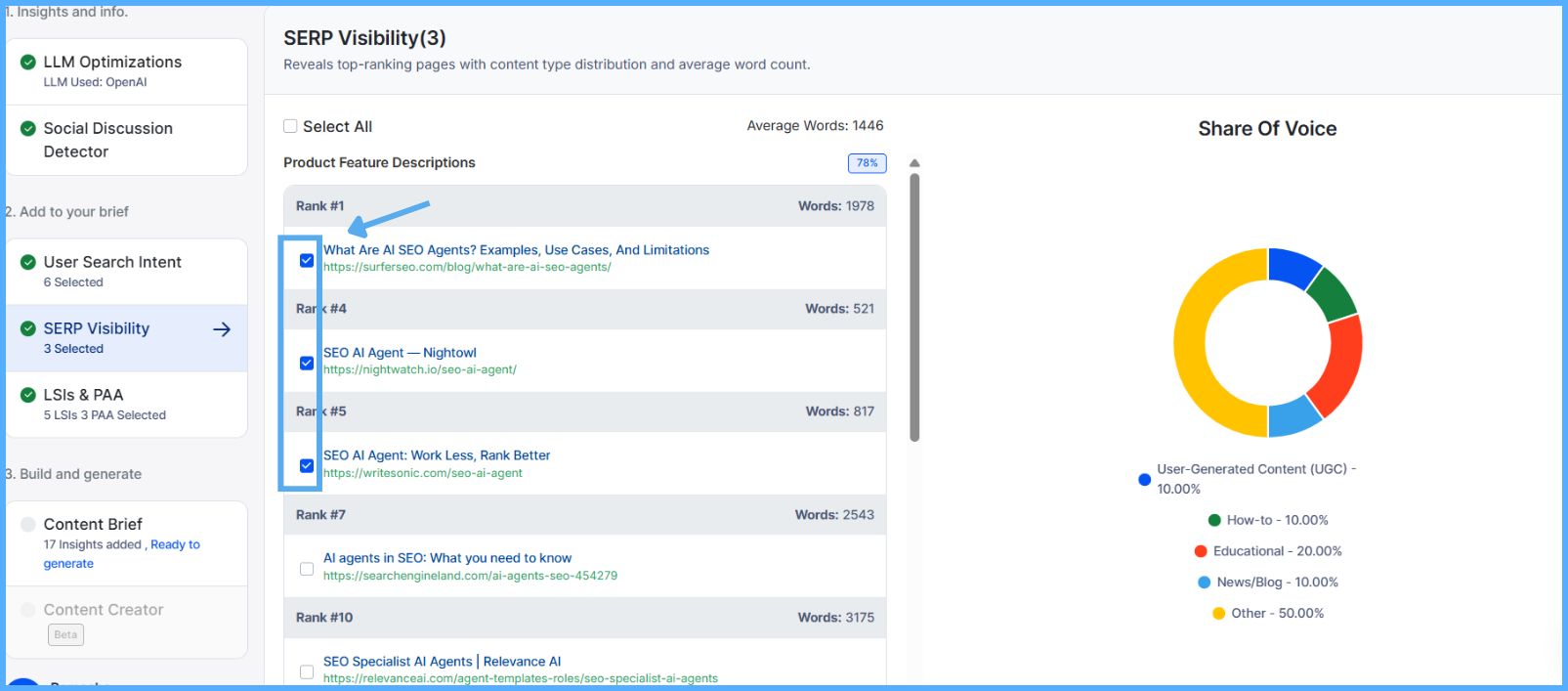
AI SEO strategies address this challenge by tracking dual visibility:
SERP Visibility Result → Show exactly how your pages rank on Google, including featured snippets, People Also Ask, and other SERP features.
LLM Visibility Result→ Show how your brand or keywords are being surfaced (or ignored) inside AI-generated answers.
This dual approach gives you insights that no traditional SEO tool provides. For example, you might rank on Google for “best AI SEO tools,” but ChatGPT may still omit your brand in its answer. Without an AI SEO approach, you’d never know.
By seeing both sides, you can adjust strategy, optimizing not just for search engines, but also for AI-driven answer engines. For growing teams, adopting an AI Search Visibility Platform for Startups can make this dual optimization process seamless—helping brands understand how they appear across both traditional SERPs and AI-generated results.
Did you know?
In short, AI SEO approaches ensure your brand stays visible not just on Google. They ensure you’re visible where users are searching now and in the future.
Can AI SEO Agents enhance content optimization and creation?
Yes, AI SEO agents can greatly enhance content optimization and creation by automating key steps in the SEO workflow. Instead of spending hours on manual research and editing, these systems combine automation with real-time insights to deliver content that is both search-engine friendly and engaging for users.
Key Benefits of AI SEO Agents for Content Optimization:
-
Smarter Keyword Research
AI SEO agents analyze search trends, competitor strategies, and user intent to surface high-value keywords. This reduces manual effort while ensuring your content aligns with the right search opportunities. -
Content Generation & Refinement
Beyond suggesting topics, AI agents can draft outlines, recommend headings, and optimize readability, ensuring every piece of content is structured for both relevance and quality. - On-Page SEO Optimization
From meta tags to headers and media, AI systems fine-tune on-page elements to meet current SEO best practices. This helps improve SERP rankings and enhances user experience. -
Content Gap Discovery
By analyzing competitor coverage, AI tools highlight missing subtopics or questions your audience is searching for. Filling these gaps helps create more comprehensive, authoritative content. -
SERP Feature Targeting
AI agents track changes in SERP layouts and recommend adjustments to capture featured snippets, People Also Ask, and other high-visibility placements. -
Content Repurposing
A single article can be repurposed into multiple formats—blogs, social posts, or video scripts—allowing consistent messaging across different platforms without additional manual effort.
Examples of AI SEO Tools:
-
Writesonic → Provides AI solutions for optimizing visibility across both AI-powered search and traditional engines.
-
Relevance AI → Focused on multi-agent SEO automation for agencies, covering keyword research, content creation, and reporting.
-
Profound → Specializes in “Generative Engine Optimization,” helping brands monitor and improve their presence in AI-driven search results.
By weaving AI SEO agents into your strategy, content creation becomes faster, more data-driven, and scalable—ensuring every piece you publish is optimized to rank higher and resonate better with your audience.
What Are the Benefits of SEO AI Agents for Content Planning and Brief Creation
Content creation doesn’t begin with writing. It begins with planning. This includes analyzing SERPs, studying competitors, gathering People Also Ask questions, and structuring outlines.
Doing all this manually often takes 4–6 hours per piece, which slows teams down dramatically.
AI SEO Automation streamline this process, collecting keyword clusters, competitor outlines, and SERP data into ready-to-use briefs.
Did you know?
- Target keyword clusters
- Ranking competitor outlines
- SERP data on featured snippets & FAQs
- Suggested headings, subheadings, and stat placements

Writers then receive a ready-to-use content roadmap. Instead of starting from scratch, they begin with a fully optimized structure. For agencies handling multiple clients, this reduces bottlenecks; for startups, it ensures consistent quality even without a dedicated strategist.
Consider this workflow: A startup founder wants to launch a blog on “AI in education.” Instead of spending days compiling research, they use KIVA to generate briefs that already include headings, questions, and keyword clusters. Within hours, they can assign structured drafts to writers.
Did you know?
By combining clustering with automated briefs, KIVA turns research-heavy processes into execution-ready outputs, allowing teams to produce more content without sacrificing strategy.
How Do SEO AI Agents Save Time and Reduce SEO Costs
How Do SEO AI Agents Save Time and Reduce SEO Costs
SEO AI agents are reshaping the way businesses approach optimization. By automating repetitive tasks and leveraging data-driven insights, they make SEO faster, smarter, and more cost-effective.
- Automating Repetitive Tasks
AI agents take over routine SEO processes such as keyword research, content optimization, and technical audits. By automating these repetitive tasks, they free professionals to focus on creative strategies and high-level planning. Work that once took hours can now be completed in minutes, resulting in faster and more efficient workflows. - Enhancing Efficiency and Productivity
AI agents can process large amounts of data in real time, providing instant insights and actionable recommendations. This allows teams to adjust campaigns quickly and stay aligned with algorithm changes and market trends. Continuous monitoring and optimization improve campaign performance while saving valuable time. - Reducing Operational Costs
Using AI agents significantly lowers the cost of SEO operations. Unlike human teams, AI tools function around the clock without salaries, breaks, or additional overhead. Businesses can achieve major savings compared to traditional methods, making AI a highly cost-effective solution for organizations of all sizes. - Improving Accuracy and Precision
AI-driven insights reduce the risk of human error by basing decisions on reliable data rather than guesswork. By analyzing large datasets with precision, AI ensures SEO strategies are accurate, targeted, and more effective. This leads to improved search rankings and stronger overall results. - Scaling Operations
AI agents make it possible to scale SEO efforts without increasing costs proportionally. They can manage multiple tasks simultaneously, ensuring consistency across campaigns. Whether handling large-scale projects or multiple client accounts, AI provides the scalability needed to expand operations smoothly and efficiently.
How Do SEO AI Agents Help Prioritize SEO on a Budget
Budget constraints are a reality for startups, freelancers, and even mid-sized agencies. The challenge isn’t “What can we do?” but “What should we do first for maximum ROI?”
This is where AI SEO methods provide real value, surfacing underutilized keywords, refreshing opportunities, and quick wins. By analyzing Google Search Console data, KIVA surfaces
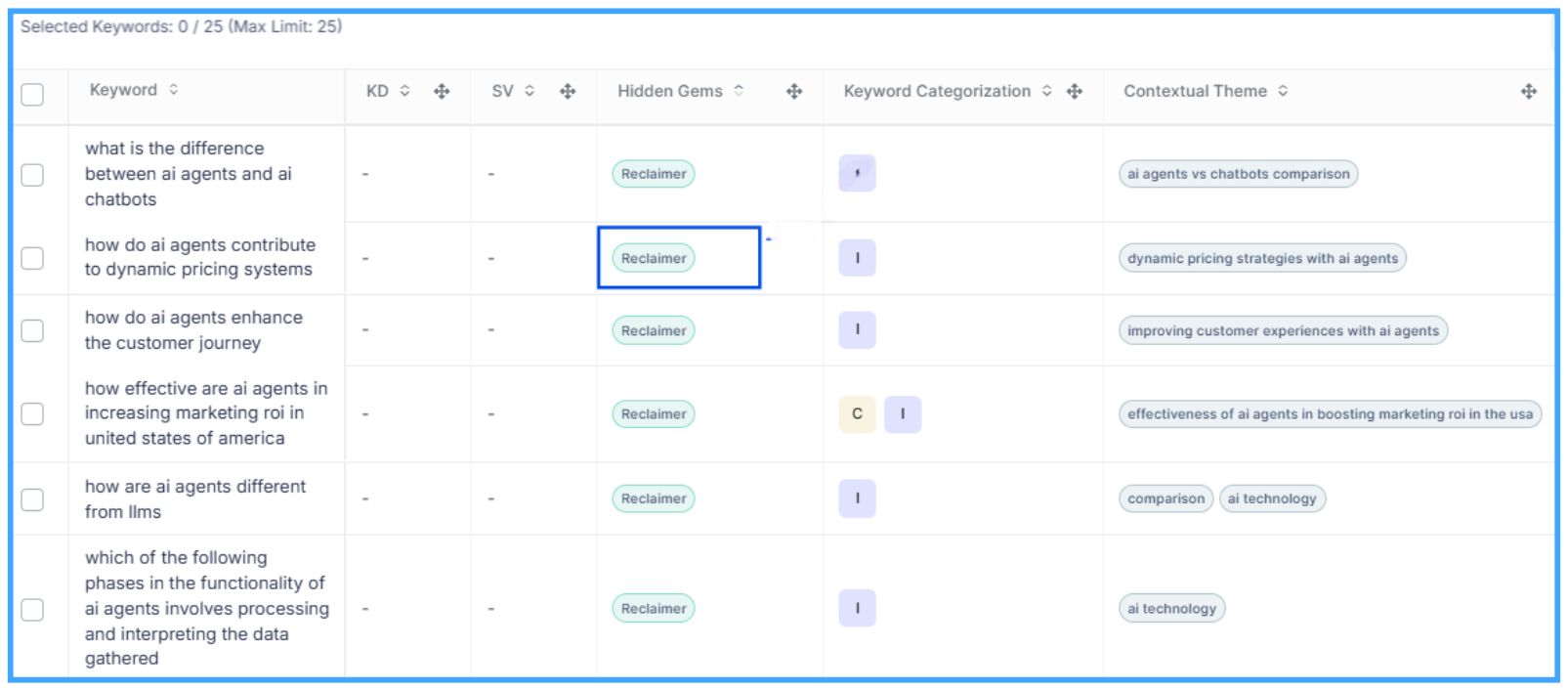
Instead of wasting time chasing high-volume, ultra-competitive terms, teams can focus on ROI-driven opportunities that actually move the needle.
Imagine an e-commerce store ranking on page 2 for “eco-friendly water bottles.” KIVA identifies this as a hidden gem, recommends optimization, and within weeks, the page jumps to page 1, boosting traffic and sales without new content investment.
Did you know?
For teams on a budget, AI SEO approaches ensure every action counts no wasted effort, just focused growth.
How Does an AI SEO Approach Enable Data-Driven SEO Decisions
SEO reports can be overwhelming. Rankings, impressions, CTRs, and traffic often fail to show the true picture of performance. Leaders want clarity: Which content actually drives conversions? Which keywords align with business goals?
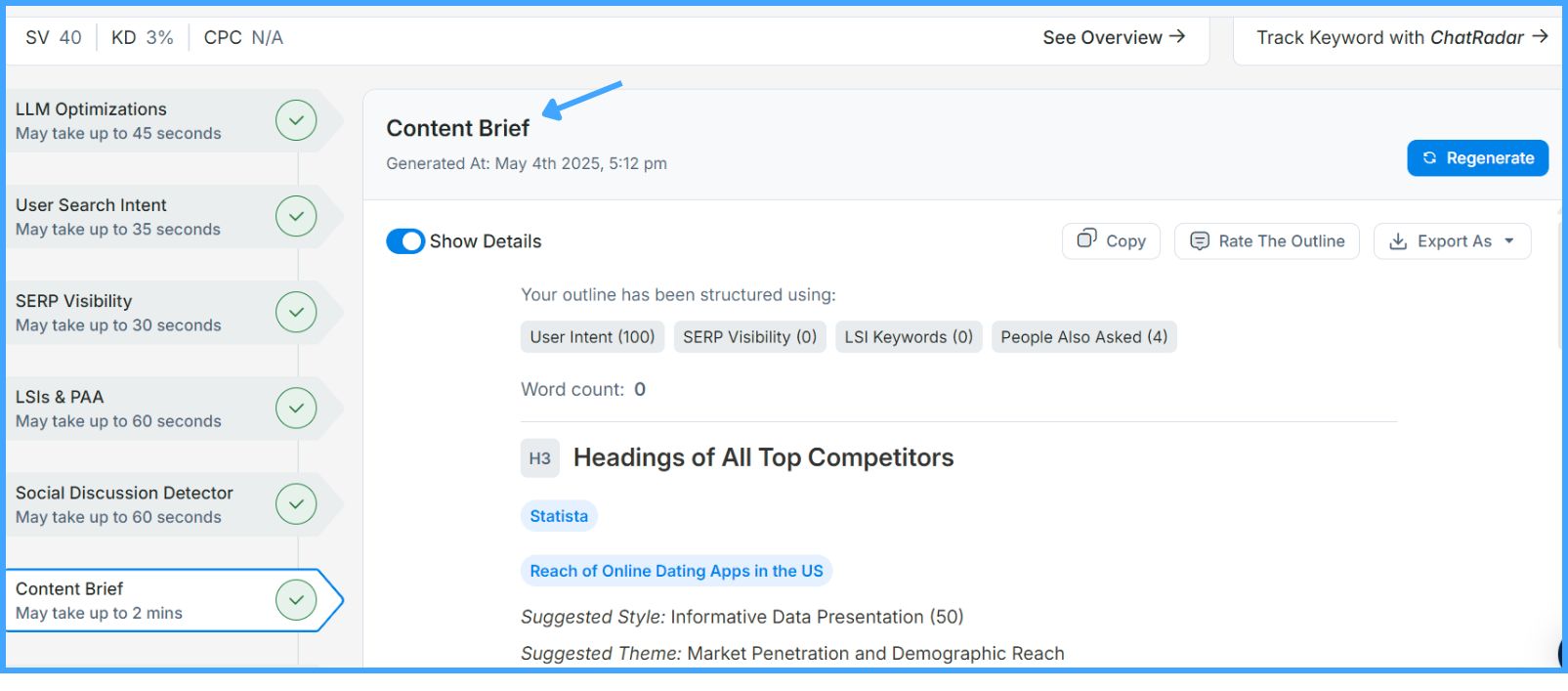
AI SEO Systems transform reporting from vanity metrics to actionable insights. Instead of simply showing keyword positions, KIVA layers in:
- User intent alignment → Matches keywords to customer journey stages for strategic relevance.
- SERP features captured → Tracks presence in snippets, FAQs, videos, and images.
- Content type performance → Compares effectiveness across blogs, landing pages, and videos.
- Engagement signals → Measures time on page, bounce rates, and conversions.
This creates decision-ready reports that help businesses prioritize strategies based on revenue potential, not just traffic.
Did you know?
With AI SEO Automation, teams no longer drown in data. They gain clarity, precision, and confidence in every decision.
Can SEO AI Agents Improve Content Quality and Human Readability
Perhaps the most common critique of AI content is that it feels robotic, optimized for algorithms but disconnected from readers.
In 2025, this is no longer acceptable. Google’s EEAT framework (Expertise, Experience, Authority, Trust) requires content that demonstrates both expertise and human resonance.
Many AI SEO approaches now include the Humanize AI feature. Instead of spitting out generic text, it adapts to your brand guidelines, adjusting tone, readability, and structure. This ensures content feels natural, authentic, and aligned with your brand voice.
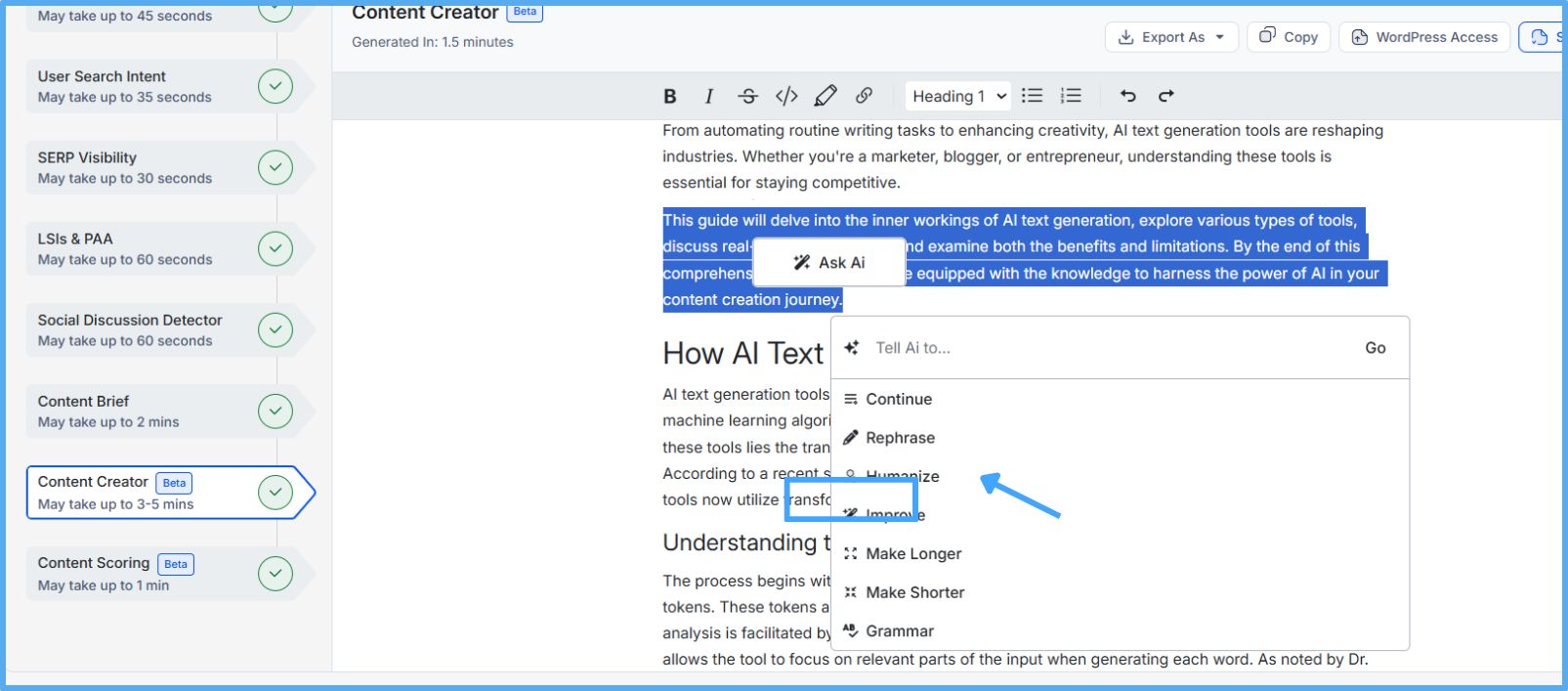
For example, A B2B SaaS company may need an authoritative, professional tone, while a D2C lifestyle brand may need friendly, conversational copy. KIVA adapts automatically, ensuring consistency across every channel, which aligns with proven strategies on how to maintain brand voice for brands managing multiple content streams.
When paired with clustering, briefs, and visibility tracking, this feature guarantees that SEO content isn’t just optimized to rank, but also designed to engage and convert.
Read More Articles
FAQs
Conclusion:
The benefits of SEO Agents in 2025 go far beyond automation. They simplify keyword research, track visibility across SERPs and AI platforms, generate structured briefs, uncover hidden gems, and even humanize AI-generated content.
In short, the overall benefits of AI SEO Agents are clear: they don’t replace SEO, they amplify it. By handling repetitive groundwork, they free professionals to focus on creativity, storytelling, and strategy.
If you’re ready to put these benefits into practice, explore how KIVA by Wellows brings AI SEO automation into action.
Checkout More Relevant Articles!