AI SEO Automation is no longer optional. Search is shifting fast, SERPs are packed with features, and AI layers like Overviews are changing what “visibility” even means.
That speed creates a real constraint. Manual audits, static reports, and slow on-page SEO update cycles cannot react at the pace SERPs now change. By the time a drop becomes visible, competitors have often already taken the space.
Recent data highlights the impact. When AI Overviews appear, click-through rates to classic results can fall sharply, with some queries seeing drops as high as 80% ( Authoritas, 2025 ).
Relying only on legacy AI SEO optimization routines increases exposure as layouts, intent, and visibility mechanics shift faster than manual workflows can adapt.
Teams with limited time feel this pressure most. Freelancers, startups, consultants, and agencies are expected to move faster each month, while manual processes continue to add friction.
Wellows addresses this gap by connecting AI visibility signals directly to structured SEO actions. It blends Search Engine Visibility insights into automated workflows, so changes surface earlier, context is clearer, and updates ship without guesswork.
Why Manual SEO Breaks In 2025: SERPs now change daily, and AI Overviews compress click opportunities. Slow audits and delayed updates cause visibility losses before teams can respond.
How Wellows Solves It: Wellows runs a focused 4-step workflow — Strategize → Execute → Monitor → Optimize. Visibility data is converted into clear priorities, update-ready actions, daily monitoring, and measurable citation progress in one system.
What Success Looks Like: Faster refresh cycles, broader SERP coverage, and stronger eligibility for citations across both Google results and AI-generated answers.
What Is SEO Automation And How Does It Work?
AI SEO Automation uses connected, AI-driven workflows to handle repeat SEO tasks from signal collection to execution. It reduces manual effort and keeps pages aligned with how search engines and AI systems evaluate content today.
Automation is often confused with single tools such as AI writing assistants or rank-tracking dashboards.A helpful baseline is What is AI SEO, which frames how model-driven signals influence workflows beyond standalone tools.
SEO automation works when signals, insights, and actions stay linked inside one workflow, replacing disconnected checks like a periodic technical SEO audit with continuous visibility monitoring. This prevents teams from jumping between tools or waiting for slow audits before fixing emerging issues.
A clear way to understand SEO automation is to separate what it is not from what it actually is.
Not Automation
Single Tools
➡️ AI content drafts without live SERP context
➡️ Manual audits done once a month
➡️ Static reports that do not trigger action
True Automation
Connected Workflows
➡️ AI insights that explain changes across SERPs and AI answers
➡️ Structured briefs and drafts generated from those signals
➡️ Clear next steps teams can execute quickly
This is where the modern Strategize → Execute → Monitor → Optimize workflow fits. It forms the operating model behind real AI SEO automation.
- Strategize: Review Citation Score, sentiment, and competitor gaps to identify the highest-impact opportunities.
- Execute: Convert those opportunities into SERP-aligned content updates and citation outreach without manual delays.
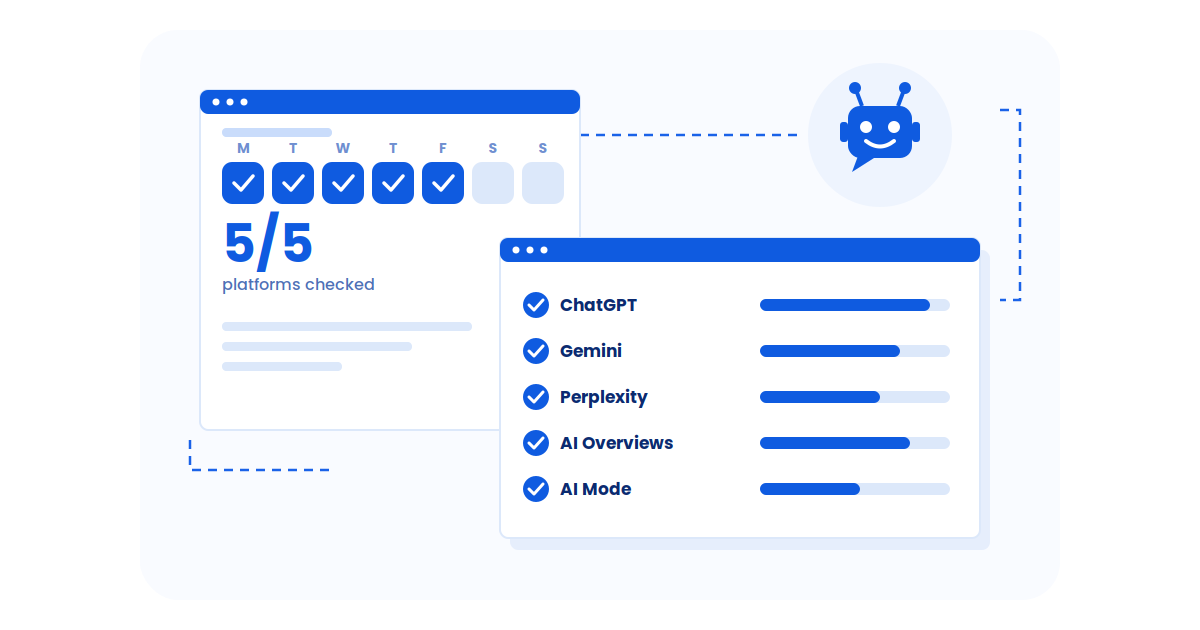
- Monitor: Track visibility shifts daily across SERPs and AI answers to detect decay early.
- Optimize: Apply targeted content and technical improvements so AI engines cite your pages more consistently.
Wellows supports each stage within one system. It tracks visibility across search and AI platforms, surfaces citation wins and gaps, enables content and outreach execution, refreshes opportunities daily, and provides clear optimization guidance. Content scoring and human review maintain quality while automation handles repeat work.
Did you know?
- In 2025, 64 percent of SEO professionals reported using AI tools regularly for keyword research, reflecting how quickly automation has become part of standard SEO workflows (Gitnux, 2025).
- In 2025, around 40% of SEO tasks can now be automated with AI, which is why teams are moving away from manual checklists toward connected systems (WifiTalents, 2025).
As search evolves at this pace, manual workflows become the bottleneck. Automation keeps pages aligned with live SERP and AI signals, allowing updates to ship before visibility losses compound.
Once automation is in place, core on-page and technical SEO principles remain essential—just applied faster and with greater consistency.
Most platforms surface raw data and leave users to design the workflow themselves. This creates overload, especially for solo operators or small teams.
Wellows is built around clarity. Instead of charts alone, it connects visibility signals directly to actions. You see what changed, which opportunity matters most, and which update to prioritize.
A simple beginner flow inside Wellows looks like this:
- Strategize: Add your site and review Citation Score, sentiment, and competitor gaps.
- Execute: Select a high-value opportunity and turn it into a brief, draft, or outreach action.
- Monitor: Let daily tracking surface new wins or early drops automatically.
- Optimize: Apply suggested fixes and refine content quality before publishing.
For beginners, this removes guesswork, reduces tool sprawl, and creates a clear path from insight to published improvement.
How Do I Automate My SEO Tasks Without Hiring An Expensive Agency?
For small teams, agencies often create two constraints at once. They cost more than an internal tool stack, and their delivery cycles still slow you down with audits, reports, and revisions. Even after paying, publishing and follow-ups usually remain in your hands.
If you do decide to outsource execution, start with this ranked list of top AI SEO agencies.
A more practical approach is to keep strategy in house and let AI SEO Automation handle repeat execution. Wellows AI visibility platform is designed for this setup. It provides a connected loop so teams can move faster without outsourcing control.
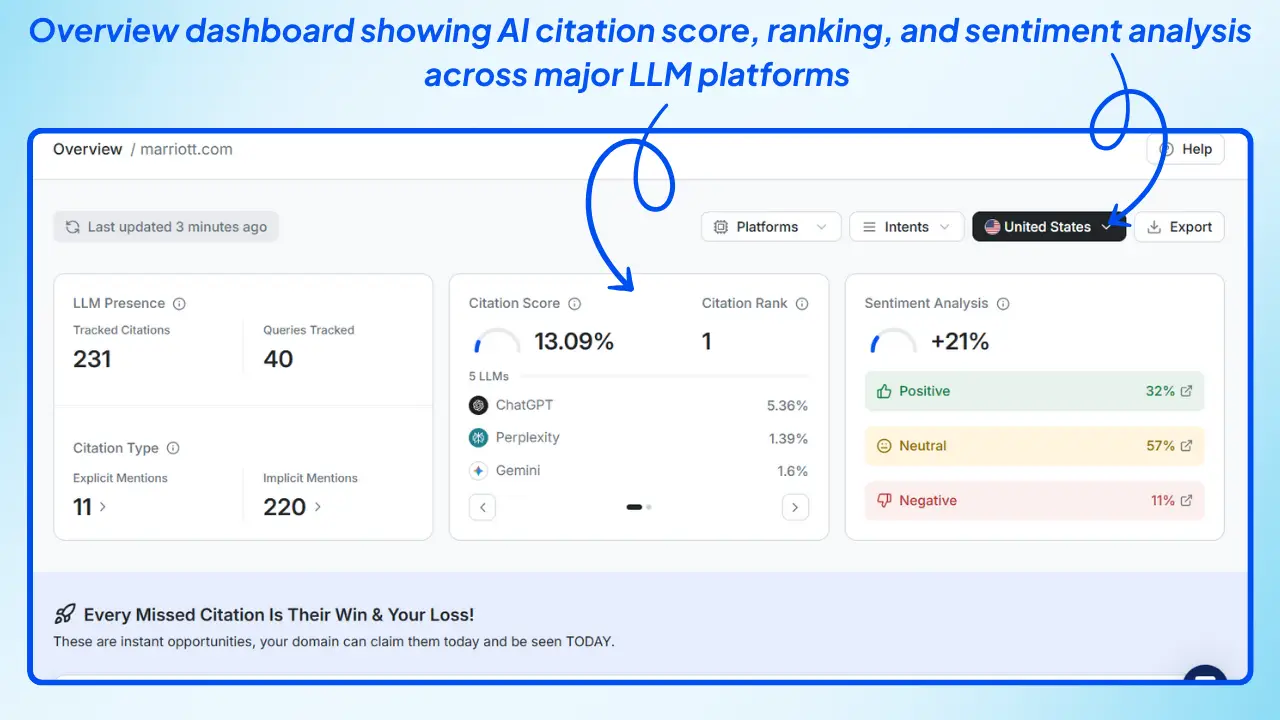
Here is the solo or lean team automation path inside Wellows:
- Detect visibility drops early: Pages and topics are monitored across SERPs and AI results so decay appears at the signal level, not after traffic declines. For fast-moving Tech startups, detecting decay before performance drops ensures critical visibility is preserved during key growth stages.
- See missed SERP features and AI citation gaps: Competitor wins such as PAA, snippets, or AI mentions are surfaced alongside gaps where your content is not represented.
- Cluster keywords by intent: Queries are grouped into clean intent clusters so each page targets a focused theme instead of scattered keywords.
- Generate SERP aligned briefs: Briefs are built from live SERP patterns, intent signals, and topic gaps, removing guesswork around structure and coverage.
- Draft, humanize, and publish faster: Optimized drafts are created from briefs, refined with your voice, and shipped without rebuilding content from scratch.
The result is agency-level execution speed without giving up ownership. Automation absorbs the repeat work, while decisions and final quality stay with you.
Can AI SEO Automation Tools Really Improve My Google Rankings?
AI tools do not guarantee top rankings. Performance still depends on competition, content quality, and how Google evolves its results. What automation changes is execution speed.
Most ranking losses happen because teams react late or update too slowly. When refresh cycles shorten and alignment improves, rankings tend to stabilize. Here is why:
- Faster Refresh Cycles: Pages are updated before competitors capture new SERP space.
- Better SERP Format Alignment: Content adapts to AI Overviews, PAA, snippets, and video blocks instead of relying only on keywords.
- Stronger Intent Coverage: Missing subtopics and intent gaps surface early, allowing fixes before visibility drops.
- Early Decay Detection: Declines in clicks or exposure are identified at the signal level, making recovery easier.
This is where Wellows fits. It runs a connected automation loop around visibility by monitoring pages across SERPs and AI search, detecting early shifts, and converting those signals into intent clusters, SERP aligned briefs, and update-ready drafts.
Final editorial control stays with your team. Automation removes tracking and sorting delays so execution keeps pace with changing results.
Did you know?
Ranking gains come from timely, aligned updates—not promises. When execution lag disappears, visibility and rankings tend to hold over time.
How Does Wellows Automate The Full AI SEO Automation Process?
AI SEO automation works only when visibility data and execution stay connected. Wellows is designed around this principle. Instead of adding more dashboards, it converts AI search signals into concrete actions teams can apply quickly.
Wellows runs automation through four connected stages. The system focuses on prioritization, execution, daily monitoring, and continuous citation improvement.
Wellows Automation Method
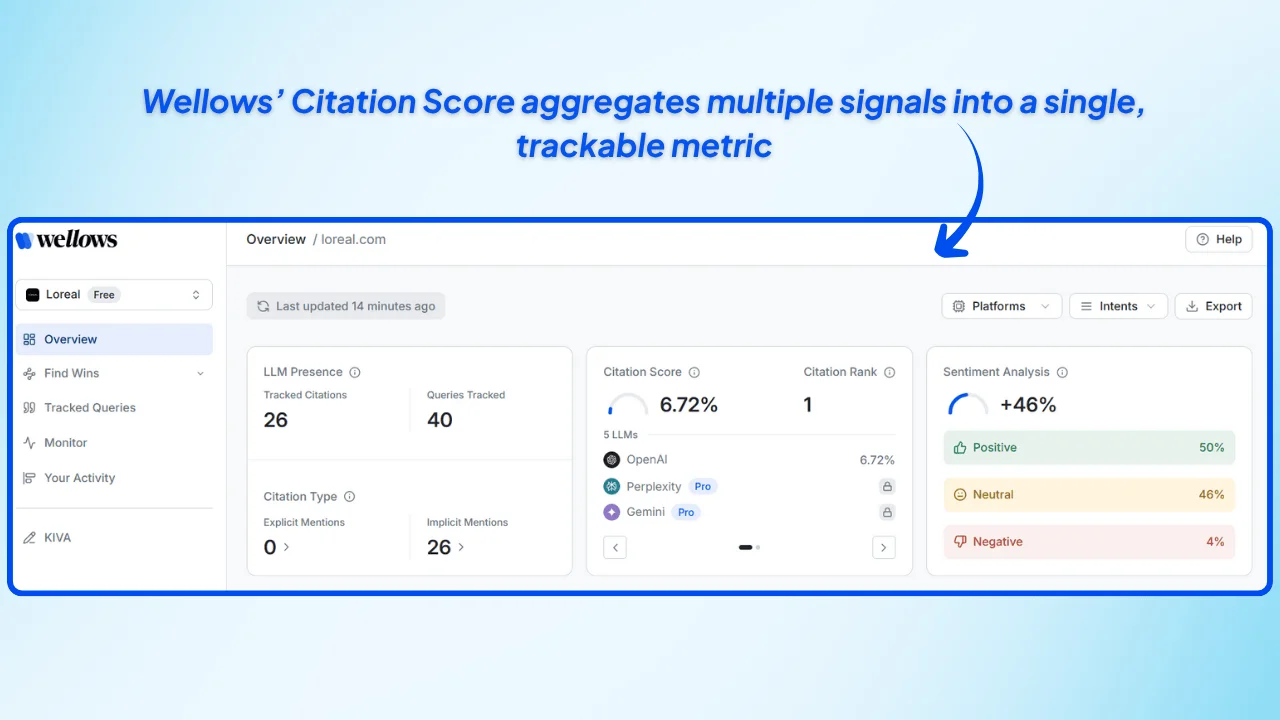
Strategize → Execute → Monitor → Optimize across SERPs and AI search
Below is how each stage operates inside Wellows and how it maps to common constraints lean teams face.
Stage 1: Strategize with Citation + Competitor clarity
The job: Establish a clear baseline for how AI systems currently interpret your brand and content.
How Wellows automates it:
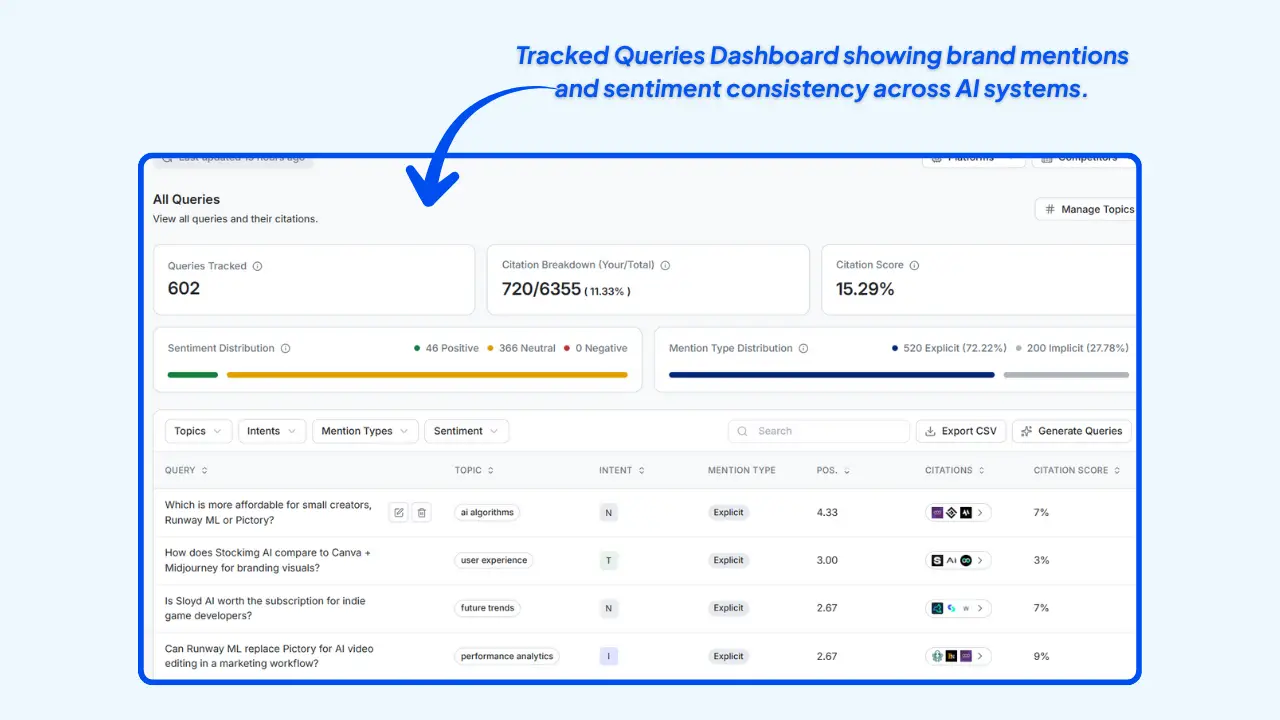
Wellows provides a single strategic view through Tracking, combining Citation Score, cross-LLM sentiment, and competitor comparisons. This makes it clear how AI engines read your brand at a given point in time.
Daily Update then refreshes new opportunities each day and assigns citation potential to each one, allowing teams to prioritize work based on expected impact rather than assumptions.
Why this matters:
AI search is not a single system. Each model cites and ranks sources differently. Planning without platform-level visibility increases the risk of prioritizing the wrong pages or channels.
Did you know?
Stage 2: Execute SERP-aligned actions inside Wellows
The job: Convert strategy into changes that improve visibility.
How Wellows automates it:
Execution happens through two coordinated paths:
- Content execution: Target topics are expanded using the Query Fan-Out Generator, followed by visibility-aligned briefs created with KIVA Content Brief. Drafts are then produced through the Content Creator for faster iteration.
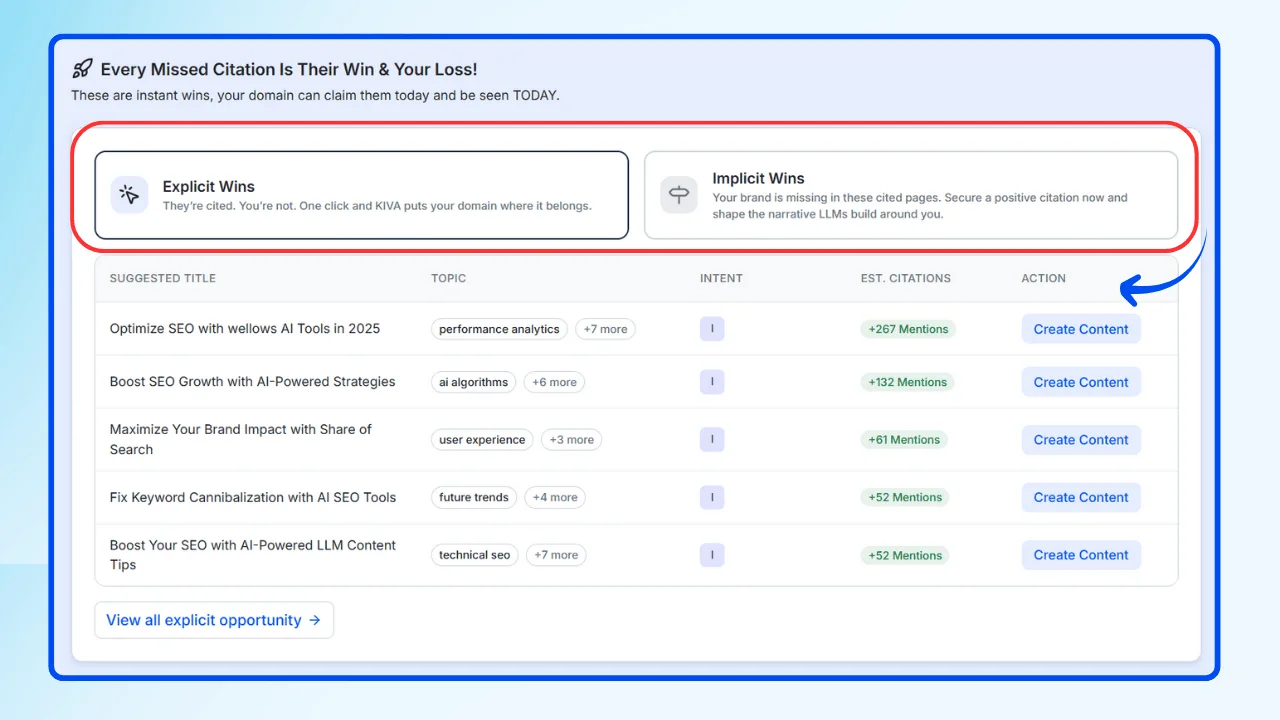
- Citation outreach: Explicit Wins surface competitor-cited pages where your brand is absent, while Implicit Wins identify uncredited mentions. Both highlight outreach targets with projected citation lift.
Why this matters:
Visibility losses usually come from slow execution or misaligned updates. This stage keeps effort focused on changes with measurable upside.
Did you know?
Did you know?
Stage 3: Monitor visibility shifts daily
The job: Detect movement early before visibility erosion compounds.
How Wellows automates it:
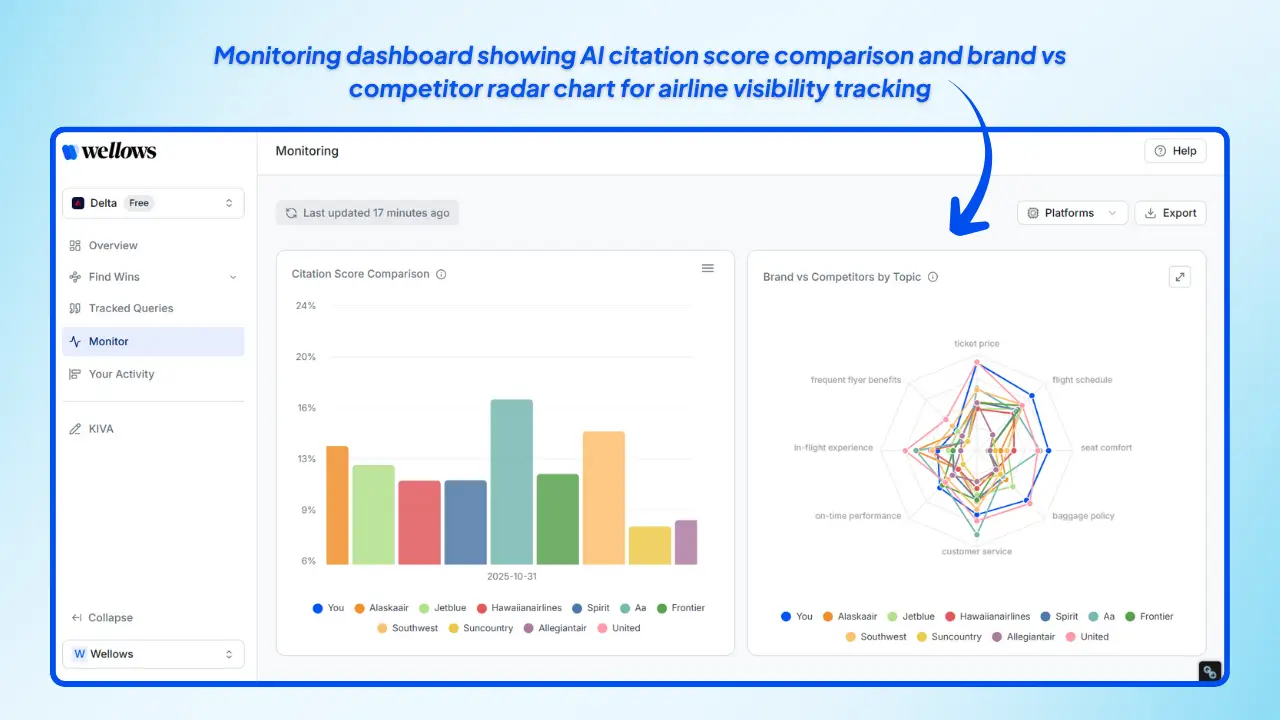
Daily monitoring combines:
- Monitoring — tracks brand and competitor visibility across major AI platforms.
- Commentary — interprets what changed, why it shifted, and what action to take next.
Why this matters:
AI-driven results evolve continuously. Monthly reviews surface issues after the opportunity window has already closed.
Did you know?
Stage 4: Optimize for higher AI citations
The job: Strengthen pages so AI systems select them more consistently.
How Wellows automates it:
Optimization combines validation and quality control:
- Validator verifies citation sources and removes duplicates, preventing optimization based on inaccurate data.
- Content Scoring evaluates readability, originality, factual depth, and competitive alignment.
After scoring, content can be refined using the free AI humanizer tool by Wellows to improve flow while maintaining accuracy and intent. 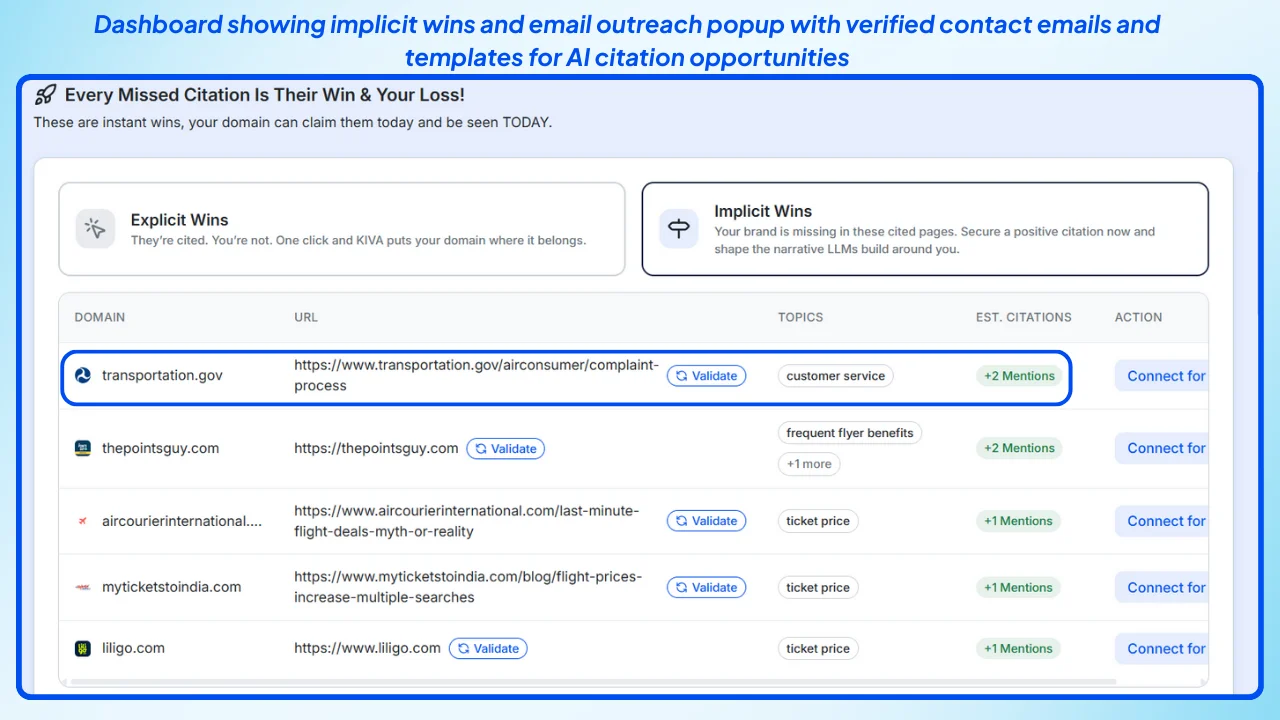
Why this matters:
Speed without validation leads to weak results. This stage ensures updates are accurate, competitive, and citation-ready before publication.
Did you know?
The Bottom Line For Teams Using Wellows
Why This Matters
Wellows keeps AI SEO automation operational by running one connected system:
- Strategize using Citation Score and competitor clarity to prioritize effectively.
- Execute SERP-aligned content and citation actions with minimal delay.
- Monitor visibility shifts daily to catch losses and opportunities early.
- Optimize with verified data and quality checks so updates remain citation-ready.
Decisions and final edits stay with your team. Automation absorbs repeat work and keeps visibility moving forward through consistent, measurable steps.
Once this system is running, core SEO principles remain unchanged—they are simply applied faster, more consistently, and with better timing. This is how teams protect SERP space and improve AI citation coverage into 2026.
What Are The Benefits of SEO Automation for Different Types of Teams?
SEO automation delivers different value depending on team structure and constraints. Startups, agencies, freelancers, and consultants face distinct bottlenecks, but all benefit from systems that reduce manual work and keep visibility moving forward.
Wellows reduces this friction by automating keyword discovery, intent-based clustering, brief creation, and daily visibility tracking. These signals help teams publish with structure and refresh content before decay affects performance.
Many early-stage teams rely on AI Search Visibility for Startups to maintain execution speed without outsourcing.
This approach also supports a focused AI-Visible Marketing Strategy for Startups, where visibility data guides what to create, update, or expand next.
For a broader breakdown, this GenAI visibility stack for startups outlines how early teams structure automation.
According to HubSpot’s 2025 State of Marketing Report, 47% of marketers struggle to measure SEO success. Automation helps startups stay consistent without slowing execution.
This platform consolidates SERP and AI visibility signals, groups keywords by intent automatically, and converts gaps into briefs and drafts teams can deploy efficiently.
Agency teams often use AI search visibility for agencies to standardize execution while reducing manual overhead.
As client volume grows, automation becomes foundational. This guide on automation for agency workflows explains how teams maintain quality while scaling delivery, and the AI visibility for digital marketing agencies playbook shows how to turn that execution into client-ready citation deliverables.
A 2025 SeoProfy report found that 67% of SEO experts identify repetitive task reduction as automation’s biggest benefit.
This platform simplifies execution by clustering keywords, aligning topics by intent, and generating structured briefs that shorten the path from idea to publication.
Many solo marketers adopt AI Search Visibility for Freelancers to reduce spreadsheet work and focus on high-impact fixes.
A survey conducted by Aleyda Solís found that 41% of freelancers use AI weekly to validate optimization ideas, reflecting how automating SEO for websites has become part of routine workflows.
Wellows translates SERP movement, intent gaps, and AI citation misses into ranked actions, keeping recommendations focused and measurable.
Many consultants use AI search visibility for consultants to speed up diagnosis and clarify strategy.
Industry surveys in 2025 show that AI delivers the most value when it surfaces actionable issues early, aligning closely with automation-first consulting models (SEOFOMO, 2025).
That same year, 58% of consultants cited “actionable issue detection” as the most valuable AI application, highlighting how SEO automation supports business growth.
Teams that automate tend to see earlier performance gains because gaps close sooner. A 2025 Gartner-backed survey reported an average 25% lift in organic traffic for brands using AI in SEO, driven by quicker updates and stronger intent alignment (BusinessTechWeekly, 2025).
Avoid These AI SEO Automation Pitfalls In 2026
AI can accelerate SEO execution, but only when automation is applied with context and control. In 2026, most failures come from scaling speed without validation, intent awareness, or visibility feedback loops.
- Over-automation without QA: Teams automate too much and trust outputs blindly. This results in thin pages, misaligned intent, and unstable structure. Wellows mitigates this by keeping human review in the loop and scoring drafts for clarity, depth, and factual accuracy before anything is published.
- Publishing drafts without voice control: AI drafts are shipped with minimal editing. Over time, content becomes generic and brand trust erodes. Structured briefs reduce this risk by anchoring drafts to clear outlines, intent signals, and tone guidelines instead of generic templates.
- Automating strategy instead of workflows: Some teams let tools decide what to target next. Strategy becomes reactive and fragmented. Effective automation focuses on repeat execution tasks, while prioritization and topic selection remain human-led.
- Ignoring SERP features and AI answer formats: Pages are updated for keywords only, without adapting to how results now appear. This leads to missed opportunities in snippets, PAA, and AI citations. Monitoring SERP layouts and AI answer patterns together ensures updates match the formats that actually earn visibility. If your structure still relies on manual grouping, this semantic clustering checklist helps align clusters with real SERP and LLM behavior.
- Not tracking competitor visibility shifts: Competitors gain SERP space or AI mentions, but the change goes unnoticed for weeks. Recovery becomes harder as gaps widen. Daily competitor monitoring shortens response time and surfaces new opportunities as they appear.
The guiding principle stays the same: automate execution, not judgment. Keep strategy deliberate, validation continuous, and updates grounded in real visibility signals.
A Simple AI SEO Automation Roadmap (Weekly → Monthly → Quarterly)
AI SEO automation performs best when it runs on a predictable cadence. Daily monitoring is the foundation, so visibility signals and execution stay in motion without constant manual checks.
Weekly rhythm: keep visibility tight and stop decay early
- Monitor daily AI and SERP visibility to detect shifts as they happen.
- Review new Explicit Wins and Implicit Wins to understand where citations are gained or lost.
- Apply fast updates to pages showing early decline, before competitors capture the space.
Monthly rhythm: execute deeper refreshes and expand coverage
- Use automation to extend topic coverage with new intent clusters and query variations.
- Refresh briefs and sections where SERPs now reward added depth, clearer answers, or revised structure.
- Improve on-page layout with cleaner headings, stronger internal links, and metadata aligned with current result formats.
Quarterly rhythm: reset priorities and prepare for the next shift
- Run a full competitor visibility review across AI platforms to uncover new gaps and emerging wins.
- Reorder your roadmap using Citation Score trends and accumulated daily opportunity data.
- Audit the Strategize → Execute → Monitor → Optimize loop to confirm automation is still reducing effort and improving citation coverage.
For lean teams, this rhythm works best when strategy, execution, monitoring, and citation optimization stay connected in a single workflow.
How Do Different Industries Benefit From AI SEO Automation in 2026?
AI SEO automation does not produce the same impact across every industry. The difference depends on how people search, how frequently SERPs shift, and how trust-sensitive decisions are within each category.
In sectors where AI search already influences discovery and evaluation, automation becomes essential. Manual workflows react too slowly to protect visibility, even though AI-driven referrals are still emerging rather than dominant.
Did you know?
Industry Automation Impact Distribution (2026)
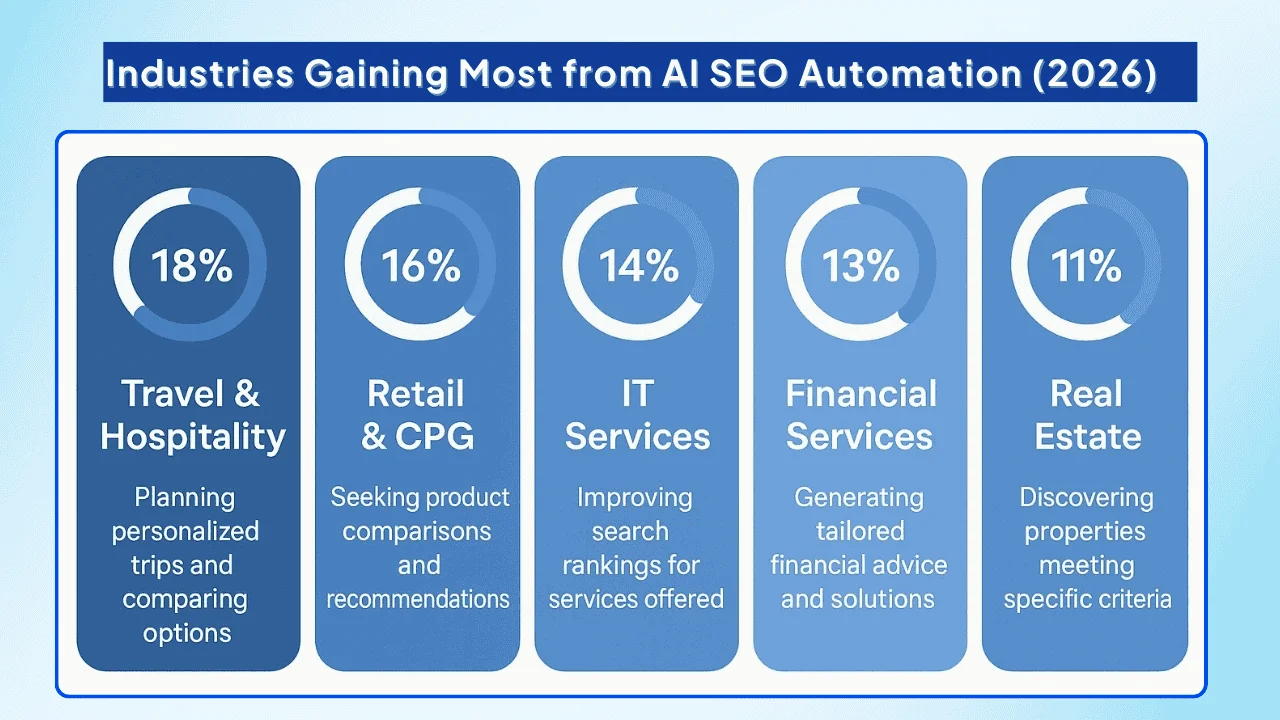
Key insight: Industries with higher AI-search usage and consultative intent benefit most from automation because delayed audits and slow updates translate directly into lost visibility.
Buyer-led industries are seeing the earliest AI-search shift. First Page Sage’s 2025 research shows the percentage of consumers using generative AI during the purchasing journey is highest in:
- Travel & Hospitality: 18% (personalized planning and comparison-heavy searches)
- Retail & CPG: 16% (product discovery, alternatives, and recommendations)
- IT Services: 14% (vendor evaluation and solution comparison)
- Lifestyle, Health & Wellness: 13%
- Food & Beverage: 13%
Where AI search already influences decisions, SERP layouts and AI answer formats change faster. Automation protects visibility by detecting decay early and enabling updates before competitors consolidate those positions (First Page Sage, 2025).
- High-consultative categories lead because queries are layered and context-heavy. SERPs in these spaces evolve constantly through PAA expansion, AI Overviews, and intent fragmentation. Automation helps teams detect movement early, identify intent gaps, and deploy aligned updates on time.
- Regulated industries follow because freshness, accuracy, and evidence matter more than speed alone. Automation reduces manual load while keeping human QA mandatory.
- Fast-moving consumer sectors benefit differently as visibility spikes around trends and product cycles. Here, automation wins through rapid clustering, frequent brief refreshes, and continuous SERP-format alignment.
What This Means For Your Industry
High-consultative industries (Education, Health, B2B Services): Run weekly Detect → Execute cycles to catch early decay. In sectors like the healthcare industry, continuous intent expansion keeps pages citation-ready.
Regulated / YMYL industries (Finance, Legal, Healthcare): Automate freshness checks, SERP gap detection, and evidence-based brief updates. Maintain strict publish-time QA.
Fast-moving consumer categories (Ecommerce, Retail, Fashion, Consumer Tech): Automate trend discovery and clustering. Refresh briefs monthly to match new AI Overview triggers, PAA shifts, and product-led intent changes.
SaaS and B2B product brands: Use automation for long-tail use-case clustering, daily competitor tracking, and fast refresh cycles. Smaller teams win by reacting faster than incumbents.
Local and GEO-driven industries (Real Estate, Travel, Hospitality): Automate location-based clustering and regional SERP monitoring so pages adjust immediately when AI answers or map layouts shift.
If your industry already shows AI-driven discovery—such as travel, retail, IT services, or wellness—automation is not a scaling advantage in 2026. It functions as a visibility defense system.
The Future of AI SEO Automation: Trends and Predictions
AI-driven SEO automation is entering a structural shift. It is no longer centered on speeding up keyword research or drafting content faster. Search itself is evolving into an AI-led, conversational, and multimodal system.
As a result, automation will increasingly focus on helping brands earn visibility inside AI answers, voice interfaces, and visual discovery paths rather than traditional blue-link rankings alone.
Below are the most relevant, research-backed AI SEO automation trends shaping the near future:
1. Conversational + Multimodal Search Optimization: AI Mode and AI Overviews prioritize dialogue-based interactions, follow-up questions, voice input, and image-based queries. Automation will emphasize AI-readable structure, entity clarity, and summary-friendly formatting to support these formats (Google, 2025).
2. Answer Engine Optimization (AEO) & Citation Visibility: Optimization will shift toward being selected and cited inside AI-generated answers. Platforms will track “mention share” and citation presence across LLMs instead of relying solely on traditional ranking signals (Developers Google, 2025).
3. Predictive SEO Forecasting: Automation will move beyond retrospective reporting toward forecasting intent drift, emerging topics, and AI Overview triggers. This allows teams to publish and refresh content before demand peaks rather than reacting after visibility shifts (Google, 2025).
4. Real-Time Voice Search Automation: Voice-first AI interfaces such as Search Live require automation that generates question-led clusters and spoken-language journeys aligned with conversational intent, not keyword lists (The Verge, 2025).
5. Visual Search & Scene-Level Image SEO: With Google Lens and Circle to Search scaling camera-driven discovery, automation will expand object tagging, intent-matched alt text, and visual schema to support scene-level understanding in multimodal results (Business Google, 2025).
6. Social + Community Search Integration: SEO automation will increasingly analyze TikTok, Reddit, YouTube, and forum discussions to extract real user language and emerging needs, feeding AI-ready topic maps and briefs grounded in actual demand (Pew, 2025).
7. Trust-Layer Automation (Ethics + Verification): As AI systems prioritize reliability, automation will enforce citations, freshness checks, claim validation, and transparency standards to maintain citation eligibility and long-term trust (Google Search Central, 2025).
Read More Articles
- How to Build Topical Authority in SEO Without Spending Thousands on Tools
- Search Behavior Patterns in SEO: Turning Insights Into Winning Content Ideas
- How Can Pattern Recognition Improve Visibility in AI-Generated Answers?
- How to Design Content Briefs for GEO?
- Can GSC Data Guide Your GEO Strategy?
- How to Understand User Intent in Generative Engines?
- Brand Signals for AI Search Visibility: What Matters in 2026
- How to Rank High on ChatGPT (Complete 2025 Framework)
- How to rank in Perplexity
- How to Optimize SEO with AI Topic Clusters for Better Visibility in 2026
- How to Humanize AI Content for SEO
- How to Use AI for Competitor Analysis
FAQs
Traditional SEO tools mainly report data. Modern automation systems detect visibility changes, organize insights, and guide execution by turning signals into clear next actions. This reduces manual analysis and helps teams respond faster to SERP and AI-search shifts.
No. Automation handles repeatable tasks such as clustering, tracking, monitoring, and brief creation, but humans are still needed for strategy, accuracy checks, and brand alignment. Automation accelerates execution; it does not replace judgment.
Tasks that require speed and consistency benefit most. These include intent-based keyword clustering, metadata updates, internal linking suggestions, visibility and citation tracking, decay detection, and continuous SERP monitoring.
Yes. Without review, automation can misinterpret intent, weaken structure, or over-optimize content. Keeping human QA in the loop ensures clarity, tone accuracy, and alignment with real user needs.
No. Automation speeds up research and execution, but manual SEO remains essential for positioning, narrative clarity, and understanding audience context. The strongest outcomes come from combining automation with expert oversight.
Conclusion: Your AI SEO Automation Action Plan for 2026
AI SEO automation is now the line between sustained visibility and gradual decline. Search is moving faster, SERPs are denser, and AI Overviews are reshaping how brands are discovered. When workflows stay manual, visibility erodes before teams have time to react.
The teams performing best in 2026 share three consistent habits:
- They plan from real AI visibility signals such as Citation Score, sentiment, and competitor gaps, so effort goes where impact is highest.
- They execute the right updates quickly by turning opportunities into SERP-aligned content and citation actions instead of relying on slow, fragmented processes.
- They monitor and optimize continuously, allowing visibility to grow on a steady cadence rather than through isolated, reactive fixes.
Wellows helps you run a single connected workflow in four steps — Strategize → Execute → Monitor → Optimize — so you can move faster without losing control over quality or decisions.
✅ Strategize: Track Citation Score, sentiment, and competitor gaps with opportunities refreshed daily.
✅ Execute: Convert those opportunities into SERP-aligned content updates and outreach with clear citation lift targets.
✅ Monitor: Follow daily visibility shifts across AI platforms, with trends and competitor movement explained clearly.
✅ Optimize: Apply personalized recommendations, validate citations, and refine content quality before publishing.
Start small by automating one repeat task this week. Expand step by step as your workflow matures. The objective is simple: reduce manual friction, accelerate updates, and maintain strong coverage across both Google results and AI-driven discovery.