Structured SEO briefs are no longer optional—they are the cornerstone of modern search visibility. A brief is the blueprint that guides writers, strategists, and marketers in creating content that doesn’t just rank on Google but also earns mentions and citations across AI engines like ChatGPT, Gemini, Claude, and Perplexity.
According to HubSpot’s “Content Performance” guidance, almost 48% of marketers say their organizations do not track content performance effectively, meaning many briefs miss critical optimization steps.
This article explores what structured SEO briefs are, why they’re vital for Generative Engine Optimization (GEO), and how businesses can use them to future-proof content strategies.
Along the way, we’ll highlight best practices, common mistakes, and emerging workflows supported by KIVA by Wellows, an AI SEO agent built for dual visibility across traditional search and AI-driven platforms.
What Exactly Are Structured SEO Briefs, and How Do They Differ from Unstructured Briefs?
At their core, structured SEO briefs are organized documents that combine keyword strategy, user intent, SERP analysis, and brand guidelines into a cohesive roadmap for content creation. Unlike unstructured briefs—which may simply list a keyword and title—structured briefs define:
Primary & secondary keywords (clustered semantically).
User intent categories (informational, transactional, navigational).
SERP landscape insights (word count, content type, ranking patterns).
Entity relationships (supporting concepts, LSIs, People Also Ask queries).
Brand voice & style rules to ensure consistent messaging.
Unstructured briefs lack this depth, leaving writers to guess at search intent and optimization priorities. The result is inconsistent output, wasted resources, and weaker rankings.
In 2025, structure is more important than ever because AI engines parse information differently than search engines.
A scattered, unstructured brief may still produce content, but it won’t achieve visibility across GEO ecosystems where clarity, semantic alignment, and authority signals determine citation-worthiness.
How Has AI Search Changed the Role of SEO Briefs in 2025?
Search today is not just about ranking in Google—it’s also about being useful to AI. Engines like ChatGPT and Gemini are increasingly pulling content into answers rather than just listing links.
Did you know?
Structured briefs help bridge the gap between what search engines expect (keywords, SERP signals) and how AI interprets content (intent, entities, trust). By aligning these technical and semantic requirements, businesses can secure a stronger Google Ranking and ChatGPT visibility for their high-value assets. They ensure your content is ready for both blue links and AI citations.
Why Are Structured SEO Briefs Critical for Visibility in AI-Driven Search Engines?
Generative engines like ChatGPT, Claude, Gemini, and Perplexity rely on structured signals to decide which sources to trust. Unlike search engines, which rank based on backlinks and CTR, AI engines evaluate:
- Entity clarity → Are the concepts clearly defined and attributed?
- Content structure → Are headings, questions, and answers logically mapped?
- Trust signals → Are there citations, statistics, and expert sources?
- Brand Signals → Is the brand mentioned consistently across authoritative contexts?
Without a structured brief, writers are likely to overlook these elements, resulting in content that may rank temporarily. LLM citation tracking can then reveal that the content is rarely cited in AI-generated answers.
For example, when testing citations in 2024, Wellows found that pages with structured briefs earned 38% more mentions in AI summaries than pages created without them.
The reason? Structure makes information easier for AI to parse and reuse.
What Are the Key Elements Every Structured SEO Brief Should Include?
Did you know?
A high-performing structured SEO brief has 8–10 non-negotiable components:
- Keyword Strategy Checklist → Primary + secondary + long-tail queries.
- Search Intent Mapping → Explicitly mark queries as informational, transactional, or navigational.
- SERP Landscape Analysis → Note competitors’ content length, format, and ranking signals.
- Entity Mapping → List all relevant entities (primary, secondary, tertiary) and their attributes.
- People Also Ask Integration → Pull related questions from Google to cover query depth.
- Brand Signals → Include tone, style, and authority elements for consistency.
- Meta Guidance → Titles, descriptions, and URL structures.
- Internal & External Linking Strategy → Anchor text mapped to GEO KPIs and supporting content.
- Evidence Plan → Stats, expert quotes, and case studies to support E-E-A-T.
- Visibility Optimization → Notes on how to adapt content for Gemini, ChatGPT, and other AI engines.
Each of these aligns with both SEO fundamentals and AI visibility requirements. Together, they make content more scannable for algorithms while reducing rewrites for humans.
How Can Businesses Create Structured SEO Briefs Step by Step?
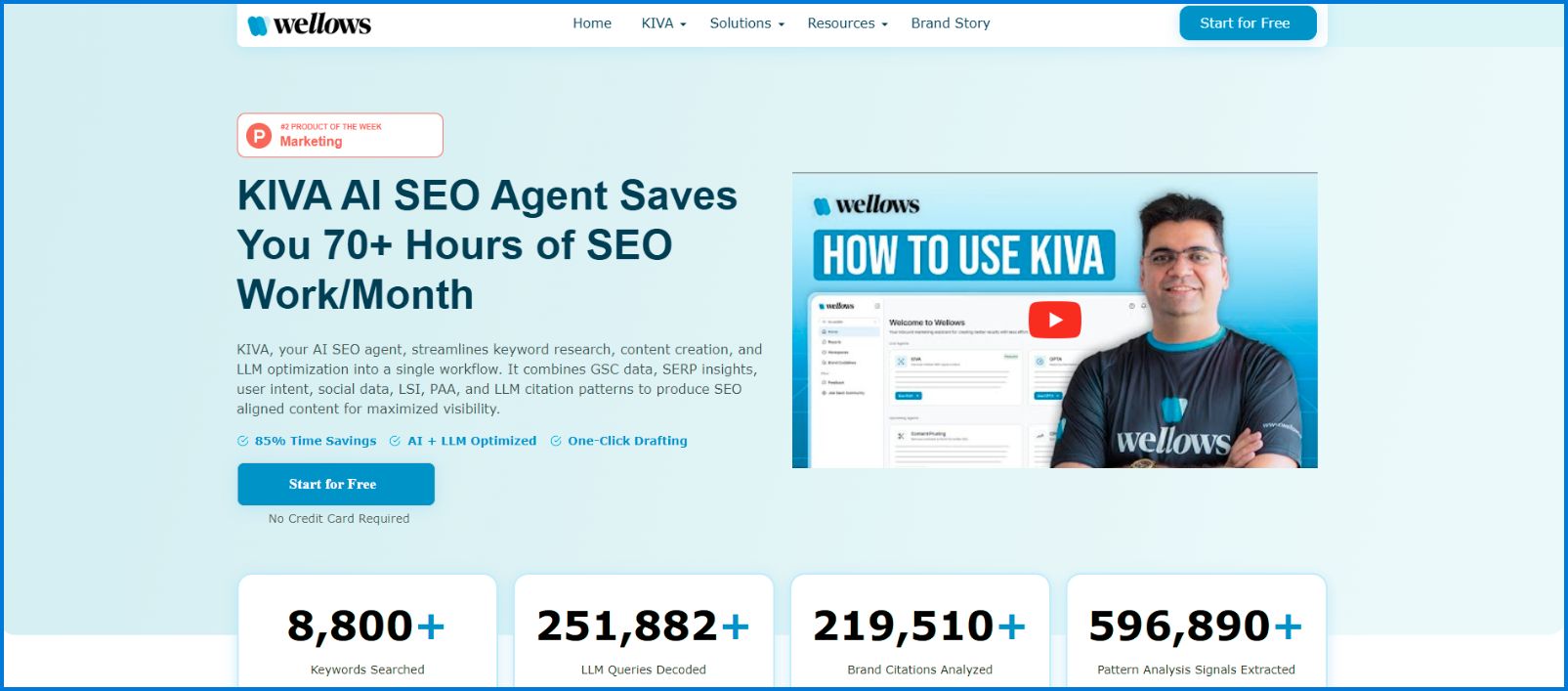
Creating a structured brief isn’t guesswork—it’s a repeatable process. Here’s a simplified workflow:
- Start with keyword discovery → Use Platform like SEMrush, Ahrefs, or KIVA’s Keyword Clustering to group terms semantically.
- Define user intent → Classify keywords into intent categories (informational, navigational, transactional).
- Analyze SERPs → Identify word counts, content types, and competitor strengths.
- Map entities and attributes → Build a knowledge graph for topical authority.
- Integrate PAA + LSIs → Pull related questions and semantic variations.
- Draft outline headings → Phrase H2s and H3s as questions to align with natural queries.
- Insert Brand Guidelines → Ensure tone and style consistency.
- Plan internal/external linking → Anchor to Context, SEO vs GEO, and other relevant assets.
- Add evidence requirements → Minimum 3 data points per section (statistic, case study, expert quote).
- Finalize and distribute → Share with content teams as the single source of truth.
Manually, this takes 3–5 hours per brief. With KIVA acting as your AI SEO Agent, Content Brief Generation takes ~15 minutes and includes SERP-aligned structure, intent classification, semantic keywords, and LLM visibility checks.
How Do Structured SEO Briefs Impact Rankings and GEO Visibility?
The impact of structured SEO briefs is evident when you look at how users interact with search results. Recent research shows that 65% of people who search on Google click on an organic result, making structured, optimized content the single biggest driver of visibility.
Consistency also plays a major role. According to Stratabeat, businesses publishing 9 or more blog posts per month see approximately 3.6× more organic traffic compared to lower-frequency blogs. Structured briefs help enable this consistency by giving teams a clear roadmap.
While large-scale public benchmarks on AI citations are still emerging, the evidence is clear: content built from structured briefs tends to perform better in both human search and AI-powered summaries.
Marketers often report stronger engagement, higher trust signals, and fewer revisions when briefs provide clarity from the start.
What Tools Help in Making Structured SEO Briefs More Effective?
You can build a structured SEO brief manually in Google Docs, but that process is time-intensive and often inconsistent.
Traditional SEO platforms like SEMrush, Ahrefs, and Clearscope are useful for keyword research, SERP snapshots, and semantic insights, yet they still leave teams stitching together data from multiple sources.
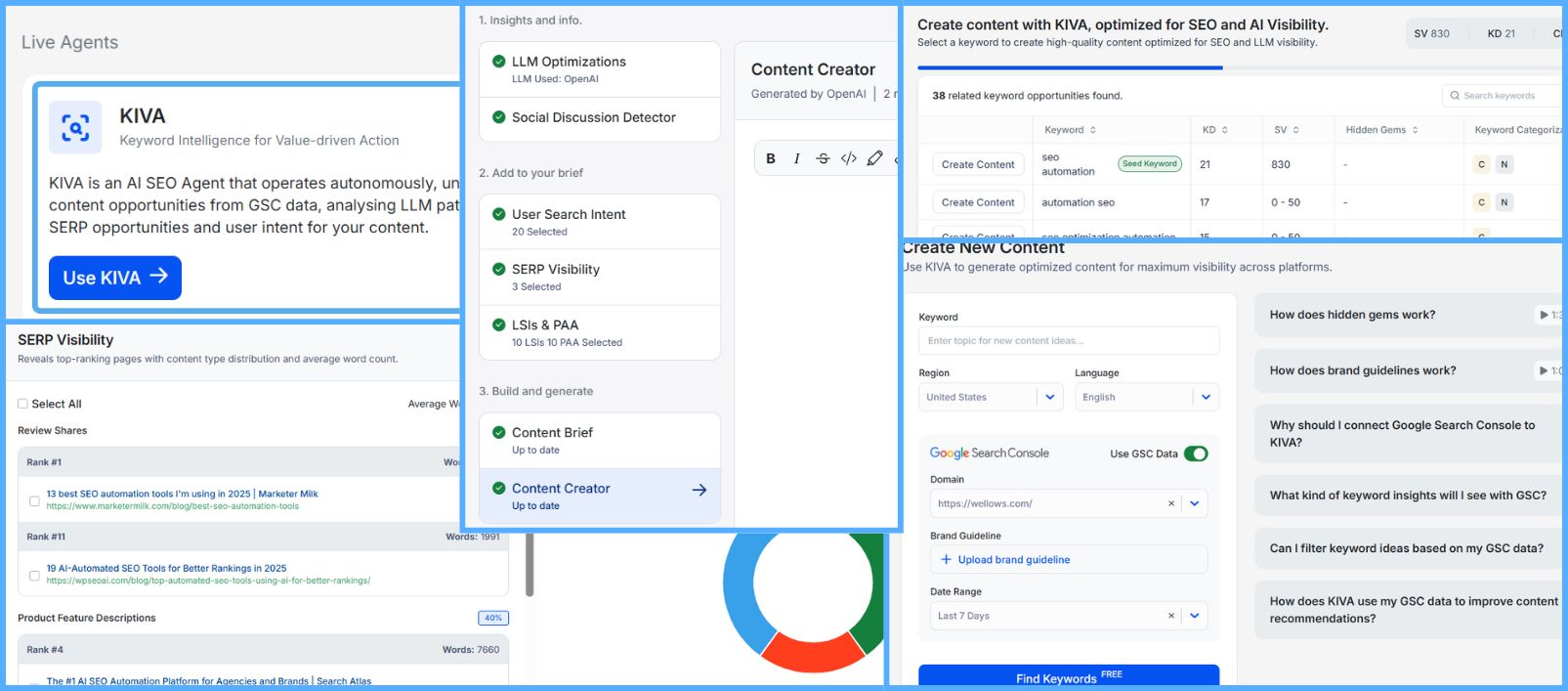
This is where KIVA by Wellows takes a different approach. Rather than acting as a simple generator, KIVA functions as an AI SEO agent that unifies traditional search data and AI-driven signals into one workflow.
It doesn’t just suggest keywords — it automates the briefing process and accelerates content creation, ensuring every draft is aligned with Google’s SERPs as well as the way large language models (LLMs) like ChatGPT, Gemini, Claude, and Perplexity interpret information.
Some of the standout capabilities include:
- Quick Wins: Generate a complete 7-day content strategy in about 30 seconds, highlighting immediate ranking opportunities.
- Hidden Gems: Surface overlooked, high-potential keywords buried in your Search Console data.
- LLM Visibility Analysis: Reveal how AI engines interpret and cite your topics, optimizing content for GEO as well as SEO.
- Content Brief Creation: Build structured, SERP-aligned, and LLM-ready briefs that writers can use without hours of manual research.
- Content Creation: Produce authoritative, SEO-optimized articles directly from briefs, cutting production time from hours to minutes.
By combining these functions, KIVA transforms what used to take hours into a streamlined, repeatable process.
The result is not just speed but confidence — every brief and piece of content is optimized for the dual world of Google and AI engines.
How Do Structured SEO Briefs Differ from Other Strategic Documents?
Marketers often confuse briefs with other planning tools. Key distinctions:
- SEO Plans → Macro-level strategy covering goals, timelines, and KPIs.
- Content Briefs → Tactical outlines for individual content pieces.
- Structured SEO Briefs → Hybrid documents that combine strategy + execution, optimized for SEO and GEO simultaneously.
Think of structured SEO briefs as the bridge between planning and production.
How Do You Adapt Structured SEO Briefs for Different AI Search Platforms?
Each AI engine parses information differently:
- Gemini → Prefers structured, data-backed content with schema markup.
- ChatGPT → Leans on entity clarity and natural Q&A formatting.
- Claude → Values narrative flow and ethical tone alignment.
- Perplexity → Prioritizes citation depth and external linking authority.
A well-structured brief anticipates these needs by including platform-specific notes, ensuring your content doesn’t just rank—it gets reused across LLMs.
What Common Mistakes Do Marketers Make When Creating SEO Briefs?
Even with the best intentions, common pitfalls include:
Ignoring search intent (focusing only on keywords).
Keyword stuffing without entities (hurts readability and GEO visibility).
Missing Brand Signals (leading to inconsistent messaging).
Lack of evidence (weakens E-E-A-T trust).
Unclear structure (confuses both writers and algorithms).
Avoiding these requires discipline, checklists, and often automation. An Agent like KIVA embeds these safeguards directly into the briefing process—for example, ensuring user intent is mapped, SERP data is integrated, and brand signals are applied consistently.
How Can Structured SEO Briefs Support Cross-Platform Content Strategies?
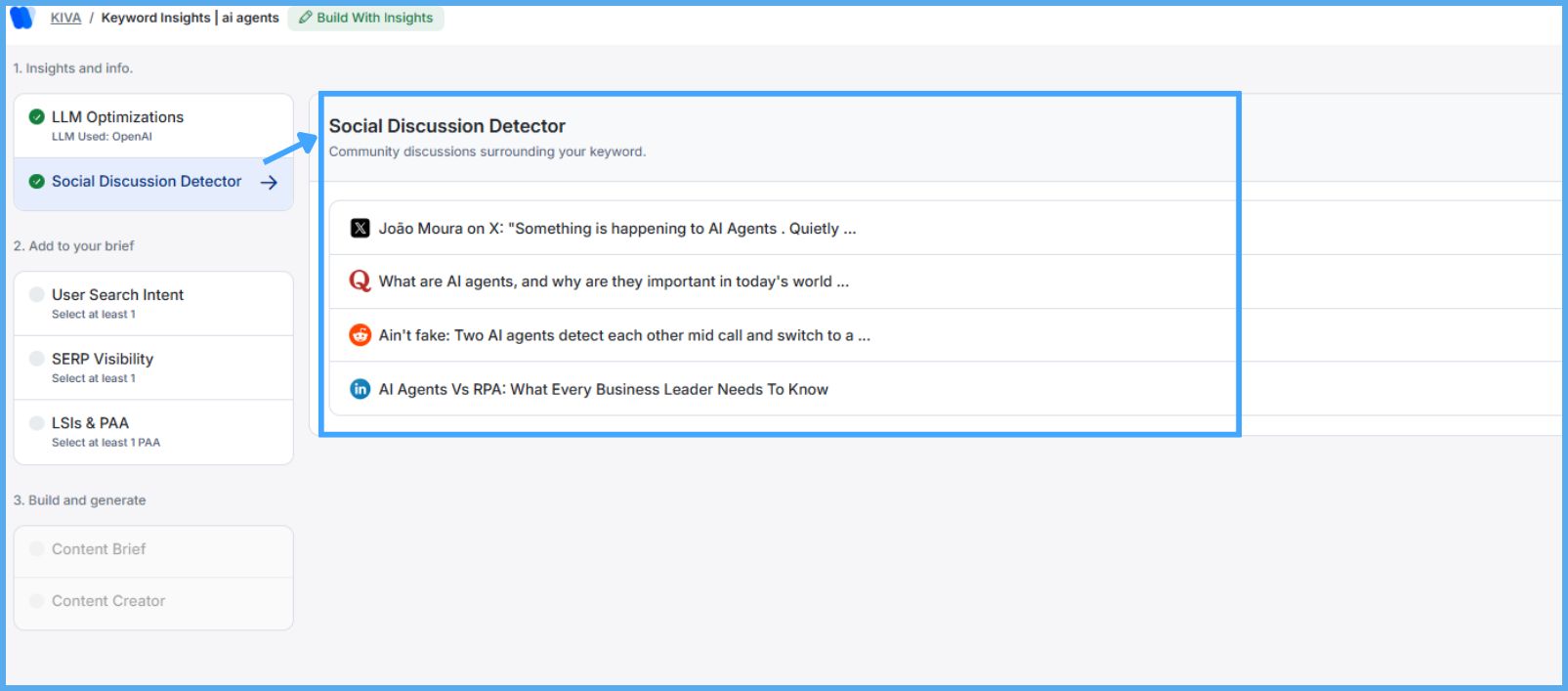
Modern content isn’t siloed. Structured briefs enable multi-channel alignment, which is foundational to how agencies deliver AI search visibility across search engines, generative models, and social discovery surfaces.:
- SEO alignment → Google, Bing, and SERPs.
- GEO alignment → Gemini, ChatGPT, Claude, Perplexity.
- Social integration → Reddit, Quora, and LinkedIn conversations with KIVA’s Social Discussion Detector.
This ensures every piece of content resonates across discovery ecosystems.
What Results Can Companies Expect from Adopting Structured SEO Briefs?
Real-world results are compelling:
Time Savings: According to Nine Peaks Media, around 17% of SEO professionals save more than 10 hours per week by using AI-powered or automated SEO workflows compared to manual methods.
Visibility Gains: Semrush’s 2025 data shows that the share of Google queries triggering AI Overviews more than doubled from 6.5% in January to over 13% by March, proving how fast visibility dynamics are evolving.
AI Performance: A Semrush SEO benchmark found that 57% of AI-generated content ranks in the top 10 search results, nearly matching the performance of human-written content — evidence that structured, AI-optimized briefs help brands stay competitive.
The ROI is clear: structured SEO briefs aren’t just theory—they deliver measurable growth.
How Do You Build a Repeatable Workflow for Structured SEO Briefs?
Scalability requires systems. A repeatable workflow looks like this:
- Discovery → Keywords, queries, intent.
- Analysis → SERPs, competitors, LLM signals.
- Briefing → Structured SEO brief creation.
- Execution → Writer or AI-assisted drafting.
- QA & Optimization → E-E-A-T check, Brand Signals, LLM visibility.
- Measurement → Track GEO KPIs, citations, traffic.
- Iteration → Refresh briefs quarterly for evolving AI patterns.
How Do Structured SEO Briefs Enhance E-E-A-T and Brand Authority?
Google and AI engines both prioritize trustworthy content. Structured briefs support this by:
Did you know?
- Embedding expert quotes and academic references.
- Ensuring consistent Brand Signals across all content.
- Mapping authorship details for credibility.
According to Google’s 2024 Search Quality Rater Guidelines, structured, evidence-backed content scores higher on trust and expertise.
Can Structured SEO Briefs Future-Proof Your Content Strategy?
Yes. AI models are evolving monthly, but one constant remains: structured data is easier to process. Structured briefs future-proof strategies by:
Ensuring semantic clarity for machine parsing.
Providing evergreen frameworks adaptable to new AI engines.
Reducing volatility from algorithm updates by focusing on entities and context, not hacks.
What Industries Benefit Most from Structured SEO Briefs?
While all industries can benefit, adoption is highest in:
- SaaS & Tech → Need structured topical authority for fast-moving markets.
- E-commerce → Category + product briefs improve long-tail coverage.
- Agencies & Publishers → Scale content production without losing quality.
Structured briefs help each by balancing scale with precision.
How Do Structured SEO Briefs Integrate with Analytics and Measurement?
Tracking impact goes beyond rankings. Key GEO KPIs include:
- AI Citations Earned (ChatGPT, Gemini, Claude).
- SERP Visibility Scores (from SEMrush or Ahrefs).
- Content Efficiency Metrics (revisions, time-to-publish).
- Engagement Signals (CTR, time on page, internal link clicks).
Structured briefs make measurement easier by aligning inputs (briefs) with outputs (KPIs).
Read More Articles
FAQs:
Conclusion:
In 2025, structured SEO briefs are not just a tool for better rankings—they are the blueprint for GEO success. By combining keyword strategy, user intent, entity mapping, and evidence into a single structured document, businesses can:
Save hundreds of hours in wasted revisions.
Improve Google visibility while also earning AI engine citations.
Build brand authority through consistency, trust, and E-E-A-T compliance.
The future of search is hybrid—SEO vs GEO is no longer a choice you need both. KIVA, as an AI SEO Agent, illustrates how structured briefs can be built and scaled for this hybrid world saving time, reducing guesswork, and ensuring brands are both ranked and cited across Google and AI engines.
As AI continues to reshape discovery, one thing is certain: brands with structured SEO briefs will be the ones cited, visible, and trusted across every search platform of tomorrow.