SEO and AI search are converging, yet Google Ranking and ChatGPT visibility often diverge, leaving brands at risk of missed opportunities. While a high Google ranking has traditionally been the ultimate goal for online discoverability, it no longer guarantees visibility in generative AI platforms. Recent studies show that top-ranking Google pages appear in ChatGPT responses only about 62% of the time, highlighting a growing gap in dual-search visibility.
As users and decision-makers increasingly rely on AI-powered search engines for answers, brands must rethink their visibility strategy. Platforms like Wellows help organizations bridge this gap using the GenAI Visibility Stack and Citation Score, providing clarity on how brands perform across both Google and ChatGPT.
By tracking Google rankings and ChatGPT mentions simultaneously, Wellows enables brands to remain discoverable, measurable, and relevant in a world where AI search engines are reshaping brand performance benchmarks—making a ChatGPT Visibility Tracker essential for understanding when strong SEO performance translates into actual presence inside AI-generated answers.
Does a High Google Ranking Guarantee Visibility in ChatGPT?
Many marketers assume that strong SEO automatically translates to AI visibility. However, Google and ChatGPT use fundamentally different mechanisms to surface content:
This divergence explains why some high-ranking Google pages fail to appear in AI-powered answers. Brands cannot rely solely on search engine optimization if they aim to achieve full-spectrum visibility instead, they must actively learn how to rank high on ChatGPT through effective ChatGPT SEO by aligning their content with the specific logic of Large Language Models.
Why Are Google Rankings and ChatGPT Mentions Often Different?
The difference arises from how user intent and AI reasoning are interpreted by each platform:
Did you know?
By understanding these factors, brands can adjust their strategies to account for AI answer variability, where the same query can surface different sources depending on intent interpretation, prompt structure, and model behavior—directly affecting visibility beyond rankings.
How Does User Intent Affect Google Ranking and ChatGPT visibility?
User intent plays a critical role in determining how visibility manifests across platforms:
- Informational queries: Google dominates when users seek comprehensive guides, research, or definitions. ChatGPT may reference the same content but often summarizes it rather than linking directly.
- Task-driven queries: ChatGPT excels when users seek actionable recommendations, such as tools, apps, or brand solutions. Google may provide content-heavy options but fewer direct recommendations.
Understanding user intent allows brands to align their content strategy for dual visibility ensuring their presence across both search and AI platforms, and clarifying how brands get recommended in AI-driven answers.
What Factors Influence a Brand’s Visibility Across Generative Engines?
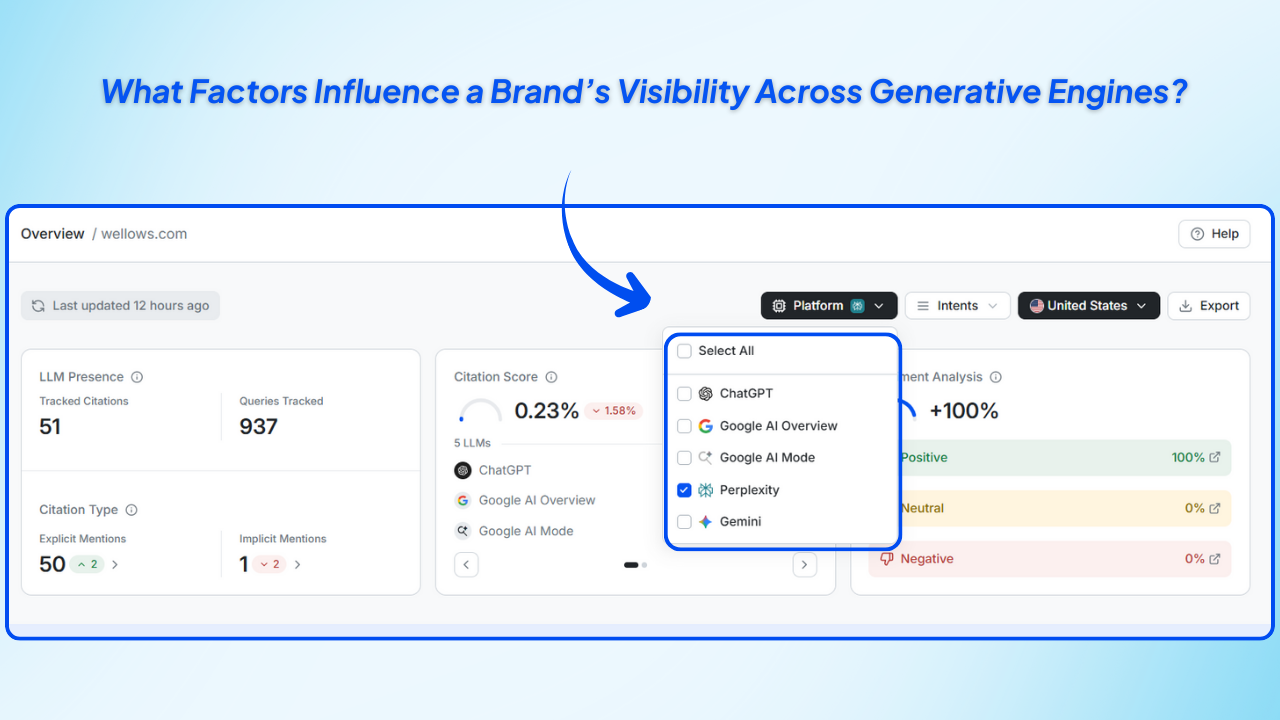
Brands can improve AI visibility through targeted optimization. Understanding the core Generative Engines Visibility Factors is essential for building a strategy that works across platforms. Key factors include:
Structured data and schema markup: Helps AI engines understand your content context. Citation and authority signals: Wellows tracks both explicit and implicit mentions to calculate a Citation Score. Citation and authority signals: Wellows tracks both explicit and implicit mentions to calculate a Citation Score. Real-time web signals: LLMs consider recent data, meaning frequently updated or relevant content has higher visibility.
How Can Brands Measure and Improve Google Ranking and ChatGPT visibility?
Monitoring performance across both platforms is essential. Wellows provides tools to:
- Track Citation Score and LLM Visibility: Measures both direct and implied brand mentions.
- Analyze prompt-specific mentions: Identifies which AI queries favor or overlook your brand.
- Evaluate sentiment: Understand whether AI-generated mentions are positive, neutral, or negative.
By continuously monitoring these metrics, brands can refine their content strategies to maximize visibility in both Google and ChatGPT. Using an AI Search Visibility Audit Checklist can help ensure all key performance indicators, from Citation Score to prompt coverage, are systematically tracked and optimized without missing critical insights.
How Does Visibility Differ Across Industries in Google and ChatGPT?
Research shows that AI visibility varies significantly by industry:
Did you know?
What Are Best Practices for Generative Engine Optimization (GEO) and SEO Together?
To achieve dual visibility, brands should integrate SEO and GEO strategies:
- Map content to intent-driven prompts: Anticipate how users phrase queries in AI systems.
- Enhance SERP Visibility: Improve page-level authority and keyword relevance for Google.
- Elevate Citation Score: Build authoritative references and get brand mentions across platforms.
- Use structured and FAQ-rich content: Makes content easier for LLMs to process and cite.[/did_you_know]
By combining Generative Engine Optimization with SEO, brands maximize the probability of appearing across both Google search and ChatGPT responses.
Structure answer blocks strategically: If you want to master how to optimize for Google AI Overviews, create concise 2–3 sentence answers under question-based headers supported by verifiable sources.
How Can Brands Bridge Google Ranking and ChatGPT visibility Gaps for Maximum Reach?
Bridging visibility gaps requires an adaptive dual-platform strategy:
- Continuously compare Google rankings and AI results.
- Monitor LLM responses and identify missing mentions.
- Optimize content to increase alignment with both informational and task-based queries.
- Use real-time tracking and analytics tools like Wellows to respond quickly to visibility changes.
Brands that adopt this approach gain comprehensive exposure across both traditional search and generative AI.
How Do Brands Maintain Control Over Their AI Visibility and Reputation?
Managing AI visibility goes beyond appearing in search results—it involves reputation and sentiment management:
Monitor explicit and implicit brand mentions. Verify accuracy through tools like citation validators. Update content regularly to resolve contradictions or outdated information. Avoid manipulative tactics such as prompt injection or black hat SEO, which can harm trust and long-term visibility.
Why Are Real-Time Monitoring and Structured Content Critical for Google Ranking and ChatGPT visibility?
AI search engines prioritize recent and structured content:
Timely updates ensure LLMs reference current and accurate information. Structured content allows AI to parse context easily, improving citation likelihood. Integration of FAQs, tables, and schema markup enhances both Google and ChatGPT recognition.
Real-time monitoring combined with structured content is essential to maximize dual-platform visibility.
How Can Content Be Optimized to Get Cited by ChatGPT and Other AI Engines?
AI engines prioritize content that is clear, authoritative, and contextually relevant:
Did you know?
What Metrics Should Marketers Track to Compare Google Ranking and ChatGPT visibility?
Marketers need to monitor multiple KPIs:
- SERP Visibility: Traditional SEO ranking performance.
- LLM Visibility: Mentions, citations, and recommendation frequency in AI engines.
- Citation Score: Tracks both direct and indirect AI mentions.
- Sentiment Analysis: Measures positivity, neutrality, or negativity of mentions.
- Prompt Coverage: Ensures brand appears for all relevant user queries.
What Role Do LLM Updates and Training Data Play in AI Visibility?
Generative AI engines rely on model updates and training data:
LLMs update periodically, meaning older content may be deprioritized. Real-time web signals can influence AI recommendations immediately. Wellows prioritizes tracking public data and timely content to optimize brand mentions.
Read More Articles
- AI Algorithm Updates: SEO Impact & Recovery Tips
- Boost AI Search Visibility with Knowledge Graphs
- AI Search Marketing: ChatGPT vs Traditional Search
- Why Structured SEO Briefs Are the New Foundation of AI Search Success
- Effective LLM Citation Strategies for SEO Success
- How to Build GEO Brand Signals That Win AI Citations in 2025
- AI Search Visibility for Healthcare & Hospitals
- How Can Pattern Recognition Improve Visibility in AI-Generated Answers?
- Bridging Google Rankings and LLM Citations Gap
- How Will Google’s AI Mode Transform Traditional SEO Practices?
- AI SEO Automation for Generative Search Visibility (2026)
- AI Competitive Benchmarking for SEO
- Why Your Website Traffic Is Dropping (Causes & Fixes)
FAQs:
Conclusion:
The search landscape is evolving. Google Ranking and ChatGPT visibility no longer overlap perfectly, making dual-platform monitoring and optimization essential. Brands that rely solely on traditional SEO risk missing opportunities in AI-driven search results.
By integrating Generative Engine Optimization (GEO) with SEO, leveraging structured content, and tracking Citation Score and LLM visibility, organizations can achieve full-spectrum online visibility. Platforms like Wellows enable marketers to monitor performance, identify gaps, and ensure positive brand representation in both Google and AI-generated responses.
Success today requires a balanced strategy: adapt to user intent, optimize content for both search and generative engines, and monitor visibility continuously. Brands that act proactively can dominate across Google, ChatGPT, Gemini, Perplexity, and AI Overviews, ensuring they remain discoverable, authoritative, and relevant in the AI-driven digital era.