AI driven search systems are reshaping how information is discovered, evaluated, and reused. While traditional search engines still play a role, an increasing share of queries are now resolved directly within AI generated interfaces such as AI Overviews, conversational assistants, and answer focused search environments.
In these contexts, visibility is no longer defined by ranking a webpage. It is defined by whether a source is selected as part of the generated response.
This evolution has made AI Search Visibility with Knowledge Graphs a practical requirement rather than a theoretical idea and a core concern within Generative Engine Optimization.
Visibility is now determined by how clearly AI systems can retrieve, understand, and trust structured representations of entities and the relationships between them.
Instead of competing for a position in a list, brands now compete for semantic inclusion and accurate representation inside AI generated answers.
Why Are Traditional SEO Metrics Being Replaced by AI Search Visibility Signals?
For many years, SEO success followed a predictable pattern. Higher rankings led to more clicks, and more clicks translated into growth. AI mediated search disrupts this sequence by satisfying intent directly within the interface, often before a user reaches a website.
Independent research supports this shift. Ahrefs reported a 34.5 percent decline in average click through rate for the top organic result when an AI Overview is present. Pew Research Center found that when an AI-generated summary appears on Google, users are far less likely to click on traditional search result links. In searches with an AI summary, visits that resulted in a click on a standard result fell to about 8%, compared with 15% when no AI summary was present, and only about 1% of visits included a click on a source within the AI summary. As a result, visibility must now be evaluated through different signals, including: These signals reflect how AI systems interpret and prioritize entities rather than how users interact with ranked results.
What Does AI Search Visibility with Knowledge Graphs Mean in Practice?
AI search visibility is your brand’s presence inside AI-generated answers across platforms (like Google’s AI experiences, ChatGPT-style assistants, and other answer engines). It’s not only whether you appear, but how consistently you show up, for which topics, and in what context.
Knowledge graphs enter the picture because AI systems don’t “read” the internet the way humans do. They rely heavily on structured understanding: entities (people, brands, products, concepts) and the relationships between them.
In practice, AI Search Visibility with Knowledge Graphs means you’re building an online presence that’s:
easy to retrieve (technically accessible),
easy to interpret (clear structure),
easy to trust (credible, corroborated),
and easy to connect (strong entity relationships).
A helpful way to think about it: classic SEO aimed to rank pages; knowledge-graph-driven visibility aims to make your brand and facts about your brand easy for AI systems to reuse.
One phrase you’ll hear in advanced discussions is Generative Engine Visibility Factors the core signals that determine whether AI engines include you in answers. These include retrievability, clarity, authority, and entity relationships.
How Do AI Search Engines Discover, Understand, and Select Content?
Most AI-driven search experiences follow a pattern:
- Retrieval: The system finds candidate sources (pages, docs, databases).
- Understanding: It extracts meaning — what the content says, who/what it’s about.
- Synthesis: It generates an answer by summarizing, combining, and compressing information.
- Selection & citation: It chooses what to reference (sometimes with links, sometimes without).
This is where a lot of brands lose. They publish “good content,” but the content is hard to extract, ambiguous, or doesn’t clearly communicate entity relationships. AI engines don’t want to guess. They want content that reduces uncertainty.
This also explains why informational content triggers AI Overviews so often: it’s easier to summarize and cite. Semrush’s AI Overviews data has shown how strongly AI Overviews skew toward informational intent (even as commercial and navigational triggers grow).
If you want to win visibility, write and structure content so that retrieval and understanding are effortless, and so AI systems can confidently attribute ideas to you.
Why Are Knowledge Graphs Central to AI Search Visibility?
A knowledge graph provides a structured way for machines to understand meaning, not just text. Instead of treating content as isolated pages, it organizes information into entities and the relationships between them.
Entities can include organizations, products, technologies, concepts, or features such as AI Overviews, structured data, search visibility, or schema markup. Relationships describe how those entities connect, for example, whether something influences another concept, is part of a larger system, supports a process, or is commonly associated with a topic.
This structure matters because AI systems do not simply retrieve definitions when generating answers. They evaluate how ideas relate to one another, which entities belong together, and which sources appear reliable within a given context. Without those connections, even accurate content can be difficult for AI to interpret confidently.
Knowledge graphs reduce that uncertainty. When your content clearly communicates:
what your brand is,
what you offer,
what you’re known for,
and how your topics relate,
A knowledge graph provides a structured way for machines to understand meaning, not just text. Instead of treating content as isolated pages, it organizes information into entities and the relationships between them.
Entities can include organizations, products, technologies, concepts, or features such as AI Overviews, structured data, search visibility, or schema markup. Relationships describe how those entities connect, for example, whether something influences another concept, is part of a larger system, supports a process, or is commonly associated with a topic.
This structure matters because AI systems do not simply retrieve definitions when generating answers. They evaluate how ideas relate to one another, which entities belong together, and which sources appear reliable within a given context. Without those connections, even accurate content can be difficult for AI to interpret confidently.
Knowledge graphs reduce that uncertainty. When your content clearly communicates.
What Types of Knowledge Graphs Influence AI Search Results?
When people say “knowledge graphs,” they often mean different things. For AI search visibility, three types matter most:
1) The public web knowledge graph layer (Google-style)
This includes widely recognized entities (companies, people, places) and facts that are corroborated across trusted sources. It’s influenced by consistent references, reputable citations, and structured entity data.
2) Your site’s content knowledge graph (owned)
This is how your own pages connect entities and topics. Are your product pages linked to use cases? Are your guides tied to definitions? Do your authorship and credentials connect clearly?
3) Your brand knowledge graph (distributed)
This is the broader web-wide story of your brand, shaped by mentions, reviews, citations, press, community discussions, and consistent messaging across the internet.
AI visibility happens when these layers reinforce each other instead of contradicting each other.
This is also where brand measurement platforms can help. For example, Wellows positions Citation Score as a visibility metric across multiple AI platforms, which is useful because the same brand can be strong in one engine and invisible in another.
How Does Entity Mapping Improve AI Search Visibility?
Entity mapping is the practice of identifying the key entities you want to be known for and then making sure your content connects them clearly and repeatedly.
The goal isn’t to repeat keywords. The goal is to reduce confusion.
Entity mapping improves AI visibility because it strengthens:
Entity recognition: AI can tell what’s a brand, what’s a product, what’s a concept.
Entity disambiguation: AI doesn’t confuse you with similar terms or competitors.
Relationship confidence: AI can confidently connect your brand to relevant topics.
When you do this well, AI engines don’t just “find your page.” They build a clearer mental model of your brand.
This is where internal linking becomes strategic (not random). If your core topics are connected with consistent anchors and clear page hierarchies, you’re effectively building a more navigable knowledge graph for machines and humans.
Why Do Brand Mentions and Citations Matter More Than Backlinks in AI Search?
Backlinks still matter but AI systems increasingly care about how widely and consistently your brand is referenced and whether those references appear in credible contexts. A mention in an authoritative source can shape how AI describes you and even if it doesn’t pass classic link equity the way SEO tools measure. This is why marketers keep talking about “citations,” “mentions,” and “share of voice” in AI answers. Search Engine Land’s AI visibility guidance emphasizes expanding beyond classic SEO tactics and focusing on retrievability, authority signals, and entity mapping. (Search Engine Land) This is also where GEO KPIs come into play the measurement layer for generative visibility. Instead of only tracking rankings and traffic, you track things like: If you’re serious about AI visibility, you need these metrics otherwise you’re guessing.
What Strategic Actions Strengthen AI Search Visibility with Knowledge Graphs?
This is where most guides get vague. Let’s keep it practical.
If you want stronger AI visibility, you need a plan that covers four pillars:
1) Make your content retrievable
AI cannot cite what it cannot access. Your most important pages must be crawlable, indexable, and easily rendered.
2) Make your content extractable
Use clear headings, short sections, bullet points, tables, and answer-first writing so AI systems can lift accurate snippets without misreading.
3) Make your brand believable
Cite credible sources show clear credentials demonstrate real experience and maintain consistent definitions. Authority is shaped by perception and AI systems reflect what the web presents as trustworthy.
4) Make your entity relationships stronger
Connect your key topics into a clear knowledge graph through internal linking, structured data, and consistent entity naming.
If you want a simple label for this whole approach, it’s basically most effective strategies for AI Visibility enhancement are the strategies that improve retrieval, extraction, authority, and entity confidence at the same time.
This is also where a tool like Wellows fits naturally for teams, because it focuses on tracking visibility signals (citations, mentions, sentiment) across AI platforms and surfaces opportunities to improve coverage.
What Technical Foundations Enable Knowledge Graph–Driven AI Visibility?
Technical SEO matters more in AI search than many people realize, because AI systems are far less forgiving about extraction issues.
Key technical foundations include:
Crawlability and indexation hygiene
If your site blocks important sections via robots.txt, uses noindex carelessly, or has broken internal links, you’re making retrieval harder.
Rendering and JavaScript dependency
If key content only appears after client-side rendering, some crawlers and extraction systems may miss it or interpret it inconsistently.
Schema markup and structured entity signals
Schema doesn’t “guarantee” visibility, but it reduces ambiguity. And there’s evidence it improves performance. Schema App has reported that pages with Schema App markup had a higher click-through rate than pages without.
Even beyond click-through, schema helps machines interpret page meaning — which is exactly what AI-driven search needs.
Core Web Vitals and performance
Speed affects crawling efficiency and user experience. Even if the AI cites you, a slow page can still lose the conversion.
How Can You Audit AI Search Visibility Using Knowledge Graph Principles?
You don’t improve what you don’t measure. And AI visibility is fragmented across engines.
Start with a simple AI Search Visibility Audit Checklist:
- Can AI systems retrieve your pages reliably (crawlability, indexation, rendering)?
- Can they extract answers easily (structure, chunking, headings, summaries)?
- Do your pages clearly communicate entities (who/what this page is about)?
- Is your structured data accurate and complete (Organization, Article, FAQPage, Product where relevant)?
- Are your brand mentions growing across credible domains?
- Are you tracking where you appear across engines (Google AI experiences, ChatGPT-style assistants, etc.)?
At this point, many teams add a monitoring layer. Wellows, for example, positions itself as a “single source of truth” for multi-engine visibility signals, including citation-based measurement. That can speed up auditing because you’re not manually checking dozens of prompts across platforms.
How Does E-E-A-T Operate as an Entity Signal in AI Systems?
E-E-A-T isn’t just a Google concept anymore. AI systems also lean toward sources that appear credible. Think of E-E-A-T as entity trust signals: This matters because AI engines often cite sources that feel safe, established, and corroborated — especially in categories where accuracy matters. You can strengthen E-E-A-T signals by: It’s not about looking “polished.” It’s about reducing uncertainty for both humans and machines.
How Should Content Be Structured for AI Extraction and Knowledge Graph Inclusion?
To improve AI Search Visibility, content must be optimized not only for users but also for how AI systems crawl, interpret, and reuse information. Well-structured content increases extractability, strengthens entity signals, and supports knowledge graph inclusion.
Place the primary answer at the top of each section:
Each section should begin with a clear, concise answer or definition. This “answer-first” structure helps AI systems quickly identify relevance and improves the likelihood of being cited in AI Overviews and answer engines.
Use concise, single-topic paragraphs:
Short paragraphs focused on one topic improve semantic clarity. This helps AI systems extract specific facts, map entities accurately, and avoid misinterpreting content context.
Organize content with semantic headings and clear sections:
Use descriptive H2 and H3 headings to define topical boundaries. Bullet points, lists, and short summaries reinforce content hierarchy, making it easier for AI systems to understand relationships between entities within a knowledge graph.
Leverage tables for structured comparisons:
Tables provide structured data that clearly defines differences and relationships between concepts. AI systems can parse tables efficiently, which increases the chances of your content being reused in AI-generated summaries.
Include FAQ sections aligned with search intent:
FAQ content mirrors natural-language queries and aligns closely with AI prompt patterns. Direct questions and concise answers strengthen entity relevance and improve visibility in AI Overviews and generative search results.
By applying these on-page SEO best practices, content becomes more retrievable, more extractable, and easier for AI systems to connect within a knowledge graph. This structured approach directly supports stronger AI Search Visibility with Knowledge Graphs.
How Can AI Search Visibility Be Measured Beyond Traffic and Rankings?
Traditional analytics can tell you what happens after the click. AI visibility often happens before the click — and sometimes without a click at all. To measure visibility now, you typically track: This is where the term GEO is often used as shorthand for generative visibility strategy and measurement: it’s about being included in answers, not only ranking in lists. In practice, many teams validate this by checking whether their content is being explicitly cited, implicitly referenced, or missed entirely in AI-generated responses using a ChatGPT Visibility Tracker, rather than relying on traffic or rankings alone. If you’re running a serious program, you’ll want both:
Why Is Multi-Platform AI Search Visibility Tracking Essential?
One of the sneakiest mistakes brands make: they optimize for one engine and assume they’re covered everywhere.
But AI platforms behave differently:
- Some favor big, established publications.
- Some cite niche sources with unique data.
- Some lean heavily on structured pages and clear definitions.
That’s why cross-engine tracking matters. Even the same question can produce wildly different sources depending on the platform.
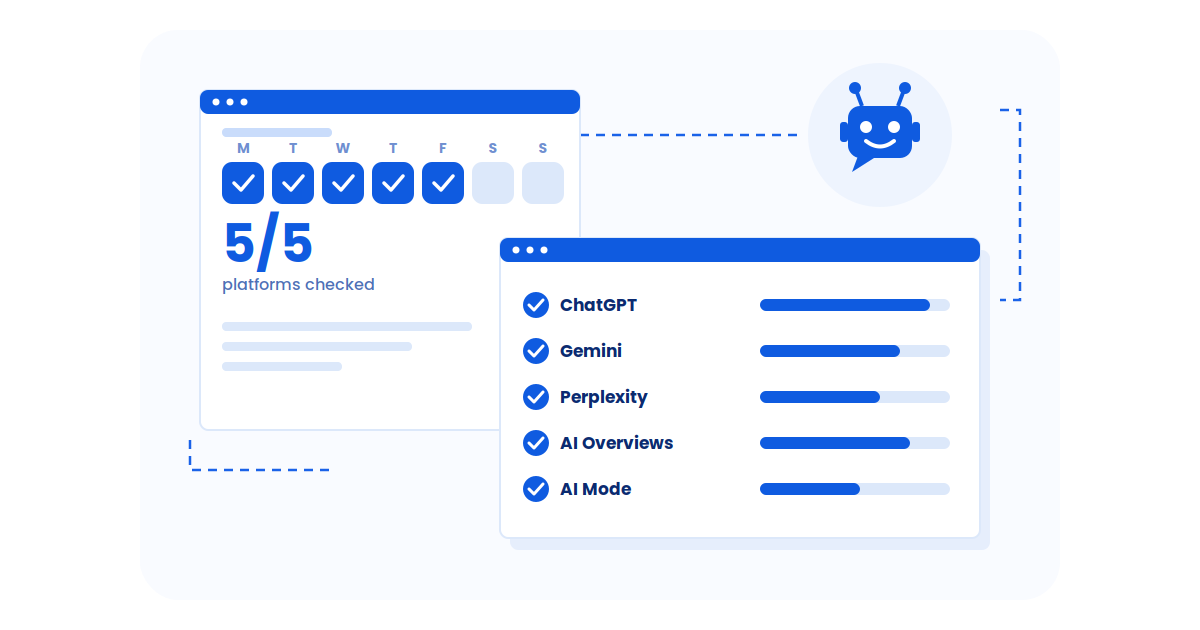
It’s also why visibility monitoring tools exist. Wellows, for instance, highlights cross-platform tracking (ChatGPT, Gemini, Perplexity, and Google AI experiences) as part of how they help teams understand where they’re visible and where they’re missing.
What Common Knowledge Graph Mistakes Reduce AI Search Visibility?
If you want quick wins, avoid these common traps:
Mistake 1: Treating schema like “just for rich results” Schema is also about machine understanding. If your entity markup is incomplete or inconsistent, AI interpretation becomes fuzzier. Mistake 2: Inconsistent entity naming across your site If you describe the same product in five different ways, AI may treat it like five different things. Mistake 3: Publishing isolated content islands If your important pages aren’t meaningfully connected, you’re not building a strong internal knowledge graph. Mistake 4: Ignoring off-site signals Your brand knowledge graph is shaped by the web. If the only place you’re mentioned is your own website, you’ll often struggle to be selected in competitive categories. Mistake 5: Measuring only clicks AI visibility is often impression-based. You need citation-based measurement too.
How Can Brands Future-Proof AI Search Visibility with Knowledge Graphs?
If you want lasting visibility rather than short lived spikes the future proof approach usually follows a clear and structured path.
This is how you turn AI visibility into a compounding asset. Not a one-time “SEO project,” but an ongoing system.
Read More Articles
- AI Algorithm Updates: SEO Impact & Recovery Tips
- AI Search Marketing: ChatGPT vs Traditional Search
- Does Google Ranking Ensure Visibility in ChatGPT
- AI Search Visibility for Fashion & Apparel Brands in 2026
- Avoid SEO Mistakes Blocking Brand Visibility in AI Search
- AI Search Visibility for Banking & Financial Services Brands
- AI Search Visibility for Biotechnology Brands
- AI Search Engines: How Brands Get Recommended
- How to Use AI Content Scoring to Improve SEO & Quality 2026
- AI Competitive Benchmarking for SEO
FAQs:
Large language models (LLMs) like ChatGPT or Claude do not have direct, native access to Google’s proprietary Knowledge Graph. Instead, they rely on statistical patterns learned from their training data to “guess” facts. However, the connection between these two technologies is changing in three key ways:
- Google Gemini: As Google’s own AI, Gemini is uniquely integrated with Google Search and can query the Knowledge Graph in real-time to verify facts and entities.
- The “Ground Truth” Connection: For other models, developers often use a method called RAG (Retrieval-Augmented Generation). This acts as a bridge that allows the AI to “look up” facts in a structured graph before it answers a user.
- Public vs. Private: While Google’s specific graph is private, many AI systems use public versions like Wikidata to learn how different real-world concepts (people, places, things) relate to each other.
Essentially, the Knowledge Graph acts as a reliable database of truth, while the LLM acts as the conversational voice that explains that truth to you.
Conclusion:
AI search visibility is no longer only about ranking pages. It’s about helping AI systems understand who you are, what you’re about, and why you’re trustworthy and then reinforcing that understanding through a consistent knowledge graph across your site and the wider web.
If you get the fundamentals right such as retrievability extractability authority and entity relationships you give AI engines what they need to include you in the answers users actually see.
Once you are ready to measure and scale this approach tools like Wellows become useful not as another SEO tool but as a way to track citations sentiment and visibility across the AI platforms shaping modern discovery.