When was the last time you Googled your biotech brand — and an AI assistant answered before your website appeared? That’s the new norm. AI Search Visibility for Biotechnology Brands isn’t a buzzword — it’s how patients, HCPs, and investors now find innovation.
According to Capgemini (2024), nearly 70% of consumers already rely on generative AI to explore products and services. One day you’re ranking in Google — the next, ChatGPT or Gemini is spotlighting someone else.
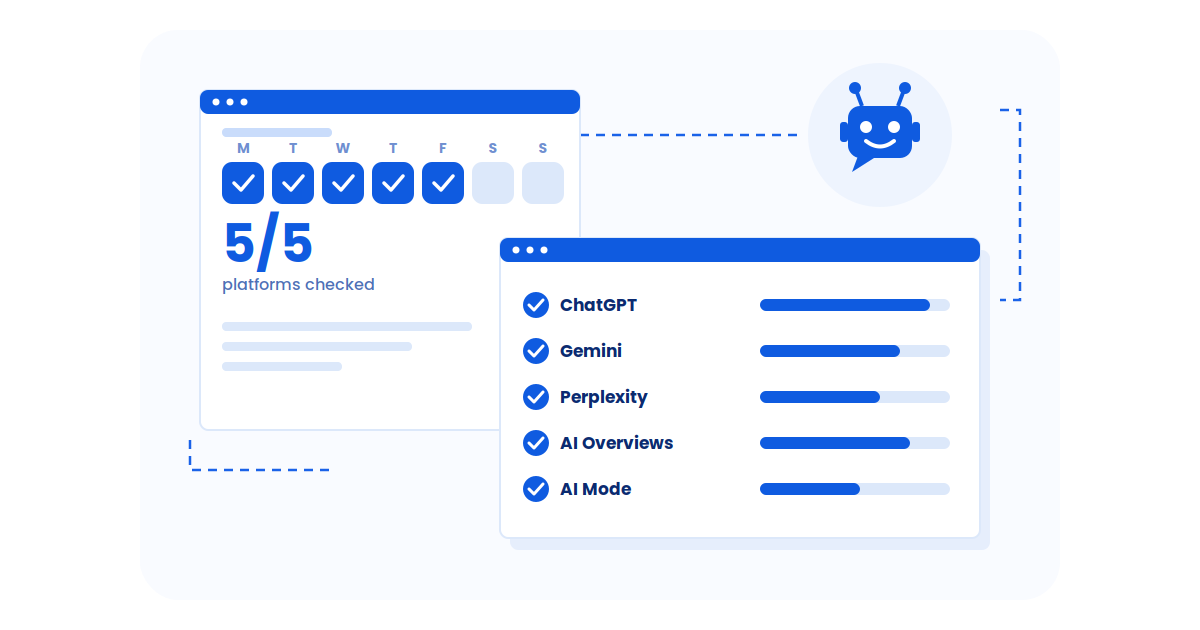
That’s why Wellows exists. It shows how your biotech brand appears across ChatGPT, Claude, Gemini, and Perplexity — and even filters results by region with GEO-level AI analytics.
See your Citation Score, uncover implicit mentions, and benchmark against competitors — all in one dashboard. You’ll finally know how AI sees (or skips) your brand and how to fix it.
Traditional SEO tools don’t track this. Wellows does — giving biotech teams the clarity to boost authority where it matters most: inside AI answers.
Did you know?
Did You Know? AI referrals jumped 1,300% in 2024 (eMarketer, 2024), and Gartner (2025) predicts search traffic will fall 25% by 2026. For biotech brands, showing up in AI isn’t optional — it’s how discovery happens.
What Is AI Search Visibility and Why Does It Matter for Biotechnology Brands?
AI Search Visibility for Biotechnology Brands refers to how prominently biotech companies appear in responses generated by AI-powered tools like ChatGPT, Google’s Gemini (SGE), Bing Copilot, Claude, and Perplexity.
Unlike traditional search engines that list web links, these AI systems deliver direct, context-rich answers synthesized from multiple reliable sources.
For biotechnology companies, this means that when someone asks an AI about a disease, treatment, or drug innovation, your brand’s presence in that answer builds trust and authority. Missing from these AI-generated responses could mean losing visibility and credibility—even if your traditional SEO performance is strong.
As healthcare professionals and patients increasingly rely on AI for research, decisions, and product discovery, visibility in large language model (LLM) outputs has become as crucial as ranking in search engines. This marks a significant shift toward Generative Engine Optimization (GEO) — the practice of making content AI-readable and citation-friendly.
The Current State of AI Search Visibility in Biotech
- Consumers are turning to AI for health insights: About 60% of U.S. adults report using AI tools to search for health information or guidance (EMarketer, 2025).
- Clinicians are integrating AI into daily practice: Nearly 20% of general practitioners in the U.K. have used generative AI tools like ChatGPT for clinical reference or patient communication (BMJ Health & Care Informatics, 2024).
- AI Overviews reshape how patients discover information: Google’s 2024 expansion of AI Overviews has made cited webpages and structured data more visible, increasing the value of accurate, well-structured biotech content (The Verge, 2024).
- AI trust among users is rising: Around 63% of U.S. adults who search health topics online consider AI-generated health information somewhat or very reliable (Annenberg Public Policy Center, 2025).
Biotech companies are now strengthening AI search visibility through Wellows — an AI visibility platform that tracks where brands appear across ChatGPT, Gemini, Claude, and Perplexity. It reveals citation scores, sentiment trends, and competitor benchmarks, helping teams close visibility gaps and improve how AI systems interpret their content.
With Wellows, biotechnology brands can build structured, credible, and AI-optimized content that earns more citations and strengthens authority across health-related AI searches.
How Can Biotechnology Companies Improve Their AI Search Visibility?
As generative AI becomes the new default for search, biotechnology brands need to rethink how they’re discovered online. Platforms like ChatGPT, Gemini, and Claude now answer questions that used to drive traffic directly to your site — but traditional SEO can’t measure how often your brand appears in those answers.
That’s where solutions like Wellows come in. In fact, understanding the Generative Engine Visibility Factors is now essential for brands looking to optimize presence across AI-generated responses.
Rather than optimizing for rankings alone, biotech marketers must now optimize for AI recognition, citation, and relevance. Here’s what that shift requires
- Know where you stand: Get a real-time snapshot of how your brand appears (or doesn’t) across top AI platforms.
- Benchmark against peers: Understand how competitors are performing and where they’re getting cited more often — without manual tracking.
- Spot hidden gaps: Identify topics where your brand is discussed but not credited, or where it’s entirely missing from the conversation.
- Adapt to AI logic: Align your messaging with how large language models interpret expertise, relevance, and authority.
- Act on opportunities: Use data-driven suggestions to fill visibility gaps and reinforce brand authority in AI-generated responses.
In the next section, you’ll see how this process unfolds in action — using a real-world scan of a major biotech brand with Wellows.
How Can Biotechnology Brands Use Wellows for AI-Driven Search Visibility?
If you’re in biotech marketing, you’ve probably wondered: “How visible is our brand in ChatGPT or Gemini when someone asks about treatment options or biologics?” I wondered too — so I ran a real-world test on Amgen using Wellows. What I found was equal parts impressive and urgent.
Below is the exact 8-step flow I followed to analyze Amgen’s AI search visibility for biotechnology brands.
Each step includes real insights to help you visualize how biotech brands can harness AI search data to get ahead — especially as tools like Wellows and AI SEO agents now use SERP visibility to uncover opportunities that weren’t trackable before.
1. Add Your Brand Domain
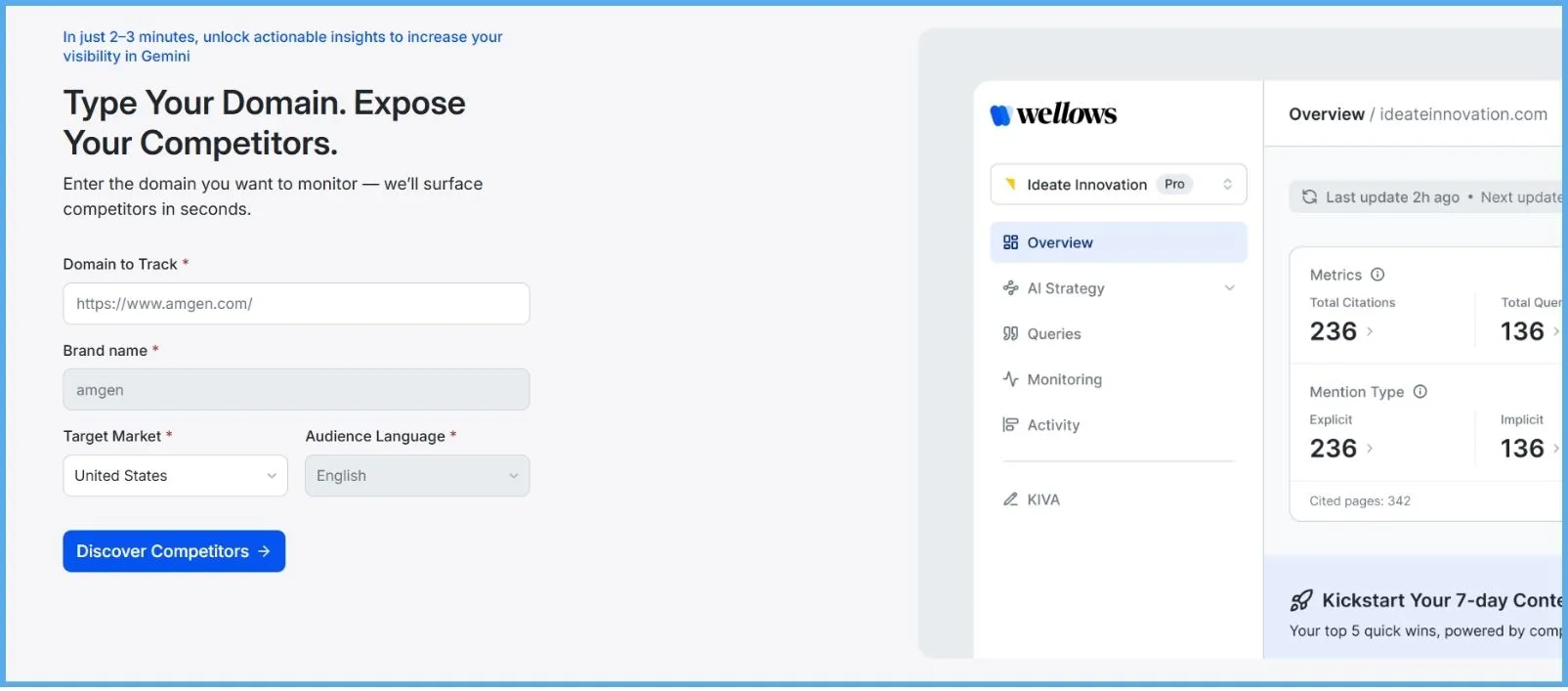
I entered amgen.com into Wellows. Within seconds, I had a live map of Amgen’s visibility across ChatGPT, Claude, Gemini, and Perplexity. Even minor copy changes on public pages (like a slightly outdated description) impacted whether AI models cited Amgen. It was the fastest and clearest baseline scan I’ve seen.
2. Automatic Competitor Mapping
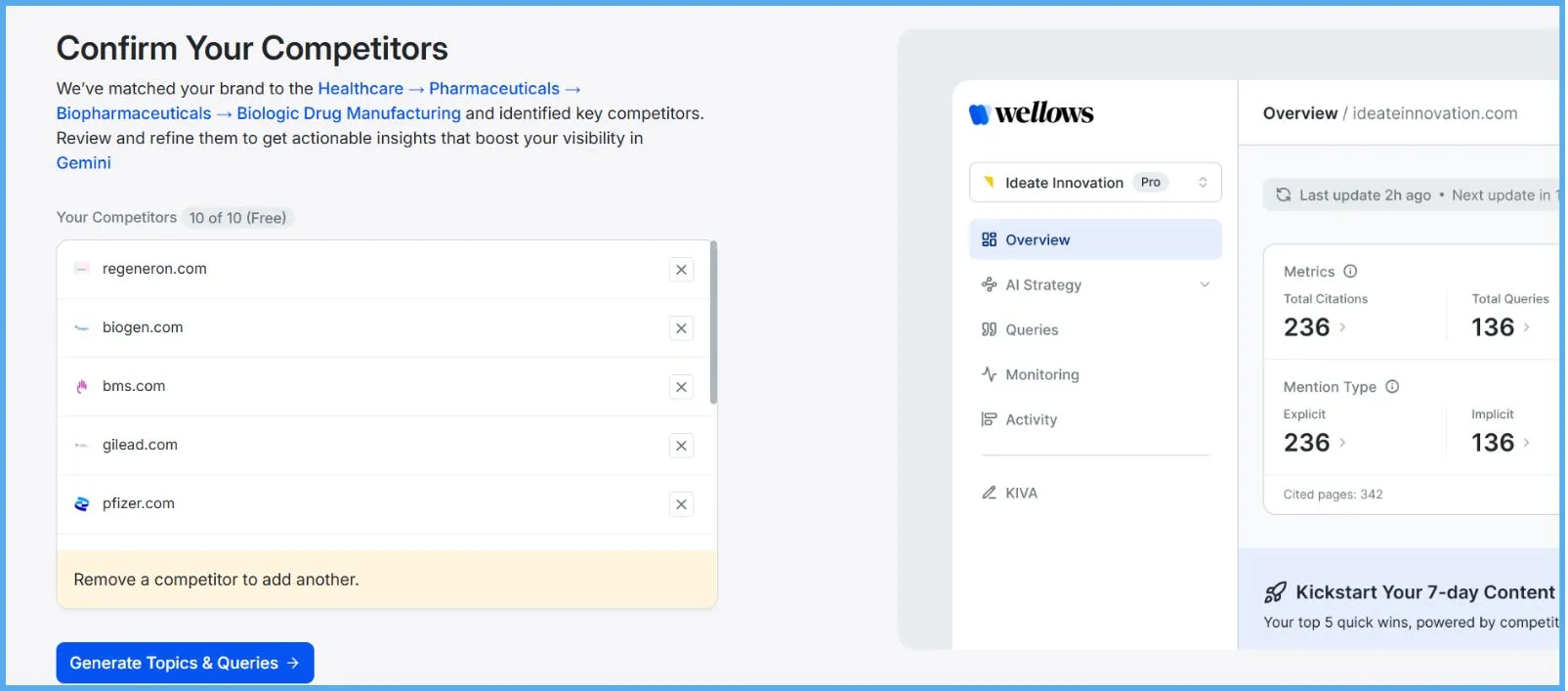
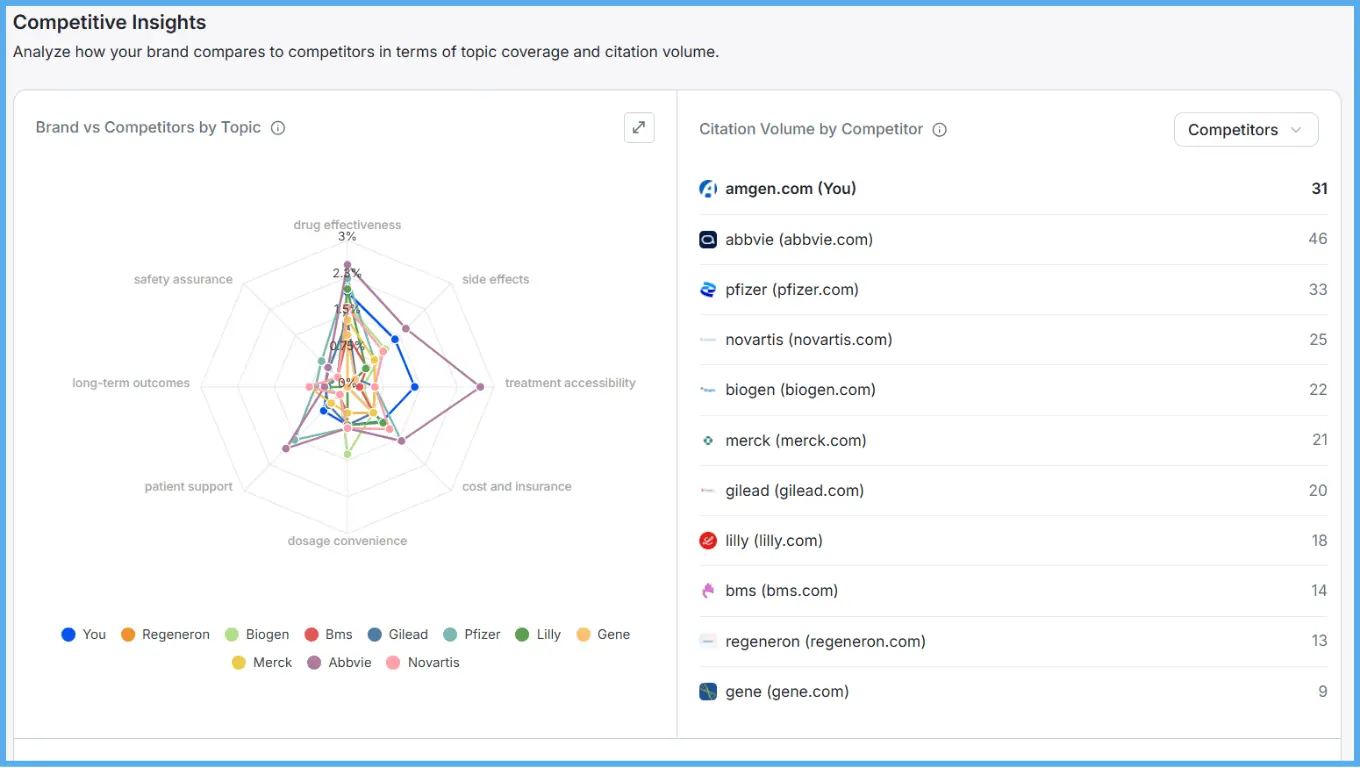
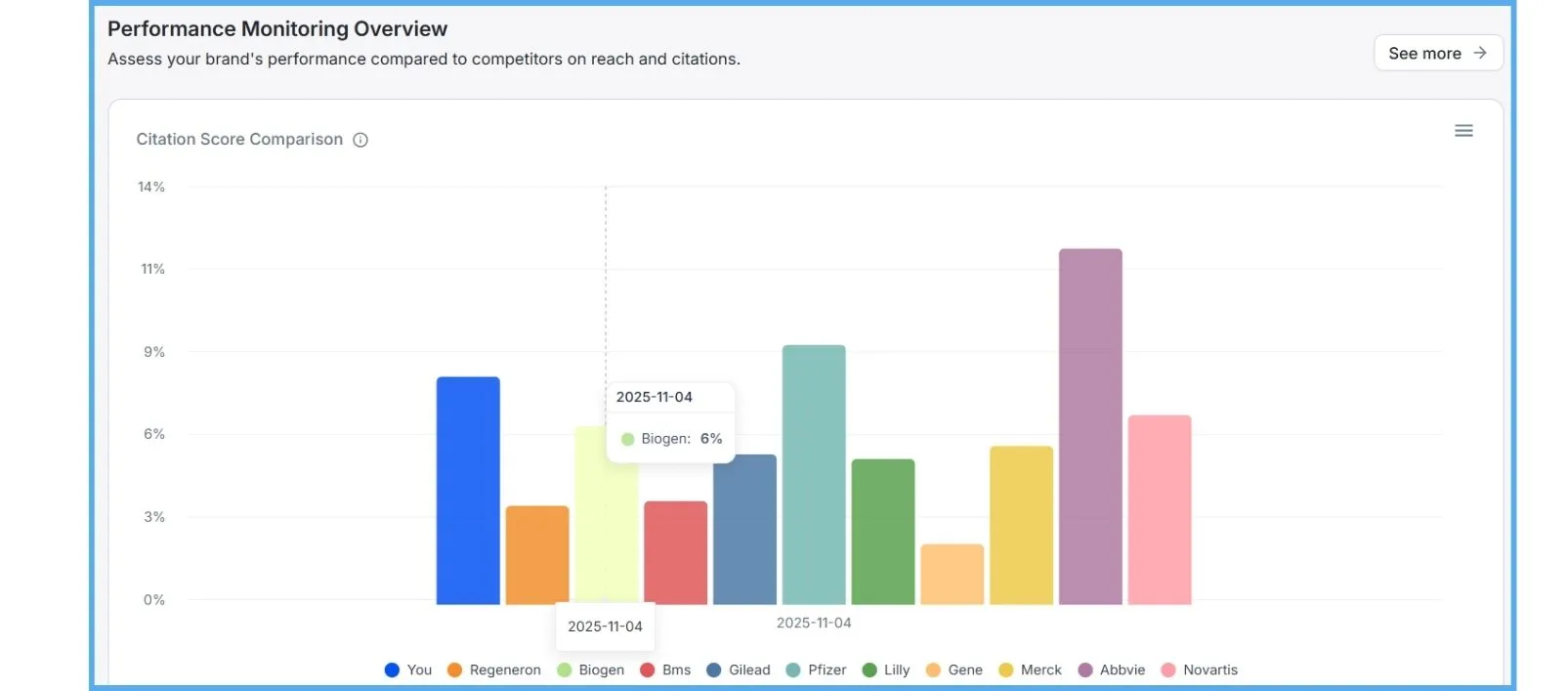
Wellows recognized Amgen’s vertical — Biologic Drug Manufacturers — and surfaced relevant peers: AbbVie, Pfizer, Biogen, Merck. No manual setup. Just data. AbbVie had 46 citations, Pfizer 33 — a benchmark to measure Amgen against immediately.
3. Fine-Tune Topics
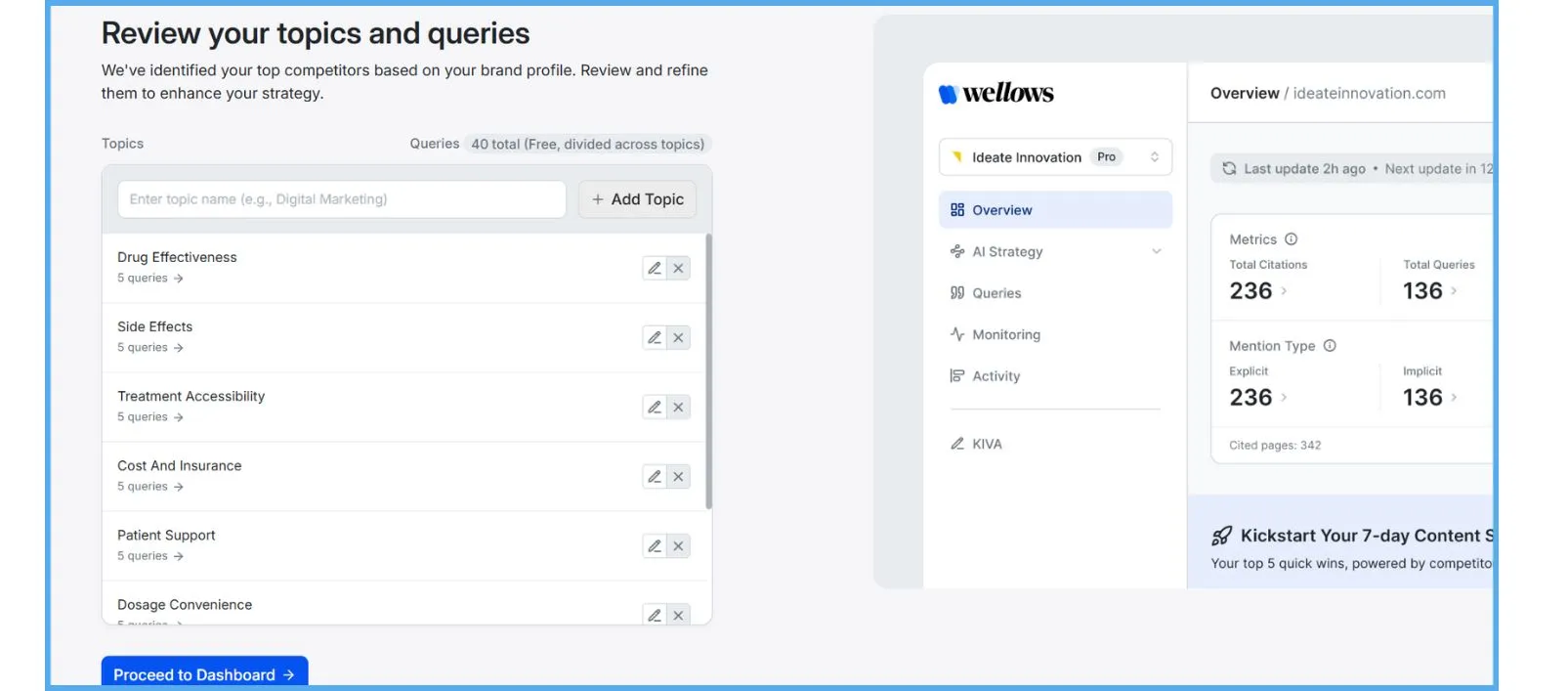
Topics like drug efficacy, affordability, and safety came pre-loaded. I added “biosimilars vs biologics” — a hot topic right now — and instantly got updated data on how Amgen was represented. The system adapts to what AI actually cares about.
4. Review the Dashboard
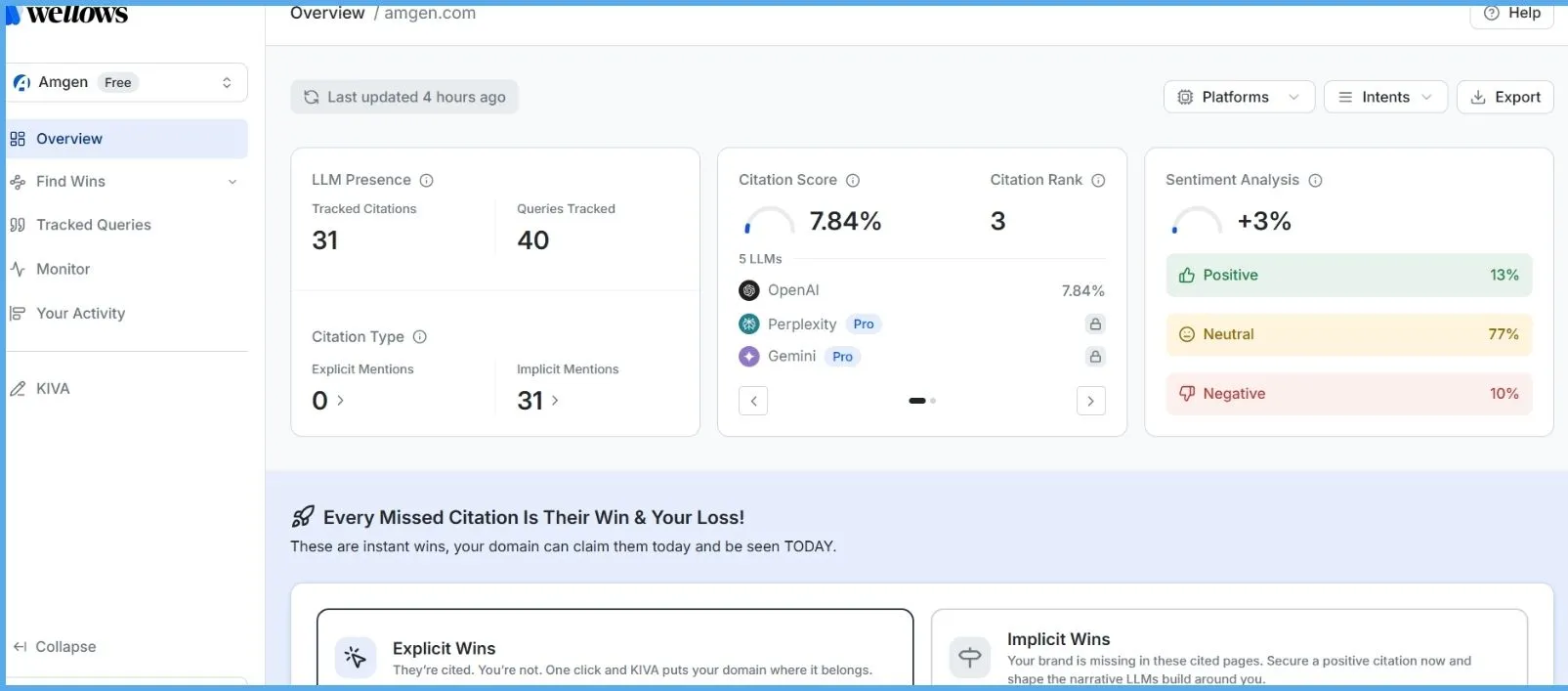
The LLM Presence, Citation Score (Amgen was at ~7.84%), and Sentiment Analysis painted a clear picture: high factual coverage, mostly neutral-positive tone. I could see where Amgen showed up by platform — ChatGPT, Claude, etc. — and track where it stood out or lagged.
Much of this visibility correlated with how platforms weigh structured data signals to interpret brand authority and content precision.
5. Identify Explicit & Implicit Wins
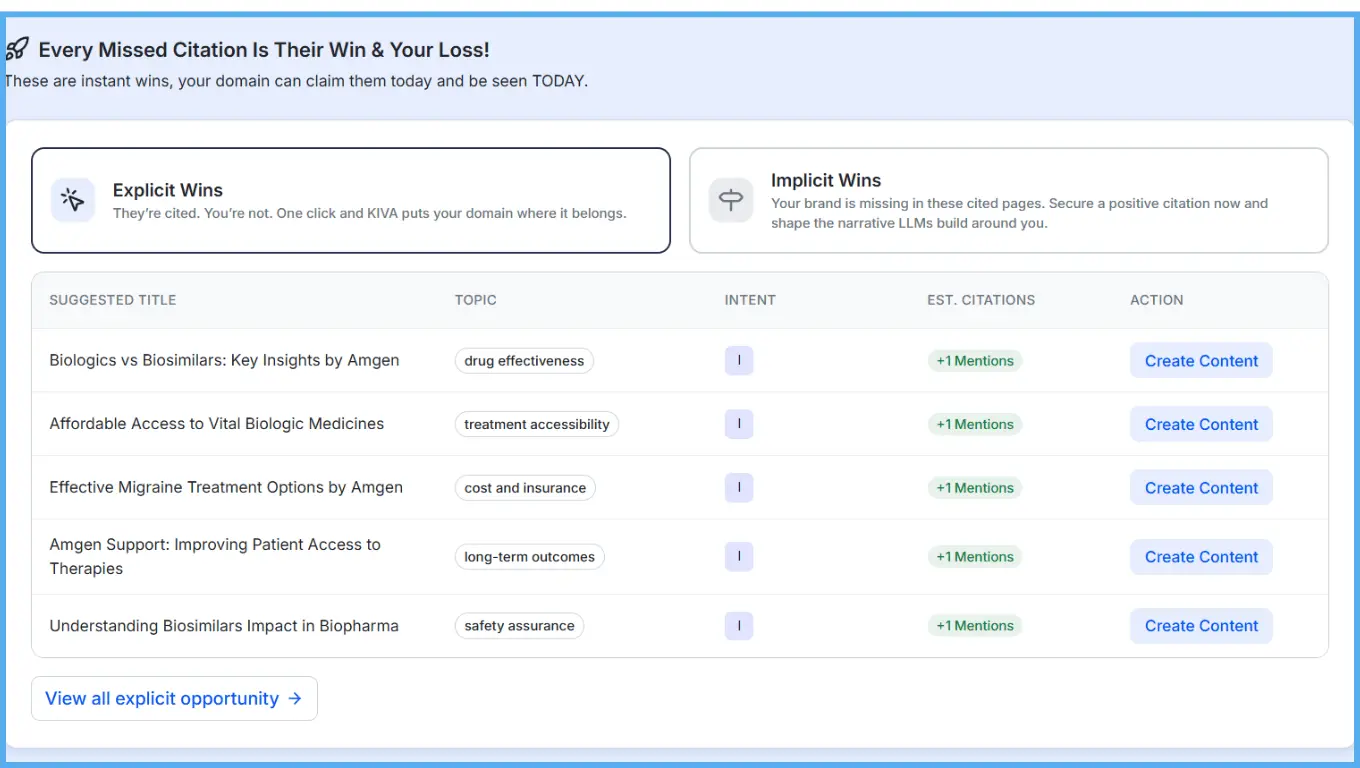
This was gold. I saw:
- Explicit Wins – where competitors were cited but Amgen wasn’t (e.g. AbbVie featured in affordability content).
- Implicit Mentions – where Amgen was mentioned but not credited.
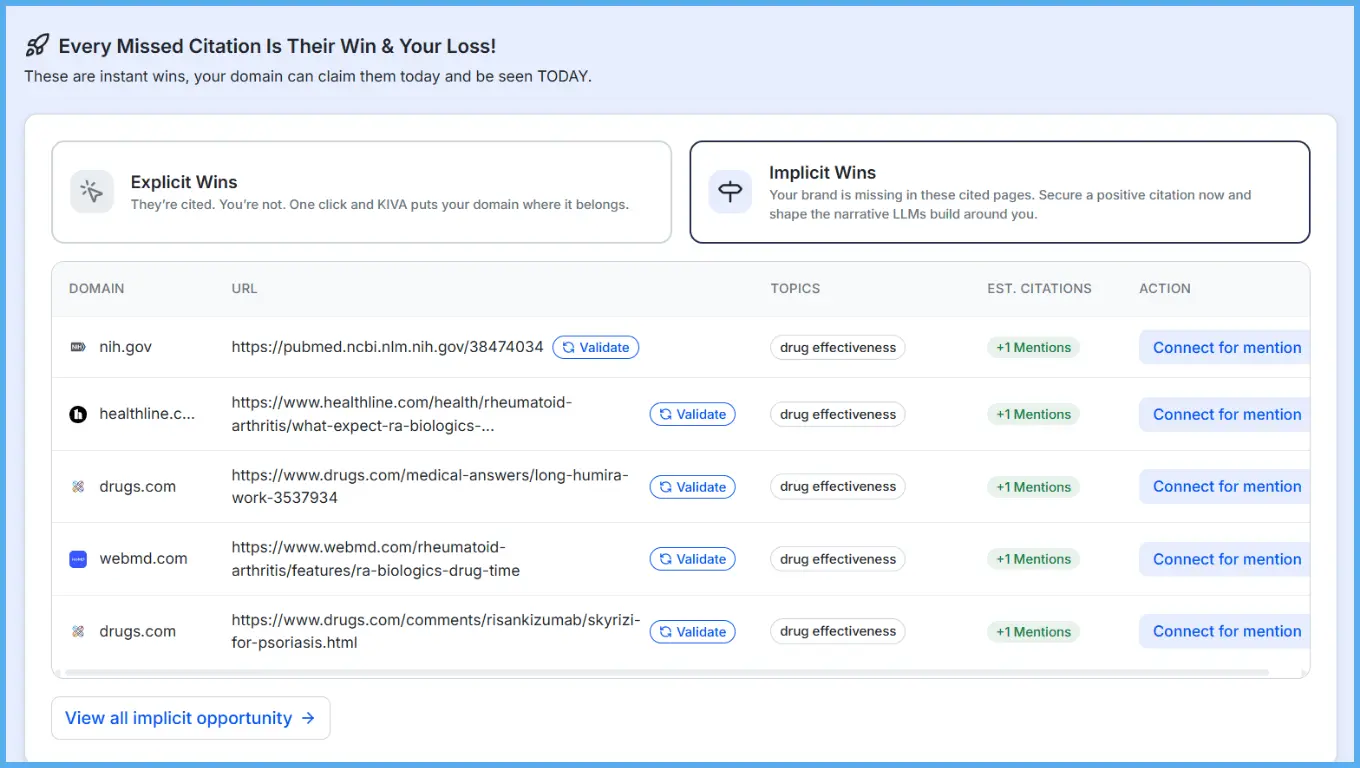
One-click content prompts helped us act fast. For example, “Biologics vs Biosimilars: Insights from Amgen” was flagged as a missed opportunity.
6. Competitive Insights
Radar charts showed Amgen strong in efficacy and support, but lagging in cost/access queries — areas where AbbVie and Pfizer dominated. These visuals made strategic gaps crystal clear.
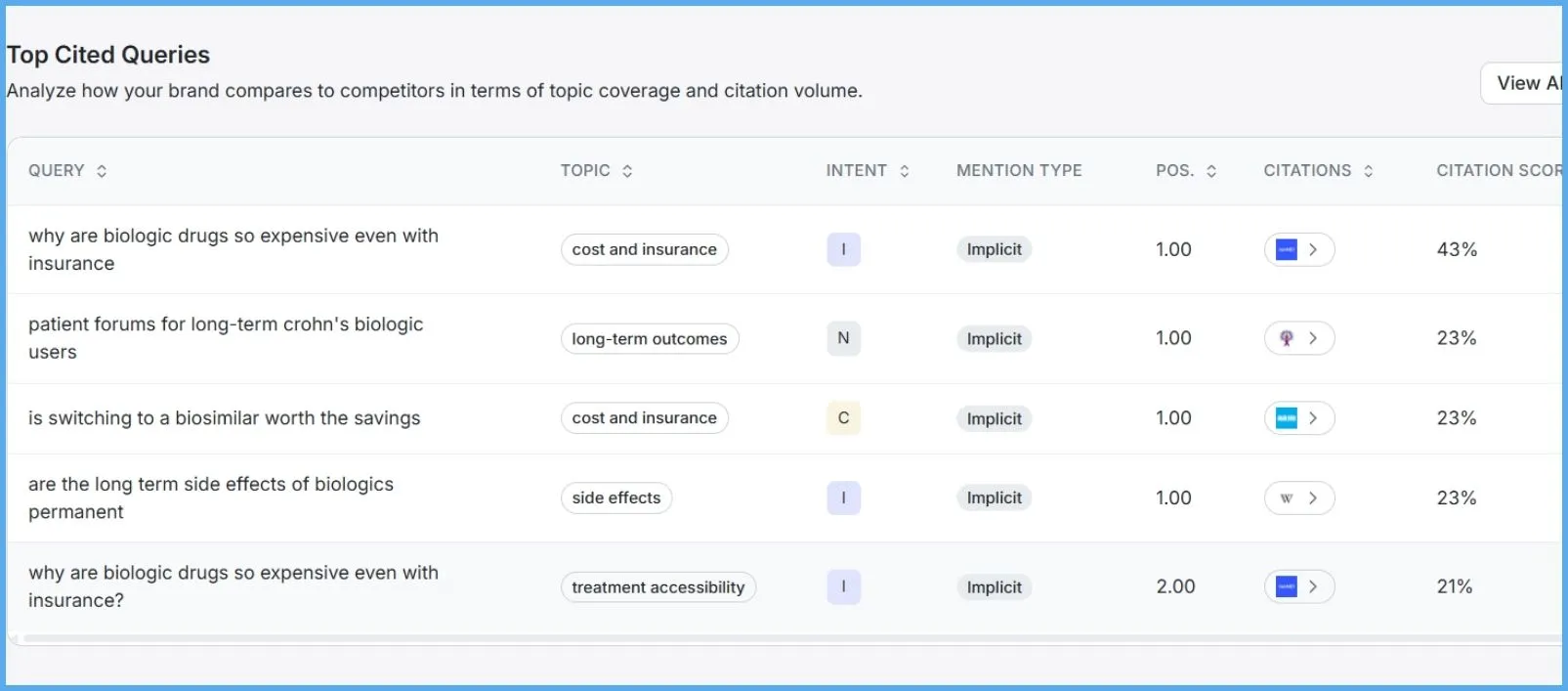
7. Cited Query Analysis
I discovered the actual AI questions that triggered Amgen mentions — like “Are biosimilars as effective as biologics?” or “Why are biologics so expensive?” This shaped our content roadmap instantly. These are the queries where we must show up with credible, structured responses.
8. Track Over Time
With monthly trends, I saw Amgen’s Citation Score rise gradually — from ~6.9% to 7.84% — after targeted content changes. It confirmed that AI visibility is dynamic. You can shift perception and share with focused action.
Pro Tip: Before every new therapy launch or press cycle, I now run a visibility check. It catches missed citations and identifies where LLMs are shifting focus. Want to see your brand’s real AI footprint?
10 Tips to Transform Your Strategy for Biotechnology Brands
Want to make your biotech brand stand out in the era of AI-driven discovery? These 10 tips blend classic SEO principles with next-gen practices — like semantic structuring, competitive benchmarking, and LLM targeting — to help you dominate AI Search Visibility for Biotechnology Brands.
If you’re just starting to shape your strategy, begin with this essential guide on how to optimize for AI Overviews to align your site with how AI models parse and prioritize biotech information.
10 Tips to Transform Your Biotech Strategy
1. Define Your Sub-Niche
Be laser-focused. Whether it’s immunotherapy for rare cancers or biosimilars for inflammatory diseases, owning a sub-niche makes it easier for AI models to associate your brand with specific expertise. Clear positioning increases your chances of being included in domain-relevant answers.
2. Highlight Your USPs
Showcase what makes your brand different. If it’s a superior safety profile, unique delivery mechanism, or unmatched access program, make that visible through whitepapers, press releases, and structured content. Authority is built through evidence, and AI responds to that.
3. Study Competitor Content
Use visibility tools to see which competitor pages are earning citations from LLMs. Analyze how they structure their content, what questions they’re answering, and where you’re missing. This helps you spot gaps and build stronger, more visible content.
4. Stay Trend-Aligned
Keep your content fresh. Publish around current biotech developments — whether it’s CRISPR, real-world outcomes, or regulatory news. AI platforms prefer up-to-date information, especially for health-related queries, so aligning with timely topics pays off.
5. Target High-Value Queries
Identify the queries that directly impact your brand — like “biologics for rheumatoid arthritis” or “does [DrugName] cause side effects?” Build targeted content around those. This isn’t just SEO — it’s meeting people exactly where AI is surfacing their concerns.
6. Build Supporting Content
Think beyond product pages. Create content on adjacent topics — patient education, cost considerations, side effect management — to broaden your topical authority. This increases your chances of being cited in diverse answer contexts.
7. Align with the Patient (or HCP) Journey
Structure content for each decision stage: discovery, evaluation, and action. A simple example: “What are biosimilars?” → “Biologics vs Biosimilars” → “Getting started with [Your Therapy].” This layered approach improves relevance across search intent.
8. Update Product-Specific Visibility
Audit your visibility by product. A new therapy may be underrepresented in AI results simply because it lacks fresh content or structured data. Use schema (like ClinicalTrial or Drug) and update key pages to improve findability.
9. Optimize Branded Searches
When people ask AI about your brand, make sure your sources — website, LinkedIn, Wikipedia, Google Business — are consistent, current, and optimized. This ensures AI pulls the right facts and minimizes misinformation risks.
10. Use Quick Wins with Wellows
Platforms like Wellows can pinpoint where competitors are getting cited instead of you, and highlight new AI-generated queries worth targeting. These data-driven cues make it easy to move fast — and build stronger AI search visibility for biotechnology brands.
What Are Common Challenges Biotech Brands Face in Achieving AI Search Visibility?
Even with a strong strategy, optimizing for AI-driven search comes with unique challenges for biotechnology brands. Visibility gaps often stem from outdated data, inconsistent messaging, or limited third-party mentions. Here’s how Wellows helps biotech companies overcome these hurdles and build stronger AI search visibility:
| Problem | Solution | Does Wellows Help? |
|---|---|---|
| Outdated Summaries AI may pull stale content, misrepresenting your brand. |
Keep web pages updated with recent data, trials, and partnerships. | Flags outdated citations for correction. |
| Few External Mentions Low third-party visibility reduces AI trust. |
Pursue PR, expert interviews, and journal mentions. | Identifies gaps and citation opportunities. |
| Competitor Visibility Others may dominate citations. |
Benchmark keywords and publish structured content faster. | Reveals competitor edge and content gaps. |
| Inconsistent Messaging AI gets confused by mixed signals. |
Standardize language across web and media. | Monitors tone and brand consistency. |
| Complex Content AI may not interpret biotech language well. |
Simplify language and use structured formats. | Flags low-performing pages for AI refinement. |
| Negative Sentiment Bad PR can lower visibility. |
Address concerns with clear, updated safety info. | Includes sentiment tracking and response triggers. |
In summary: The right platform can turn uncertainty into strategy — offering clarity, compliance, and measurable improvement in AI search visibility for your biotech brand. For tactical execution, explore these top ChatGPT visibility tips designed to help your content surface in AI-generated responses.
Why Should You Choose Wellows for Your Biotech Brand?
With AI platforms like ChatGPT and Gemini shaping healthcare conversations, biotech marketers need a visibility solution built for this new landscape. Here’s a clear comparison of Wellows, Zutrix, and Semrush’s AI Visibility Index to help assess which platform best supports AI search visibility for biotechnology brands.
| Feature | Wellows | Zutrix | Semrush AI Index |
|---|---|---|---|
| AI Model Coverage | Monitors ChatGPT, Claude, Gemini & Perplexity in real time with brand-level citation detail. | Tracks multiple LLMs using a rank-based tracker, but lacks citation specificity. | Covers ChatGPT and Google SGE only, with limited citation context. |
| Citation Clarity | Differentiates explicit citations (linked) from implicit mentions (unlinked references). | Provides mention volume but not type; lacks detail on missed links or context. | Shows only aggregate brand visibility, without citation breakdown. |
| Query-Level Insights | Reveals specific LLM queries that trigger brand mentions, with competitor overlap. | Relies on keyword input; limited discovery of new or emerging queries. | Shows industry-level benchmarks, not brand-level question visibility. |
| Sentiment & Topic Mapping | Automatically scores sentiment and classifies citations by relevant healthcare topics. | Offers basic sentiment stats; topic tagging is limited or manual. | No sentiment or topic filters available in standard views. |
| Actionable Outreach | Highlights missed citations (Explicit Wins) and provides email-ready contact info for PR teams. | Offers visibility suggestions but no outreach integrations or contact data. | Designed for analysis only; no PR or outreach functionality built in. |
| Competitor Intelligence | Fully customizable competitor sets with topic-by-topic side-by-side comparison. | Manual addition of competitor domains; analysis shown per project. | Broad category benchmarking only; lacks fine-grained peer tracking. |
| Workflow Fit | Purpose-built for AI visibility; complements SEO tools without duplicating them. | Part of a broader SEO suite; AI visibility is one tab among many. | Enterprise SEO add-on; better suited for agencies or publishers. |
| Pricing | Flexible freemium model with scale-up plans for growth. | Mid-range subscription targeting SMBs and SEO professionals. | Custom enterprise pricing; limited self-serve access. |
Bottom Line: If your team is focused on understanding how AI models interpret, cite, and compare biotech content, Wellows offers the most granular and actionable visibility system in this space. It’s especially useful when navigating how core concepts like the transformer model influence what gets surfaced in generative search results.
Why Search Intent Matters in the Biotechnology Market?
AI visibility isn’t just about showing up — it’s about showing up at the right moment. In biotech, aligning content to search intent ensures your brand meets patients, HCPs, or researchers at every stage of their journey. Here’s how to do it right:
Informational Intent
Queries like “How do biologics work?” signal early-stage interest. Create clear explainers and educational blogs that demystify complex science — these build trust and earn citations in AI-generated responses.
Navigational Intent
Searches such as “[YourBrand] clinical trial results” show users are already aware of you. Make sure your official pages are up to date, schema-tagged, and AI-discoverable so LLMs route users directly to your site.
Transactional Intent
When users want to act — e.g. “Sign up for [Drug] support program” — structure your product pages with clear CTAs and schema (like Product or Service) so AI can suggest the action directly in its reply.
Comparative Intent
These users are weighing options — “[Drug A] vs [Drug B] side effects”. Publish data-backed comparison content and use FAQ or Q&A schema.
Even if you’re one of the compared brands, showing up fairly can secure citations and shape perception — especially as AI models apply logic shaped by mechanisms like cross-attention to determine contextual relevance.
AI Search Visibility for Biotechnology Brands: Key Market Insights
AI is a Primary Channel: 47% of consumers now turn to tools like ChatGPT or Claude for health advice (Pew Research, 2024). Your biotech brand must show up in those moments — with structured, credible information.
Younger Audiences Act on AI: Nearly 25% of Gen Z and Millennials have followed AI advice without speaking to a doctor (Salesforce, 2023). Visibility in their digital path is critical for influencing awareness and preference.
Video & Forums Drive Influence: 88% of people watch health content on YouTube, and 85% say it influences decisions (VidMob, 2022). Forums like Reddit are now even referenced in AI results — biotech brands should guide and support these narratives.
Offline Still Closes the Loop: Despite digital research, 85% of patients still follow up with a provider (Bennett et al., 2014). Use AI visibility to connect search behavior with offline action — through clinic finders, provider pages, or trial locators.
To stay relevant, biotech companies must evolve beyond traditional SEO. Building visibility in AI answers means structuring content for intent, using schema markup, and leveraging tools built for AI-driven search discovery.
Audience Insights for Biotechnology Brands
Biotech audiences can range from patients and caregivers to healthcare professionals and investors. Each group has unique needs and search behaviors.
Knowing their intent and pain points helps shape content, SEO, and AI visibility strategies that truly engage and convert them — especially as AI systems use sophisticated attention mechanisms to evaluate and surface content based on relevance and context.
Here’s a breakdown of typical audience segments and how to reach them:
| Audience | Profile | What Matters Most | How to Engage |
|---|---|---|---|
| First-Time Patients | Newly diagnosed or their caregivers. | Clarity on conditions, treatment basics, emotional support. | Provide beginner-friendly guides, visual explainers, and Q&A content. Use simple language and structured markup to help AI surface your brand as a trusted source. |
| Chronic Condition Patients | Patients managing long-term illness. | Latest therapies, side effect tips, affordability help. | Share comparison content, support options, and long-term care tips. Mark up key answers so AI can pull from your brand when users ask specific condition questions. |
| Healthcare Professionals | Physicians, nurses, pharmacists. | Clinical data, MOA, efficacy, safety, patient outcomes. | Create HCP-specific portals with studies, trial data, and reference material. Use precise medical language and metadata so AI cites your material in expert contexts. |
| Budget & Access Seekers | Patients focused on cost or insurance coverage. | Price clarity, insurance info, discount programs. | Build a clear “Financial Support” section. Use schema to answer queries like “What does [Drug] cost?” and enable AI to show your support programs directly. |
| Tech & Science Enthusiasts | Investors, STEM-curious, innovation followers. | Scientific breakthroughs, R&D, biotech trends. | Maintain a pipeline blog with semi-technical updates, patent news, and innovation stories. Link to journals and news sources — AI will recognize you as a thought leader. |
| Caregivers & Advocates | Family members, community leaders, advocacy groups. | Trustworthy info, step-by-step support tools, community guidance. | Offer downloadable toolkits, guides, and checklists. Use headings, bullet formats, and schema so AI surfaces your support content for advocacy-related queries. |
How Can Biotechnology Brands Leverage AI Search Visibility to Drive Business Growth?
In today’s AI-shaped digital landscape, biotechnology brands can use AI-driven search visibility as a growth engine. Rather than waiting to be found, you can shape where, when, and how your brand appears in critical AI touchpoints—especially when your ideal customers are actively researching treatments, trials, or scientific breakthroughs. Here’s how:
- Optimize for AI-Led Queries: AI search tools like ChatGPT prioritize structured, direct-answer content. Shift from broad SEO to Answer Engine Optimization (AEO). Use schema markup, direct language, and structure your pages around complex, biotech-specific questions—e.g., “Which biologics are FDA-approved for Crohn’s disease in 2025?”
- Enhance Technical Visibility: Ensure your site loads fast, has clear site architecture, and is easily crawlable by AI bots. AI models reward speed and semantic structure—your XML sitemap and internal linking now influence LLM citations.
- Earn Authoritative Backlinks: Strategic digital PR, scientific citations, and third-party mentions help AI rank your content as trusted. Publish in journals, partner with biotech communities, and get featured in industry media.
- Leverage Visibility Monitoring: Use AI visibility platforms like Wellows to see how your brand appears across LLMs and uncover missed opportunities. Update and re-optimize content based on where you rank—and where you don’t yet show up.
- Promote Ethical AI Transparency: Be explicit when using AI-generated content or chatbots. Brands that lead in responsible AI earn trust and more consistent citations across regulated industries like biotech.
By treating AI visibility as an ongoing strategy—not a one-off checklist—biotech brands can gain a durable edge. Every optimized page, patient story, or whitepaper becomes an asset that LLMs can surface when it matters most.
What Role Does Content Quality Play in AI Search Visibility for Biotech Companies?
In AI-driven search, content quality isn’t optional—it’s the gatekeeper for whether your biotechnology brand gets cited or sidelined. AI assistants like ChatGPT and Gemini evaluate content not just by keywords, but by structure, authorship, freshness, and authority signals. Here’s how to ensure your content passes the quality test that LLMs use to rank and recommend.
Expert-Led Content Wins
AI models prioritize scientific accuracy and credibility. Content written or reviewed by PhDs, MDs, or regulatory professionals carries more weight in biotech.
Ensure each article or resource includes visible credentials, bio blurbs, or author schema to satisfy Google’s E-E-A-T (Experience, Expertise, Authoritativeness, Trustworthiness) framework. It’s not just about good writing—it’s about demonstrable expertise.
Structured Data = Discoverability
Using schema markup like FAQ, HowTo, Product, or MedicalCondition increases your discoverability in AI-generated responses.
LLMs need structure to understand what your page is about—semantic markup helps models like Gemini or Claude cite your content confidently instead of guessing. For biotech, this is especially critical for pages related to drugs, mechanisms of action, or clinical trial data.
Update or Be Overlooked
Outdated content won’t get surfaced by AI tools that prioritize recency. Refresh your biotech pages regularly—especially after FDA updates, label changes, or new trial phases.
Implement version dates visibly and signal updates in metadata so crawlers and AI models know your information is current and reliable.
Mentions Matter Beyond Your Site
LLMs weigh external references to validate brand credibility. Secure backlinks or citations from respected sources: academic journals, scientific news outlets, or government health databases.
Forums like Reddit and HealthUnlocked are also indexed by AI—monitor for brand mentions there and correct misinformation when needed. Tools like Wellows help identify “Implicit Wins” where your brand is mentioned but not cited—so you can take action.
Diversify with Multimodal Content
AI search isn’t just about reading text—it’s increasingly about understanding images, videos, charts, and transcripts. Add explanatory videos (like “How Biosimilars Work”), embed clinical data tables, and offer downloadable visuals.
Structured multimedia not only boosts engagement, but also increases AI pickup as models evolve toward multimodal comprehension (like GPT-4V and Gemini Advanced).
Bottom line: great biotech content must now serve both the human reader and the AI model. The brands that master this hybrid publishing mindset will own the next generation of organic visibility—on traditional search engines and inside LLMs alike.
What Are the Future Trends in AI Search Visibility for the Biotechnology Sector?
AI search is reshaping biotech visibility at the speed of innovation. From zero-click results to cross-platform AI summaries, here are the next big trends biotech brands must prepare for:
- AI Overview Takeovers: Google and ChatGPT are shifting from linking to summarizing. 65% of B2B queries now yield AI answers upfront. This means your content must be the source behind those summaries—or you’ll vanish from top-of-funnel discovery. (LeadWalnut, 2025)
- Content From Experts, For Machines: Google is citing expert-led biotech content 70% more often in AI Overviews than it did a year ago. Publish long-form, science-rich pieces under verified authorships. (Search Engine Land, 2025)
- Explosive AI Adoption in Biotech: The AI-in-biotech market is expected to hit $11.4B by 2030. With so much innovation, the search landscape will be flooded. Strategic visibility helps you stand out in a crowded, rapidly advancing space. (ValueSpectrum, 2025)
- Partnerships Power Visibility: Brands like Recursion and Exscientia are combining AI with drug discovery. These partnerships generate authoritative content and research that becomes AI-quotable. Collaborate with academic institutions and AI-first labs. (Market.us, 2025)
- Visibility-First Marketing Stacks: Tools like Wellows are being adopted early by biotech marketers who want to future-proof brand presence across Gemini, ChatGPT, and Claude. Don’t just publish—track and optimize how you’re seen in LLMs. (Nilead, 2025)
The bottom line? AI search visibility is now a competitive moat. Brands that adapt fast—optimizing content, embracing AI tools, and publishing for both humans and models—will own the next decade of digital biotech discovery.
Explore More AI Search Visibility Guides for Biotech Brands
Want to see how AI-driven search strategies empower different biotech segments? Explore our industry-specific visibility playbooks below:
- AI Algorithm Updates: SEO Impact & Recovery Tips: Understand AI SEO updates, ranking impacts, and recovery strategies
- AI Search Visibility for Cybersecurity Brands: Secure visibility in AI-driven risk, compliance, and threat intelligence results.
- AI Search Visibility for B2B SaaS Brands: Rank in AI tool recommendations, software reviews, and tech stack comparisons.
- AI Search Visibility for Healthcare & Hospitals: Improve clinical citations, specialty recognition, and patient-intent visibility across AI-generated answers.
- AI Search Visibility for Automotive Brands: Get discovered in AI-powered car comparisons and mobility advice.
- AI Search Visibility for Aviation & Airlines Brands: Appear in AI travel planning and flight discovery results.
- AI Search Visibility for Beauty & Personal Care Brands: Get featured in AI beauty recommendations, product comparisons, and skincare insights.
- Boost AI Search Visibility with Knowledge Graphs: Use structured entity mapping to gain AI citations.
Each guide delivers biotech-specific strategies to align your content with AI models like ChatGPT, Claude, Gemini, and Perplexity — ensuring your brand earns visibility where it matters most.
FAQs
AI models weigh multiple factors to decide which brands to include in answers. Key signals include authority (scientific accuracy and trust), content clarity, structured data (schema markup), recency (how up-to-date your content is), and semantic relevance to the user’s query. The more your brand is mentioned and cited across authoritative sources, the higher your likelihood of being recommended.
Frequent, accurate citations in AI answers build brand trust and authority. When AI models consistently surface your company in relevant queries, users see you as credible. On the other hand, being misrepresented—or entirely omitted—can damage perception. Monitoring AI citations helps you safeguard brand integrity and proactively correct misinformation.
The most impactful AI models for biotech visibility are OpenAI’s ChatGPT, Google’s Gemini (SGE), Anthropic’s Claude, and Perplexity. These platforms power health-related queries and summarize medical content. Monitoring your brand’s presence across all helps you understand reach and optimize content for each engine’s strengths.
When AI assistants cite your treatments or therapies during condition-specific queries, patients are more likely to explore your brand further. Optimizing for AI search visibility means creating structured, trusted content around patient questions. This improves chances of being the brand that patients discover first — especially when searching for support programs or treatment options.
Focus on content that directly answers high-intent patient and HCP questions. This includes Q&A pages, FAQs, comparison tables, safety profiles, and explainer articles. Format with schema markup and structured layouts. AI models favor content that’s scannable, medically reliable, and semantically aligned with queries.
Conclusion
The era of AI search visibility for biotechnology brands is here – and it’s redefining how people discover and trust healthcare companies. From my own analysis of AI-driven visibility patterns, I’ve seen how quickly the landscape can shift, and how even a strong brand can disappear from AI answers if they don’t adapt.
That’s where Wellows comes in. It bridges the gap between traditional SEO and the new world of AI visibility – tracking citations, analyzing queries, and showing you exactly where your brand stands across ChatGPT, Gemini, Bing, and more.
As someone who’s observed brands struggle to stay visible in AI-driven search, I can say one thing with certainty: this shift isn’t coming, it’s already here.
The good news is that with the right visibility tools and strategies, your brand doesn’t have to be left behind. Wellows ensures your team focuses on strategy, not guesswork – providing the data and insights needed to take action.
The future of search and discovery is undeniably AI-powered. With a proactive approach and the right platform in your toolkit, your biotech brand won’t just adapt to that future – it will help lead it.