AI-driven search is redefining how B2B SaaS brands are discovered and evaluated. Decision-makers now consult ChatGPT, Google Gemini, or Perplexity instead of browsing multiple search results. These systems summarize insights, rank credibility, and shape brand preference directly inside AI responses.
AI Overviews now appear in 13% of global searches, cutting organic clicks by 79% (BrightEdge, 2025).
This evolution makes traditional SEO incomplete. Wellows, an AI visibility platform, tracks how often SaaS brands are mentioned or cited across AI engines, revealing unseen visibility gaps.
As Gartner predicts a 25% decline in traditional search traffic by 2026, brands that optimize for AI search visibility will define the next phase of SaaS growth.
- AI has replaced traditional discovery: Buyers now rely on ChatGPT, Gemini, and Perplexity to research, compare, and shortlist SaaS vendors—often without visiting SERPs.
- Citations matter more than rankings: Visibility comes from being mentioned or cited inside AI answers, driven by structured, credible, machine-readable data.
- GEO is the new SEO: Generative Engine Optimization (schema, FAQs, pricing clarity, integrations, proof) determines whether AI can understand and recommend your product.
- Most SaaS brands leak visibility: Many appear implicitly in AI answers but aren’t named—fixing data gaps turns missed mentions into owned citations.
- Wellows makes AI visibility measurable: By tracking citations, sentiment, competitors, and intent across LLMs, brands can systematically grow AI-driven discovery and pipeline
What Is AI Search Visibility for B2B SaaS Brands
AI search visibility is the frequency a SaaS brand is mentioned or cited in AI-generated results from tools like ChatGPT, Gemini, or Perplexity. Instead of ranking on search pages, SaaS visibility in AI search depends on structure, credibility, and speed, the levers behind AI Search Visibility for B2B SaaS Brands.
Generative Engine Optimization (GEO) structures brand data, so AI systems can interpret it accurately. It connects attributes like pricing, integrations, and security to your entity, helping AIs verify and cite it.
Brands with structured, transparent data are more likely to earn AI citations, and LLM citation tracking helps monitor those citations across AI platforms.
Current State of AI Search Visibility in B2B SaaS
- Major SaaS leaders dominate: Industry giants like Salesforce, HubSpot, and Microsoft lead in AI-generated visibility. Their early advantage comes from structured data adoption, strong domain authority, and verified mentions across trusted platforms. These brands consistently appear in AI-generated comparisons due to rich metadata and consistent knowledge graph presence.
- Niche brands lag behind: Smaller SaaS startups typically hold under 10% citation share within their categories. Many lack schema markup, external validation, and unified brand metadata, preventing AIs from confidently referencing them in generative answers.
- Visibility factors: Brands using structured data, consistent listings, and verified third-party mentions see significantly stronger inclusion. In 2025, FAQ and Review schema increased citation frequency by 3.7× when combined with high-authority validation (StatDigital, 2025).
- Sentiment trends: AI sentiment remains steady, with about 62% neutral and 33% positive mentions. Most AI-generated citations summarize factual product or feature data rather than opinions, reflecting stable trust levels across SaaS leaders.
💡Insight: B2B SaaS visibility within AI systems is consolidating fast. Brands prioritizing structured, credible, and up-to-date data gain measurable share of AI citations, while inconsistent or outdated content quickly loses traction in generative search environments.
How Can B2B SaaS Brands Optimize Their Content for AI Search Engines
AI-driven search is transforming how SaaS buyers research, evaluate, and compare software. Marketers now rely on ChatGPT, Gemini, and Perplexity for insights like “best CRM for startups” or “secure cloud automation tools for SMBs.”
To stay visible, SaaS brands must evolve beyond traditional SEO into strategies that help AIs read, interpret, and recommend their data accurately.
Freelancers can use AI Search Visibility Tools for Marketing Freelancers to manage GEO workflows and track brand mentions without large-scale resources.
If you want your SaaS product to be recommended by AI (ChatGPT, Gemini, Perplexity), treat AI answers as a new evaluation layer. AI systems recommend SaaS vendors they can verify quickly, compare objectively, and explain with confidence.
To increase recommendations:
- Clarify core SaaS facts: Make pricing tiers, integrations, security/compliance, and “best for” use cases easy to scan—not hidden in marketing copy.
- Use structured data: Add Product, FAQPage, and Review schema so features, plans, and proof points are machine-readable.
- Match comparison intent: Publish “best SaaS for [role/use case]” and “[Your tool] vs [competitor]” pages that align with buyer prompts.
- Build external trust signals: Earn reviews on G2/Capterra, analyst mentions, and credible media coverage to reinforce authority.
- Maintain data consistency: Keep product details aligned across your website, documentation, listings, and partner profiles.
In short: AI recommends SaaS it can validate, compare, and trust—not the most promotional brand.
Structured Data The Foundation of AI Visibility
Structured data is now the backbone of AI visibility for SaaS brands. Schema markup helps AIs interpret product details, features, and credibility signals instead of guessing from context.
The most critical types include Product, FAQ, Review, and Pricing schema. These give AIs machine-readable context from functionality and pricing tiers to uptime guarantees ensuring the brand is cited correctly.
In 2025, BrightEdge reported that pages with structured schema are 38% more visible in AI Overviews. Proper schema also boosts citation accuracy by clarifying entity relationships between brand, product, and industry.
Keeping SaaS data updated including pricing, integrations, uptime, and compliance ensures AIs reflect accurate information. Consistency across pages builds model confidence and strengthens visibility across multiple AI systems.
Authority & Mentions Building Trust in AI Search
AI systems rely heavily on external credibility. Mentions on trusted third-party platforms like G2, Capterra, TechCrunch, and Forbes strengthen your authority signal and improve inclusion in AI-generated results.
According to StatDigital (2025), SaaS brands with 10 or more authoritative mentions see 2.8× higher inclusion across AI responses compared to those with fewer. These references validate brand trust and help AIs determine expertise and reliability.
In generative search, E-E-A-T (Experience, Expertise, Authoritativeness, and Trustworthiness) defines credibility. A brand consistently validated by analysts, publications, and user reviews gains long-term AI visibility advantages.
Third-party validation is the new backlink. Many Tech startups also secure AI citations faster by earning credibility on review sites and industry blogs.
How Can B2B SaaS Brands Measure and Track Their AI Search Visibility
Before defining any visibility strategy, I used the Wellows AI visibility platform to analyze how a leading B2B SaaS platform performs across major AI systems. The goal was to understand how frequently it appears inside AI-generated responses and which factors shape its presence in generative search.
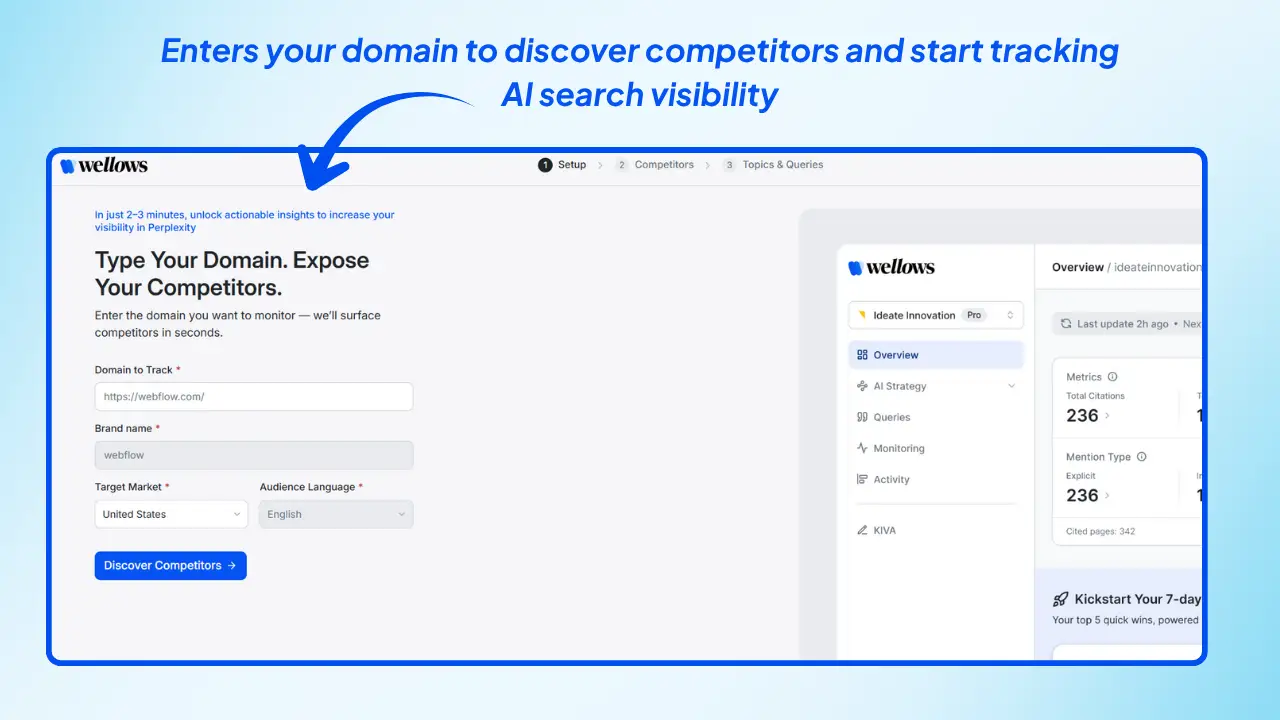
Enter Your Brand Domain:
Adding the SaaS platform’s domain to Wellows triggered a comprehensive AI scan across ChatGPT, Gemini, and Perplexity.
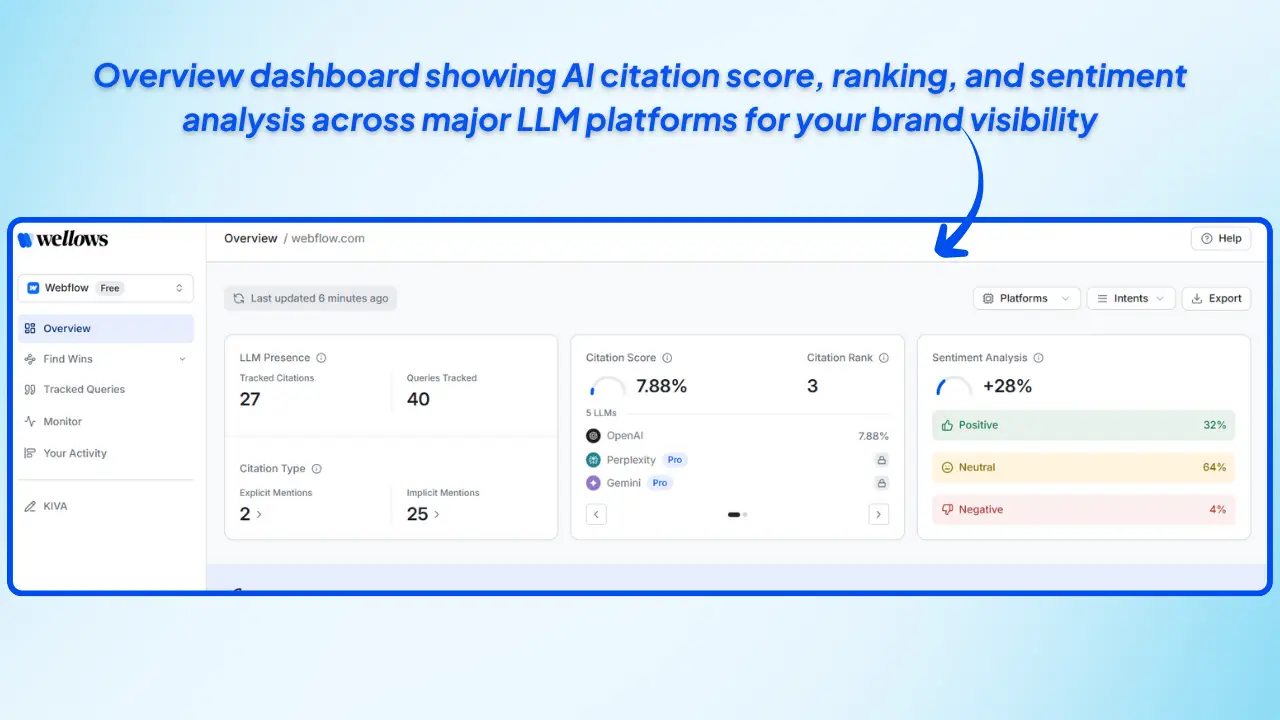
The platform detected 27 total citations including 2 explicit and 25 implicit mentions resulting in a 7.88% citation score and a 3rd place ranking in its category.
Sentiment analysis revealed +28% visibility momentum with 32% positive, 64% neutral, and only 4% negative mentions.
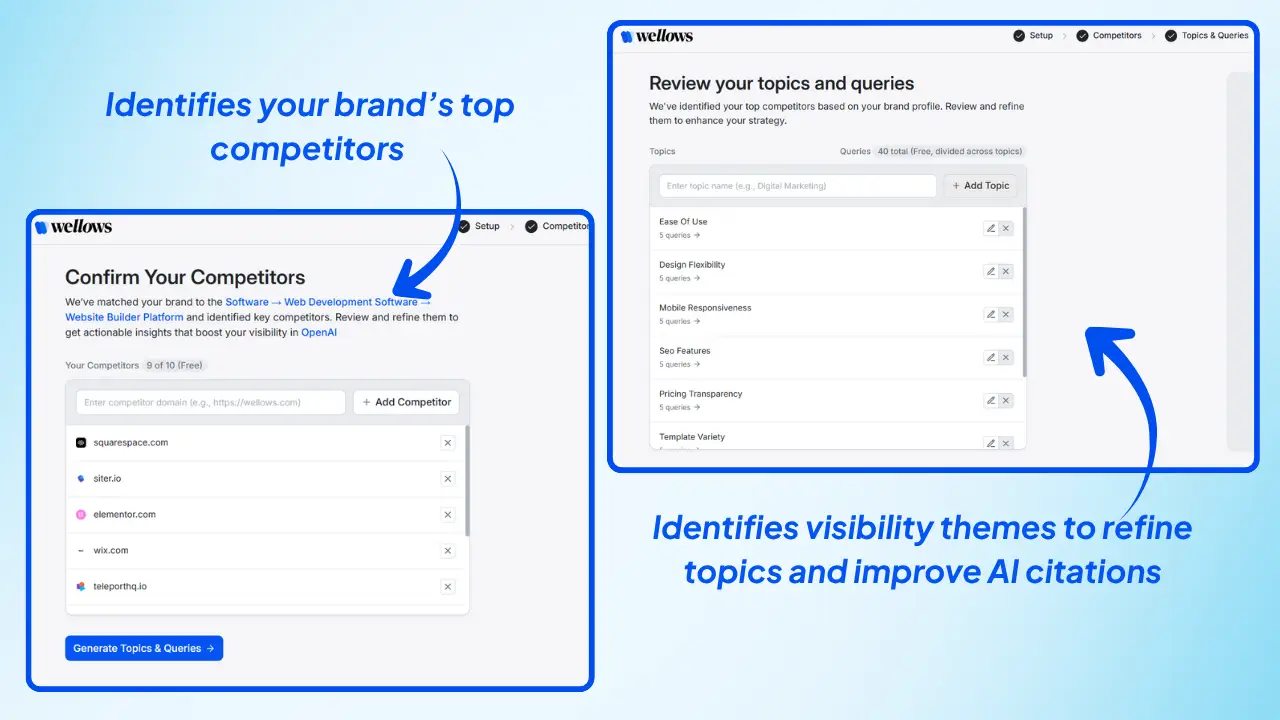
Brand Matching & Category Identification:
Wellows automatically classified the platform within the software and automation segment and benchmarked it against comparable SaaS competitors. It showed leadership in usability and customer support, while visibility gaps appeared in integration coverage and template variety.
Review Explicit and Implicit Mentions:
Wellows separated explicit citations those directly linked to the domain from implicit mentions, where AI systems referenced the brand without credit.
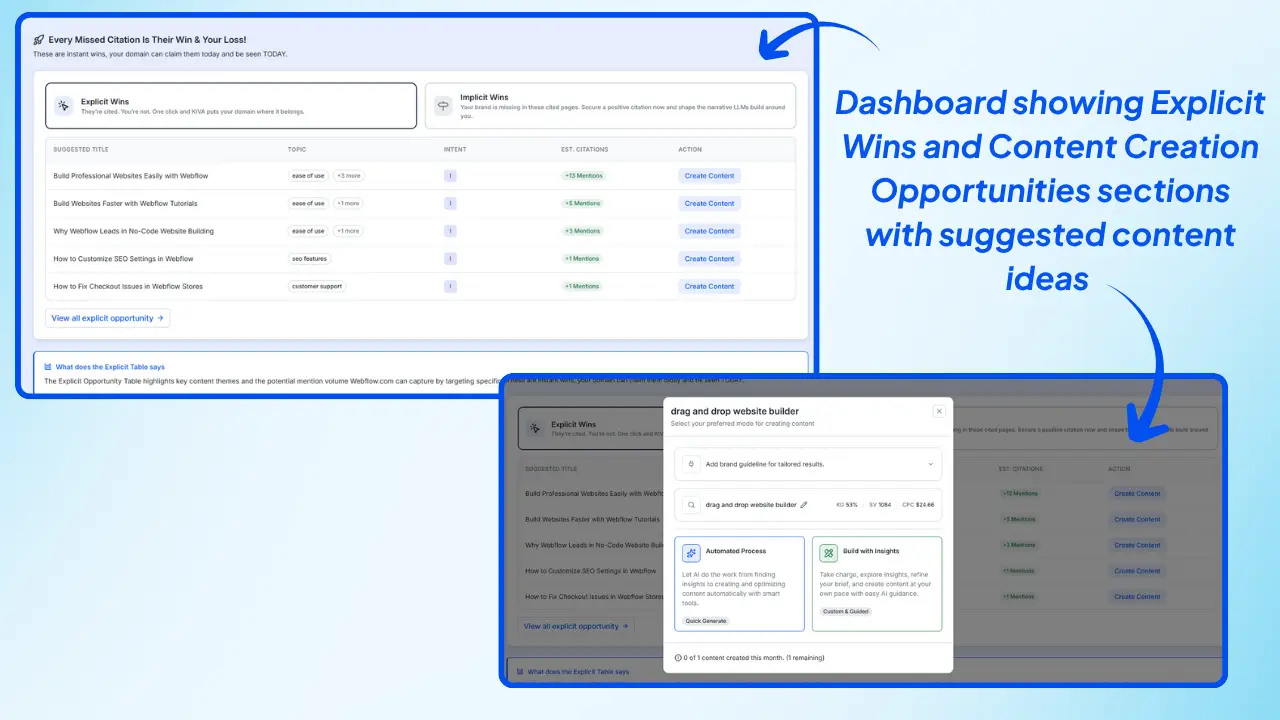
These implicit mentions are labeled as “instant wins” because they represent unclaimed visibility that can be secured through structured data or content reinforcement.
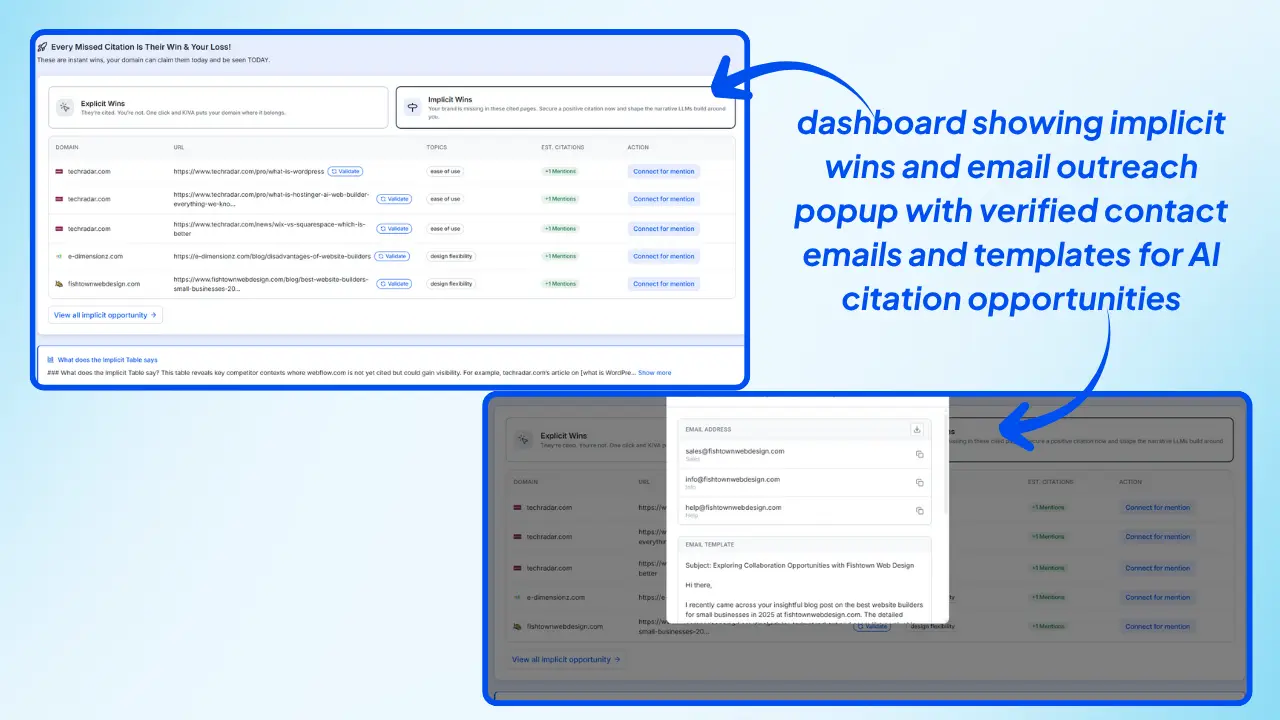
Top Cited Queries:
AI systems most often mentioned the brand within user queries related to design flexibility, plugin marketplace options, and integration reliability. These patterns reveal how AIs evaluate SaaS capabilities, providing direct insight into which content themes increase citation likelihood.
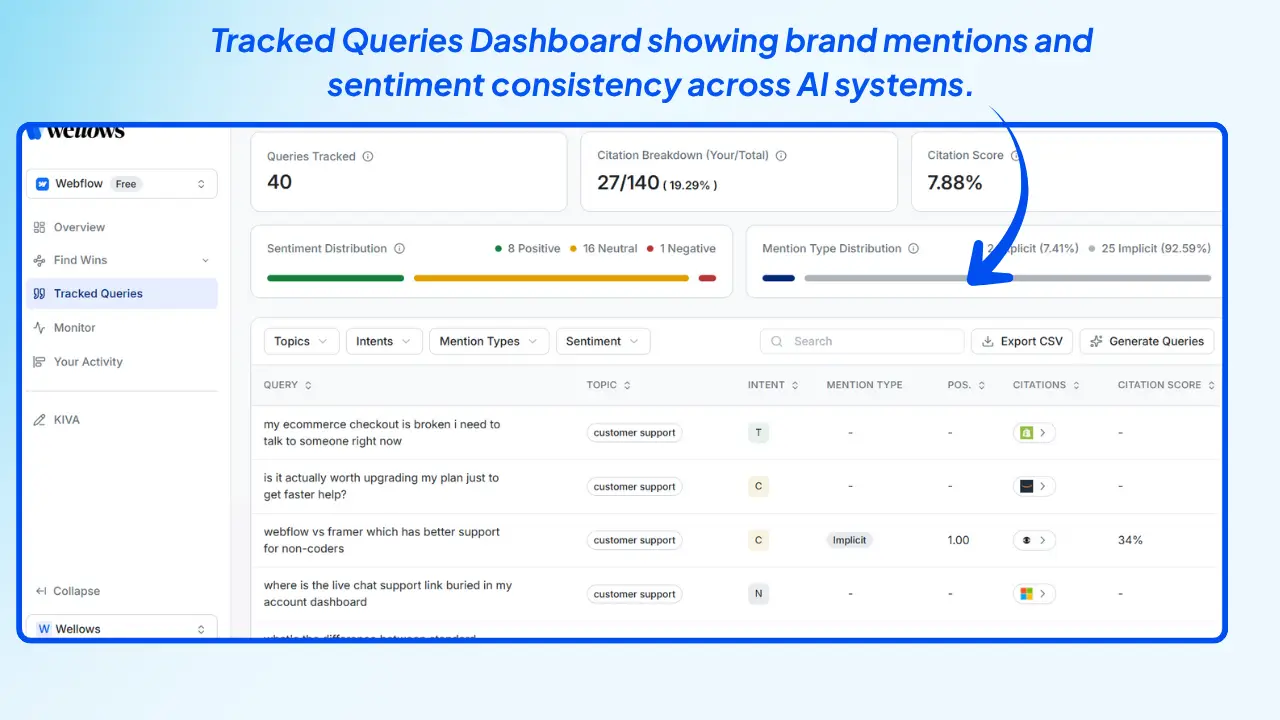
Analyze Citation Sentiment:
Positive sentiment clustered around features and customer experience, while neutral mentions covered tutorials and community content. The balance confirmed consistent brand perception a key factor influencing how AI systems summarize software performance.
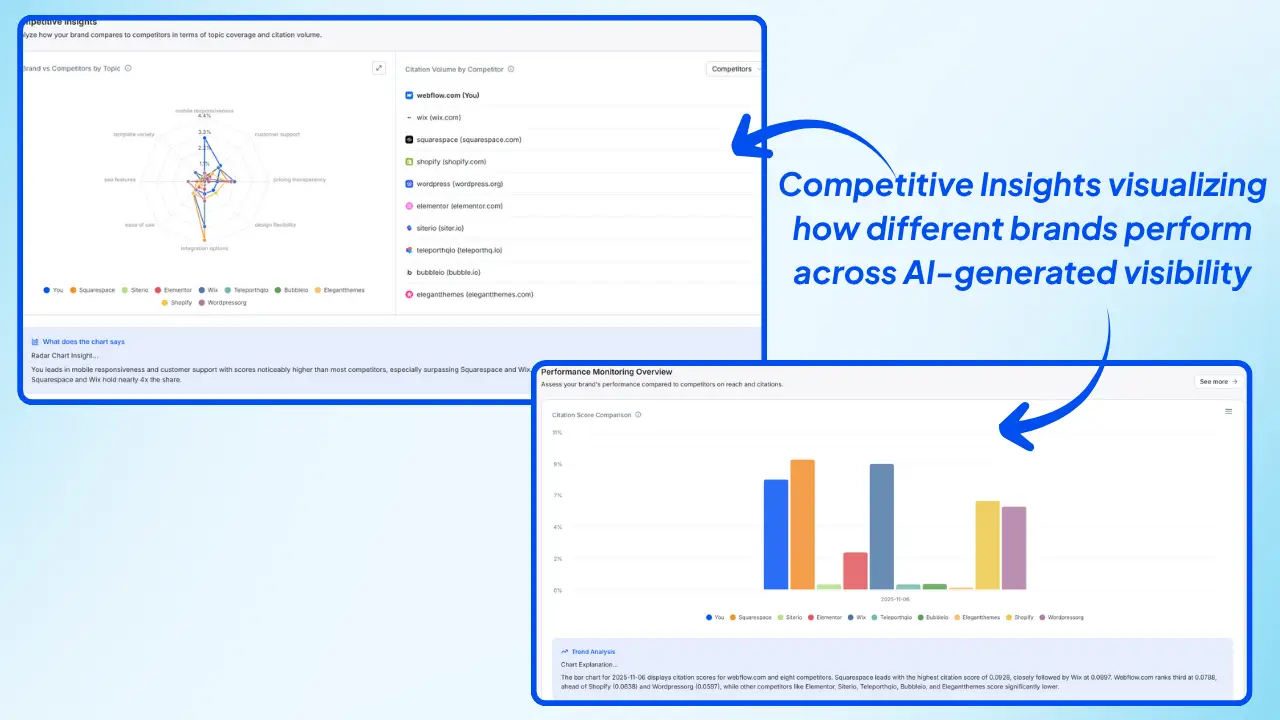
Monitor Long-Term Visibility:
Performance tracking in Wellows showed stable citation growth, with visibility spikes correlating with product releases and major content campaigns. This reinforced that timely updates, external validation, and structured content are critical to sustaining AI visibility momentum.
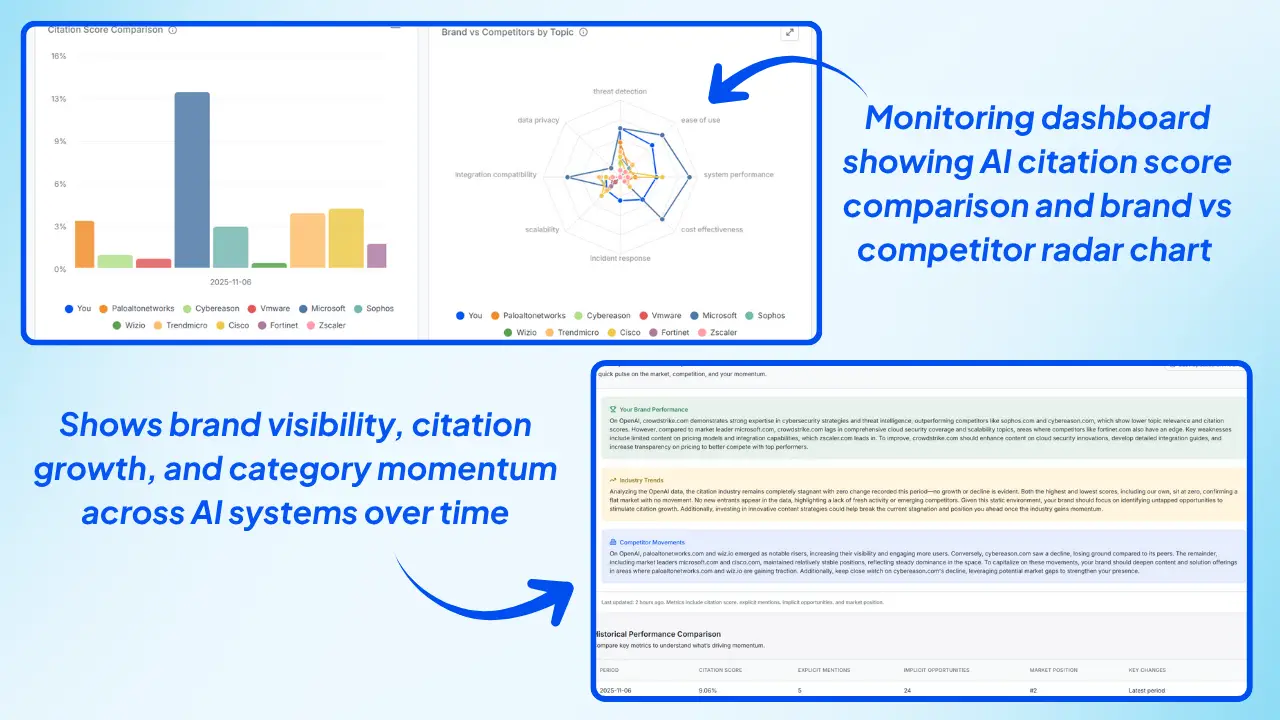
With a single scan, Wellows delivers a full visibility report including citation count, sentiment ratio, and benchmark comparisons across all major AI systems.
Curious how visible your SaaS brand is inside AI engines?
What Strategies Can Improve a B2B SaaS Brand’s Presence in AI-Generated Search Results
10 Tips to Transform Your Strategy for B2B SaaS Brands
SaaS visibility in AI search depends on structure, credibility, and speed of response. Wellows data shows that brands actively optimizing for factual accuracy and freshness achieve up to 2.4× higher citation frequency across generative engines.
Define your niche: Focus on one SaaS category such as automation, analytics, or CRM to strengthen topical authority within AI models.
Use factual proof: Support every claim with updated statistics, case studies, or performance benchmarks to build AI trust.
Track AI-cited competitors: Monitor which brands dominate citations across ChatGPT, Gemini, and Perplexity to identify content gaps.
Stay current on trends: Update pages as new features, regulations, or integrations emerge. Fresh data increases inclusion in AI-generated results.
Target high-intent queries: Build content around prompts like “best SaaS tool for startups” or “secure automation for SMBs.” These align directly with generative search intent.
Build content ecosystems: Interlink blogs, help guides, and FAQs to reinforce entity relationships between product features and user benefits.
Match buyer journey: Map content to decision stages awareness, comparison, and proof so AIs can interpret commercial relevance.
Keep data updated: Refresh pricing, uptime, and product specs monthly. Outdated or conflicting data reduces citation trust.
Own branded questions (AEO): Claim answer ownership for queries like “is [Brand] secure?” or “how does [Brand] compare?” through Answer Engine Optimization.
Act on implicit wins fast: Convert uncredited mentions into verified citations using structured markup or digital PR outreach.
Wellows for Freelancers streamlines AI search visibility — combining GEO tracking, citation insights, and measurable growth within a single workflow.
How Can B2B SaaS Brands Overcome Common Challenges in AI Search
Even top-performing SaaS companies face recurring visibility barriers. The table below outlines the most common challenges and practical solutions identified through Wellows platform audits.
| Challenge | Solution | Insight |
|---|---|---|
| Measuring AI visibility | Use AI visibility tools like Wellows to track citations, sentiment, and missing mentions across LLMs. | Visibility metrics replace rankings as the new SEO baseline. |
| Competitor dominance | Analyze which competitors lead in citations and fill topical or intent-based content gaps. | AI visibility rewards precision and coverage over volume. |
| Outdated data | Refresh structured data, feature pages, and knowledge graph entries quarterly. | Stale content signals low trust to AI systems. |
| Negative mentions | Use sentiment monitoring to detect tone shifts and address concerns with transparent communication. | Proactive response improves long-term brand sentiment and AI confidence. |
Agencies can explore Wellows to track client visibility, benchmark competitors, and automate AI citation reporting from a single dashboard.
Why Choose Wellows for Your B2B SaaS Brand
Selecting the right visibility solution determines how effectively your SaaS brand can detect, analyze, and recover missed AI mentions. Compared with competing tools, Wellows offers deeper LLM coverage, real-time analysis, and industry-specific benchmarking.
| Feature | Wellows | TryProfound | PromptWatch AI |
|---|---|---|---|
| Multi-LLM Coverage | Tracks across ChatGPT, Gemini, Perplexity, Claude, and Bing Copilot. | Limited to OpenAI and Bing. | Single-engine tracking only. |
| Implicit Mention Detection | Identifies unlinked citations and classifies them as “instant wins.” | Detects explicit mentions only. | Not available. |
| Sentiment + Visibility Fusion | Combines tone and frequency to reveal brand perception across AI platforms. | Tracks visibility without sentiment analysis. | No visibility scoring. |
| Sector Benchmarking | Provides category-level performance against direct SaaS competitors. | Generic keyword benchmarking. | Unavailable. |
| Intent Clustering | Maps citations by search intent (informational, comparative, transactional). | Manual tagging required. | Not supported. |
| Real-Time Playbooks | Suggests next-step actions for each missed citation in one click. | Static suggestions only. | Unavailable. |
Marketing Consultants can use Wellows to run precise AI visibility audits, monitor sentiment trends, and deliver data-backed insights to clients.
Why Search Intent Matters in the B2B SaaS Market
Search intent drives how AIs decide which brands to cite in generative responses. According to 2025 Wellows visibility research, 88% of AI Overviews originate from informational queries, making intent-based optimization critical for SaaS growth.
💡 Insight: AIs prefer structured, fact-based content written for clarity, not persuasion.
💡 Insight: Consistent, schema-optimized help pages improve recognition within AI-generated pathways.
💡 Insight: Transparent pricing, verified case studies, and reviews increase AI citation likelihood.
💡 Insight: Comparative pages with verified data consistently outperform brand-only content in AI citations.
Market Insights for B2B SaaS Brands
AI has redefined how SaaS brands are discovered, validated, and compared. Wellows’ 2025 research highlights five market shifts reshaping visibility.
- 79% of global B2B buyers say AI search has changed how they conduct research (G2 Buyer Behavior Report, 2025).
- Nearly all B2B buyers now expect digital-first interactions, with self-service and remote options dominating the buying journey (McKinsey B2B Pulse, 2024).
- Voice and mobile research queries are steadily increasing across enterprise categories, reflecting the rise of conversational discovery and AI assistants in professional workflows.
- Two-thirds of B2B decision-makers are now Millennials or Gen Z, reshaping buying expectations toward digital convenience and AI-assisted research (Deloitte Gen Z & Millennial Survey, 2025).
- 56% rely on review sites and 55% use AI search to shortlist vendors (G2 Buyer Behavior Report, 2025).
Startups can leverage Wellows to accelerate early-stage discovery, secure brand citations in AI systems, and scale visibility faster across generative search.
Audience Insights for B2B SaaS Brands
Different SaaS audiences trigger different AI mentions. Understanding each group’s behavior helps tailor data and content toward visibility growth.
| Audience Segment | Key Priorities | Content That Triggers AI Mentions |
|---|---|---|
| Founders & SMBs | Low setup time, measurable ROI. | Comparison guides and pricing models. |
| Enterprise IT Teams | Security, uptime, and integration reliability. | Technical audits and compliance FAQs. |
| Department Heads | Productivity and team automation gains. | Use-case articles and performance dashboards. |
| Procurement Leaders | Cost transparency and third-party proof. | Contract summaries and benchmark reports. |
| Developers | APIs, extensibility, and open integration. | Documentation and open-source examples. |
| Analysts | Market differentiation and adoption trends. | Data-backed case studies and visibility charts. |
What Are the Latest Trends in AI Search Visibility for SaaS
The 2025 SaaS visibility landscape highlights how data quality, sentiment, and transparency shape AI-driven discovery.
- “X vs Y” comparative queries have grown by 180% year-over-year.
- Compliance and security visibility influence enterprise inclusion rates.
- Community content drives nearly 40% of citations across LLM outputs.
- Transparent pricing correlates with higher transactional mentions.
- Sentiment-driven citations now affect ranking across generative engines.
Discover how AI-driven visibility strategies reshape brand discovery across industries. Each guide reveals how structured data, verified mentions, and GEO techniques strengthen visibility inside AI-generated answers.
- AI Search Visibility for Cybersecurity Brands: Secure visibility in AI-driven risk, compliance, and threat intelligence results.
- AI Search Visibility for Education & EdTech Brands: Be cited in AI-driven course recommendations and learning platform queries.
- AI Search Visibility for Automotive Brands: Get discovered in AI-powered car comparisons and mobility advice.
- AI Search Visibility for Aviation & Airlines Brands: Appear in AI travel planning and flight discovery results.
- AI Search Visibility for Legal Services Brands: Strengthen citations across attorney recommendations, case-type queries, and practice-area evaluations.
- AI Search Visibility for Healthcare & Hospitals: Improve clinical citations, specialty recognition, and patient-intent visibility across AI-generated answers.
💡 Insight: Across every industry, the rule is simple if AI can’t find or trust your data, your brand disappears from the conversation. These guides ensure your organization remains visible wherever generative engines shape discovery.
FAQs
Conclusion
AI-driven answers now shape how B2B SaaS is found and chosen. As assistants summarize results, citations replace blue links, and visibility shifts from rankings to being named inside responses. This transformation rewards brands that publish precise, structured, and verifiable information.
AI visibility is now core to marketing because it influences discovery, evaluation, and preference in a single step. Teams that align content to real questions, maintain structured data, and earn trusted mentions win inclusion and, as a result, pipeline.
Wellows bridges this shift. The AI visibility platform measures cross-LLM citations, detects explicit and implicit mentions, benchmarks your category, and provides actionable playbooks so you can close gaps fast and convert visibility into growth.