Patients increasingly rely on ChatGPT, Gemini, Perplexity, and Bing AI to compare symptoms, evaluate treatments, and choose providers. Because these systems answer directly, AI Search Visibility for Healthcare & Hospitals now determines which medical centres appear first in patient decisions.
Why is AI Search Visibility important for Healthcare & Hospitals?
Because LLMs now act as the first point of medical discovery. If an AI system cannot verify your hospital’s specialties, physicians, insurance coverage, or clinical pathways, it simply recommends another provider that has clearer signals.
Hospitals gain visibility when physician profiles, service-line pages, and insurance details match the structural patterns shown in the ChatGPT visibility experiment. Platforms like Wellows analyse how LLMs validate hospital data and surface citation gaps.
- 65.8% of U.S. adults distrust their healthcare system’s use of AI, and 57.7% fear AI tools may be unsafe (JAMA Network)
- 54% of UK adults support AI in care, but 17% believe it will worsen quality (The Health Foundation)
- 31% of Americans use chatbots before doctor visits, and 20% seek LLM-based second opinions (Rolling Stone)
These trends confirm that AI already influences patient pathways yet only hospitals with clear, verifiable clinical and organisational signals appear reliably in AI-generated recommendations.
What Is AI Search Visibility for Healthcare & Hospitals?
AI Search Visibility for Healthcare & Hospitals reflects how confidently generative systems identify a hospital, its physicians, and its clinical services. Models rely on clear organisational data, verified medical sources, and stable signals that confirm who you are and what you treat principles also outlined in the Search Engine Visibility framework.
This includes accurate physician identity mapping, well-defined treatment pathways, and precise insurance and location details that reduce ambiguity. When these signals align with LLM trust patterns hospitals appear more reliably in AI-driven medical guidance.
What Is the Current State of AI Search Visibility in Healthcare 2026?
The latest Wellows insights show that AI-driven healthcare discovery is rapidly shifting. In my own research within the healthcare sector, I found that only a small group of U.S. health systems consistently appears in high-intent medical queries—showing just how uneven LLM visibility has become.
As part of this analysis, I ran Mayo Clinic as a case study to understand why some hospitals outperform others. Mayo consistently ranked higher because its clinical authority signals, organisational data, and service-line clarity were far stronger than peers such as HopkinsMedicine, MDAnderson, UCLAHealth, and ClevelandClinic.
This performance illustrates the narrowing gap between traditional Google Ranking and ChatGPT visibility, proving that the same high-authority clinical data required for search engines is now the primary fuel for generative citations.
| Metric | Value |
|---|---|
| Tracked Queries | 40 |
| Total Citations | 14 |
| Citation Score | 4.19% |
| Top Competitors | HopkinsMedicine, MDAnderson, UCLAHealth, ClevelandClinic, UCSFHealth, NYP |
| Strongest Topics | Doctor expertise, quality of care |
| Weakest Topics | Insurance clarity, patient experience |
The data shows that hospitals gain visibility when AI engines can verify their clinical strengths, but lose ground when insurance details or patient-experience signals are unclear. These gaps represent the largest optimisation opportunities in the current healthcare landscape.[/highlighter]
Hospital AI Search Visibility Optimization: How Hospitals Get Cited in AI Search
Use this checklist to help AI systems verify your hospital’s services, clinicians, locations, and coverage details—so your organisation is more likely to be cited in AI-generated answers when patients compare providers.
Publish one clear service-line page per specialty (conditions treated, procedures, next steps).
Standardize physician profiles (credentials, specialties, locations, appointment links).
Keep insurance acceptance pages current (payer lists, facility coverage, billing FAQs).
Add schema markup (Hospital, MedicalOrganization, Physician, MedicalProcedure, FAQPage).
Create symptom → department pathways (when to use ER vs urgent care vs specialist).
Maintain accurate local signals (hours, addresses, departments by location, phone numbers).
Turn high-friction questions into AI-ready FAQs (referrals, wait times, telehealth, test results).
Align third-party profiles (Healthgrades, U.S. News, insurer directories) with your official facts.
Monitor LLM answers for misattribution and update pages to improve citations over time.
How To See Where Your Hospital Appears in AI Search Visibility Results
When I assess AI Search Visibility for Healthcare & Hospitals, I begin with a simple question: how often do AI systems name your hospital, medical center, or specialty service when patients ask about symptoms, treatment options, or the best care providers in their region?
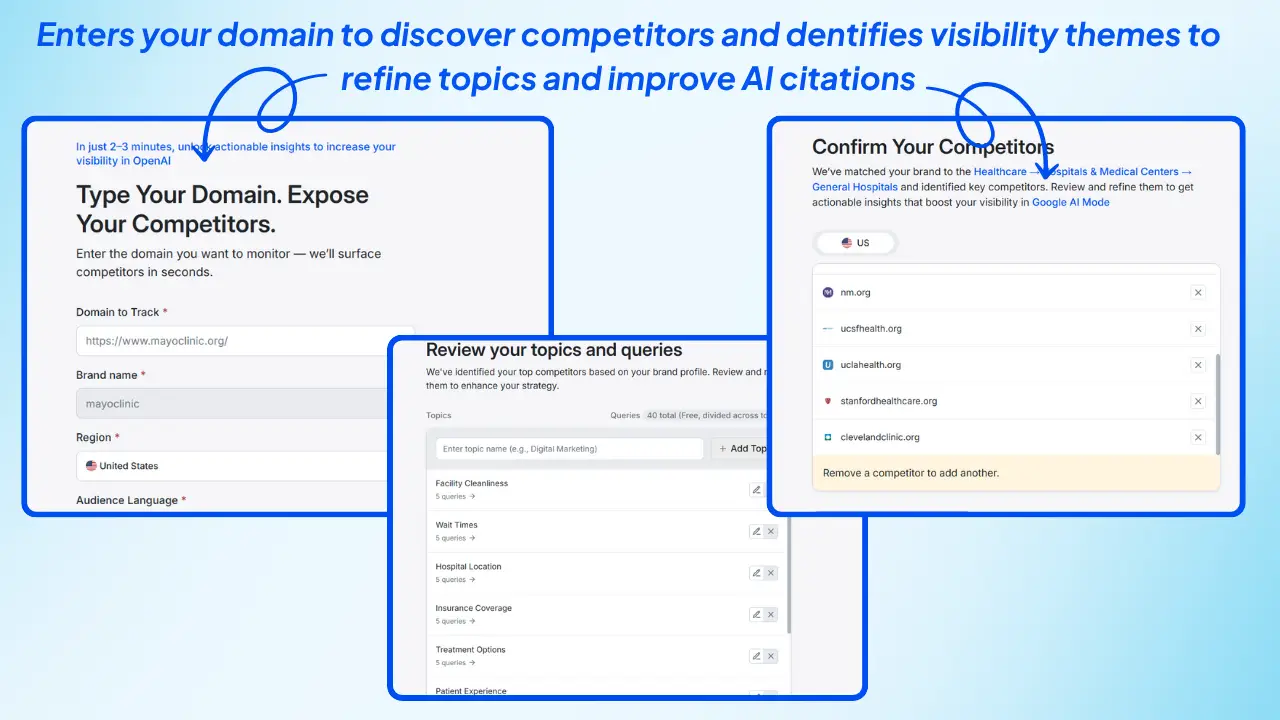
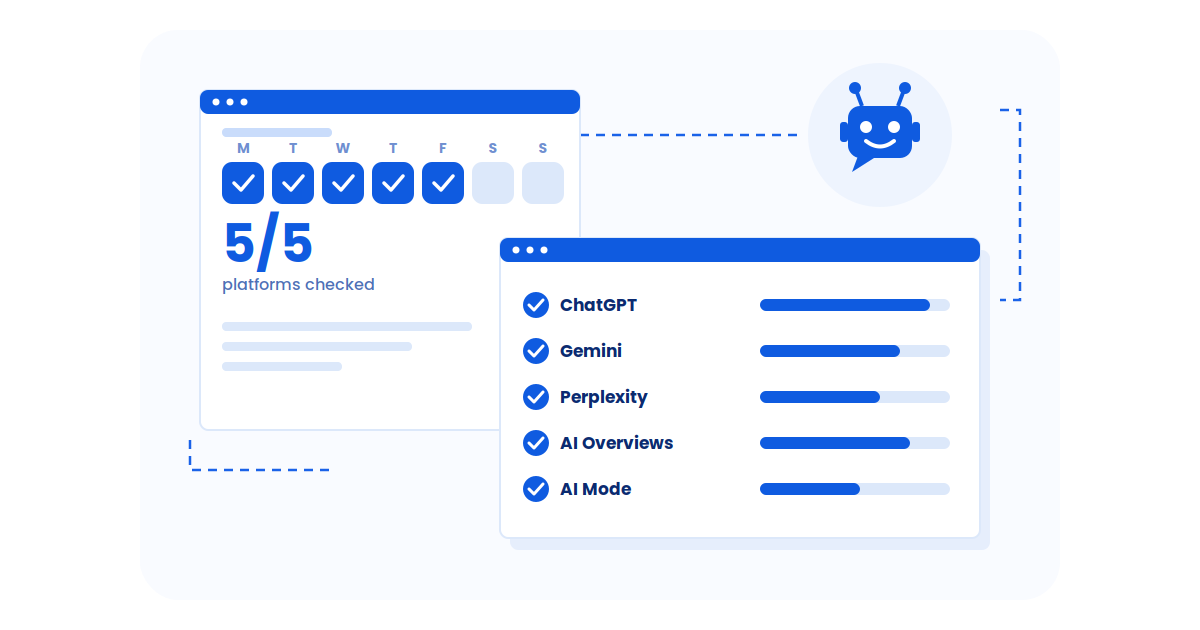
I add the hospital’s domain into the Wellows AI search visibility platform. In the 2026 healthcare snapshot, Wellows scanned 40 clinical-intent queries and surfaced 14 citations for major U.S. providers. The platform converts scattered LLM outputs into a measurable Citation Score that shows how often hospitals appear across ChatGPT, Gemini, Perplexity, and Bing AI.
Next, I review how Wellows groups each provider across medical themes. Hospitals cluster into areas such as doctor expertise, treatment pathways, quality of care, hospital location, and patient experience. These clusters help reveal why systems like HopkinsMedicine, MDAnderson, UCLAHealth, and ClevelandClinic appear more frequently for certain specialties.
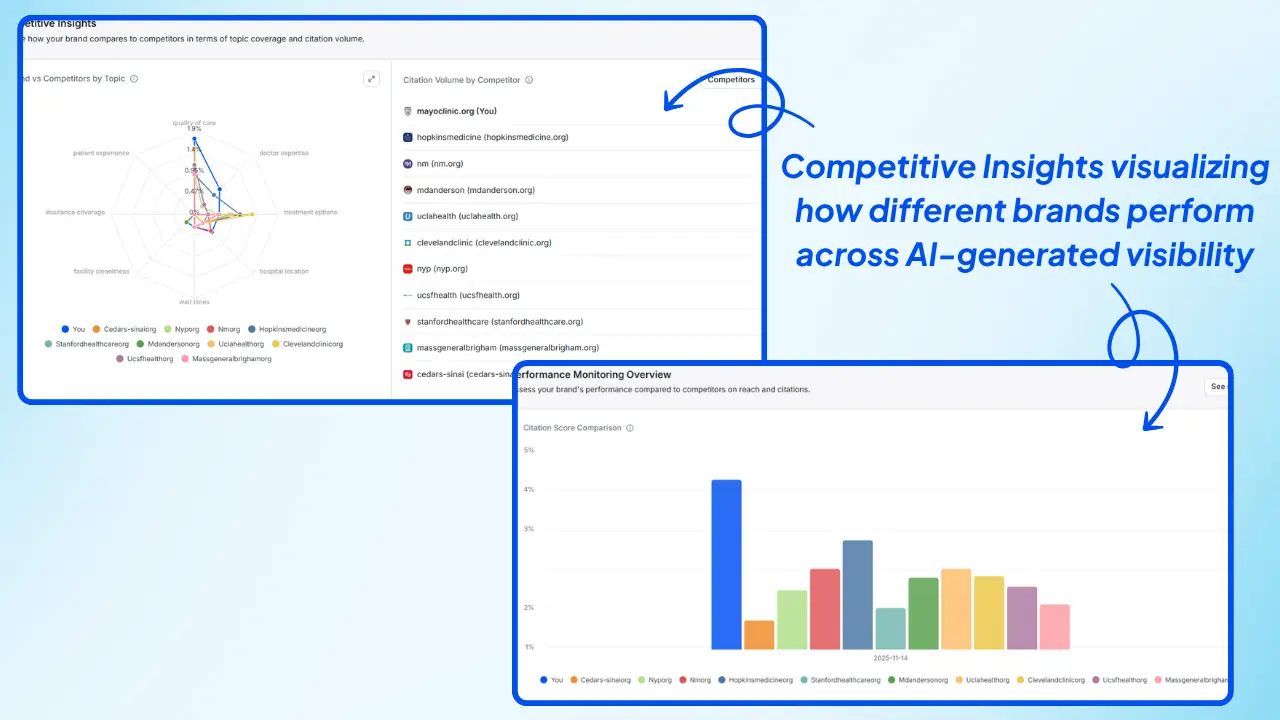
The Citation Score Comparison chart shows this competitive hierarchy. Leading systems outperform because their physician pages, procedure descriptions, and clinical terminology align with LLM validation patterns. Mid-tier hospitals fall behind when treatment explanations, specialty pages, or diagnostic pathways are incomplete or inconsistent.
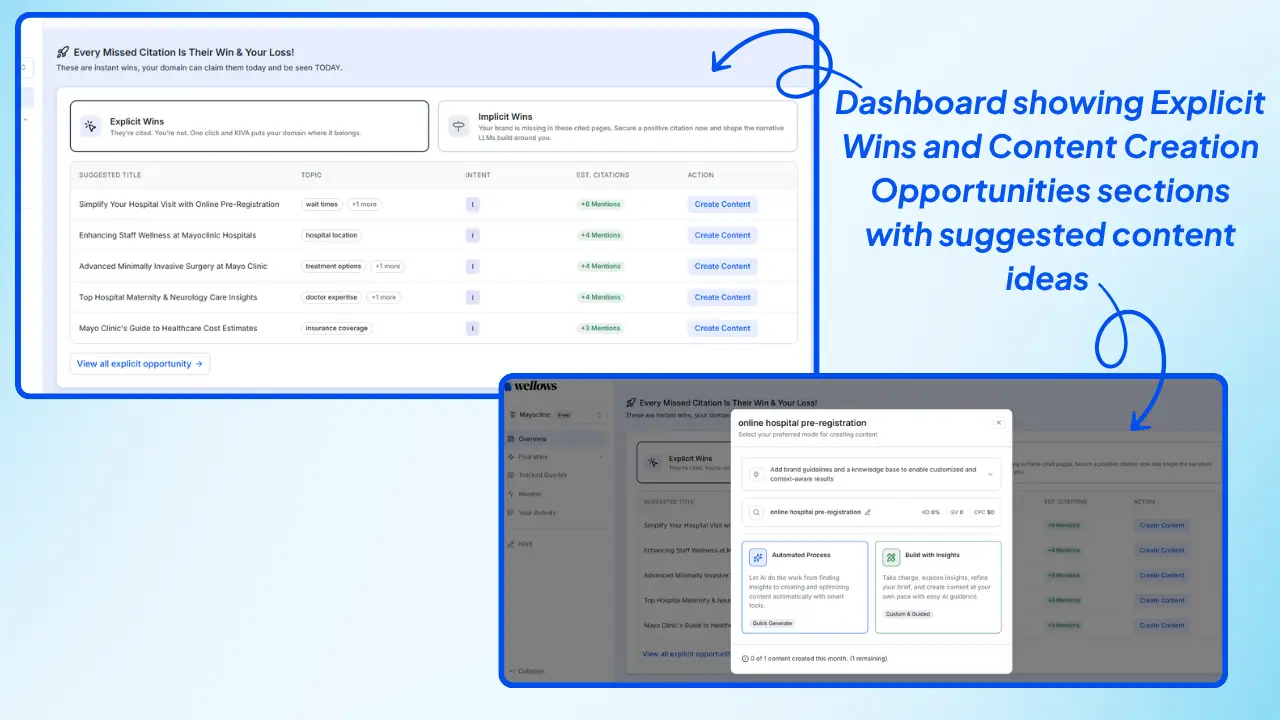
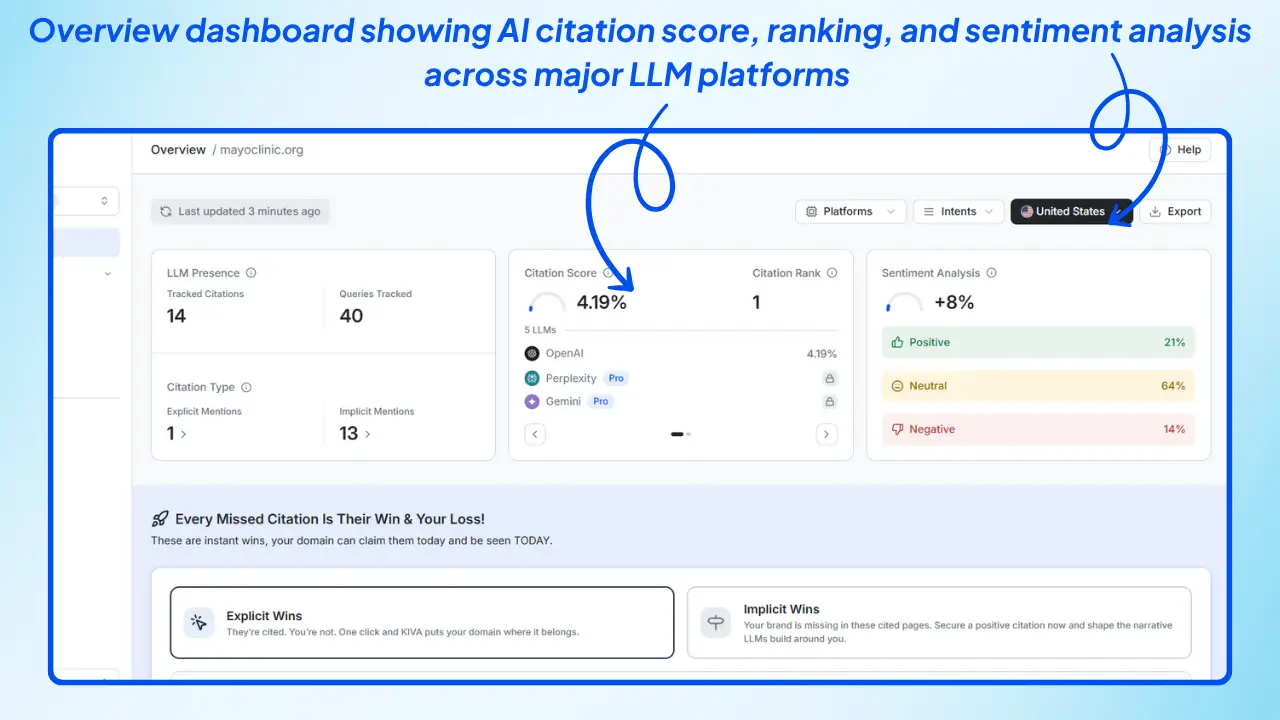
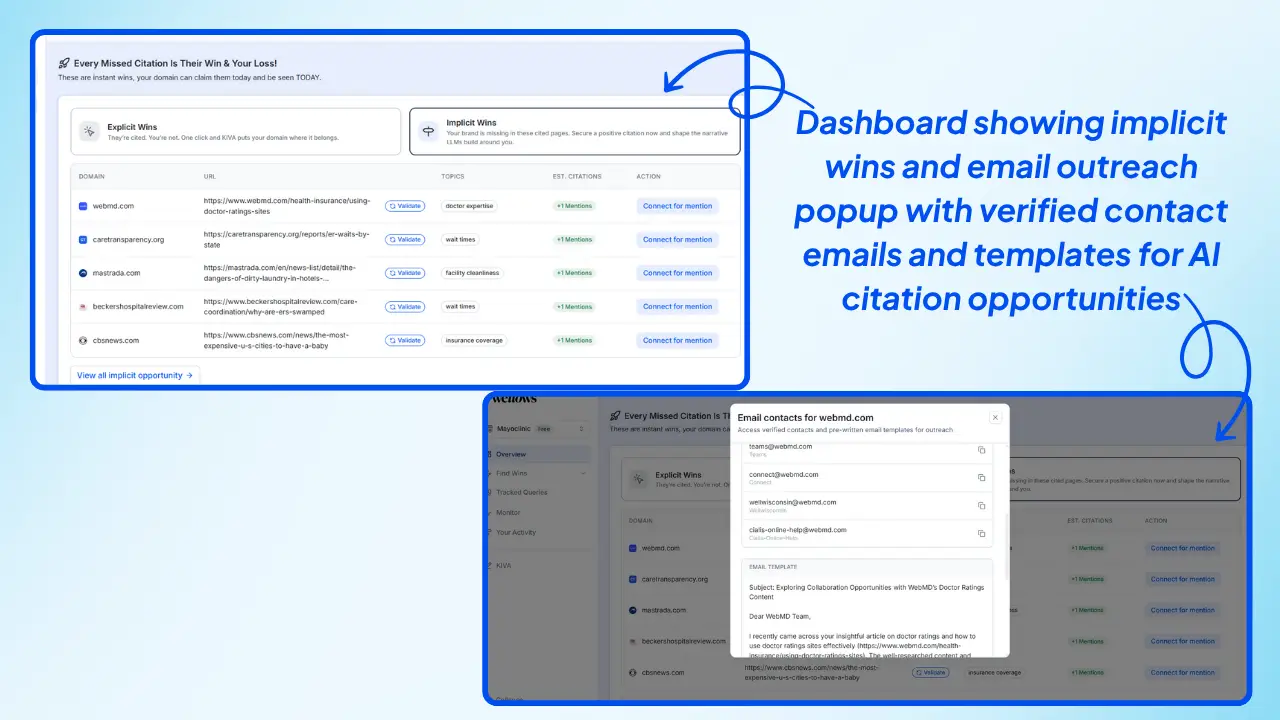
I then analyse explicit and implicit wins. Explicit wins show where your hospital is named directly, while implicit wins reveal cases where AI highlights clinical strengths like “minimally invasive surgery” or “neurology outcomes” but cites another provider. These gaps turn into targeted updates for service-line pages, physician bios, and structured clinical data.
Top cited queries show which patient intents drive visibility: treatment options, doctor expertise, wait times, and quality of care. Sentiment follows similar patterns.
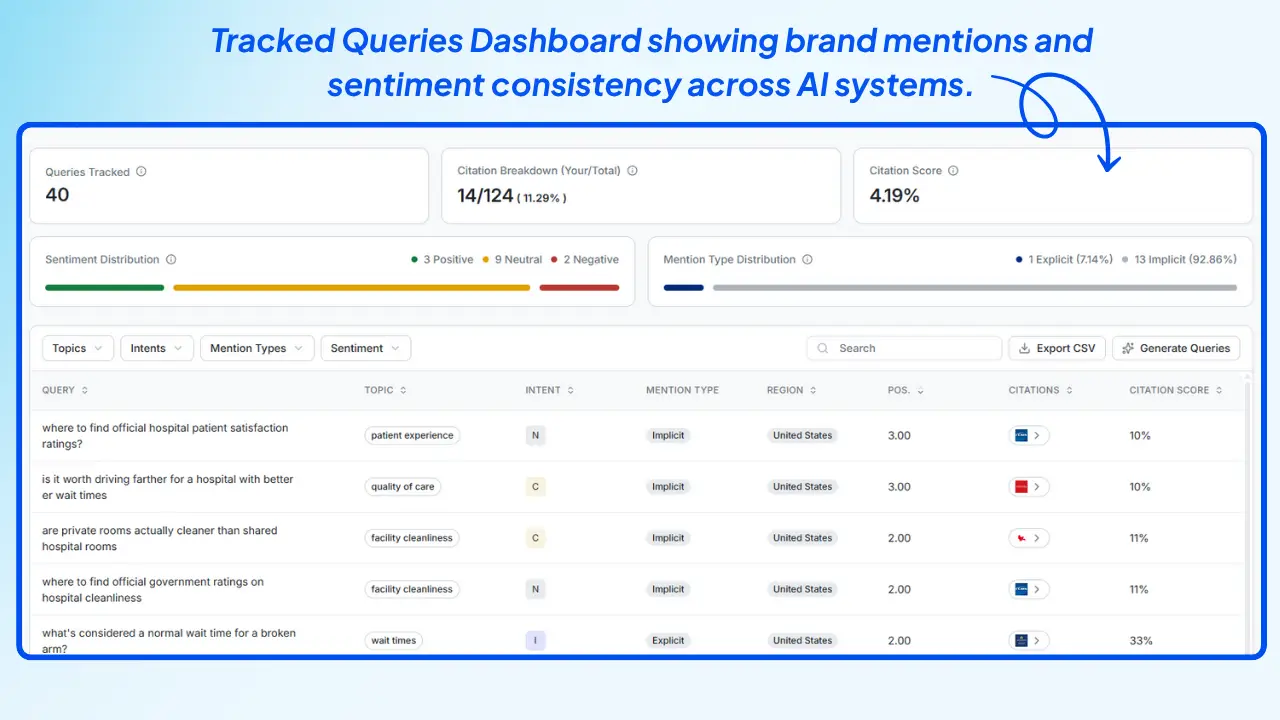
In the healthcare snapshot, major systems show around 21% positive, 64% neutral, and 14% negative tone, reflecting how LLMs summarise care experiences, billing clarity, and triage efficiency. These trends align with diagnostic patterns observed in the Perplexity visibility research.
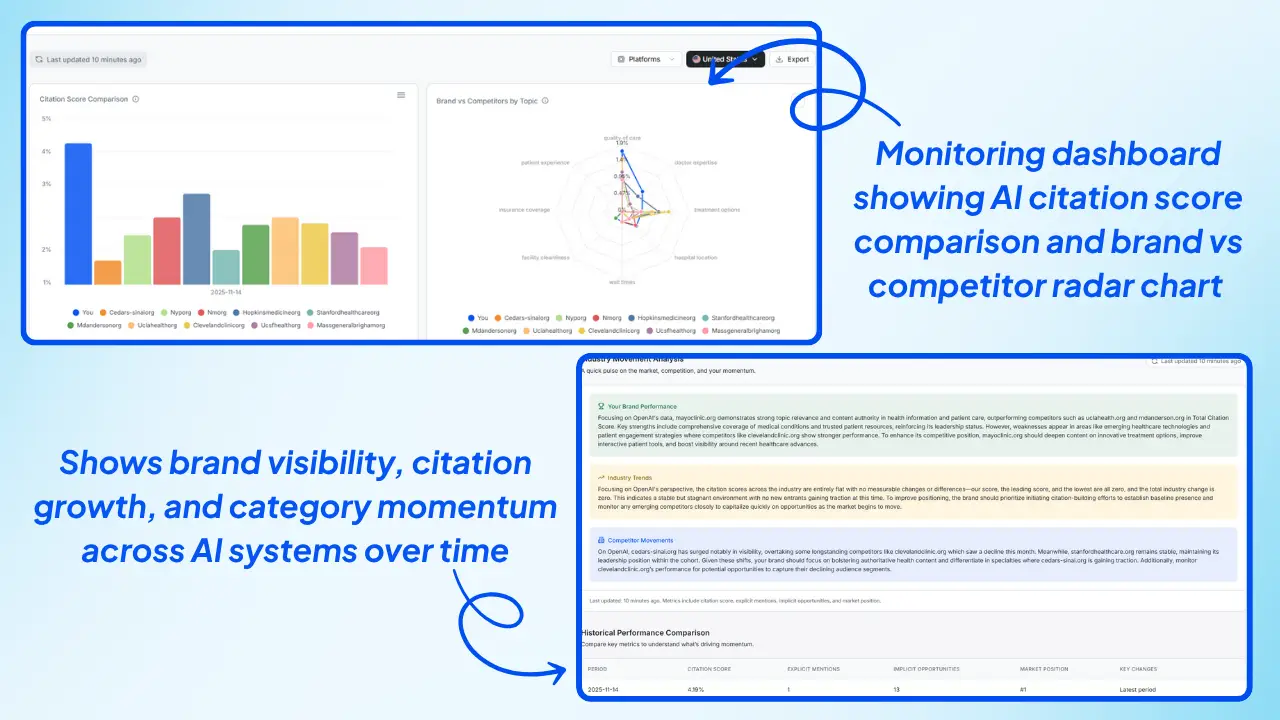
By reviewing naming frequency, specialty-level coverage, misattributed expertise, physician identity gaps, and sentiment consistency, hospitals gain a complete picture of how AI systems evaluate their clinical authority across patient journeys.
If you want to know more, you can Start Your 7-Day Trial.
Beyond healthcare, the same visibility challenges appear in fast-moving sectors, including those outlined in AI Search Visibility for HealthTech & Medical Devices Brands, where structured signals drive citation behaviour.
Wellows supports agencies managing multi-brand portfolios and startups that need strong entity signals early. These patterns mirror the AI Search Visibility priorities now facing Healthcare & Hospital systems.
Why Competitor Hospitals Rank Higher in AI Results
Competitor hospitals appear more often in AI answers because their clinical and organisational information is easier for LLMs to verify and reuse with confidence:
Key reasons AI systems cite competitor hospitals more often supported by the AI visibility enhancement research:
Competitor hospitals rank higher because their organisational data is easier for LLMs to validate (clear departments, consistent naming, structured metadata).
They earn more citations when physician profiles include complete credentials, specialties, affiliations, and consistent identity signals.
High-authority third-party references (Healthgrades, U.S. News, academic networks) increase verification confidence and citation likelihood.
Hospitals with complete service-line pages and clear care pathways are easier for AI to match to symptoms and treatments.
Consistent GEO signals (locations, hours, services by clinic) help AI answer “near me” and regional care queries accurately.
Clear insurance acceptance and appointment pathways reduce ambiguity, improving trust and visibility in AI-generated medical answers.
Key AI Behaviors That Influence Hospital Visibility
Did you know?
- LLMs follow predictable patterns when answering prompts such as “which hospital is best for…” or “where can I get treatment for…”. These patterns make strong hospital AI search visibility optimization essential for reliable citations.
- Queries like “urgent care near me” boost hospitals with accurate GEO data. Providers using aligned healthcare system GEO strategies earn higher placement because AI systems trust their location, hours, and service-line structure.
- Insurance-focused questions such as “does this hospital accept my insurance” favour hospitals with clear payer lists. Coverage accuracy directly strengthens hospital brand presence in AI search by reducing verification gaps.
- AI models also rely on external validation. Data from CDC, NIH, U.S. News, and Healthgrades increases entity confidence a behavior consistent with insights from the search visibility myths analysis.
- Hospitals perform better in prompts like “how to get medical center mentioned in AI health answers” when physician credentials, treatment pathways, and outcome summaries follow clear clinical structures.
- Competitors gain an edge when their terminology aligns with queries such as AI Healthcare Search Optimization or AI Search Visibility Healthcare. This clarity helps explain why competitors hospitals rank higher in AI results.
How Can AI Improve Search Visibility for Healthcare?
You can improve hospital brand presence in AI search when clinical information is structured clearly enough for models to verify. Effective AI Healthcare Search Optimization helps LLMs read hospital entities, physician identities, and treatment pathways with minimal ambiguity.
Practical AI Visibility Strategies for Healthcare Systems
Insight: Hospitals improve AI visibility fastest when GEO, structured data, and clinical clarity move together. These changes make it easier for LLMs to verify your organisation and recommend it confidently inside patient-focused medical answers.
How Hospitals Can Use GEO to Appear in Zero-Click Medical Answers
Hospitals surface more often in zero-click medical answers when LLMs can safely reuse structured, concise explanations. GEO creates the clarity AI systems need to lift clinical information without distortion.
Build linear clinical journeys across pages. Clear mapping reduces ambiguity in prompts like “who treats numbness in the arm” or “where to get an MRI.”
Hospitals that publish concise, medically verified pathways earn more placements because AI systems can reference them without altering clinical meaning.
How AI Technologies Rank, Compare, and Cite Hospitals
AI systems compare hospitals by analysing how clearly each organisation communicates clinical expertise, outcomes, and service-line structure. Modern Artificial Intelligence Search Enhancement for Hospitals relies on signals that reduce ambiguity and help models generate safe, verifiable answers.
LLMs improve hospital placement by using patterns tied to How does AI improve hospital search results? prioritising hospitals that provide consistent, structured, and externally validated information across their clinical pages.
Did you know?
Did you know?
Did you know?
Did you know?
Did you know?
Hospitals that maintain structured clinical detail, strong third-party alignment, and precise entity signals are cited more often because AI systems can verify them with higher confidence.
The Role of Third-Party Health Sources in AI Search Visibility
AI systems depend heavily on trusted external health sources when ranking and citing hospitals. These sources act as clinical verification layers, helping LLMs confirm whether a hospital’s information is accurate, safe, and consistent across the medical ecosystem.
Platforms like Healthgrades, WebMD, and U.S. News shape visibility because they document physician credentials, hospital rankings, and procedure-level details. Mayo Clinic’s reference libraries strengthen clinical authority signals because LLMs treat its content as medically reliable baseline data.
Government sources such as NIH and CDC reinforce factual accuracy. Their terminology styles influence how AI models evaluate medical phrasing, diagnostic clarity, and treatment explanations for hospital pages.
Local health systems and insurance directories add another layer of validation. When location data, accepted insurance plans, and care networks match across these sources, hospitals earn stronger placement in patient-intent queries.
Research publications like NEJM and JAMA also affect ranking patterns. Their evidence-based definitions help AI systems judge whether a hospital’s descriptions of outcomes, procedures, or risks align with accepted clinical standards.
Wellows separates these influences into explicit and implicit citations. Explicit citations occur when AI directly names the hospital. Implicit citations appear when the model uses the hospital’s strengths but attributes them to a competitor due to stronger external validation.
Explicit citation: When ChatGPT names a hospital because its physician data matches Healthgrades and NIH terminology.
Implicit citation: When AI uses your oncology strengths but cites another hospital because their WebMD and U.S. News listings are more complete.
External reinforcement: When CDC-aligned phrasing increases trust in your treatment explanations, improving reuse in zero-click answers.
Governance, Accuracy & Compliance in AI-Powered Healthcare Search
Hospitals must govern AI-facing content carefully to prevent clinical misinformation. According to a 2022 CDC report, 58.5% of U.S. adults used the Internet in the past 12 months to look for health or medical information, increasing the risk of harm when outdated or ambiguous content is reused by LLMs.
Keeping medical pages updated is essential. Treatment guidelines from CDC and NIH shift frequently, and AI systems prioritise hospitals whose explanations align with current national standards.
HIPAA boundaries also guide what hospitals can publish. Public-facing pages must avoid embedding patient identifiers, case details, or metadata that could expose health information (HHS HIPAA Privacy Rule, 2024).
Bias reduction matters because research shows clinical AI models can amplify disparities when data lacks diversity (JAMA, 2023). Clear, standardised phrasing reduces the chance of biased interpretations in high-intent queries.
Physician credential accuracy is another core factor. Boards and certification directories remain primary verification sources, and AI systems reference them when determining professional authority (ABMS, 2024).
Sentiment monitoring helps hospitals detect how AI systems summarise patient experience. Negative shifts often come from billing confusion, wait times, or outdated service-line descriptions that models misinterpret.
Wellows strengthens governance by identifying mismatches in how LLMs describe your hospital such as outdated phrasing, inconsistent service-line details, or misattributed strengths so teams can correct issues before they impact visibility or patient trust.
Why Healthcare Marketers Need AI Search Visibility Platforms
Most hospital marketing tools were built for the SERP era. They track keywords and traffic, but they cannot see how ChatGPT, Gemini, Perplexity, or Bing AI describe, compare, or cite a hospital inside real medical queries. This creates a critical blind spot in AI Search Visibility for Healthcare & Hospitals.
Wellows closes that gap. As an AI search visibility platform and GenAI visibility stack, it measures how often a hospital is cited, how specialties are framed, and where competing systems outperform you. These insights align with patterns seen in AI visibility enhancement strategies.
| Feature | Wellows | Traditional SEO Suite | Basic AI Monitoring Tools |
|---|---|---|---|
| AI Citation Tracking (ChatGPT, Gemini, Perplexity, Bing) | Yes Tracks hospital, specialty, procedures & provider mentions. | No Tracks SERPs only. | Partial Mentions without clinical context. |
| Implicit Citation Detection | Yes Finds where your treatments appear without your hospital name. | No Cannot interpret LLM outputs. | No Counts direct mentions only. |
| Citation Score + Sentiment | Yes Combines frequency, category share, and tone. | Partial General brand metrics only. | Limited No sentiment intelligence. |
| Healthcare-Focused Benchmarking | Yes Benchmarks against Hopkins, Cleveland Clinic, MD Anderson, UCLA Health. | No Keyword-only comparisons. | No Rarely supports specialty benchmarking. |
| Explicit vs Implicit Wins | Yes Highlights missed citations in treatment pathways & specialty queries. | No Cannot classify LLM reasoning. | No No distinction in citation types. |
| Intent Clustering | Yes Groups queries around oncology, cardiology, neurology, insurance & location. | No Clusters keywords only. | Partial Weak medical intent understanding. |
| Real-Time Sentiment Tracking | Yes Tracks how AI systems describe care quality & patient experience. | Partial Reviews only, no LLM outputs. | Limited No historical visibility. |
| Product-Led Visibility Playbooks | Yes Generates fixes for specialties, treatments, and insurance clarity. | No Manual interpretation required. | No Raw data without guidance. |
This mirrors principles in the evolution of modern search, where AI search visibility functions as a core performance channel.
Insight: With Wellows, healthcare marketers clearly see how LLMs talk about their hospital, where competitors win clinical citations, and which patient intents drive discovery. Each missed mention becomes a structured action schema updates, pathway improvements, or third-party cleanups.
How to Measure Progress & Plan a 90-Day AI Visibility Roadmap
A 90-day roadmap helps hospitals measure how AI systems evaluate their clinical authority, service lines, and patient-facing accuracy across LLMs.
These improvement cycles mirror patterns seen in the broader clinical sectors, including insights from the AI search visibility for biotechnology brands study.
Did you know?
- Audit Citation Score, Rank, and sentiment across AI systems.
- Clean physician profiles, procedure pages, and medical terminology.
- Update structured data for hospitals, departments, and treatments.
- Rewrite high-intent FAQs using medically safe phrasing.
Did you know?
- Expand service-line clusters for oncology, cardiology, neurology, and orthopedics.
- Clarify insurance acceptance and billing guidance.
- Create symptom → service → treatment pathways that LLMs can reuse.
- Strengthen GEO signals for regional and local discovery.
Did you know?
- Improve visibility on Healthgrades, WebMD, U.S. News, and NIH-linked sources.
- Fix misattributions surfaced in Wellows implicit-win reports.
- Monitor sentiment shifts and update pages with outdated phrasing.
- Re-run Wellows scans to confirm visibility movement across departments.
This cycle ensures hospitals maintain consistent visibility across AI-driven medical queries and prevent competitors from capturing category authority.
The same AI visibility principles shaping hospitals now support professionals who manage complex visibility workflows. Wellows helps marketing freelancers deliver structured, AI-ready content for clients and enables marketing consultants to diagnose visibility gaps across brands using the same model-friendly patterns now essential for Healthcare & Hospitals.
Discover how AI Search Visibility shapes discovery across major sectors. These guides explain how organisations strengthen citations, entity clarity, and sentiment inside AI-generated answers.
- AI Search Visibility for Fashion & Apparel Brands: Improve product-level clarity, sizing consistency, and trend relevance inside generative search.
- AI Search Visibility for Education & EdTech Brands: Increase citation accuracy for institutions, programs, and credential information.
- AI Search Visibility for Banking & Financial Services Brands: Improve trust signals for lending, advisory, and compliance-related AI queries.
- AI Search Visibility for Consumer Electronics Brands: Guide covering metadata, spec clarity, and AI-optimized device visibility.
- AI Search Visibility for Entertainment Brands: Enhance citations in zero-click recommendations and viewer-intent queries.
Insight: Across all industries, organisations that control their metadata, structured signals, and third-party accuracy gain stronger placement in generative answers and outperform competitors inside AI-driven discovery flows.
FAQs
Competitors often maintain stronger third-party references, clearer procedure pathways, and more complete physician identity signals. These factors increase their citation frequency across major LLMs.
Conclusion
AI has become the new front door for patient decisions, shifting discovery from search results to instant answers inside ChatGPT, Gemini, Perplexity, and Bing AI. Hospitals now compete on how clearly these systems can verify their specialties, locations, physicians, and treatment pathways.
Strong structured signals accurate metadata, consistent terminology, and reliable third-party references determine whether a hospital appears in high-intent medical queries or is replaced by a competitor with clearer clinical authority.
Wellows strengthens this foundation by identifying citation gaps, misattributed strengths, and sentiment shifts across LLMs. Its insights help hospitals correct inaccuracies early, secure new citations, and build stable AI search visibility.