The data we once relied on to prove SEO performance is evaporating, dark social hides referral paths, third-party cookies are on the way out, SERP layouts keep shifting, and AI-powered “search” is rewriting how people find answers.
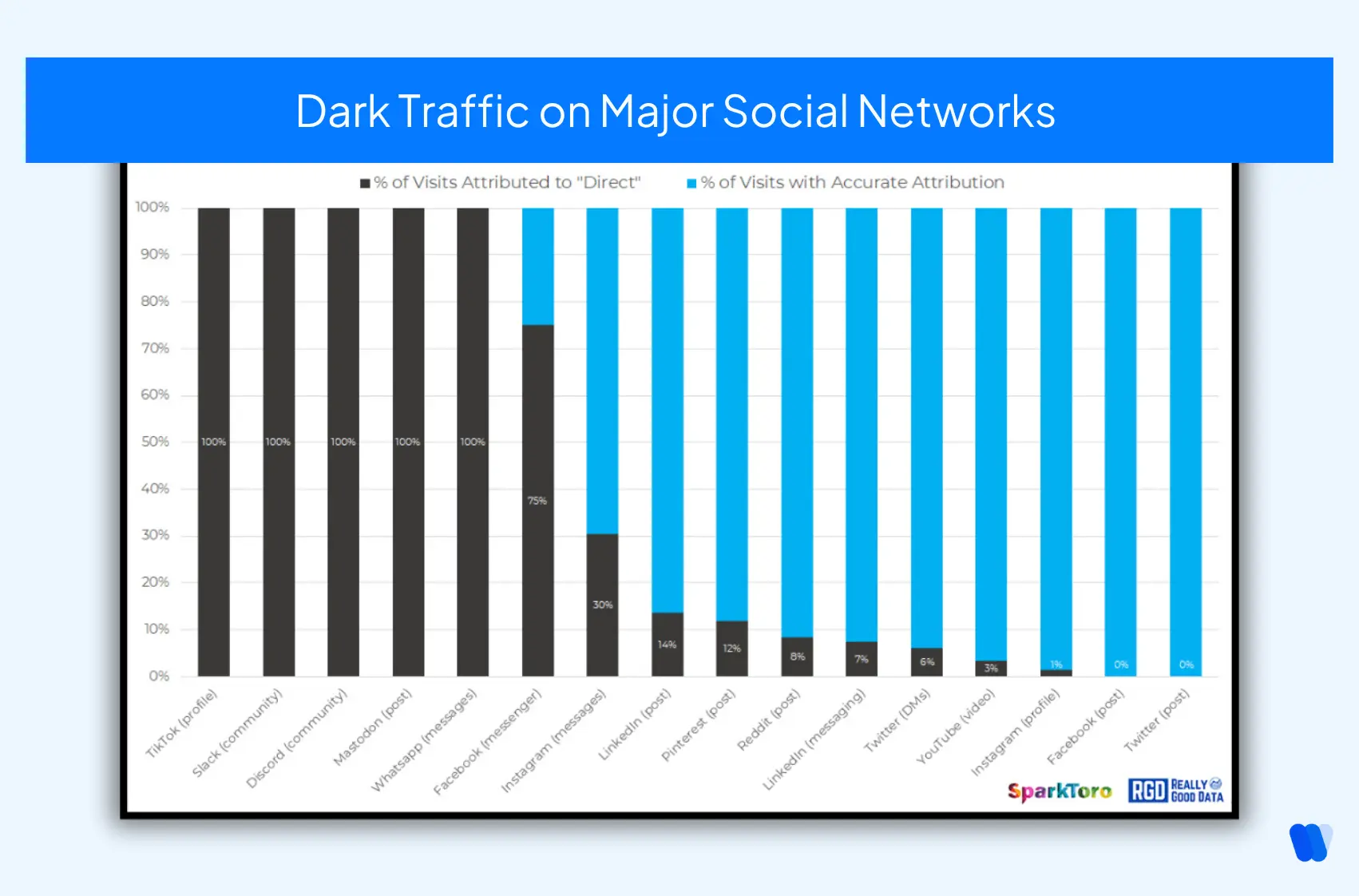
And as the chart below shows, much of our traffic is buried in “dark visitors”, platforms like TikTok, Slack, Discord, Mastodon, and WhatsApp all register as Direct—and it’s quite possible that a significant slice of these hidden visits is coming from LLM-powered interfaces.
Here’s how the 6 GEO + SEO Myths can cost you visibility:
- The rise of dark social: and why so much referral traffic now shows up as “Direct”
- The cookie apocalypse: how third-party restrictions and privacy changes are erasing our data
- New SERP realities: from zero-click answers to AI overviews—show why you must combine SEO and GEO to surface in both SERPs and AI answers.
- Rethinking KPIs: which legacy metrics to retire—and the new benchmarks you should set
- Attribution 2.0: tactics for reclaiming insights in a fragmented ecosystem
- AI “search” strategies: optimizing for conversational engines and voice assistants
- Actionable playbook: practical steps to rebuild your dashboard for 2025 and beyond
Which Six SEO Myths Have Emerged in the Generative Experience Optimization Era?
As GEO reshapes how content gets surfaced, some old SEO assumptions are starting to crack. Here are 6 GEO + SEO myths you’ll want to leave behind:
1. Generative Engine Optimization Means SEO Is Obsolete
1. What it means
With AI and smart agents answering queries directly, optimizing for search engines is supposedly pointless—users no longer click through to websites. That’s why SEOs are now moving to generative engine optimization.
Why This Matters
Why It’s Not True:
AI Still Sources from the Web: Even when an LLM supplies an answer, it often cites or links back to in-depth content—so if you’re not optimized, you won’t get referenced.
Cross-Platform Visibility: SEO best practices fuel discoverability on app stores, voice assistants, and vertical search engines, not just traditional SERPs. The Top GEO Tactics explain how to integrate these SEO foundations with GEO for maximum visibility.
Competitive Edge Through Quality: Brands that refine their expertise, authority, and trust signals outperform generic AI summaries in both click-throughs and conversions.
2. Keyword Lists Are Dead
1. What it means
What it means: Because search engines now understand topics and intent, digging into spreadsheets of exact keywords is a waste of time.
Why This Matters
Why It’s Not True:
Keywords Power Intent Mapping: Behind every topic cluster are real search terms—modern research tools still need seed keywords to discover semantic variations.
Trend Signals Live in Keywords: Shifts in phrasing and emerging questions show up first in raw query data, guiding you to the hottest, most relevant subjects.
Strategic Content Prioritization: Knowing which keywords drive high-value traffic lets you allocate resources effectively, rather than guessing at what topics matter.
3. Social Buzz Can Replace Search Traffic
1. What it means
What it means: An active social media strategy is enough—you don’t need to bother with SEO if you’re trending on TikTok, LinkedIn, or Instagram.
Why This Matters
Why It’s Not True
- Different User Mindsets: Social captures entertainment and discovery; search captures intent-driven needs—both feed the funnel in complementary ways.
- Ephemeral vs. Evergreen: Viral posts decay quickly; SEO investments compound, surfacing your content months or years after publication.
- Indirect SEO Benefits: Social engagement can generate natural backlinks and mentions, but it can’t substitute for the structural signals search engines need.
4. Paid Ads Outshine Organic SEO
1. What it means
What it means:
Why bother with slow organic work when a few dollars in paid ads delivers top-of-page placement instantly?
Why This Matters
Why It’s Not True
- Sustainability vs. Stop-Start: Paid visibility vanishes when you pause your budget; SEO builds lasting equity that grows with each new optimized asset.
- Cost-Per-Acquisition Matters: In competitive verticals, cost per click can spiral—consistent SEO traffic often costs a fraction over time.
- Trust & Credibility: Users tend to skip ads for organic listings they perceive as more authoritative—strong SEO signals reinforce brand credibility.
5. Voice Search Kills Traditional On-Page SEO
1. What it means
What it means:
Once users speak queries aloud, standard on-page elements like meta tags, headings, and internal links no longer matter.
Why This Matters
Why It’s Not True
- Voice Still Reads Your Markup: Assistants pull from structured data, headings, and snippet-friendly content—so tidy HTML and schema remain essential.
- Local and Featured Snippet Wins: Voice devices lean on local packs and snippet answers; traditional SEO tactics are the gateway to those positions.
- Hybrid User Journeys: Many voice sessions transition back to screens—if your pages aren’t optimized, you’ll miss both voice and visual opportunities.
6. SEO Takes Forever to Move the Needle
1. What it means
What it means:
Because organic growth is slow, it’s not worth the investment—better to pour resources into faster channels.
Why This Matters
Why It’s Not True
- Quick Wins Exist: By updating underperforming pages, targeting low-competition queries, or optimizing for featured snippets, you can see noticeable lifts in weeks.
- Real-Time AI Insights: Generative AI platforms highlight content gaps and on-page fixes instantly, enabling rapid experimentation and fast pivots.
- Compounding ROI: Every optimized piece builds on the last—over time, a library of quality assets delivers exponential traffic and lead growth
Are SEO Goals Really Dead or Are they Evolving?
With so much changing in how search and AI work together, it’s easy to fall for half-truths. One debate that is part of 6 GEO + SEO myths questions the role of SEO in the age of LLMs. Here’s what actually has happened to SEO goals after the emergence of GEO.
- SEO is obsolete: New LLM visibility systems will eliminate the need for optimization.
- New LLM visibility systems will eliminate the need for optimization: Long-form and educational content is a waste of effort.
- SEO will disappear: AI assistants (like chatbots and voice agents) will handle all user queries without sending traffic to websites
- SEO hasn’t died: It’s refocused on understanding user intent in generative engines and delivering content that truly answers people’s questions.
- Overusing keywords or chasing low-quality backlinks no longer moves the needle: Search engines now reward clear structure, depth, and readability.
- LLMs now have new KPIs: GEO KPIs boost pages that show real expertise, trustworthiness, and genuine value rather than just matching keywords
How can you Adapt Your SEO KPIs for Generative Engine Optimization?
As GEO reshapes how content is found and cited, your SEO metrics need to evolve too. Here’s how to rethink your KPIs to stay aligned with both GEO and SEO in 2025 — especially as more visibility happens inside AI-generated answers that never produce a traditional click.
Many teams now validate this shift by checking whether their content is being cited, paraphrased, or excluded entirely in AI responses using a ChatGPT Visibility Tracker, rather than relying on rankings or referral data alone.
1. Prioritize Semantic Reach Over Exact-Match Keywords
Replace “keyword coverage” with a metric for topic completeness—how many related questions or concepts your pages satisfy.2. Assess Content Structure and Clarity
Introduce a “Readability & Structure Score” that rewards properly marked headings, lists, and concise explanations—elements AI assistants rely on to compose answers.
3. Grow Branded Query Share
Monitor your percentage of searches that include your brand name or product terms. As AI “search” surfaces fewer URLs, brand affinity becomes a key driver of click-through.
4. Embrace Dark Traffic Attribution
Since third-party cookies and referral data are fading, shift to measuring direct engagement signals—time on page, scroll depth, and repeat visits—to capture “invisible” traffic from chatbots and private channels.
5. Track Dynamic Content Adaptation
Implement a “Trend Responsiveness” metric: the speed at which you update or spin up new content in response to emerging AI-driven search queries or trending topics.
6. Optimize for Engagement, Not Just Clicks
Swap legacy CTR goals for “Engagement Efficiency,” combining dwell time and interaction events (e.g. video plays, downloads) to reflect true user value in an AI-first ecosystem.
7. Set New Benchmarks for AI Answer Success
Define targets for how often your content is used verbatim in AI responses, and how those AI-driven referrals convert—turning untracked “dark” impressions into accountable ROI.
Read More Articles
How to Design Content Briefs for GEO?
Can GSC Data Guide Your GEO Strategy?
How Will Google’s AI Mode Transform Traditional SEO Practices?
FAQs
SEO will evolve to prioritize intent-driven, conversational content that AI “answer engines” can readily surface.
Success hinges on crafting clear, structured information that serves both human readers and AI models.
AI tools analyze search patterns to identify emerging topics and suggest on-the-fly optimizations.
They streamline content audits, surface semantic clusters, and help you fine-tune relevance at scale.
Emphasize concise Q&A sections, clear headings, and schema markup so AI assistants can parse and quote your content.
Optimize for user intent over exact keywords, focusing on depth and authoritative answers.
Increasing traffic may flow through AI platforms without traditional referrers, making engagement metrics like dwell time critical.
Websites must balance human-friendly design with AI-optimized structure to maintain visibility and trust.
Why SEO Thrives in the Age of Generative Engines?
After discussing the 6 GEO + SEO myths, it can be said that AI isn’t replacing SEO, it’s turbocharging it by making search more personalized, predictive, and conversational. Embracing AI-driven tactics alongside solid optimization ensures your content stays visible both in traditional rankings and inside AI “answer engines.”
Key Takeaways for AI-Enhanced SEO
- Hyper-Personalized Messaging: Leverage AI to tailor content based on individual behavior and real-time signals.
- Predictive Trend Spotting: Use machine learning to anticipate search patterns and publish ahead of the curve.
- Conversational & Voice Readiness: Structure answers with clear headings, bullet points, and schema so AI assistants can quote you directly.
- Automated Content Audits: Employ AI tools for continuous site health checks, gap analysis, and on-the-fly recommendations.
- Engagement-First Metrics: Shift focus from pure clicks to dwell time, scroll depth, and repeat visits to capture “dark” traffic.
- Balanced AI + Human Strategy: Combine data-driven insights with expert storytelling to maintain authority, trust, and long-term growth.