Viewers now turn to ChatGPT, Gemini, and Perplexity to decide what to watch, and these systems highlight only the entertainment brands they recognise as reliable entities.
Because AI answers replace long scrolling sessions, AI Search Visibility for Entertainment Brands now shapes which platforms, studios, and titles gain attention.
As this behaviour grows, brands with accurate metadata, consistent catalog details, and strong authority signals appear more often in generative answers. Missing or outdated information lowers the chances of being mentioned, even when a title is relevant to the query.
Wellows, an AI search visibility platform, tracks where entertainment brands appear across major LLMs, identifies misattributed or incomplete mentions, and highlights opportunities to improve overall Citation Score.
- Viewers now ask ChatGPT, Gemini, and Perplexity what to watch, so AI answers heavily influence entertainment discovery.
- AI recommends brands it can verify—with accurate metadata, consistent catalog details, and trusted authority signals.
- Missing or outdated info reduces your chances of being mentioned, even when your title/service fits the query.
- Wellows tracks where your entertainment brand appears across major LLMs, flags misattributions, and measures Citation Score vs competitors.
- To improve AI visibility, publish AI-ready facts (pricing/plans, device support, 4K/HDR, download rules, region availability) and monitor citations over time.
What Is AI Search Visibility for Entertainment Brands
Search Ebgine Visibility for Entertainment Brands describes how clearly AI systems recognise, reference, and reuse a platform, studio, or title when answering viewer questions. These systems rely on structured metadata, verified catalog information, and trusted third-party sources to determine which brands are safe to cite.
Because generative engines deliver direct explanations instead of link lists, visibility depends on entity clarity, fact consistency, and stable sentiment across authoritative domains. When these signals are strong, AI assistants recommend a brand confidently inside zero-click answers.
That confidence-based citation model is reshaping how digital-first companies grow, FinTech Startups are applying the same logic, optimizing their data layers to appear in zero-click answers around payments, investing, and financial planning.
Wellows acts as an AI visibility solution by measuring citations across ChatGPT, Gemini, Bing AI, and Perplexity, comparing performance with competitors, and surfacing gaps where a brand should appear but currently doesn’t.
How Can You Assess Your Current Visibility in AI-Powered Search Results
When I audit AI Search Visibility for Entertainment Brands, I begin with a simple question: how often do AI assistants name your platform, studio, or title when viewers ask what to watch, where to stream something, or which service offers the best value?
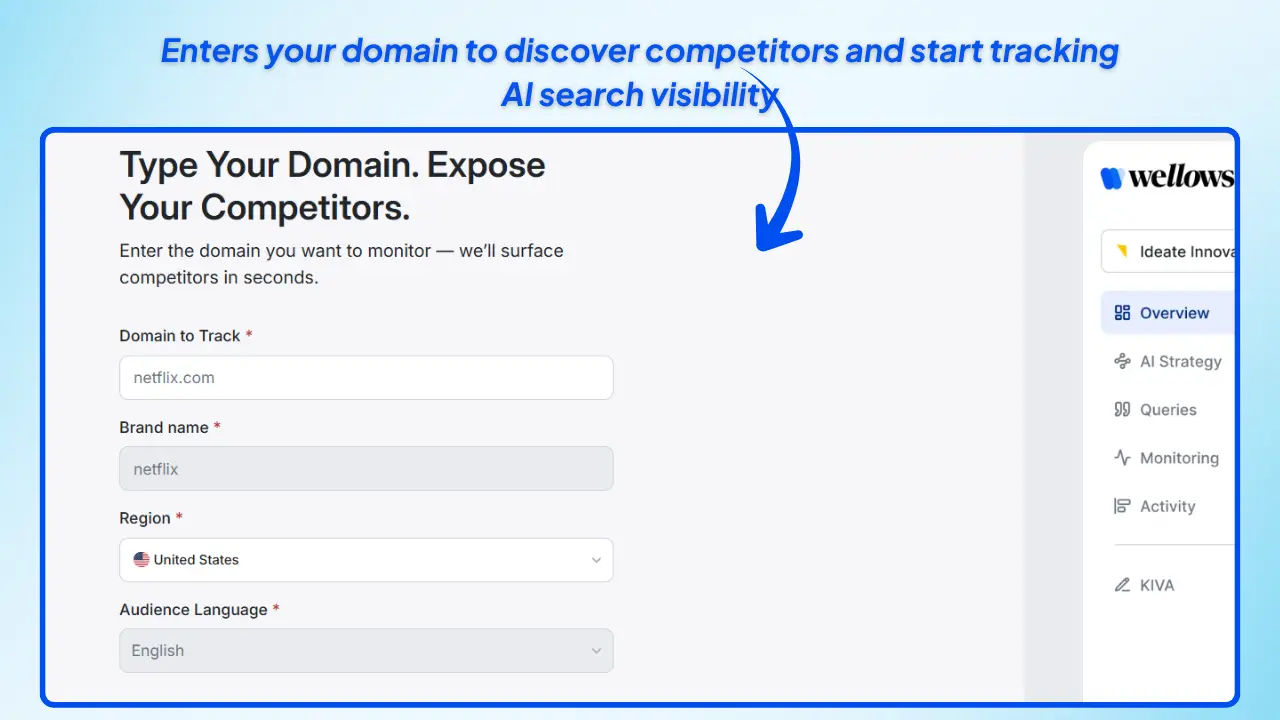
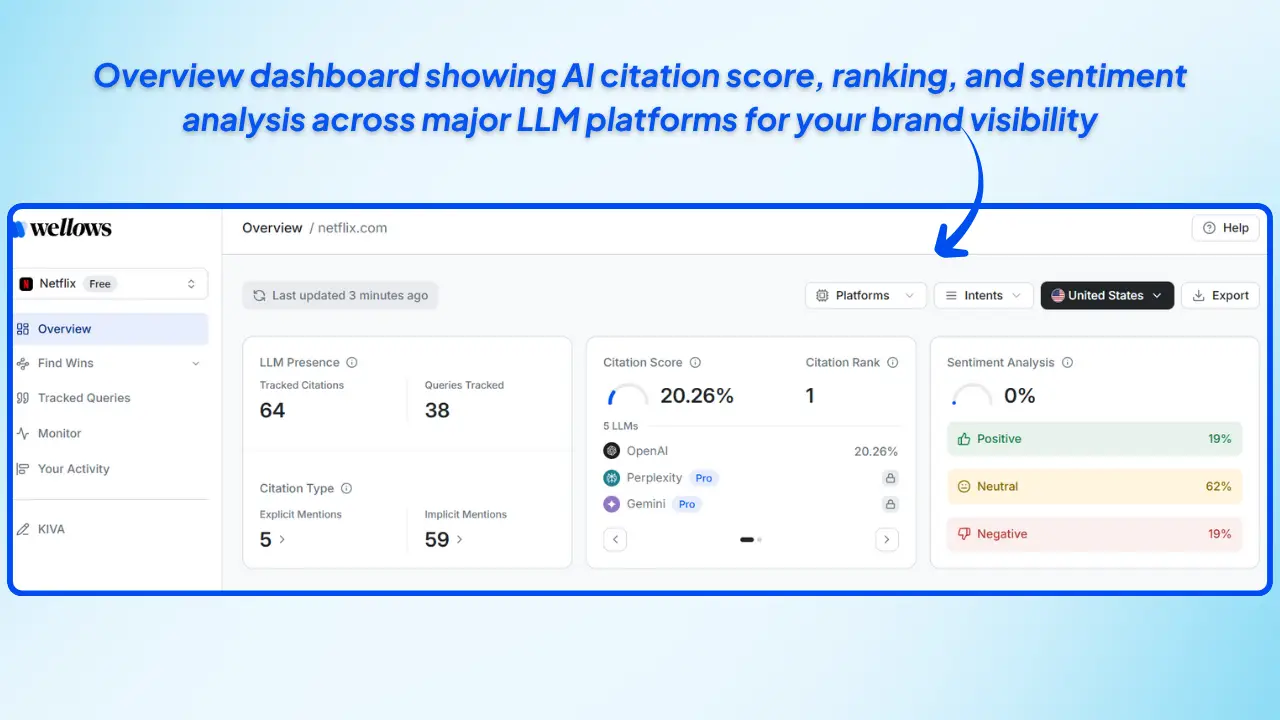
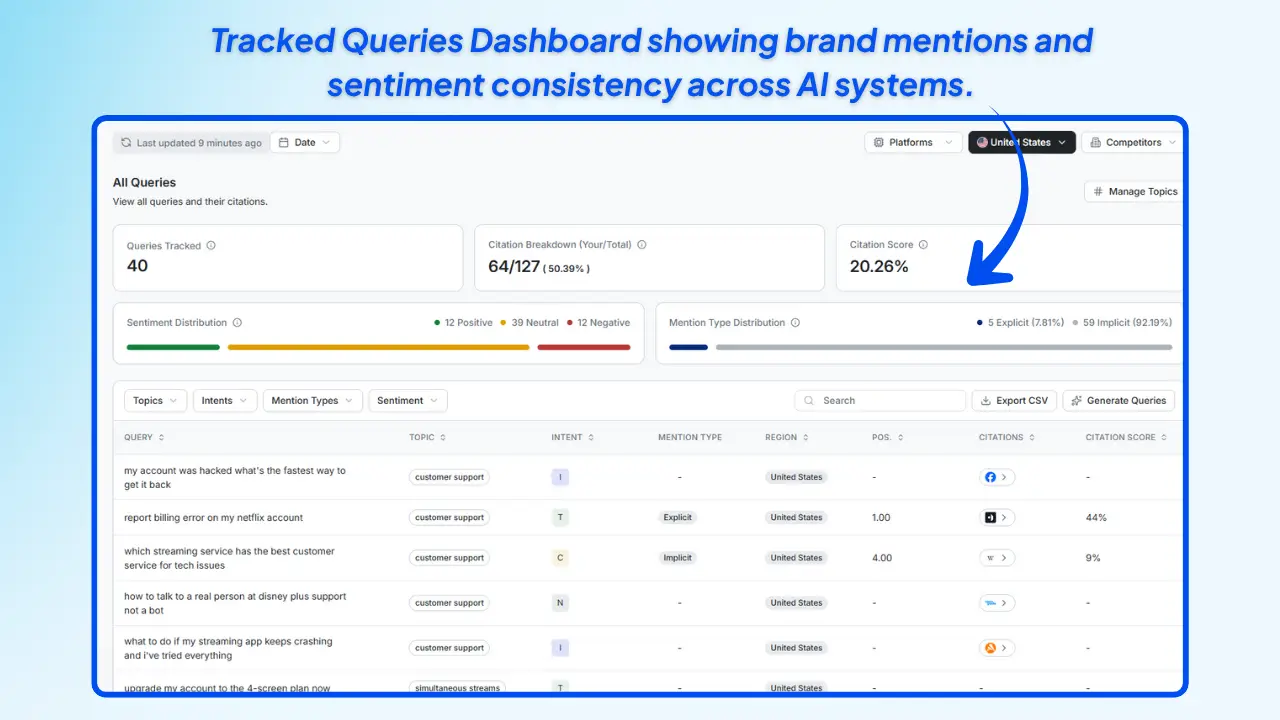
I then add the brand’s domain into the Wellows AI search visibility platform. In the snapshot for netflix.com, Wellows scanned 38 entertainment queries and detected 64 citations, producing a 20.26% Citation Score and the top Citation Rank across major LLMs. That shifts visibility from guesswork to measurable performance.
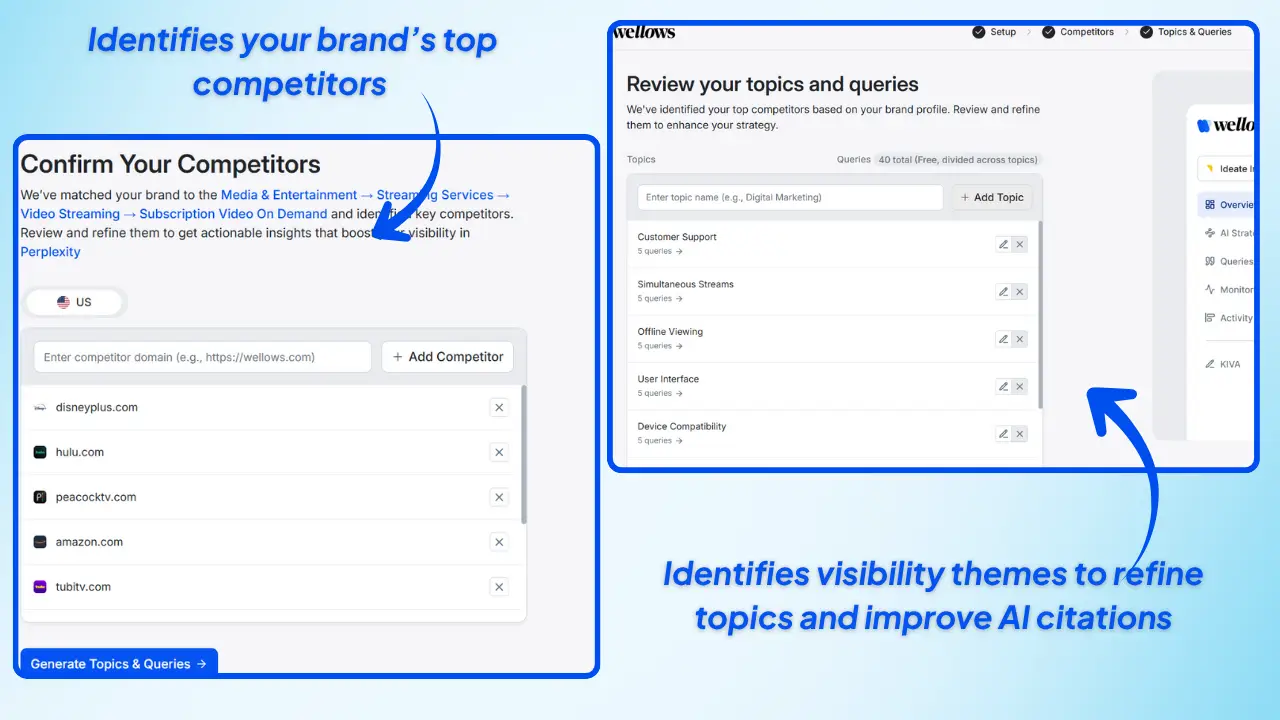
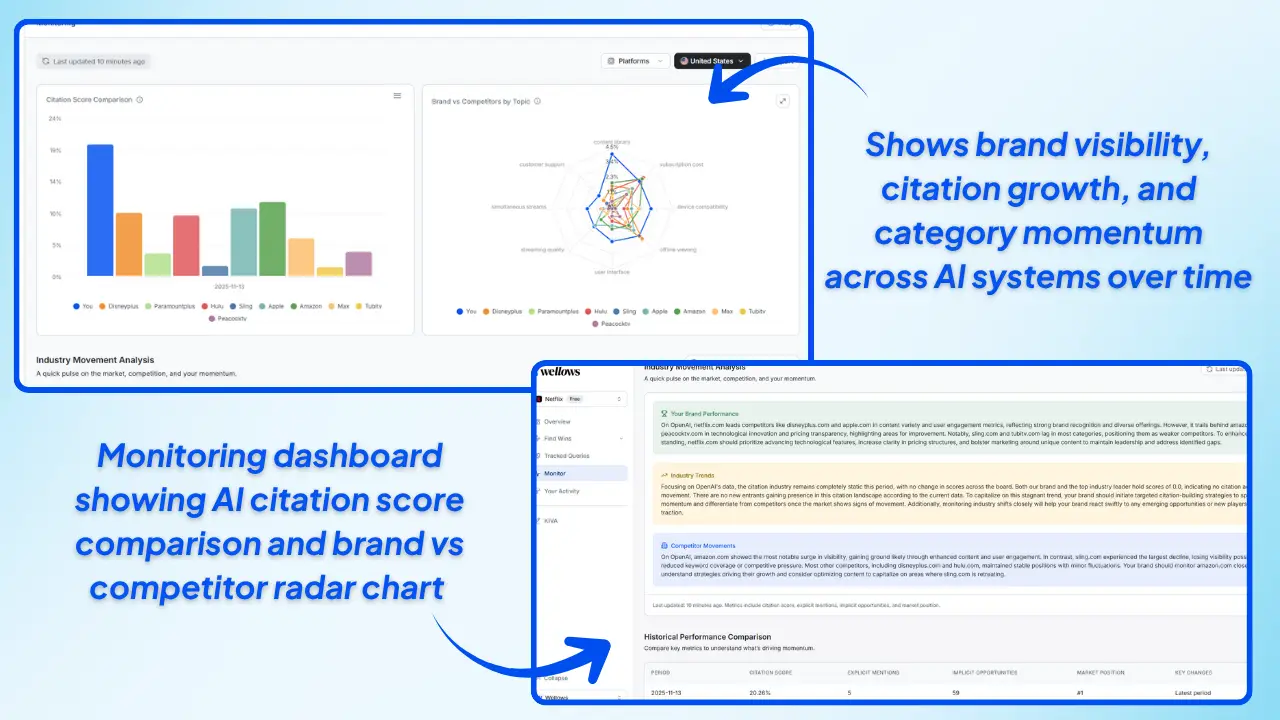
Next, I review how Wellows groups the domain within the industry. It automatically maps streaming services into clusters such as content library, subscription cost, device compatibility, and offline viewing. It then benchmarks the domain against Amazon Prime Video, Disney+, Hulu, Apple TV+, Max, Peacock, Paramount+, Sling, and Tubi, revealing which brands dominate AI-powered watch recommendations.
The Citation Score Comparison chart shows the competitive hierarchy. Netflix leads with a 0.203 score, while Amazon (0.115), Apple (0.106), and Disney+ (0.099) follow with roughly half its visibility. Mid-tier platforms like Max, Peacock, and Paramount+ sit lower, showing where emerging players can gain ground.
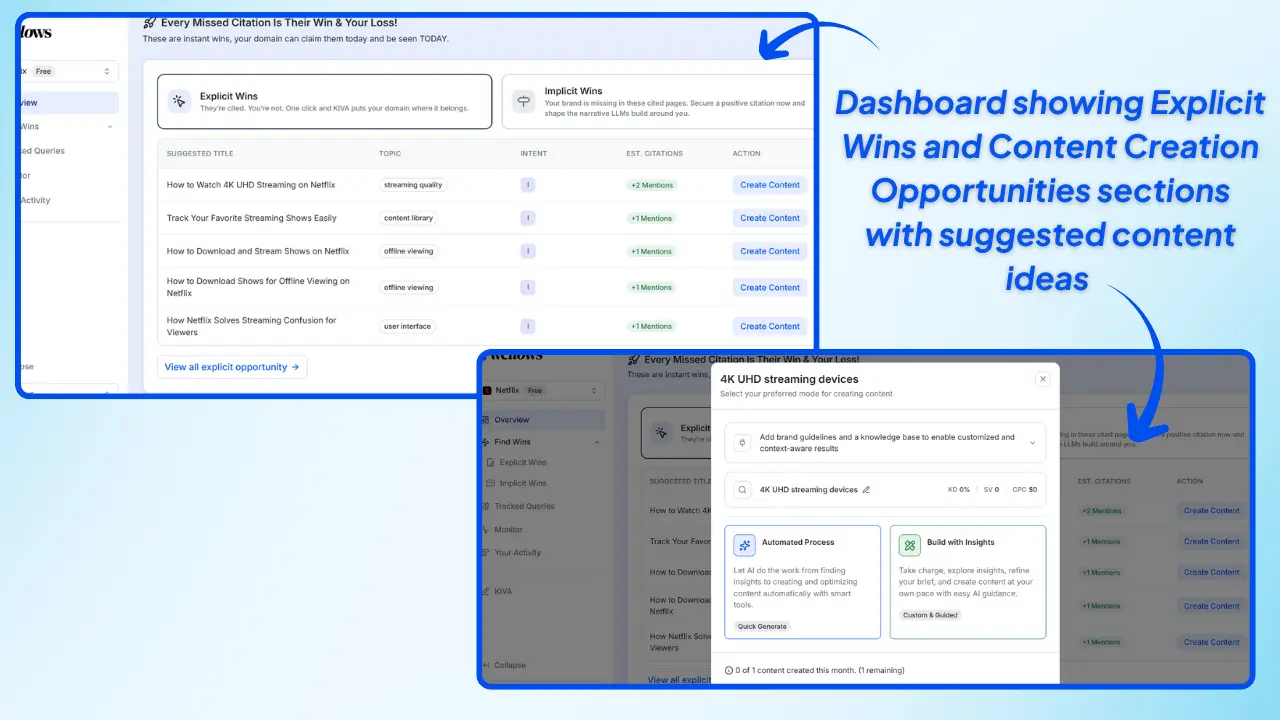
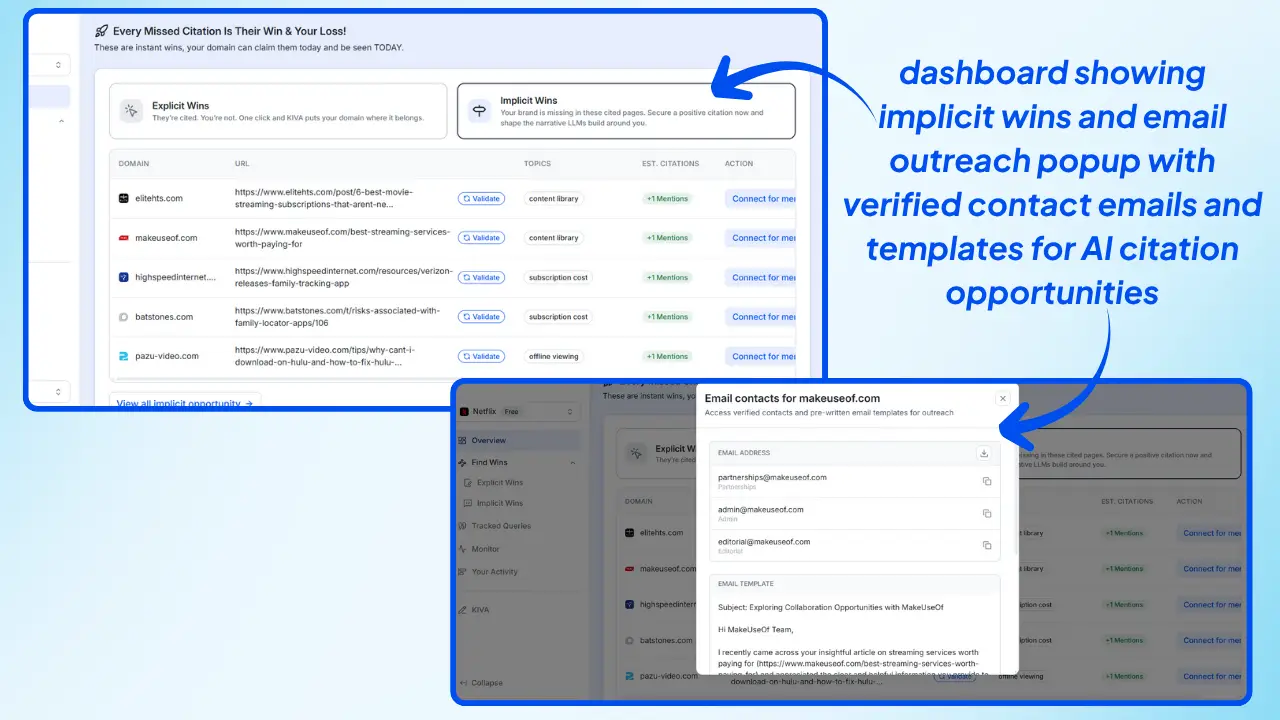
From there, I analyse explicit and implicit wins. Wellows separates direct citations from cases where your value appears but your brand does not. In entertainment, I frequently see competitors credited for 4K streaming quality, offline downloads, subtitle accuracy, or interface design. Each entry becomes a targeted content, metadata, or product explanation fix.
The Top Cited Queries and Competitive Insights views reveal which viewer intents drive citations—such as “why can’t I download this movie,” “best streaming platforms for families,” or “compare subscription costs across services”—and which platforms AI prefers to recommend first. That helps align product messaging with real viewer language instead of internal assumptions.
Finally, I track how sentiment and citations shift over time. Wellows monitors Citation Score, Rank, and sentiment as new seasons drop, global releases launch, or pricing changes roll out. In the Netflix snapshot, 62% neutral and 19% negative sentiment highlight areas where billing issues, device limits, or download restrictions shape how AI summarises the platform.
How Streaming Service AI Visibility Optimization Improves AI Search?
Streaming service AI visibility optimization: How do streaming platforms improve AI search visibility without repeating the same content? Focus on a single, quotable checklist that adds new “verification facts” (plans, devices, regions, downloads) AI can reuse.
Keep plan + pricing pages factual and updated so AI can cite current details.
Publish a device compatibility matrix (TV/console/mobile/web).
State 4K/HDR/Dolby support clearly, including plan/device limits.
List offline download rules (limits, expiry, supported devices).
Add region availability pages for country-level catalog differences.
Create canonical “where to watch” pages for priority titles.
Standardize tier + add-on naming (ads/no-ads) across the site.
Add short FAQs for top friction queries (billing, region lock, downloads).
When these elements are structured and consistent, AI systems can confidently compare streaming platforms and include them in generative recommendations without relying on third-party summaries.
What Is the Current State of AI Search Visibility in Entertainment
Major streaming platforms dominate: Large entertainment brands such as Netflix, Amazon Prime Video, Disney+, Hulu, and Apple TV+ capture most citations in AI-generated viewing recommendations. Their vast catalogs, global licensing, and consistent metadata make them “safe defaults” when AI assistants answer broad questions about what to watch.
Netflix leads in AI visibility: In the Wellows snapshot for netflix.com, the platform records 64 tracked citations across 38 queries, resulting in a 20.26% Citation Score and a #1 Citation Rank. Amazon, Disney+, Apple TV+, and Hulu follow, while services like Paramount+, Peacock, Sling, and Tubi form the mid-to-lower tier.
Topic-level patterns: Most entertainment-related AI answers cluster around recurring themes such as streaming quality (4K, HDR, Dolby Vision), offline downloads, subscription cost, family-friendly options, and device compatibility. In Wellows data, queries like “why can’t I download this movie,” “best app for 4K streaming,” and “compare streaming subscription prices” appear frequently across LLMs.
Sentiment trends: For netflix.com, Wellows shows 62% neutral, 19% positive, and 19% negative sentiment across AI systems. This reflects how assistants describe technical limitations or billing concerns factually, rather than exaggerating praise or criticism.
Monitor performance over time: Competitive Insight charts reveal that large players dominate broad topics like streaming quality and device support, while emerging areas—such as AI-powered recommendations, platform usability, or regional catalog availability—have no clear leader. New entrants can gain visibility by owning these narrow, high-intent viewer queries.
What Entertainment Brand GEO Strategies Improve AI Search Visibility
Entertainment brand GEO strategies: How can entertainment brands improve AI Search Visibility so ChatGPT, Gemini, and Perplexity can verify titles, features, and availability and cite them reliably?
Use an entertainment-native GEO playbook that moves from metadata → proof → monitoring. This keeps the section quotable, avoids repeating your other “GEO techniques” content, and helps AI reuse clean factual blocks without guessing.
9 Practical GEO Strategies for Entertainment Teams
Insight: For entertainment brands, GEO is a revenue lever. When AI engines clearly read your catalog, capabilities, and technical strengths, AI Search Visibility for Entertainment Brands converts directly into app installs, subscriptions, and returning viewers.
How Can Streaming Platforms Use GEO Optimization Techniques
GEO helps streaming platforms structure catalogs, metadata, and viewer guidance so AI systems can identify titles accurately and cite them inside generative answers. Clean entity signals make it easier for ChatGPT, Gemini, and Perplexity to describe your platform correctly.
These steps also strengthen foundational elements covered in the GEO framework, helping platforms earn more citations across AI systems.
Did you know?
- Structure every title clearly: Give each movie, series, and episode a stable page with cast, synopsis, ratings, release dates, regions, and technical specs to reduce confusion between versions or remakes.
- Strengthen metadata completeness: Add codec support, HDR types, audio formats, device compatibility, and region availability. These details shape how AI explains playback differences across platforms.
- Optimise help content for LLM queries: Convert troubleshooting topics—downloads, playback quality, streaming errors—into short, clear explanations aligned with patterns introduced in LLM pattern analysis.
- Make catalog data machine-readable: Use schema for Movie, TVSeries, Episode, and VideoObject so AI systems can confirm details without relying on third-party sites.
- Tie optimisation to viewer intent: Shape content around real AI prompts such as offline viewing, 4K streaming, ad-free options, or family-friendly features.
- Document core user journeys: Explain onboarding, profiles, parental controls, watchlists, downloads, and quality adjustments so AI can represent your UX accurately.
- Align GEO with product metrics: Track trial starts, app installs, session duration, and reactivation events, then map these shifts to Citation Score trends inside Wellows.
- Create clusters for key use cases: Build topic clusters around 4K quality, smart TV compatibility, offline mode, or parental controls to strengthen topical authority.
- Use Wellows as your monitoring loop: Monitor citations, sentiment, and category rank over time, refining metadata and structured content when competitors dominate important queries.
How Can You Optimise Content for AI-Driven Zero-Click Searches
AI-driven zero-click searches pull complete answers directly into ChatGPT, Gemini, and Perplexity, leaving no need for users to visit a results page. For entertainment brands, this means your content must be structured so AI can safely reuse your explanations while still creating pathways for trials, installs, and watch-time.
- Shape content around real viewer questions: Use natural phrasing such as “why can’t I download this movie?” or “best streaming app for families” as headings. These queries mirror the way users speak inside LLMs.
- Answer fully but guide next steps: Provide complete explanations, then add subtle product-led cues like “start a free trial” or “see device compatibility.” Zero-click still drives conversions when pages match intent.
- Design AI-friendly sections: Break information into short blocks with focused headings, feature summaries, and problem-solution sequences. Clean segmentation helps AI lift accurate, self-contained chunks.
- Match topics to existing generative patterns: Align content with how LLMs already summarise platform features. This approach is supported by findings in AEO vs GEO, where structured, intent-led answers outperform keyword-heavy pages.
- Own high-intent “how” and “which” queries: Build clusters around themes like offline mode, 4K quality, smart TV support, or parental controls so assistants associate your brand with specific viewer needs.
- Optimise support content for reusability: Rewrite FAQs and troubleshooting guides in short, direct steps. AI systems rely on concise, verifiable sequences when answering device or playback questions.
- Tie zero-click visibility to funnel metrics: Measure installs, trial starts, subscription upgrades, or reactivations from pages that LLMs frequently surface. This shows how zero-click visibility converts to product outcomes.
- Strengthen entity clarity across sections: Ensure consistent naming for titles, seasons, features, and plans. Fragmented naming makes it harder for AI to recognise your brand confidently.
- Refresh content based on Wellows data: Prioritise updates where Citation Score is low or sentiment is inconsistent. Use visibility gaps as a roadmap for new support pages or metadata improvements.
AI recommends shows, films, and platforms it can verify fast. To increase recommendations:
- Create one canonical page per title with cast, year, synopsis, genres, runtime, rating, and availability
- Add structured data (Movie, TVSeries, Episode, VideoObject) and keep it consistent across pages
- Publish “where to watch” and “best for” pages aligned to viewer prompts (family, 4K, offline, region)
- Maintain accurate region/plan availability and update when licensing changes
- Strengthen third-party consistency on IMDb, Rotten Tomatoes, Wikipedia, and major entertainment press
In short: recommendations rise when your catalog facts are stable, structured, and repeated consistently across trusted sources.
What Role Do Third-Party Sources Play in AI Search Visibility
Third-party domains shape how AI systems understand entertainment brands. ChatGPT, Gemini, and Perplexity often rely on trusted external sources when catalog details, ratings, or feature explanations are unclear on a brand’s own site. These external signals guide entity confidence and influence whether your platform appears inside AI-generated recommendations.
Did you know?
- Review aggregators act as authority signals: Platforms like Rotten Tomatoes, IMDb, and Metacritic help AI validate cast, ratings, and critical reception. Consistent details across these sites reduce uncertainty in generative answers.
- Media and entertainment news drive credibility: Coverage from Variety, Deadline, or Hollywood Reporter gives AI additional proof about release timelines, renewals, production changes, and awards.
- Streaming comparison sites influence recommendations: Tools that compare plans, picture quality, and pricing are frequently surfaced in LLM answers because they offer structured, verifiable data.
- Community platforms affect sentiment: Large discussions on Reddit and social forums shape the tone of AI explanations and influence how assistants summarize viewer experiences.
- Digital PR strengthens entity clarity: Features, interviews, or original data published on authoritative domains expand structured references—an approach supported by insights in Digital PR for GEO.
- Explicit vs implicit citations in Wellows: Third-party pages often contain value points AI reuses without naming the original platform. These become high-priority opportunities for cleanup, updates, or outreach.
AI systems cite third-party sites up to 3–5x more often than brand domains when product data is incomplete or inconsistent. Strengthening external accuracy directly increases your chances of being named inside generative answers.
How Should Entertainment Brands Handle Bias, Governance, and Privacy in AI Search
AI-generated answers often blend factual data with inferred patterns, which can create inaccuracies or reinforce bias. For entertainment brands, this affects how shows, creators, genres, and platforms are represented across ChatGPT, Gemini, and Perplexity. Maintaining trust requires consistent governance and clear, verifiable data across all touchpoints.
- Address representational bias early: Ensure descriptions of casts, genres, characters, and themes are detailed and inclusive. AI often pulls from public summaries, so incomplete narratives can misrepresent your content.
- Keep catalog information consistent: Conflicting titles, ratings, runtimes, or release dates make AI fall back on third-party assumptions. Consistency across all pages significantly reduces misinformation.
- Define a lightweight AI governance model: Set rules for metadata updates, FAQ structures, title naming, and content versioning. Governance ensures LLMs do not surface outdated or conflicting information.
- Protect viewer data in AI workflows: Avoid feeding identifiable user information into external AI tools. Use minimal, anonymized inputs and follow clear permission frameworks to maintain trust.
- Use Wellows to detect tone shifts: Sentiment monitoring reveals when AI descriptions turn negative or unbalanced. These insights guide corrective updates before misperceptions spread.
- Audit LLM outputs regularly: Review AI answers for errors about cast, licensing, platform capabilities, or availability. Structured audits follow principles similar to the LLM pattern analysis checklist.
Even small metadata errors—like a wrong release year or missing cast member—can propagate across multiple AI assistants for months, creating persistent misinformation loops about your titles or platform.
Why Should Entertainment Brands Use AI Search Visibility platforms
Most SEO tools were not built for the AI search era. They track rankings, impressions, and backlinks, but they cannot see how large language models describe, compare, or cite your entertainment platform in real viewer queries. For AI Search Visibility for Entertainment Brands, this leaves a major blind spot—because recommendations now flow through ChatGPT, Gemini, Perplexity, and AI Overviews, not just search results.
Wellows closes that gap. It operates as an AI search visibility platform and GenAI visibility stack for streaming platforms, studios, and production companies. It measures how often your brand appears in AI answers, how those mentions are framed, and how you compare to competing services and catalogs. This aligns with performance insights described in AI visibility enhancement strategies.
| Feature | Wellows | Traditional SEO Suite | Basic AI Monitoring Tools |
|---|---|---|---|
| AI Citation Tracking (ChatGPT, Gemini, Perplexity, Bing) | Yes Tracks how often streaming platforms, titles, features, and studios are cited across major AI engines. | No Measures SERP rankings only. | Partial Surfaces mentions but lacks entertainment context. |
| Implicit Citation Detection (Unlinked Mentions) | Yes Finds where AI describes your value—catalog depth, quality tiers, availability—without naming your brand. | No Cannot read LLM-generated answers. | No Only counts direct brand mentions. |
| Citation Score + Sentiment Fusion | Yes Combines mention frequency, share of voice, and tone into a single AI visibility score. | Partial Shows general brand metrics, not LLM-specific scoring. | Limited Provides surface-level counts with no sentiment model. |
| Entertainment-Focused Benchmarking | Yes Benchmarks you against Netflix, Disney+, Prime Video, Hulu, and other streaming competitors. | No Compares keyword rankings, not AI recommendations. | No Rarely supports category benchmarking. |
| Explicit vs Implicit Wins Dashboard | Yes Highlights missed citations when AI recommends competitors for features your platform already offers. | No Cannot classify LLM outputs. | No Does not separate citation types. |
| Query Intent Clustering | Yes Groups AI prompts around viewer needs like 4K streaming, offline downloads, parental controls, and device support. | No Groups by keywords only. | Partial Clusters prompts but without entertainment-specific context. |
| Real-Time Sentiment Tracking | Yes Monitors tone for your brand and competitors across AI assistants. | Partial Tracks reviews but not AI sentiment. | Limited Lacks historical tone trends. |
| Visibility Playbooks & Content Suggestions | Yes Generates GEO-aligned ideas based on streaming queries, catalog gaps, and feature misattributions. | No Leaves analysis to the team manually. | No Provides raw data without guidance. |
This mirrors core principles explained in the evolution of modern search, where AI visibility is now a performance channel—not a side metric.
How Should You Measure Progress and Plan the Next 90 Days
To make AI Search Visibility for Entertainment Brands measurable, you need KPIs that show how often AI assistants mention your platform, how accurately they describe your catalog, and how your visibility compares to competitors. These signals matter because generative engines shape viewing decisions across major AI systems.
- Citation Score: Measures how frequently AI systems name or recommend your brand.
- Citation Rank: Shows your position versus competing streaming platforms across shared viewer prompts.
- Tracked Queries: Prompts like “best 4K streaming service” or “where can I watch this title.”
- LLM Coverage: Visibility consistency across ChatGPT, Gemini, Perplexity, and Bing AI.
- Sentiment by Topic: Tone associated with catalog size, streaming quality, user interface, and pricing.
These KPIs fit the broader measurement principles outlined in LLM visibility audits, which help teams map visibility gaps, citation patterns, and competitive strengths.
90-Day Plan
- Weeks 0–4: Run a Wellows audit, correct metadata inconsistencies, identify explicit and implicit wins, and update FAQ or feature pages with structured markup.
- Weeks 4–8: Build topic clusters around viewer intents such as offline downloads, HDR formats, device support, and subscription value.
- Weeks 8–12: Strengthen citations across review sites, media publishers, and partner platforms while improving content based on Citation Score movement.
This approach aligns with the patterns discussed in LLM seeding, where consistent signals help AI systems trust and reuse your brand more often.
Generative engines rely heavily on consistent metadata. Even a single outdated title description can reduce citation frequency across multiple AI systems for weeks.
Discover how AI Search Visibility shapes discovery across different industries. Each guide explains how brands strengthen citations, entity recognition, and sentiment inside AI-generated answers.
- AI Search Visibility for Cybersecurity Brands: Strengthen your presence in AI-driven risk intelligence and compliance-related queries.
- AI Search Visibility for B2B SaaS Brands: Increase visibility in AI-powered software recommendations and product comparison prompts.
- AI Search Visibility for Automotive Brands: Boost discovery in AI-generated mobility guidance, model comparisons, and purchase advice.
- AI Search Visibility for Aviation & Airlines Brands: Enhance how your routes, pricing, and travel services appear in AI itinerary and trip-planning answers.
- AI Search Visibility for Banking & Financial Services Brands: Improve visibility in AI-led financial guidance, lending queries, and money management prompts.
- AI Search Visibility for Beauty & Personal Care Brands: Strengthen presence in AI-powered beauty recommendations, product advice, and skincare guidance.
- AI Search Visibility Audit Checklist: A practical framework to measure, fix, and grow your brand’s citations across major AI search platforms.
Insight: Entertainment is one of the fastest-shifting categories in AI search. Brands that control their metadata, entity clarity, and third-party citations gain stronger placement in generative answers—and avoid being replaced by competitors inside recommendation engines.
FAQs
Conclusion
The biggest risk for entertainment brands today is simple: if AI assistants don’t cite you, viewers don’t see you. In an environment where audiences ask ChatGPT, Gemini, and Perplexity what to watch, AI Search Visibility for Entertainment Brands now defines discovery, relevance, and competitive advantage.
Strong metadata, structured catalog signals, and consistent third-party references help generative engines verify your identity and recommend your titles with confidence. Because AI answers compress the viewing journey into a single response, even small improvements in data quality and sentiment can shift how often your platform appears in those results.
The visibility loop stays the same: audit → structure → earn citations → monitor & improve. When teams follow this cycle, each update strengthens how AI systems understand your brand and increases the likelihood of being cited for intent-rich queries across formats and devices.
Wellows, an AI search visibility platform, turns these signals into measurable insights—helping entertainment brands see where they appear, where they’re missing, and how to climb higher across major AI systems.