Search is changing fast because AI algorithm updates are reshaping how engines understand meaning, measure trust, and decide what deserves visibility.
Instead of relying mainly on keyword matching, modern ranking systems increasingly use semantic understanding, entity relationships, and quality frameworks like E-E-A-T (Experience, Expertise, Authoritativeness, Trustworthiness).
That’s why rankings can feel more volatile—and why recovery often takes longer than it used to.
This guide explains, in plain language, what AI-driven updates are, what they change in SEO, how confirmed Google updates fit into the “AI era,” and what to do if your site drops.
What Are AI Algorithm Updates?
AI algorithm updates are changes to how search systems use machine learning and language models to evaluate content, interpret queries, and rank results.
Unlike older “rule-based” algorithms (where ranking factors were closer to fixed signals), AI-driven systems can:
- Understand intent (what the user actually wants), not just words
- Detect content depth vs. fluff
- Evaluate consensus and trust signals at scale
- Improve retrieval using semantic similarity (meaning-based matching)
Traditional algorithm updates vs. AI-driven updates
In simple terms:
Traditional: “Does this page contain the right keywords and links?” AI-driven: “Does this page truly answer the intent, align with trustworthy understanding, and deserve to be referenced?”
That shift is why a site can lose rankings even if it “looks optimized” on-page.
What are the Major Google Algorithm Updates in History?
To rank first now a days, you need to understand how Google evolved from simple filters to the complex AI systems of 2026. This timeline covers the foundational “Legacy” era through to the current “Generative AI” era.
| Era | Update Name | Year | Primary Impact & 2026 Relevance |
| Legacy | Panda & Penguin | 2011-12 | Stopped thin content and spam links. Now part of core AI. |
| Semantic | Hummingbird | 2013 | Taught Google to understand intent instead of just keywords. |
| AI Start | RankBrain | 2015 | The first time Google used Machine Learning to rank results. |
| Context | BERT | 2019 | Improved understanding of natural, conversational language. |
| Quality | Helpful Content | 2023 | The Turning Point: Google began penalizing SEO-first content. |
| AI Spam | March 2024 Core | 2024 | Massive 45-day update that reduced “low quality” content by 45%. |
| Retrieval | MUVERA (June) | 2025 | Integrated multi-vector retrieval to better understand complex topics. |
| Real-Time | Dec 2025 Core | 2025 | Refined AI Overviews and rewarded verified expert authorship. |
| Current | 2026 Priorities | 2026 | GEO (Generative Engine Optimization) and Brand Citations. |
Why AI Algorithm Updates Accelerated After 2024?
Two big changes made AI updates feel more frequent and more impactful:
Google introduced AI-generated summary experiences (AI Overviews) and continued evolving them. These features change how users interact with results and how traffic flows.
Google’s official guidance explains that core updates are broad changes designed to improve overall results, and impact can take time to assess and recover from.
On top of those “named” updates, many smaller improvements aren’t announced so the ecosystem feels like it’s always moving.
How AI Algorithm Updates Are Reshaping Search Rankings?
1) Rankings are less about matching and more about meaning
AI pushes search toward semantic search: relationships between topics, entities, and intent.
What this means for you:
- Pages that “mention the keyword” but don’t fully satisfy the query can drop
- Pages that cover the topic comprehensively (with clear structure) often rise
2) Visibility ≠ clicks (the zero-click reality)
AI summaries can answer users immediately, reducing clicks to websites even if you’re visible. Which is why becoming a cited source matters, and why teams focus on how to rank in Google AI Overviews instead of relying on rankings alone. This is why modern SEO is shifting from “rankings only” to visibility + citation + brand demand.
3) “One page” SEO is weaker than “site authority” SEO
AI systems are better at judging whether your site is a credible source—not just whether one page is polished. That’s why topic clusters and consistent quality matter more.
Major AI-influenced core & spam updates (2025)
In 2025, Google introduced major AI-driven core and spam updates that prioritized high-quality, original, and authoritative content while targeting template-based AI spam and manipulative link practices.
Key updates, including the March 2025 Core Update, August 2025 Spam Update, and December 2025 Core Update, reinforced the importance of real human value, expertise, and authentic E-E-A-T signals over AI-generated filler and spammy backlinks.
These updates, particularly the deeper integration of the Helpful Content System, aimed to significantly reduce low-quality and unoriginal content by using AI technologies such as SpamBrain to identify and counter deceptive tactics.
March 2025 Core Update June 2025 Core Update August 2025 Spam Update December 2025 Core Update
Foundational AI transition updates (2024)
2024 included major shifts that laid the groundwork for AI-era ranking behavior, including core and spam updates and the broader rollout of AI-generated answer experiences (AI Overviews).
Pre-AI foundations before 2024 (brief context)
Earlier systems like helpful-content style quality improvements, review systems, and spam systems mattered because they trained the ecosystem toward “people-first” value and away from manipulation—setting the stage for AI-era evaluation.
What These AI Algorithm Updates Have in Common?
Across confirmed core/spam cycles and AI-feature expansion, the consistent themes are:
Helpfulness and satisfaction signals are prioritized (Google frames core updates as broad improvements to show more relevant, satisfying content).
E-E-A-T becomes more important in competitive spaces (especially YMYL).
Semantic coverage beats surface optimization: comprehensive answers win.
Authority is evaluated broadly: your site’s reputation matters, not just one page.
AI Mode, AI Overviews & Generative Search Systems
AI Overviews are AI-generated summaries shown in search results for certain queries, often paired with links to sources.
Why this matters for SEO?
In the generative era, you can “win” in multiple ways:
- Rank traditionally (blue links)
- Get cited in AI-generated summaries
- Earn brand visibility even when clicks decline
That’s why many teams now apply Generative Engine Optimization while optimizing content so it can be confidently retrieved, summarized, and cited by AI systems, not just ranked.
Inside Google’s Semantic Shift (MUVERA & AI Retrieval)
Google’s move toward AI-driven search is powered by advanced semantic retrieval systems, including MUVERA (Multi-Vector Retrieval Algorithm). Rather than relying heavily on exact keywords, MUVERA helps Google understand the meaning behind queries and content by analyzing context, relationships between topics, and intent at scale. In practical terms, this shift means Google can now evaluate whether a page truly addresses what a user is looking for—even if the wording differs from the query. The system compares concepts, not just phrases, making it far easier to identify high-quality, comprehensive content and far harder for thin rewrites or keyword-stuffed pages to succeed. Search has become meaning-first, not keyword-first Entities, topic relationships, and contextual relevance carry more weight Superficial rewrites and templated content are easier for AI systems to detect To align with MUVERA-style AI retrieval systems, focus on: Answering the full intent, not just a fragment of the query Writing in natural language that covers related subtopics and variations Strengthening internal linking so Google can clearly see topical relationships Building topical depth across your site instead of isolated pages When your content demonstrates clear context, depth, and connections, AI retrieval systems like MUVERA are better able to recognize it as a reliable and relevant source—improving both rankings and inclusion in AI-driven search experiences.

What this semantic shift means in practice?
How to adapt your content strategy?
Top AI-Driven Ranking Signals After Algorithm Updates
Below are the Visibility Factors that tend to matter most after AI-driven changes:
1) E-E-A-T signals
Practical ways to strengthen:
Real author bios, credentials, and “why trust us”
First-hand experience elements (photos, steps, real examples)
Reliable citations for claims
2) Semantic topic coverage
Cover definitions, steps, edge cases, comparisons, and FAQs
Don’t rely on one “perfect” keyword paragraph—build complete topical coverage
Reliable citations for claims
3) Citation and reputation authority
Earn mentions from credible sources
Build digital PR and real references, not manipulative link schemes
4) Content freshness (where relevant)
Update time-sensitive pages (especially in fast-moving niches)
Add “last updated” and actually update the substance
5) Engagement and satisfaction
Clear structure, fast load, strong UX
Make answers easy to consume
Industries Most Impacted by AI Algorithm Updates
AI-driven volatility is usually highest in YMYL (health, finance, legal), because incorrect information can cause harm. Systems apply stricter trust expectations there.
What to do if you’re in YMYL:
- Add credentialed reviewers or expert reviewers
- Improve sourcing
- Make compliance and accuracy obvious
How Long Do AI Algorithm Update Effects Last?
Google’s guidance notes that after improvements, it may take days to months to see effects, and sometimes longer depending on reevaluation cycles.
A practical way to set expectations:
- Week 0–2 (during/just after rollout): volatility, noise, mixed signals
- Weeks 3–6: clearer pattern emerges; winners/losers stabilize
- Months 2–4: deeper sitewide reassessment can show results if improvements are real and consistent
Recovering from Ranking Drops Caused by AI Algorithm Updates
If rankings drop, the biggest mistake is trying to “game” what happened with random changes. AI-era recovery works best when you treat it like a quality + authority project, not a keyword tweak.
The recovery mindset
Don’t panic-delete content
Don’t rewrite everything at once
Identify what lost visibility, why, and fix systematically
AI Algorithm Recovery Checklist
Use this AI Search Visibility Audit Checklist as a structured and thorough approach to diagnosing and recovering from AI-driven ranking drops:
-
Confirm the timing of the impact
Verify whether the visibility decline aligns with a confirmed algorithm update by cross-checking official update timelines and rollout periods. -
Segment and analyze the impact
Clearly identify where losses occurred by reviewing:-
Pages that experienced the largest visibility declines
-
Query types affected (informational vs. commercial)
-
Countries, regions, or devices where performance dropped
-
-
Conduct a content quality audit
Review impacted pages to determine whether they:-
Provide the most complete and helpful answer to the search intent
-
Demonstrate genuine experience and subject-matter expertise
-
Reference credible, authoritative sources where appropriate
-
-
Evaluate topical authority and internal structure
Assess whether your content:-
Is organized into well-defined topic clusters rather than isolated pages
-
Uses internal links effectively to signal topical relationships and depth
-
-
Strengthen trust and E-E-A-T signals
Improve overall credibility by:-
Enhancing author bios, editorial guidelines, references, and contact/about pages
-
Reducing, consolidating, or improving thin, anonymous, or low-value content on critical topics
-
-
Perform a technical SEO audit
Identify and resolve issues related to:-
Crawling and indexing
-
Core Web Vitals, page speed, and mobile usability
-
Broken templates, links, or structural elements
-
-
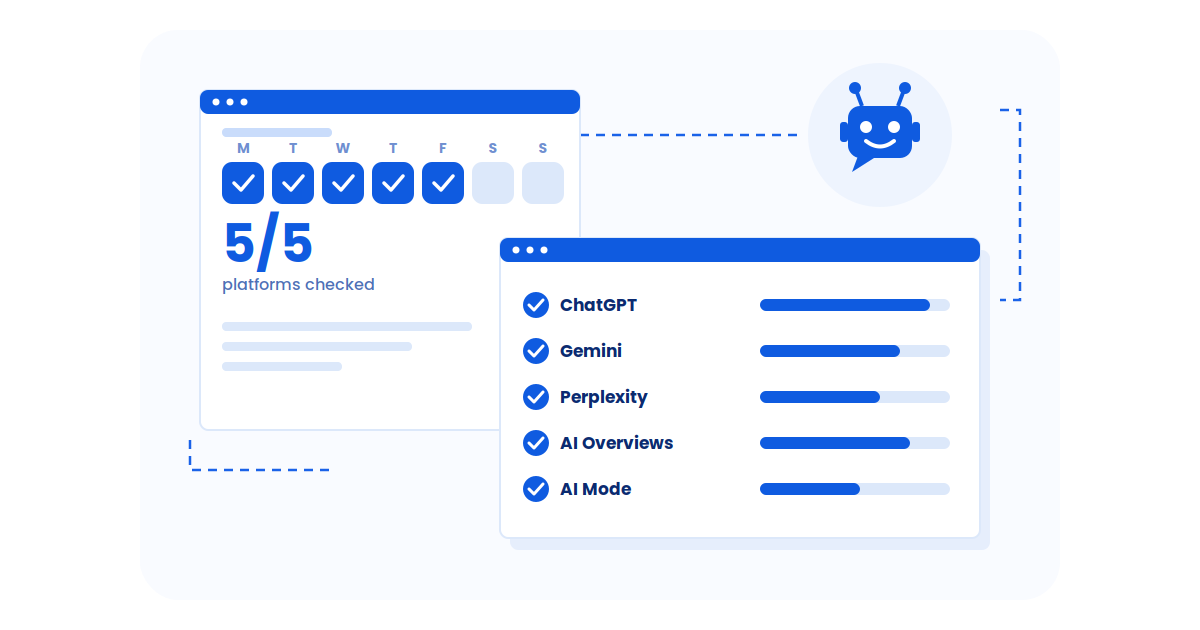
Measure AI visibility, not just traditional rankings
Track whether your content is being cited or surfaced in AI-driven search experiences and monitor performance trends over time instead of reacting to short-term fluctuations.
Measuring Success After AI Algorithm Updates
Traditional rank tracking alone can mislead you in AI-era search, because:
- SERPs change layout frequently
- AI Overviews can steal clicks
- Visibility might improve even if clicks don’t
That’s why teams track GEO KPIs such as:
- AI citation presence (when measurable)
- Share of voice for target topics
- Branded search growth
- Conversions from organic (not just traffic)
Effective Strategies for Long-Term AI Search Visibility
These are Effective Strategies for AI Visibility that tend to work across updates:
1) Build “reference-worthy” content
Aim to become the page people cite, not just the page that ranks.
- Definitions + steps + examples + limitations + FAQs
- Include original insights and experience
2) Strengthen topic clusters
Create a pillar page and supporting pages that answer sub-intents.
- Link them clearly
- Avoid orphan pages
3) Improve author credibility and editorial clarity
- Named authors
- Reviewers for YMYL
- Update policies
4) Refresh content with purpose
Don’t just change dates—add new data, new sections, improved clarity.
5) Invest in real authority signals
- PR mentions
- Partnerships
- Thought leadership
- Community recognition
Common Mistakes to Avoid After AI Algorithm Updates
These mistakes often delay recovery and compound ranking losses after AI-driven updates.
Read More Articles
- Boost AI Search Visibility with Knowledge Graphs
- AI Search Marketing: ChatGPT vs Traditional Search
- Does Google Ranking Ensure Visibility in ChatGPT
- AI Search Visibility for Fashion & Apparel Brands in 2026
- Avoid SEO Mistakes Blocking Brand Visibility in AI Search
- AI Search Visibility for Banking & Financial Services Brands
- AI Search Visibility for Biotechnology Brands
- AI Search Engines: How Brands Get Recommended
- How to Use AI Content Scoring to Improve SEO & Quality 2026
FAQs:
Conclusion: