TL;DR
| Definition A citation gap analysis shows which AI answers cite your competitors but not you. |
Why it matters If competitors are named and cited in AI answers and you aren’t, people who ask AI see them, not you. |
| Quick start Ask five real customer questions in ChatGPT or Google AI Mode and write down who gets named and cited. |
Fix first The gap that needs the fewest extra citations on a topic you sell. Close it with a new page, a better page or a mention on a cited page. |
An AI citation gap analysis starts from a simple fact. When someone asks ChatGPT or Google’s AI Mode a question, the answer names a few brands and links to a few pages. Those links are citations. If your competitors are named and cited and you aren’t, that’s a citation gap. You find the gaps, see how big they are, and fix the ones that matter most: by writing a page, improving a page, or getting mentioned on the pages the AI already trusts.
Here is what a gap looks like. On 5 November 2026 we asked Google AI Mode (US) “what are the best tools to track my brand in AI search answers”.
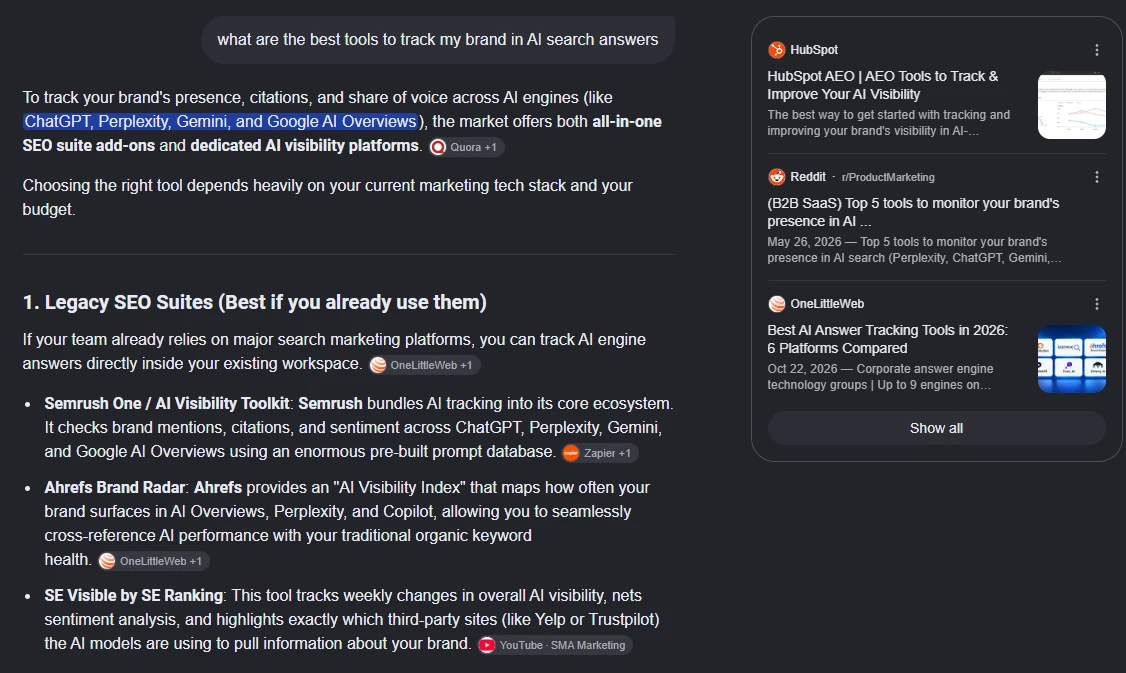
The answer named Profound, Peec, Semrush, Ahrefs, SE Ranking and HubSpot. It cited pages on Quora, OneLittleWeb, Zapier, YouTube, Reddit, HubSpot, Adobe and Searchable. It didn’t mention Wellows anywhere. For Wellows, that one answer is a citation gap. AI answers change from run to run. In a SparkToro study (published 28 January 2026), 600 volunteers ran 12 prompts 2,961 times on ChatGPT, Claude and Google’s AI, and there was less than a 1 in 100 chance that ChatGPT or Google’s AI gave the same list of brands twice (SparkToro research on AI answer consistency). So a single answer is a clue, not a verdict. A citation gap analysis checks many prompts, many times, so you can see the pattern.
1What do the key terms mean?
You only need seven terms to follow this guide:
- Prompt: the question someone types into an AI tool, such as “best CRM for a small agency”.
- AI engine: the tool that writes the answer. In this guide that means ChatGPT, Gemini, Perplexity, Google AI Overviews (the AI summary at the top of some Google results) and Google AI Mode (Google’s chat-style search).
- Mention: your brand’s name appears in the answer text.
- Citation: the answer links to a page as its source.
- Own-site (explicit) citation: the cited page is on your own website.
- Third-party (implicit) citation: the cited page is on someone else’s site, and it mentions your brand.
- Citation share: the percentage of all citations in a set of answers where you appear. Wellows defines it as “the fraction of every (prompt × engine) citation where you appear”.
Mentions and citations are different results, and they don’t always go together. Semrush’s 2026 AI Visibility Index (126 million US prompts, January to April 2026, a Semrush study) found that on Gemini the overlap between the brands an answer mentions and the domains it cites can be as low as 30% (Semrush AI Visibility Index announcement). So count both.
A note on the name: some teams call this a citation gap audit. In academic research, “citation gap” means something else: some groups of papers or authors get cited less than others, for example by region (Rungta et al., Geographic Citation Gaps in NLP Research, 2022). This guide is only about AI search.
2How can you do a citation gap analysis in 15 minutes for free?
You don’t need a tool to see your first gaps. You need five questions and a notes page.
| 1 | Ask 5 real questions. Use ChatGPT or Google AI Mode. Pick questions a customer would ask before they know your name, such as “best [your product type] for [your customer]”. Don’t include your brand in the question. |
| 2 | Write down what you see. For each answer, note the brands it names and the pages it cites. Most answers show sources as links, chips or cards next to the text. |
| 3 | Mark the gaps. Wherever competitors appear and you don’t, mark it as a gap. Note the kind of page that got cited: a list, a forum thread, a video, or a competitor’s own page. |
Here is the AI Mode answer from above, written up as one row:
| Field | Example |
|---|---|
| Prompt | what are the best tools to track my brand in AI search answers |
| Engine, date | Google AI Mode (US), 5 Nov 2026 |
| Brands named | Profound, Peec, Semrush, Ahrefs, SE Ranking, HubSpot |
| Pages cited | quora.com, onelittleweb.com, zapier.com, youtube.com, reddit.com, hubspot.com, business.adobe.com, searchable.com |
| You named? | No |
| You cited? | No |
| Gap? | Yes. Almost all cited pages are on other people’s sites, including a Reddit thread and a YouTube video, so this looks like a third-party gap. |
If you want a quick check on one engine, Wellows has free AI citation checkers. The ChatGPT visibility tracker shows whether ChatGPT mentions or cites a domain, and there are matching free tools for Perplexity citations and Google AI Overviews citations. Five prompts give you a feel for the problem. To decide what to fix, you need the full method below.
3What are the four types of citation gap?
The four types are a missing page, a page that exists but isn’t cited, a third-party gap and an engine gap. The type tells you the fix, so sort first and act second.
| Gap type | What you see | Usual fix |
|---|---|---|
| 1. Missing page | No page on your site answers the prompt. Competitors’ pages get cited. | Create one strong page for that question |
| 2. Page exists, not cited | You have a good page. It may even rank in Google. The AI cites other pages. | Improve the existing page |
| 3. Third-party gap | The AI cites reviews, lists, videos or threads that name competitors, not you. | Outreach and honest participation |
| 4. Engine gap | You’re cited on one AI engine and missing on another for the same prompt. | Look at that engine on its own |
Type 2 surprises people who rank well in Google. Ahrefs checked 15,000 long-tail queries (published 11 August 2025). On average, just 12% of the URLs AI assistants cited also ranked in Google’s top 10. For ChatGPT it was 8.0% for in-text citations and 6.1% for references. For Perplexity it was 28.6% (Ahrefs, AI search overlap study). We cover this split in more depth in why pages that rank in Google still miss LLM citations.
Type 4 is common because each engine draws on a different slice of the web. Wellows’ citation overlap study covered 22.7 million citations across ChatGPT, Gemini, Perplexity, Google AI Overviews and Google AI Mode, from January to June 2026. Pages overlapped just 6.8% between engines. On the same question, Perplexity never cited 89.1% of the websites ChatGPT cited (Wellows AI citation overlap study). Winning on one engine tells you little about the others.
4How do you analyze citation gaps in AI search, step by step?
Build a prompt set from real questions, pick competitors and engines, run every prompt and log every cited page, find the most-cited domains, work out citation share by topic and by engine, then give each gap one fix. You can do it by hand in a spreadsheet or run it on a schedule in a tracker.
Step 1: Build a prompt set from real questions
Your prompts should sound like your buyers. Good places to find them:
- Google Search Console queries of eight words or more. Long queries often read like prompts typed into Google. One query in Wellows’ own Search Console data reads: “what is the process agencies follow to discover ai citation gaps where ai tools reference a brand but don’t link back to the client’s website?”
- Questions from sales calls, demos and support tickets.
- Common patterns: “best [product] for [use case]”, “[competitor] alternatives”, “[you] vs [competitor]”, “how to [job your product does]”.
Start with 20 to 50 prompts per topic. That’s a rule of thumb, not a tested number. Group the prompts by topic, because you’ll read the gaps topic by topic.
Keep most prompts free of your brand name. Branded prompts make you look good. In Wellows’ tracking, the top prompts by visibility are all “wellows vs X” comparisons. For example, one “wellows vs [competitor]” prompt had 16 citations and 94.12% visibility on 5 November 2026. The real gaps sit in prompts where the buyer hasn’t picked a brand yet.
Step 2: Pick competitors and engines
Choose three to five competitors you actually lose to. Then add the domains the engines keep citing, even if you don’t sell against them. The brand that leads a topic is often not one of your usual rivals. It can be an all-round SEO suite, a publisher or a review site. Check who actually holds the citations instead of assuming it’s your usual rivals.
Check each engine separately. Engine gaps only show up if you keep them apart.
Step 3: Run every prompt and log every cited page
Run each prompt on each engine. Copy the sources into a log. AI answers change between runs, so run each prompt more than once, on different days, before you call something a gap. Use one row per prompt, per engine, per run:
| Column | What to record |
|---|---|
| Prompt | The exact wording you used |
| Topic | The group the prompt belongs to |
| Engine | ChatGPT, Gemini, Perplexity, AI Overviews or AI Mode |
| Date and location | When and where you ran it (answers vary by both) |
| Brands mentioned | Every brand named in the answer, in order |
| Cited URLs | Every source link the answer shows |
| Your site cited? | Yes or no (own-site citation) |
| Third-party page naming you cited? | Yes or no (third-party citation) |
| Leading competitor | The brand with the most citations in this answer |
| Gap type | 1 to 4, from the table above |
| Fix and owner | Create, improve, outreach or engine check, plus one named person |
Get the template as a Google Sheet (File > Make a copy). It has four tabs: How to use; Log, with a “Gap?” formula and the AI Mode example in row 2; Domains, which counts how often each domain is cited; and Priority, which works out the score in the “fix first” section below.
Step 4: Find the most-cited domains
Once your log has a few dozen rows, count how often each domain appears in the cited URLs. Put your competitor citations and everyone else’s in the same count. The domains at the top show where the engines get their answers for your topic. The top few become your outreach list.
The AI Mode example above is a tiny version: one answer that cited eight different domains (quora.com, onelittleweb.com, zapier.com, youtube.com, reddit.com, hubspot.com, business.adobe.com and searchable.com). One answer can’t tell you which domain matters most. A real count needs many prompts, run more than once.
Step 5: Work out citation share by topic and by engine
Citation share tells you how big each gap is:
Citation share = citations where you appear ÷ all citations counted
Work it out for each topic and each engine. Do it for you and for the leading competitor. For example, on 6 November 2026 Wellows’ tracking counted 1,570 citations in ChatGPT’s answers to our prompts, and 71 of them were ours: 71 ÷ 1,570 = 4.5%. Count own-site and third-party citations separately too, because they need different fixes.
Step 6: Sort each gap and give it one fix
Tag each gap with its type from the four-type table. Give it one main fix and one owner. A gap with three owners and four possible fixes stays open.
Should you do it by hand or with a tracker?
By hand is enough if you have fewer than about 20 prompts, check one or two engines, and need a one-off answer. Ask each engine yourself and fill in the template.
A tracker makes sense when you need the same prompts re-run every day or week across several engines, with your competitors’ shares next to yours and a list of the third-party pages behind each answer. Manual logs break down at that point. If your team already pays for an SEO suite with an AI visibility report, check what it covers before you add another tool. The tools table below compares six options.
5Example: What did Wellows’ own citation gap analysis show?
It showed that wellows.com is far behind the brands that lead its category, that more than four in ten of its citations come through other people’s pages, and that the clearest open gaps are YouTube videos, Reddit threads and comparison pages. Wellows tracks wellows.com in its own app. The project covers 339 prompts in the US across ChatGPT, Perplexity, Google AI Overviews, Google AI Mode and Gemini. We read the numbers below from the app on 5 and 6 November 2026; each table and screenshot gives its date. Every figure is Wellows data on wellows.com, and most of it doesn’t flatter us.
The competitor gap and the engine gap
The Overview screen ranks every brand the project tracks by visibility score. On 6 November 2026, wellows.com ranked 10th at 4.6%. The four brands at the top, all AI visibility or SEO tools, scored between 42.6% and 45.2%. We have left their names out. A gap of about 40 points is not something one page closes.
Prompt Tracking can be filtered by engine. Here is the same project on each engine, read on 6 November 2026:
| Engine | Visibility score | Wellows citations / all citations | Own-site / third-party |
|---|---|---|---|
| ChatGPT | 4.52% | 71 / 1,570 | 31 / 40 |
| Google AI Overviews | 4.99% | 79 / 1,584 | 40 / 39 |
| Google AI Mode | 4.60% | 49 / 1,066 | 28 / 21 |
| Gemini | 4.42% | 64 / 1,447 | 38 / 26 |
| Perplexity | No results yet | – | – |
The four engines with results add up to the project’s total for the day: 263 Wellows citations out of 5,667. That is a day newer than the summary screenshot below, so the totals differ slightly. Perplexity showed no results on this day.
What this means
Wellows’ share hardly changes from engine to engine (4.4% to 5.0%), so the engine gap is not in the share. It is in how we get cited. On ChatGPT, 40 of 71 citations (56%) came through other people’s pages. On Gemini, 38 of 64 (59%) were wellows.com’s own pages. So a ChatGPT fix is mostly third-party work, and a Gemini fix is mostly our own pages. The app’s daily brief also names ChatGPT as the engine where Wellows is furthest behind a competitor. Perplexity has to be checked by hand until the app has results for it.
Own pages vs other people’s pages
Prompt Tracking counts Wellows’ citations and splits them into explicit and implicit:

- Tracked prompts: 339
- Visibility Score: 4.86%
- Total Citations: 282 / 5,800
- Citation distribution: 161 explicit, 121 implicit
What this means
121 ÷ 282 = 43%. So 43% of the citations that count for Wellows came through other people’s pages, not wellows.com. An analysis that counted only wellows.com links would have missed more than four in ten of them.
The third-party gap: 419 pages that mention competitors
All Outreach Opportunities lists “Sites that already mention your competitors”, with a projected citation figure for each. For wellows.com it shows 419 open opportunities, none contacted yet.
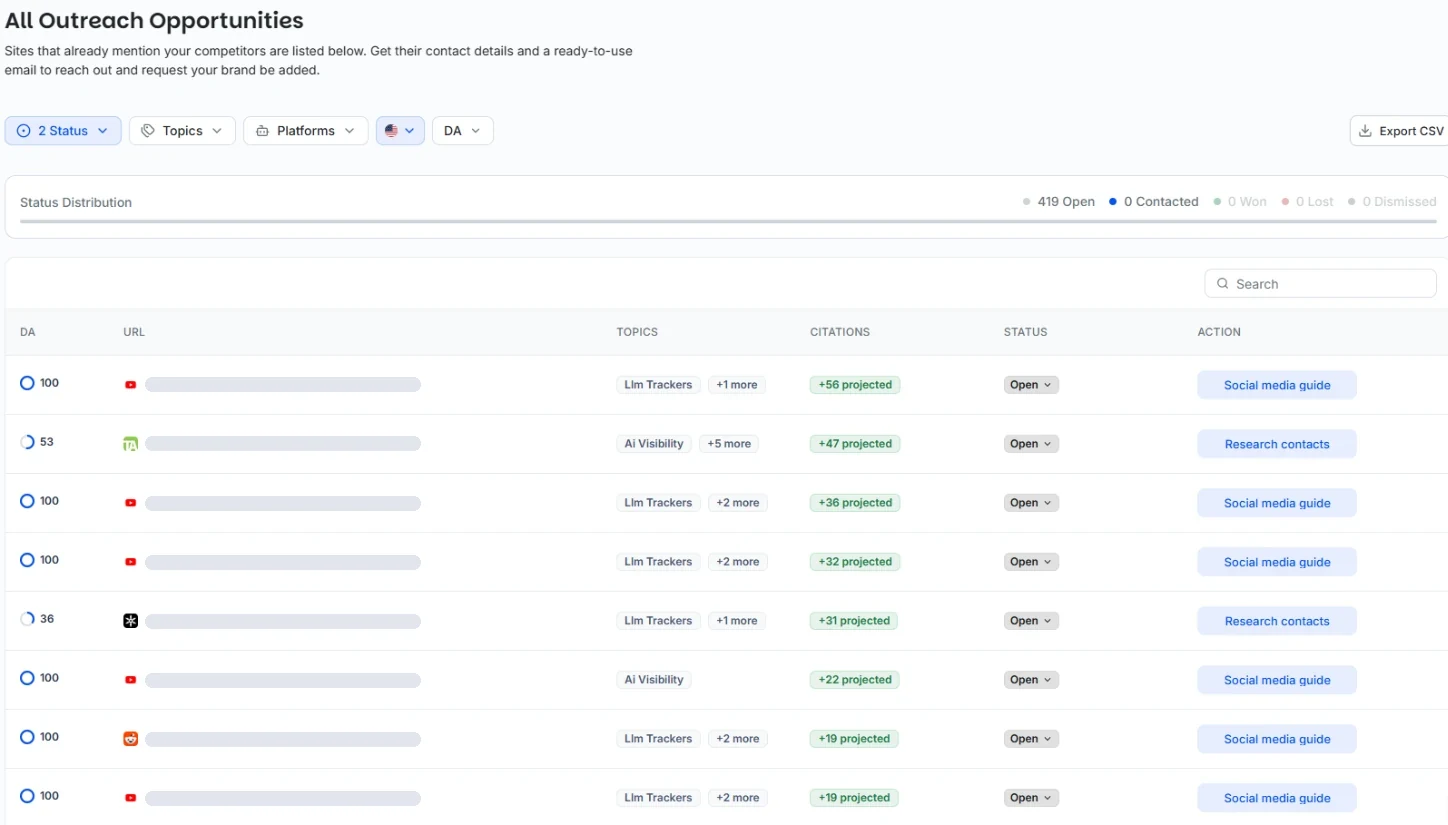
Of the top 10 by projected citations, 7 are YouTube videos, 1 is a Reddit thread, and 2 are “best AI search tools” articles on software and marketing sites (+47 and +31 projected).
The top YouTube video shows +56 projected. For the YouTube and Reddit rows, the app’s action is “Social media guide”. For the two articles, it’s “Research contacts”.
What this means
At the top of the list, Wellows’ third-party gap is mostly video and community rather than editorial lists.
The own-page gap: 91 New Content Opportunities
New Content Opportunities (under Content > New Content in the app) shows the other side: the topics where competitors appear in AI answers, turned into pages to create. The app describes it as a way to “See which topics your competitors appear for in AI-generated answers across LLMs”. For wellows.com it lists 91 suggested titles, each with a topic, an intent and projected citations.
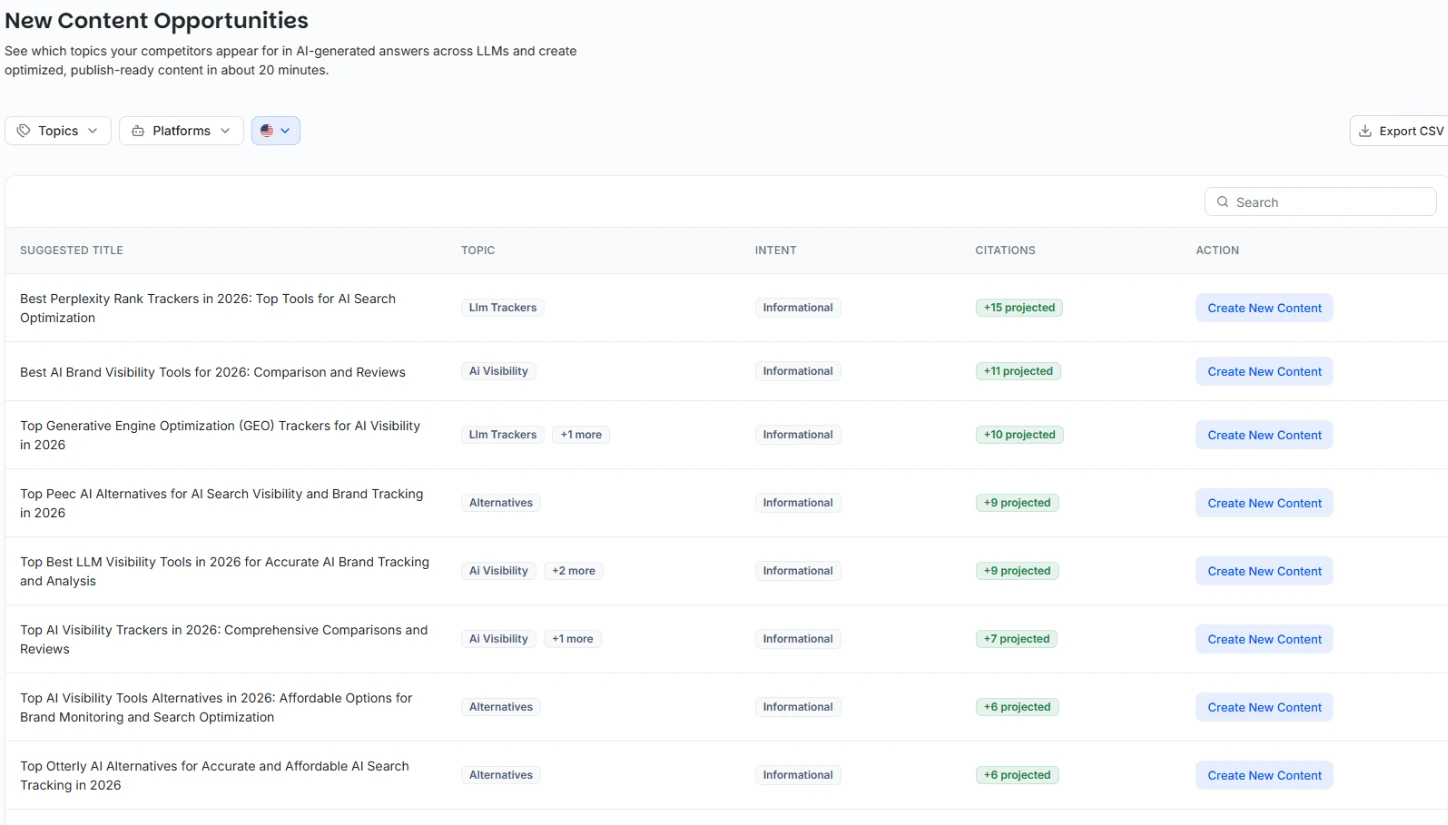
| Suggested title (top 5 of 91) | Topic | Projected citations |
|---|---|---|
| Best Perplexity Rank Trackers in 2026: Top Tools for AI Search Optimization | Llm Trackers | +15 |
| Best AI Brand Visibility Tools for 2026: Comparison and Reviews | Ai Visibility | +11 |
| Top Generative Engine Optimization (GEO) Trackers for AI Visibility in 2026 | Llm Trackers +1 | +10 |
| Top Peec AI Alternatives for AI Search Visibility and Brand Tracking in 2026 | Alternatives | +9 |
| Top Best LLM Visibility Tools in 2026 for Accurate AI Brand Tracking and Analysis | Ai Visibility +2 | +9 |
Of the top 10 suggested titles, 6 are “best” or “top” tool lists, 3 are alternatives pages and 1 is a checklist.
What this means
Almost all of the suggested pages are comparisons: tool lists and alternatives. The AI Mode answer at the top of this guide points the same way: two of its visible source cards were “top tools” round-ups.
6Which citation gap should you fix first?
Fix the gap where a small effort buys the most, on a topic you sell. Then match the fix to the kind of page the AI already cites.
A simple score if you work by hand
Give each gap three scores from 1 to 3:
- Relevance: how close the topic is to what you sell. 1 = loosely related, 3 = your core product.
- Distance behind the leader: 1 = within 10 percentage points, 2 = 10 to 30 points behind, 3 = more than 30 points behind.
- Effort: 1 = fewer than 10 extra citations or one page to fix, 2 = 10 to 40 citations or several pages, 3 = more than 40 citations or a mix of new pages and third-party work.
Priority = relevance × distance ÷ effort. Fix the highest score first.
Here is the score worked on three made-up topics, to show the maths:
| Topic | Relevance | Distance (leader vs you) | Effort (to goal) | Priority |
|---|---|---|---|---|
| Topic A (core product) | 3 | 3 (48% vs 5%) | 1 (+4 citations) | 3 × 3 ÷ 1 = 9 |
| Topic B (related feature) | 2 | 2 (25% vs 8%) | 1 (+6 citations) | 2 × 2 ÷ 1 = 4 |
| Topic C (core product) | 3 | 3 (70% vs 4%) | 3 (+60 citations) | 3 × 3 ÷ 3 = 3 |
Topic A goes first. It’s core to what you sell, the leader is far ahead, and the next step is small. Once those citations are banked, raise the goal, because 5% is still a long way from 48%. Topic C scores lowest even though it matters as much, because no single fix closes it. Treat it as a longer programme, not a weekend job.
Rules if you use a tracker
A tracker gives you more signals. These five rules turn them into a decision:
| Signal in your data | What it tells you | First move |
|---|---|---|
| Few citations needed to reach the goal, on a topic you sell | A cheap, relevant win | Do it first |
| The leader holds most of the citations on the topic | One page won’t close it | Plan new pages plus third-party work, and set a realistic goal |
| One engine has your lowest share and the most citations in its answers | The most citations are at stake there | Look at that engine on its own |
| The top third-party sources are videos or threads | Another blog post won’t reach them | Take part where the conversation is, honestly |
| A suggested page matches one you already have | It’s an improve gap, not a create gap | Improve the existing page before writing a new one |
On Wellows’ data, the video rule points at the YouTube and Reddit rows at the top of the outreach list. This is our reading of the numbers, not a result.
Two cautions. First, a “projected” figure is not a result. Judge each fix by re-measuring, not by the projection. Second, if you fill a “best tools” gap in your own category, say that you publish the page, show a dated test method, and say when a competitor is the better pick. A list that ranks its own publisher first by default is hard to trust, and readers can tell.
7How do you close each type of citation gap?
Create one strong page for a missing page, improve the page that isn’t cited, earn mentions on the third-party pages the AI already cites, and study a weak engine on its own. Closing gaps is the practical side of answer engine optimization (AEO), also called generative engine optimization (GEO).
Missing page: create one strong page per question
Write one page that fully answers the question. Put the direct answer in the first two or three sentences. Make each section make sense on its own, because an AI engine may quote just one. Don’t make a separate page for every way of wording the prompt. Google’s AI optimization guide warns that separate pages for every fan-out query variant (the extra sub-questions an AI searches behind one prompt), made to manipulate rankings or AI responses, count as scaled content abuse (Google Search Central). In Wellows, New Content Opportunities shows the topics your competitors appear for in AI answers, with a suggested title, intent and projected citations for each.
Page exists but isn’t cited: improve it
Start with access. Search engines must be able to crawl and index the page. Put the main text in the page’s HTML rather than loading it later with scripts, so crawlers that don’t run scripts can still read it. Then compare your page with the pages that do get cited for the same prompt. Do they answer sooner? Give a number you lack? Cover a sub-question you skip? Fix those things. Don’t count on technical extras. Google’s AI optimization guide says you don’t need AI text files or Markdown versions of pages to appear in Google Search, and that Google Search ignores them.
Third-party gap: earn the mention
Go after pages the AI already cites. For lists and reviews, contact the editor with facts they can check. For YouTube and Reddit, take part as yourself: answer the question, show your work, and say who you are. On 15 May 2026 Google clarified that its spam policies apply to generative AI responses in Search, and the policies now name attempts to manipulate them (Google spam policies). Planted comments and fake reviews are a risk, not a shortcut. Getting useful, honest content onto the sites AI engines read is sometimes called LLM seeding. Our guide explains what LLM seeding is and how to do it without spam. Wellows’ outreach list of pages that already mention your competitors gives contact details or a social media guide for each page.
Engine gap: look at the engine on its own
See what the weak engine cites for your main prompts: which sites, which kinds of page, how recent. Don’t assume a fix that worked on one engine will carry over. The overlap figures above show how rarely engines agree on sources.
8How often should you re-run it, and how do you measure progress?
Re-run the same prompts, on the same engines, in the same country. Compare the same length of time before and after. If you change the prompts between runs, the comparison means nothing. Monthly is a sensible default in a fast-moving market. Set a start date and a goal date up front.
Report three numbers separately: own-site citations, third-party citations and mentions. When a topic’s share moves, credit everything you did on that topic, not one page.
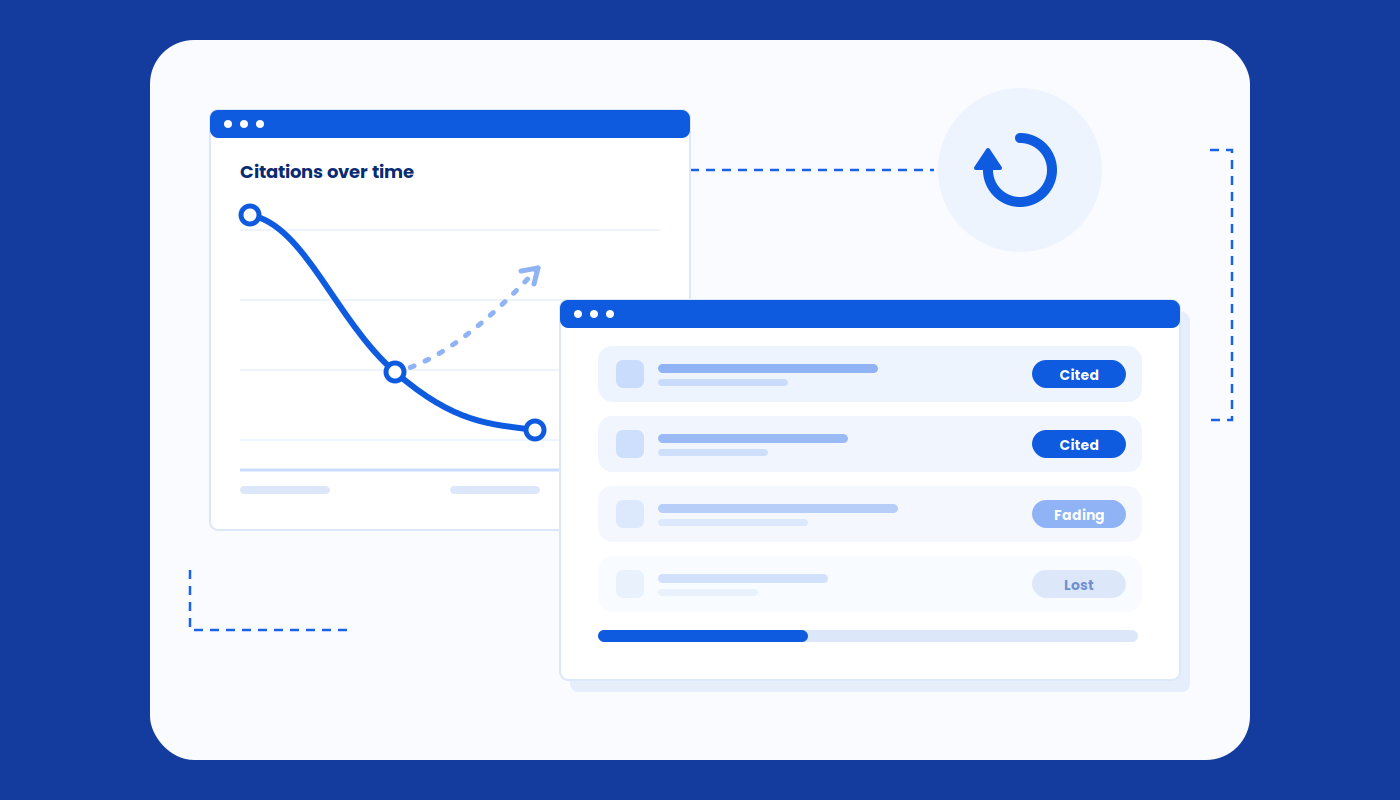
Re-running also catches the opposite problem: pages that used to be cited and slowly stop. That’s covered in how to measure and fix AI citation decay.
9Which tools run an AI citation gap analysis?
Wellows, Peec AI, the Semrush AI Visibility Toolkit, Ahrefs Brand Radar, Similarweb AI Search Intelligence and Profound all show how your AI citations compare with your competitors’. Use one when you outgrow the spreadsheet. We checked each one on its own website on 5 November 2026. Wellows publishes this guide, so read the Wellows row with that in mind.
| Tool | What it shows for citation gaps | AI engines | Starting price (checked 5 Nov 2026) |
|---|---|---|---|
| Wellows | Visibility next to competitors; own-site vs third-party citations; New Content Opportunities; a list of pages that mention competitors, for outreach | ChatGPT, Gemini, Perplexity, Google AI Overviews, Google AI Mode | Basic, $29 a month (12 prompts on all 5 engines, daily) |
| Peec AI | Gap analysis of “sources that appear often and name competitors but not you”, plus citation share and source types | Starter: 3 models chosen from ChatGPT, AI Mode, AI Overviews, Copilot, Gemini and Naver AI. Perplexity is on Enterprise. | Starter, $95 a month (50 prompts) |
| Semrush AI Visibility Toolkit | Competitor Research to find “the prompts and topics where others are getting cited but you aren’t” | Names ChatGPT, Gemini and Google’s AI; Prompt Tracking examples are ChatGPT and Google AI Mode | $99 a month |
| Ahrefs Brand Radar | Benchmarks your brand against competitors in AI search, with an AI share of voice metric | AI Overviews, AI Mode, ChatGPT, Perplexity, Gemini, Copilot (Claude with custom prompts) | Brand Radar add-on: custom prompts from $50 a month; AI Visibility Index from $199 a month |
| Similarweb AI Search Intelligence | The domains that most influence AI answers for each topic, with the exact links, plus brand mention share | Names ChatGPT, Perplexity, Gemini and AI Mode | AEO Intelligence plan, $99 (billing period not stated on the page; 1 user, 3 months of history) |
| Profound | How your brand and competitors appear in AI platforms, including citations and competitive presence | Trial: ChatGPT, Gemini, AI Overviews. Enterprise: up to 9 engines. | No public prices: 7-day free trial; Enterprise is custom |
How to choose: if you already pay for Semrush or Ahrefs, try their AI reports first, because you may not need another tool. If you need Copilot or Claude, Wellows isn’t the right pick, because it doesn’t track them. Wellows fits teams that want all five engines on a small budget and want the gaps turned into pages to create and sites to contact.
In short: a citation gap analysis shows which AI answers cite your competitors but not you. Log real prompts on each engine, sort every gap into one of the four types, and fix first the gap that needs the fewest extra citations on a topic you sell.
10Citation gap analysis FAQ
Is a citation gap analysis the same as a content gap analysis?
No. A content gap analysis looks for topics or keywords your competitors rank for in search and you don’t. A citation gap analysis looks at AI answers: which pages the AI cites for a prompt, and whether any of them is yours or mentions you. Some citation gaps are content gaps (type 1). Many aren’t (types 2 to 4).
Can I do a citation gap analysis for free?
Yes. Ask each engine your prompts by hand, log the sources in the template above, and work out citation share in a spreadsheet. It’s slow, and it gets unreliable beyond a few dozen prompts because answers change from run to run.
How many prompts do I need?
Five is enough to see the problem. For decisions, start with 20 to 50 per topic. With fewer, one odd answer can swing the share.
Does ranking first in Google close a citation gap?
Not on its own. In Ahrefs’ study of 15,000 long-tail queries, only 8.0% of ChatGPT’s in-text citations ranked in Google’s top 10. Perplexity leaned on Google rankings more, at 28.6%.
Is citation share the same as AI share of voice?
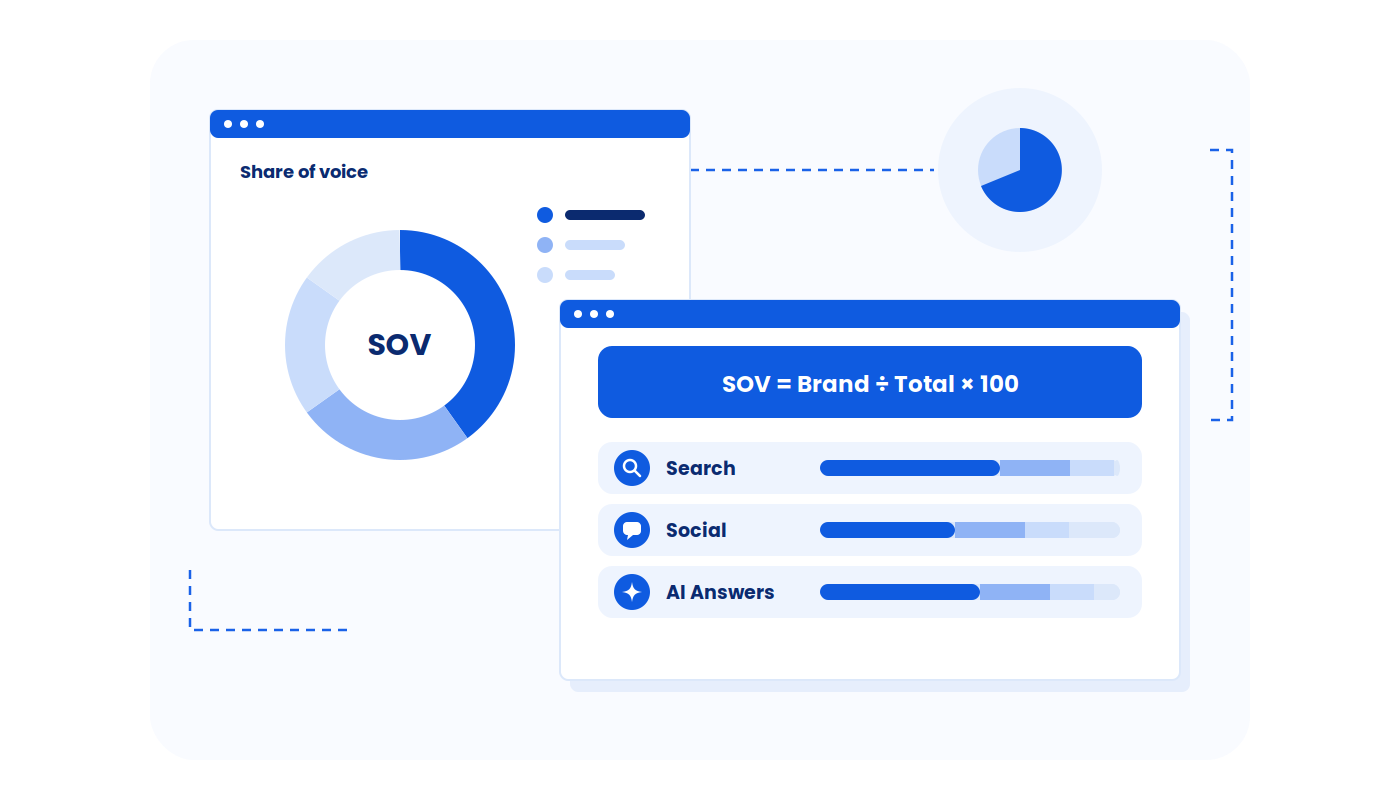
Not quite. Share of voice usually counts how often a brand is mentioned in answers. Citation share counts how often you appear among the cited sources. The two can move in different directions, so track both if you can. For the maths, see how to calculate share of voice for search, social and AI.
Can I run a citation gap analysis on Claude or Copilot?
The manual method works in any AI assistant that shows its sources. Wellows tracks ChatGPT, Gemini, Perplexity, Google AI Overviews and Google AI Mode.
Your next step
Ask five real customer questions in ChatGPT or Google AI Mode today and fill in one row each. If the gaps look real, copy the citation gap template, build a 20-prompt set for one topic and fix the highest-scoring gap first.