Staying visible online is harder than ever, with competitors jumping on new trends almost as soon as they appear. For brands that come in late, the opportunity often slips away.
This is where Predictive SEO Insights make the difference they help businesses prepare for what’s coming instead of scrambling to catch up. By spotting search patterns early, you can meet demand right when it matters most.
This proactive approach gives you a real edge over traditional SEO tactics. Instead of reacting to algorithm changes or chasing keywords that are already saturated, Predictive SEO Insights help you anticipate where the next opportunities will be.
Publishing content ahead of the curve positions your brand as a trusted authority. Over time, that early momentum builds stronger rankings and long-term visibility.
The real strength of Predictive SEO Insights is how they turn data into content that connects with people.
It’s not about guessing it’s about creating timely, relevant resources that answer future questions before they’re even asked.
By anticipating your audience’s needs, you meet them with solutions while competitors are still catching on. The result is a smarter, more sustainable SEO strategy that keeps you ahead.
What are Predictive SEO Insights and why do they matter in 2025?
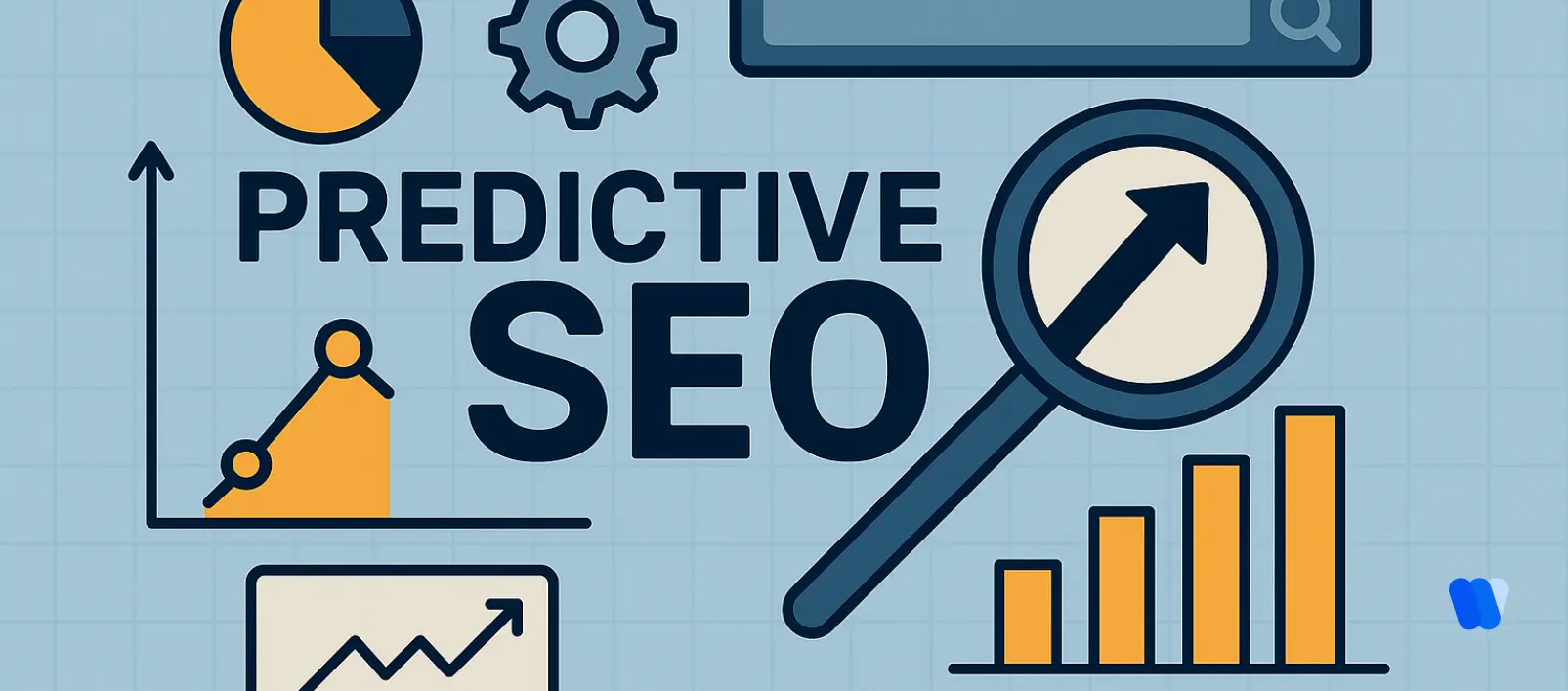
Predictive SEO insights are forward-looking signals derived from first-party data (like analytics, server logs, and Google Search Console), enriched with third-party datasets (such as SERP panels, clickstream reports, and social chatter), and powered by machine-learning models that forecast user intent, demand shifts, and search ranking factors.
Instead of describing the past, they estimate which topics, intents, and SERP features will rise next.
Why This Matters
- Algorithm velocity: Google publicly states it “runs hundreds of thousands of experiments each year and launches thousands of changes” to Search meaning static “playbooks” age fast and proactive modeling wins.
- AI Search reshapes SERPs: After the AI Overviews rollout, Similarweb observed a material rise in zero-click behavior for news queries in the UK from 56% to 65% illustrating how AI summaries can absorb clicks you once captured. Planning for that reality is no longer optional.
- Competition compresses: When everyone tracks the same keywords, only those who forecast topic inflections, entity gaps, and feature shifts (FAQ → Discussions & Forums, Top stories → AI Overviews, etc.) consistently outrun the pack.
What is the Impact of User Behavior and Search Trends on Predictive SEO?

Search engines evolve in response to people, not the other way around. Every shift in how users browse, search, and consume content influences the way rankings work.
Predictive SEO exists to spot these changes early so instead of reacting late, brands can prepare content that matches what users will want tomorrow.
Take mobile search as an example. Today, nearly 60% of Google searches come from mobile devices. That single shift forced Google to roll out mobile-first indexing, prioritize site speed, and reward mobile-friendly designs.
Predictive SEO goes further by modeling emerging behaviors like voice search and visual discovery, then shaping strategies that meet those needs before they fully mature.
Social platforms are another early signal. A conversation trending on TikTok, Reddit, or YouTube often shows up in Google searches shortly after.
Predictive SEO overlays social chatter, Google Trends, and SERP data to anticipate these ripples and capture search visibility just as demand rises.
Broader expectations also matter. With privacy regulations tightening and cookie tracking fading, users now gravitate toward brands that feel transparent and trustworthy.
Predictive SEO incorporates these macro shifts, signaling that entity-rich, credible content is not optional if you want to remain visible in AI-driven search.
At its heart, predictive SEO isn’t about chasing keywords that already peaked. It’s about reading behavior patterns, spotting demand before it spikes, and publishing the right answers at the right moment.
How do Predictive SEO Insights differ from traditional SEO approaches?
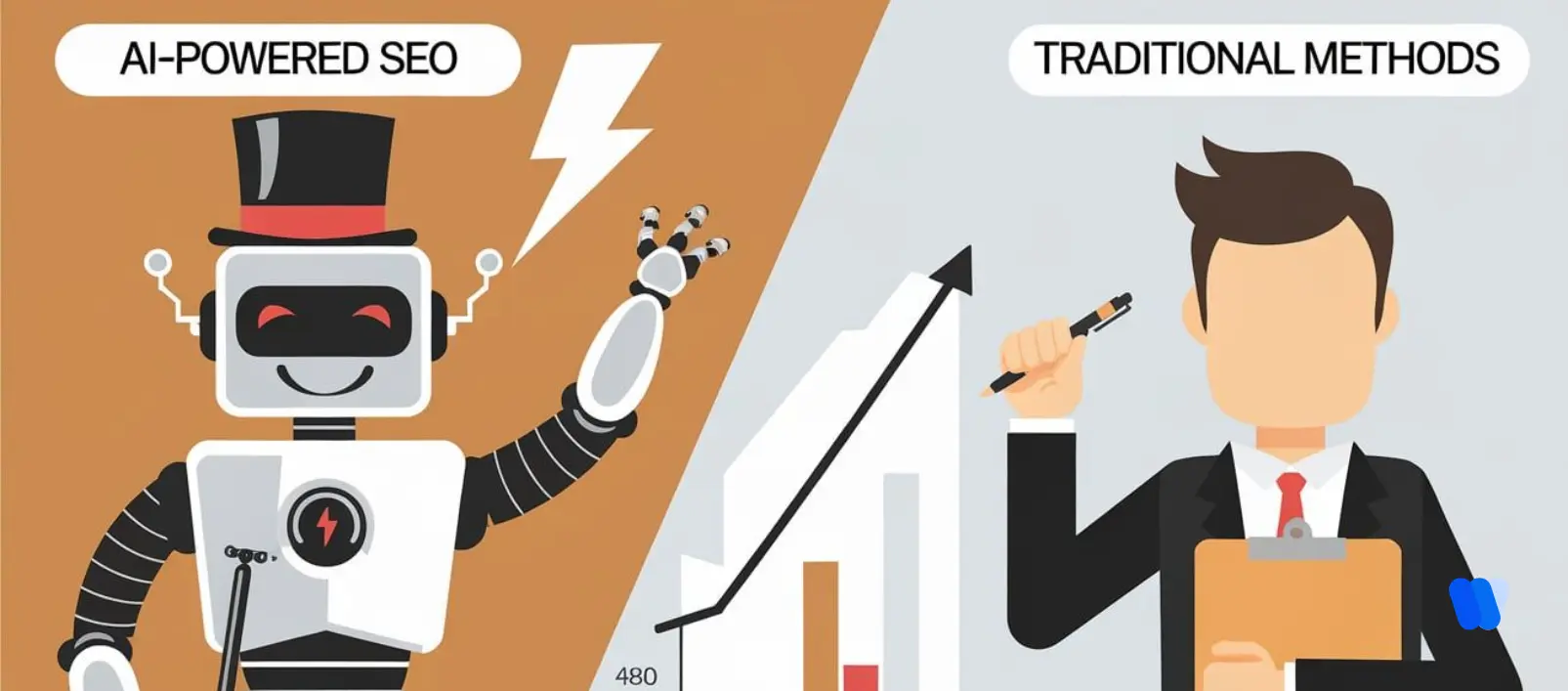
Traditional SEO asks, “What ranked last quarter, and where are we weak?” Predictive SEO asks, “What intent grows next, and what will Google show for it?”
- Timing: Reactive audits fix what’s broken. Predictive modeling prioritizes what will matter next release cycle (topics, SERP features, Core Web Vitals corridors).
- Unit of analysis: Traditional keyword lists treat terms as isolated. Predictive insights cluster entities, attributes, and intents into keyword clustering maps, then identify which clusters will rise and which features (videos, how-tos, discussions, AI snippets) are likely to dominate.
- Outcome: Traditional plans chase volume. Predictive plans position you for share of future clicks even when zero-click searches and AI panels dilute classic results.
A contemporary wrinkle: AI-driven surfaces increasingly answer head queries. The analysis above shows how quickly that can move.
Plan as if SERPs will keep absorbing routine questions; invest in evergreen depth, expert perspective, and unique data that LLMs and search quality systems prefer to cite.
How can Predictive SEO Insights identify emerging keyword trends?
You don’t guess. You model. Start with three layers:
Did you know?
- Seed entity mapMap the core topic’s entities and attributes (e.g., “tax credits → small business, eligibility year, filing deadlines”). Expand with LSI Keywords (phrase variants and co-occurring concepts), not as a gimmick, but to cover the semantic field users actually search.
- Time-series trend signals
- Pull Google Search Console impressions and queries for the last 16–24 months; fit lightweight seasonal models to detect predictive keyword trends in SEO (e.g., holiday, fiscal, product cycle).
- Overlay social velocity (Reddit, X, YouTube comments) and news cadence so you can see where attention peaks before keyword tools catch up.
- Feature-aware clusteringCluster queries by intent and SERP feature: which groups consistently trigger People Also Ask, video carousels, or AI Overviews? Those clusters will behave differently when AI Search expands. Invest where you can credibly own the best answer.
Practical outputs you want on one page:
- A Next-90-Days cluster set with estimated demand delta, likely SERP features, and the smallest content unit that can win.
- A short list of “High-Potential Keywords”: low-visibility terms where you already appear positions 8–20 and can move quickly with Header Tags, Meta Tags, on-page SEO, Internal Linking, and a tighter canonical tag strategy.
How do Predictive SEO Insights enhance a competitor-driven strategy?
A competitor-driven strategy is smarter when it looks forward. Beyond rank trackers, you want three things:
SERP lens by feature: Track which modules your rivals gain (e.g., Reviews drop, Video gains, Forums emerge). Forecast where those features spread into your head terms.
“Share of Search” trend: Use impression share across your brand + category terms to see if your Share of Search rises or falls relative to rivals an early indicator of momentum that often precedes share of traffic.
Update timing: Monitor publish velocity and update windows. If the category leader refreshes strategic pages every 28–42 days, that is a signal. Iterate your cadence accordingly.
Then act fold findings into your SEO Site Audit so the roadmap explicitly calls out “competitor deltas” (missed entities, weaker E-E-A-T sections, unclaimed FAQs).
You’re not copying; you’re jumping the queue by spotting the next intent expansion earlier.
What role does Predictive SEO play in e-commerce success?
E-commerce wins with inventory-aware and seasonality-aware content. Predictive insight helps you:
Forecast seasonal spikes for category + attribute pairs (e.g., “waterproof trail shoes size 10” vs. generic “trail shoes”) and pre-build landing modules two sprints early.
Match merchandising to intent: If queries add “compare,” “durability,” or “sizing,” ship richer comparison blocks and size guides that AI Search can summarize and humans will trust.
Protect from zero-click: Create post-click utility (fit calculators, clear return policies, store availability) that AI panels cannot replace and that shoppers actually need.
As AI panels expand (Google I/O 2025 continued the AI drumbeat), expect more informational clicks to stay on Google.
Your counter is deeper product experience content and structured Image SEO that keeps you in visual modules while building authority for high-intent terms.
How can Predictive SEO improve content strategy and user-intent alignment?
Think of content planning as a rolling Question → Answer system:
Model the next questions (not just today’s): pull “rising” queries, forum phrasing, and support tickets; transform them into H2/H3 written as real questions.
Answer directly in the first 2–3 sentences under each heading, then expand with data, examples, and entity-rich detail.
Signal intent to crawlers and LLMs: tight Header Tags, descriptive Meta Tags, correct canonical tag, and concise definitions high on the page.
You’re building a library that is easy for both SERPs and assistants to quote. That requires clear nouns + predicates (“Schema markup clarifies product attributes” beats “It helps a lot”) and first-word flow that mirrors how people search (“How do I…,” “Why does…,” “What’s the difference between…”).
How do Predictive SEO insights support AI Search and LLM readiness?
Assistants favor clear definitions, consistent entities, and original evidence. To become the cited source:
Did you know?
- Lead with definitions and concrete outcomes (“What is it?” “What changes next?”).
- Publish unique inputs: mini-studies, process screenshots, code snippets, or checklists competitors don’t have.
- Write in teachable chunks: concise headings that directly answer How/What/Why.
As AI Overviews and assistants reshape discovery, Similarweb’s real-world data shows zero-click behavior jumped for news queries when AI panels appeared.
That’s your signal to build content worth quoting and to structure it so AI models can easily parse it.
How do Predictive SEO Insights help manage algorithm volatility?
Instead of waiting for ranking drops, monitor leading indicators and automate guardrails:
Did you know?
- Experience signals: track Core Web Vitals corridors, render budget, template regressions, and SEO Metrics like crawl success and internal PageRank proxies.
- Intent mismatch: watch for landing pages drifting from the Search Engine Ranking Factors Google emphasizes for a query (e.g., a commercial page ranking for an informational query).
- Feature drift: alert when a query flips to a different SERP mix (e.g., Forums surge, Top stories disappear, AI Overview appears).
If you’re running SEO without a team or need to SEO prioritize on a budget, automate these checks:
- Weekly SEO Site Audit deltas.
- Alerts on significant changes in SERPs modules for target clusters.
- Change logs tied to publish dates so you can correlate updates with ranking movement.
How can businesses implement Predictive SEO Insights step by step?
A pragmatic five-phase loop you can run every quarter:
- Audit your baseline
- Crawl the site. Fix crawling/indexing blockers.
- Pull 16–24 months of Google Search Console keyword analysis data to find rising terms and decaying assets.
- Flag SEO visibility issues (thin content, cannibalization, orphaned pages).
- Forecast demand and SERP shape
-
- Use Google Trends and forum listening to confirm emerging topics.
- Label each cluster with likely SERPs features (PAA, video, AI Overview, shopping).
- Prioritize where your expertise and proof can set you apart.
- Design content the way people ask
- Turn clusters into question-based H2/H3s.
- Open each section with a direct 2–3 sentence answer.
- Add Internal Linking that mirrors user journey, not just navigation.
- Ship with clean technical signals
- Correct Meta Tags, Header Tags, and canonical tag usage.
- Add schema where eligible (FAQ for genuine Q&As, How To where you have steps).
- Tighten media: compress images and add descriptive alt text that reinforces the entity context (Image SEO).
- Monitor, learn, and automate
- Track cluster-level rankings and Share of Search patterns.
- Refresh pages on a predictable cadence (light-touch updates keep you competitive and LLM-quotable).
- Use lightweight AI SEO Automation to flag regressions and surface near-wins you can convert quickly.
Which industries benefit most from Predictive SEO Insights?
Retail & e-commerce: Highest seasonality; real-time predictive SEO insights align inventory, promo pages, and buying guides with upcoming surges.
SaaS: Feature launches and security seasons (compliance deadlines) reward early “What changed?” explainers and migration guides.
Healthcare: Annual cycles (open enrollment, allergy season) and emergent topics require entity-rich clarity and medical review.
Finance: Filing seasons and rate moves favor scenario explainers (“what if rates do X?”) and compliant, evergreen education.
Visual sectors (fashion, home, travel) should double down on Image SEO by using predictive modeling to anticipate which visual queries will spike, then shipping galleries and shoppable visuals with clean alt text and EXIF where appropriate.
What are the limitations and challenges of Predictive SEO Insights?
Did you know?
- Data quality: Predictive models are only as good as the inputs. Dirty tracking and missing query data lead to false positives.
- Over-fitting to today’s SERP: Features change. Don’t hard-code to one layout; build for intent satisfaction first.
- Resource trade-offs: Forecasting suggests many ideas; focus on compounding assets (evergreen guides, comparison hubs, original studies) over scattershot posts.
A final caution from the real world: when AI Overviews expand, zero-click searches rise in some contexts.
Build content that people need to visit, and content that assistants want to cite (definitions, evidence, clarity).
How do Predictive SEO Insights future-proof your strategy?
Predictive insight reshapes your workflow:
Did you know?
- You plan by intent clusters, not single terms.
- You publish answers before the questions peak.
- You structure pages so AI Search and humans extract value quickly.
- You monitor leading indicators (feature drift, impression share, update cadence), not just last week’s positions.
Do this consistently and you’ll see the competitive gap widen even as AI absorbs simpler queries because your library becomes the reference assistants and editors cite, not just another result on page one.
FAQs
Conclusion:
Outsmarting competitors in today’s search landscape isn’t about chasing every keyword or reacting to algorithm changes after the fact. It’s about staying proactive, leveraging predictive SEO insights to anticipate where user intent, keyword trends, and SERP dynamics are heading.
By analyzing data patterns, aligning with future ranking factors, and forecasting shifts before they happen, businesses can protect visibility and capture opportunities early.
Predictive SEO insights give you a competitive vantage point, ensuring your strategy evolves with Google’s AI-driven search and industry-specific trends.
Whether you’re managing an e-commerce site, a SaaS brand, or a growing small business, predictive analysis helps you move from reactive firefighting to proactive growth.
When you consistently apply these insights, your competitive edge compounds, showing up in higher SERP positions, stronger Share of Search, and a pipeline that grows ahead of the competition.