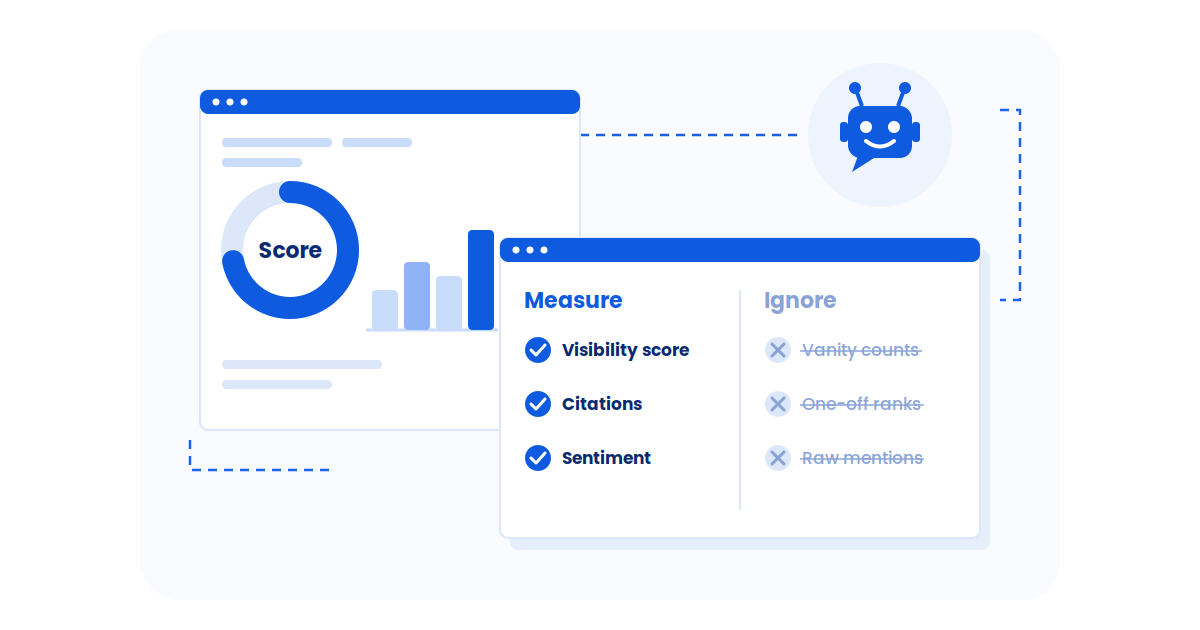
Search engines no longer rely on exact keyword matches. One common question that still comes up is:
If you’ve ever searched “Define LSI keywords” or “Explain LSI keywords,” you’re not alone this guide clears up what the term means, why it’s outdated, and what to do instead.
LSI keywords come from Latent Semantic Indexing, a system created in the 1980s for analyzing patterns in large sets of text. The term still circulates in SEO spaces, but Google has confirmed it doesn’t use LSI as part of its ranking algorithm. It’s a legacy concept with no real value in modern search.
Did you know?
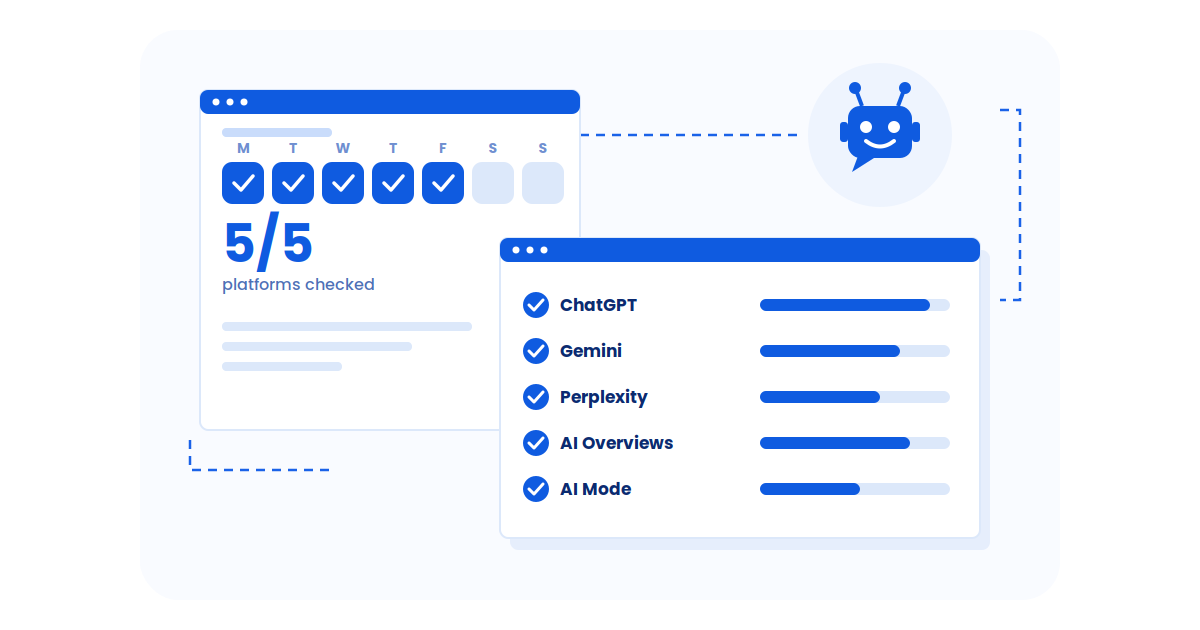
As generative engines like ChatGPT, Gemini, and Perplexity reshape how information is surfaced, understanding how your content is interpreted across these systems is becoming just as critical as traditional rankings. Tools such as a ChatGPT Visibility Tracker help bridge this gap by showing how content is actually surfaced and framed within AI-generated responses, not just where it ranks in classic SERPs.
To see how visibility tracking works across search and AI platforms.To see how visibility tracking works across search and AI platforms. [/did_you_know]
Semantic SEO is what actually matters today. It focuses on meaning, context, and how AI visibility platforms and search engines interpret the relationships between words and topics. The goal is to match intent, not repeat phrases.
This guide walks you through the outdated myths to ignore, proven tactics that work today, and how to align content with what search engines actually understand in 2026.
What Are LSI Keywords and Why They Don’t Exist
Many SEO blogs still mention “LSI keywords” as if they’re a legitimate part of Google’s algorithm. This leads to outdated strategies and misinformed content decisions. Before applying any keyword technique, it’s important to understand where the term came from and why it’s no longer relevant.
If you’re trying to explain LSI terms or define LSI in the context of search engines, start here: LSI stands for Latent Semantic Indexing. Below we break down where it came from—and why Google never used it for rankings.
What is Latent Semantic Indexing (LSI)?
Latent Semantic Indexing was a mathematical system created in 1988 to find patterns in large sets of text. It was designed to improve document retrieval in early databases—not for search engines.
LSI worked by identifying patterns in how terms co-occurred and mapping them into topics using singular value decomposition (SVD). The goal was to reduce noise in large documents and uncover hidden structures in word use.
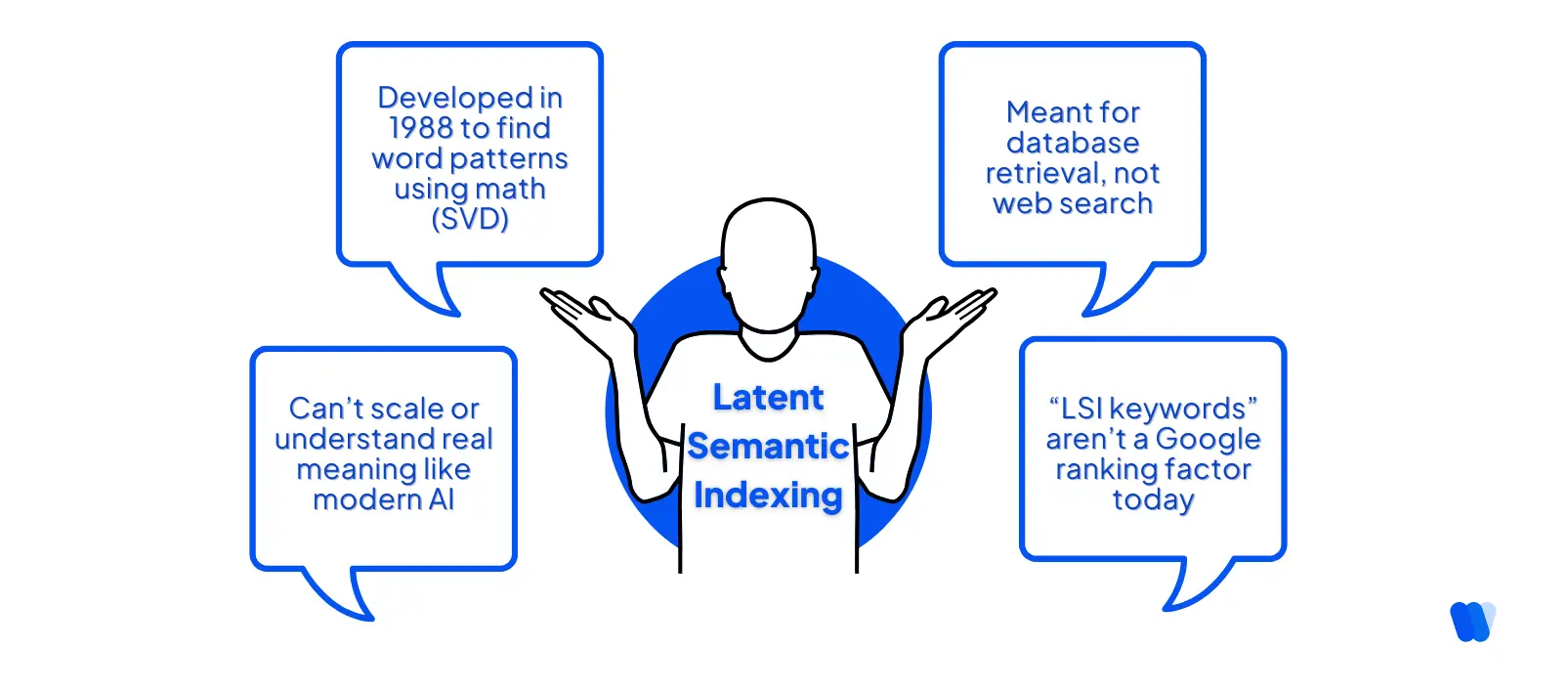
Some SEO communities still reference LSI as if it were a ranking signal. This creates confusion, especially for beginners, because it sounds technical and plausible. But using “LSI keywords” today can distract from building content that actually matches user intent.
Why Google Doesn’t Use LSI
Modern SEO practices focus on user intent, contextual understanding, and topical authority—none of which require outdated indexing systems like LSI. It was never designed to scale to billions of documents, nor can it process modern language nuances.
“There’s no such thing as LSI keywords – anyone who’s telling you otherwise is mistaken, sorry.” (Source: Search Engine Roundtable)
Many marketers still ask, “How do LSI keywords improve SEO?” or “Can LSI keywords impact results?” The short answer: they don’t as a signal—any uplift people saw was simply clearer topical coverage, not “LSI” itself.
Google now uses advanced systems like BERT, Neural Matching, and MUM that analyze intent, sentence structure, and contextual meaning—not simple word pairs.
LSI ≠ Synonyms ≠ Semantic Terms
- LSI keywords: Based on outdated indexing methods from the 1980s. Not used by Google.
- Synonyms: Words with similar meanings that can often be used interchangeably.
Example: “Search engine optimization” and “organic search strategy.” - Semantically related terms: Words or entities contextually linked by topic or user intent, not necessarily synonyms.
Example: For “What are LSI keywords?”, semantically related terms might include “semantic SEO,” “Google ranking factors,” “BERT algorithm,” and “search intent.”
Did you know?
Did you know?
Why Are LSI Keywords Important For SEO?
LSI keywords are important for SEO because they help provide context, relevance, and depth to your content, allowing search engines to better understand what your page is about. The term “LSI keywords” refers to words and phrases that are semantically related to a primary keyword, enriching the meaning and clarity of your content.
However, it’s important to note that while the concept of Latent Semantic Indexing (LSI) was developed in the 1980s to analyze relationships between words in smaller datasets, Google does not use LSI technology in its search algorithms. In fact, in 2019, Google’s John Mueller clarified, “There’s no such thing as LSI keywords – anyone who’s telling you otherwise is mistaken, sorry.”
Despite this, using semantically related terms within your content remains beneficial for SEO. Incorporating related phrases naturally improves content comprehensiveness, helping search engines understand context and user intent more effectively.
This aligns with modern SEO practices, where search algorithms prioritize high-quality, contextually relevant content over simple keyword repetition.
In summary, even though “LSI keywords” as a concept is outdated and not directly used by Google, the practice of adding semantically related terms continues to play a vital role in improving content relevance, enhancing user experience, and potentially boosting search engine rankings.
What Is Semantic SEO?
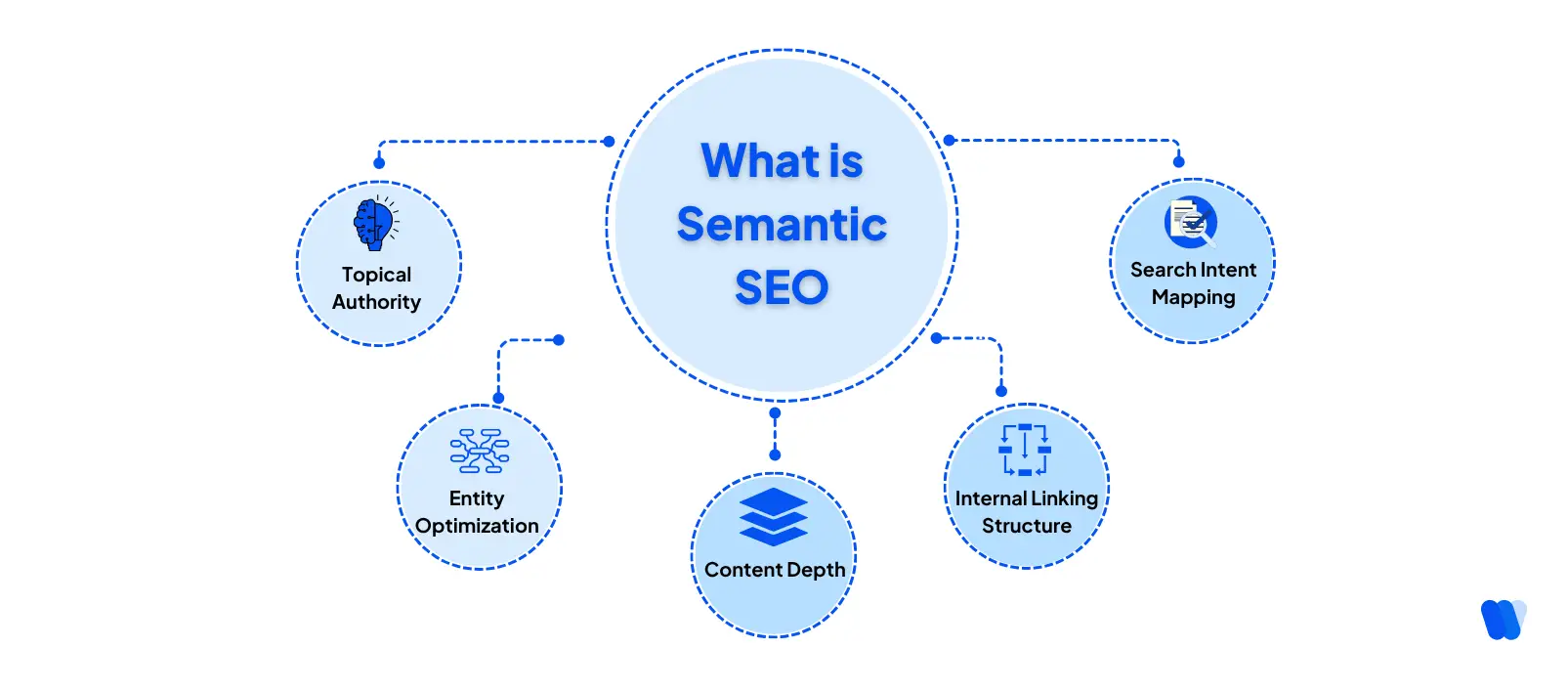
Semantic SEO is the practice of creating content that helps search engines understand the true meaning behind a page, not just the words on it, especially as LLM SEO reshapes how information is interpreted across search and AI-driven interfaces.
It focuses on concepts, relationships, and intent, rather than exact keyword matches.
In practice, semantic indexing aids search ranking by helping systems interpret meaning, relationships, and intent—not just matching words.
- Hummingbird (2013): Introduced semantic understanding over keyword matching.
- RankBrain (2015): AI-driven intent recognition.
- BERT & MUM: Advanced NLP that interprets context like humans do.
Modern search uses NLP and AI to understand entities, relationships, and context. Semantic SEO means covering topics in depth, mirroring natural language, and mapping content to user intent.
How To Find Semantic Keywords
Semantic keywords aren’t found by scanning a list of “LSI terms.” They come from understanding how users think about a topic and how search engines process meaning.
1. Manual Thinking: Start With Context
Use visual mapping. Place your topic in the center, then branch into natural questions, tools, and related problems. This approach aligns well with AI-powered workflows that help solo consultants scale SEO efficiently, as outlined in scaling SEO with AI as a solo consultant.
Example: For “LSI keywords,” related terms might include Latent Semantic Indexing, Semantic SEO, Google NLP, and BERT. These terms emerge naturally from how people discuss the topic—not from an LSI formula.
2. Google’s Built-In Clues
- Autocomplete suggests common queries as you type.
- Related searches expand the topical scope.
- Bolded terms in SERPs highlight what Google considers contextually important.
3. SERP Scraping: Identify Structures
- Meta titles & descriptions of top-ranking pages.
- Recurring headers (H2s, H3s) across results.
- Keyword density (to spot themes, not for stuffing).
4. Tools for Deeper Discovery
- Wellows: AI SEO Tool for entity detection & keyword clustering.
- Ubersuggest: Surfaces related keyword groupings.
- Semrush: Provides topic clusters and entity-level insights.
If you’re wondering what tools can find LSI keywords, think in terms of semantic discovery instead: clustering, entity extraction, and SERP-driven context—and when AI-powered SERP features are in play, an AI Overviews Tracker can add another layer by showing how your content is surfaced beyond traditional blue-link rankings (e.g., Wellows clustering and entity detection).
The goal isn’t to stuff keywords, but to expand semantic scope—so your content covers intent-rich topics that search engines and users both recognize.
How Can I Identify LSI Keywords For My Content?
You can identify LSI keywords for your content by finding terms and phrases that are semantically related to your main keyword. These related words help search engines understand context, making your content more comprehensive and relevant.
While the concept of Latent Semantic Indexing (LSI) originated decades ago, Google has confirmed that it does not directly use LSI in its algorithms. However, identifying and including related keywords can still strengthen your SEO and improve content quality.
1. Use Google’s Autocomplete and Related Searches: Start typing your primary keyword into Google’s search bar to see autocomplete suggestions. After hitting enter, scroll to the bottom of the page to find “Related searches.” These suggestions reveal how users search for similar topics and provide valuable keyword variations.
2. Leverage Keyword Research Tools: Tools like Google Keyword Planner, SEMrush, and Ahrefs can help you find contextually relevant terms. They provide search volume, keyword difficulty, and trend data, enabling you to select keywords that align with your audience’s intent.
3. Analyze Competitor Content: Review top-ranking pages for your target keyword. Note the recurring words and phrases used within their content — these often serve as semantically related keywords contributing to their higher rankings.
4. Explore User Questions: Platforms such as AnswerThePublic, Quora, and Google’s “People Also Ask” section are goldmines for discovering related topics and queries. These insights help you integrate natural variations of your keywords into your content.
When adding related keywords, make sure they fit naturally within your writing. Avoid keyword stuffing and focus on delivering valuable, context-rich information that improves both readability and SEO performance.
Does Google Use LSI Keywords In Its Ranking Algorithm?
Google does not use LSI keywords in its ranking algorithm. Latent Semantic Indexing (LSI) is an old information retrieval technique developed in the 1980s to analyze word relationships within small, static datasets. However, Google’s algorithms have evolved far beyond this approach and do not rely on LSI for ranking web pages.
In 2019, John Mueller, Google’s Search Advocate, confirmed this by stating, “There’s no such thing as LSI keywords – anyone who’s telling you otherwise is mistaken, sorry.” This clarification dispelled the common misconception that Google uses LSI to determine keyword relevance.
Instead, Google relies on advanced technologies like natural language processing (NLP), machine learning, and artificial intelligence to understand context, meaning, and user intent. These systems help Google interpret queries more accurately and match them with the most relevant content.
While LSI itself isn’t used, incorporating semantically related words and phrases in your content remains beneficial. Doing so improves the depth and clarity of your content, aligning with Google’s focus on high-quality, context-rich information that satisfies user intent.
Using ChatGPT for Ideas, But Getting Real Insights with Wellows
You can use ChatGPT to brainstorm related questions or terms—it’s quick and helps jumpstart your ideation process.
But it doesn’t reveal how those terms perform in live search or how AI tools actually structure their responses.
That’s where Wellows comes in as an AI SEO Tool, it helps growing teams simplify SEO execution, automate workflows, and adapt faster without heavy resources.
One of its most powerful capabilities is the Wellows LLM Visibility feature, which shows how large language models generate answers and lets you track that behavior directly for smarter optimization.
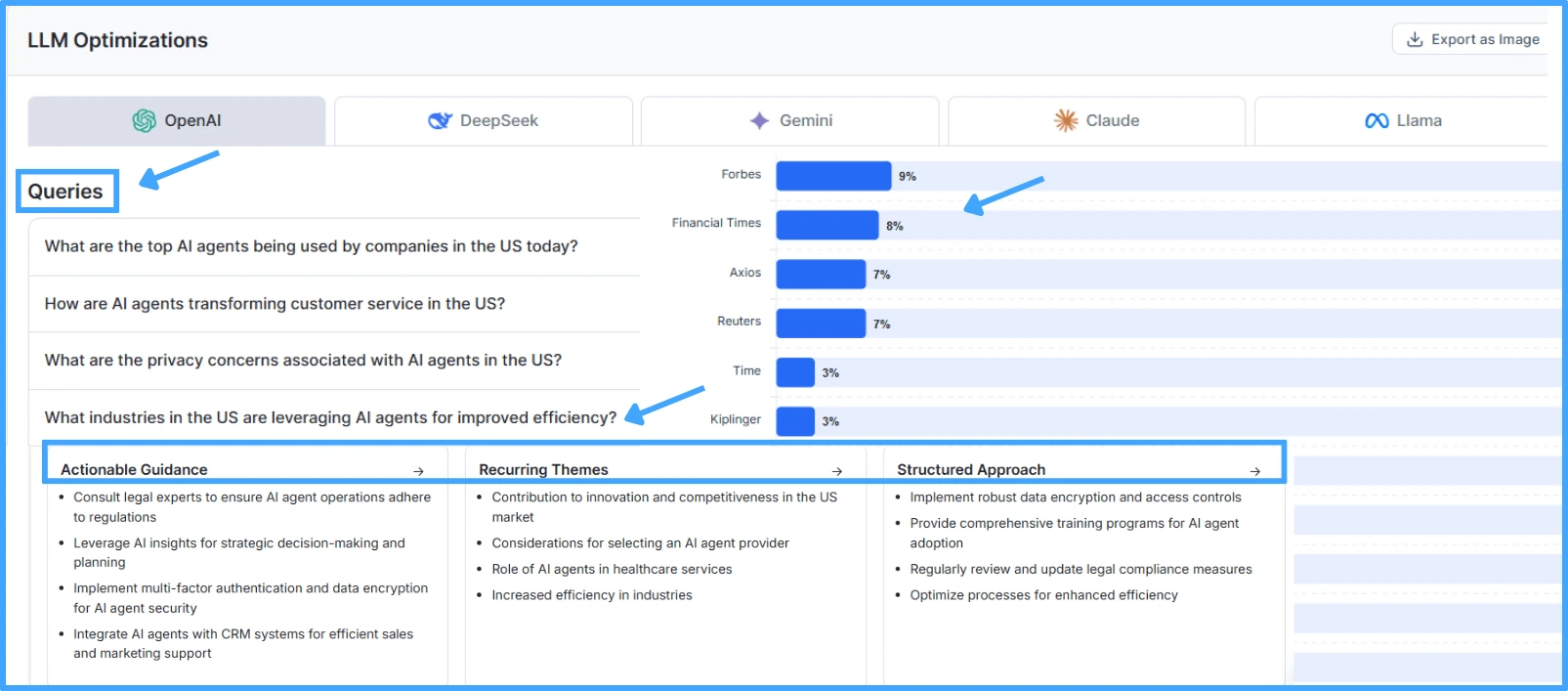
You can analyze how ChatGPT interprets your topics, what it pulls from, and how it assembles answers—giving you data to align with what actually appears in SERPs.
For growing teams, an AI Search Visibility Platform for Startups can bridge this gap—combining performance analytics with real-time insights to track how content performs across both search and AI-driven interfaces.
For light brainstorming, ChatGPT is helpful. But for deeper visibility, real-time SERP alignment, and structured content planning, Wellows delivers a far more strategic edge.
How to Use Semantic Keywords in Content
If you come across a list labeled “LSI keywords,” the practical way to integrate them into content is to treat them as semantic prompts. Use them where they fit naturally, validate against live SERPs, and prioritize intent coverage over repetition as part of a structured on-page SEO approach.
Pairing that process with an on-page SEO checklist also helps ensure your titles, headings, internal links, and page structure support semantic clarity.
For teams that want to go beyond guesswork, the Wellows AI SEO Tool automates this process.
Its Lexical Semantic Indexing feature pulls live search data from Google and Bing, helping you uncover contextually relevant terms to strengthen briefs and outlines.
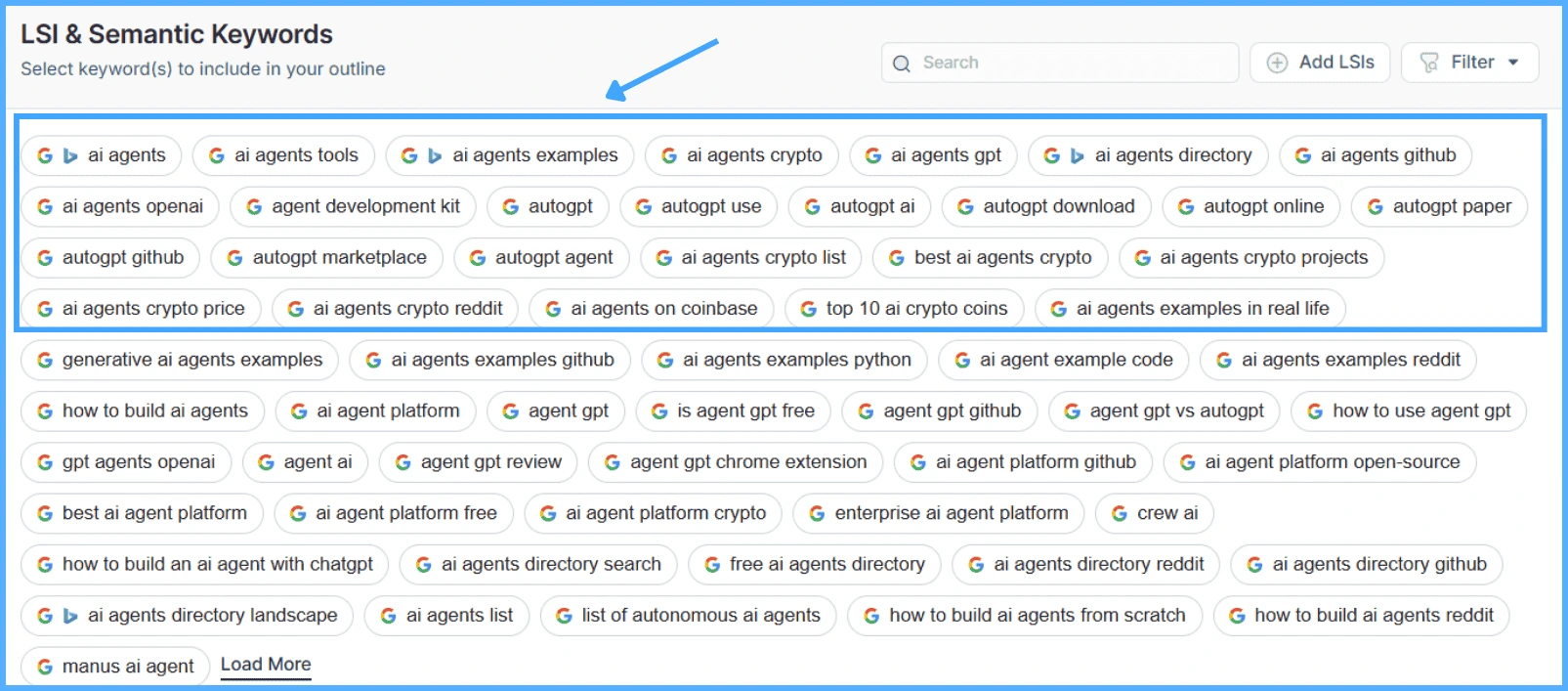
This ensures every content brief covers the right phrases, structured in a way that aligns with how both search engines and large language models understand topics.
Combined with User Intent Analysis, Wellows shows exactly which terms reinforce relevance, fill semantic gaps, and improve SERP alignment. Adding semantic keywords isn’t about sprinkling terms—it’s about placing the right ideas where they naturally belong.
Strategic Placement: Where to Use Them
- Title tags: Include a main keyword or a semantic variation to define the page
- Subheadings: Use context-rich phrases that reflect user queries
- Image alt text: Describe visuals in plain, topic-relevant language
- Body content: Naturally weave in related terms while answering the user’s question
Tip: One mention in each key area is usually enough if the surrounding content is strong.
Match User Intent, Not Just Words
Semantic SEO works when your content reflects the searcher’s intent. If someone searches “best email tools for freelancers,” your content should address features, pricing, and integrations—not just repeat the phrase.
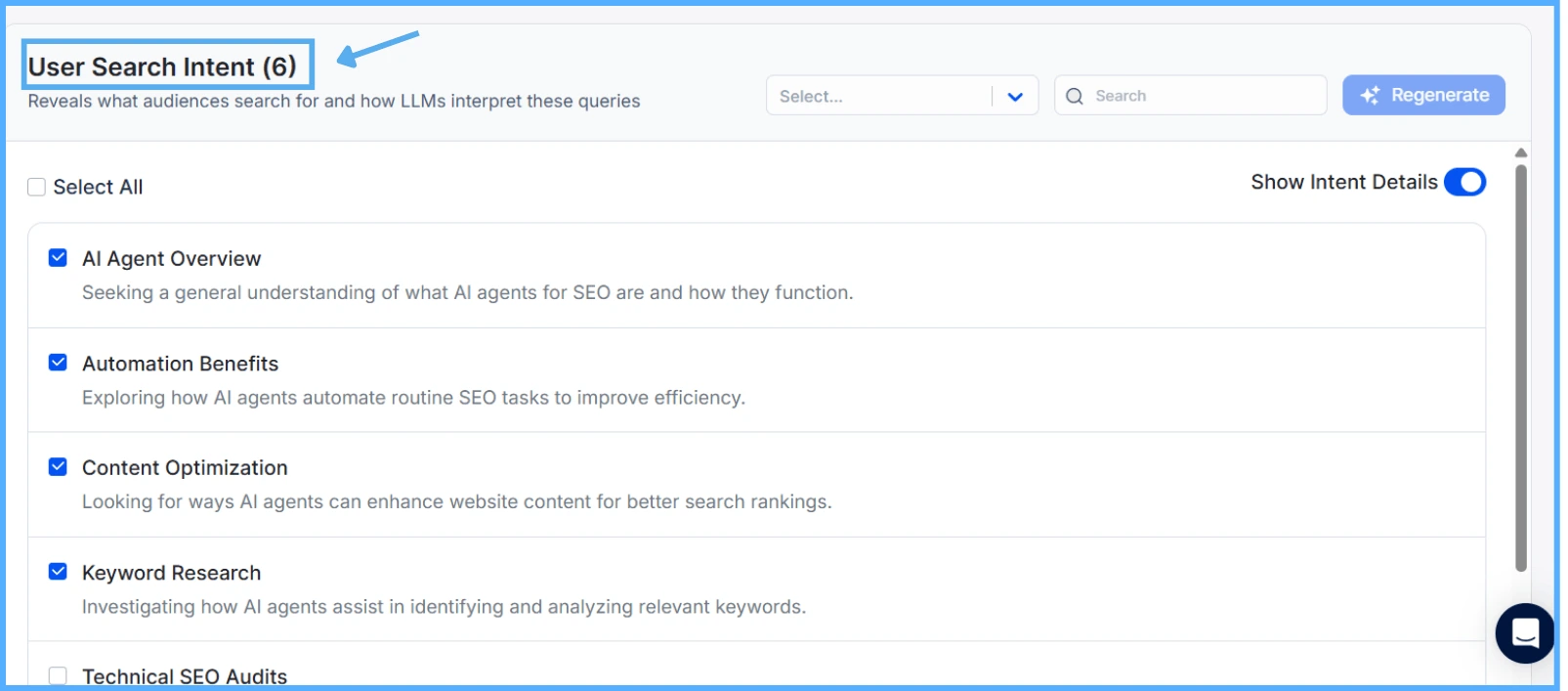
With Wellows User Intent Analysis, you can match terms to exact search motivations—whether informational, commercial, or transactional—so your coverage fits both human and AI expectations.
Build Around Topics, Not Keywords
- Primary topic pages
- Subtopic sections
- Internal links between related concepts
This structure forms a topic cluster, helping search engines understand your expertise.
Example: If your topic is “What Are LSI Keywords,” semantic coverage should also include “Latent Semantic Indexing,” “synonyms vs semantic terms,” “BERT and NLP,” and “how search engines interpret meaning.”
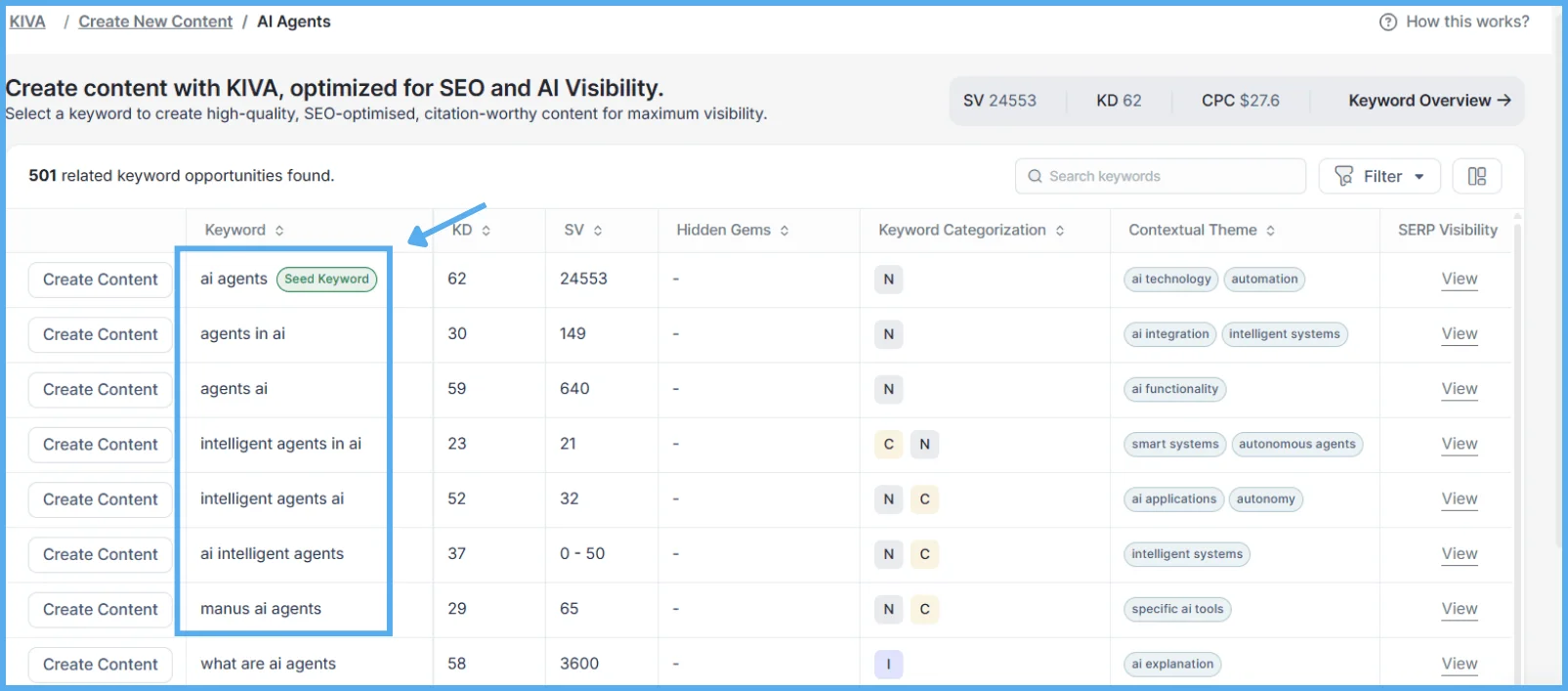
You’re not repeating the keyword—you’re showing that the page understands the full scope of the topic.
Why Semantic Keywords Matter for SEO
Semantic keywords anchor your page within its topic and related entities, improving how systems interpret relevance when analyzed with Real-Time SEO Data.
Below are practical ways they influence context, AEO visibility, and long-term authority.
Help Google Understand Context and Coverage
Semantic keywords help Google grasp what your page is truly about. Instead of guessing based on one phrase, it sees the broader context—the surrounding entities, terms, and structure. That improves how your page is classified and matched to user queries.
Improve AEO and Long-Tail Visibility
Answer Engine Optimization (AEO) means preparing content for featured snippets, “People Also Ask,” and AI-generated responses. Using semantic keywords boosts your chances of showing up for long-tail variations like “Does Google use LSI?” or “difference between LSI and semantic SEO.”
That same semantic coverage improves visibility in AI search, where answers are summarized and cited based on context—not exact-match keywords.
If you’re still wondering about LSI’s role, remember: wins come from robust semantic coverage—not the LSI label.
Avoid Keyword Stuffing and Build Authority
Repeating “LSI keywords” ten times doesn’t build relevance—it raises flags. Semantic terms let you expand coverage naturally, improving readability and signaling topical depth. That’s how you build authority over time.
Semantic SEO Best Practices
Turn semantic principles into repeatable technical SEO checklists for agencies and workflows.
Use the following practices to upgrade old content, structure new pages, and keep intent and entities aligned.
1. Update Older Content with Semantic Terms
Review older posts written with exact-match focus. Add relevant entities and intent-based terms to keep them competitive and discoverable.
2. Use Schema to Support Context
Structured data like FAQ or Article schema reinforces context—but only when paired with strong semantic content. Don’t add schema as decoration; use it to support meaning.
3. Don’t Rely on LSI Lists or AI Autocomplete
Some tools still output “LSI keywords.” Treat them as clues, not commands. Always validate against live SERPs.
4. Think Like a Reader, and a Search Engine
Ask: What questions would a user have? Then ask: What phrasing helps Google understand I’ve answered them? That’s the heart of semantic SEO.
What to Do
- Use related terms that reflect user intent, not just variations
- Answer full topic questions in natural, specific language
- Place semantic terms in titles, headings, alt text, and internal links
- Use Wellows LLM Visibility to see where your content shows up across AI and search, then fix gaps.
- Support semantic clarity with structured data when it reinforces content meaning
What to Avoid
- Don’t rely on lists of so-called “LSI keywords”—they’re outdated
- Don’t keyword stuff or chase density targets
- Don’t copy AI-generated terms without checking SERPs
- Don’t optimize for words—optimize for meaning
Example: Keyword-Stuffed vs. Semantic-Rich
Old style: “What are LSI keywords? LSI keywords help with LSI SEO. These LSI terms improve LSI rankings.”
Modern style:“What are LSI keywords? While the term refers to an outdated indexing method, today’s search engines use semantic signals and user intent to understand content more accurately.”
Read More Articles
FAQs
Google’s algorithms use advanced systems like BERT and MUM to understand context, intent, and language—not outdated indexing models.
In 2019, John Mueller (Google Search Advocate) clarified: “There’s no such thing as LSI keywords – anyone who’s telling you otherwise is mistaken.”
While Google doesn’t use LSI keywords, using semantically related terms naturally in your content remains valuable. It improves topical depth, helps search engines understand context, and creates a better user experience.
Final Takeaway
If you’re still asking what are LSI keywords, it’s likely because the term continues to circulate in SEO conversations—yet in reality, it no longer applies to how modern search works. Search engines and LLMs don’t rely on outdated indexing techniques; instead, they interpret meaning, relationships, and user intent.
What matters now is semantic SEO an intent-driven approach that focuses on relevance, topical depth, and how content is understood by both Google and language models like ChatGPT, Claude, and Gemini.
By shifting from keyword stuffing to semantic structuring, your content gains the context, clarity, and visibility needed to perform across both SERPs and AI-driven discovery platforms.
So if you set out to explain or define LSI keywords, the modern answer is to skip the label and build semantic, intent-driven coverage instead.