Being a solo consultant can feel like running a marathon with a heavy backpack. You’re juggling client work, strategies, content, and reporting. All by yourself.
The biggest hurdles? Limited resources, less time, and not always having deep SEO expertise. Unlike big agencies, you don’t have a team to share the load or access to advanced AI SEO tools that streamline research and execution.
This is where AI steps in as your secret advantage. Think of it as an extra set of hands—or even a full research and strategy partner. Many solo consultants now rely on AI search visibility platforms for consultants to bridge the gaps, surface data-driven opportunities, and compete confidently at a higher level.
In this blog, you’ll discover 7 practical tips to scale SEO with AI as a Solo Consultant. These strategies will help you save time, simplify your workload, and serve clients more effectively.
TL;DR
- AI helps solo consultants save time on keyword research, content, audits, and reporting.
- Wellows shows where you and your clients appear across search + AI engines so you focus on high-impact topics.
- Use AI for execution (research, drafts, dashboards); keep strategy, creativity, and client relationships human.
- Block your week by function and use AI to cut busy work so you can avoid burnout and grow with retainers.
What Are the Tips for Solo Consultants to Scale SEO with AI?
Scaling SEO alone can feel overwhelming, but AI and visibility platforms make the journey easier. Instead of spending hours on research, writing, or analysis, you can let AI handle the heavy tasks while a platform like Wellows shows you where you’re actually visible across search and AI engines.
Here are 7 simple yet powerful tips to help solo consultants use AI and Wellows to work smarter, save time, and grow their impact.
1. Automate Keyword Research with AI
Finding the right keywords can take hours, but AI speeds it up in minutes. It uncovers high-value, long-tail, and semantic keywords you might miss on your own.
In fact, 68% of marketers say AI helps identify keyword opportunities they would have otherwise overlooked. (Gitnux, 2025)
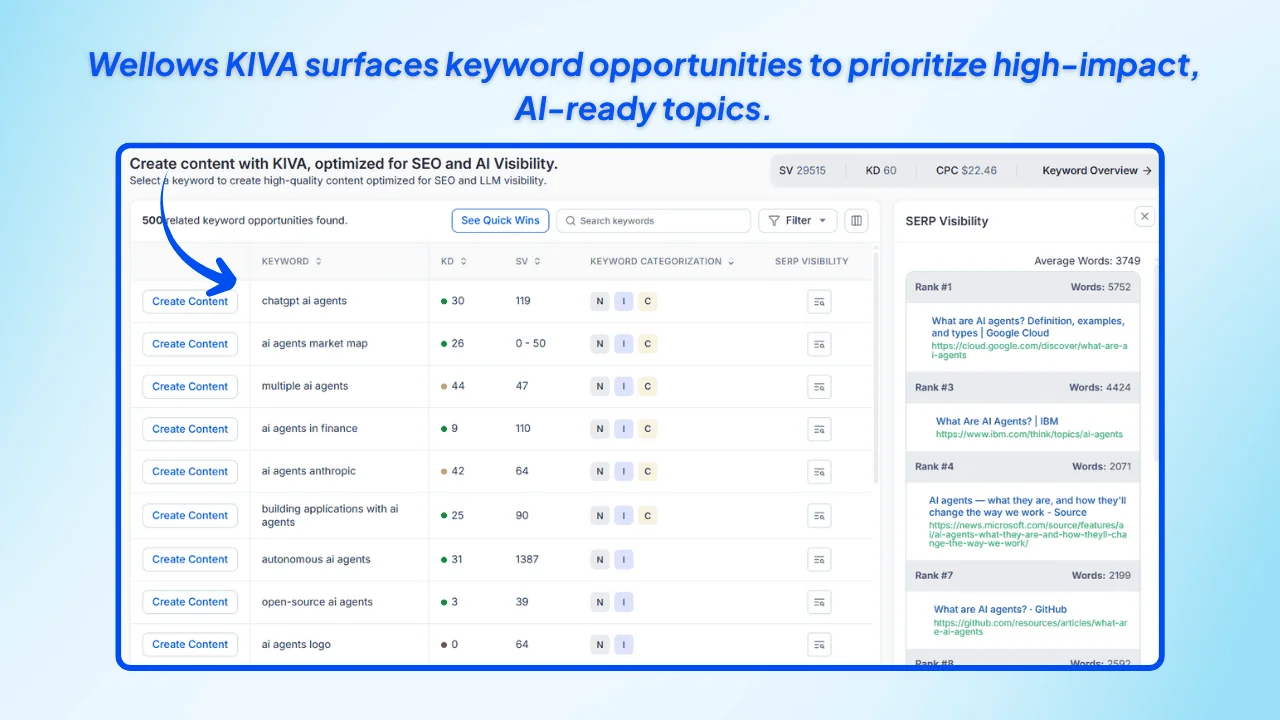
Wellows AI search visibility platfrom legacy feature KIVA keyword opportunities surface hundreds of related queries with search volume, difficulty, categorization tags, and SERP visibility, helping solo consultants quickly choose high-value topics and create content that supports their overall AI and search visibility strategy.
2. Streamline Content Creation with AI SEO Agents
Creating blogs, landing pages, and descriptions doesn’t have to drain your energy. AI can generate drafts quickly, helping you get content out faster. Used well, AI SEO supports faster outlining, cleaner structure, and tighter alignment with the queries clients actually care about.
Still, your role matters. Human oversight ensures the final piece feels authentic, personal, and trustworthy—something AI alone can’t achieve.
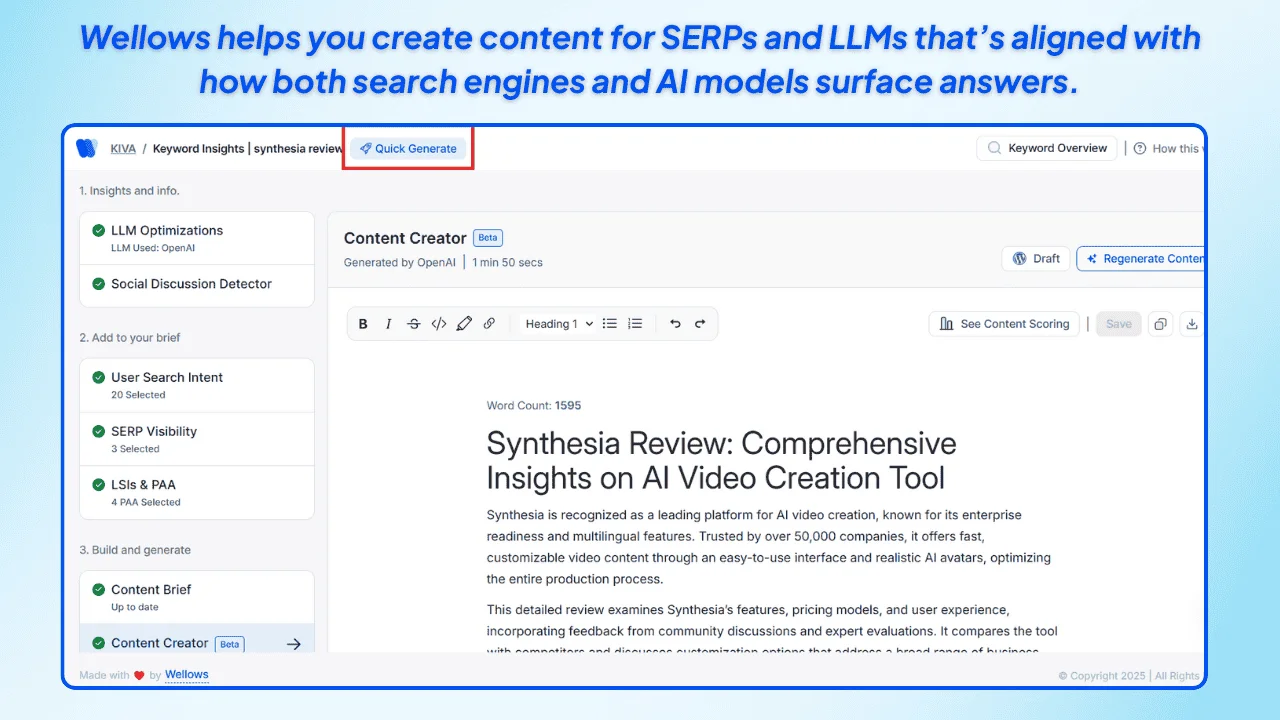
While Wellows isn’t a writing tool, it powers smarter briefs for whatever AI writer you use. By pulling in keyword intent, SERP patterns, and AI query data, Wellows helps you create content for SERPs and LLMs that’s aligned with how both search engines and AI models surface answers.
3. Scale Content Optimization with AI
On-page SEO is time-consuming, but AI can run quick audits. It checks titles, meta tags, and readability to ensure your content is always optimized.
You can also use AI to refresh older posts, update data, and repurpose content into new formats.
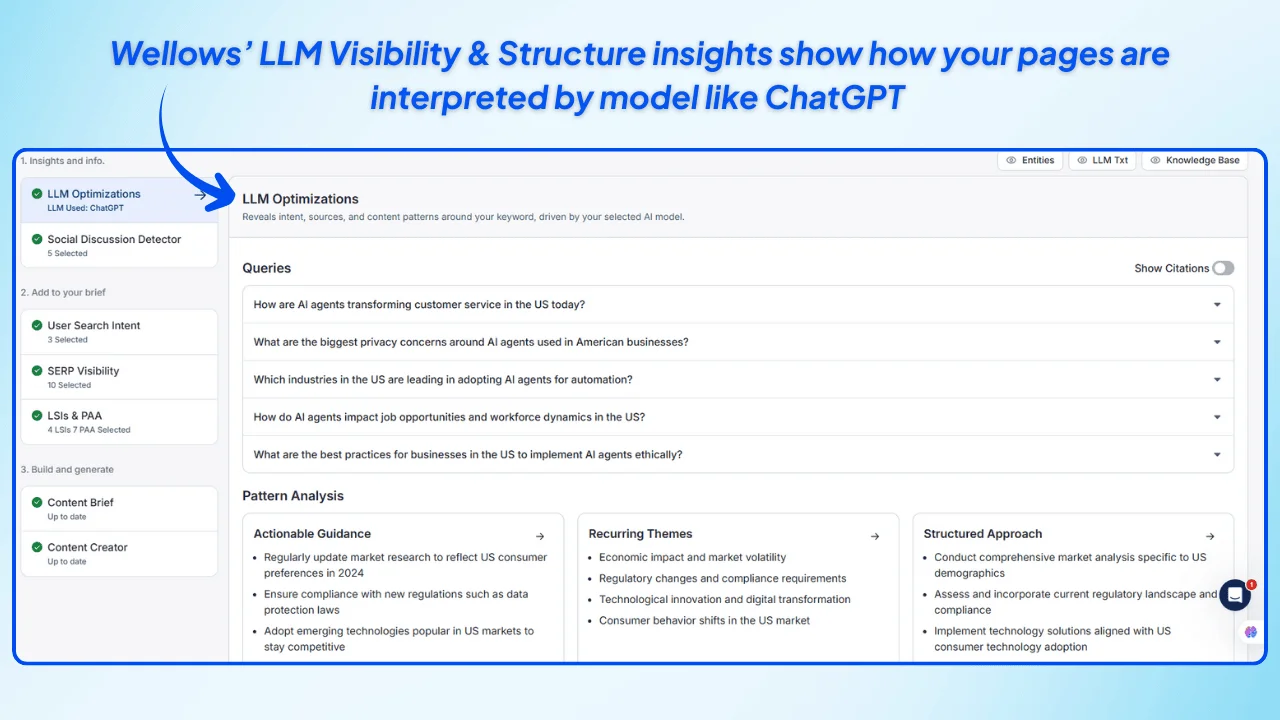
Wellows’ LLM Visibility & Structure insights show how your pages are interpreted by model like ChatGPT and whether they’re citation-ready for LLM-txt optimization. This means your content isn’t just optimized for search engines—it’s also more likely to be cited inside AI-generated answers.
4. Stay Ahead with AI-Powered Competitor Insights
Keeping an eye on competitors is tough when you’re solo. AI tracks their rankings with site audits, backlinks, and content strategies, giving you insights without the manual grind.
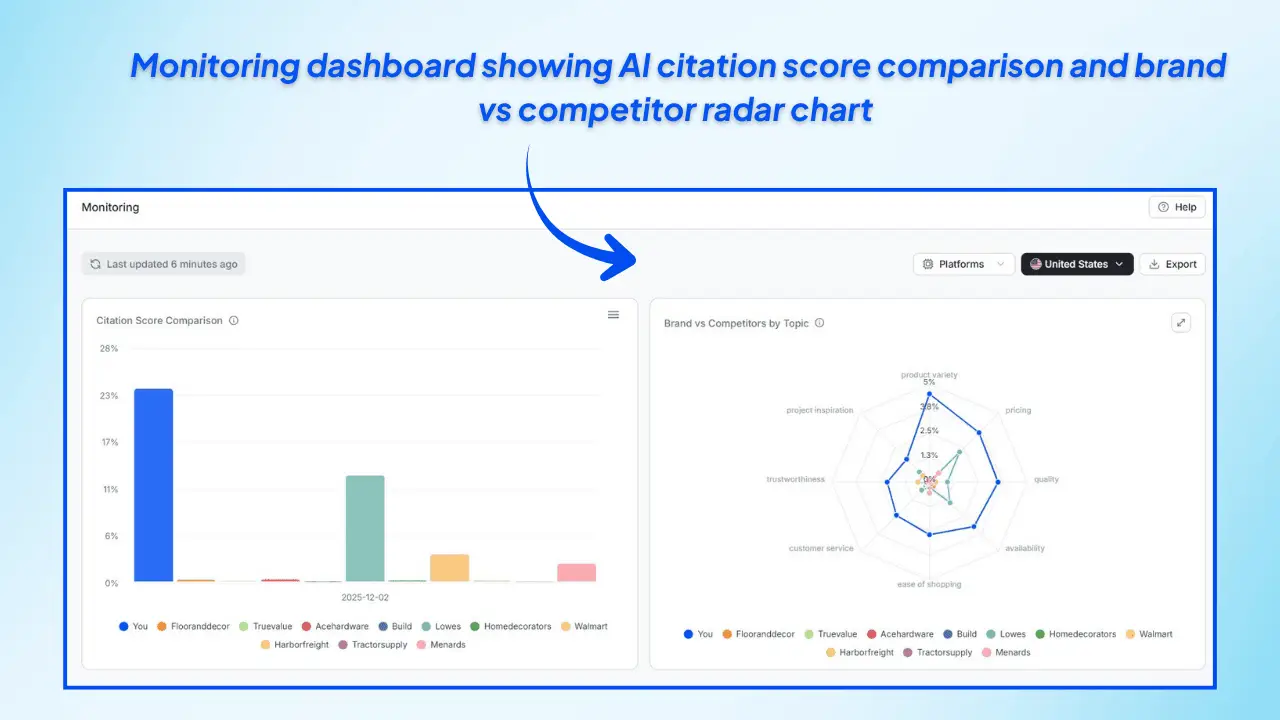
Wellows’ Competitor Visibility insights show which rival pages rank in SERPs, which domains and URLs get cited by AI engines, and what formats they use to win those placements. This makes it easier to:
- Spot topics and queries where competitors dominate
- See which pages earn the most citations across ChatGPT, Gemini, and Perplexity
- Prioritize content and outreach where outperforming them will actually move your visibility
5. Personalize Client Reporting with AI Dashboards
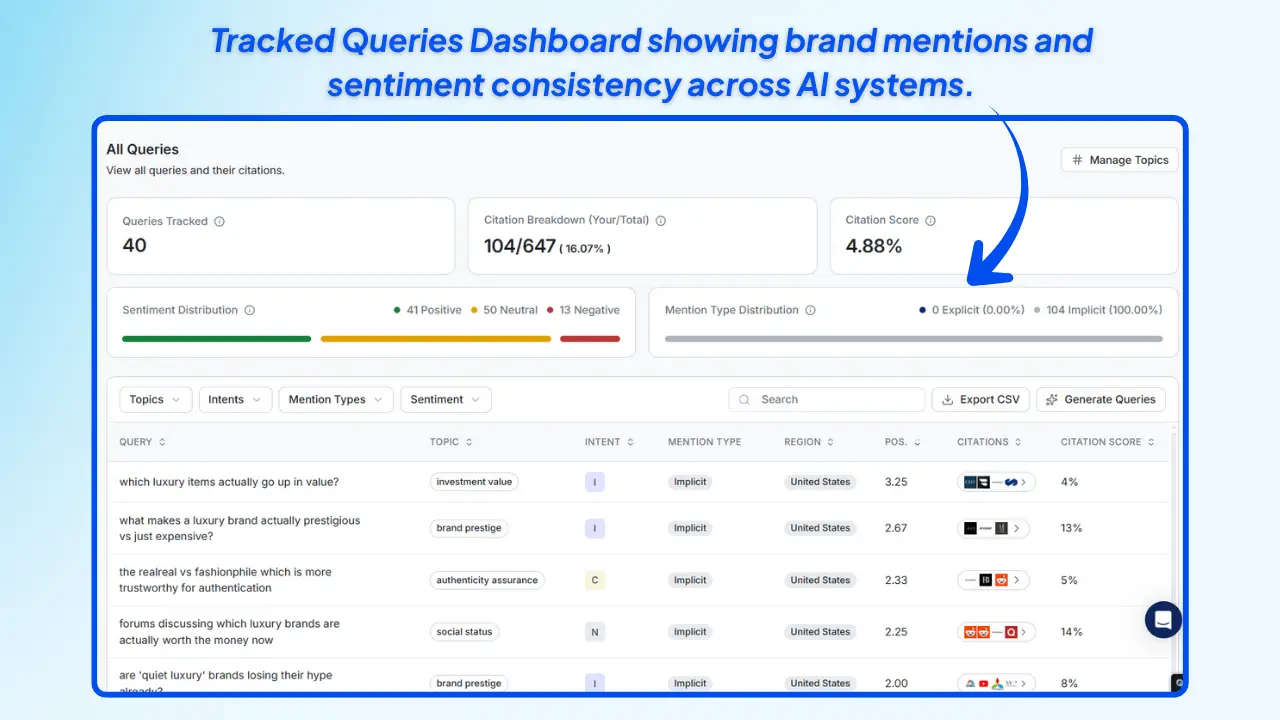
Clients love clear reports, but making them can eat up your time. AI turns raw SEO data into simple visual dashboards that are easy to understand.
In fact, automated SEO reporting saves teams approximately 50 hours per month. (Adaptify, 2025)
Because of SEO automation marketers are replacing spreadsheets with AI agents—and platforms like Wellows make it easy to show not just rankings, but how often clients are cited across AI models and search experiences.
6. Enhance Link Building with AI Assistance
Backlink research is often repetitive, but AI makes it smarter. It helps you find quality prospects and strengthen internal linking strategies alongside personalized outreach messages.
AI can also predict which link opportunities will bring the most value, so you invest your time wisely. This keeps your link-building strategy strong and focused.
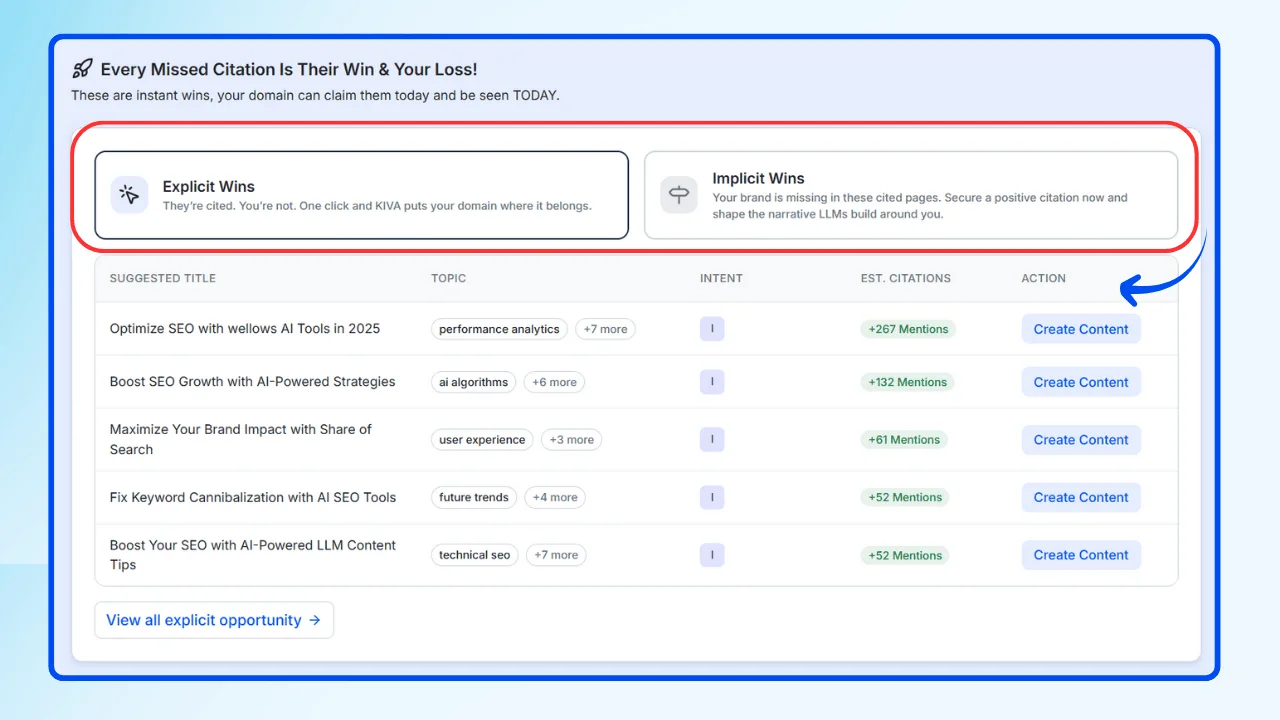
Wellows’ AI visibility tracking reveals where your brand is cited across major AI engines—highlighting both explicit citations (when your brand is clearly credited) and implicit citations (when your content is used but not attributed).
This makes link building far more strategic. By seeing which pages, domains, and discussion hubs LLMs pull from for your target topics, you can:
- Convert implicit citations into earned links
- Prioritize outreach to high-influence sources
- Strengthen authority where AI already relies on your content
Together, these insights help you build links that not only support SEO but also shape how AI models reference your brand in future answers.
7. Use AI for Predictive SEO and Future-Proofing
SEO is always changing, but AI helps you stay one step ahead. It forecasts keyword shifts, traffic patterns, and even the impact of algorithm updates as AI search reshapes how people find information online.
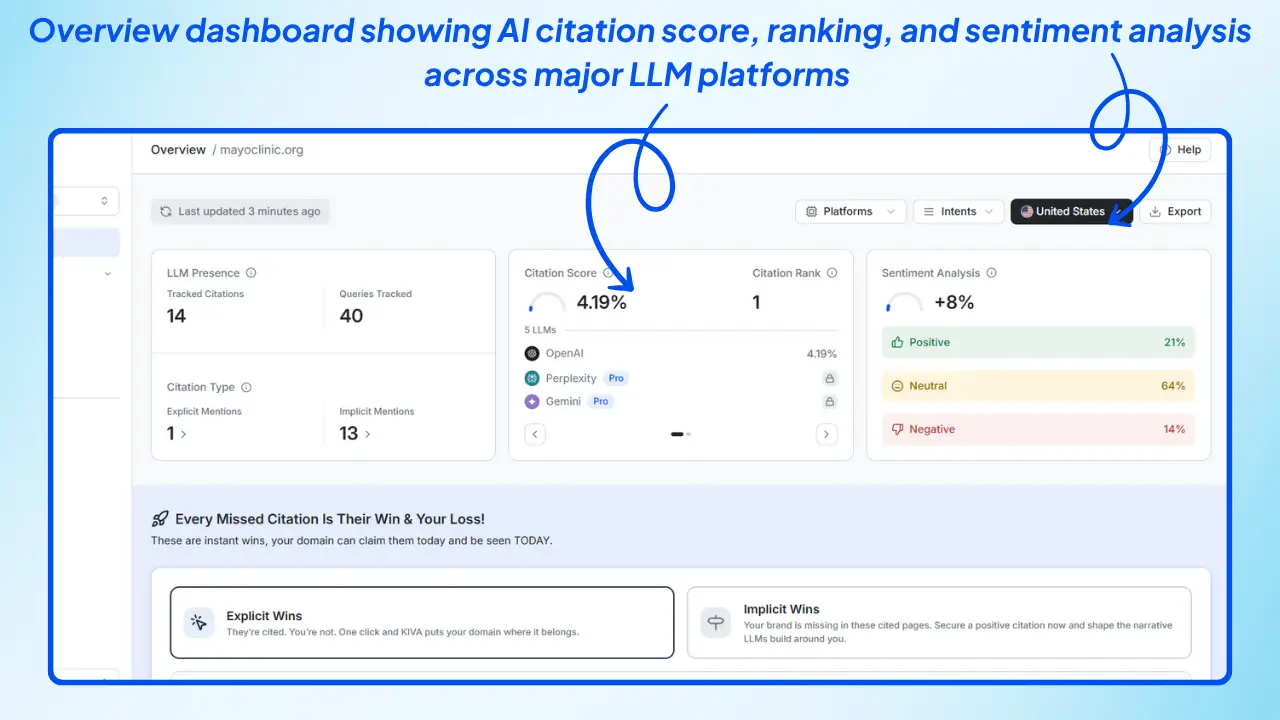
Wellows’ multi-LLM visibility dashboards and Citation Score reveal how your brand appears across ChatGPT, Gemini, Perplexity, Google AI Overview, and AI Mode over time. By monitoring shifts in citations, sentiment, and competitor presence, solo consultants can spot emerging patterns early, double down on winning topics, and future-proof their strategy before rivals catch up.
Why Solo Consultants Should Use AI For SEO?
As a solo consultant, your biggest bottleneck is time. AI helps you automate the heavy, repeatable parts of SEO so you can spend more of your week on strategy, clients, and revenue instead of manual grunt work.
1. Automate Repetitive SEO Tasks: Use AI for keyword expansion, content drafts, and basic on-page checks so you’re not starting from scratch every time you open a new brief or blog.
2. Turn Data Into Decisions Faster: Let AI summarize audits, surface patterns, and highlight issues across pages, so you move straight from “what’s happening” to “what we do next” with each client.
3. Scale Output Without Hiring A Team: Produce more optimized pages, reports, and ideas per month without adding headcount—ideal when you want to grow capacity but stay solo.
4. Use Wellows To See What Actually Works: Combine AI execution with Wellows, which tracks how you and your clients show up across search and AI engines, so you focus effort on pages, topics, and citations that drive real visibility.
5. Compete With Larger Agencies: AI plus visibility analytics let you deliver faster, sharper SEO and AI-search insights—helping you match (or beat) the output of bigger teams while staying lean.
6. Protect Your Time For Strategy And Clients: With execution handled by AI workflows and monitoring handled by Wellows, more of your calendar goes to deep work, client conversations, and higher-value decisions—where your expertise matters most.
Tip: Use on page SEO analysis before automation to make sure AI workflows are targeting your most impactful pages.
What Tools Should Solo Consultants Use For Projects, Invoicing, And Clients?
When you’re working solo, your tool stack is basically your team. The right setup keeps you organized, paid on time, and consistently visible to clients and search/AI engines—without drowning in tabs.
You don’t need dozens of tools. You need a few reliable categories that work well together:
- Project management – to keep client work structured and deadlines under control
- Invoicing & finance – to get paid on time and track cash flow
- Client communication – to keep conversations and approvals in one place
- AI visibility & SEO intelligence – to understand how clients (and you) are seen across search and AI engines
Here’s how that can look in practice.
1. Project Management: One Source Of Truth For Client Work
You need somewhere to manage deliverables, timelines, and tasks so nothing lives only in your head.
Popular choices include tools like Trello, Asana, Notion, or ClickUp—anything that lets you:
- Turn each client into a separate project or board
- Track briefs, content status, and approvals
- Set due dates and recurring tasks (like monthly reports or audits)
The goal isn’t complexity—it’s clarity. A lean project tool keeps you confident about “what’s next” for every client so you can focus on strategy instead of firefighting.
2. Invoicing & Finance: Make Getting Paid Boringly Simple
As a solo consultant, cash flow is everything. Your finance stack should make sending invoices and tracking payments as routine as brushing your teeth.
You might use:
- An invoicing tool (e.g., Stripe, PayPal, Wave, or a lightweight accounting app)
- Simple recurring invoices for retainers and monthly SEO packages
- Clear payment terms baked into your proposals and contracts
The less time you spend manually chasing invoices, the more energy you have for client work—and for building your own visibility.
3. Client Communication: Centralize Conversations And Feedback
Endless email threads are where details go to die. A simple communication stack keeps you close to your clients without overwhelming you.
Solo consultants often combine:
- Email + a call tool (Google Meet, Zoom) for check-ins and reporting calls
- A shared Slack channel or similar for faster collaboration with long-term clients
- Calendly or another scheduling tool for discovery calls and recurring meetings
The key is consistency—your clients should know exactly where to reach you and where updates will live.
4. Wellows: The AI Visibility & SEO Intelligence Layer
On top of those “run the business” tools, you need one platform that tells you how visible you and your clients actually are across search and AI engines.
That’s where Wellows fits into the stack—not as another dashboard, but as your AI visibility layer:
- Track Citation Scores to see how often a brand is referenced across ChatGPT, Gemini, Perplexity, and AI Overviews.
- See explicit vs. implicit citations so you understand where content is being used and when it’s credited.
- Monitor sentiment and competitor visibility to find quick-win opportunities for new content, outreach, or optimization.
- Connect insights to your workflow by turning visibility gaps into clear tasks inside your project management tool.
Instead of guessing which topics to double down on or where to build links, Wellows shows you:
- Where your clients are already visible in AI responses
- Where competitors are winning attention
- Which pages and topics deserve your next hour of effort
For a solo consultant, that’s the difference between “doing SEO tasks” and running a focused, AI-informed visibility strategy that scales across multiple clients.
Put simply:
- PM tool = how you deliver the work
- Invoicing tool = how you get paid for the work
- Comms tool = how you collaborate on the work
- Wellows = how you decide which work actually moves the needle in search and AI
What are the Challenges Solo Consultants Face?
AI can help solo consultants scale faster, but it’s not a magic solution. Like any tool, it comes with its own set of risks. Being aware of these challenges will help you use AI wisely without losing the value you bring as a consultant.
Did you know?
Over-reliance on AI
If you depend too heavily on AI, the output can become repetitive or generic. Search engines value originality, so blindly publishing AI-written content may harm your credibility. Always review and refine AI’s work with your own expertise.
Did you know?
Data interpretation limits
AI is great at analyzing data and spotting patterns, but it can’t always understand context. For example, it might highlight a keyword trend that doesn’t fit your client’s audience. Human judgment is still needed to decide which insights are useful and which to ignore.
Did you know?
Maintaining your unique edge
Your clients don’t hire you just for reports or keywords—they want your strategic thinking and creative approach. If you lean too much on AI, you risk blending in with everyone else. Protect your unique style, insights, and problem-solving skills.
Did you know?
Keeping up with AI’s pace
AI tools evolve quickly. What works today may look outdated tomorrow, making automation for workflows essential for staying efficient. As a consultant, you’ll need to stay updated on new AI capabilities and adapt them to your workflow without letting them overwhelm you.
By keeping these challenges in mind, you can make AI your assistant—not your replacement. The key is balance: let AI handle the heavy lifting while you focus on strategy, creativity, and client re
How Can A Solo Consultant Structure Their Week To Avoid Burnout?
When everything depends on you, it’s easy to let client work fill every hour and push marketing, admin, and rest to “later.” A simple weekly structure—supported by AI and tools like Wellows—helps you protect deep work, visibility, and recovery time.
Here’s a practical way to shape your week.
- A. Block Your Week By Function:
Instead of reacting to whatever’s in your inbox, group time by type of work:
- Client delivery blocks – 2–3 deep-work blocks per day for audits, strategy, and implementation.
- Marketing blocks – 2–3 sessions per week for content, LinkedIn, and outreach.
- Admin blocks – 1–2 short windows for invoicing, emails, and scheduling.
- Review & planning – one weekly session to look at performance and adjust priorities.
Keep these blocks at consistent times so your brain knows what each part of the day is for.
- B. Let AI Handle The Busy Work:
A lot of “busy work” in SEO comes from repeating the same checks and pulling the same data. Let AI take that over:
- Use AI tools for keyword expansion, draft outlines, and content rewrites instead of starting from a blank page.
- Automate report templates so only commentary and recommendations need your input.
This frees up more of your blocks for thinking and decision-making—not copying numbers between tabs.
- C. Use Wellows As Your Visibility Hub:
Manual SERP checks and AI queries across multiple platforms can eat hours each week. Wellows condenses that into one view:
- Daily or weekly visibility checks instead of ad-hoc manual searches.
- Citation Score and sentiment trends so you quickly see if a client is gaining or losing ground.
- Explicit and implicit citation insights to decide what to work on next (content updates, link outreach, or technical fixes).
Start your week by opening Wellows, reviewing shifts, and turning the top 2–3 opportunities into tasks in your project tool.
- D. Protect Time For Your Own Marketing:
To avoid feast-or-famine cycles, treat your own visibility like a client project:
- Block at least two marketing sessions per week (e.g., one for content, one for distribution).
- Use AI to repurpose one asset into multiple formats (blog → LinkedIn post → email).
- Leverage Wellows data to decide which topics and pages you should push next based on where you’re starting to earn or lose citations.
These blocks should be non-negotiable—no client work gets booked over them.
- E. Treat Time Off As Non-Negotiable:
Burnout shows up when “just one more thing” keeps invading evenings and weekends. Build limits into your week:
- Set a latest end time for client work and stick to it.
- Use AI and Wellows to compress low-value work (manual checks, formatting, repetitive analysis) into shorter windows.
- Keep at least one block per week completely free for thinking, learning, or rest.
The goal isn’t to do everything. It’s to let AI and Wellows handle monitoring and repetitive work so your time goes to high-impact tasks—and you still have energy left at the end of the week.
Balancing AI with Human Creativity and Strategy
AI is powerful when it comes to speed and automation, but it can’t replace the human touch. As a solo consultant, your real value lies in creativity, empathy, and strategic thinking. Finding the right balance ensures AI supports your work instead of overshadowing it.
AI is excellent at execution. It can handle repetitive or time-consuming tasks like keyword research, audits, or reporting. This frees up your time so you can focus on higher-level thinking and client relationships.
But strategy still belongs to you. AI can process data, but it can’t set goals, build trust, or design unique approaches. Use AI insights as a foundation, then apply your expertise to turn them into actionable strategies.
Creativity and empathy also remain human strengths. Clients value authentic messaging, personalized communication, and problem-solving—all of which require emotional intelligence. These are areas where no AI can fully match your skills.

Long-term SEO growth depends more on insights than on tools. AI tools may evolve quickly, but your ability to align data with client goals and market trends is what truly drives sustainable results.
By blending AI’s efficiency with your own creativity and strategy, you can deliver outcomes that stand out—proving that the best results happen when humans and AI work together.
What Strategies Help Solo Consultants Avoid Feast-Or-Famine Income?
Feast-or-famine usually happens when you rely on one-off projects and only market yourself when things are slow. To create more predictable revenue, you need steady demand and offers that renew instead of ending.
1. Shift To Recurring Offers: Move beyond one-off audits and projects by adding monthly SEO retainers, visibility monitoring packages, or consulting subscriptions. Recurring work smooths income and makes forecasting easier.
2. Keep A Simple, Weekly Lead Routine: Block 2–3 hours each week for marketing—publishing or repurposing content, starting warm conversations, and resharing case studies—so pipeline building never fully stops when client work gets busy.
3. Use AI To Stay Visible When You’re Busy: Let AI help you turn one in-depth piece into multiple posts, emails, or short videos, and refresh older content with new data so your brand stays active in front of prospects without constant manual effort.
4. Use Wellows To Make Visibility Predictable: Rely on Wellows to see where you or your clients show up across ChatGPT, Gemini, Perplexity, and AI Overviews, how often you’re cited, and which topics are compounding—then build retainers around ongoing visibility monitoring and optimization.
5. Maintain A Basic Financial Buffer: Save 2–3 months of essential expenses and set aside a portion of every invoice. A small runway gives you space to say no to bad-fit work and stay consistent with long-term visibility and lead generation.
FAQs
No. AI is great for automating tasks and analyzing data, but it lacks creativity, empathy, and strategic judgment. Consultants bring the human insight that clients trust.
Start small. Use AI for keyword research, content optimization, or reporting. Once you’re comfortable, expand into other areas like competitor analysis or predictive SEO.
Yes. With AI, solo consultants can automate time-consuming SEO tasks like keyword research, reporting, and audits, allowing them to scale without needing a large team.
AI handles repetitive work such as clustering keywords, generating content drafts, or creating reports. This lets consultants focus on strategy and client relationships.
Yes. AI acts as a force multiplier, allowing solo consultants to deliver results at a scale that was once only possible for larger teams.
Focus on one or two main formats (e.g., blog + LinkedIn or podcast + newsletter) and let AI handle repurposing. Turn one core piece into multiple posts, clips, or emails, and use tools like Wellows to see which topics actually earn visibility so you double down on what works instead of creating content nonstop.
Lean on inbound and warm outreach: helpful content, case studies, and simple CTAs to book a call. Combine this with LinkedIn networking, referrals, and visibility data from Wellows (which shows where you’re already being discovered in AI and search) so you can attract interested leads instead of pushing cold pitches.
Conclusion
AI gives solo consultants the power to scale like big agencies. It helps you save time, automate routine tasks, and focus on delivering high-value strategies that impress clients.
The best approach is to start small. Use AI for one or two areas, like keyword research or reporting, then expand as you grow more comfortable.
These tips for solo consultants show how AI agents like Wellows can simplify the workload while amplifying results. Remember, AI is here to support you—not replace you. Think of it as your assistant, while you remain the strategist guiding the big picture. With this balance, you can achieve more than ever as a solo consultant.