If you’ve ever stared at a messy spreadsheet full of keywords, wondering how to turn chaos into a clear content plan, you’re not alone.
Recent data shows that 67% of marketers in 2025 struggle to organize and categorize growing keyword lists as search behavior becomes more complex (HubSpot, 2025).
The challenge isn’t the keyword list itself—it’s keeping campaigns aligned, managing deadlines, and staying ahead of shifting search and AI visibility expectations.
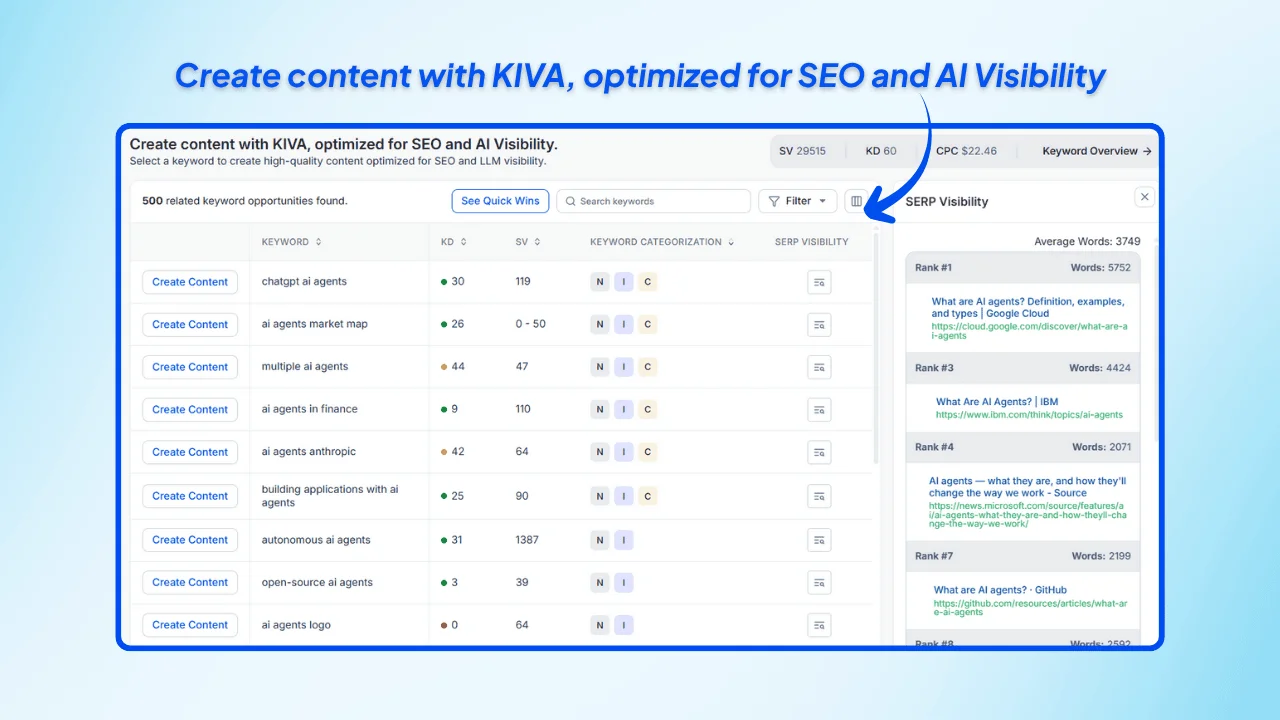
Inside Wellows — the Search Visibility Platform, this process becomes dramatically easier. KIVA, now a legacy visibility workspace within Wellows, centralizes keyword discovery, clustering, and content mapping in one unified workflow.
Instead of switching between scattered tools, teams drop in a single seed keyword and instantly see structured clusters, semantic variations, and intent signals—organized inside a visibility table that removes manual guesswork.
This shifts clustering from a tactical SEO chore into a core on-page SEO visibility workflow. The platform helps teams build connected content ecosystems, not isolated posts—strengthening topical depth, entity clarity, and long-term search visibility.
TL;DR — What You’ll Learn in This Guide
Keyword clustering is no longer just an SEO trick — it’s the backbone of how modern teams plan, structure, and scale content with clarity.
- Wellows turns messy keyword lists into clean, intent-based clusters using semantic and SERP signals.
- You’ll see how clusters help you build connected content ecosystems instead of isolated posts.
- Clustering inside the platform speeds up research, briefs, writing, and internal linking.
- You’ll learn how clusters map to funnel stages, content formats, and campaign sprints.
- The guide also covers visualization, multilingual SEO, local SEO, and performance tracking.
- By the end, you’ll know how to turn one seed keyword into full pillar pages, supporting content, and long-term visibility.
Clustering gives you structure. Wellows makes the structure usable.
What Is Keyword Clustering and Why Does It Matter for Teams?
Standalone keywords are hard to use. But when grouped by shared meaning and intent, they create a clear roadmap of what to write, how deep to go, and which topics users care about most.
Keyword clustering groups related queries into meaningful themes. In the platform, these clusters are strengthened using SERP visibility patterns so every theme aligns with real user behavior—rather than guesswork.
For content, product, and growth teams, clustering helps you:
- Create fewer, more comprehensive pages that fully address a topic
- Capture semantic and entity variations in one workflow
- Shorten ideation, briefing, and content production cycles
- Build clear internal linking paths that improve visibility signals
This approach works for lean teams too. One strategist consolidated 18 scattered articles into five high-depth pieces and increased engagement by 40% (AIContentfy).
Many tools cluster keywords, but the visibility workspace inside the platform takes a different approach. Instead of acting as a traditional SEO tool, it functions as a search visibility layer—combining keyword relationships, SERP signals, semantic themes, and entity structures into one unified view.
That’s why KIVA’s Keyword Clustering exists in Wellows: to make clustering effortless, accurate, and aligned with search visibility patterns. This reflects why modern teams increasingly replace spreadsheets and manual SOPs with visibility systems that eliminate guesswork.
For growing teams, using Wellows’ Search Visibility Platform for Startups ensures every topic is grounded in entity clarity, demand signals, and SERP-validated patterns.
Simply add a seed keyword, and the system automatically surfaces:
- Semantically related variations
- Intent-based clusters
- Contextual themes recognized by search engines and LLMs
Each cluster becomes a deeper content opportunity—helping you outline pillar pages, supporting articles, and internal linking paths that reflect how people search and how AI models interpret relevance.
The goal isn’t to “hack SEO.” It’s to bring clarity. With a structured visibility workspace, teams can focus on creating meaningful, well-organized content that supports long-term discoverability.
How to Implement Keyword Clustering (Step-by-Step)
Feeling overwhelmed by 5,000+ keywords from Semrush or GSC? You’re not alone. I’ve been there—multiple projects, messy spreadsheets, and no clear content direction.
Managing clustering at scale is only one challenge—keyword research, content briefs, and reporting consume even more time. That’s why workflow automation for core SEO tasks is becoming essential for agencies handling multiple clients.
For solo consultants especially, these challenges highlight the need for AI-powered SEO workflows, explored in detail in scaling SEO with AI as a solo consultant. That’s why workflow automation for core SEO tasks is becoming essential for agencies handling multiple clients.
Here’s the step-by-step I use to stay sane:
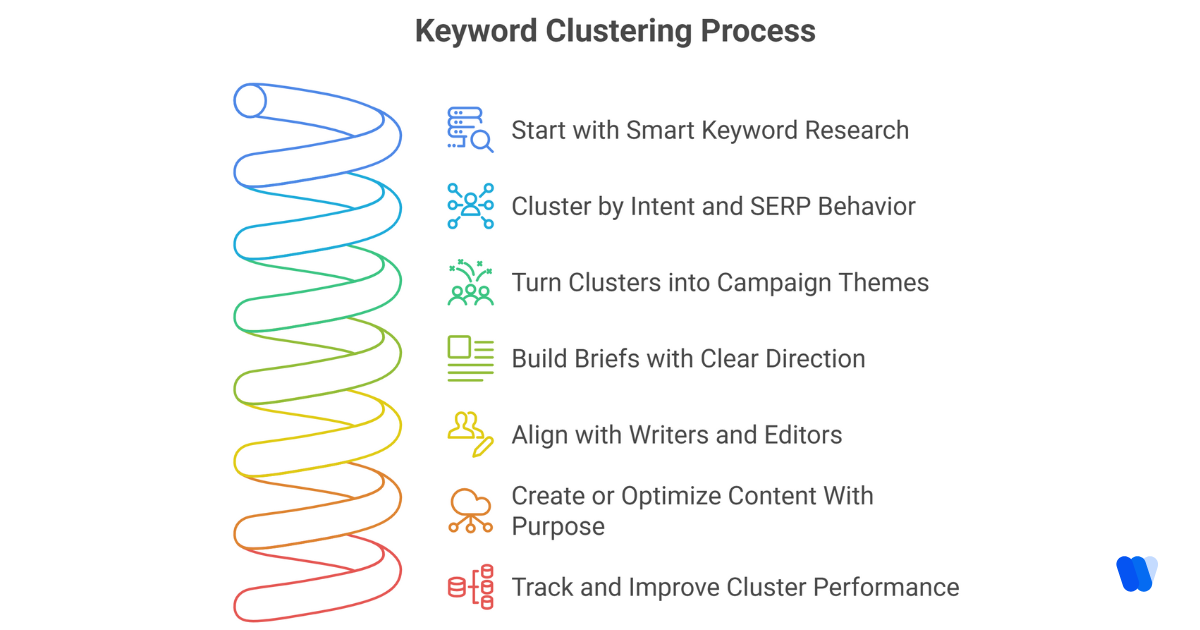
1. Start with Smart Keyword Research
Don’t stop at keyword volume. Blend inputs like:
- Google Search Console insights
- Competitive gap analysis
- Sales and support FAQs from your client’s teams
And focus on low-competition keywords early—they’re easier to rank for and make cluster strategies more achievable.
2. Cluster by Intent and SERP Behavior
Group keywords not by how they look, but by what they mean and how they surface together in real search results.
Inside Wellows, the intent-based clustering workspace analyzes semantic meaning, SERP behavior, real-time search data, and funnel relevance. This removes the need for manual interpretation and prevents misleading groupings that happen when you rely on keyword appearance alone.
Because the clustering engine reads how queries co-occur on the SERP, it highlights what actually competes together, not what simply “sounds” similar—making planning far more accurate for visibility workflows.
If you’re optimizing beyond Google, this matters even more. Bing SEO relies heavily on literal matching and structured topic clusters, so intent-aligned groups inside Wellows help maintain consistent discoverability across multiple search engines.
3. Turn Clusters into Campaign Themes
Each keyword cluster becomes the seed for:
- A pillar page or hub article
- A set of supporting blogs
- Or a targeted landing page
This helps you plan editorial calendars around content ecosystems, not just isolated posts.
4. Build Briefs with Clear Direction
When it’s time to move from strategy to content, clear briefs make everything faster. A strong brief keeps your team aligned, avoids guesswork, and turns clusters into content that’s easy to execute.
Pairing each brief with an on-page SEO checklist also helps writers and editors apply consistent page-level optimization without slowing down production.
Each cluster should generate a content brief that includes:
- Primary and secondary keywords mapped to the cluster
- Working title + suggested H2s based on SERP patterns
- Top-ranking competitors shaping the search landscape
- Search intent and funnel stage for precise positioning
Inside Wellows, the content-brief workspace (powered by the legacy KIVA module) automates this step. It pulls in keyword clusters, LLM-recognized patterns, SERP structures, and even social sentiment to generate a ready-to-build outline in seconds—so teams can move from planning to production without losing momentum.
5. Align with Writers and Editors
Briefs only work if everyone’s on the same page.
Before a piece gets written, take 5 minutes to align:
- What’s the core angle or narrative?
- What does “success” look like for this piece?
- Are there any internal linking targets from related clusters?
6. Create or Optimize Content With Purpose
Here’s where the real work happens—and where the value of clustering finally pays off. Instead of publishing isolated articles, teams can use clusters to build connected, high-depth content that covers multiple angles of a topic while maintaining strong, ongoing technical SEO audit standards.
Inside Wellows, the content creation workspace (powered by the legacy KIVA module) helps turn these clusters into structured drafts. The Content Creator and Humanize AI features ensure every piece feels natural, stays on-brand, and follows modern visibility standards—so teams create faster without sacrificing clarity or quality.
This approach allows you to:
- Avoid keyword cannibalization by assigning one intent per page
- Serve multiple query types (how-to, comparison, definition) within a single pillar
- Strengthen topical authority using thoughtful internal linking paths
For example, if you’re planning a content sprint for a SaaS brand, a cluster around “SaaS SEO” might generate:
- “SEO Checklist for SaaS Startups”
- “Best Keyword Research Tools for B2B SaaS”
- “How SaaS Companies Can Scale Organic Traffic”
These examples align with how startups use AI for SEO to streamline research, structure topical coverage, and accelerate organic growth through smarter visibility workflows.
Remember: If your content isn’t connected to a clear cluster with purpose, intent, and internal pathways—it’s just another blog floating in the void.
7. Track and Improve Cluster Performance
Clustering isn’t a one-and-done task—it’s a system you refine over time.In fact, solo marketers use an SEO agent to help track keyword movement and adjust clusters without spending hours manually checking reports.
Use tools like SE Ranking or Semrush Position Tracker to monitor:
- Ranking movement at the cluster level
- Content overlap or cannibalization
- Top-performing themes across clients
Why Keyword Clustering Is a Game-Changer for Content Operations
When you’re handling multiple clients, deadlines, and performance KPIs, efficiency and clarity aren’t luxuries—they’re survival tools.
That’s where keyword clustering comes in as more than just an SEO tactic—it’s a workflow transformer.
Here’s how keyword clustering reshapes how content teams operate:
- Save hours by clustering up to 200,000 key
- Generate briefs that scale across freelancers and in-house teams
- Visualize traffic potential and gap opportunities
- Align client strategy with Google’s semantic evolution
Whether you’re using clustering manually in spreadsheets or leveraging tools like Keyword Insights or SEO Spark, the outcome is the same: less guesswork, more impact.
Keyword clustering isn’t just about SEO—it’s about running leaner, smarter campaigns that align with how people actually search.
The Hidden Cost of Not Clustering
Skipping clustering might save you time up front—but it costs you in the long run.
- Competing pages
- Keyword cannibalization
- High bounce rates
- Confused user experience
And worst of all? The client noticed—and wasn’t happy. When keyword clustering is missing, content usually spreads across multiple pages with overlapping topics, diluted signals, and no clear hierarchy.
This is a common pattern for solo consultants and freelancers who rely heavily on spreadsheets—something we highlight in our breakdown of the unique challenges freelancers face in SEO. Without a structured visibility workflow, it’s easy to unintentionally duplicate themes and weaken topical authority.
Clustering solves a major part of that issue by giving your topics direction—but it still sits within a larger visibility framework.
When all of these layers work together, content stops drifting and starts forming a cohesive ecosystem that aligns with how modern search engines interpret relevance.
How Does Keyword Clustering Relate to Google’s Understanding of Search Intent?
Keyword clustering aligns perfectly with how Google now interprets search intent. Google no longer matches pages to single keywords—it evaluates the full meaning behind a query.
Modern systems like BERT and other intent-driven models analyze context, relationships, and semantic patterns. Clustering taps into that same logic by grouping terms that share the same purpose, outcome, or user expectation.
When related keywords sit in one cluster, they reflect a single intent pattern. For example, “vanilla cake recipe,” “how to make vanilla cake,” and “homemade vanilla cake” don’t require three separate pages.
Google sees them as variations of one intent. A single well-structured page that answers the entire intent performs better because it mirrors how Google understands and categorizes meaning.
Clustering also becomes clearer when you study the SERP. If multiple queries consistently trigger the same set of ranking pages, Google is telling you they belong to one user intent. This eliminates guesswork and helps you create content that speaks to the complete user journey instead of fragments of it.
Inside Wellows — the AI Search Visibility Platform, this alignment becomes even more natural. The system reads semantic relationships, surfaces shared themes, and highlights the intent signals connecting your keywords. This ensures your content blueprint matches how Google reads and groups information across the SERP.
By writing to the intent behind the cluster—not the individual keyword—you create deeper, more comprehensive content. Google rewards that clarity because it satisfies more variations of what the user is trying to achieve. It results in stronger visibility, better engagement, and broader relevance across your topic.
A Keyword Clustering Workflow You Can Repeat
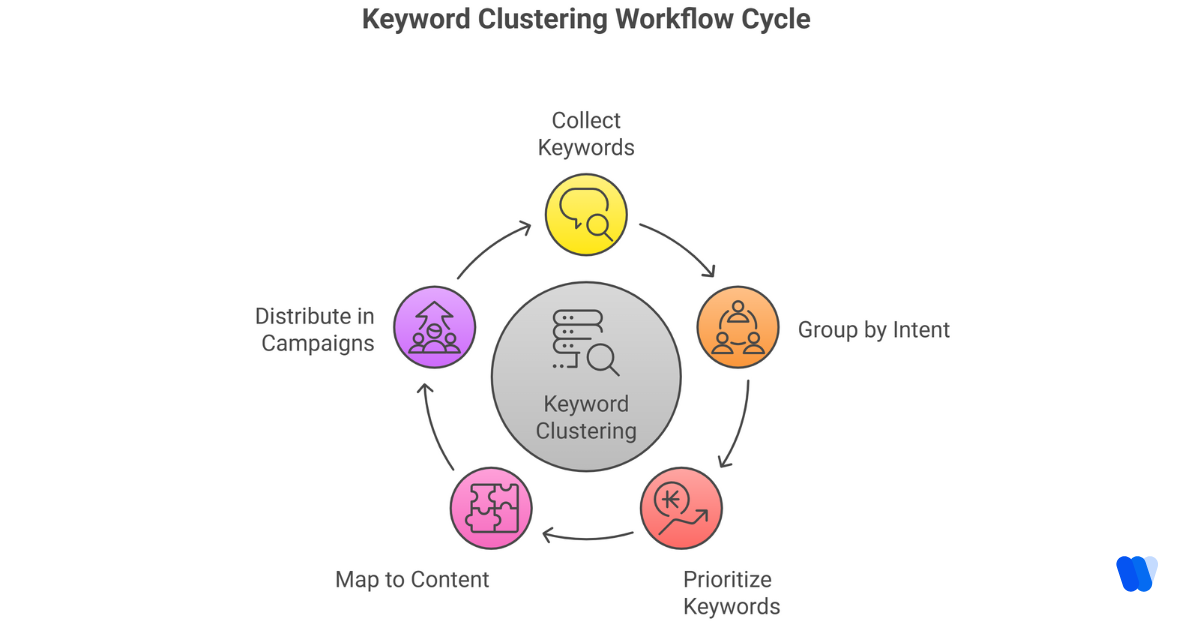
Consistency is key, this framework helps you turn clustering into a repeatable, scalable habit that fits neatly into your everyday processes. Clustering works—but only if it becomes a habit, not a one-off strategy deck.
Here’s how to build it into your DNA:
Step 1: Collect and Curate Keywords
Use Google Keyword Planner, Semrush, or the keyword discovery workspace inside Wellows to gather meaningful lists that reflect real search behavior.
Step 2: Group by Intent and Semantic Similarity
Organize terms into clusters using NLP-driven tools or the automated grouping available in the KIVA workspace, which simplifies similarity mapping.
Step 3: Prioritize by Volume + Relevance
Blend search data with business context to decide which clusters matter most at this stage of your visibility plan.
Step 4: Map to Content Formats and Funnel Stages
Assign each cluster a clear format—blog, comparison guide, landing page—and match it to the appropriate stage in the funnel to keep your strategy aligned.
Step 5: Distribute Across Campaign Sprints
Feed your editorial calendar with cluster-ready topics so production remains predictable and scalable across campaigns.
What Tools Are Available for Automated Keyword Clustering?
When your keyword list jumps from a few dozen to several thousand, manual clustering stops being realistic. At that point, you need automation that supports scale—not to replace strategy, but to handle the heavy lifting in the background.
Inside Wellows, clustering is part of the search visibility workflow. You add a seed keyword, and the platform surfaces semantic clusters, intent groups, and contextual themes in a unified view, so planning becomes clearer and more controlled.
KIVA, now a legacy workspace within Wellows, still supports this flow by reducing the mechanical work and keeping your focus on direction and decisions rather than raw data handling.
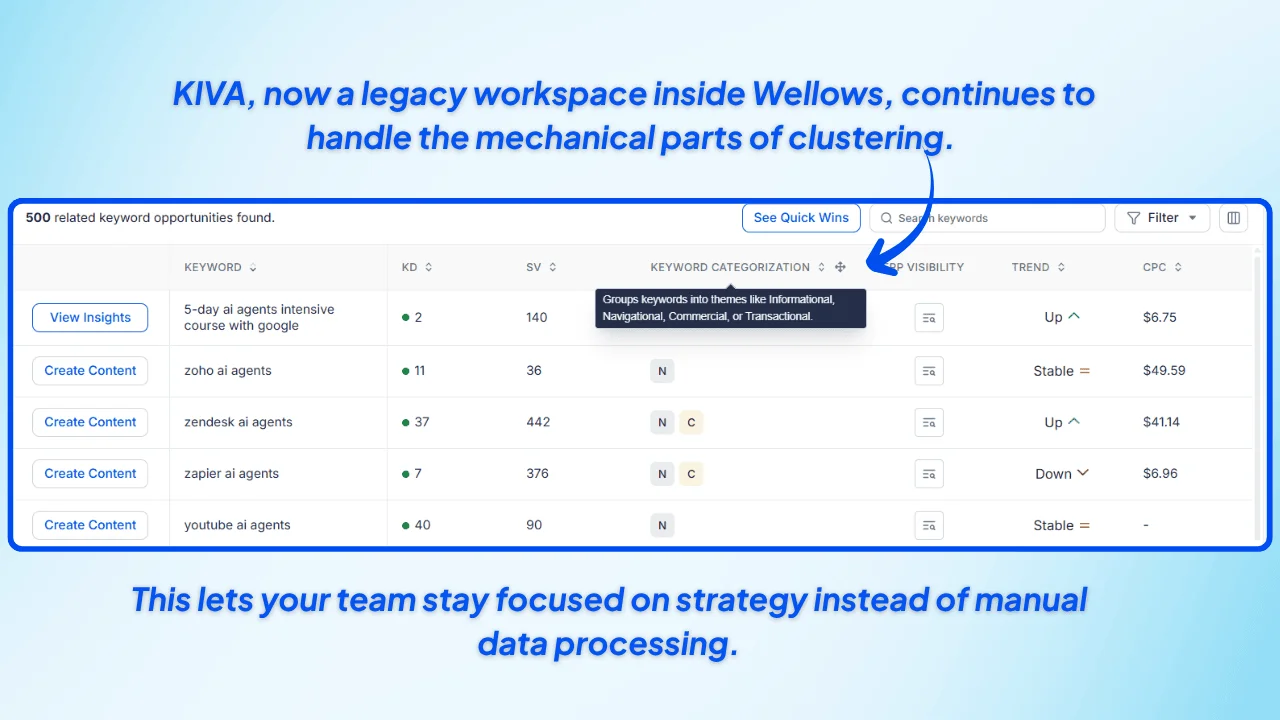
- Auto-grouping related keywords using SERP similarity, intent patterns, and semantic proximity
- Connecting clusters to funnel stages and suggesting suitable content formats
- Producing structured briefs with H1–H3 outlines, PAA-style questions, related terms, and competitor references
- Helping kickstart writing through Quick Generate, turning clusters into working drafts with minimal friction
Teams using similar visibility-led workflows have cut planning time by as much as 70%, freeing capacity for competitive research, testing new angles, and deepening content quality.
Outside the platform, several dedicated tools also support automated keyword clustering in more standalone setups:
- Keyword Insights – Groups large keyword sets using live SERP overlap for each market.
- Serpstat Clustering – Automatically clusters up to tens of thousands of queries based on shared results pages.
- Zenbrief – Offers a free NLP-driven clustering tool suited to smaller or test lists.
- SEOptimer – Generates simple topical maps from a root keyword to guide basic content planning.
- Behamics – Delivers fast clustering for bulk keyword inputs with straightforward grouping.
These standalone tools can be useful, but they often require exporting data, reshaping it in spreadsheets, and reconnecting it to briefs and production workflows.
With Wellows, clustering, briefs, internal pathways, and content creation sit in one place—so you can cluster fast, adapt often, and ship content that truly supports long-term visibility.
What Is the Best Way to Visualize Keyword Clusters for Reporting Purposes?
The simplest way to visualize keyword clusters is to turn them into clear, structured visuals that show how topics connect, what users are searching for, and where the biggest opportunities exist.
Inside Wellows, this happens automatically through organized visibility tables that map semantic relationships, intent patterns, and SERP behavior in one clean view.
For reporting, these visuals make it easier for teams and stakeholders to understand:
- Which themes matter most across campaigns
- How keywords group together based on meaning and search behavior
- Where opportunities exist for new or deeper content
- How clusters align with funnel stages and visibility goals
The visibility tables in Wellows, strengthened by the legacy KIVA workspace, automatically format clusters into digestible views. Each cluster appears with related terms, intent markers, and structural cues, removing the need for manual chart-building.
Teams often enhance reporting by exporting these clusters into simple charts or grids that show:
- Cluster size (how many related keywords)
- Intent patterns (informational, comparison, transactional)
- Opportunity signals (search behavior and gaps)
- Content mapping (which URLs serve which cluster)
This approach keeps keyword reporting clean, visual, and easy to present, whether you’re updating clients, internal teams, or leadership. With this visibility platform handling the clustering logic and structure, you spend less time organizing and more time interpreting what actually drives visibility.
How to Map Keyword Clusters to Funnel Stages?
Once you’ve mapped your keyword clusters to funnel stages, the next question is: Which clusters should you focus on first?
Not every opportunity deserves the same priority, especially when you’re balancing search volume, difficulty, and business goals.
A solid clustering strategy considers both user intent and funnel position, so your content meets readers where they are:
- Top of Funnel: Educational blogs, how-to guides, definition pages
- Middle of Funnel: Comparison posts, “best of” lists, FAQs
- Bottom of Funnel: Product landing pages, customer stories, decision-stage content
Let’s say you’re working with a B2B client. A cluster around “cloud security for startups” could split like this:
- TOFU: “What Is Cloud Security?”
- MOFU: “Best Cloud Security Solutions for Startups”
- BOFU: “Why Client is the Right Cloud Security Partner”
Clustering this way gives you format clarity and campaign structure, so your editorial calendar builds towards conversion, not just clicks.
Should I Use Keyword Clustering for Local SEO Campaigns?
Yes — keyword clustering is extremely effective for local SEO, especially when you’re targeting U.S. cities, neighborhoods, and service areas.
Inside Wellows, clustering becomes even more valuable because every local keyword is grouped by intent, semantic meaning, and real SERP behavior, giving you a structured way to build location-focused content that actually aligns with how people search.
This matters because U.S. local queries often include service type, urgency, and precise geography — making structured clustering essential for visibility.
- Boost local relevance with clusters built around U.S. cities, ZIP codes, and neighborhoods
- Capture long-tail intent like “emergency plumber in Austin TX” or “best dentists near Brooklyn”
- Improve content clarity by grouping local topics into clean, actionable themes
- Build topical authority across service areas by covering all related subtopics
Because clustering groups variations such as “roof repair Dallas,” “Dallas roofing prices,” and “best roofing companies near me,” you get a full visibility map instead of scattered keywords. This helps you plan pages that match local user intent across the U.S.
Inside the platform, the clustering workspace (powered by the legacy KIVA module) automatically surfaces related local terms as soon as you enter a seed keyword. That means you can move from local keyword lists to location-aligned briefs and complete content workflows in far less time.
A simple way to use clustering in U.S. local SEO:
- Start with location + service keywords (e.g., “HVAC repair Boston”)
- Cluster by neighborhood, intent, and urgency
- Build pillar pages for major cities and supporting pages for nearby areas
- Link clusters internally to strengthen geographic relevance
- Revisit clusters monthly as local search trends shift
In short, keyword clustering isn’t optional for U.S. local SEO — it’s the structure that makes your pages easier to discover. And with Wellows connecting clusters to briefs, formats, and visibility signals, teams get a cleaner, faster workflow that consistently improves local performance.
Is Keyword Clustering Effective for Multilingual or International SEO?
Keyword clustering is highly effective for multilingual and international SEO because it helps you organize search behavior across regions, languages, and cultural contexts in a structured, scalable way.
When different audiences search differently, clustering gives you clarity, consistency, and direction across all markets.
Benefits of Keyword Clustering in Multilingual SEO:
- Enhanced relevance: Clusters help tailor content to how each market naturally phrases queries, improving visibility and engagement.
- Comprehensive coverage: By grouping related multilingual terms, you create content that answers more queries without duplication.
- Efficient content production: Regional teams can build from the same cluster structure, reducing inconsistency and guesswork.
- Better user experience: Content feels coherent and culturally aligned, increasing trust and conversions.
Read More Articles
FAQs
Final Thoughts: Smarter SEO Starts With Smarter Clustering
Keyword clustering isn’t just another SEO task—it’s how modern teams bring structure, clarity, and direction to their visibility planning. When done well, it removes the guesswork behind what to publish, how deep to go, and how topics connect across a broader content ecosystem.
Here’s what to keep in mind as you embed clustering into your workflow:
- Group keywords by intent, not wording
- Use real SERP signals to validate cluster boundaries
- Turn each cluster into a theme that guides campaigns
- Create standardized briefs you can reuse across sprints
- Prioritize clusters that strengthen business or client goals
- Match clusters to funnel stages and content formats
- Measure performance at the cluster level to see what scales
Whether you’re supporting a handful of clients or managing multiple pipelines, clustering brings consistency to how topics are chosen, structured, and executed.
It doesn’t matter if your workflow relies on spreadsheets or AI models—the real value comes from making clustering a stable, repeatable habit that helps teams move faster with less friction.
But if you want to accelerate that process with fewer errors and deeper insights, the visibility workspaces inside the platform—including the legacy KIVA workspace—make clustering easier to manage. They help unify keyword discovery, grouping, and brief creation, especially when comparing AI-driven SEO vs. traditional optimization.