According to AIOSEO SEO Statistics, 2024, recent research reveals that a staggering 94.74% of keywords get fewer than 10 searches per month.
This highlights a major challenge for marketers—most keywords attract little to no traffic. But it also opens up a hidden opportunity: with the right Keyword Research Checklist, you can uncover low-volume gems that competitors ignore.
If you’ve been struggling to analyze Competitor Keywords that actually bring targeted traffic, this checklist is designed to simplify the process and transform the way you approach SEO within a structured technical SEO audit framework.
Backed by proven SEO methodologies and strong on-page SEO fundamentals, I’ve broken down keyword research into clear, actionable steps that work in today’s search environment.
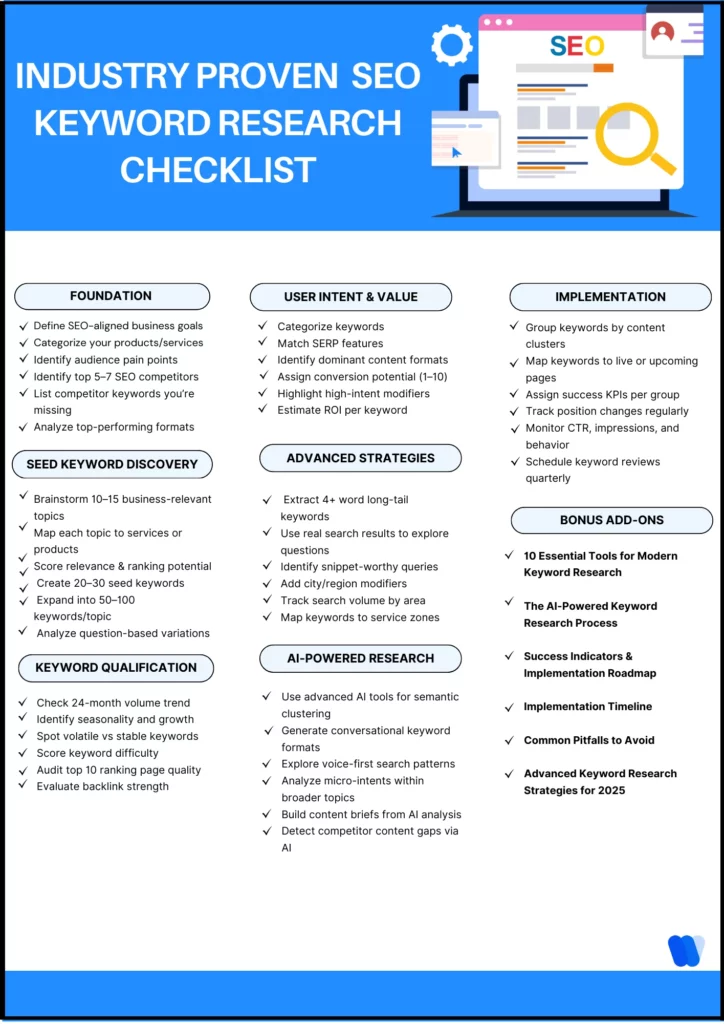
TL;DR — What You’ll Learn in This Guide:
- 94.74% of keywords get fewer than 10 searches monthly — most terms bring low traffic.
- A structured keyword research checklist helps uncover hidden low-volume, high-intent keywords.
- Competitor keyword analysis reveals real traffic opportunities others miss.
- Checklist breaks research into clear phases: goals, seed discovery, analysis, intent, and clustering.
- Backed by proven SEO data, this guide helps you build a smarter, ROI-focused keyword strategy.
What Are Keywords and Why Do They Matter?
Keywords are the specific words and phrases that users type into traditional or generative search engines when looking for information, products, or services online.
They serve as the critical bridge between user queries and your content.
Keywords can be categorized into multiple levels.

-
- Industry Level — Digital Marketing
- Niche Level — SEO
- Sub-niche Level — SEO > Keyword Research
- Micro-niche Level — SEO > Keyword Research > AI-assisted Keyword Analysis
- Long-tail Level — “How to find low-competition keywords with ChatGPT”
This Keyword Research checklist covers essential points to help you carry out effective keyword research, organized into logical phases for systematic implementation.
What Are The Important Steps In A Keyword Research Checklist 2025?
Before diving into the details, it’s important to remember that a Keyword Research Checklist only delivers results when followed step by step. Each stage builds on the last—starting with a solid foundation, moving into discovery, then analysis, and finally optimization.
Let’s begin with the first step.
Step 1: Define Goals and Analyze Your Business
Before diving into keyword lists, start with the basics—your business goals and audience needs. This step ensures your research aligns with real objectives, not just search volume. By grounding SEO in strategy, every keyword you target supports growth, visibility, and ROI.
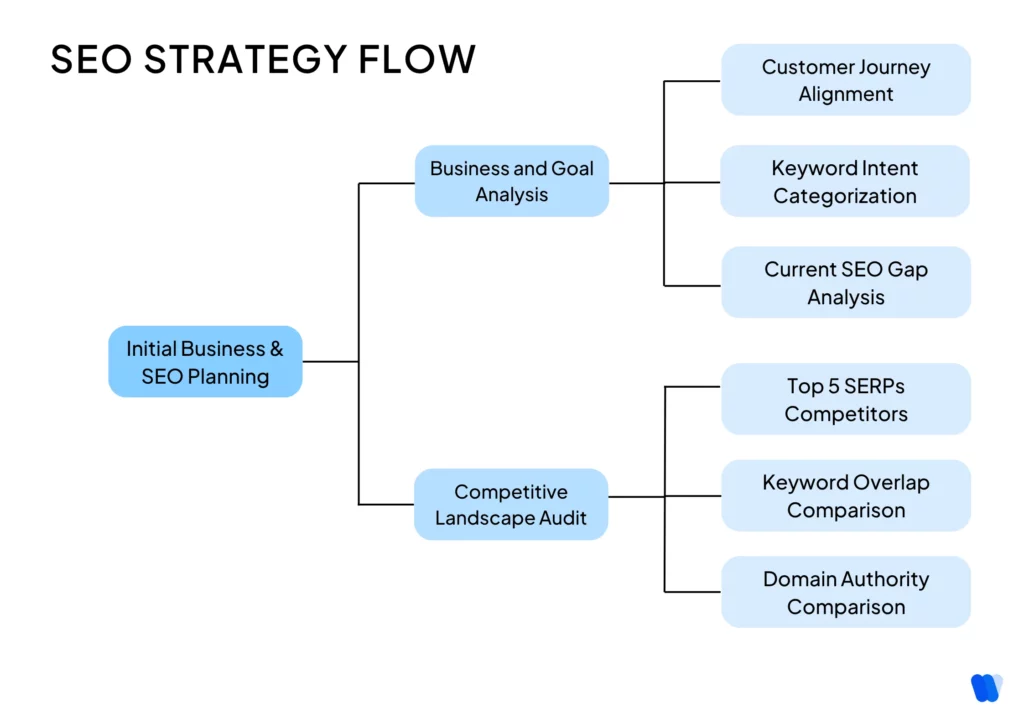
Lay the groundwork by aligning SEO goals with business objectives, audience needs, and competitor gaps. This ensures that your keyword research is not just about rankings but also about driving real results for your brand.
Business and Goal Analysis
Every keyword strategy begins with clarity. If your business goals aren’t well-defined, your SEO efforts won’t have a clear direction. Aligning SEO with your objectives sets the foundation for success.
- Define your core business objectives and how they translate to SEO goals.
- Map your customer journey stages to different keyword intent types.
- Audit your current organic search performance and identify gaps through an in-depth SEO site audit.
Competitive Landscape Assessment
Your SEO competitors may not be the same as your business competitors. By analyzing who dominates the SERPs, you uncover gaps and opportunities to improve your positioning.
- Identify your top 5–7 direct competitors in search results (not just business rivals).
- Analyze which keywords competitors rank for but you don’t.
- Evaluate domain authority differences between your site and competitors.
RESEARCH NOTE: Strategic Competitor Analysis
Research by Moz indicates that SERP competitors often differ from business competitors. Their 2023 study found that, on average, only 62% of businesses competing in the same industry appear in the same search results.
Focus on who’s actually ranking for your target terms, not just who sells similar products.
Step 2: Seed Keyword Discovery
Once your goals are clear, the next step is finding the raw material for your keyword strategy. Seed keywords form the foundation—they’re broad, high-level terms that represent your products, services, or niche. These seeds later expand into long-tail variations and topic clusters.
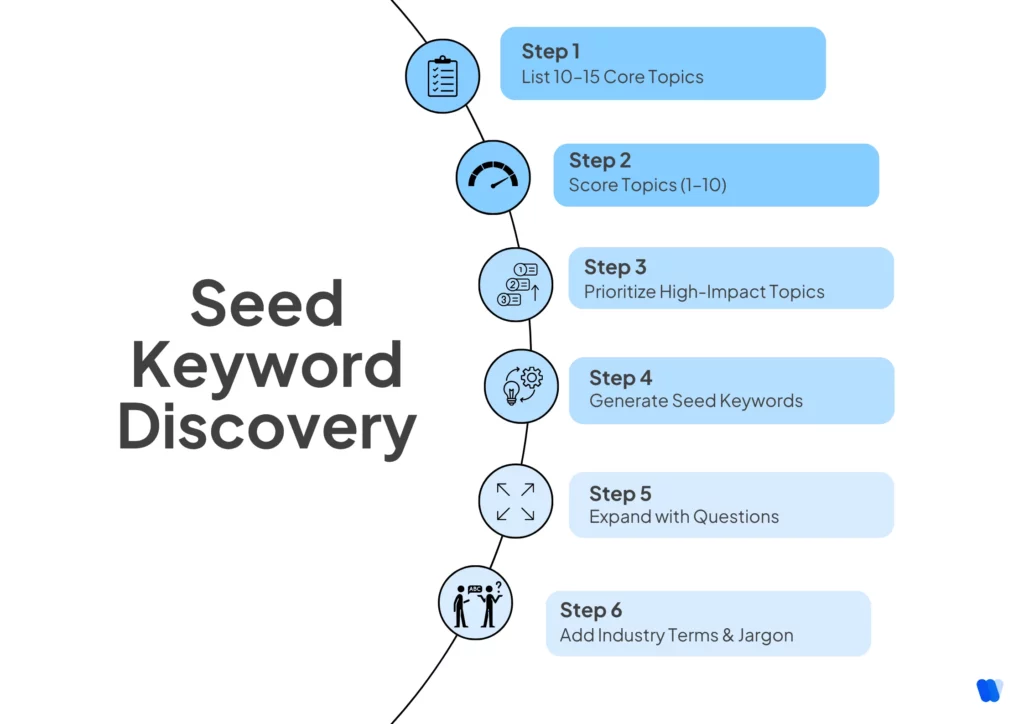
Core Topic Identification
Start by identifying the themes that truly matter to your business and audience. This step ensures your keyword research is focused and tied directly to growth opportunities.
- Brainstorm 10–15 primary topics relevant to your business
- Rate each topic on a scale of 1–10 for alignment with business goals
- Prioritize topics with the strongest impact and current ranking potential
Seed Keyword Expansion
Once topics are mapped, expand them into actionable keywords. Use tools and industry knowledge to capture different angles of search intent.
- Generate 20–30 seed keywords for each core topic
- Include question-based variations to mirror real search behavior
- Note industry-specific terminology and jargon that your audience uses
METHODOLOGY NOTE: Seed Keyword Strategy
When developing seed keywords, start broad but stay relevant. Research by the Content Marketing Institute (2023) found that companies using 15–25 structured seed terms expanded into hundreds of long-tail variations—achieving 37% higher organic visibility than ad hoc approaches.
Content Marketing Institute, 2023
Step 3: Keyword Analysis and Qualification
After collecting seed keywords, the next step is to analyze and qualify them. this process ensures you’re targeting the right terms that bring both traffic and ROI potential, and it’s where a well-structured keyword research checklist really proves its value.
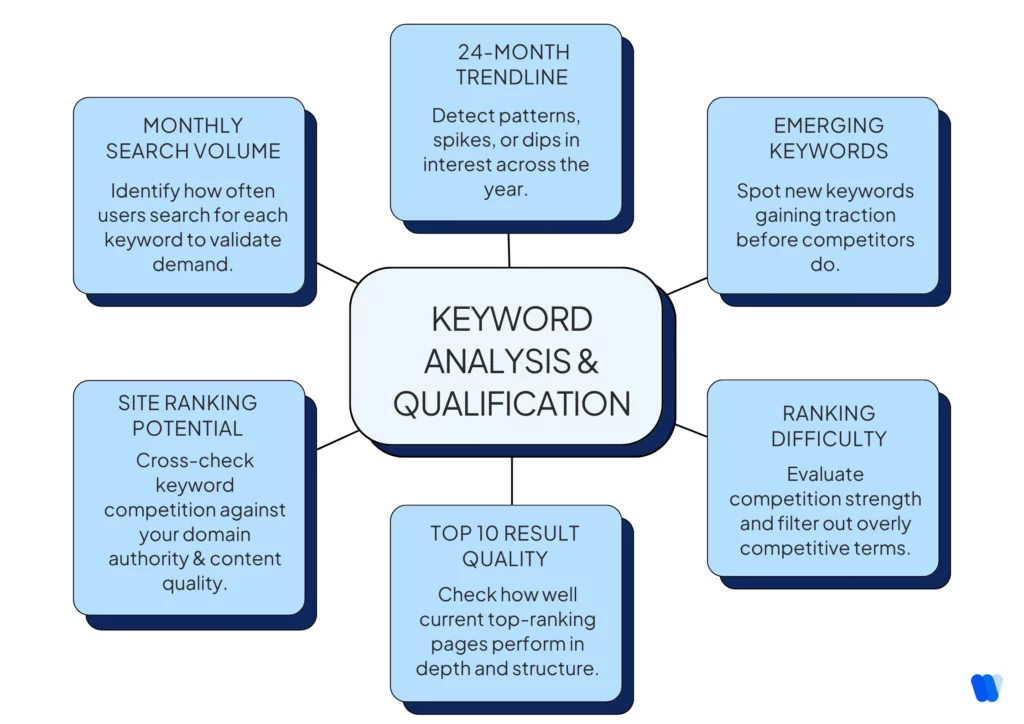
Search Volume and Trends Assessment
Before choosing target terms, you need to understand how much demand exists. Looking at trends over time helps avoid keywords that are declining in popularity.
- Check monthly search volume for each keyword to validate demand.
- Analyze trend data from the last 12–24 months to spot seasonality.
- Identify emerging keywords using Google Search Console keyword analysis to catch early growth opportunities.
Difficulty and Competition Evaluation
Not all keywords are worth chasing. You need to weigh the challenge of ranking against your site’s current authority.
- Assess keyword difficulty scores with trusted SEO tools.
- Review top 10 search results to evaluate content depth and authority.
- Calculate realistic ranking potential while addressing common SEO visibility issues like thin content or weak backlinks.
RESEARCH TIP: Keyword Scoring Methodology
A 2023 study by Backlinko analyzed over 306 million keywords and found that a balanced scoring approach incorporating multiple factors yields the most effective keyword prioritization.
Their data showed that websites using multi-factor prioritization saw ranking improvements 31% faster than those focusing on single metrics like search volume alone. Backlinko, 2023
| Factor | Weight | Criteria |
|---|---|---|
| Search Volume | 20% | Based on volume relative to niche averages |
| Keyword Relevance | 30% | Based on alignment with business goals |
| Competition Level | 25% | Based on difficulty metrics and SERP analysis |
| Conversion Potential | 25% | Based on intent signals and historical performance |
Step 4: User Intent and Content Mapping
Once you’ve qualified your keywords, the next step is aligning them with user intent and the right stage in your sales funnel. This ensures your content meets searcher expectations and improves both visibility and conversions.
Search Intent Classification
Understanding intent behind a keyword is critical—without it, you risk creating content that ranks but doesn’t satisfy searchers.
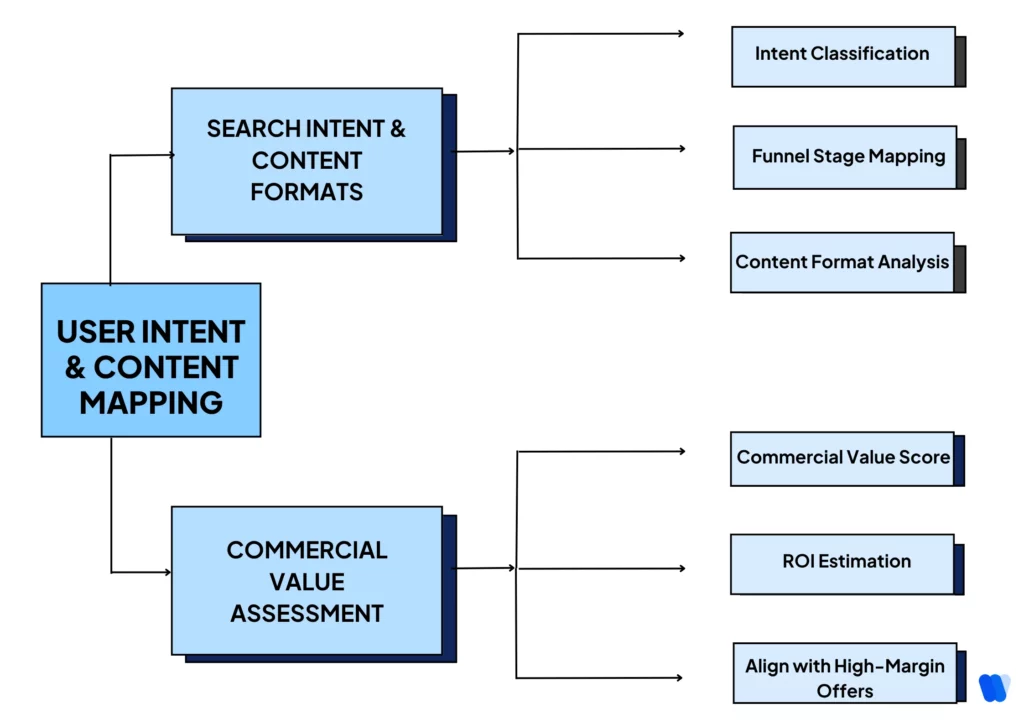
- Categorize each keyword by primary intent: Informational, Navigational, Commercial Investigation, or Transactional.
- Identify content formats currently ranking, such as listicles, how-tos, or videos, to match user expectations.
- Map keywords to appropriate funnel stages, ensuring relevance from awareness to purchase.
RESEARCH NOTE: Understanding SERP Features
According to SEMrush’s SERP Features study (2023), each SERP feature reveals how Google interprets the dominant user intent behind a query. Their analysis of over 2 million keywords found that:
- Featured Snippets appear in 19% of informational queries
- Shopping Results appear in 67% of transactional queries
- Video Carousels appear in 23% of how-to related searches
- Local Packs appear in 42% of location-based commercial queries
Designing your content to match the dominant SERP features can increase visibility by up to 28%. SEMrush, 2023
Commercial Value Assessment
-
Assign commercial value scores to each keyword (1-10 scale)
-
Estimate potential ROI for ranking improvements on target keywords
-
Prioritize keywords that align with your highest-margin products/services
DATA INSIGHT: Value vs. Volume
Research from BrightEdge found that the highest search volume keywords aren’t always the most valuable.
Their 2023 conversion study analyzed 950,000 keywords across 16 industries and found that:
- High-volume head terms averaged 0.8-1.2% conversion rates
- Mid-tail terms (2-3 words) averaged 2.4-3.1% conversion rates
- Long-tail terms (4+ words) averaged 3.8-4.6% conversion rates
This demonstrates that targeted, specific terms often deliver better ROI despite lower search volumes.
Step 5: Advanced Keyword Strategies
Once you’ve built a strong foundation of seed and qualified keywords, the next step is to uncover advanced opportunities. This includes targeting long-tail terms, featured snippets, and location-based variations that can deliver higher conversions.
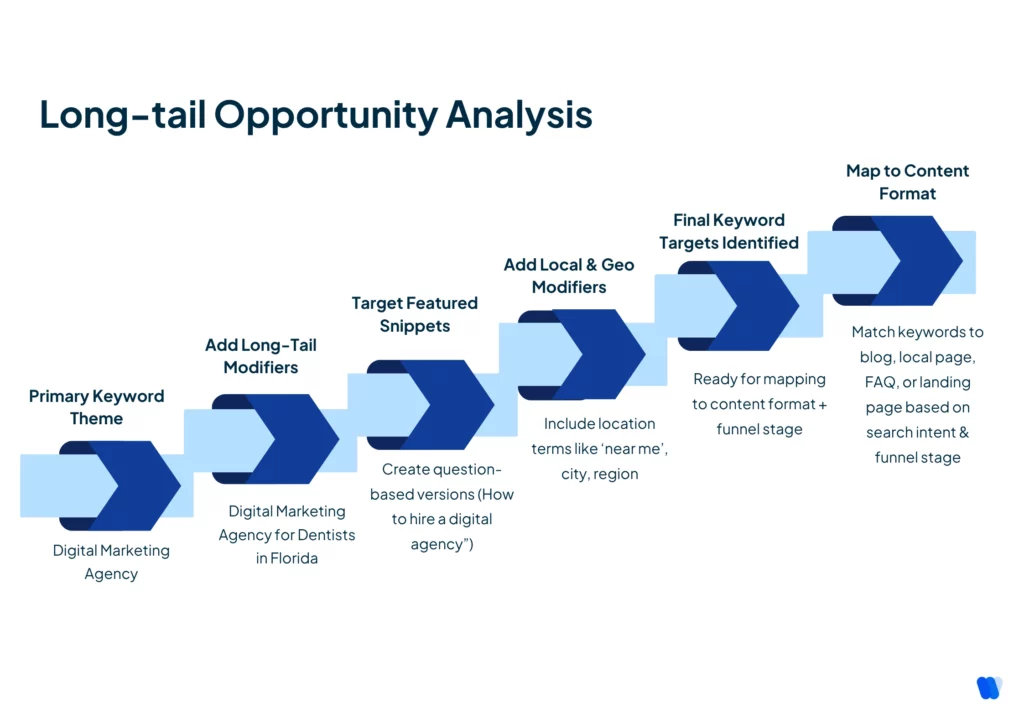
Long-tail Opportunity Analysis
Long-tail keywords often have lower search volumes but much higher conversion rates. They also help you capture niche intent that competitors may miss.
- Identify long-tail variations (4+ words) of your primary keywords.
- Analyze featured snippet opportunities for long-tail informational queries.
- Prioritize high-converting terms even if they show lower search volumes.
RESEARCH NOTE: People Also Ask (PAA) Data
According to a 2023 analysis by STAT Search Analytics, the PAA feature appears in 87% of all informational searches.
Their research showed that mining PAA questions can reveal valuable long-tail opportunities missed by traditional keyword tools.
Their methodology involves:
- Searching for primary keywords
- Recording all initial PAA questions
- Expanding each question to reveal new related questions
- Creating branching topic maps from the expanded questions
Using a structured keyword research checklist can reveal dozens of unique keyword opportunities for each primary term, helping marketers better organize and prioritize their content strategy.
Local and Geo-targeted Keyword Analysis
Local SEO opportunities are critical if your business serves specific regions. Geo-targeted terms often have less competition and stronger intent.
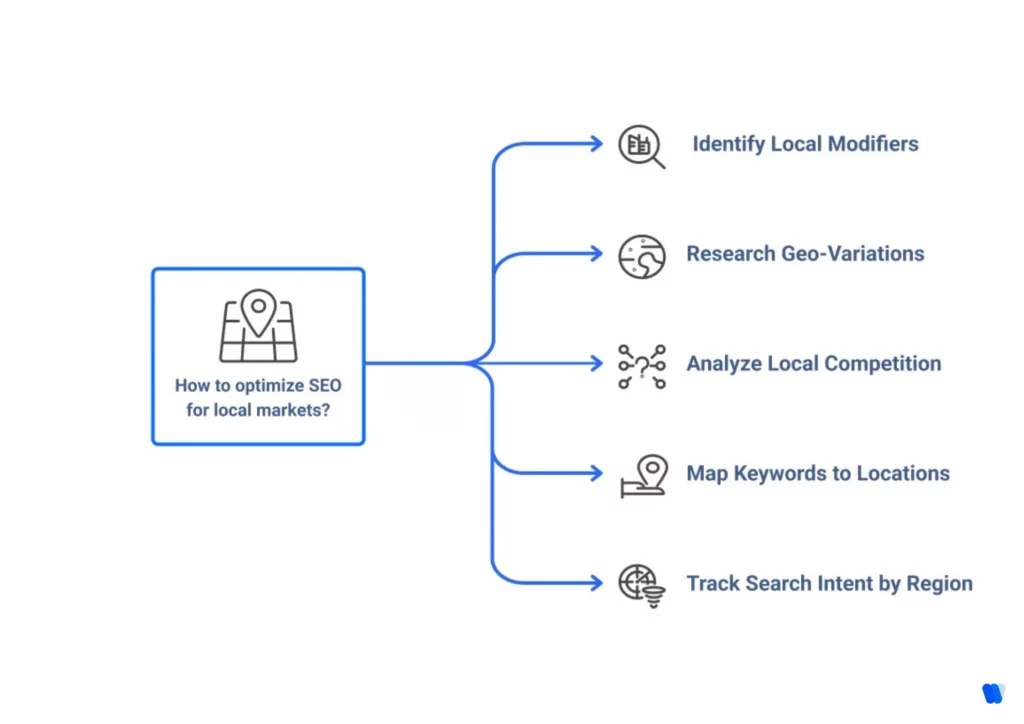
- Identify location-specific modifiers relevant to your business.
- Analyze competition levels for local keyword variations.
- Note intent differences across multiple geographic markets.
DATA INSIGHT: Long-tail Conversion Patterns
A 2023 study by SEMrush analyzing conversion rates across 7.8 million keywords found that long-tail keywords convert at an average of 1.8x the rate of head terms.
While conversion multipliers vary by industry (ranging from 1.3x to 2.1x), the data consistently shows higher conversion rates for more specific search queries. SEMrush, 2023
Step 6: AI and Next-Gen Keyword Research
Modern keyword research goes beyond traditional tools. By leveraging AI and large language models (LLMs), you can uncover deeper semantic connections, predict intent more accurately, and align your content with conversational search trends.
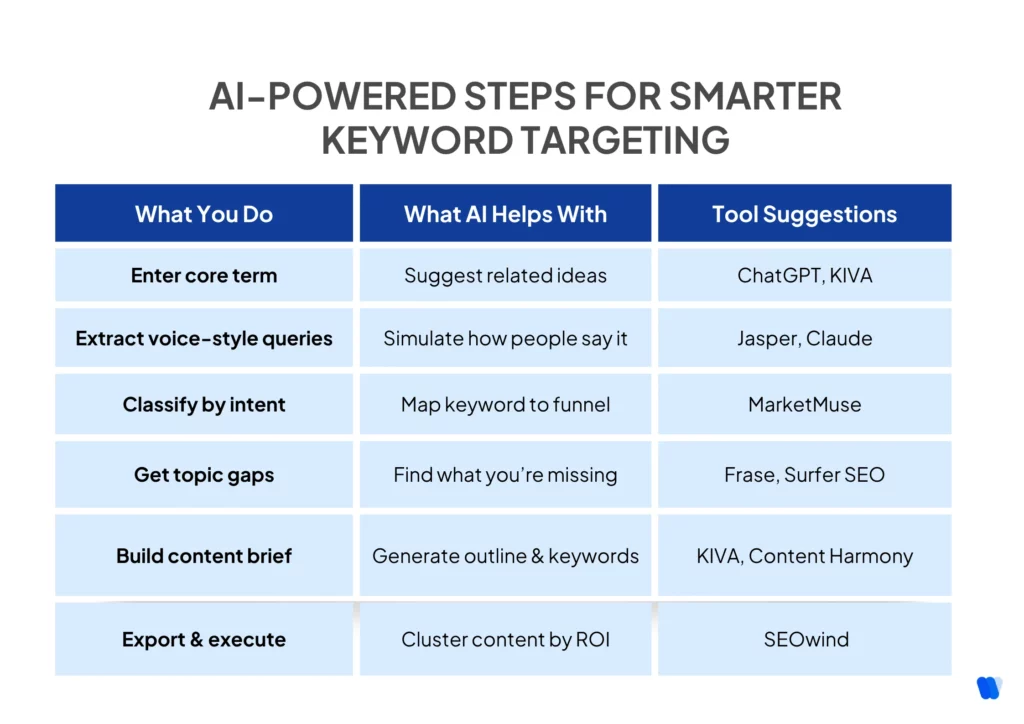
LLM and AI-Assisted Keyword Discovery
AI-powered discovery allows you to generate keyword variations that mirror how people and search engines actually think and ask questions.
- Use AI tools to identify semantic relationships between keywords.
- Generate conversational variations with LLMs for natural search queries.
- Map keywords to potential voice search queries and long-form phrases.
RESEARCH NOTE: Large Language Models (LLMs)
According to research from Stanford University’s AI Index Report 2023, LLMs have revolutionized keyword research by identifying semantic relationships that traditional tools miss.
Their analysis showed that LLM-assisted keyword discovery uncovered 34% more semantically related terms compared to traditional methods. Stanford AI Index, 2023
Key applications include:
- Semantic Expansion: Identifying conceptually related terms beyond synonyms.
- Intent Classification: Predicting searcher needs using subtle language patterns.
- Content Gap Analysis: Building comprehensive topic clusters.
Search Intent Prediction with AI
AI can also take keyword research a step further by predicting intent and identifying gaps in your content strategy.

- Analyze user intent signals that go beyond simple keyword matching.
- Generate AI-powered briefs aligned with real searcher needs.
- Spot content gaps by comparing AI-generated clusters against existing assets.
METHODOLOGY NOTE: Semantic Relationship Mapping
A 2023 study by the Search Engine Journal found that modern LLMs can uncover 31% more relevant keyword variations than traditional tools by analyzing semantic connections. Search Engine Journal, 2023
Step 7: Implementation and Tracking
Once your keyword list is finalized, the real work begins—putting it into action. Implementation and tracking ensure your strategy is aligned with business goals and delivering measurable results.
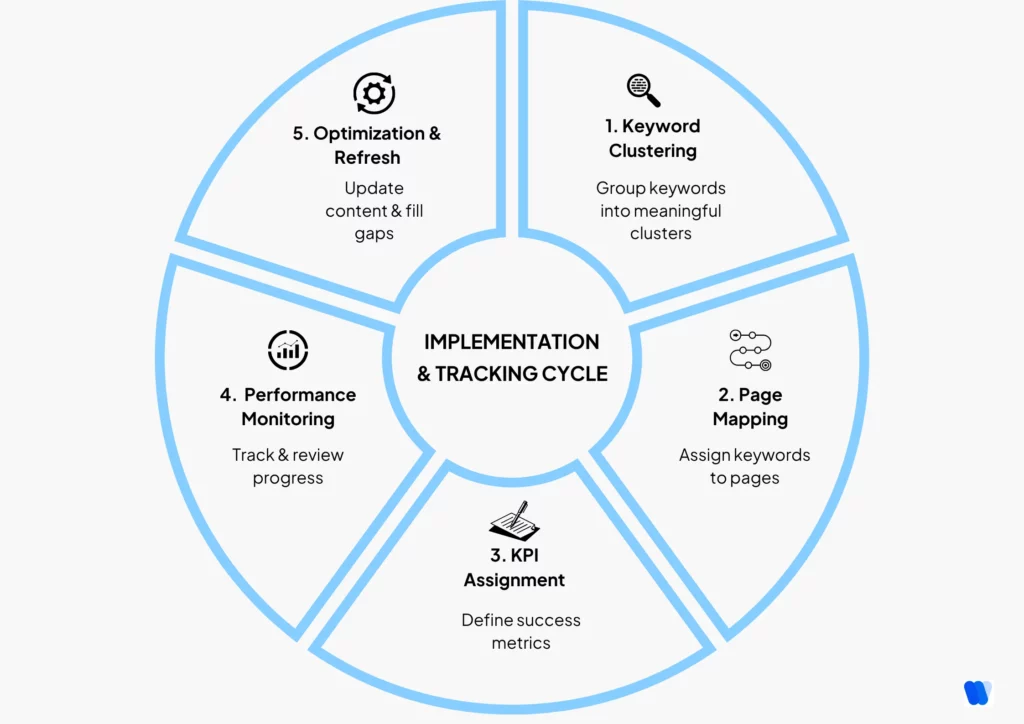
Keyword Organization and Prioritization
Organizing keywords into clusters helps you cover topics comprehensively and build authority across themes rather than isolated terms.
- Group keywords by topic clusters using keyword clustering to align with user intent.
- Map keywords to existing or new pages to structure your site effectively.
- Assign KPIs to each cluster so success can be tracked with clarity.
RESEARCH NOTE: Topic Clusters
A NinjaOutreach case study found that implementing a topic cluster and internal linking strategy led to a 40% increase in organic traffic compared to using a traditional keyword approach
Their analysis of 3,400 websites revealed that search engines now favor comprehensive coverage of topics over single-keyword targeting.
Key components of the topic cluster model include:
- Pillar Content: Broad, comprehensive coverage of the main topic.
- Cluster Content: In-depth articles on related subtopics.
- Internal Linking: Strong connections across all related pages.
- Semantic Relevance: Alignment with user intent across the cluster.
Performance Monitoring System
Tracking results allows you to adjust your strategy as needed and ensure ROI. Without measurement, even the best strategy risks falling short.
- Track keyword rankings regularly to monitor visibility gains.
- Schedule quarterly reviews to find new opportunities and update targets.
- Spot trending topics early and create content before competitors.
MEASUREMENT TIP: Beyond Rankings
According to Databox (2023) research, companies that connect keyword performance to business outcomes see a 45% higher ROI from their SEO efforts.
Analysis of 1,200 marketing teams revealed that top performers track these key metrics:
- Visibility Metrics: Rankings, impressions, CTR.
- Traffic Metrics: Organic sessions, engagement, bounce rate.
- Engagement Metrics: Time on page, scroll depth, interactions.
- Conversion Metrics: Leads, sales, and revenue tied to SEO.
- ROI: (Organic Revenue – SEO Investment) ÷ SEO Investment.
How Often Should I Update My Keyword Research Checklist?
Regularly updating your keyword research checklist is essential for maintaining an effective SEO strategy. Search trends, user behaviors, and industry landscapes shift constantly, which means a keyword list that worked six months ago may already be outdated. A general best practice is to conduct a comprehensive review every 3 to 6 months. This keeps your strategy aligned with real opportunities instead of relying on assumptions that no longer reflect search reality.
Additionally, it’s beneficial to monitor the performance of your core keywords on a monthly or even bi-weekly basis. This continuous monitoring helps you quickly identify fluctuations in search volume or competition, allowing for timely adjustments to your strategy.
- Monthly: Refresh your priority keywords, validate KD and search volume, and prune underperformers.
- Quarterly: Reassess topic clusters, competitor gains, and emerging SERP features.
- Annually: Reset your seed keywords, scoring model, and align with any major business changes.
Pro Tip: Treat your keyword checklist like a living document. If you notice sudden ranking drops, intent shifts, or new competitor content dominating the SERP, don’t wait for the next review cycle—update it immediately.
Is There a Keyword Research Checklist Specifically for Local SEO?
Yes — local SEO uses its own keyword research checklist because search behavior changes based on location, proximity, and user intent.
1. Identify Local Search Terms
Start by understanding how people in your target area naturally search for your service.
Did you know?
- Begin with core service keywords (“plumber,” “bakery,” “family lawyer”).
- Add city, area, or neighborhood modifiers like “near me,” “in Austin,” “Brooklyn NY.”
- Include long-tail phrases such as “affordable dentist in Miami” or “emergency plumber downtown Chicago.”
2. Use Tools That Reveal Real Local Demand
Use keyword tools that reflect real-time, location-based search intent.
Did you know?
- Google Keyword Planner for city and region-level search volumes.
- Google Autocomplete to see commonly searched local phrases.
- People Also Ask (PAA) to capture local question intent.
- AnswerThePublic for neighborhood-level keyword variations.
3. Analyze Local Competitors
Review what nearby competitors rank for to uncover gaps and high-intent local queries.
Did you know?
- Analyze competitor service pages and local landing pages.
- Check which keywords competitors target for your city or area.
- Review map pack results to understand competitive positioning.
- Study ranking content formats in your local SERP (guides, lists, service pages).
4. Add Local Keywords Across Key Touchpoints
Implement your local keywords everywhere users and search engines expect location relevance.
Did you know?
- Update service pages with area-specific terms.
- Optimize title tags and meta descriptions with city and region modifiers.
- Create dedicated city landing pages for each service area.
- Use local keywords in your Google Business Profile.
- Add local schema markup for stronger geographic signals.
5. Track Local Performance and Adjust
Monitor your keyword performance to stay aligned with changing search behavior.
Did you know?
- Track impressions and clicks from local SERPs.
- Monitor visibility in the local map pack.
- Review organic traffic from targeted cities or neighborhoods.
- Refresh your keyword list as local trends evolve.
This simplified local SEO checklist helps you discover city-specific keywords, align content with local intent, and strengthen your visibility across organic and map-based results.
How Do I Use Google Keyword Planner in a Keyword Research Checklist?
Google Keyword Planner helps you discover, refine, and organize keywords using real search data.
1. Access Google Keyword Planner
Start by opening Google Keyword Planner to begin your analysis.- Visit Google Keyword Planner.
- Sign in with your Google account.
2. Define Your Target Audience
Understand who you’re targeting before generating keywords.- Identify demographics and search behavior.
- List core problems your audience wants solved.
- Note their common phrases and terms.
3. Generate Seed Keywords
Create a list of broad seed terms for keyword expansion.- Brainstorm core niche-related terms.
- Add synonyms and related phrases.
- Include product, service, and pain-point keywords.
4. Discover New Keywords
Use Google Keyword Planner to expand your seed list.- Select Discover New Keywords.
- Enter seed keywords to get new suggestions.
- Review ideas based on real Google searches.
5. Refine Your Keyword List
Filter and evaluate keyword suggestions.- Filter by location, language, and networks.
- Use negative filters to remove irrelevant terms.
- Check search volume, difficulty, and CPC.
6. Analyze Search Intent
Match keywords to what users genuinely want.- Label terms as informational, navigational, or transactional.
- Pick keywords aligned with content goals.
- Match user expectations based on intent.
7. Evaluate Keyword Difficulty
Understand competition for each keyword.- Check competition level for every term.
- Choose keywords with balanced volume and difficulty.
- Spot high-value commercial intent terms.
8. Identify Long-Tail Keywords
Find longer, intent-rich keyword phrases.- Look for 4–6 word long-tail variations.
- Select keywords with lower competition.
- Use long-tail terms for niche targeting.
9. Group Keywords Into Clusters
Organize terms into structured keyword clusters.- Group keywords by themes and search intent.
- Place related supporting keywords under each core keyword.
- Use clusters for content planning and topical authority.
10. Map Keywords to Content
Assign keywords to the right pages.- Use one primary keyword per URL.
- Add 2–4 secondary supporting keywords.
- Avoid keyword cannibalization.
11. Document Your Keyword Strategy
Save all keyword findings in a structured format.- Record search volume, competition, and intent.
- Track assigned URLs and content types.
- Update the list every 30–60 days.
This checklist helps you use Google Keyword Planner effectively and build a clear, structured keyword strategy.
10 Common Keyword Research Mistakes to Avoid
Keyword research is critical for building a strong SEO strategy. Avoid these mistakes to save time and improve long-term visibility.
1. Ignoring Long-Tail Keywords
Long-tail keywords bring higher intent and better conversions than broad head terms. Use a mix of head terms and long-tail keywords to balance authority and conversions.
2. Ignoring Actual SERP Results
Keyword tools estimate data, while real SERPs show actual competition and intent. Check the live SERPs to confirm competition, content format, and search intent.
3. Choosing Low-Trending Keyword Phrases
Declining or seasonal keywords limit long-term performance. Use trend tools to focus on stable or upward-moving keywords.
4. Focusing on Irrelevant Keywords
High-volume keywords often bring unqualified traffic if they don’t match your niche. Choose keywords that directly match your audience needs and offerings.
5. Ignoring Search Intent
Content fails when it doesn’t match what the searcher expects. Match each keyword with the proper intent—informational, commercial, or transactional.
6. Ignoring Competitor Analysis
Competitors reveal keyword gaps and proven opportunities. Study competitor keywords to find gaps you can cover more effectively.
7. Disregarding Seasonal Trends
Not accounting for seasonality can reduce traffic during peak months. Map keywords to seasonal cycles so your content matches demand.
8. Focusing Solely on Search Volume
High volume doesn’t matter if the keyword is too competitive or irrelevant. Prioritize keywords with the right balance of volume, difficulty, and relevance.
9. Keyword Cannibalization
Multiple pages targeting the same keyword weaken rankings. Assign a unique primary keyword to each page to avoid competition.
10. Not Updating Keyword Strategy Regularly
Search behavior changes, and outdated keywords lose effectiveness. Update your keyword strategy every 3–6 months to stay aligned with search trends.
Effective LLM Prompts for Keyword Research
Based on tested effectiveness and verified results, these prompts can enhance your keyword discovery process:
Topic Expansion Prompt
“Generate 50 related subtopics, questions, and keyword ideas for [CORE TOPIC]. Include beginner, intermediate, and advanced concepts. Group them by user intent.”
Competitor Gap Prompt
“Analyze these top-ranking articles about [TOPIC] and identify content gaps, questions they don’t answer, and perspectives they miss: [URLs of top 3 competitors]”
User Intent Prompt
“For the keyword [TARGET KEYWORD], create a detailed profile of what the searcher is trying to accomplish, what questions they have, what objections they need overcome, and what information would satisfy their search.”
Content Outline Prompt
“Create a comprehensive content outline for a page targeting [KEYWORD]. Include H2s, H3s, key points to cover, statistics to include, and questions to answer.”
SERP Analysis Prompt
“Analyze these titles and meta descriptions from the top 10 results for [KEYWORD] and identify patterns, common themes, and differentiation opportunities: [Paste SERP titles/descriptions]”
How Do I Identify High-Traffic And Low-Competition Keywords?
Low-competition keywords help you gain visibility faster without competing directly with high-authority sites. Here are seven reliable methods from this keyword research checklist that uncover real opportunities.
1. Use a Keyword Research Tool
Keyword tools help you quickly discover search volume, difficulty, and related clusters for your seed terms.
- Look for keywords with low KD.
- Target low–medium volume terms (100–1,000 monthly).
2. Analyze Google’s SERP Features
Google’s SERP shows real search behavior through autocomplete, PAA, and related searches.
- Use autocomplete to uncover long-tail angles.
- Mine People Also Ask questions for content ideas.
- Check Related Searches for overlooked queries.
3. Target Emerging Topics
New and rising topics are low-competition because competitors haven’t optimized for them yet.
- Monitor Reddit, LinkedIn, and X conversations.
- Confirm interest using Google Trends.
- Publish early before SERPs mature.
4. Cover Trending Content
Trending keywords can deliver fast visibility when tied to events, launches, or breaking updates.
- Watch Google Discover and industry news.
- Publish quickly before competitors react.
5. Use Social Platforms for Hidden Keywords
Social platforms reveal real user language and questions that haven’t reached traditional keyword tools yet.
- TikTok’s “Others Searched For” tab.
- YouTube comments and Q&As.
- Quora threads for recurring pain points.
6. Explore Forums and Niche Communities
Forums provide natural language and real problems that often map directly to long-tail keywords.
- Explore subreddits relevant to your industry.
- Study niche forums for unanswered questions.
- Identify patterns in repeated discussions.
7. Research Your Competitors
Competitor research reveals keywords they rank for but haven’t fully optimized—these are easy entry points.
- Analyze competitor URLs in keyword tools.
- Filter for low-KD keywords they appear for.
- Identify topics where their content is thin.
How to Measure Success with a Keyword Research Checklist?
According (Gartner, 2023), organizations with well-defined marketing metrics are 2.3x more likely to achieve their objectives.
Based on industry benchmarks, these indicators suggest effective keyword research:
Success Metrics Checklist:
✓ Visibility Improvements: Rankings for target keywordsimprove SERPS and GEO visibility by at least 20% within 3-6 months
✓ Traffic Growth: Organic traffic increases by 15-30% within 6 months of implementation
✓ Conversion Alignment: At least 30% of your target keywords have commercial intent
✓ Competitive Advantage: You’ve identified keyword opportunities your top 3 competitors are missing
✓ Search Coverage: Your keyword strategy addresses all stages of the buyer’s journey
✓ Content Efficiency: Content created based on keyword research performs 40% better than non-research-based content
✓ Long-term Value: Your strategy includes both quick wins (low difficulty) and strategic targets (high value)[/emphasize]
By following this evidence-based keyword research methodology, you’ll be well-positioned to overcome the visibility challenges that prevent most content from receiving organic traffic, creating sustainable search visibility that drives meaningful business results.
FAQs
The best way to find long-tail keywords is to use real user signals from Google. Start with Autocomplete, People Also Ask, and Related Searches. Then look at forums, Reddit threads, YouTube comments, and social platforms where users ask highly specific questions. Combine these insights with keyword tools to confirm search volume and difficulty.
You can download free keyword research checklist templates from HubSpot, Backlinko, Asana, Attrock, and Scalenut. These templates help you structure keyword discovery, analysis, intent mapping, and clustering without starting from scratch.
Validate long-tail keywords using Google Keyword Planner, Google Search Console, and low-volume keyword tools. Even low-search terms can drive targeted traffic if they show clear intent and appear in PAA or Autocomplete.
Review your keyword list every 30–60 days to track shifts in volume, SERP features, and competitor movement. A full checklist refresh every 3–6 months keeps your strategy aligned with current trends.
Yes. Blog posts target informational queries and long-tail questions, while landing pages focus on commercial and transactional terms. Separating them improves intent alignment and reduces keyword cannibalization.
Expand your SEO knowledge with these detailed step-by-step guides:
- On-Page SEO Checklist – Optimize titles, headings, content, and internal links for higher rankings.
- SEO Framework Checklist – Follow a structured framework that connects technical SEO, content, and authority building.
- SEO Marketing Strategy Checklist – Align SEO with business objectives and create a strategy that delivers measurable growth.
- SEO Audit Checklist – Run a complete website audit to uncover technical issues and opportunities for quick wins.
- Content Marketing Plan Checklist – Build and execute a structured content marketing plan that drives traffic, engagement, and conversions.
- AI Visibility Deliverables Checklist for Agencies: A practical framework for documenting progress, aligning expectations, and proving value as AI search becomes a permanent part of the buyer journey.