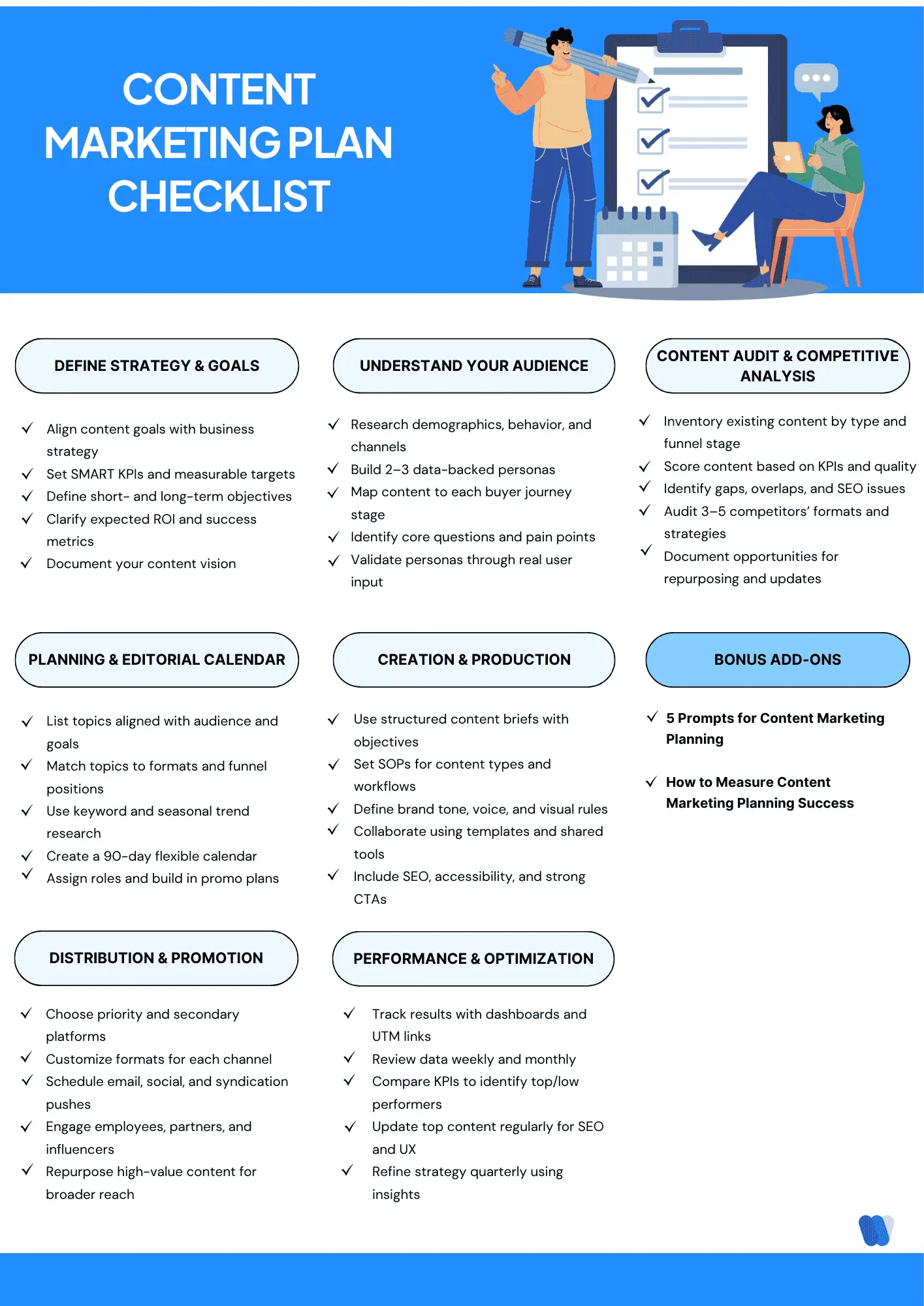
Content marketing has become the cornerstone of modern digital marketing strategies, helping brands connect with their audience through valuable, relevant content. This Content Marketing Plan Checklist is designed to ensure your strategy covers all critical areas—from planning to execution—so your efforts deliver consistent results.
According to CoSchedule, organizations with documented content marketing strategies are 313% more likely to report success than those without structured plans, while marketers who proactively plan their content are 356% more likely to succeed than those who don’t.
This comprehensive checklist guides you through the essential phases of developing and implementing a successful content marketing plan that drives engagement, builds authority, and generates measurable results for your business.
What is Content Marketing?
Content marketing is a strategic marketing approach focused on creating and distributing valuable, relevant, and consistent content to attract and retain a clearly defined audience — and ultimately, to drive profitable customer action.
Unlike traditional advertising, content marketing agencies aims to provide genuine value to prospects and customers through educational, entertaining, or inspiring content. If you’re asking yourself ‘How do I create an effective content marketing plan from scratch?’ the key is to follow a structured checklist.
That’s exactly what I’ll cover in the step-by-step framework below. Before you begin creating any content, make sure your drafts sound clear, natural, and human. You can quickly refine AI-written paragraphs using the free AI humanizer tool by Wellows to smooth robotic tone and align your message with authentic reader-friendly style.
What Should Be Included in a Content Marketing Plan Checklist?
A content marketing plan checklist gives structure to your efforts, ensuring nothing is left to guesswork. It acts as a roadmap to keep your strategy aligned with business goals, audience needs, and measurable outcomes. Below are the essential areas every plan should cover before diving into execution.
This checklist breaks down the content marketing planning process into seven distinct phases, each with detailed steps to ensure a comprehensive approach.
1. Strategy Development and Goal Setting
Every successful content marketing plan starts with a strong foundation. Defining your strategy and aligning it with business goals ensures that your efforts create measurable impact and long-term value. For deeper insights, explore AI-driven content strategies that show how automation strengthens planning and execution.
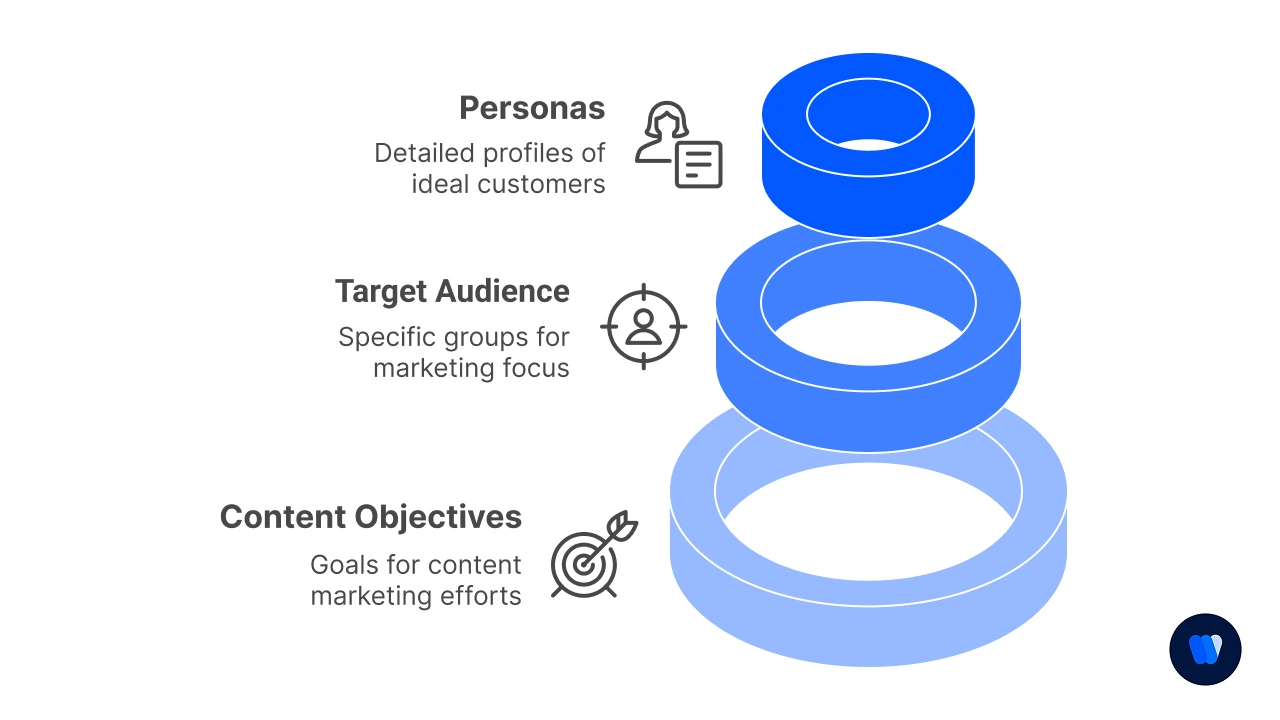
Defining Your Content Marketing Objectives
Your goals act as the compass for your strategy. Clearly defined objectives help you focus your efforts and measure progress with accuracy.
-
- Align content marketing goals with overall business objectives
- Establish specific, measurable, achievable, relevant, and time-bound (SMART) goals
- Identify key performance indicators (KPIs) for measuring success
- Determine both short-term and long-term content objectives
- Set realistic expectations for content marketing ROI
- Create a vision statement for your content marketing program
fPractical Resource: Taskade’s Content Strategy Checklist:
This customizable AI-powered checklist helps you define clear goals, identify your target audience, and plan distribution channels in a structured way. It’s a hands-on tool to put your documented strategy into action without missing any critical step.
Pro Tip: Write down your objectives and review them regularly.
Teams that document their strategy are significantly more likely to achieve their goals than those who keep plans informal.
Identifying Target Audience and Personas
To make content resonate, you need a deep understanding of your audience. Knowing their challenges, motivations, and preferences ensures your message feels relevant and impactful.
- Research demographic and psychographic data of your ideal customers
- Create 2-3 detailed buyer personas with specific needs and pain points
- Map content needs to each stage of the buyer’s journey
- Identify key questions your audience is asking
- Research where your audience consumes content online
- Analyze competitors’ audiences for additional insights
- Conduct interviews with existing customers to validate persona assumptions
Pro Tip: Revisit your personas quarterly. Markets evolve, and so do your customers’ needs.
Personas that worked last year may need updating based on new data and customer feedback.
Setting Goals Tip
When setting content marketing goals, work backward from your business objectives.
For example, if your target is to increase sales by 15%, determine how many leads your content marketing must generate to achieve that, factoring in conversion rates. This reverse-engineering method makes your goals realistic and actionable.
2. Content Audit and Competitive Analysis
Before building new content, it’s critical to assess what you already have and understand how competitors perform. A content marketing plan checklist should always include a content audit to show you what’s working, what’s outdated, and where the gaps are, while competitor analysis helps uncover opportunities to differentiate your strategy.
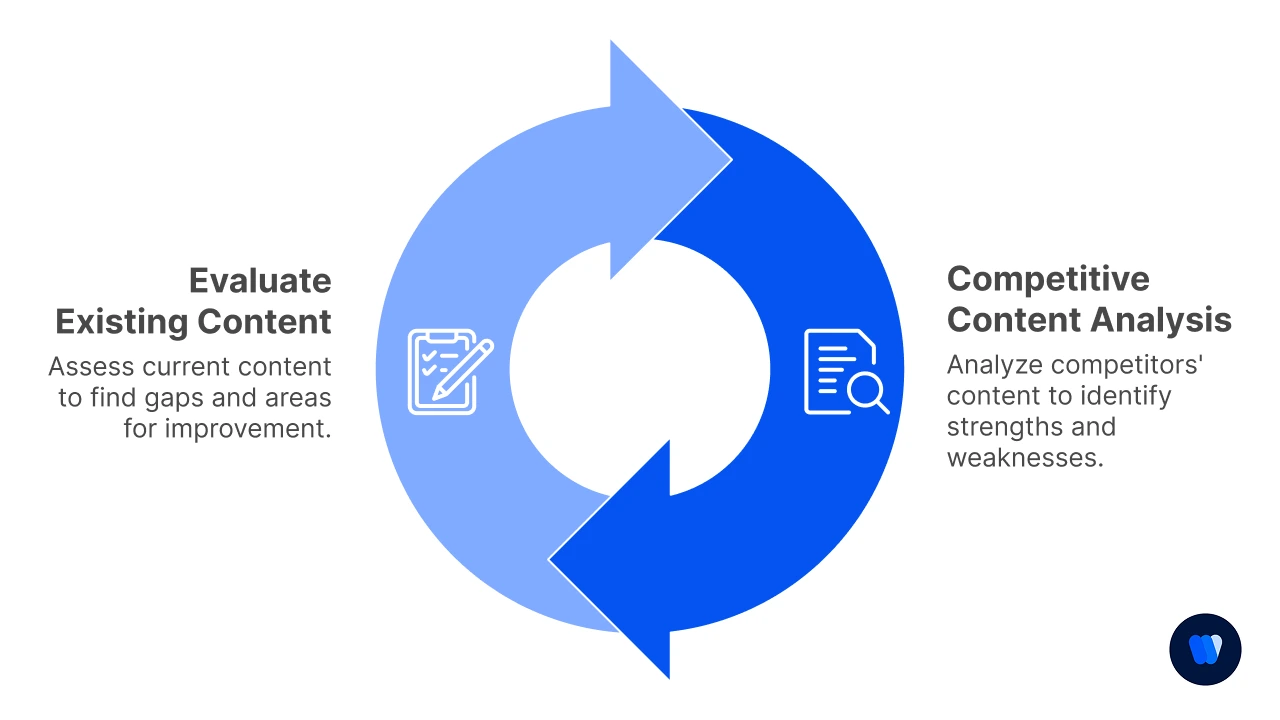
Evaluating Existing Content
Reviewing your current assets ensures you build on strengths and address weaknesses. This step helps you optimize, update, or remove content that no longer serves your goals.
- Inventory all existing content across channels and platforms
- Categorize content by type, topic, target persona, and funnel stage
- Assess content performance against established KPIs
- Identify content gaps and opportunities for repurposing
- Evaluate content for SEO and technical issues
- Document outdated content that needs updating or removing
- Rate content quality against established brand standards
Also check for content cannibalization, where multiple pages compete for the same keyword and dilute performance.
Pro Tip: Conduct a full content audit at least annually.
In between, run quarterly mini-audits on your highest-traffic and highest-converting pages to keep them optimized and fresh.
Competitive Content Analysis
Understanding your competitors’ approach reveals both strengths to learn from and gaps you can exploit. Analyzing their performance gives you a benchmark for your own strategy.
- Identify 3–5 direct competitors to analyze
- Evaluate competitors’ content types, topics, and publishing frequency
- Analyze competitors’ content engagement metrics when available
- Identify competitors’ content distribution channels and tactics
- Determine content gaps and opportunities in your market
- Assess competitors’ content quality and presentation style
- Document successful competitor content formats to inspire your strategy
Recommended Framework: Backlinko’s Content Marketing Plan Template:
Backlinko provides a step-by-step template for competitor analysis, topic selection, and promotion strategies. It’s a proven framework for identifying content gaps and creating content that can outperform your rivals.
Pro Tip: The best insights come from asking *why* competitor content performs well.
Look beyond metrics—study the storytelling and emotional triggers they use to connect with their audience.
Content Audit Framework
| Content Metric | Good | Needs Improvement | Action Required |
|---|---|---|---|
| Traffic | >500 views/month | 100–500 views/month | <100 views/month |
| Engagement | >2% CTR, >1min time on page | 1–2% CTR, 30–60s time on page | <1% CTR, <30s time on page |
| Conversions | >3% conversion rate | 1–3% conversion rate | <1% conversion rate |
| SEO | Page 1 ranking | Page 2–3 ranking | Beyond page 3 |
| Relevance | Current information | Partially outdated | Completely outdated |
Keyword Research and Topic Validation
Effective keyword research ensures your content strategy is grounded in real audience demand. By targeting high-intent search terms, you attract the right audience at the right stage of their journey.
Leveraging an AI Search Visibility Platform for Startups can further enhance this process by uncovering emerging keyword opportunities and tracking ranking shifts with greater precision.
- Identify high-volume and long-tail keywords
- Map keywords to buyer journey stages
- Use tools (Google Keyword Planner, SEMrush, Ahrefs)
- Analyze competitor keyword rankings
- Prioritize based on search volume, competition, and business goals
3. Content Planning and Calendar Development
A strong content strategy becomes actionable only when it’s organized into clear topics and timelines. This stage helps you decide what to create, when to publish it, and how to keep your efforts consistent.
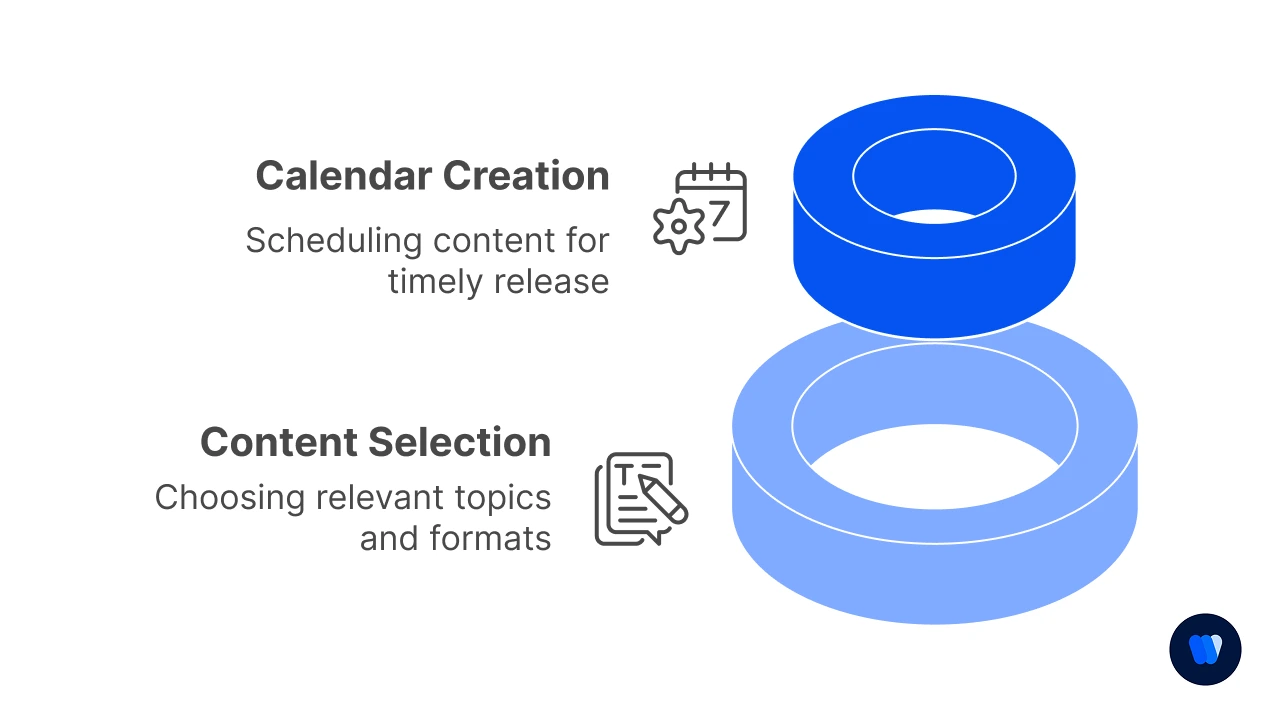
Content Topic and Format Selection
Choosing the right topics and formats ensures that your content matches audience intent and supports business goals. This step helps you prioritize high-value ideas and build variety into your plan.
- Create a master list of content topics based on audience research
- Map topics to different stages of the customer journey
- Determine the most effective content formats for each topic
- Prioritize topics based on business goals and audience needs
- Research keywords for each planned content piece
- Balance educational, entertaining, and promotional content
- Identify seasonal or timely topics to incorporate into your plan
Pro Tip: Keep a running topic backlog.
Adding ideas as they come ensures you never run out of inspiration and prevents strong concepts from getting lost in the day-to-day workflow.
Editorial Calendar Creation
An editorial calendar provides structure and accountability, making it easier to maintain a steady publishing cadence. It also helps teams align on deadlines and responsibilities.
- Select an appropriate calendar tool (spreadsheet, project management software, etc.)
- Establish a consistent publishing cadence for each channel
- Assign topics, deadlines, and responsibilities to team members
- Schedule content production, review, and publishing dates
- Include space for content promotion activities
- Build in flexibility for timely or reactive content
- Plan content themes for different time periods
Customizable Resource: Venngage’s Content Marketing Checklist Template
Venngage offers editable calendar templates that let you organize content by themes, dates, and formats. With customizable fonts and layouts, you can easily align your publishing schedule with your brand’s style and goals.
Pro Tip: Avoid overplanning.
Limit your calendar to a three-month horizon so you stay structured but flexible enough to adjust for performance data and market shifts.
Calendar Management Note
The most effective calendars are living documents that evolve with your strategy.
Review them monthly to align with performance data, new priorities, and industry trends. Reserve about 20% of your slots for reactive opportunities, which often turn into your best-performing content.
Allocate Budget and Resources
Producing consistent, high-quality content requires not just ideas but also the right investment of time, money, and people. Defining budget and resources upfront ensures that your strategy is realistic and scalable.
- Estimate the budget for content production, promotion, and tools
- Allocate funds for writers, designers, video editors, and freelancers
- Identify software and platforms needed (SEO tools, CMS, analytics, project management)
- Assign internal team roles and responsibilities clearly
- Balance in-house vs. outsourced content creation to optimize costs
- Plan for paid promotion budgets alongside organic content efforts
Organizational Aid: Smartsheet’s Content Marketing Plan Templates
Smartsheet provides ready-to-use templates for one-page strategies, campaign tracking, and social media planning. These tools make resource allocation transparent and efficient, ensuring every dollar and hour invested is tied to measurable results.
Pro Tip: Treat your content budget like an investment portfolio—spread across creation, distribution, and optimization. Tracking ROI per channel ensures smarter resource allocation in the next cycle.
Smartsheet’s Content Marketing Plan Templates
Budgeting and resource allocation become much easier with Smartsheet’s ready-to-use templates. From one-page strategy documents to social media calendars and creative brief checklists, these tools help teams plan campaigns, track progress, and maintain a clear overview of content investments. By using structured templates, you reduce guesswork and ensure every dollar spent is tied to measurable outcomes.
4. Content Creation and Production
This stage turns planning into tangible content. The goal is to streamline workflows, ensure quality, and produce assets that align with both brand standards and SEO best practices. A well-defined content marketing plan checklist at this step helps maintain consistency and ensures every piece supports long-term business goals.
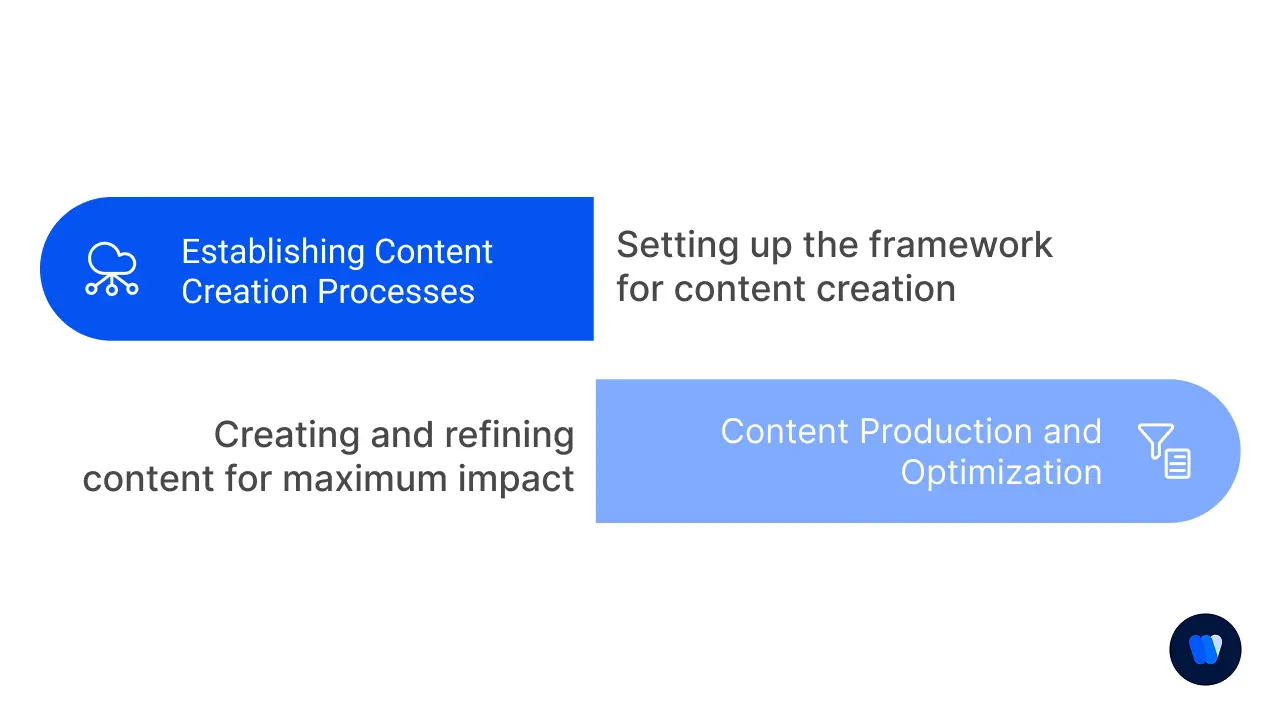
Establishing Content Creation Processes
Strong processes prevent bottlenecks and ensure consistency across all content types. Defining steps upfront saves time and keeps teams aligned.
- Develop content briefs with clear objectives, keywords, and calls-to-action
- Create standard operating procedures (SOPs) for different content types
- Establish review and approval workflows
- Define quality standards and style guidelines
- Set up collaboration tools for content team members
- Create templates for common content formats
- Establish a process for managing content assets (images, videos, etc.)
Pro Tip: Even small teams should document their workflows. It reduces errors, speeds onboarding, and ensures consistent quality when working with freelancers or partners.
Content Production and Optimization
Once processes are in place, the focus shifts to creating high-quality content optimized for both users and search engines.
- Assemble required resources (writers, designers, editors, etc.)
- Conduct thorough research before content creation
- Focus on creating high-quality, original content
- Optimize content for search engines with target keywords
- Ensure content meets accessibility standards
- Include compelling calls-to-action in each piece
- Create custom visuals to enhance written content
Pro Tip: Headlines and introductions drive the most engagement. Invest extra effort here to maximize clicks and keep readers engaged.
Content Brief Template Tip
A structured content brief with keywords, persona details, goals, and CTAs aligns creators with strategy.
Brands using briefs reduce revision cycles by up to 40% and publish faster without losing quality.
Visual Content Integration
Strong visuals transform text into engaging, memorable experiences. They simplify complex ideas and improve retention.
- Add infographics, charts, and graphics
- Use branded templates for consistency
- Add videos, GIFs, or animations
- Optimize visuals for mobile and web speed
- Use alt text for SEO and accessibility
- Repurpose content into visuals (infographics, reels, carousels)
5. Content Distribution and Promotion
Even the best content won’t succeed without effective promotion. This step focuses on distributing assets through the right channels and amplifying reach with targeted tactics.
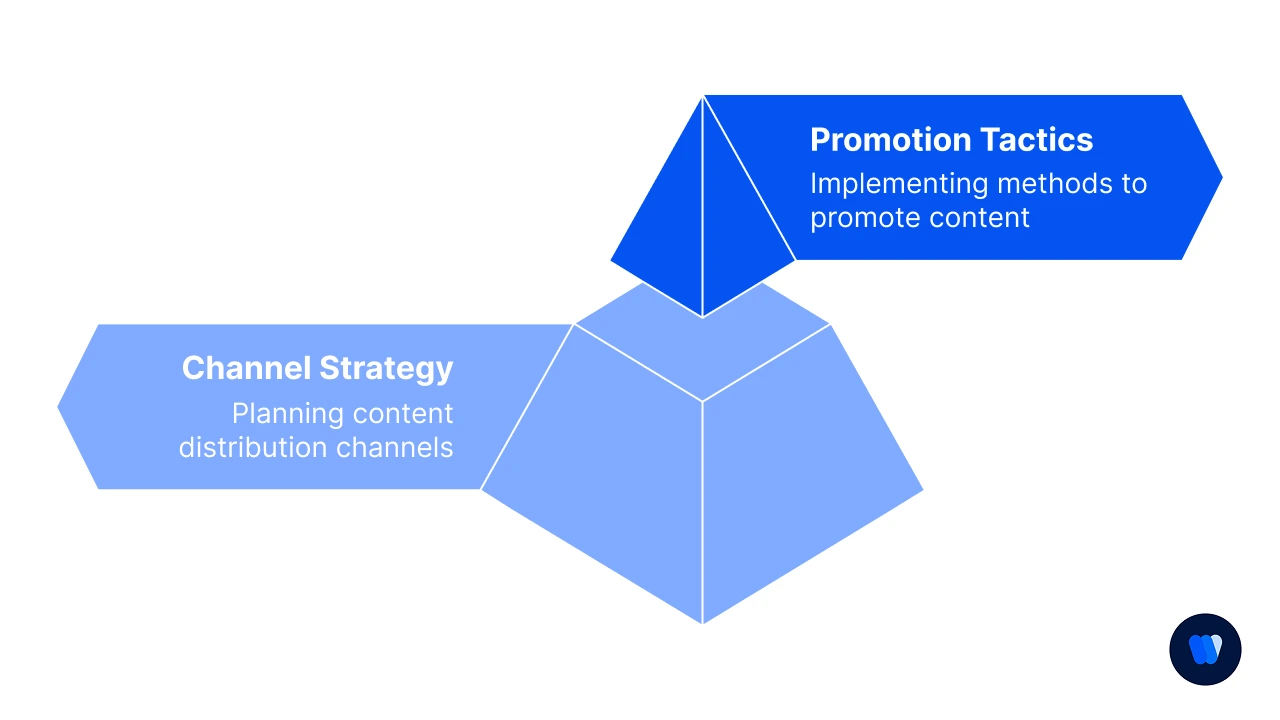
Channel Strategy Development
Choosing the right platforms ensures content reaches the intended audience. Tailor formats and messaging for maximum performance on each channel.
- Identify primary and secondary distribution channels
- Customize content format for each platform’s requirements
- Create a social media posting schedule
- Plan email marketing campaigns to distribute content
- Identify opportunities for content syndication
- Research industry publications for guest posting
- Establish partnerships for cross-promotion
Pro Tip: Focus on fewer but higher-impact channels first. Mastering one or two key platforms often delivers better ROI than spreading efforts too thin.
Content Promotion Tactics
Promotion drives visibility. Leveraging multiple tactics helps maximize engagement and ensures content gets in front of the right audience.
- Create multiple social media posts for each content piece
- Develop paid promotion strategies for high-value content
- Implement internal linking strategies for website content
- Leverage employee advocacy for content amplification
- Engage with relevant online communities to share content
- Reach out to influencers who might share your content
- Repurpose content into different formats for wider reach
Promotion Toolkit: HubSpot’s Content Promotion Kit
HubSpot offers a free kit with checklists, influencer outreach templates, and social media promotion guides. It’s designed to amplify your reach and ensure your content gets maximum visibility across channels.
Pro Tip:Tag and notify individuals mentioned in your content. They’re more likely to share it with their networks, boosting credibility and reach. Including this step in your Content Marketing Plan Checklist ensures higher visibility and stronger brand authority.
Content Distribution Matrix
| Content Type | Primary Channels | Secondary Channels | Promotion Tactics |
|---|---|---|---|
| Blog Posts | Website, LinkedIn | Twitter, Facebook, Email | SEO, social sharing, email newsletter |
| Videos | YouTube, TikTok | Website, Instagram | Teasers, hashtags, paid ads |
| Infographics | Pinterest, LinkedIn | Twitter, Website | Social sharing, embed in blog posts |
| Podcasts | Spotify, Apple Podcasts | Website, LinkedIn | Guest promotion, audiograms, transcripts |
| Webinars | Website, LinkedIn | Email, YouTube | Registration campaigns, replays, highlights |
6. Performance Measurement and Analysis
Tracking performance is essential to understand what’s working and what’s not. This step ensures your content strategy remains data-driven and adaptable to changing business goals.
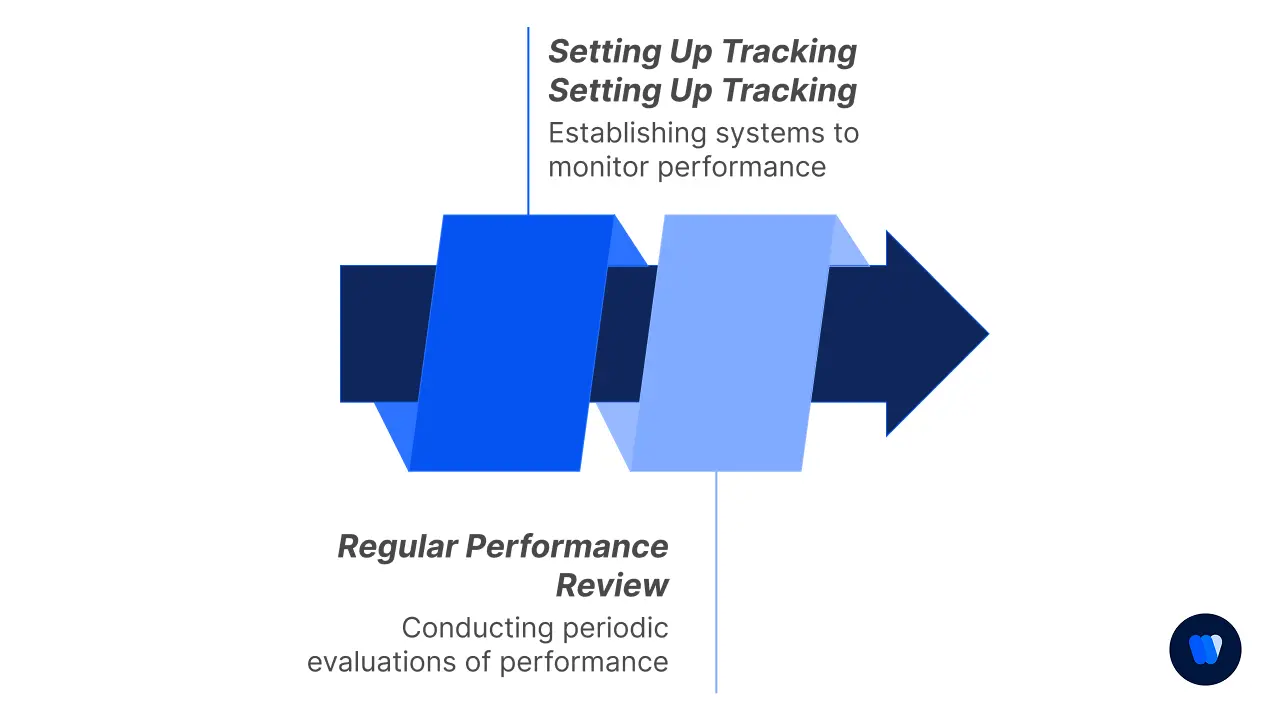
Setting Up Tracking and Analytics
Establishing reliable tracking systems gives you the clarity needed to make informed decisions. Analytics reveal how your content performs across different channels.
- Configure Google Analytics for content performance tracking
- Set up goal tracking for content conversions
- Implement UTM parameters for campaign tracking
- Create custom dashboards for content metrics
- Install heat mapping tools to analyze content engagement
- Set up social media analytics for distributed content
- Implement A/B testing for content optimization
Pro Tip: Keep tracking simple at first. Focus on 3–5 core metrics tied directly to business goals, then expand as your strategy matures.
Regular Performance Review
Ongoing reviews ensure you catch underperforming content early and maximize the impact of your top-performing assets.
- Schedule weekly quick reviews of content performance
- Conduct monthly in-depth content analytics meetings
- Compare performance against established KPIs
- Identify top-performing and underperforming content
- Document insights and learnings from analytics
- Track content ROI where possible
- Share performance reports with stakeholders
Pro Tip: Use a one-page performance snapshot for stakeholders. Highlight key insights, top wins, and recommended actions without overwhelming them with data.
Analytics Insight Note
Look beyond vanity metrics like page views. Focus on engagement (time on page, scroll depth), conversions (sign-ups, leads), and business impact (influenced revenue, retention).
Some B2B brands find that lower-traffic posts with higher engagement produce 3× more qualified leads than high-traffic articles.
7. Content Optimization and Strategy Refinement
Optimization ensures your content stays relevant and competitive. This step focuses on refreshing high-value assets and scaling successful strategies for long-term growth.
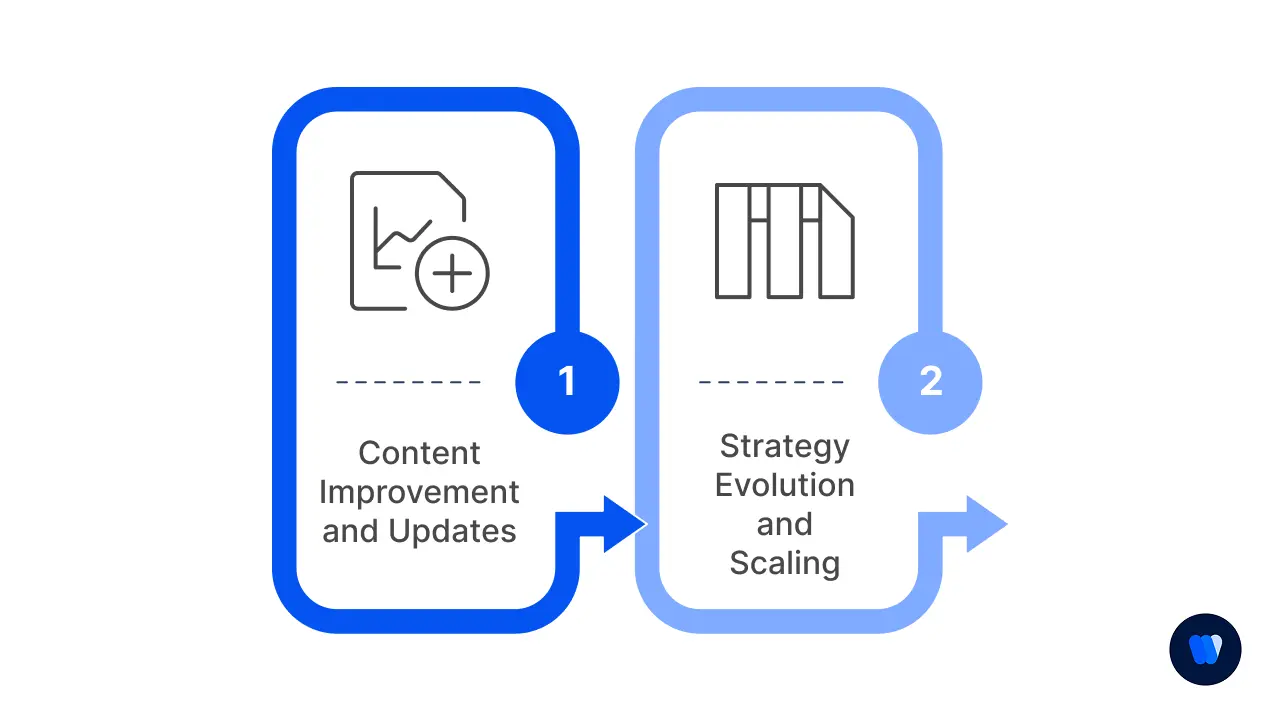
Content Improvement and Updates
Regular updates keep your content accurate, visible, and engaging. Even small tweaks can significantly boost traffic and conversions.
- Identify high-potential content for optimization
- Update outdated statistics and information
- Improve SEO elements based on keyword performance
- Enhance visuals and formatting for better engagement
- Add internal links to newer relevant content
- Expand thin content with additional valuable information
- Fix broken links and technical issues
When updates don’t happen consistently, content doesn’t just stagnate — it gradually loses rankings, traffic, and engagement. This slow decline is known as content decay, and it’s one of the most common reasons high-performing content stops delivering results over time.
Pro Tip: Refreshing top-performing posts with updated data and keywords can increase organic traffic by up to 65%.
Strategy Evolution and Scaling
As your business grows, your content strategy should evolve too. Scaling proven tactics ensures consistent results while exploring new opportunities.
- Review overall strategy quarterly against business goals
- Adjust content mix based on performance data
- Identify opportunities to scale successful content types
- Experiment with new content formats and channels
- Update buyer personas with new insights
- Refine content workflows for greater efficiency
- Plan resources for strategy expansion
Pro Tip: Use the 70/20/10 model: 70% proven formats, 20% evolving ideas, 10% experimental. This balance sustains results while driving innovation.
Content Optimization Protocol Tip
Schedule quarterly reviews of your top-performing pieces. Even strong content can benefit from updated stats, visuals, or stronger CTAs.
Using an AI SEO agent helps spot keyword gaps, optimize for LLMs, and monitor SERP changes. A structured content marketing plan checklist ensures these optimization steps are consistently applied.
Brands applying this approach often see a 28% boost in conversions by systematically improving top assets. Think of it as following a practical content optimization checklist—a reliable framework for keeping your best content competitive.
5 Prompts for Content Marketing Planning
How Can I Measure the Success of My Content Marketing Plan?
Publishing content is only half the journey. The real question is your content actually moving the needle? Measuring success means tracking the right signals, not just vanity metrics. Use the framework below to evaluate your plan effectively.
1. Align with Business Goals
Your content should map to concrete outcomes—leads, revenue, retention. If you can’t draw a line from a content asset to a business goal, it’s likely wasted effort.
- Define how each campaign supports awareness, lead-gen, or conversions.
- Attribute content touches to pipeline stages and closed-won revenue.
- Report ROI by content type (e.g., ebooks vs. webinars vs. blogs).
Did you know?
Example: Goal = 200 leads/quarter. Track gated ebooks, webinar signups, and blog CTAs that collectively deliver those 200 leads—and calculate cost-per-lead for each source.
2. Track Efficiency of Resources
Effective plans use time, tools, and budget wisely. Measure output versus input to spot bottlenecks and low-yield tasks.
- Compare production hours vs. outcomes per asset (leads, MQLs, revenue influence).
- Monitor cost-per-lead (CPL) and cost-per-acquisition (CPA) by content type.
- Audit workflow latency (brief → draft → design → publish) to remove friction.
Did you know?
Example: A 3-hour blog that generates 50 leads outperforms a 20-hour case study with 5 downloads—reallocate effort accordingly.
3. Measure Consistency and Quality
Cadence matters, but quality keeps people reading. Evaluate whether your output meets expectations and maintains brand standards.
- Track publishing frequency versus plan (weekly, biweekly, monthly).
- Use engagement signals—time on page, scroll depth, bounce rate—to gauge value.
- Collect qualitative feedback (comments, ratings, CS input) to refine tone and depth.
Did you know?
Example: Posts with 2:30+ average read time and 60%+ scroll depth signal strong quality; pages with <20s time-on-page need rewriting or better hooks.
4. Evaluate Adaptability
Strategy isn’t static. Use data and trend shifts to evolve topics, formats, and channels so you stay relevant.
- Run quarterly content reviews to add, prune, or refresh based on performance.
- Test new formats (short-form video, carousels, interactive tools) against control pieces.
- Update briefs and personas with fresh insights from sales and support.
Did you know?
Example: If LinkedIn carousels drive 3× engagement vs. static posts, prioritize carousels in next quarter’s calendar.
5. Check Engagement and Growth
Beyond traffic, measure relationship signals. Growing, returning audiences are the clearest indicator your content resonates.
- Track return visitors, subscriber growth, and email CTR.
- Monitor social shares, comments, brand mentions, and community growth.
- Measure CTA click-throughs and micro-conversions (downloads, demo requests, trials).
Did you know?
Example: Newsletter CTR rising from 2% → 6% and 40% returning traffic indicate stronger loyalty and message–market fit.
Bottom line: Tie every metric back to a business goal, report ROI by content type, and iterate quarterly. That’s how you turn activity into outcomes.
Checkout More Checklists!
- On-Page SEO Checklist
- Content Strategy Checklist
- Blog Post Checklist
- Keyword Research Checklist
- LLM Pattern Analysis Checklist
- Editorial SEO Style Guide Creation with LLMs Checklist
- E-E-A-T Strengthening SEO Checklist Using LLM Outputs
- On-Page SEO Content Checklist for LLM-Generated Content
- AI Visibility Deliverables Checklist for Agencies (2026 Guide)
FAQs
The main objectives define how content supports growth, lead generation, awareness, or retention. Aligning content with business goals ensures measurable impact.
Your target audience includes defined demographics, psychographics, and pain points. Identifying them ensures content resonates and delivers value.
Recognizing audience struggles allows you to craft content that solves problems, builds trust, and positions your brand as a helpful authority.
The right mix—blogs, videos, infographics, podcasts—depends on where your audience engages most. Choosing suitable channels maximizes reach and impact.
Tracking KPIs like engagement, conversions, traffic, and ROI provides clarity on performance and helps refine strategies for better results.
Teams often require writers, designers, editors, SEO tools, CMS, analytics platforms, and project management software to implement plans efficiently.
Regularly reviewing performance data, updating personas, and testing new formats ensures your content remains relevant and aligned with evolving trends.
Conclusion
A content marketing plan checklist isn’t just a nice-to-have—it’s the foundation for consistent growth, authority, and measurable ROI. By documenting your strategy, auditing existing assets, setting clear goals, and refining execution through data, you transform guesswork into a repeatable system.
Brands that succeed don’t just create more content—they create smarter content. From aligning with business objectives to optimizing distribution and tracking performance, every step in this checklist helps ensure your marketing efforts truly move the needle.
The key takeaway? Treat content as a strategic asset, not a one-off task. With a documented plan, the right tools, and ongoing refinement, your business can drive engagement, build trust, and achieve long-term impact.