SEO remains essential for online visibility, and with large language models (LLMs) generating content at scale, I’ve developed this practical On-Page SEO Content Checklist LLM based on what actually works. Today, it’s not just about SEO—it’s also about GEO (Generative Engine Optimization), making sure your content is discoverable not only in search engines but also in AI-driven results.
After optimizing hundreds of AI-created pages across various industries, I’ve seen how proper optimization transforms raw LLM output into content that genuinely ranks, converts, and shows up in generative AI answers.
This guide represents the strategies I personally use with my clients to ensure AI-generated content meets both search engine requirements and user expectations—while future-proofing content for GEO.
What is On-Page SEO for LLM-Generated Content?
On-page SEO for LLM-generated content involves optimizing AI-created text so it performs better in search results while still serving user needs authentically.
And so it can be surfaced in AI answer engines (including Perplexity), where how to rank in Perplexity depends heavily on clarity, structure, and citation readiness.
I find that LLM content requires special handling, especially around factual accuracy, voice consistency, and adding that human touch Google increasingly rewards. Before publishing AI drafts, I cross-check them against the core on page SEO factors so intent, structure, metadata, internal links, and UX are all covered.
Without a proper checklist, even well-written AI content may struggle to gain visibility or user trust.
When I work with clients who use AI content tools, I emphasize that effective on-page SEO combines technical optimization with thoughtful human review. This balance creates valuable resources that search engines recognize as worthy of top rankings.
Let me walk you through the practical steps included in this checklist to help you get the best results from AI-generated content.
Essential Elements Of An On-Page SEO Content Checklist LLM
When working with LLM-generated content, success comes from more than just keyword stuffing. To make your pages rank and deliver value, your checklist should cover both technical SEO and human-first elements. Here are the essentials:
1. Keyword Research and Intent Alignment: Strong SEO starts with the right keywords. Focus on primary, secondary, and long-tail terms that match user intent. This ensures your LLM content answers real questions while targeting ranking opportunities.
2. Content Structure and Formatting: Clear structure makes content scannable for both readers and search engines. Use H2s, H3s, bullet points, and logical flow. Well-formatted content increases engagement and improves indexing efficiency.
3. E-E-A-T Integration: LLM output needs human trust signals. Add first-hand examples, author bios, and citations to credible sources. These E-E-A-T elements strengthen credibility and boost long-term visibility in SERPs. You can also track how these signals translate into AI mentions by following a Brand Visibility Audit on LLMs process.
4. Technical SEO Elements: Technical precision helps your content perform. Optimize title tags, meta descriptions, image alt text, and URL structures. Implement schema markup to improve rich results and enhance discoverability.
5. User Experience and Mobile Optimization: Great content fails if the experience is poor. Ensure fast loading times, mobile responsiveness, and accessible design. A smooth UX signals quality to search engines and keeps readers engaged.
6. Continuous Content Updates: Search engines reward freshness, but they also quietly devalue pages that aren’t maintained. Regularly reviewing content to add new stats, examples, and insights helps prevent Content Decay, where once-ranking pages gradually lose visibility due to outdated information or declining relevance. Ongoing updates maintain trust, accuracy, and ranking stability over time without requiring full rewrites.
On-Page SEO Content Checklist LLM for Better Rankings and Visibility
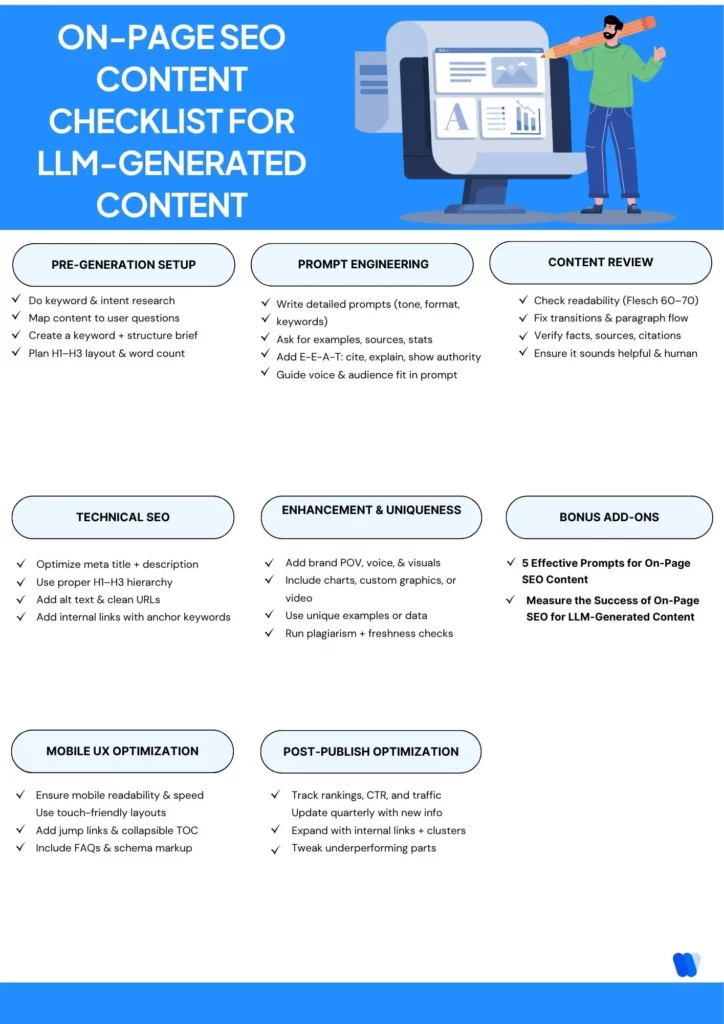
The On-Page SEO Content Checklist LLM is your step-by-step guide to optimizing AI-generated content so it meets both search engine standards and user expectations. By applying these techniques, you’ll improve keyword integration, enhance user experience, and build long-term authority in your niche.
1. Pre-Generation Strategy
Strong content doesn’t begin at writing—it begins with planning. Before you ask an LLM to generate anything, you need to define the right keywords, intent, and structure. This ensures your content is both optimized for SEO and valuable to real readers.
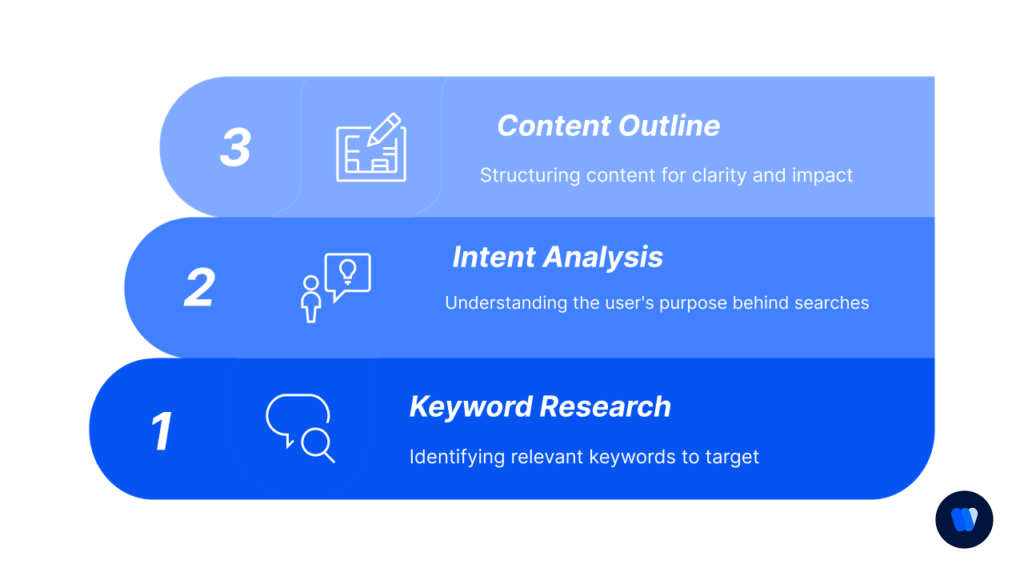
This checklist item focuses on keyword research, intent analysis, and building a content outline that guides the AI toward producing clear, structured, and user-focused output.
Keyword Research and Intent Analysis
Good SEO starts with understanding what people search for and why. Researching keywords and analyzing intent helps you create content that ranks while addressing real audience needs.
- Start with comprehensive keyword research using tools like Semrush or Ahrefs
- Analyze search intent for each keyword (informational, navigational, commercial, transactional)
- Identify relevant long-tail keywords and semantic variations for added context
- Research competitor content ranking for target keywords to uncover gaps
- Evaluate keyword difficulty and search volume to prioritize opportunities
- Create a keyword map to guide content structure planning
- Identify questions users frequently ask (from People Also Ask sections)
Content Outline Development
A strong outline gives the AI a roadmap. By defining sections, keyword placements, and goals in advance, you set the stage for structured, high-quality output.
- Develop a detailed content briefs with main sections and subtopics
- Assign specific keywords to each section for natural distribution
- Define clear content goals and key messages for every piece
- Design a logical content structure with proper heading hierarchy (H1, H2, H3)
- Include notes for factual information requiring citations and verification
- Specify target word count for each section based on competitor analysis
- Add specific questions the content should answer to meet user intent
Technical Note: Pre-Generation Content Strategy Setup
Before creating content, set up these foundational elements to maximize your LLM’s effectiveness:
- Keyword Selection: ?primary_keyword=[main_topic]&secondary_keywords=[subtopics]&search_intent=[informational/commercial/transactional]
- Audience Definition: ?persona_type=[decision_maker/researcher/end_user]&pain_points=[specific_challenges]
- Content Format: ?format=[blog/guide/listicle/case_study]&word_count=[target_length]
- Featured Snippet Objective: ?snippet_type=[paragraph/list/table/video]&target_query=[specific_question]
This structured setup ensures your planning phase translates directly into optimized, search-ready content when using AI tools.
| Research Component | Best Approach | Optimal Implementation |
|---|---|---|
| Primary Keywords | Search volume 1K+, KD <50 | H1 and intro paragraph |
| Secondary Keywords | Long-tail variations, 5+ words | H2/H3 headings |
| Topic Clusters | Hub and spoke model | Internal linking strategy |
| Featured Snippets | Direct question answering | First 40–50 words post-heading |
2. LLM Prompt Engineering
Prompts are the blueprint for AI-generated content. If your instructions lack clarity, the output often feels generic and unstructured. A strong prompt ensures the LLM delivers content that balances SEO requirements with natural readability.
This checklist item focuses on crafting detailed prompts that define structure, tone, keywords, and credibility markers, so your content feels authentic and optimized. By aligning with the On-Page SEO Content Checklist LLM, you can guide AI tools to produce content that is both search-friendly and user-focused.
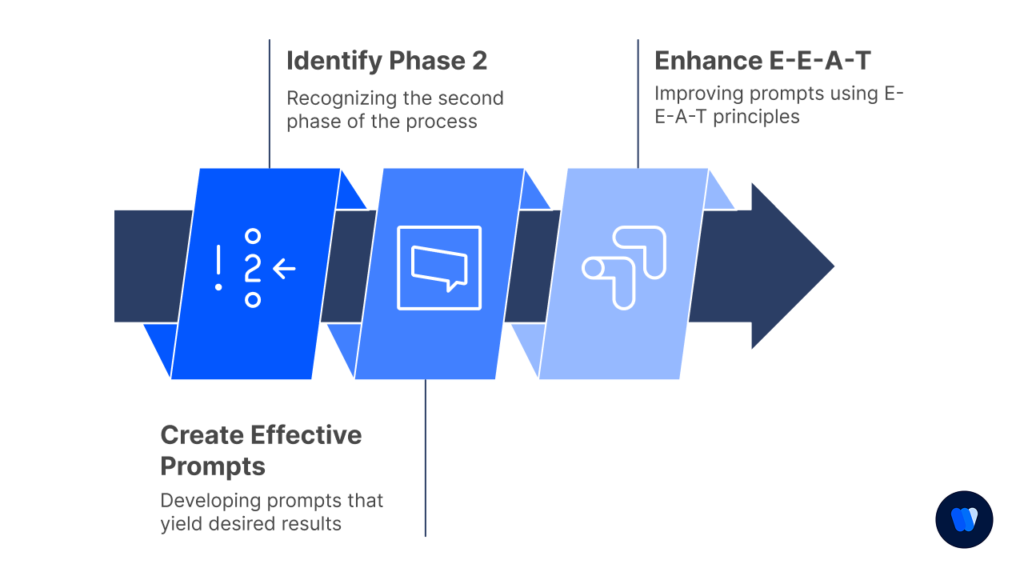
Creating Effective Prompts
Effective prompts guide the AI step by step. They set the framework for headings, keyword use, and writing style, helping you avoid content that feels robotic or off-topic.
- Specify exact content structure with H2s and H3s
- Include primary and secondary keywords with placement guidance
- Define the brand’s tone of voice and writing style for consistency
- Request examples, statistics, or case studies to add depth
- Set word count guidelines for sections and overall article
- Emphasize natural keyword flow to avoid robotic text
- Ask for formatting like lists, tables, or callout boxes
E-E-A-T Enhancement Instructions
LLM output often lacks credibility. Adding E-E-A-T requirements to your prompts ensures the AI includes the right trust signals, making your content reliable for both users and search engines.
- Require proper citations for all factual claims
- Set expertise level and perspective based on your audience
- Include industry-specific terminology where appropriate
- Request recent updates, stats, or news in the draft
- Ask for sections addressing common audience questions
- Balance promotional and educational tone for authenticity
- Include contrary viewpoints to add completeness
How can I Optimize LLM-generated content for on-page SEO without losing natural flow and readability?
Optimizing content produced by Large Language Models (LLMs) for on-page SEO—while keeping it natural and easy to read—requires a thoughtful balance between technical SEO practices and user-focused writing. Below are key methods to strike that balance:
1- Deliver Value with Audience-Focused Content
Your content should go beyond surface-level text by being accurate, informative, and directly useful to your readers. While LLMs can draft coherent material, refining it with added context, insights, and a human touch is essential. This aligns with Google’s guidelines that reward content showing Experience, Expertise, Authoritativeness, and Trustworthiness (E-E-A-T).
2. Use Keywords in a Seamless Way
Start with in-depth keyword research to identify core and supporting terms. Incorporate them naturally in titles, headings, and body text without forcing placement. Overusing keywords can harm readability and rankings, so aim for smooth integration that feels organic to the reader.
3. Refine Meta Tags and Heading Hierarchy
Create meta titles and descriptions that are both keyword-rich and compelling to encourage clicks. Organize content with a logical heading structure (H1, H2, H3) so that both users and search engines can easily navigate the page. This improves clarity, flow, and overall SEO performance.
4. Improve Readability and User Engagement
Keep paragraphs short and digestible. Use bullet points, numbered lists, and visuals like charts, images, or videos to break up the text. Add descriptive alt text to multimedia elements to support SEO and accessibility. These practices enhance both comprehension and engagement.
5. Build Smart Internal Links
Connect your page to other relevant pieces of content on your site. Internal links guide readers to related topics, strengthen your site’s architecture, and help search engines understand content relationships. Use descriptive anchor text that flows naturally within the sentence.
6. Keep Content Fresh and Relevant
SEO isn’t a one-time task—review and update your content regularly. Add new data, examples, or insights to keep information current. Fresh content signals to search engines that your site is active and reliable, improving long-term visibility.
7. Take Advantage of AI-Powered SEO Tools
Use AI-based platforms to speed up and simplify optimization tasks. These tools can help refine keyword placement, generate meta tags, suggest internal links, and even recommend schema markup—all while helping maintain a natural flow in your writing.
By applying these strategies, you can optimize LLM-generated content for SEO without losing its natural tone, ensuring it performs well in search rankings while delivering real value to your audience.
Cheat Sheet: My E-E-A-T LLM Prompt Enhancers
| E-E-A-T Element | My Prompt Addition |
|---|---|
| Experience | “Include practical examples I can reference as first-hand experience.” |
| Expertise | “Use technical explanations with industry terminology, I would use” |
| Authoritativeness | “Reference established best practices from [specific industry sources]” |
| Trustworthiness | “Include data points with proper citations, I can verify.” |
3. Content Quality Assessment
Publishing raw AI-generated content is risky. Without review, it may contain inaccuracies, awkward flow, or irrelevant details that weaken both user trust and SEO performance.
This checklist item focuses on refining LLM output for readability, factual accuracy, and overall depth so it feels genuinely helpful and search-ready.
Readability and Engagement
Readable content improves user experience and keeps people on your page longer. Check for flow, sentence variety, and clarity to make the text engaging and easy to scan.
- Check the Flesch-Kincaid reading ease score (aiming for 60–70 for most content)
- Evaluate sentence and paragraph length variation for natural flow
- Assess logical transitions between paragraphs and sections
- Review the introduction to ensure it effectively hooks readers
- Look for appropriate transition words between sections
- Evaluate content for storytelling elements that keep readers engaged
- Verify that the content maintains a conversational tone throughout
Factual Accuracy and Depth
Trust comes from accuracy. Make sure all statistics, examples, and claims are valid, current, and properly attributed to credible sources. This reduces the risk of AI errors or “hallucinations.”
- Personally verify all factual claims and statistics before publication
- Replace outdated information with current data from reliable sources
- Compare topic coverage depth with top-ranking pages to ensure competitiveness
- Carefully check for signs of AI hallucinations or fabricated information
- Confirm all examples are realistic, accurate, and relevant to the audience
- Verify that referenced sources are credible and authoritative
- Ensure proper attribution for all quoted material and data
Tool Tip: I use Grammarly for readability assessment and Hemingway Editor for clarity improvements during content verification.
When working on a medical client’s content, this process reduced factual errors by over 90% compared to publishing raw AI output.
I also maintain a list of authoritative databases relevant to each client’s field for faster, more reliable fact-checking.
4. Technical SEO Implementation
Even the most engaging content won’t perform if it isn’t technically optimized. Search engines need clear signals to crawl, index, and rank your pages effectively. This part of the checklist focuses on on-page elements, metadata, and linking structures that strengthen both SEO performance and user trust.
By combining technical precision with clean site architecture, you create a solid foundation that maximizes the visibility of your LLM-generated content.
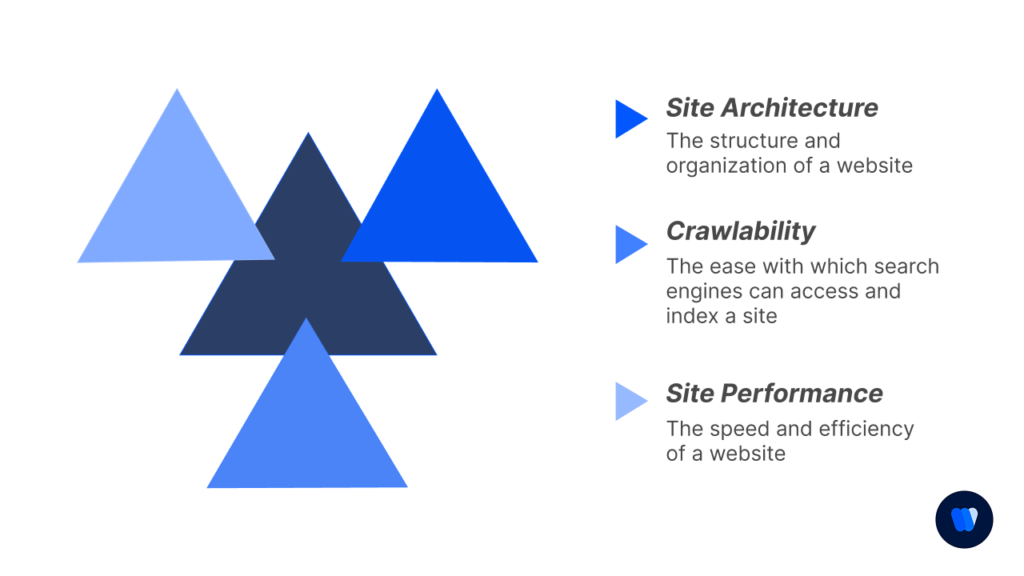
On-Page Element Optimization
Strong on-page elements help search engines understand your content’s relevance. From titles to alt text, each component should be optimized for clarity and SEO value.
- Optimize the title tag with the primary keyword (preferably near the beginning)
- Craft compelling meta descriptions with primary and secondary keywords
- Implement proper heading hierarchy (H1, H2, H3) with semantic structure
- Ensure the primary keyword appears in the H1 heading naturally
- Incorporate secondary keywords in subheadings where contextually appropriate
- Add descriptive alt text for all images with relevant keywords
- Create SEO-friendly URL structures that include target keywords
Internal Linking Structure
Internal links guide both users and search engines through your site. A thoughtful linking strategy builds authority, improves navigation, and strengthens overall site performance.
- Add 3–5 relevant internal links to other site content for context
- Use descriptive anchor text that includes target keywords when natural
- Ensure all links appear in contextually relevant locations within the content
- Include links to pillar content or topic clusters to strengthen site architecture
- Verify all internal links work correctly before publication
- Balance link distribution throughout the content for natural placement
- Add “related articles” sections to longer content pieces
Technical Note: Here’s how I approach internal linking for maximum impact:
| Content Type | Internal Linking Strategy |
|---|---|
| Product pages | Link to related products, category pages, and how-to guides |
| Blog posts | Link to service pages, related blog posts, and resource pages |
| Category pages | Link to subcategories, popular products, and buying guides |
| Resource pages | Link to blog posts, product pages, and other resources |
What tools or plugins are best for auditing on-page SEO when using LLMs to create content?
When working with Large Language Models (LLMs) to produce content, it’s important to make sure the output doesn’t just read well but also follows on-page SEO best practices. The following tools and plugins can help you review, audit, and optimize AI-generated content for stronger performance:
- KIVA (My Go-To Platform): While KIVA isn’t an auditing tool, it is my go-to platform for shaping content strategy with features like hidden gem keyword discovery, keyword clustering, brand consistency, and LLM visibility tracking.
- Surfer SEO: A content optimization platform that benchmarks your writing against top-ranking pages. It gives actionable suggestions on keyword usage, headings, and content structure, making it easier to align your LLM output with what search engines reward.
- Frase: This tool blends AI with SEO by generating content briefs, optimization recommendations, and competitor insights. It helps ensure your AI-written drafts are structured, targeted, and optimized for ranking potential.
- Screaming Frog SEO Spider: A robust website crawler that flags critical on-page issues like broken links, duplicate pages, and missing metadata. It’s especially useful for auditing large sites and maintaining the overall SEO health of your AI-generated content.
- Ahrefs: Beyond backlink tracking, Ahrefs offers comprehensive site audits, keyword research, and competitive analysis. It helps you identify optimization opportunities and monitor the long-term performance of content created with LLMs.
- SEMrush: An all-in-one SEO suite offering detailed site audits, keyword tracking, and competitor intelligence. It’s ideal for refining content strategies and ensuring your LLM-powered content aligns with current SEO trends and search intent.
By incorporating these tools into your workflow, you can effectively audit, refine, and improve the SEO quality of AI-generated content—ensuring it not only ranks but also delivers value to readers.
5. LLM Content Enhancement
AI can generate a lot of content, but it often needs a human touch to stand out. That’s where enhancement comes in—adding originality, visuals, and brand-specific voice to make content more engaging. This part of the checklist focuses on making your pages unique, polished, and truly valuable for readers. By blending AI efficiency with creative input, you deliver content that feels authentic and trustworthy.
Done right, enhancement transforms LLM output from generic text into high-performing resources that attract traffic and keep users engaged.
Originality and Uniqueness
Originality is a signal of quality. Enhance AI output by blending in your expertise, unique examples, and perspectives that competitors can’t easily replicate.
- Check content uniqueness with plagiarism detection tools like Copyscape
- Add original research, data, or insights whenever possible
- Incorporate brand-specific perspectives and expertise on the topic
- Create custom visuals, diagrams, or infographics to illustrate concepts
- Integrate unique case studies or examples from real-world experience
- Ensure content provides new value beyond existing resources
- Add personal voice elements to distinguish from generic AI content
Multimedia and Interactive Elements
Readers engage more with content that goes beyond text. Adding multimedia makes your posts visually appealing and more memorable.
- Add relevant images that break up text and illustrate key concepts
- Include videos where appropriate to enhance engagement and clarity
- Create custom graphics for important statistics or processes
- Consider interactive elements like calculators or quizzes for engagement
- Optimize all multimedia elements for fast loading to preserve performance
- Ensure proper attribution for all multimedia elements
- Add schema markup for rich results where appropriate
Cheat Sheet: My Multimedia Enhancement Strategy
| Content Type | Enhancement I Recommend |
|---|---|
| How-to guides | Step-by-step images with captions explaining each action |
| Data-heavy content | Interactive charts showing trends or comparisons |
| Complex concepts | Simple explainer videos breaking down difficult ideas |
| Product reviews | Comparison tables with visual rating indicators |
| Case studies | Before/after visuals with specific metric improvements |
6. Mobile and User Experience Optimization
Even the best-optimized content will fail if users struggle to read or navigate it. Mobile and UX optimization make sure your audience has a seamless experience on every device. This checklist item ensures your content is fast, responsive, and user-friendly. It covers everything from mobile readability to calls-to-action and navigation.
When readers find your content easy to consume, they’re more likely to stay longer, engage more, and return to your site in the future. By following the On-Page SEO Content Checklist LLM, you can align mobile usability with SEO best practices, ensuring both search engines and users value your content.
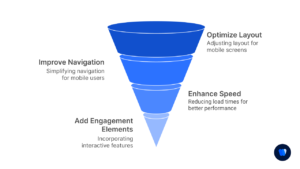
Mobile Responsiveness
Mobile traffic dominates search today. Optimizing for different screen sizes ensures your site feels polished and accessible everywhere.
- Check content readability on various mobile devices and screen sizes
- Ensure appropriate paragraph breaks for comfortable mobile reading
- Verify font size and contrast meet accessibility standards
- Test loading speed on typical mobile connections (not just office WiFi)
- Confirm all interactive elements work properly with touch controls
- Check that multimedia displays correctly across different screen sizes
- Ensure navigation elements are sufficiently sized for touch interaction
User Engagement Elements
A smooth user experience keeps readers engaged. Adding interactive and clear navigation elements helps reduce bounce rates and improve satisfaction.
- Add clear, action-oriented CTAs throughout the content
- Implement jump links for easy navigation in long-form content
- Create expandable table of contents for content scanning
- Break up text with visual elements approximately every 300–400 words
- Add FAQ sections addressing common user questions
- Incorporate interactive features when they add genuine value
- Implement appropriate schema markup for enhanced SERP features
Technical Note:
| Element | Best Practice | Testing Method |
|---|---|---|
| Text Readability | 16px+ font, 1.5 line spacing | Mobile preview tools |
| Paragraph Length | 2–3 sentences max | Thumb-scroll test |
| Media | Responsive, compressed | Mobile data simulation |
| Navigation | Touch targets 44px+ | Fat finger test |
| Loading Speed | Under 3 seconds | PageSpeed Insights |
| Interactions | Touch-friendly buttons | Device testing |
| Layout | No horizontal scrolling | Multi-device preview |
Engagement Enhancement Checklist:
- Strategic CTAs after key points
- Jump links for 1000+ word content
- Collapsible TOC for quick navigation
- Visual breaks every 300 words
- FAQ section with schema markup
- Touch-friendly interactive elements
- Accessibility compliance (WCAG 2.1)
7. Post-Publication Optimization
Publishing content is only the start of the journey. To keep your LLM-generated pages competitive, you need to monitor performance, make timely updates, and respond to data-driven insights.
This checklist item focuses on keeping your content fresh, maintaining visibility, and ensuring long-term results in search rankings.
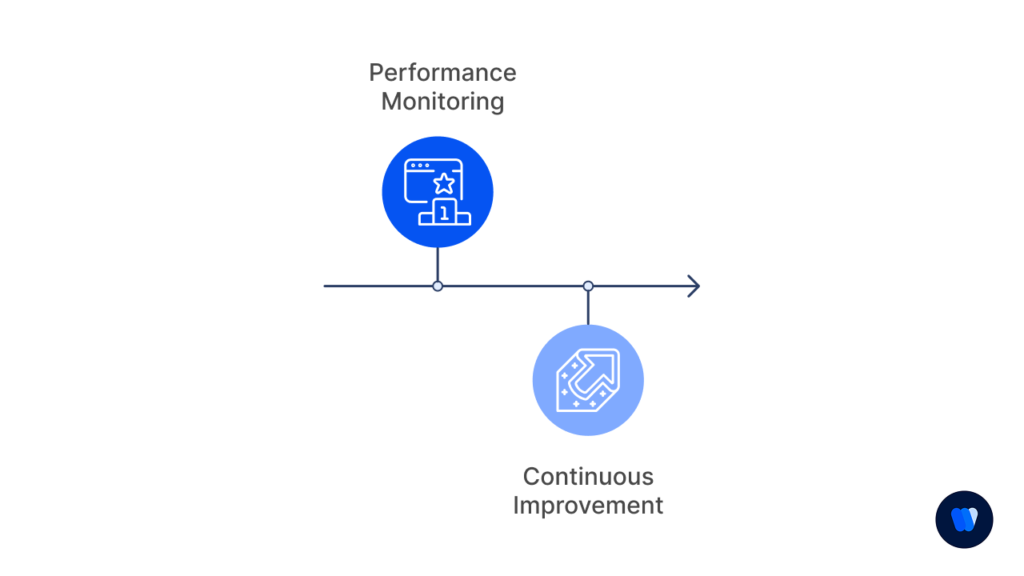
Performance Monitoring
Tracking results helps you understand what’s working and where improvements are needed. Use analytics tools to measure engagement and visibility over time.
- Set up Google Analytics and Search Console tracking for every page
- Monitor keyword ranking changes weekly with position tracking tools
- Track organic traffic trends using segmented comparisons
- Analyze behavior metrics such as bounce rate, time on page, and scroll depth
- Compare results against similar content to identify strengths and gaps
- Set up alerts for significant ranking fluctuations
- Document all insights to guide future optimization steps
Continuous Improvement
Keeping content updated is essential for maintaining trust and search visibility. Regular updates show both readers and search engines that your site remains relevant.
- Update content with fresh information at least quarterly
- Add new sections based on emerging search trends and user questions
- Optimize weak sections using performance insights
- Add new internal links to strengthen site architecture
- Address user questions or comments with timely updates
- Experiment with headings and meta descriptions when CTR is low
- Expand top-performing content into broader topic clusters
Analytics Framework for Tracking Results
Over the years, I’ve built a structured review system that consistently improves results. I maintain a spreadsheet tracking key performance indicators, with monthly reviews to spot patterns and opportunities.
| Timeframe | Key Actions | Metrics to Monitor |
|---|---|---|
| Weekly | Check ranking changes, review traffic | Position changes, organic visitors |
| Monthly | Analyze user behavior, identify weak sections | Bounce rate, time on page, exit pages |
| Quarterly | Update content, add new information | Freshness score, SERP feature gains |
| Annually | Conduct full content audit, consolidate or prune | YoY traffic comparison, conversion rate |
Quick Optimization Tips
- Update statistics and examples when metrics start declining
- Add FAQ sections based on Search Console query data
- Test alternative meta descriptions when CTR underperforms
- Add internal links from high-performing related pages
Create a comprehensive guide on [topic] targeting the keyword [primary keyword]. Structure the content with H2 and H3 headings covering [subtopic 1], [subtopic 2], and [subtopic 3]. Include relevant statistics from authoritative sources, practical examples from my experience, and actionable tips I can share with readers. Incorporate these secondary keywords naturally: [list keywords]. Write in an expert but accessible tone as if I’m speaking directly to [target audience]. Include an FAQ section addressing these questions my customers frequently ask: [list questions]. Use a balanced, objective tone, highlighting the pros and cons of each based on my experience with both products. Include a feature comparison table, pricing analysis, and user experience insights from my testing. Incorporate these LSI keywords naturally: [list keywords]. Add section headings for key comparison points and conclude with my recommendations for different user needs and scenarios. My Local SEO Content Prompt: Include local statistics, references to neighborhoods I serve, and relevant local landmarks. Structure with clear H2 and H3 headings covering [local subtopic 1], [local subtopic 2], and [local benefit]. Use a conversational tone, addressing common questions from my local customers. Include schema markup suggestions for my local business information. My E-E-A-T Focused Prompt: Include sections on [latest industry developments I follow], [my expert insights], [data-backed claims with citation suggestions], and [addressing common misconceptions I encounter]. Target the keyword [primary keyword] and incorporate these semantically related terms: [list terms]. Use an authoritative but accessible tone as if I’m sharing my expertise, and suggest places to include my credentials or client experiences. My Topic Cluster Content Prompt: Include sections on [subtopic 1], [subtopic 2], and [subtopic 3] with natural places to link to future cluster content. Incorporate these related keywords: [list keywords]. Suggest an internal linking structure and additional cluster topics I should develop. Format with proper H2 and H3 hierarchy and include an introduction establishing why I believe this topic is important for my audience.5 Effective Prompts for On-Page SEO Content
My Comprehensive Guide Prompt:
My Product Comparison Prompt:
Write a detailed comparison of [Product A] vs [Product B] optimized for the keyword [primary keyword].
Create location-specific content about [service/topic] in [city/region] targeting the phrase [location keyword].
Generate expert content on [topic] demonstrating my E-E-A-T credentials.
Create pillar content on [broad topic] optimized for [primary keyword] that will serve as the hub for my topic cluster strategy.
Based on my experience managing hundreds of LLM-generated pages, successful optimization requires tracking specific metrics that indicate both search performance and user engagement: Keyword Rankings: I track position improvements for target keywords using KIVA or Ahrefs. With proper optimization, I’ve seen LLM content achieve first-page rankings within 2-3 months for moderately competitive keywords, particularly for long-tail terms. Organic Traffic: Using Google Analytics, I measure traffic increases against baselines established before implementation. For well-optimized LLM content, I typically see 30-50% traffic increases over 6 months when following this checklist. Click-Through Rate (CTR): Google Search Console data shows that position #1 typically achieves a 27-32% CTR, with each subsequent position decreasing by roughly 3-5%. I monitor these metrics to identify opportunities for title and description optimization. Dwell Time and Bounce Rate: Pages with dwell times exceeding 3 minutes consistently perform better in rankings. I’ve found that adding interactive elements and breaking up content into scannable sections reduces bounce rates by approximately 15-25%. Conversion Rate: By implementing clear CTAs and addressing user intent thoroughly, I’ve achieved conversion rates for LLM-generated content within 0.5-1% of human-written content performance. Backlink Acquisition: Quality content naturally attracts backlinks. After implementing this optimization process, I saw that LLM-generated resource pages saw a 40% increase in natural backlink acquisition compared to their previous approach. Core Web Vitals: When I optimize images and interactive elements properly, LMM-generated pages can achieve “good” ratings across all Core Web Vitals metrics, contributing to improved rankings. Content Freshness Impact: My analysis shows that regular updates (quarterly at minimum) typically result in a 5-15% ranking improvement for most content types, with news and trending topics requiring more frequent updates. According to Google’s guidelines on helpful content, pages that demonstrate first-hand expertise and depth of knowledge consistently outperform thin content across all metrics. I’ve found that successful LLM-generated content requires regular monitoring and improvement based on performance data to maintain and improve rankings over time.
How to Measure the Success of On-Page SEO for LLM-Generated Content
By implementing this comprehensive checklist and measuring the right metrics, you’ll transform your LLM-generated content into valuable assets that actually perform in search results while providing genuine value to your audience.
Checkout More Checklists!
- The 10 Best Content Marketing Agencies: A Complete Guide 2026
- Content Strategy Checklist
- Content Marketing Plan Checklist
- Blog Post Checklist
- Keyword Research Checklist
- LLM Pattern Analysis Checklist
- Multi-Client AI Visibility Reporting Checklist for Agencies 2026
- Editorial SEO Style Guide Creation with LLMs Checklist
- E-E-A-T Strengthening SEO Checklist Using LLM Outputs
- Keyword Strategy Integration for LLM SEO Checklist
- AI Visibility Deliverables Checklist for Agencies (2026 Guide)
- SEO to GEO Transition Checklist for Agencies
- GEO Audit Checklist for Agencies 2026
FAQs
Search engines don’t directly penalize LLM-generated content, but they do evaluate quality, relevance, and trust signals. As long as the content meets Google’s helpful content guidelines and follows E-E-A-T principles, it can perform as well as human-written content.
The key is to guide your LLM with a clear content outline and keyword map. Use primary keywords in titles and intros, add secondary terms naturally in subheadings, and blend semantic variations to improve context without sacrificing readability.
LLMs save time on content creation while allowing you to scale optimization efforts. When paired with a checklist, they help maintain consistency, improve keyword coverage, and ensure your content is structured for both users and search engines.
Yes, tools like Surfer SEO, Clearscope, and Jasper integrate LLM capabilities for keyword optimization, readability, and content scoring. These tools help refine AI-generated drafts into search-ready articles with stronger alignment to SEO best practices.
- Keyword research & intent alignment
- Content structure & formatting
- E-E-A-T integration
- Technical SEO elements (titles, meta, schema, alt text)
- User experience & mobile optimization
- Continuous content updates