Why do agency clients still “disappear” even when they rank? Because more searches are being resolved inside AI-generated answers—before a click happens.
This SEO to GEO Transition Checklist for Agencies shows how to adapt workflows, KPIs, and deliverables so clients stay visible where decisions are being shaped.
In a 10M+ keyword analysis covering January–November 2025, Semrush found Google AI Overviews stabilized at around 16% of queries after surging earlier in the year (Semrush, 2025). And in a behavioral study of Google users, people who encountered an AI summary were less likely to click on links to other websites than those who didn’t see one (Pew Research Center, 2025).
This shift changes how visibility works. It’s no longer enough to rank well—brands must be included, cited, and accurately represented inside AI-generated answers.
Most agencies understand this shift conceptually. Fewer have translated it into clear workflows, measurable KPIs, and repeatable client deliverables.
That’s where this guide fits: it’s a transition checklist for agencies that already run SEO programs and now need to layer AI visibility into strategy, execution, and reporting at scale—while keeping core SEO fundamentals intact and aligning execution with GEO workflows.
TL;DR:
- Audit AI visibility on priority queries (mentions, citations, competitors).
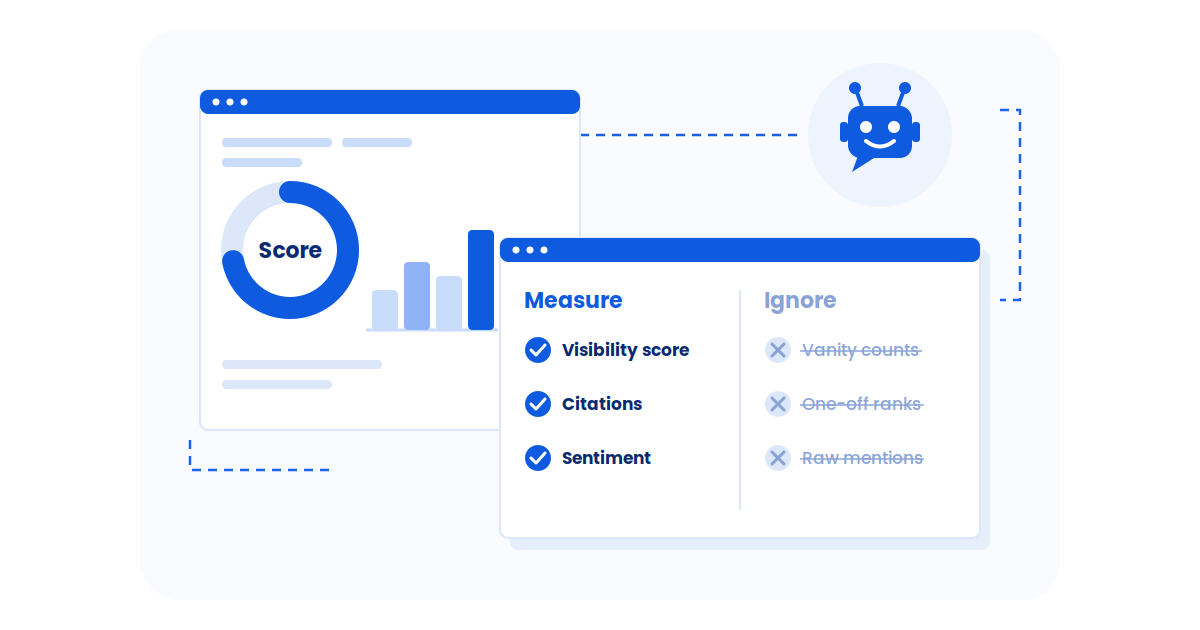
- Track GEO KPIs: citations, share of answer, prompt coverage, accuracy.
- Restructure pages for answer-first, extractable content (FAQs, lists, tables).
- Implement schema, crawlability, and a single source of truth.
- Build authority with credible sourcing and original data assets.
- Monitor and iterate monthly.
What Is The SEO To GEO Transition Checklist For Digital Marketing Agencies?
The SEO to GEO transition checklist is a step-by-step system that helps agencies move from page-focused SEO to answer-focused visibility—so clients don’t just rank in search results, but also show up inside AI-generated answers powered by Generative Engine Optimization (GEO).
It doesn’t replace SEO. Instead, it adds a GEO layer that agencies can run alongside SEO to improve:
- Appearances In AI Answers (does the brand show up at all?)
- Citations And Correct Mentions (does the AI link to the site, and is the information accurate?)
- Coverage Of Key Buyer Questions (does the brand appear for the questions buyers actually ask?)
- Consistent Reporting Across Clients (can you report results the same way for every account?)
This checklist is designed to be reused across accounts and teams. It turns GEO from random testing into a clear agency workflow: audit AI visibility, improve page structure, fix technical basics, build trust signals, and track progress over time.
That’s also how Wellows supports agencies—by operationalizing GEO into a repeatable system that tracks AI visibility, citations, and competitive presence so teams can deliver consistent, explainable results across clients.
What Are The Key Mindset Shifts Agencies Need For SEO To GEO Transition?
Before tools or tactics, agencies need to change how they think about visibility.
According to Bain & Company, around 80% of consumers now rely on AI-generated results for at least 40% of their searches, significantly reducing the role of traditional result-clicking in the decision process (Bain & Company, 2024).
When answers are delivered upfront, visibility means being part of the answer—not just ranking below it.
Did you know?
Key Mindset Shifts
- From Rankings → Citations And Recommendations inside AI-generated answers
- From Pages → Extractable Answers (clear paragraphs, bullets, and tables)
- From Traffic-Only Success → Visibility, Accuracy, And Trust in AI responses
- From One-Off Optimizations → Standardized Systems teams can repeat across clients
In short, GEO rewards content that is easy for AI systems to understand, verify, and reuse.
If clients still expect certainty, start by reframing expectations: AI outcomes are probabilistic, which is why agencies can’t “guarantee” AI results—they can only guarantee process, transparency, and iteration.
That shift is exactly why agencies need a reporting framework for AI search—to measure mentions, citations, and competitive presence inside AI-generated answers.
Agencies that focus only on rankings and clicks often struggle to explain performance when AI answers absorb user intent earlier in the search journey.
How Can Agencies Shift From Traditional SEO To Generative Engine Optimization Step By Step?
The transition works best when agencies follow a structured sequence, not scattered experiments. Here’s the high-level flow:
Audit current AI visibility by testing priority buyer queries across AI answers and logging mentions, citations, and competitors.
Define GEO-specific KPIs like citation frequency, share of answer, prompt coverage, and accuracy—so progress is measurable.
Restructure content for extraction using answer-first sections, FAQs, lists, and tables that AI systems can lift and cite.
Ensure technical and data readiness with correct schema, crawlable pages, and a single source of truth for key product and brand details.
Build authority beyond the website through credible sources, original data assets, digital PR, and consistent third-party mentions.
Monitor, correct, and iterate monthly to improve inclusion, fix inaccurate AI mentions, and close prompt coverage gaps over time.
The sections below break each step into a practical, repeatable checklist you can apply across accounts.
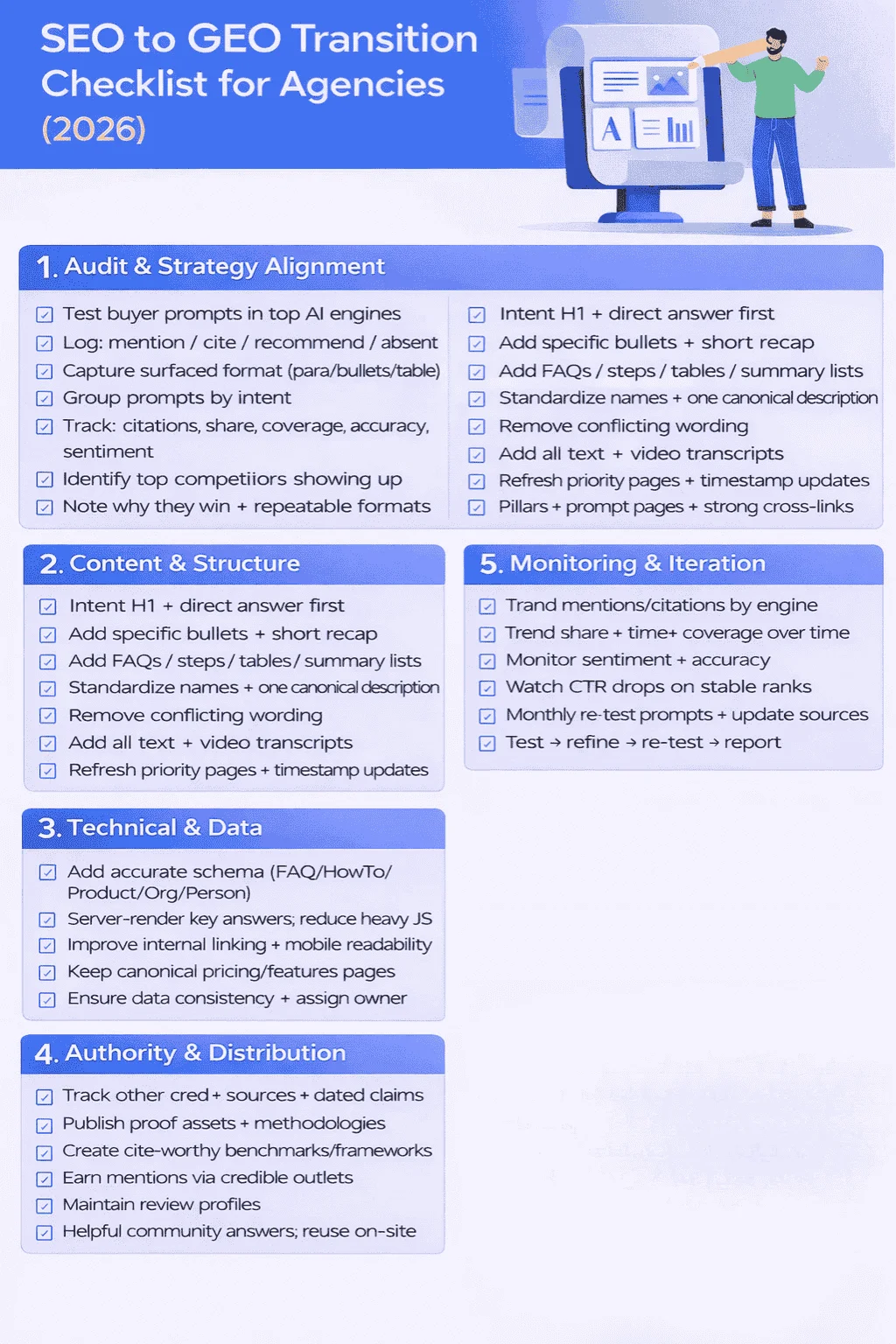
SEO to GEO Transition Checklist for Agencies 2026
This checklist helps agencies transition from traditional SEO programs to AI visibility and Generative Engine Optimization (GEO)—without abandoning the SEO foundations that still drive discovery, trust, and demand capture.
1. Audit & Strategy Alignment
Before optimizing for AI visibility, agencies need clarity on where clients stand today and how GEO success will be measured.
1.1 Current AI Visibility Audit
Establish a baseline of how each client appears inside AI-generated answers.
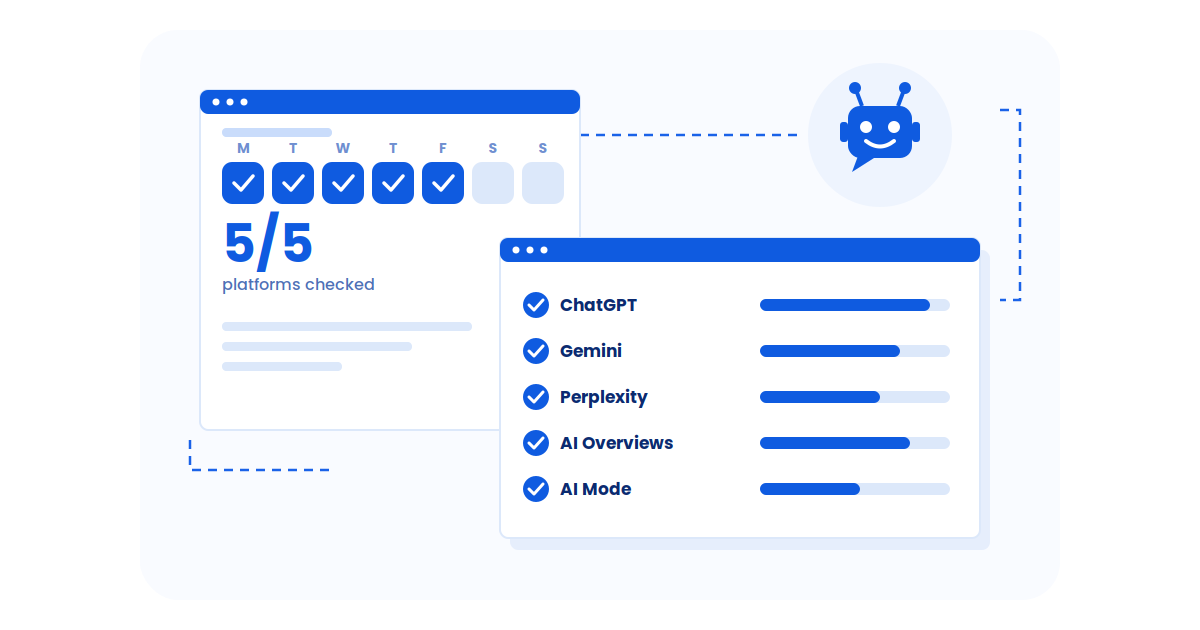
Query Testing: Test real buyer queries across Google AI Overviews, ChatGPT, Perplexity, Gemini, and other relevant systems.
Visibility Logging: Record whether the brand is mentioned, cited, recommended, or absent.
Format Capture: Capture the format being lifted (paragraph, bullet list, table, definition).
Intent Grouping: Group queries by intent (definition, comparison, pricing, best-for, how-to).
The goal is not perfection—it’s visibility mapping. This shows which content is already AI-readable and where gaps exist.
1.2 Define GEO KPIs (Shift The Success Model)
Traditional SEO KPIs alone cannot explain performance in AI answers. GEO requires new leading indicators.
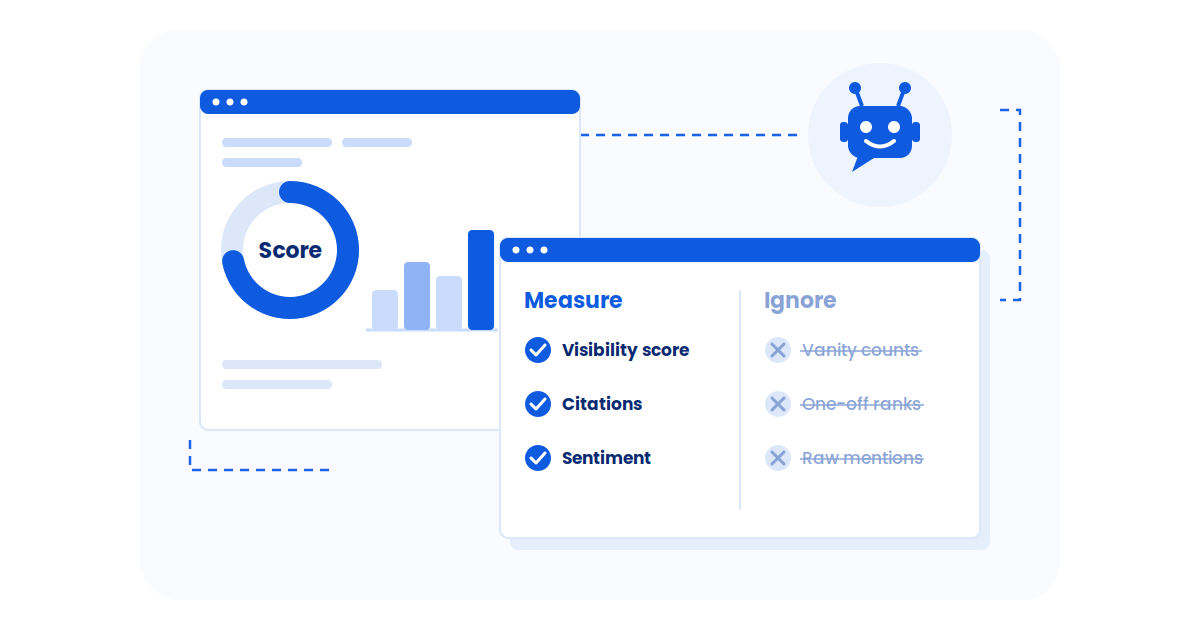
Primary GEO KPIs
Citation Frequency: Track citation frequency (how often your brand or URLs are cited)
Share Of Answer: your mentions relative to competitors within a fixed prompt set
Prompt Coverage: percentage of priority prompts where the brand appears
Accuracy Rate: correct vs. partial vs. incorrect mentions
Brand Sentiment: tone inside AI responses
These metrics shift conversations from “Why didn’t traffic increase?” to “Where and how are we being represented?”
1.3 Competitor Analysis (AI-Specific)
In GEO, competitors aren’t just ranking competitors—they’re citation competitors.
Citation Competitors: Identify which competitors appear most frequently in AI answers.
Reason Mapping: Analyze why they’re being cited (structure, clarity, data, authority).
Pattern Tracking: Note recurring formats: tables, FAQs, concise definitions, benchmarks.
This reveals patterns you can replicate without copying content.
1.4 Content Gap Analysis
AI systems favor specific content types. Many SEO-heavy sites are missing them.
Format Gaps: Identify missing formats: comparisons, “best-for” pages, pricing explainers, how-to workflows.
Priority Scoring: Prioritize gaps based on prompt importance and competitive dominance.
Page Mapping: Map each gap to an existing or new page (avoid content sprawl).
This ensures GEO work enhances—not bloats—your content ecosystem.
2. Content & Structure Optimization
GEO rarely requires rewriting everything. Most gains come from restructuring content to be extractable.
2.1 Answer-First Content Structure
AI systems look for direct answers early.
Clear H1: Use a clear H1 aligned with query intent.
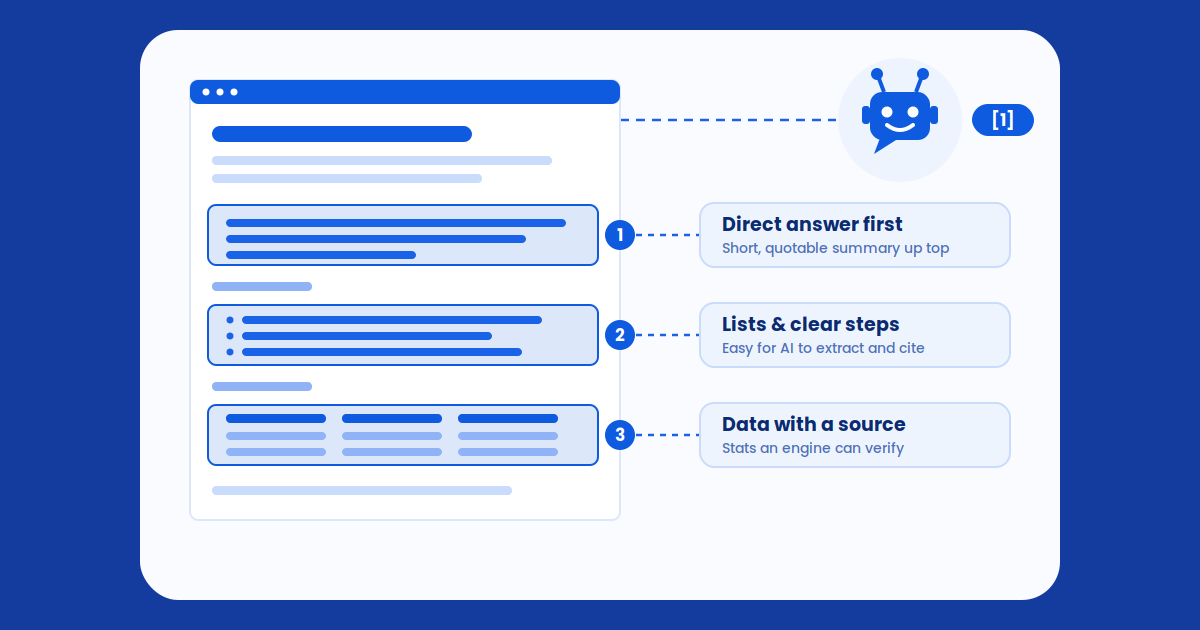
Direct Answer First: Add a 1–2 sentence direct answer at the top of each key section.
Specific Support: Add 3–5 supporting bullets with specifics (numbers, constraints, dates).
Section Recap: Add a short recap summary (40–60 words).
This answer-first pattern creates liftable units without sacrificing depth.
2.2 Extractable Formats
Certain formats are consistently favored for AI extraction.
FAQ Coverage: Add FAQs for clear Q&A coverage.
Step Lists: Use numbered steps for processes.
Comparison Tables: Create comparison tables with attributes and “best-for” rows.
Summary Lists: Use lists that summarize choices or criteria.
These formats reduce ambiguity and increase reuse in AI responses.
2.3 Entity Optimization
AI visibility improves when entities are clearly defined and consistent.
Name Standards: Standardize brand, product, and feature names across the site.
Canonical Description: Maintain one canonical description for offerings and positioning.
No Conflicts: Avoid conflicting language across pages.
This reduces misrepresentation inside AI answers.
2.4 Multimodal Content Readiness
AI systems increasingly process multiple content types.
Alt Text: Add descriptive alt text to images.
Transcripts: Include videos with full, crawlable transcripts.
Visual Support: Ensure visuals reinforce—not replace—core text answers.
2.5 Freshness & Updates
Outdated content loses trust.
Regular Updates: Update high-priority pages regularly.
Timestamp Changes: Timestamp meaningful updates.
Refresh Proof: Refresh statistics, dates, and examples.
Freshness acts as a credibility signal in AI responses.
2.6 Hybrid Content Strategy: Long-Form + Answer-Ready
Agencies should not choose between depth and clarity—GEO works best when paired with strong SEO pillars.
Pillar Pages: Maintain long-form pillar pages to establish topical authority.
Answer Modules: Add answer-first summaries, FAQs, and tables within those pillars.
Support Pages: Create supporting subpages for highly specific prompts.
Cross-Linking: Cross-link pillar pages and answer-focused content.
This hybrid approach preserves SEO performance while increasing AI citation likelihood.
3. Technical & Data Readiness
Strong GEO performance depends on clean, accessible technical foundations.
3.1 Schema Markup (Used Correctly)
Schema helps machines understand meaning—when applied honestly.
FAQPage Schema: Implement FAQPage schema for real FAQs.
HowTo Schema: Implement HowTo schema for genuine step-based content.
Product Schema: Add Product or SoftwareApplication schema where applicable.
Entity Schema: Add Organization and Person schema for clear entities.
Schema Accuracy: Ensure schema matches visible content exactly.
Schema is a meaning label—not a shortcut.
3.2 Technical Accessibility
AI systems need fast, clear access to answers.
Server Rendering: Render key answers server-side.
Lightweight Pages: Minimize dependency on heavy client-side scripts.
Answer Hubs: Build clean internal linking to answer hubs.
Mobile Clarity: Ensure strong mobile readability.
3.3 Single Source Of Truth
Conflicting data creates inconsistent AI answers.
Canonical Pages: Maintain canonical pages for pricing, features, and positioning.
Data Consistency: Keep data consistent across the site, docs, and public profiles.
Update Ownership: Assign documented ownership for updates.
4. Authority & Distribution
AI systems don’t rely on websites alone—they observe the wider ecosystem.
4.1 Strengthen E-E-A-T Signals
Named Authors: Use named authors with credentials.
Dated Sources: Add clear sourcing and dated claims.
Method Notes: Include methodology notes for original data.
Proof Assets: Publish proof assets (reports, benchmarks, whitepapers, PDFs).
Data Reuse: Reference original data across multiple pages.
Strong proof signals increase trust—and citations.
4.2 Expand Citation Profile
Industry Contributions: Contribute guest content to credible industry publications. Partnering with Social Media Marketing Agencies on co-authored insights or data-driven reports can expand citation reach across both AI search and social ecosystems.
Review Presence: Maintain profiles on relevant review platforms (where applicable).
Original Benchmarks: Create original data, benchmarks, or frameworks that others can cite.
These assets position your brand as a reference, not just a participant.
4.3 Community Engagement
Helpful Answers: Post helpful, non-promotional answers on Reddit and Quora.
Prompt Alignment: Align community answers with your priority prompt set.
On-Site Reinforcement: Reuse community insights on-site to reinforce authority.
5. Monitoring & Iteration
GEO is not a one-time project—it’s an ongoing system.
5.1 Advanced Monitoring
Engine Tracking: Track citations and mentions by engine.
Coverage & SOV: Measure share of answer and prompt coverage over time.
Quality Checks: Monitor sentiment and accuracy of mentions.
CTR Signals: Watch CTR drops on stable rankings as AI-summary signals.
Tool Support: Supplement manual checks with AI citation monitoring tools.
5.2 Monthly Reviews
Re-Test Prompts: Re-test priority prompts monthly.
Label Accuracy: Label mentions as correct, partial, or incorrect.
Fix Sources: Update authoritative source content where needed.
5.3 Continuous Optimization Loop
Continuous Optimization Loop: Run a test → refine → re-test → report loop.
Stable Prompt Set: Keep prompt sets stable for trend analysis.
Scale With Proof: Scale changes only after patterns are validated.
SEO remains the foundation. GEO extends visibility into the answers buyers actually see. Agencies that succeed won’t be the ones chasing tools—they’ll be the ones running clear systems clients can understand, trust, and measure.
What Does A 3-Month SEO To GEO Transition Plan Look Like For Agencies?
- Days 1–30: Build The GEO Baseline:
Focus on setting direction and creating a clear starting point before making big changes.
- Run A Baseline AI Visibility Audit: Test priority buyer queries across Google AI Overviews, ChatGPT, Perplexity, and Gemini, then log mentions, citations, and competitor placements.
- Define Prompt Sets And GEO KPIs: Lock a stable prompt set per client and track citation frequency, share of answer, prompt coverage, and accuracy.
- Restructure Top Priority Pages: Apply answer-first formatting (direct answer + bullets + recap) on the pages most likely to win citations—especially for Gemini-specific optimization.
- Days 31–60: Fix The Gaps And Improve Eligibility:
Focus on closing the biggest coverage gaps and making your site easier for AI systems to read and trust.
- Close Major Content Gaps: Create or upgrade missing formats like comparisons, “best-for” pages, pricing explainers, and how-to workflows.
- Implement Schema And Technical Fixes: Add relevant schema (FAQPage, HowTo, Product, Organization, Person) and ensure pages are crawlable, fast, and easy to extract from.
- Publish The First Authority Asset: Release one proof-based asset (mini benchmark, data summary, or case study) designed to earn citations.
- Days 61–90: Scale Visibility And Standardize Delivery:
Focus on expanding results across more prompts and turning the work into a repeatable service.
- Expand Prompt Coverage: Increase the number of tracked prompts and optimize additional pages using patterns proven in the first 60 days.
- Standardize Reporting: Ship a consistent client-ready report showing citations, share of answer, prompt coverage, accuracy, and actions taken—then monitor changes continuously using real-time AI visibility alerts.
- Scale Across Multiple Clients: Turn the workflow into templates (prompt sets, audit sheets, reporting format) so the process runs the same across accounts.
What Success Looks Like After An SEO To GEO Transition
After an SEO to GEO transition, success is no longer measured only by rankings or traffic. Instead, it’s defined by how consistently and accurately a brand appears inside AI-generated answers across search and AI platforms. With AI visibility platforms like Wellows, agencies can clearly track and explain this shift through citation data, prompt coverage, and representation metrics.
- More Frequent And Accurate AI Citations: Your brand and URLs are cited more often in AI answers, with details that correctly reflect your offerings.
- Faster Inclusion After Publishing Or Updates: New or updated pages begin appearing in AI-generated answers sooner, showing improved AI readability and trust.
- Clearer Client Conversations Around Visibility: Reporting focuses on citations, share of answer, and prompt coverage instead of rankings alone.
- Fewer Traffic-Only Performance Disputes: Even when clicks decline due to AI summaries, agencies can still demonstrate real visibility gains.
What Are The Top Mistakes Agencies Make During SEO To GEO Transition?
Most agencies don’t struggle with GEO because of missing tools—they struggle because GEO is treated as a minor SEO tweak instead of a new visibility system built around AI answers.
- Treating GEO Like “SEO With AI Keywords”: Adding keywords without improving structure, clarity, and proof rarely earns AI citations.
- Ignoring GEO Reporting: Without citation and prompt tracking, agencies can’t explain performance when clicks decline.
- Overproducing Unstructured Content: Long pages without clear answers, bullets, or tables are hard for AI systems to extract.
- Skipping Entity Consistency: Inconsistent product names and positioning often lead to incorrect AI answers.
- Not Monitoring Accuracy: Mentions are celebrated without checking whether the AI answer is actually correct.
Successful agencies treat GEO as a systematic visibility layer—not a one-off experiment.
How Agencies Can Measure And Prevent These Mistakes:
Use an AI visibility platform like Wellows to monitor mentions and citations across AI-driven search experiences. Track prompt coverage, share of answer, and accuracy rate so visibility stays measurable and comparable over time. Then run monthly accuracy checks and update the source page whenever AI answers are outdated, incomplete, or incorrect.
Checkout More Checklists!
- LLM Pattern Analysis Checklist
- Keyword Strategy Integration for LLM SEO Checklist
- E-E-A-T Strengthening SEO Checklist Using LLM Outputs
- On-Page SEO Content Checklist for LLM-Generated Content
- Editorial SEO Style Guide Creation with LLMs Checklist
- Multi-Client AI Visibility Reporting Checklist for Agencies 2026
- GEO Audit Checklist for Agencies 2026
FAQs
Test your priority queries inside AI systems and note which pages are mentioned or cited. Then review what gets lifted (paragraphs, bullets, tables) and restructure key sections using answer-first summaries and extractable formats.
Start with FAQPage and HowTo schema where you have real Q&A or step-based content. Add Product/SoftwareApplication and Organization/Person schema only when it matches the visible content exactly.
AI systems respond to full questions, not just short keywords. Prompt research mirrors how buyers actually ask, which improves your chances of being included and cited in AI answers.
Start with accurate, visible-content-matched schema: FAQPage, HowTo, then Product/SoftwareApplication, Organization, and Person where relevant. Use Wellows to track whether those pages earn citations in AI answers.
You can turn this guide into a reusable checklist for audits, content sprints, and client reporting. Copy the sections into a template and reuse the same workflow across every account.
Final Takeaway: SEO Isn’t Dying—Visibility Is Expanding
SEO remains the foundation that enables discovery, crawling, and indexing—and that foundation is not going away.
What’s changing is where visibility is earned. The SEO to GEO transition checklist for agencies exists to help teams expand beyond rankings and traffic into AI-driven visibility, where brands are surfaced, cited, and trusted inside generated answers.
For agencies, the real advantage isn’t simply knowing that GEO exists. It’s having a clear, repeatable transition system that can be applied across clients, measured consistently, and explained without confusion.
When agencies combine strong SEO fundamentals with structured GEO workflows, they don’t lose relevance—they gain a broader, more durable form of search visibility clients can see, understand, and trust.