AI visibility is now an agency-wide responsibility. As Google AI Overviews, ChatGPT, Gemini, and other AI systems shape how buyers research and shortlist vendors, agencies are no longer judged only on rankings or traffic, but on whether clients consistently appear inside AI-generated answers.
In 2025, AgencyAnalytics reported that 70% of agencies say client reporting plays a critical role in retention, which is exactly why AI visibility work must be packaged into consistent, client-readable outputs (AgencyAnalytics, 2025).
For agencies managing multiple client accounts, the question isn’t “Can we track AI visibility?” It’s: How do we report it across dozens of brands in a way that scales, stays consistent, and proves progress?
That’s what this guide delivers: a multi-client AI reporting checklist built for portfolio-level reporting, so every account receives the same standard, comparable deliverables.
If you’re still building the reporting foundation for a single account, start with agency reporting for AI search to align metrics, cadence, and stakeholder-ready summaries.
Once that foundation is in place, multi-client reporting becomes a scale problem: standardizing prompts, normalizing time windows, and comparing visibility trends across accounts.
And when a client needs diagnosis, not just reporting, the AI search visibility audit checklist is the companion for identifying what’s missing and why.
This article assumes you’re already monitoring AI visibility in some form and now need a repeatable reporting system that works across clients, teams, and stakeholders.
TL;DR , Multi-Client AI Visibility Reporting Checklist
- AI-generated answers increasingly influence buyer shortlists before users ever click a website.
- Agencies are expected to prove visibility inside AI outputs, not just rankings or traffic.
- Multi-client reporting requires standardized metrics, normalized prompt sets, and a consistent reporting cadence.
- This checklist focuses on reporting outputs (dashboards, trends, citations, risk flags, executive summaries), not audits or optimization.
- The goal is to reduce ambiguity, improve retention, and make search engine visibility progress comparable across a client portfolio.
What Multi-Client AI Visibility Reporting Means
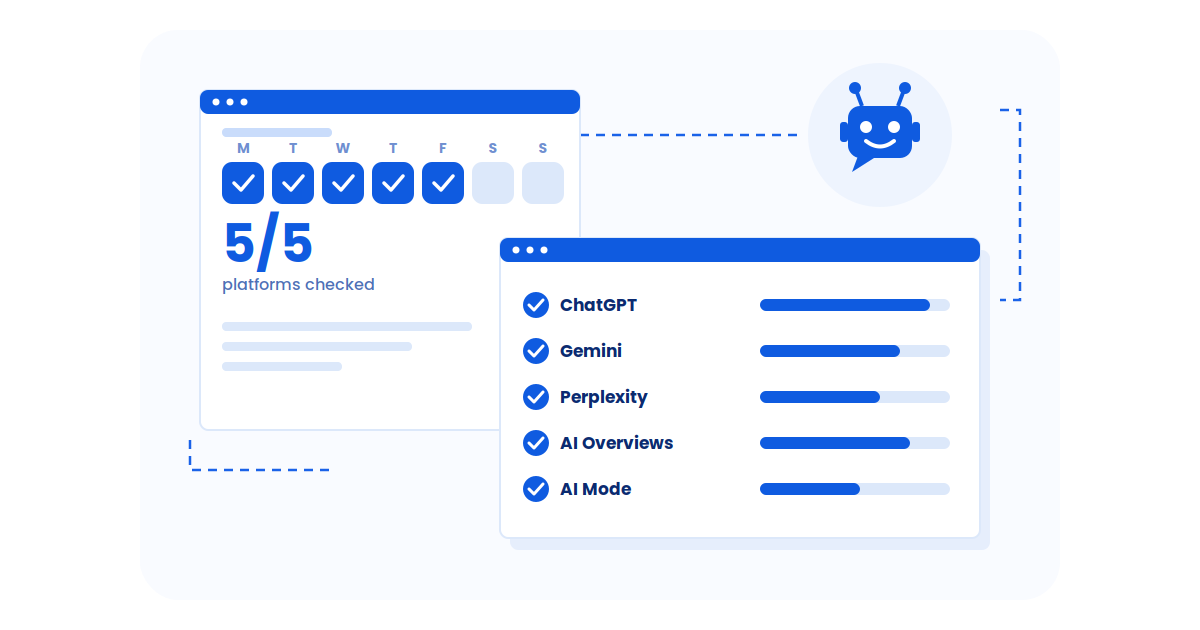
Multi-Client AI Visibility Reporting is an agency-focused analytics process that tracks how multiple client brands are mentioned, portrayed, and sourced across generative AI platforms such as ChatGPT, Gemini, Perplexity, Claude, and Google AI Overviews.
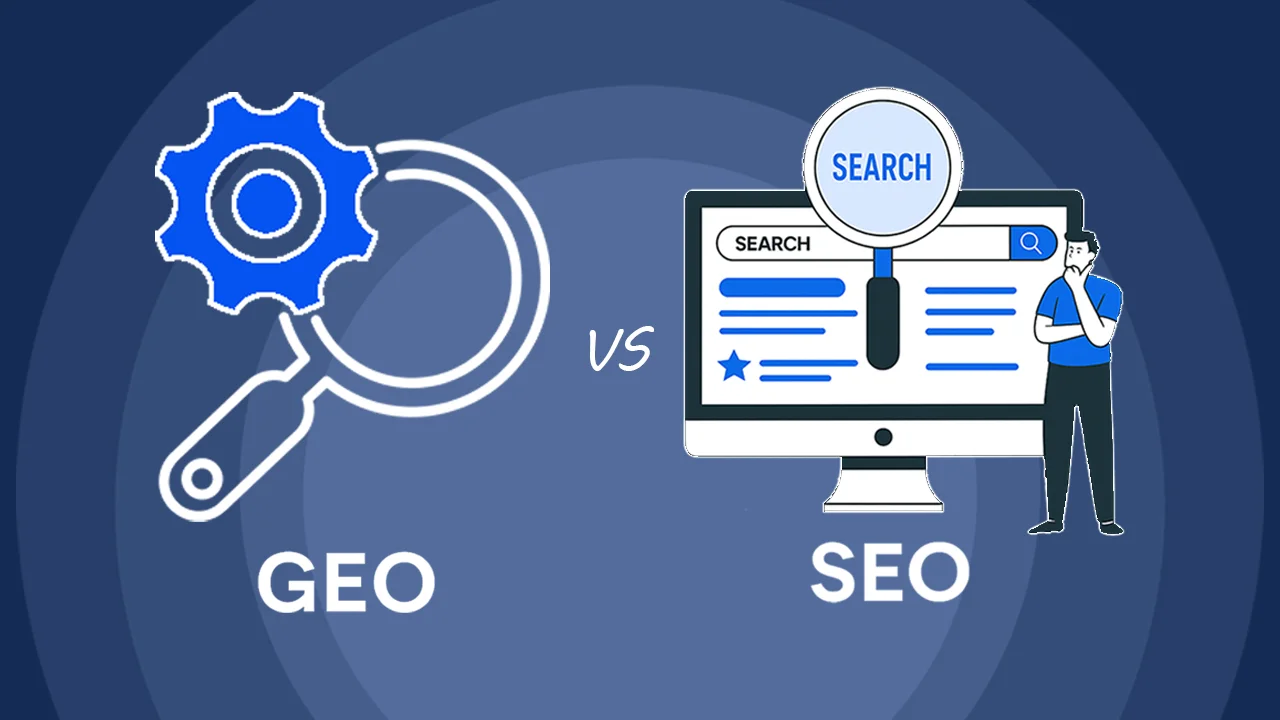
It’s part of generative engine optimization (GEO) because it measures visibility inside AI-generated answers, not just blue-link rankings.
Unlike traditional SEO reporting, it measures brand presence, accuracy, and sentiment in AI-generated answers, not just rankings, impressions, or traffic, especially when you look at how GEO differs from SEO.
In practical terms, it answers portfolio-level questions top AI SEO agencies get asked every month: Which clients are being recommended by AI, where are competitors showing up instead, and what changed since the last reporting period?
Unlike single-account reporting, multi-client reporting needs:
- Consistency: Identical definitions for metrics like visibility, citations, and coverage across all accounts.
- Comparability: Normalized prompt sets and reporting windows so trends are real, not artifacts of different inputs.
- Scalability: Repeatable reporting templates and dashboards that don’t break when you add 10 more clients.
- Clarity: Executive-ready summaries that translate AI visibility into business relevance for stakeholders.
What Agencies Track Across Multiple Clients
To keep AI visibility reporting consistent across a portfolio, agencies standardize a small set of signals across every account.
Core Reporting Components
Did you know?
- Unified dashboard: One view to monitor and compare AI visibility across many clients and segments.
- Share of AI Voice (SAIV): The share of AI-generated responses that mention a client compared to competitors, often tracked alongside broader AI visibility KPIs.
- Citation tracking: Which URLs and assets AI models use as sources when describing or recommending a brand, including how LLM citations vs backlinks differ in what they signal.
- Sentiment and accuracy checks: Whether AI’s portrayal is positive/neutral/negative and whether key facts are correct.
- Competitor benchmarking: Where rivals appear instead of the client, revealing coverage and content gaps.
Tools Agencies Use for Multi-Client AI Reporting
Did you know?
- Wellows: Built for agencies to track AI visibility across platforms and turn citations, mentions, and sentiment into client-ready reporting at scale.
- Peec AI: Competitive tracking for multi-brand visibility monitoring.
- Athena HQ: Often used for fast prospect reporting and lightweight snapshots.
- Profound: Used by larger teams managing enterprise-scale, multi-brand portfolios.
- Local Falcon & Brandlight.ai: Used for localized, multi-location, and multi-model tracking contexts.
Why Agencies Need a Multi-Client AI Visibility Reporting Framework
Multi-client AI visibility reporting solves a painful scaling problem:
As AI-driven discovery grows, agencies can’t rely on manual spot checks and ad hoc screenshots. The more accounts you manage, the faster reporting becomes inconsistent, and inconsistency is where clients lose confidence.
A portfolio-level reporting framework helps agencies:
Standardize deliverables across accounts and retainers.
Reduce ambiguity by showing visibility changes over time in a consistent format.
Improve retention by packaging progress into client-readable outputs.
Make performance comparable across clients without mixing methodologies.
If you also need a broader operational view of delivery (beyond reporting), pair this checklist with how agencies deliver AI search visibility to align execution and reporting in one program.
Principles That Prevent Reporting Chaos Across Multiple Clients
- One portfolio definition of “AI visibility”: decide what counts as visibility (citation, mention, recommendation) and keep it consistent.
- Normalize prompts and intent sets: the portfolio must be measured using comparable prompt categories and buying-stage intent.
- Use repeatable output formats: dashboards, summaries, and trend reports must follow the same structure across accounts.
- Separate account insights from portfolio insights: account reports explain “why”; portfolio reports explain “where to focus.”
- Don’t mix audit steps into reporting: audits diagnose; reporting proves progress. Keep them distinct.
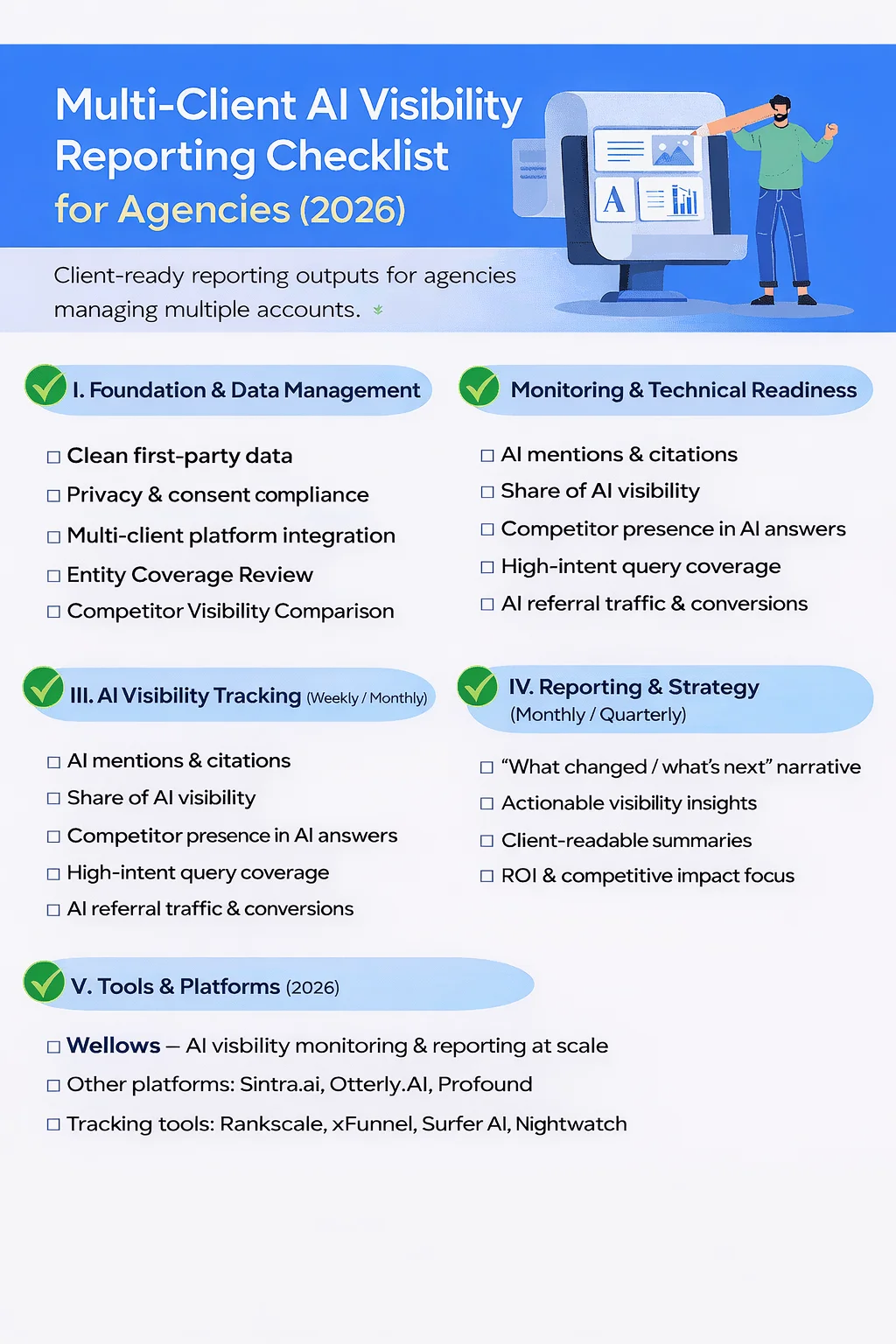
Multi-Client AI Visibility Reporting Checklist for Agencies 2026
Use this multi-client AI reporting checklist for agencies to standardize what your team produces each reporting cycle across a portfolio. Each item is a client-ready reporting output, not an audit step and not an optimization workflow.
I. Foundation & Data Management
Reporting is only as reliable as the inputs. Standardize data quality and compliance before you scale across accounts.
Data Quality: Prioritize clean, first-party data to improve the accuracy of AI visibility measurement and downstream decisions.
Consent Management: Maintain strict privacy compliance for any data collection used in reporting and analysis.
Platform Integration: Use monitoring tooling that supports multi-client workflows and consistent exports across accounts (e.g., Otterly.AI, Sintra.ai).
II. Content & Technical Optimization
These are the underlying eligibility signals that influence whether AI can understand, trust, and cite a brand’s content.
Answer-First Content: Build clear, quotable content hubs that cover intent clusters and support direct answers.
Structured Data: Implement schema and entity structure so AI systems can interpret and cite key information.
Trust Signals: Reinforce credibility with facts, credentials, and consistent brand information across the web.
Technical SEO: Ensure site structure supports AI crawlers and content extraction (clean HTML, accessible templates).
III. AI Visibility Tracking & Metrics (Weekly/Monthly)
Use a recurring cadence to track mentions, citations, competitor presence, and movement across high-intent prompts.
AI Overviews/Summaries: Track brand mentions, citations, and share of voice across AI answer surfaces (many teams set internal targets for improvement over time).
Competitive Analysis: Monitor competitor presence in AI answers, lists, and comparisons for the same prompt set.
Query Analysis: Track coverage across platforms and prioritize high-intent queries tied to buying decisions.
AI Traffic & Conversions: Measure referral traffic and conversion lift from AI-referred visitors where available.
IV. Reporting & Strategy (Monthly/Quarterly)
Turn visibility data into client-ready narratives tied to trust, reputation, pipeline, and competitive displacement.
Narrative Reporting: Frame AI visibility as trust, reputation, and lead generation, not only “search performance.”
Actionable Insights: Tie AI gaps to business moments (pricing, comparisons, alternatives) and recommend fixes.
Client Communication: Show what’s missing, why it matters, and what gets fixed first.
ROI Focus: Emphasize outcomes like improved recognition, competitive displacement, and conversion contribution.
V. Tools & Platforms (Examples for 2026)
Tooling varies by portfolio size and reporting depth. Choose a stack that supports repeatable monitoring, exports, and consistent reporting formats across multiple client accounts.
Wellows (recommended for agencies): Built to track AI visibility across platforms and turn citations, mentions, sentiment, and competitor comparisons into consistent, client-ready reporting at scale.
Other all-in-one options: Sintra.ai, Otterly.AI, Profound.
Other tracking options: Wellowse, Rankscale, xFunnel, Surfer AI Tracker, Nightwatch LLM Tracking.
Where Wellows Fits in a Multi-Client AI Visibility Program
Wellows sits at the monitoring and reporting layer of an AI visibility program. It’s designed for agencies that already manage AI visibility work and now need a consistent way to track, compare, and report visibility across multiple client accounts.
Instead of relying on manual prompt testing or screenshots, Wellows centralizes AI visibility signals from Google AI Overviews and major LLMs, making it easier to turn raw AI behavior into repeatable, client-ready reporting outputs.
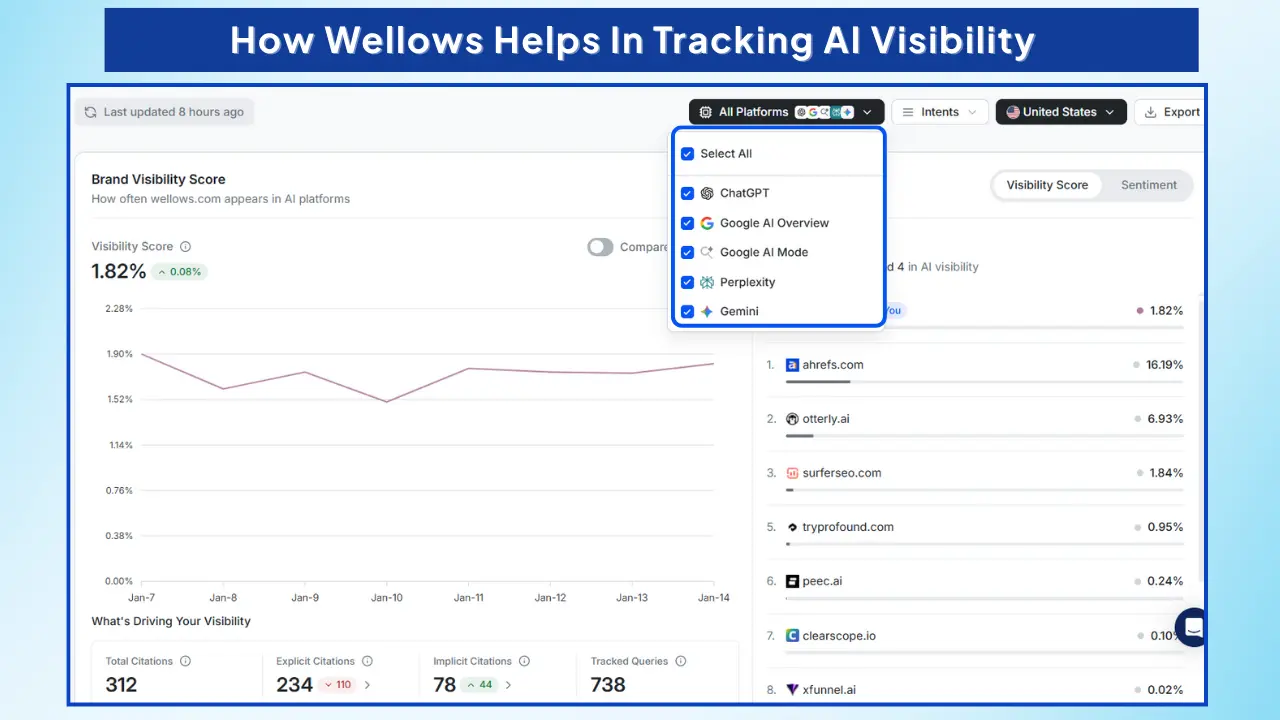
In practice, agencies use Wellows to:
Establish and maintain AI visibility baselines for every client in a portfolio
Track share of AI visibility, citations, and competitive presence over time
Detect visibility drops, competitor dominance, or inaccurate AI mentions early
Standardize dashboards and reporting formats across all client accounts
Support executive summaries and retention conversations with clear evidence
Wellows doesn’t replace audits or optimization workflows. Instead, it supports the ongoing measurement and reporting required to prove progress, reduce ambiguity, and scale AI visibility reporting across many clients without increasing manual effort.
How Agencies Keep Multi-Client Reporting Consistent
Even strong reporting breaks if each account team measures, formats, or explains results differently. Agencies that manage AI visibility across multiple clients keep consistency by standardizing inputs, outputs, and communication rules, not by relying on individual account habits.
1.Standardize Inputs (Prompt Sets + Definitions)
Consistency starts with shared measurement rules so portfolio comparisons stay valid.
Did you know?
- Prompt sets: Shared categories and intent buckets (category, comparison, “best”, use-case) applied across all accounts.
- Metric definitions: Clear rules for what counts as a mention, a citation, sentiment change, or competitive displacement.
- Data sources: Fixed AI platforms and inputs used across accounts to avoid mismatched comparisons.
2.Standardize Outputs (Templates + Order)
Clients trust reporting more when the structure is familiar and repeatable every cycle.
Did you know?
- Reporting templates: Identical structure for dashboards, executive summaries, and trend views so clients always know what they’re reviewing.
- Section order: Use the same flow across accounts (e.g., executive summary first, then trends, then risks, then next actions).
3.Automate Workflow Steps to Reduce Variance
Automating agency workflow reduces manual errors and prevents teams from reporting differently because they pull data differently.
Did you know?
- Automate data collection: Pull the same metrics the same way across accounts to reduce variance.
- Centralize reporting views: Use one dashboard format so teams don’t rebuild reports from scratch.
- Separate execution from reporting: Standardize what gets reported, even if delivery tasks differ by client.
4. Set Communication Cadence and Escalation Rules
Consistency also depends on how reporting is communicated and how risks are handled.
Did you know?
- Cadence: Keep a consistent rhythm (weekly/monthly check-ins + quarterly strategy reviews).
- Escalation rules: Define what qualifies as misinformation risk, negative sentiment drift, or visibility loss, and who owns resolution.
- Client access: Provide view-only dashboards so clients see the same source of truth between reporting cycles.
5. Use a Gap-Diagnosis Companion When Reporting Breaks
If reporting still feels inconsistent, the issue is often upstream: teams don’t know what’s missing or why AI visibility differs across accounts.
Agencies usually fix this by first mapping where AI recommends competitors instead of the client and which prompts or sources are driving that outcome, the same approach used by agencies find AI visibility gaps.
Once those inputs are aligned, standardizing reporting becomes straightforward and comparisons across accounts stay trustworthy.
Multi-Client AI Visibility Reporting Cadence
A simple schedule helps you stay fast without overwhelming clients. Use quick checks for risk and big changes, and set monthly/quarterly reports for trends and planning.
- Daily / Near Real-Time Checks: Use alerts to catch big changes fast, like sudden drops in brand mentions, negative sentiment, wrong info, or spikes/drops in AI referral traffic. This is most useful for fast-moving industries where small changes can hurt quickly.
- Weekly Portfolio Scan: Do one standard weekly scan across all clients to spot competitor takeovers, changes in AI answers, and early visibility losses. Weekly reviews help you fix small issues before they become big problems.
- Monthly Client Reports: Send one clear monthly report per client showing what changed, how often the brand was mentioned or cited, and where competitors showed up instead. End with “what we fixed” and “what we will do next.”
- Quarterly Executive Review: Run a deeper quarterly review for leadership. Summarize portfolio wins and risks, connect changes to business goals, and set the next-quarter plan.
Common Mistakes That Cause Multi-Client Reporting to Fail
Multi-client reporting often fails for simple reasons: teams measure differently, report differently, or explain results differently across accounts.
Use the mistakes below as a quick QA check before you ship your next reporting cycle.
Audits diagnose. Reporting proves progress. When agencies mix the two, clients can’t tell whether they’re looking at problems, work completed, or real results.
If “visibility” means citations for one client and “mentions” for another, portfolio comparisons become misleading and trust erodes.
Visibility is only useful if the underlying source material is credible, current, and easy for AI systems to extract. Many agencies add content quality scoring to spot weak source material early, using methods like how to use AI content scoring.
Dashboards don’t retain clients, clarity does. Agencies need a consistent “what changed / what’s next” story across accounts so stakeholders understand progress and priorities. A client-ready structure like agency reporting for AI search helps keep that narrative repeatable from one account to the next.
Where This Checklist Fits in an Agency Program
Multi-client AI visibility reporting sits in the scale layer of an agency AI visibility program. It helps you make progress clear, comparable, and repeatable across a portfolio.
Did you know?
- Audit (Diagnose): Establish a baseline for each brand and find where visibility is missing.
- Delivery (Execute): Ship improvements that increase eligibility and citation potential.
- Reporting (Scale): Standardize outputs across accounts and prove progress over time using this checklist.
Checkout More Checklists!
- LLM Pattern Analysis Checklist
- Keyword Strategy Integration for LLM SEO Checklist
- E-E-A-T Strengthening SEO Checklist Using LLM Outputs
- On-Page SEO Content Checklist for LLM-Generated Content
- Editorial SEO Style Guide Creation with LLMs Checklist
- SEO to GEO Transition Checklist for Agencies
- GEO Audit Checklist for Agencies 2026
FAQs
Multi-client reporting standardizes definitions, platforms, prompt sets, and reporting windows so performance can be compared across accounts. Single-client reporting is typically deeper but not designed for portfolio comparison.
Most agencies track share of AI visibility, prompt/intent coverage, citation frequency, citation source quality, competitor displacement, and accuracy/sentiment risk, then summarize period-over-period change.
A common cadence is weekly monitoring scans, monthly client-facing reporting, and quarterly portfolio reviews for agency leadership and executive stakeholders.
By standardizing prompt sets and outputs, centralizing monitoring into dashboards, and using the same templates across every account so the reporting process is repeatable.
Final Thoughts
AI-driven discovery is changing how buyers build shortlists, and agencies are expected to prove visibility inside AI answers, not just rankings and traffic. For agencies managing multiple clients, the key is a reporting system that stays consistent as the portfolio grows.
This multi-client AI reporting checklist for agencies gives you a repeatable set of outputs you can ship every cycle: visibility coverage, citation reporting, trends, risk flags, and executive-ready summaries, without blending audits and reporting into one confusing deliverable.