Search is changing fast and if I’m being honest, most brands are still playing by old rules.
For years, we were told that links and citations were the ultimate signals of visibility. Get more backlinks, get more traffic. Simple. But AI-powered search engines don’t think like Google used to—and that’s where things get interesting.
When I started digging into how AI search tools actually surface brands, I noticed something surprising: being mentioned often matters more than being linked. AI doesn’t just scan URLs. It reads conversations, understands context, and recognizes which brands keep showing up in meaningful ways.
So the real question isn’t “How many sites link to you?” anymore.
It’s “How often is your brand talked about—and in what context?”
In this blog, I’ll break down the real difference between brand mentions and citations, explain how AI search interprets both, and share what actually drives visibility in this new search era. If you want your brand to show up in AI answers—not just blue links—you’re in the right place.
- AI search prioritizes context, frequency, and entity recognition, not just backlinks.
- Brand mentions (linked or unlinked) matter more than citations because AI understands brands through language.
- AI treats brands as entities, so consistent mentions across relevant conversations build trust and visibility.
- Citations still matter, but mainly as supporting signals, not primary drivers.
- In 2025+, brands that are talked about clearly and often are far more likely to appear in AI-generated answers.
How AI Search Engines Determine Brand Visibility
AI search engines don’t rank content the way traditional search engines do and once I understood this, a lot of things started to make sense.
Instead of just counting links or keywords, AI systems focus on understanding meaning, context, and credibility. They read content the way a human would. They look at who is being talked about, how often, and in what kind of conversation.
When I analyze AI-generated answers, I notice a few consistent patterns:
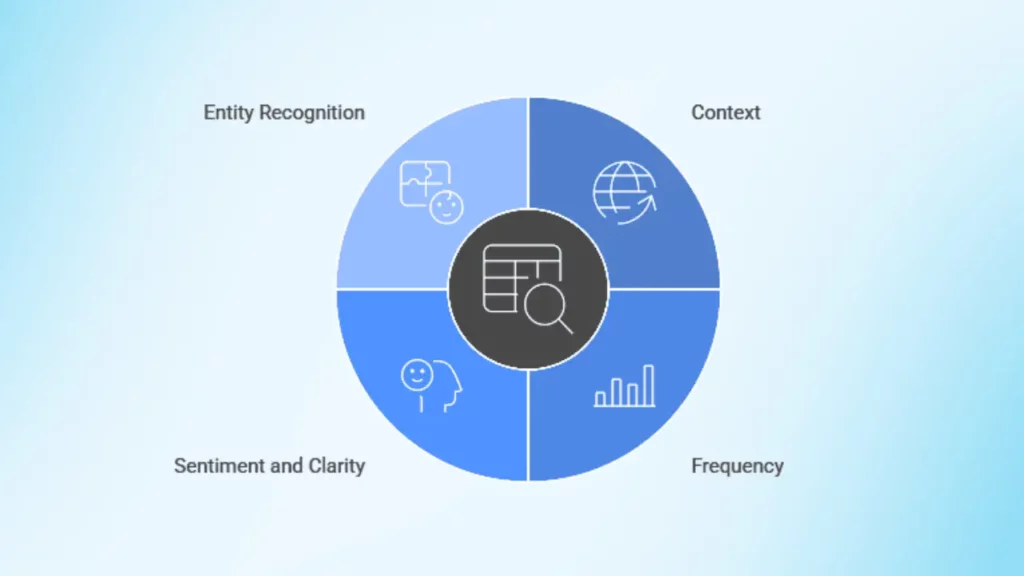
- First, context matters more than placement. A brand mentioned naturally within a useful explanation carries more weight than a random link dropped into a paragraph. AI looks for relevance, not just references.
- Second, frequency builds familiarity. If a brand keeps appearing across articles, forums, guides, reviews, and expert discussions, AI starts recognizing it as a trusted entity. It’s similar to how people trust names they hear often.
- Third, sentiment and clarity play a role. AI doesn’t just notice that your brand is mentioned—it understands whether the mention is positive, neutral, or negative. Clear, helpful, and authoritative mentions help reinforce trust.
- Finally, entity recognition is key. AI search engines treat brands like entities, not websites— a shift that increasingly shapes how generative engine optimization for brand visibility is approached heading into 2026. That means your brand name, product names, and core topics need to appear consistently and clearly across the web for AI to connect the dots.
That shift is exactly why brand mentions are becoming impossible to ignore.
What Are Brand Mentions?
When I talk about brand mentions, I’m not just talking about links. A brand mention is any time your brand is referenced in content—whether or not there’s a clickable URL attached to it.
In AI search, mentions act like signals of recognition. They help AI understand who you are, what you do, and where you belong in a topic.
Let’s break this down.
An explicit brand mention is when your brand name is mentioned and linked.
For example:
- A blog that mentions your brand and links to your website
- A review that includes your brand name with a clickable URL
- A comparison article linking your brand as a reference
These mentions still matter—but in AI search, the link itself is no longer the main signal. What matters more is how clearly and naturally your brand is referenced within the content.
An implicit brand mention is when your brand name is mentioned without any link.
This could be:
- A blog talking about your brand but not linking to it
- A forum post or discussion mentioning your brand name in context
- An AI-generated answer referencing your brand without a URL
From what I’ve seen, AI search engines are very good at recognizing these unlinked mentions. They don’t need a hyperlink to connect the brand name to the entity behind it. In fact, BrightEdge found that 44% of ChatGPT prompts have zero brand mentions at all, and only about 3% have 10+ brands mentioned, underscoring how mentions are still selective yet influential when they occur. (BrightEdge, 2025)
AI relies on context, repetition, and topic alignment. When your brand name keeps appearing in relevant discussions—even without links—AI still registers it as a trusted and recognized entity.
Why Brand Mentions Matter in AI Search
Brand mentions matter because they match how AI understands the web.
First, semantic understanding. AI focuses on meaning, not mechanics. A natural brand mention inside helpful content sends a strong signal.
Second, entity reinforcement. Every time your brand name appears, AI strengthens the connection between your brand and its core topics.
Finally, trust and topical relevance. When AI repeatedly sees your brand mentioned in authoritative and relevant contexts, it becomes more confident showing your brand in AI-generated answers — the same signals that strengthen brand authority in AI SEO over time.
That’s why in AI search, being mentioned often—and clearly—can matter more than being linked.
What Are Citations?
In traditional SEO, citations were everything. If you wanted to rank, you needed other websites to link to you. For a long time, that approach worked well because search engines relied heavily on links to understand authority.
But AI search engines don’t rely on citations in the same way anymore.
Let’s look at how citations were originally defined and used.
Traditional SEO Definition of Citations
In classic SEO, a citation usually meant one of two things.
First, linked mentions, also known as backlinks. This is when another website mentions your brand and links back to your site. Search engines treated these links like votes of confidence.
Second, NAP citations, mainly used in local SEO. These include your Name, Address, and Phone number listed consistently across directories like Google Business Profile, Yelp, or local listings.
Both types helped search engines verify that a business was real, relevant, and trustworthy.
How Citations Were Used in Classic Search Algorithms
When I look back at how traditional search worked, citations made sense for that time.
Search engines relied on authority and PageRank. The more high-quality sites linking to you, the more authoritative you appeared. Links were a measurable, scalable signal.
Citations also helped with crawl-based validation. Search engines followed links to discover pages, confirm relationships between sites, and decide which pages deserved visibility.
In short, if you had strong citations, you had a better chance of ranking.
Limitations of Citations in AI-Driven Search
This is where things start to break down.
First, link dependency. Citations only work if a link exists. But AI doesn’t need links to understand brands, topics, or relationships. It can recognize entities without crawling URLs.
Second, context loss. A link alone doesn’t explain why a brand is important or how it’s relevant. AI search focuses on meaning, and links often lack that depth.
Finally, manipulation risks. We’ve all seen how backlinks can be bought, exchanged, or gamed. AI systems are designed to reduce reliance on signals that can be easily manipulated.
From what I’ve seen, citations still matter, but they’re no longer the strongest signal in AI-driven search. LLM citation tracking shows that AI models evaluate authority differently from traditional search, prioritizing trusted, repeated references over backlink counts.
Brand Mentions vs. Citations — Key Differences
At first glance, brand mentions and citations may seem similar. Both involve your brand showing up on the web. But when I look at how AI search engines actually use these signals, the differences are hard to ignore.
In AI-driven search, how your brand is talked about matters more than how it’s linked — a growing gap between traditional Google rankings and LLM citation behavior that many brands are still struggling to adapt to.
Here’s a clear breakdown.
Brand Mentions vs. Citations: A Simple Comparison
| Factor | Brand Mentions | Citations |
| Link dependency | No link required | Requires a link |
| Context richness | High — appears within meaningful explanations | Low — often just a reference |
| Entity recognition | Strong — reinforces brand as an entity | Moderate — tied to URLs, not meaning |
| Role in AI Overviews | Frequently used as source signals | Less visible, often ignored |
| Impact on zero-click visibility | High — helps brands appear in AI answers | Limited — depends on link display |
Why These Differences Matter in AI Search
- Link dependency is the biggest shift. Citations depend on links. Brand mentions don’t. AI search engines can recognize your brand name without needing to crawl a URL.
- Context richness is where brand mentions really win. When your brand appears inside a clear explanation, AI understands what you do and why you matter. Citations rarely provide that depth.
- Entity recognition is another key difference. AI treats brands as entities, not websites. Brand mentions help strengthen that entity identity, while citations still focus on pages and domains.
When it comes to AI Overviews, brand mentions are far more likely to show up. AI-generated answers often summarize information without linking out—yet they still name brands they trust.
And finally, zero-click visibility. This is where I see the biggest impact. Even when users don’t click anything, brand mentions keep your name visible, familiar, and top-of-mind—signals that increasingly define brand performance in AI search beyond traditional traffic-based metrics.. Citations, on the other hand, often disappear when no click happens.
How AI Search Engines Interpret Brand Mentions vs. Citations
AI search engines don’t rank information the way classic search engines do. They interpret it. And once I understood how large language models (LLMs) process brand signals, the role of mentions versus citations became much clearer.
Instead of asking “Which page should rank first?”, AI asks “Which brands make sense to mention in this answer?”. Which is exactly the mindset you need for how to rank in Perplexity.
Here’s how that happens.
How LLMs Process Brand Information
- Co-occurrence: LLMs pay close attention to which words, topics, and brands appear together. When your brand repeatedly shows up alongside specific concepts or problems, AI learns that association. Over time, your brand becomes linked to that topic in the model’s understanding.
- Sentiment: AI doesn’t just see your brand name—it understands tone. Positive, neutral, or negative mentions all send different signals. From what I’ve observed, consistent, helpful, and authoritative mentions build trust far faster than isolated references.
- Frequency: One mention won’t move the needle. But repeated mentions across blogs, guides, reviews, and discussions help AI recognize your brand as familiar and relevant. Frequency reinforces credibility.
- Contextual authority: Where your brand is mentioned matters just as much as how often. Mentions inside expert content, detailed explanations, or trusted publications carry more weight than random or shallow references.
Why Brand Mentions Help AI Understand Brands Beyond URLs
Citations tie brands to webpages. Brand mentions tie brands to ideas.
AI search engines don’t need to visit your site to understand who you are. They build understanding from language, patterns, and context. When your brand name appears consistently in meaningful discussions, AI forms a mental model of your brand—what you do, who you serve, and when to surface you in an answer.
This is why many AI Overviews mention brands without linking to them. The AI already understands the entity—it doesn’t need the URL.
When Citations Still Matter
That doesn’t mean citations are useless.
Citations still matter when:
- Verifying source credibility
- Supporting fact-heavy or technical claims
- Helping AI trace original research or data
In these cases, links act as references—not ranking signals.
The smartest strategy isn’t choosing mentions or citations. It’s understanding which signal works best for AI visibility—and using both intentionally, which is exactly how generative engine optimization agencies approach brand visibility in AI-driven search.
Do Citations Still Matter in 2026?
Yes, but not on their own.
Citations still matter in 2025, but they no longer work as a standalone strategy. From what I’ve seen, AI search engines treat links as supporting evidence, not the main signal that determines visibility. Which is why citations work best when applied through effective LLM citation strategies instead of volume-driven link building.
Citations still help with validation. When AI sees consistent links pointing to the same brand or source, it helps confirm that the entity is real and established. This is especially useful for fact-based content, research, or technical information.
They also play a role in trust reinforcement. Links from reputable and authoritative sources can strengthen confidence around a brand. While AI doesn’t depend on backlinks the way traditional search engines did, credible citations still add weight to existing brand signals.
Citations can also act as discovery signals. They help AI systems find new content, studies, or emerging brands. In this sense, links still open doors—but they no longer decide who gets featured.
The biggest shift is that citations are no longer primary drivers of visibility. AI search engines don’t need links to understand brands. They rely on language, context, frequency, and entity recognition to decide which brands belong in an answer.
In 2026, citations mostly confirm what AI already understands. They support visibility, but they don’t create it on their own.
That’s why brands focusing only on backlinks are losing ground, while brands that are consistently mentioned in meaningful contexts continue to show up in AI-generated answers—even without links.
Why Brand Mentions Are Becoming the Primary AI Visibility Signal
AI search engines understand the web through language, not links. From what I’ve seen, brand mentions align perfectly with how AI learns, evaluates, and decides which brands to surface in answers.
- AI prefers language patterns over links: Mentions appear naturally in sentences, helping AI understand meaning and relevance without relying on URLs.
- Mentions reflect real-world relevance: Brands that are talked about often feel more “real” to AI than brands that are only linked.
- Blogs: In-depth content helps AI associate your brand with specific topics and expertise.
- Reviews: User experiences strengthen trust and sentiment around your brand.
- Forums: Ongoing discussions show active relevance and problem-solving value.
- AI-generated summaries: When AI itself mentions your brand, it reinforces recognition and future visibility.
Data backs this shift. An analysis of AI search visibility found that brand mentions had a stronger correlation (0.664) with AI visibility than backlinks (0.218), showing that being talked about now matters more than being linked. (Digital Information World, 2025)
How to Optimize for Brand Mentions and Citations Together
In 2025, the goal isn’t choosing between brand mentions or citations. The real win comes from using both together, in a way that fits how AI search engines actually work.
I’ve found that the best visibility comes when brands focus on being talked about first—and then supported by the right links.
If you want people (and AI) to mention your brand, your content has to be worth talking about — the kind of content that naturally earns mentions in AI search through clarity, relevance, and strong positioning.
- Thought leadership: Share clear opinions, strong viewpoints, and original perspectives. AI notices brands that lead conversations instead of repeating what already exists.
- Original data: Studies, surveys, benchmarks, and unique insights give others a reason to reference your brand naturally.
- Quotable insights: Short, sharp ideas are easy to repeat. If people can quote you, AI can remember you.
Mentions don’t happen by accident—they happen where conversations already exist.
- PR: Features, interviews, and expert commentary help your brand appear in trusted publications and news content.
- Community discussions: Forums, social platforms, and niche communities create natural, repeated brand mentions in real-world language.
- Industry commentary: Commenting on trends, updates, or breaking news helps position your brand inside relevant discussions that AI actively learns from.
Citations still matter—but only when used intentionally.
- Editorial links: Earn links from real content, not link schemes. Editorial mentions support credibility without looking forced.
- Authoritative references: Links from trusted, relevant sources reinforce trust signals for AI.
- Avoiding low-quality directories: Mass listings and spammy directories add little value and can dilute your overall signal.
The smartest strategy today is simple: build visibility through mentions, and reinforce it with quality citations.
Where this gets harder is at scale is when agencies need to prove movement across multiple clients, prompt sets, and AI engines, which is exactly where AI visibility solutions for growth marketing agencies becomes a real conversation, not just a theory.
That’s how brands stay visible in both AI-generated answers and traditional search results.
How I Track & Grow Brand Mentions and Citations Using Wellows
One of the biggest problems with AI visibility is that you can’t improve what you can’t see. That’s where Wellows has been genuinely useful for me.
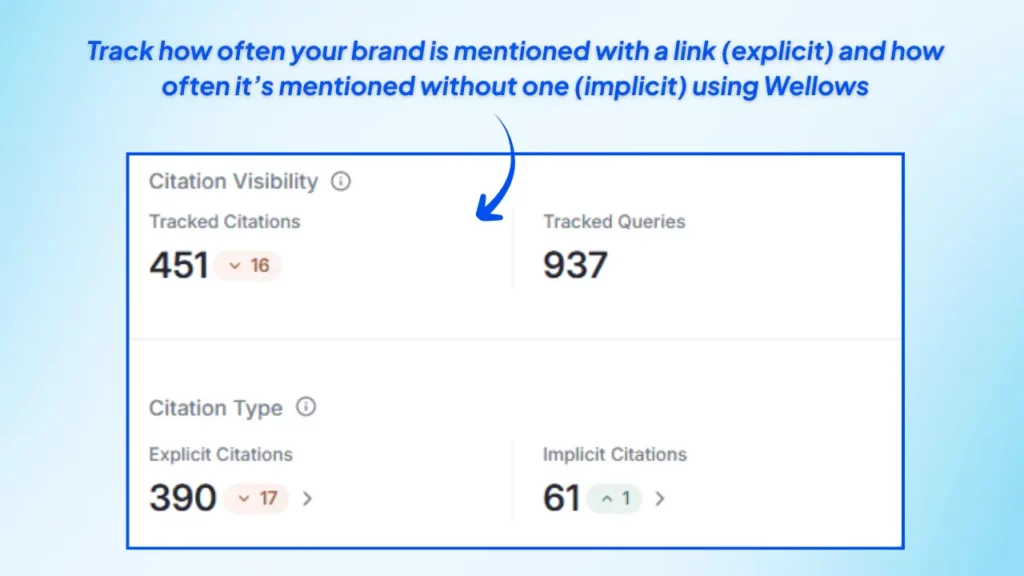
Wellows shows me the count of both explicit and implicit brand mentions, so I’m not guessing anymore. I can clearly monitor how often my brand is mentioned with a link (explicit) and how often it’s mentioned without one (implicit). Seeing both side by side helps me understand my true visibility in AI search—not just my backlink profile.
But tracking is only half the value.
What really makes Wellows different is that it doesn’t stop at reporting. It actively helps me grow both mentions and citations through its opportunities features.
For implicit mentions, Wellows highlights places where my brand should be credited but isn’t. These are contextual opportunities—relevant pages, topics, or AI-influencing content where my brand fits naturally. Instead of random outreach, I know exactly where to focus.
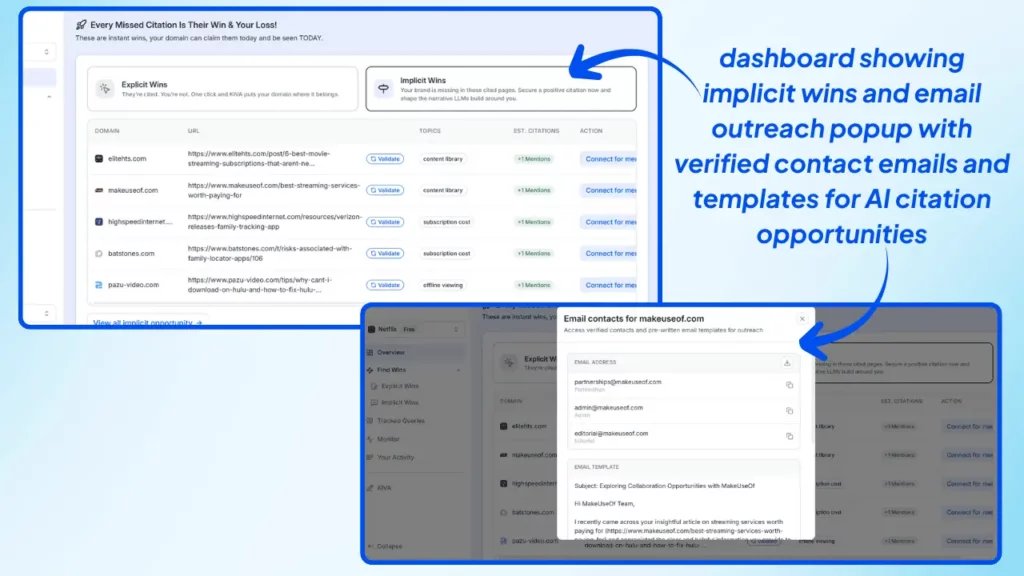
For explicit mentions, Wellows shows me citation gaps where competitors are already being referenced. That helps me create or improve content that earns proper citations in AI-generated answers and authoritative pages.
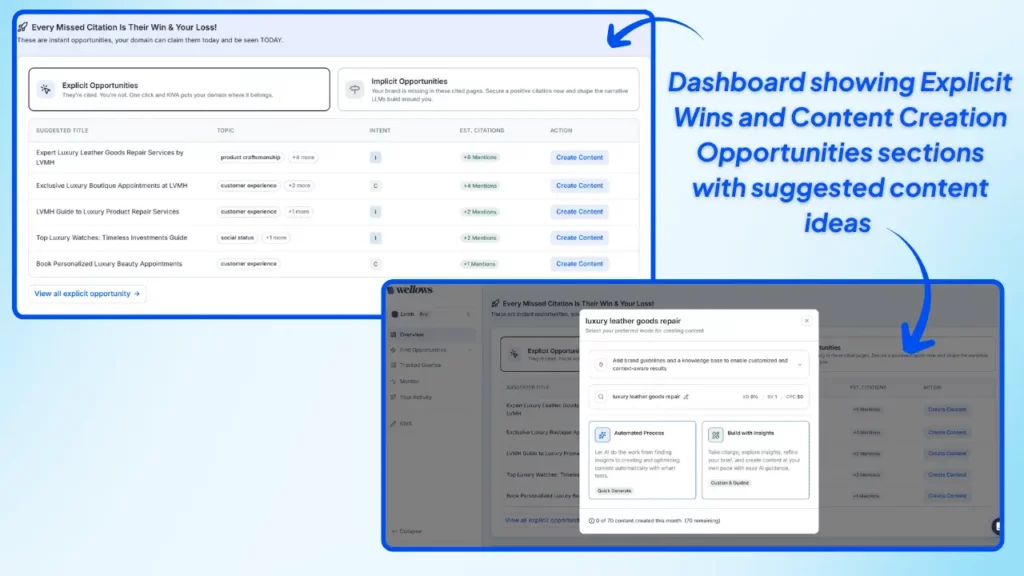
The workflow feels practical:
- Monitor how my brand appears across AI-influenced content
- Identify where I’m missing visibility
- Act on clear, relevant opportunities to grow both mentions and citations
What I like most is that this approach matches how AI search actually works. I’m not chasing links blindly. I’m strengthening brand presence, context, and recognition—while still supporting it with the right citations.
That balance is what makes visibility sustainable in AI search.
FAQs
Conclusion
AI search has changed the rules. And brand visibility is no longer built on links alone.
What actually drives visibility today is how often your brand is mentioned, where it appears, and the context around it. AI search engines don’t rank pages the way traditional search did. They understand language, recognize entities, and surface brands that feel relevant and trusted within real conversations.
Citations still matter, but they now play a supporting role. They help validate and reinforce trust, not define visibility. Brand mentions, on the other hand, help AI understand who you are and when your brand belongs in an answer.
If there’s one takeaway from this shift, it’s this: brands that focus only on backlinks will struggle in AI search. Brands that focus on being talked about—clearly, consistently, and in the right context—will continue to show up, even in zero-click and AI-generated results.
This isn’t about gaming algorithms anymore. It’s about building real presence, real relevance, and real recognition across the web.
And that’s what visibility looks like in the AI era.