The job of an AI content optimization tool changed in 2026. Rankings and content scores keep rising, but visibility across AI platforms often stays flat.
That gap is why this ranking exists. Traditional AI powered content optimization tools tools focus on Google rankings, while newer platforms, broadly known as AI visibility tools, help brands gain visibility across ChatGPT, Gemini, Perplexity, and Google AI Overviews. Mixing the two often leaves teams paying for multiple tools without improving overall AI reach.
Below are 10 AI content optimization tools ranked by what they actually optimize for, with recommendations for use case, a comparison table, and a framework for choosing the right one and the common mistakes one should avoid!
Top AI content optimization tools for 2026 include Wellows, Surfer SEO, Clearscope, Frase, and NeuronWriter for page-level optimization, with MarketMuse, Rankability, and AirOps covering enterprise strategy and high-volume production. These tools split across two distinct jobs in 2026: optimizing for Google rankings, and optimizing for AI mentions across ChatGPT, Gemini, Perplexity, and Google AI Overviews.
- Wellows: Best AI content optimization tool for citation-era visibility, with the industry’s first cannibalization-aware decision engine and line-level gap analysis from 20–50 cited URLs per prompt.
- Surfer SEO: Best for Google-focused NLP content scoring on individual pages. AI Tracker is a $95–$495/month add-on, not native.
- Clearscope: Best premium content grading for editorial teams. Uses an A++ to F letter-grade system for consistent briefing.
- Frase: Best for SERP briefs with dual SEO + GEO scoring across 8 AI platforms in the core product.
- NeuronWriter: Most affordable AI content optimization platform for small businesses, starting at $23/month with genuine NLP optimization.
- MarketMuse: Best for enterprise topical authority and personalized content strategy at scale.
- Rankability: Best for agencies scaling topic-modeled content across multiple clients.
- Semrush SEO Writing Assistant: Best for teams already inside the Semrush ecosystem who want content optimization bundled with keyword and backlink data.
- Scalenut: Best all-in-one workflow for mid-market content teams that prefer one platform over a stack of specialists.
- AirOps: Best for programmatic and high-volume AI content production with agentic multi-step workflows.
Key features to look for:
- Real-time optimization: Live scoring and recommendations while writing content
- SERP and AI analysis: Insights from top-ranking pages and AI-generated answers
- Topic modeling: Coverage suggestions to improve topical authority and entity relevance
- On-page optimization: Guidance for headings, structure, keywords, and semantic coverage
- AI visibility tracking: Monitoring mentions and citations across AI search platforms
- Workflow automation: Scalable systems for briefs, updates, and bulk content production
How to choose:
- For agencies and in-house AI visibility teams: Wellows leads with multi-platform tracking and a cannibalization-aware optimization engine.
- For small businesses on a budget: NeuronWriter at $23/month, or Wellows’ Basic plan at $29, which carries all five AI engines for citation-focused tracking.
- For beginners with no SEO experience: Clearscope’s letter-grade system is the easiest entry point.
- For Google-focused content teams: Surfer SEO or Frase, depending on budget and brief-workflow needs.
Before choosing a tool, decide what you are actually optimizing for: a higher ranking position or inclusion inside an AI-generated answer.
In 2026, those are no longer the same challenge.
How We Ranked These AI Content Optimization Tools
We compared each platform using six core factors that matter most in modern SEO and AI visibility workflows:
- Optimization depth: NLP coverage, semantic analysis, structural recommendations, citation-aware reasoning.
- AI search visibility coverage: Whether the tool tracks and optimizes for ChatGPT, Gemini, Perplexity, Google AI Overviews, and AI Mode, or treats them as an add-on.
- Cannibalization and domain-level intelligence: Whether the tool scans the existing domain before recommending changes, or assumes the writer picked the right page.
- Ease of use: How quickly someone with no SEO experience can get a usable recommendation.
- Pricing and feature access: Whether important capabilities are included in standard plans or restricted behind expensive upgrades and add-ons.
- Best-fit use cases: Which type of user benefits most from the tool, including solo creators, small businesses, agencies, in-house SEO teams, and enterprise publishers.
The 10 Best AI Content Optimization Tools in 2026
The best AI content optimization tool in 2026 depends on the job. For optimizing existing content to appear across ChatGPT, Gemini, and Perplexity, Wellows leads. For Google-focused NLP scoring on individual pages, Surfer SEO and Clearscope remain the strongest editors. For SERP briefs that also score AI visibility, Frase has closed most of the gap.
Below: 10 tools, ranked, with honest best-for and limitations for each.
1. Wellows — Best AI Content Optimization Tool for Citation-Era Visibility
- Best for: Agencies running AI search performance for clients, and in-house teams responsible for brand presence across ChatGPT, Gemini, Perplexity, and Google AI Overviews.
- Key strength: Cannibalization-aware optimization decision engine. Line-level gap analysis from 20–50 referenced URLs per prompt. All five AI engines in the base platform from $29, not as an add-on, and unlimited projects drawn from a single credit pool.
- Where it’s less of a fit: Solo creators who only need page-level content scoring will find it more capability than they need. NeuronWriter is the better budget pick for that segment.
- Pricing: Basic at $29/month (1,800 credits, 12 prompts a day), Standard at $97/month (6,500 credits, 43 a day), Growth at $249/month (18,000 credits, 120 a day), and Scale at $497/month (36,000 credits, 240 a day). Every plan includes all five AI engines and unlimited projects on one pool, with a 7-day free trial. Demo available.
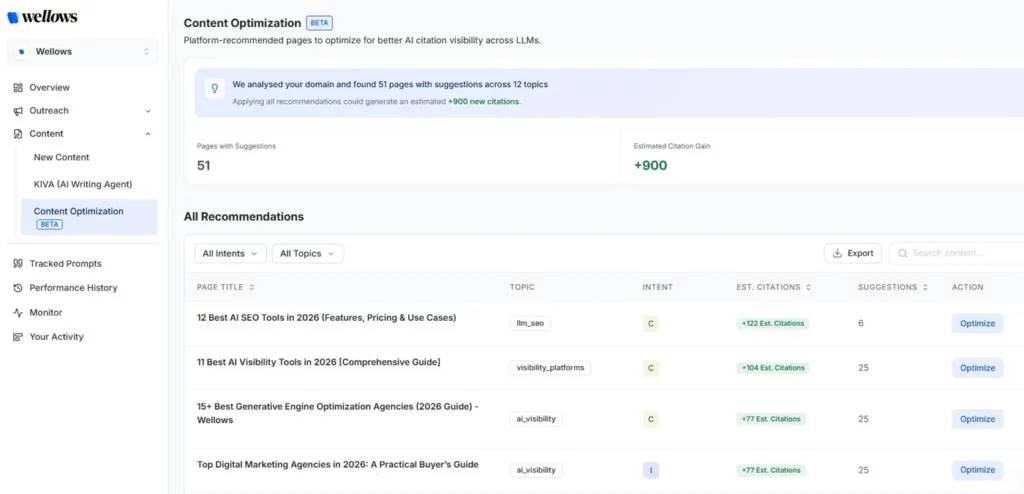
Wellows is an AI search visibility platform built for the full discovery lifecycle: tracking, gap diagnosis, content optimization, and outreach across ChatGPT, Gemini, Perplexity, Google AI Overviews, and AI Mode.
Its standout feature is AI Content Optimization, launched in April 2026. The platform positions it as the industry’s first cannibalization-aware decision engine.
Most tools start with a URL and a prompt list, then generate a brief. The problem is that they often skip two important checks: whether the selected page is actually the right page to optimize, and whether a stronger page already exists on the same domain.
Wellows flips that workflow. The user finalizes the prompts first. From there, Wellows scans the full domain and identifies the strongest existing page for each prompt. If there is no relevant page, the prompt is routed toward new content creation instead of forcing an optimization that is unlikely to work.
The recommendations are also more specific than a standard page-level brief. Wellows analyzes 20 to 50 URLs that AI systems are actively referencing for each prompt, then identifies the shared structural, entity, and depth signals behind those citations.
The full AI content optimization workflow tells you what to add, remove, or rewrite section by section, with internal linking suggestions and anchor text included.
Because projects are unlimited and prompts draw from one shared credit pool, adding a second brand or a new market does not mean a new subscription. You add prompts on the same plan for as long as the pool holds.
The Wellows research base feeds the scoring layer for readability, originality, and factual reliability.
2. Surfer SEO — Best for Google-Focused NLP Content Scoring
- Best for: Content teams optimizing for Google SERP rankings on individual pages.
- Key strength: Real-time NLP scoring, clean editor, in-CMS browser extension.
- Where it’s less of a fit: Teams whose primary goal is AI visibility rather than ranking.
- Pricing: From $49/month (Discovery). Auto-Optimize starts at the $99/month Standard tier. AI Tracker billed separately.
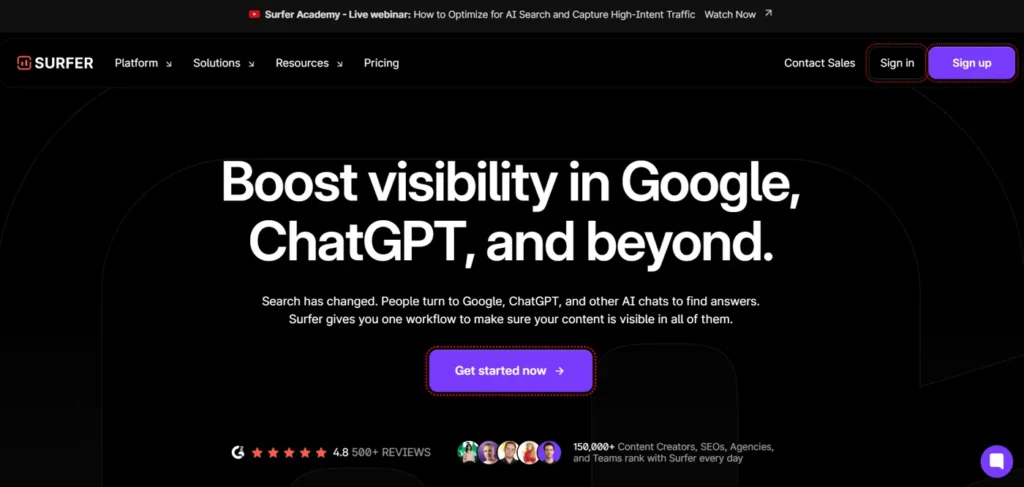
Surfer is one of the most recognizable names in SEO content optimization. Its Content Editor reviews your draft in real time and compares it with patterns found across current top-ranking pages, including NLP terms, structure, headings, and content length.
Its biggest strength is the editor itself. It gives writers a clear score, practical structure suggestions, and a clean workspace that makes optimization easier. But long-term users often notice one limitation: getting a high green score does not always translate into better rankings, and it does not necessarily improve visibility in AI-generated answers.
That is because Surfer mainly helps content match what already ranks in Google SERPs. AI inclusion is a different challenge. To appear in AI answers, content needs stronger authority signals, clearer entity coverage, better source value, and information worth citing.
Surfer does offer AI search visibility tracking through AI Tracker, but it is a paid add-on. Pricing ranges from $95 to $495 per month, on top of the regular Surfer plan.
3. Clearscope — Best Premium Content Grading for Editorial Teams
- Best for: Mid-market and enterprise editorial teams that prioritize grading consistency over feature breadth.
- Key strength: Tight, accurate NLP recommendations. Letter-grade system simplifies briefing across teams.
- Where it’s less of a fit: Solo creators on a budget; teams that need AI search tracking inside the same workflow.
- Pricing: Starts at $129/month. Demo available.
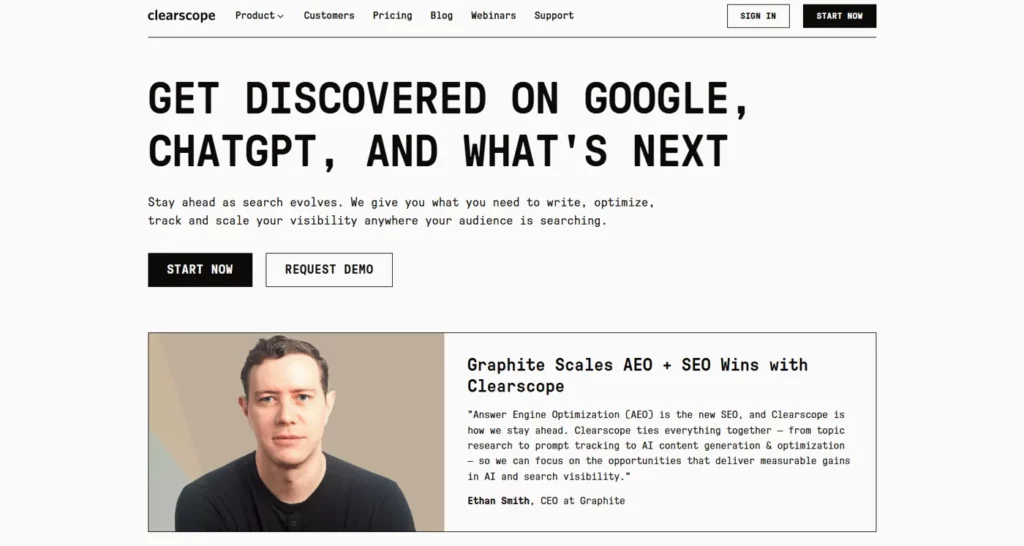
Clearscope is often seen as the editorial gold standard for content optimization. Its Content Editor gives your draft a grade from A++ to F while you write, using NLP analysis of top-performing content for your target keyword.
What makes Clearscope stand out is the quality of its recommendations. Instead of overwhelming writers with a long list of terms, it gives a tighter, more curated set of suggestions.
That usually means fewer terms to work with, but more confidence that each one actually matters.
This is why many editorial teams and large publishers rely on Clearscope. Its grading feels harder to game, and it helps keep content quality more consistent across different writers.
The main trade-off is scope. Clearscope is focused on content optimization only. It does not offer site audits, AI search tracking, GEO scoring, or cannibalization detection.
4. Frase — Best for SERP Briefs with Emerging GEO Scoring
- Best for: Content teams that want briefs, optimization, and AI visibility scoring inside one workflow at mid-tier pricing.
- Key strength: Dual SEO + GEO scoring, 8-platform AI tracking, MCP integration for agent workflows.
- Where it’s less of a fit: Teams needing domain-wide cannibalization analysis or deep per-prompt URL scraping.
- Pricing: From $49/month. 7-day free trial. Free GEO Score Checker available without signup.
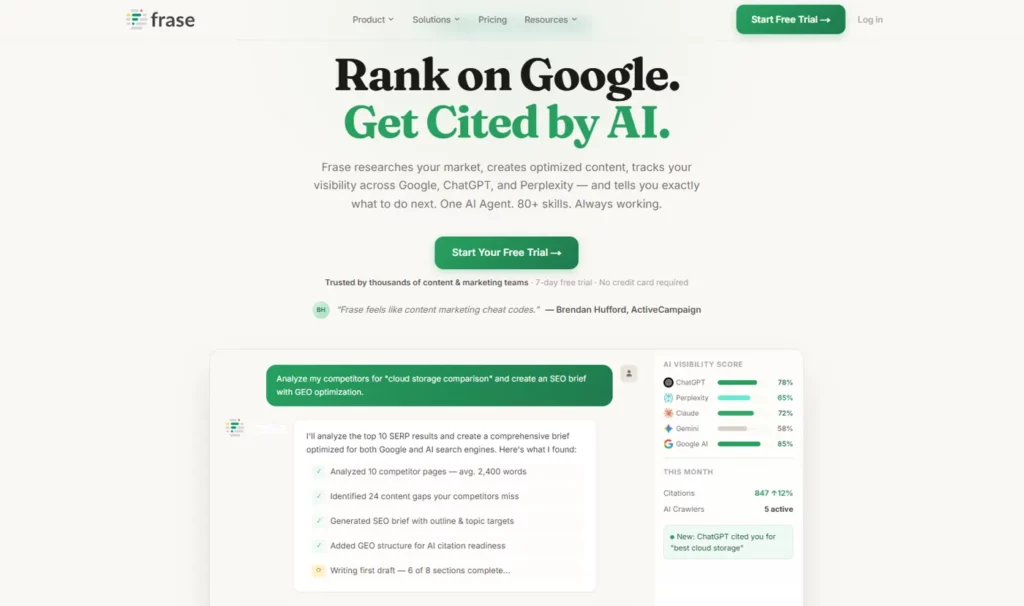
Frase made one of the biggest shifts among legacy SEO tools in 2026. Instead of staying focused only on traditional content optimization, it moved toward a broader SEO and GEO workflow.
Its core product now includes dual SEO + GEO scoring, AI search tracking across 8 platforms, a read-write MCP server for agent workflows, and autonomous content decay recovery. The important part is that these features are built into the main product, not locked behind paid add-ons.
Frase still shines most in the brief creation workflow. You can pull SERP data, build an outline, see which questions competitors are answering, and then write inside an editor that scores your content in real time.
The Question Finder is another strong feature. It pulls real queries from community forums and People Also Ask results, which helps writers understand how people actually ask questions, not just how keywords appear in search tools.
Did you know?
The format of the answer matters as much as the answer itself; which is why AI content optimization tools that score for structure rather than just keyword coverage increasingly outperform.
5. NeuronWriter — Best Budget-Friendly AI Content Optimization Platform
- Best for: Solo creators, freelancers, and small businesses who want NLP-driven optimization without a premium subscription.
- Key strength: Lowest price for genuine NLP optimization. Generous credit and team allowances at higher tiers.
- Where it’s less of a fit: Teams that need AI search tracking, cannibalization detection, or site audits in the same tool.
- Pricing: From $23/month. Gold plan at $69/month. 7-day free trial.
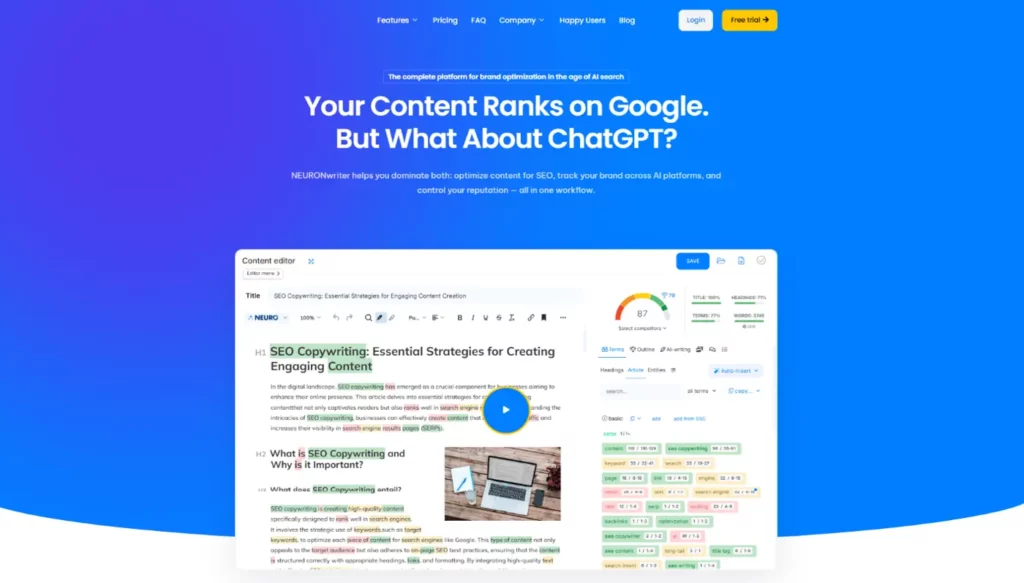
NeuronWriter is one of the most affordable AI content optimization tools for small businesses. It gives you NLP-based recommendations, semantic SERP analysis, content scoring, AI writing, internal link ideas, and a WordPress integration, starting at $23 per month.
It is not as polished as premium tools like Wellows, Surfer or Clearscope. The interface feels a little more basic, and the recommendations are not always as refined or confident as Clearscope’s. But for solo marketers, freelancers, and small businesses optimizing a few pages each month, it offers strong value for the price.
That value becomes even stronger on the Gold plan. At $69 per month, it includes unlimited articles and unlimited team members, which is rare in this price range.
6. MarketMuse — Best for Enterprise Topical Authority & Strategy
- Best for: Enterprise content teams building topical authority at scale.
- Key strength: Topic modeling, content gap analysis, personalized difficulty scoring tied to your domain’s actual authority.
- Where it’s less of a fit: Small teams or single-page workflows. AI visibility tracking is not native.
- Pricing: Offers a limited free plan. Custom pricing for paid plans is available upon request through the website.
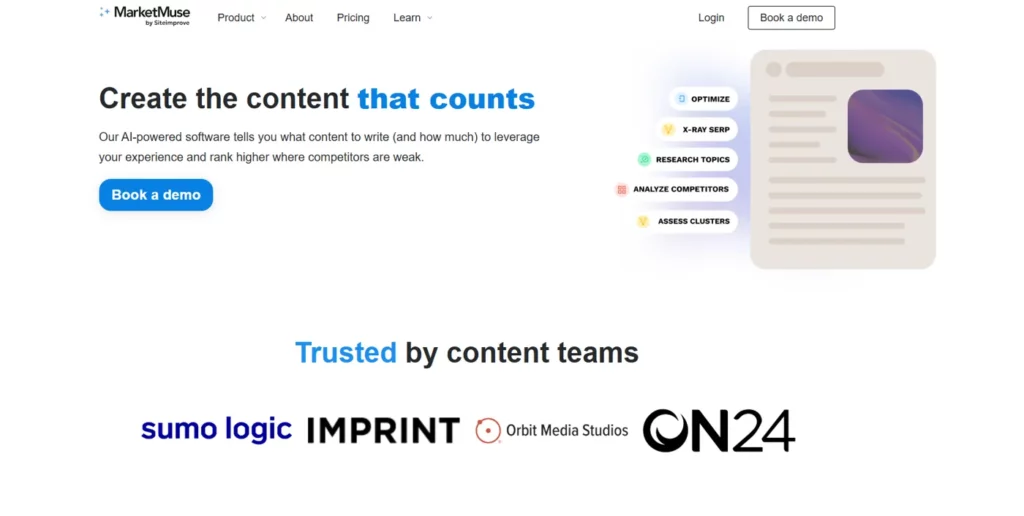
MarketMuse takes a more strategic approach to content optimization. Instead of focusing only on one draft at a time, it looks at your whole domain and helps you understand where your topical authority is strong, where it is weak, and which content gaps are worth filling.
Its biggest value is planning. MarketMuse uses personalized difficulty scoring to show which topics are realistic for your site to compete on, then recommends where your team should focus its content efforts.
So the output is less about “how do I improve this one article?” and more about “which pages, clusters, and topics should we prioritize next?”
That makes it useful for enterprise teams managing large content libraries. But for someone optimizing a single page or only publishing occasionally, it can feel like more tool than they really need.
7. Rankability — Best for Agencies Scaling Topic-Model-Driven Content
- Best for: Agencies scaling Google-focused content production across multiple clients.
- Key strength: Topic modeling tuned for both AI and human searcher relevance, agency-friendly workflows.
- Where it’s less of a fit: Teams that need native AI tracking across all major platforms inside the same tool.
- Pricing: Starts at $79/month. Demo available.
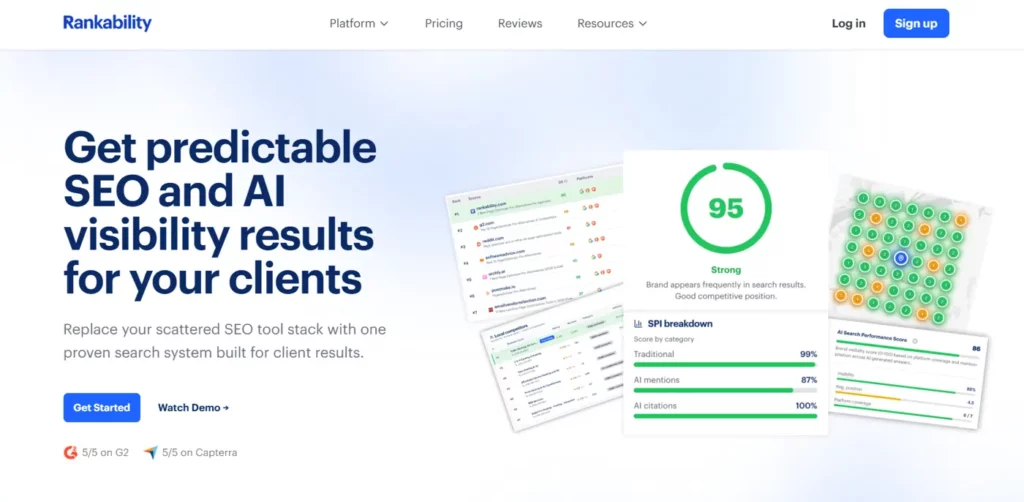
Rankability sits somewhere between Surfer and Clearscope. It offers more workflow depth than a pure editorial tool, but still keeps its focus on content optimization rather than trying to do everything.
Its main strength is topic modeling. The Content Brief and Content Score features are built around an NLP model tuned to measure topic coverage that is more closely tied to ranking performance.
Rankability also makes a lot of sense for agencies. The platform supports multi-domain dashboards, scalable brief creation, and workflows that help teams manage content across several clients without losing consistency.
So it is not just built for improving one article. It is built for teams that need to produce, optimize, and manage content at a steady pace across multiple websites.
Did you know?
8. Semrush SEO Writing Assistant — Best for Teams Inside the Semrush Ecosystem
- Best for: Teams already paying for Semrush who want content optimization without another subscription.
- Key strength: Native integration with the broader Semrush stack. Real-time multi-factor scoring inside Google Docs.
- Where it’s less of a fit: Standalone purchase. Citation-era optimization. Pricing for full features lands around $249.95/month.
- Pricing: Bundled with Semrush plans.
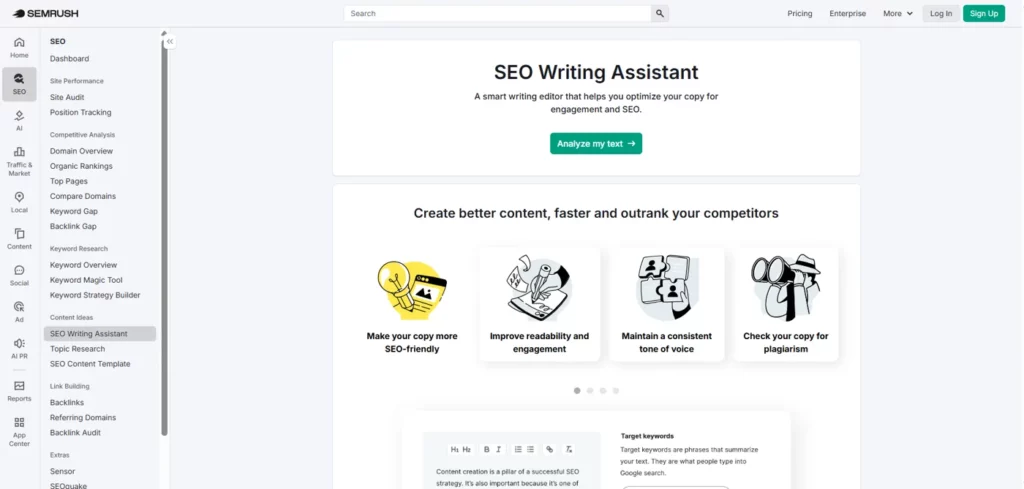
For teams already using Semrush, the SEO Writing Assistant and ContentShake AI make content optimization easier to keep inside the same workflow.
You get real-time feedback on SEO, readability, tone, and originality, along with Google Docs and WordPress integrations. That makes it convenient for teams that already use Semrush for keyword research, backlinks, competitor analysis, and site audits.
The biggest strength is the bundle. If Semrush is already part of your SEO stack, adding its content tools feels like a natural extension rather than another separate platform to manage.
As a standalone content optimization tool, though, it is not the strongest option. Many practitioners find that relying only on SEO Writing Assistant recommendations can lead to inconsistent ranking results. It is useful as a support tool, but not something most teams should treat as their full content strategy.
9. Scalenut — Best All-in-One Workflow for Mid-Market Content Teams
- Best for: Mid-market content teams that prioritize workflow consolidation over best-in-class point solutions.
- Key strength: NLP optimization, keyword clustering, and content auditing in one platform. Lower switching cost.
- Where it’s less of a fit: Teams that already run a stack of specialists; teams that need deep AI tracking.
- Pricing: Tiered plans from ~$59/month. Trial available.
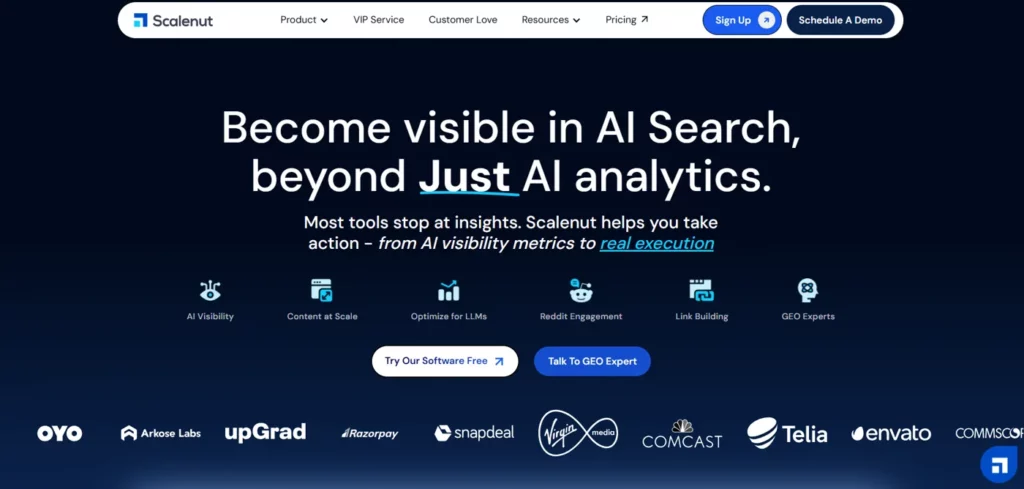
Scalenut brings planning, writing, optimization, and performance tracking into one workflow. It includes an NLP-based content editor, keyword clustering, content auditing, and AI writing, which makes it useful for teams that prefer one platform instead of managing several tools. Its main appeal is convenience. You can move from keyword research to content creation and optimization without constantly switching between different products.
That all-in-one setup is also the trade-off. Each feature does the job well enough, but none of them really beats specialist tools. Clearscope is stronger for editorial grading, while MarketMuse is better for deeper content strategy.
So Scalenut works best for teams that want a practical, connected workflow. But if you need the strongest tool for one specific job, a specialist platform may still be the better choice.
10. AirOps — Best for Programmatic & High-Volume AI Content Production
- Best for: Teams running high-volume or programmatic content production where workflow automation is more valuable than per-page optimization depth.
- Key strength: Agentic multi-step workflows, strong integrations, ability to scale content production without proportional headcount increase.
- Where it’s less of a fit: Small teams optimizing handfuls of high-stakes pages. Per-page grading depth is not the focus.
- Pricing: Usage-based tiers. Trial available.
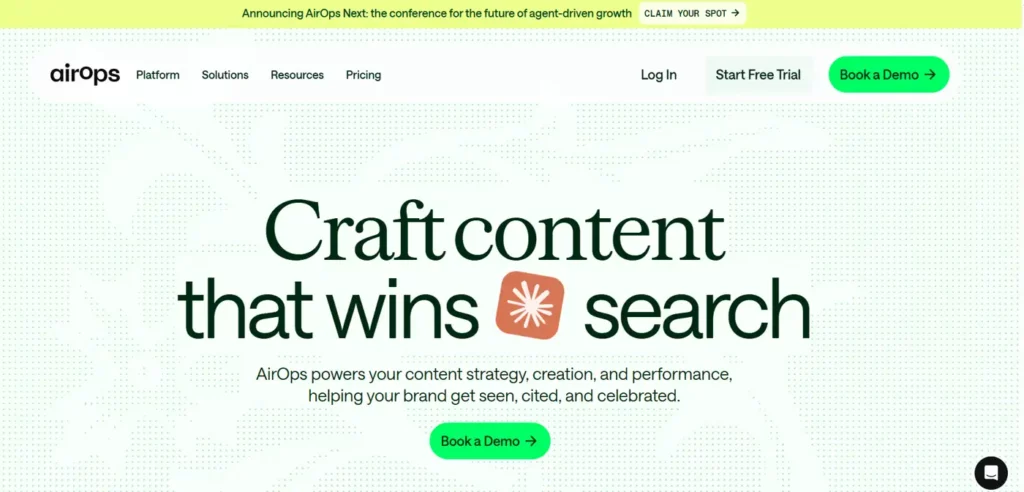
AirOps is built for agentic SEO workflows. Instead of handling each step manually, teams can set up multi-step content processes where AI agents move the work forward.
For example, keyword research can feed into outline creation, the outline can feed into draft generation, and the final content can move toward publishing with fewer manual handoffs.
The strongest use case is scale. AirOps makes the most sense for teams producing content in large volumes, such as programmatic SEO campaigns, ecommerce category or product pages, and localization projects across multiple markets.
It is less about optimizing one article and more about building a repeatable content engine that can support hundreds or thousands of pages.
AI Content Optimization Tools Compared
Here’s a comparison table to help you choose the tool that fits your needs:
| Tool | Best For | Starting Price | Key Differentiator | AI Platforms Tracked | Cannibalization Check | Native AI Writer | Learning Curve | Free Trial | AI Visibility Coverage Tested | Integrations | Team Size |
|---|---|---|---|---|---|---|---|---|---|---|---|
| Wellows | Agencies & in-house AI visibility teams | $29/mo | Cannibalization-aware decision engine; line-level gaps from 20–50 referenced URLs/prompt | ChatGPT, Gemini, Perplexity, AI Overviews, AI Mode | ✅ Full-domain, native | ✅ | Moderate | 7-day | ✅ Recommendations derived from actually-referenced URLs | WordPress, API, Google Search Console | Solo to Agency |
| Surfer SEO | Google ranking optimization | $49/mo | Real-time NLP content scoring against current SERP | Add-on only ($95–$495/mo extra) | ⚠️ Limited (Standard+) | ✅ ($10–$19/article extra) | Moderate | No (money-back) | ⚠️ Separate add-on; not built into optimization | WordPress, Google Docs, Jasper, Contentful | Small to Agency |
| Clearscope | Editorial teams, premium grading | $129/mo | Letter-grade (A++ to F) NLP scoring | ❌ | ❌ | ❌ | Low | Demo only | ❌ Optimizes for SERP, not AI inclusion | WordPress, Google Docs, MS Word, HubSpot | Mid-market to Enterprise |
| Frase | SERP briefs + emerging GEO scoring | $49/mo | Dual SEO + GEO scoring; MCP server for agent workflows | ChatGPT, Gemini, Perplexity, Claude + 4 (8 total) | ❌ | ✅ | Low-Moderate | 7-day (no CC) | ⚠️ GEO Score available; not from referenced URLs | WordPress, Google Docs, GSC, Zapier, MCP | Solo to Agency |
| NeuronWriter | Solo creators, freelancers, small businesses | $23/mo | Lowest-price genuine NLP optimization | ❌ | ❌ | ✅ | Low | 7-day | ❌ Optimizes for SERP only | WordPress, GSC, Shopify, Zapier | Solo to Small |
| MarketMuse | Enterprise topical authority | Custom | Personalized topic difficulty scoring tied to your domain | ❌ | ⚠️ Topic-level only | ✅ | High | Limited free plan | ❌ Topic-authority focus; no AI inclusion scoring | Google Docs, WordPress, API | Mid-market to Enterprise |
| Rankability | Agencies scaling Google content | $79/mo | Topic-modeling tuned for ranking correlation | ❌ | ⚠️ Limited | ✅ | Moderate | Demo | ❌ Optimizes for SERP correlation | WordPress, Google Docs | Small to Agency |
| Semrush SEO Writing Assistant | Existing Semrush users | Bundled (~$249/mo full) | Native integration with Semrush keyword & backlink data | ❌ | ❌ | ✅ (ContentShake) | Moderate | 7-day Semrush trial | ❌ SERP-correlation only | Google Docs, WordPress, MS Word, full Semrush | Small to Enterprise |
| Scalenut | Mid-market all-in-one workflow | From ~$59/mo | All-in-one: planning + optimization + auditing | ⚠️ Limited | ❌ | ✅ | Low-Moderate | Trial available | ❌ Limited AI inclusion testing | WordPress, Google Docs, Semrush, Copyscape | Small to Mid-market |
| AirOps | Programmatic & high-volume production | Usage-based | Agentic multi-step workflows for content automation | ❌ | ❌ | ✅ | High | Trial available | ⚠️ Workflow focus, not output validation | Webflow, Airtable, Shopify, Zapier, API | Mid-market to Enterprise |
AI Content Optimization Tools by Use Case
The ranking shifts by context. Same tool, different reader, different answer.
Best AI content optimization tools for agencies managing multiple client websites
Here are the three top AI content optimizaiton platforms for agencies managing multiple client websites:
- Top pick: Wellows. Multi-client workspaces, AI tracking for agencies across all major platforms in one dashboard, and the cannibalization-aware decision engine prevents the most common scaling mistake: recommending a new page when a client already has a strong existing one. Projects are unlimited on every plan, so a roster grows by drawing on the same credit pool rather than by adding subscriptions. Growth at $249/month covers roughly six clients at 20 prompts a day, and Scale at $497/month covers twelve.
- Strong second: Rankability. Topic-model accuracy and agency-friendly brief workflows make it a defensible pick for Google-focused agencies. Less coverage on AI tracking.
- Strong third: Frase. Dual SEO + GEO scoring inside one workflow, with MCP integration for agencies experimenting with agent-driven content production.
Most affordable AI content optimization platform for small businesses
Most AI content optimization platforms for small businesses are priced under $200/month at their entry tiers, making them accessible for startups, solo marketers, and lean SEO teams.
Top Affordable Options under $200/month
| Platform | Starting Price | Key Strengths |
|---|---|---|
| NeuronWriter | $23/month | NLP optimization, semantic SERP analysis, content scoring |
| Wellows’ Basic | $29/month | All five AI engines, AI visibility tracking, cannibalization-aware content optimization |
| Frase | $49/month | Content briefs, SERP research, GEO scoring |
| Surfer SEO | $49/month | Content optimization, Auto-Optimize workflows |
| Scalenut | $59/month | AI writing, SEO optimization, topic clustering |
| Rankability | $79/month | Content scoring, optimization workflows |
| Clearscope | $129/month | Enterprise-grade NLP optimization |
Affordable Budget Standouts
- NeuronWriter is the cheapest NLP-focused optimization platform at $23/month.
- Wellows Basic covers all five AI engines at $29/month, with 1,800 credits and 12 prompts a day, for small businesses focused on AI search visibility and citation optimization.
- Frase offers one of the strongest research-to-brief workflowsf or $49/month.
Easiest AI content optimization tool for beginners with no SEO experience
The easiest AI content optimization tool for beginners with no SEO experience is Clearscope. Its simple A++ to F grading system turns complex NLP optimization into an easy-to-understand score, allowing writers to improve content without technical SEO knowledge.
For beginners looking for lower-cost alternatives, NeuronWriter and Wellows are more accessible starting points.
NeuronWriter offers readable SERP analysis, built-in content scoring, and WordPress integration that reduces setup complexity. Wellows provides a more guided workflow with built-in recommendations, making AI visibility optimization easier for non-technical users.
Surfer SEO is also beginner-friendly through its Content Editor, though the advanced SERP Analyzer can feel overwhelming for first-time users.
Best Beginner-Friendly Features
| Tool | Beginner Advantage |
|---|---|
| Clearscope | Simple letter-grade optimization system |
| NeuronWriter | Easy SERP analysis and WordPress integration |
| Wellows | Guided recommendations and simplified workflows |
| Surfer SEO | User-friendly content editor |
Tools Less Suitable for Complete Beginners
- MarketMuse requires strategic SEO understanding to use effectively.
- AirOps is designed for advanced workflows and operator-level setup.
Best tool for AI visibility & generative search results
The best AI content optimization tools for generative search results is Wellows because it provides native tracking across ChatGPT, Gemini, Perplexity, Google AI Overviews, and AI Mode on every plan, starting at $29/month. Optimization recommendations derived from 20–50 actually-referenced URLs per prompt, not generic top-ranking pages.
Frase is the strongest legacy-tool option, with dual SEO + GEO scoring across 8 AI platforms in the core product.
Surfer’s AI Tracker add-on works but requires the $95–$495/month additional spend on top of base plans, and the optimization side still rewards Google-style structural patterns.
AI content optimization tool that prevents content cannibalization automatically
Wellows is the only AI powered content optimization tool that prevents content cannibalization automatically. Its decision engine scans the full domain before recommending edits, identifies the strongest candidate page for each prompt, and routes new-content opportunities separately so authority compounds instead of splitting across competing pages.
What Users Actually Notice About These Tools in 2026
Marketing pages do not match the user experience and here is what the two patterns emerged from our observation across communities:
The “green score paradox” — why hitting 100/100 doesn’t always lift rankings or AI visibility
A lot of marketers hit 100/100 content scores and expect rankings to improve, only to see traffic or AI visibility decline instead. The pattern is well documented across community discussion and review aggregates of long-term Surfer and Clearscope subscribers. (Source)
The reason is that many scoring tools reward pages that resemble existing top results, even when those results are bloated with filler. As a result, content becomes optimized for the score instead of the reader.
AI platforms like ChatGPT, Gemini, and Google AI Overviews favor clear, direct answers. Pages overloaded with SEO padding often lose to shorter, more useful content.
Content scores still matter, but they should be treated as a guideline, not the goal. The pages that perform best in AI search usually:
- Answer questions directly
- Define entities and concepts clearly
- Avoid unnecessary length and filler content
These are the foundational AI content optimization strategies that separate pages getting referenced inside AI answers from pages chasing scores.
Why teams are stacking three tools instead of using one
A lot of agencies and in-house teams now rely on multiple platforms at once, one for content scoring, another for AI visibility tracking, and a third for content briefs. (Source)
The issue is that most traditional SEO tools were built for Google rankings, not AI search. As a result, teams end up managing disconnected workflows, multiple scores, and overlapping subscriptions. That is why content optimization feels harder than SEO today, and why teams need to rethink which parts of the workflow actually matter.
One tool optimizes for SERPs, another tracks AI citations, and neither fully understands the other.
That’s why newer platforms are shifting toward all-in-one AI powered content optimization. In 2026, the real advantage is using a platform that combines search rankings, AI visibility tracking, and content optimization in one place. Wellows is built to bring all of those together for agencies and in-house teams.
How to Choose the Right AI Content Optimization Tool
Here are the four factors to consider when choosing the AI content optimization tool:
- What are you optimizing for: Google rankings, AI visibility, or both? The architecture of the tool tells you what it was built for. Add-on AI tracking signals a tool retrofitted for the citation era. Native multi-platform tracking signals a tool designed for it.
- Will the tool flag cannibalization before recommending an edit? Recommending a new page when an existing one already deserves the optimization is the most expensive mistake in content programs. Two pages on the same domain competing for the same prompt do not double your chances; they halve them.
- Is AI visibility tracking in the base plan, or is it an add-on? Pricing reveals product priority. Tools that bury AI tracking at $95+/month above the base plan are signaling where their roadmap originated. The tell worth checking is whether every engine is live on the cheapest plan, or only the first one.
- Does the price scale with clients or with usage? Per-domain and per-seat models charge you for growing. Pooled models let you add a brand, a market, or a prompt set without a new line item, so the question is whether next quarter’s bill is predictable from this quarter’s.
- Can your team execute the recommendations? A line-level gap report is only useful if someone can edit the page. For lean teams, choose tools whose output is directly editable. For stacked teams, deeper analytical depth pays off.
If you’re still wondering, ” should you choose an affordable on-page content optimization service or a premium agency instead of a tool?” the answer depends on your team structure and execution capacity.
Tools are ideal for teams that want more control and can implement recommendations internally, while services and agencies are better suited for businesses that need faster execution, strategic guidance, and hands-on optimization support.
Common Mistakes to Avoid When Using AI Content Optimization Tools
Four patterns waste budget consistently.
Bottom line:
Treating the optimization score as the goal. The score is a proxy. The goal is being read and recommended. Pages hitting a green 100 while reading like padded summaries lose to leaner pages that score 70 but answer the query directly.
Optimizing a new page when an existing one already deserves the update. This is cannibalization at the decision stage. Authority splits, rankings stall, AI references go elsewhere. Always audit the domain first.
Ignoring underserved content formats AI engines actively reference. Comparison-format pages alone drive 166,000+ citations per quarter across the top five AI engines, yet leading brands in the space capture barely 1%, per Wellows citation research. Most AI content optimization tools score whatever draft a writer puts in front of them, instead of flagging the format gaps where the playing field is wide open.
Buying enterprise tools for small business workflows. MarketMuse and Clearscope are excellent in context. Used by a solo marketer with no team to absorb the recommendations, they become expensive shelfware.
- Can Wellows Do More Than Peec AI?: Wellows vs Peec AI
- Compare the Tools Built for AI Search Growth: Wellows vs AIClicks
- Which AI Visibility Tool Fits Your Growth Strategy?: Wellows vs Promptwatch
- The Checklist for Better AI Search Visibility: AI Search Visibility Audit Checklist
- From Brand Visibility to Source Credibility: Brand Mentions vs. Citations
FAQs
For in-house teams updating old blog posts, Wellows stands out with its cannibalization-aware optimization engine, while Frase offers automated content decay detection and update suggestions.
For fully managed execution, agencies like Animalz and Grow and Convert handle the entire audit-to-publish workflow, typically costing $5,000–$15,000+ per month. Tools offer lower cost and more control, while agencies provide strategy, accountability, and hands-on execution.
Some can, most do not, natively. Tools built for the citation era (Wellows, and to a lesser degree Frase’s GEO scoring layer) analyze what AI systems are actually pulling from for a given prompt and recommend changes based on those signals. Legacy NLP-grading tools optimize for ranking patterns, which only partially overlap with Generative enigne optimization patterns — currently 38%, down from 76% in mid-2025.
Wellows is the best AI content optimization tool for SaaS startups, built for AI-driven discovery across ChatGPT, Gemini, Perplexity, and Google AI Overviews. Its $29/month Basic plan covers all five AI engines and helps early-stage SaaS brands optimize AI visibility and prevent keyword cannibalization. For startups focused only on Google rankings, Frase ($49/month) and NeuronWriter ($23/month) are solid budget-friendly alternatives.
Wellows (7-day, on every plan), NeuronWriter (7-day), Frase (7-day, no credit card), and MarketMuse (limited free plan) offer trials directly. Surfer SEO does not, only a 7-day money-back guarantee. Clearscope offers demo access on request. Trial structures change. Verify on the live pricing pages before subscribing.
The best AI content optimization software for marketing agencies is Wellows, which combines AI citation tracking, content optimization, and outreach in one platform. Growth at $249/month covers about six clients at 20 prompts a day and Scale at $497/month covers twelve, both on unlimited projects drawn from one credit pool. For agencies focused purely on Google ranking, Rankability offers the strongest topic-modeled brief workflow.
Final Verdict — Best AI content optimization platform
The strongest AI content optimization tool in 2026 is the one aligned with how search actually works today.
For Google-only rankings, tools like Surfer, Clearscope, and Frase remain strong options.
But for visibility across ChatGPT, Gemini, Perplexity, and AI Overviews, Wellows stands out with AI-native optimization built around citation visibility and cannibalization-aware recommendations, with every engine live from the $29 entry plan.
MarketMuse is better suited for enterprise topical authority, while NeuronWriter remains a solid low-cost alternative.
Still, success no longer comes from publishing more content, it comes from choosing the right pages, targeting the right prompts, and using the right optimization strategy for both rankings and AI inclusion.