An unlinked brand mention is a page that names your brand but does not link to your website.
You can find them for free with a Google search and Google Alerts. You fix one by asking the page’s author to add a link.
Start with the pages that AI engines such as ChatGPT and Perplexity already cite. Those pages can shape how AI answers describe your brand.
We ran this check on our own brand. When Wellows checked the AI-cited pages that mention Wellows on 13 November 2026, 39 of 98 (40%) had no link to wellows.com. This guide shows you what we did, so you can do the same.
In this guide
- What are unlinked brand mentions?
- Do unlinked mentions still matter for SEO and AI search?
- How to find unlinked brand mentions in 15 minutes (free)
- Which unlinked mentions to fix first
- What we found: 40% of AI-cited mentions had no link
- Correct the description before you ask for a link
- How to ask for the link (template)
- How to track whether a link request worked
- Tools that find unlinked mentions
- Pages that mention competitors but not you
- FAQ
Key terms
- Unlinked mention: a page names your brand in its text and has no link to your site.
- Nofollow link: a link with a small tag on it:
rel="nofollow",sponsoredorugc. Readers can still click it. Google says it will generally not follow it. - Explicit citation: an AI answer lists a page on your own site as a source.
- Implicit citation: an AI answer lists someone else’s page as a source, and that page mentions your brand. The Wellows app labels these pages Implicit.
What are unlinked brand mentions?
Unlinked brand mentions are places where your brand, product or founder is named in text, and the reader has no link to follow back to you.
The classic case is a “best tools” list. Your name is in the list, but nobody linked it.
Since AI search arrived, people use the same phrase for a second thing. The two get mixed up, so here they are side by side.
| Aspect | Meaning 1: on a web page | Meaning 2: in an AI answer |
|---|---|---|
| What happens | A page names your brand and does not link to your site | ChatGPT, Gemini or Perplexity names your brand, and none of the sources it lists is your site |
| Who can change it | The page’s author or editor | Nobody directly. The engine picks its own sources |
| What you do | Ask for a link, or a correction | Find the pages the engine did cite, then work on those |
What this means: behind most AI mentions is someone else’s page that names you. The cited pages that have no link to you are the ones you can act on.
Note: an engine can also name a brand from its training data, with no cited page at all.
Our guide to the difference between a brand mention and a citation covers how mentions and citations differ.
A real example from our own brand
We track prompts about our own category in the Wellows app. AI engines cite an agency guide on a local-marketing site for some of those prompts.
That guide names Wellows next to several competing tools. On 13 November 2026 our link check found no link to wellows.com in the page’s HTML.
So that one page is two things at once: an unlinked mention and an implicit citation.
Do unlinked mentions still matter for SEO and AI search?
Yes, they matter for both. The reasons are different.
For Google search
A link gives readers a way to reach you. It also gives Google a path to crawl. A plain-text mention does neither.
A nofollow link sits in between. Google’s own documentation on qualifying outbound links says links marked nofollow, sponsored or ugc “will generally not be followed”. So you get the clicks, but mostly not the crawl path.
Does Google count plain-text mentions as a ranking signal? We could not confirm that from a primary source.
For AI answers
An AI engine that reads a page sees your name whether it is linked or not. For AI answers, the text about you can matter as much as the link.
If the page says your product costs more than it does, the engine can repeat that. The same goes for a page that files you under the wrong category.
How common are they?
Ahrefs checked its own brand in its guide to unlinked mentions, first published in July 2018. It filtered the pages that mentioned Ahrefs down to 558. Those were English pages on sites with a Domain Rating of 30 or more and at least 50 organic visits a month.
164 of the 558, roughly 29%, had no link. That is one brand, checked with its own tool.
Our own check came out at 40%. It used a smaller and different set of pages.
How to find unlinked brand mentions in 15 minutes (free)
You do not need a paid tool to get your first list.
To find your unlinked brand mentions for free, here is what you need to do:
- Open Google.
- Search for your brand in quotes, and exclude your own site and your social profiles:
"your brand" -site:yourbrand.com -site:linkedin.com -site:x.com -site:facebook.com - Leave the date filter alone the first time. On repeat checks, select Tools, then Any time, then Past month.
- Open each result in a new tab.
- Press Ctrl+F (Cmd+F on a Mac) and search the page for your brand name.
- Hover over the name. If it is not a link, search the page source (Ctrl+U) for your domain to be sure.
- Paste the URL into a sheet with three columns: Linked (yes, no, nofollow), Accurate (yes, no), Contact.
- Go to Google Alerts, enter the same quoted brand name, and select Create Alert.
Note: you will not catch everything this way. Google shows only part of what it has indexed for a brand search.
Common words make the results noisy too. If your brand name is also an ordinary word, add your category to the search. For example: "your brand" "ai visibility".
If you do not want to check pages by hand, you can use a paid tool that finds them for you. We list those in the tools section below.
Which unlinked mentions to fix first
You will not have time to email every page, so you need an order. Fix first the mentions on pages that AI engines cite. Then work down by accuracy, relevance, traffic and freshness.
Search Engine Land’s guide to unlinked mentions lists six factors. One of them, page traffic and visibility, mentions pages that LLMs cite often. It suggests checking with simple keyword searches and LLM prompts.
This is the order we use.
| Order | Question | How to check |
|---|---|---|
| 1 | Do AI engines cite this page? | Run your prompts and read the sources (below) |
| 2 | Does it describe you correctly? | Read the paragraph about you: price, features, category |
| 3 | Is the page about your topic? | Title and headings |
| 4 | Does it get visitors? | Does it rank for its own title in Google? |
| 5 | Is it recent, with a named author? | Date and byline on the page |
What this means: a page that passes question 1 goes to the top of your list, even if the site is small. A page that fails question 2 needs a correction request, not a link request.
Check which mentions AI engines cite: the manual way
You can answer question 1 by hand, with no tracking tool.
To check which mentions AI engines cite, here is what you need to do:
- Write down five to ten questions a buyer would ask about your category, such as “best [category] tools for agencies”.
- Open ChatGPT with search turned on.
- Ask the first question.
- Select Sources under the answer.
- Copy every source URL into a second tab of your sheet.
- Repeat in Perplexity, Gemini and Google AI Mode.
- For each source URL, press Ctrl+F for your brand name.
Every hit is an AI-cited mention, whether or not it was in your Google list.
Note: AI answers change from one run to the next. Run each question two or three times on different days before you trust the list. Our guide to AI mention tracking shows how to do this over time.
If you do not want to paste prompts one by one, you can use the free Wellows ChatGPT visibility tracker. It takes your domain, writes about 40 queries, and reports your implicit citations. Those are mentions of your brand on third-party pages that ChatGPT draws on.
Note: the free tracker covers ChatGPT only.
The same check in Wellows
If you track prompts in Wellows, the list already exists. This is where we got ours.
To see the cited pages that mention your brand in Wellows, here is what you need to do:
- Open your project.
- Go to Performance History.
- Select URLs.
- Set the date range and the country.
- Select Filters, then set Mention Type to Implicit.
- Sort by SVS (Stable Visibility Score), highest first.
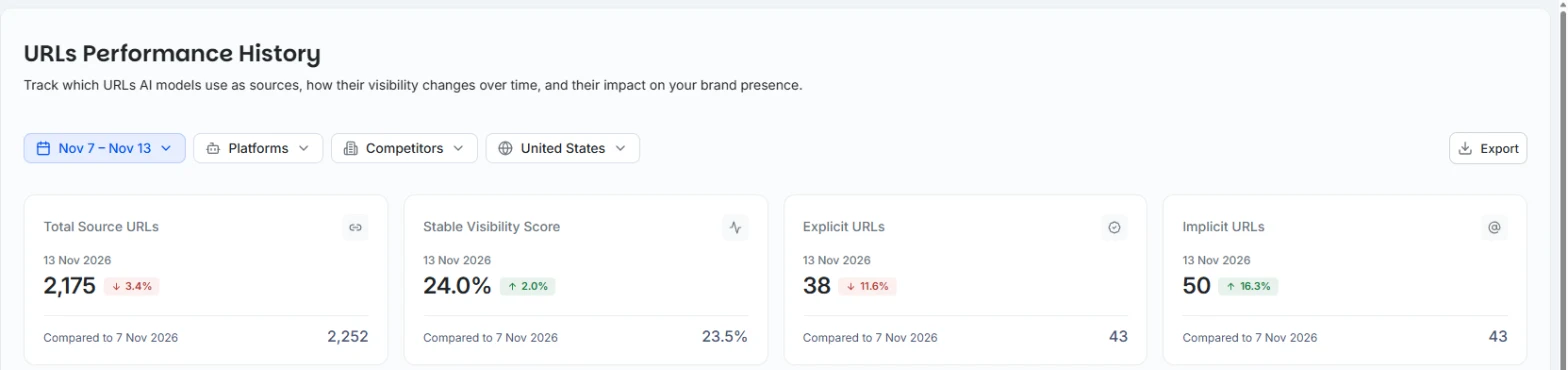
What this means: on 13 November 2026, AI engines used 2,175 different URLs as sources for the prompts Wellows tracks for its own brand in the United States. 38 were our own pages (explicit). 50 were other people’s pages that mention us (implicit).
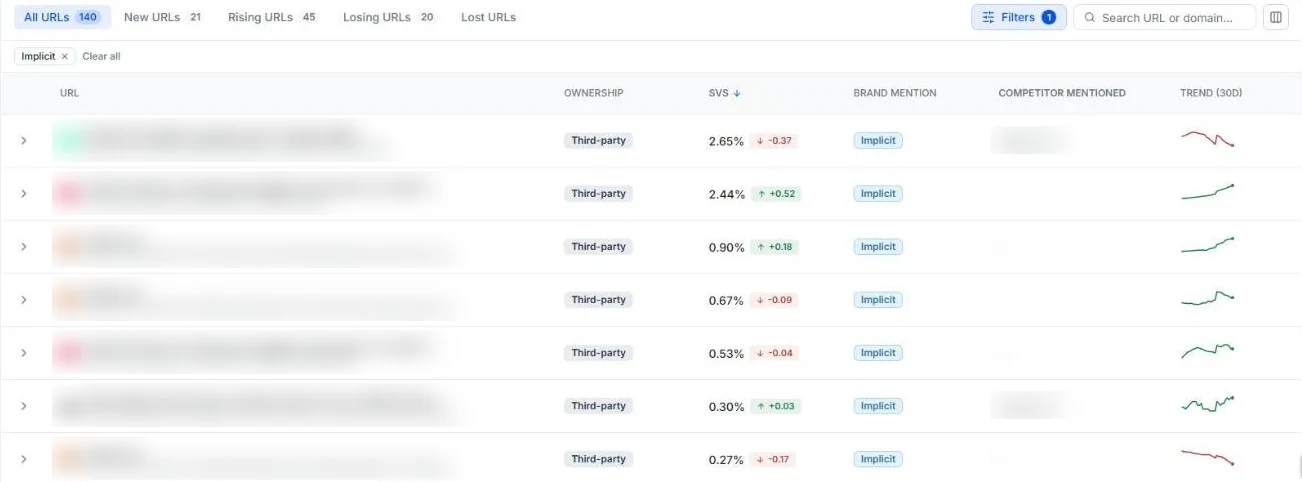
What this means: across the full week, the Implicit filter returns 140 third-party URLs. The Competitor Mentioned column shows which of the competitors you track are named on each page.
You can also check a single answer. Go to Prompts, select Responses, open any answer and select the Citations tab.
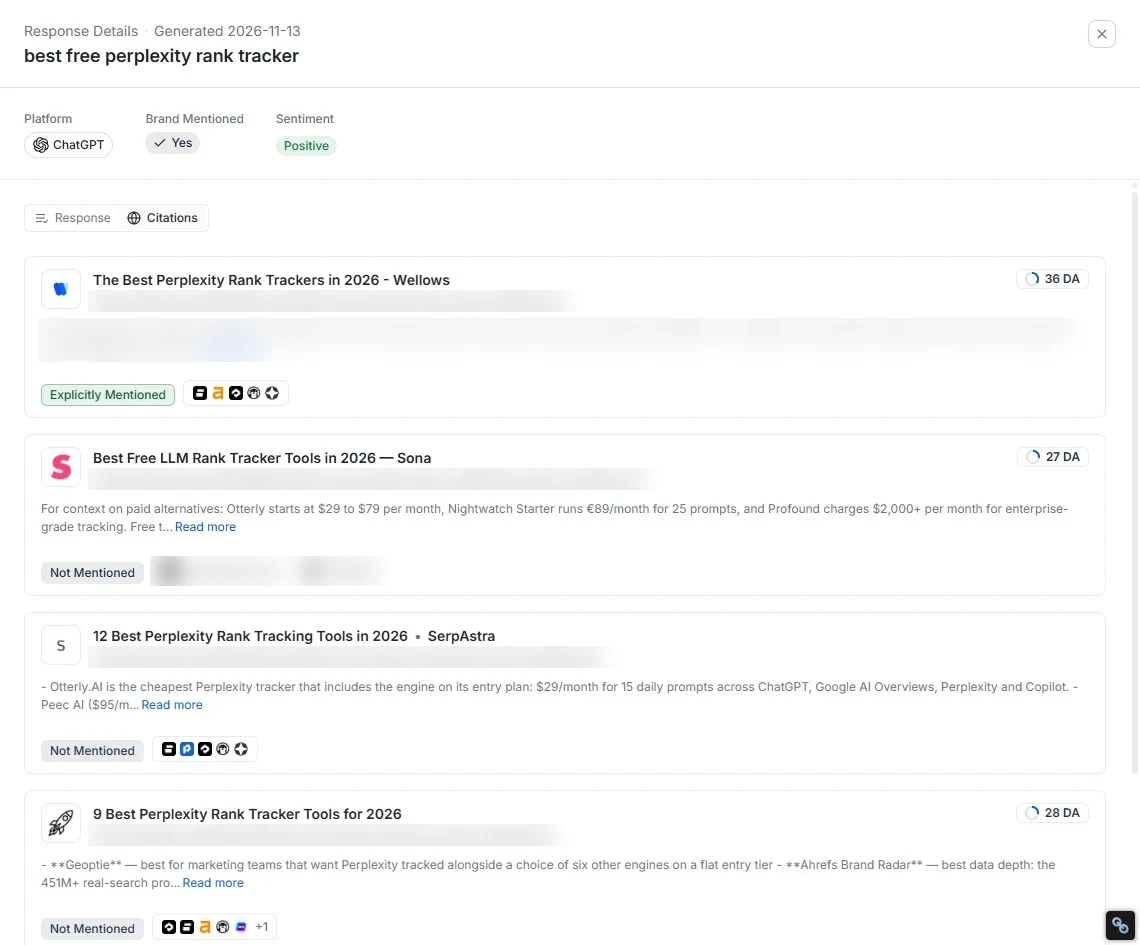
What this means: each page ChatGPT cited for this prompt carries a label. The first is our own article, so it reads Explicitly Mentioned. The three list articles below it read Not Mentioned, and they name other tools.
Note: Wellows tells you which cited pages mention your brand. It does not crawl the whole web for every mention, and it does not check whether a page links to you.
You still do the link check yourself. That is what we did next.
The AI citation tracking page explains explicit and implicit citations.
What we found: 40% of AI-cited mentions had no link
When Wellows ran a link check on the AI-cited pages that mention its own brand on 13 November 2026, 39 of 98 pages (40%) had no link to wellows.com.
The Wellows app gave us the list of pages. Our own link check found the 39, because the app does not check links.
Not every unlinked page is worth an email, though.
What we did
- We took the 140 implicit URLs from the Wellows app for 7 to 13 November 2026, United States.
- We sent one plain request to each page.
- We searched every link in the HTML for wellows.com.
- We skipped 34 URLs on YouTube, Reddit, LinkedIn and Quora. Those sites cannot be fetched reliably.
- We dropped 5 more that were blocked or returned an error.
That left 101 pages.
Finding one: three pages were not about us at all
Three of the 101 pages were about a different company. Its name is one letter off from ours.
We took them out, so the real set is 98 pages.
Finding two: 40% had no link
Of the 98 real pages, 59 (60%) link to Wellows. The other 39 (40%) mention Wellows with no link.
Two of the 59 link only to our app’s sign-up page (app.wellows.com), not to the website.
Note: the set is small and contains only pages AI engines cite. Do not compare it directly with the Ahrefs figure.
Finding three: 15 of the “linked” pages only use nofollow
On 15 of the 59 linked pages, every link to Wellows carries nofollow, sponsored or ugc.
Finding four: almost all of the unlinked pages also name a competitor
36 of the 39 also name at least one of the competitors we track in Wellows.
Most are tool lists, “X vs Wellows” comparisons and alternatives posts. Several are published by other AI visibility vendors, which changes what you can ask for.
If you run a SaaS brand like ours, start with these three page types: tool lists, comparison posts and alternatives posts. That is where most of our own unlinked mentions were.
Read these numbers with care
- One brand, one country, one week. Treat it as an example, not a benchmark.
- One article appears twice in the list, with and without www. So the 39 unlinked URLs are 38 articles.
- A page counted as linked may link only from a footer or a table. Two link only to the app sign-up page.
- A page counted as unlinked may link through a redirect or an affiliate domain. This check cannot see that.
- We read the HTML each page first sends. Links added later by JavaScript are not counted.
- We matched the brand name in that HTML. We did not read the visible text of every page.
Correct the description before you ask for a link
If a page describes your brand wrongly, ask for the correction first. AI answers repeat the description, and a link does not change the wording.
The agency guide from our example shows why. On 13 November 2026 its comparison table listed Wellows at “From $37/domain/month”. It also said we cover only ChatGPT, Perplexity and Gemini.
Our live pricing page that day showed the Basic plan at $29 per month with five engines. An AI answer that draws on that table can pass both errors on.
To check how a page describes you, here is what you need to do:
- Read the paragraph about you.
- Check the price and plans. Compare them with your pricing page today.
- Check what the product does. For us that means the list of AI engines covered.
- Check the category. Are you filed under the right kind of tool?
- Check the identity. Is it you, or the brand with the similar name?
- If anything is wrong, ask for the fix and give the source.
- Add the link as a second, smaller request in the same email.
When not to ask for a link
Skip the link request on three kinds of page:
- Competitor-owned pages. A rival’s “alternatives to you” post is unlikely to link to you. A correction request can still work if a fact is wrong.
- Forums and comment threads. Reddit, Quora and similar. Nobody owns the mention, and dropping your own link reads as spam.
- Negative pieces. A link request is the wrong reply to criticism. Fix the problem, or reply to the point they made.
How to ask for the link (template)
Make the change a ten-second job for the editor.
To ask for the link, here is what you need to do:
- Keep the email short.
- Name the exact page and the exact sentence.
- If a fact is wrong, give the right one and a source.
- Ask for the link last, with the URL you want.
This version is for a page AI engines cite.
Subject: Your [article title] is being cited by ChatGPT
Hi [first name],
You may already know this: when we ask ChatGPT “[prompt]”, your article [article title] is one of the sources it cites. We saw it on [dates].
Your article mentions [brand], and one detail is out of date: it says [wrong fact]. The current figure is [right fact] (source: [URL]). Since AI answers repeat what your page says, it seemed worth flagging.
If you update that line, would you also link “[brand]” to [URL]?
[Name, role, brand]
If the page is an ordinary mention that AI engines do not cite, you can use the same template without the ChatGPT paragraph.
Note: only mention the citation if you saw it yourself. Editors can check.
How many times should you follow up?
Follow up once, maybe twice. Semrush’s guide (September 2024) suggests two follow-ups with at least a few days between them. It warns that more than that starts to feel like spam.
How often does it work?
We only have individual reports here, not studies. In Reddit threads, one PR commenter reported a 60 to 70% success rate on reclamation emails to journalists. A digital PR team said it tries to find new coverage within 12 hours.
Those reports come from search snippets, and they are about press coverage. Expect lower numbers on old list posts.
For the outreach side in more depth, see our guides to SEO outreach and digital PR, and the citation acquisition checklist.
How to track whether a link request worked
After you send your emails, check two things: whether the link appeared, and whether the AI answers changed.
To track a link request, here is what you need to do:
- Add two columns to your sheet: Date asked and Date changed.
- Open each page again after two weeks.
- Search the page source for your domain.
- Run the same prompts you ran before, in the same engines.
- Note whether the page is still cited and how the answer now describes you.
- Repeat after four weeks.
Note: a new link on a cited page does not mean the engine will start citing your site. What you can check is the wording. Does the answer now carry the right price?
If you do not want to re-run prompts by hand, you can use the same URLs screen in Wellows. Its 30-day trend line shows whether each page is still being cited.
Tools that find unlinked mentions
We checked each vendor’s own pages on 13 November 2026.
| Tool | What it does for this job | Cost |
|---|---|---|
| Google search operators | Finds pages that name your brand. You check each for a link by hand. | Free |
| Google Alerts | Emails you when new search results appear for your brand name. | Free |
| Ahrefs Content Explorer | Searches a 23 billion page index for “websites that mention your brand but aren’t linking to you”. | Ahrefs Standard plan or higher (from $249 per month) |
| Semrush Brand Monitoring | Tracks mentions in news, blogs, discussions and social media, with a Backlinks filter for mentions that do or do not link to a URL you set. | $79 per month for 3 queries, 7-day trial |
| Brand24 | Monitors mentions across social, news, blogs, videos, forums, podcasts and reviews. Check links yourself. | From $249 per month, 14-day trial |
| Wellows | Lists the third-party pages AI engines cite that mention your brand (ChatGPT, Gemini, Perplexity, Google AI Overviews and AI Mode). It does not crawl the web for every mention or check links. | Paid, 7-day trial; free one-time ChatGPT check |
What this means: if your only goal is a bigger list of unlinked mentions for link building, Ahrefs or Semrush is the better pick. Each has a filter built for it. Wellows covers a different layer: which of those pages AI engines cite.
If you use Ahrefs, its own guide shows the workflow. Search your brand in Content Explorer and exclude your own site with -site:yourdomain.com. Then filter by language, Domain Rating and organic traffic, and export the list.
The same guide describes a “highlight unlinked mentions” option in Content Explorer that marks sites that have never linked to you.
Google Search Console will not help here. Its Links report only lists pages that link to you, so an unlinked mention never shows up there.
Pages that mention competitors but not you
There is a mirror image of the unlinked mention: a page where you should be mentioned and are not. Finding these pages is part of an AI citation gap analysis.
The three list articles labelled Not Mentioned in the screenshot above are examples.
To find these pages in Wellows, here is what you need to do:
- Open your project.
- Go to Outreach.
- Select All Opportunities.
The screen lists sites that mention your competitors. For each site you see its DA, topics, citations and a status. There is also an action to research contacts and get a ready-to-use email.
In Wellows’ own project, that list had 445 open pages for the United States on 13 November 2026.
Note: on these pages you are asking for a mention. That is a bigger ask than a link.
If you do not use Wellows, you can go back to the source URLs from your manual check. The cited pages where Ctrl+F does not find your brand are your list.
The Wellows Outreach feature page shows the workflow. Our guide on how to earn mentions in AI search covers what to pitch.
FAQ
Do unlinked brand mentions help SEO?
A link helps more than a plain mention. It gives readers and Google’s crawler a path to your site. Treat unlinked mentions as link opportunities.
Do unlinked mentions help me get cited by ChatGPT?
They can help you get mentioned, which is not the same as cited. If ChatGPT cites a third-party page that names your brand, your name can appear in the answer even though the page has no link to you.
Getting your own site cited is a separate result. It depends on your own pages.
Is a nofollow link worth asking for?
Yes. If the page has no link at all, a nofollow link still sends readers to you.
Do not ask an editor to remove nofollow from a link that is already there. Some publications apply it to every outbound link as policy.