The Visibility Score is the main number in Wellows. You’ll find it on your Overview, next to every prompt you track, and beside every competitor.
It’s a quick way to see how visible your brand is in AI answers. But like any single number, it can lead you astray if you don’t know what goes into it.
So in this post, we’ll explain how the Visibility Score works, what changed in our latest update, what the score doesn’t measure, and how to put it to good use.
What is the Visibility Score?
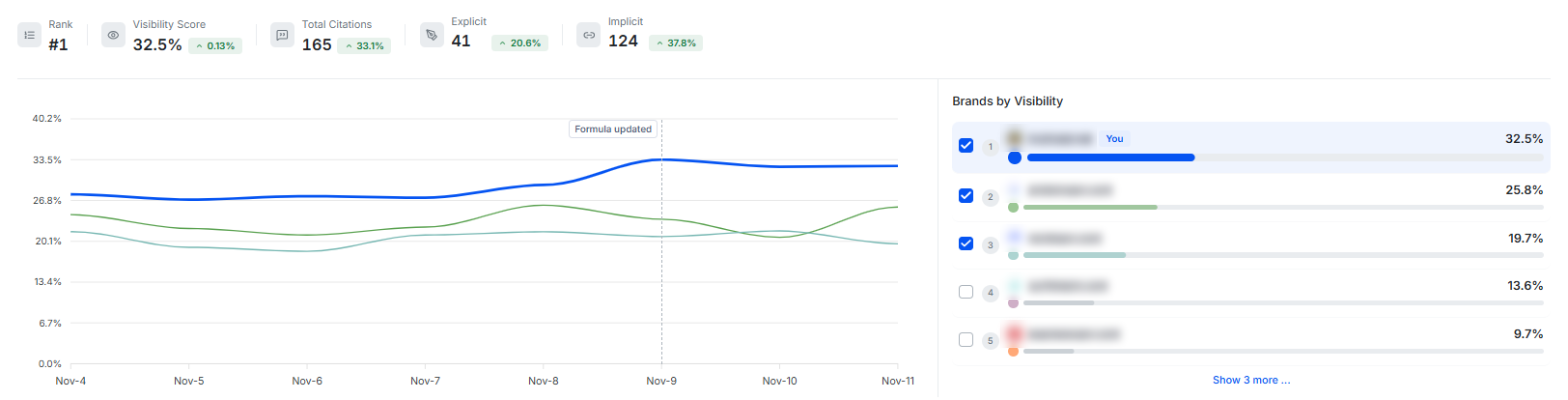
The Visibility Score shows how visible your brand is in the answers AI platforms give to the questions you track. It’s measured from 0 to 100, where 100 is the most visible.
Every day, Wellows asks your tracked questions (we call them prompts) on the AI platforms you track, such as ChatGPT, Gemini, Google AI Overviews, AI Mode and Perplexity. Then we score every answer.
Sidenote
Every brand in your project gets a Visibility Score: yours and each competitor’s. They’re all worked out the same way, from the same answers, so you can compare them fairly.
How the score used to work, and why we changed it
Until 13 November 2026, the Visibility Score was based on one thing: the web pages an AI answer linked to.
We counted how many of those pages were on your website or mentioned your brand, then divided that by all the pages the answer linked to. If an answer linked to 5 pages, and 2 of them were yours or mentioned you, you scored 40%.
Links matter, so this was a useful signal. But it had a blind spot. It looked at the links and ignored what the AI actually said. In practice, that meant:
- If an AI recommended you first but linked to nothing about you, you scored 0%.
- If an AI warned people away from you but linked to your site, you still scored well.
- Being the only brand in an answer counted the same as being one of ten.
People read what the AI says. The links come second. So we rebuilt the score around the answer itself.
How is the Visibility Score calculated?
Each time an AI platform answers one of your prompts, we score that answer for every brand you track. The score has five parts, which add up to 100.
| Part | What it asks |
|---|---|
| Mentioned | Did the AI name your brand? |
| Position | How high did it recommend you, compared with the competitors you track? |
| Tone | Did it speak well of you? |
| Cited | Did it link to pages that back you up? |
| Share of voice | How many tracked competitors shared the answer with you? |
Being mentioned counts the most, followed by being cited. Position, tone and share of voice each count for a smaller part.
We may refine how much each part counts over time. If we do, we’ll update this post.
Here’s how each part earns its points.
Mentioned
If the answer names your brand, or any other name you’ve set up for it, you earn this part in full. If not, you earn nothing for it.
This is the biggest part for a simple reason. If the AI never says your name, the reader never hears of you.
Position
A separate AI check reads the answer and ranks the brands it recommends, best first. Only the brands you track are ranked.
The brand recommended first, or the only brand recommended, earns this part in full. The second and third earn less. A brand ranked fourth or lower earns nothing for it.
Only real recommendations count. If the answer names you as background, as a comparison point or as an example of what to avoid, you get no position.
How does the check decide the order?
If the answer says one brand is the best, that brand comes first. If it suggests different brands for different needs, the brand that fits the question comes first. If it gives a numbered list, the list order is used. Otherwise, it’s the order the answer presents the brands in.
Tone
A positive answer earns the most. A neutral answer earns less. A negative answer earns nothing.
A negative answer also loses its Position points. Being listed first in an answer that criticises you isn’t a win.
Cited
This part looks at the pages the answer links to. Two kinds of page count:
- Pages on your own website. These carry the most weight.
- Pages on other websites that mention your brand. These count too, but for less.
For each kind, the first page does most of the work. Extra pages add a little more, up to a limit. Each page counts once, even if the answer links to it several times.
The two kinds add together.
Share of voice
This is your slice of the conversation. It’s shared between the tracked brands the answer names, so the fewer competitors named next to you, the bigger your slice. If you’re the only tracked brand named, you earn this part in full.
You only get share of voice when the answer names you.
Putting it together
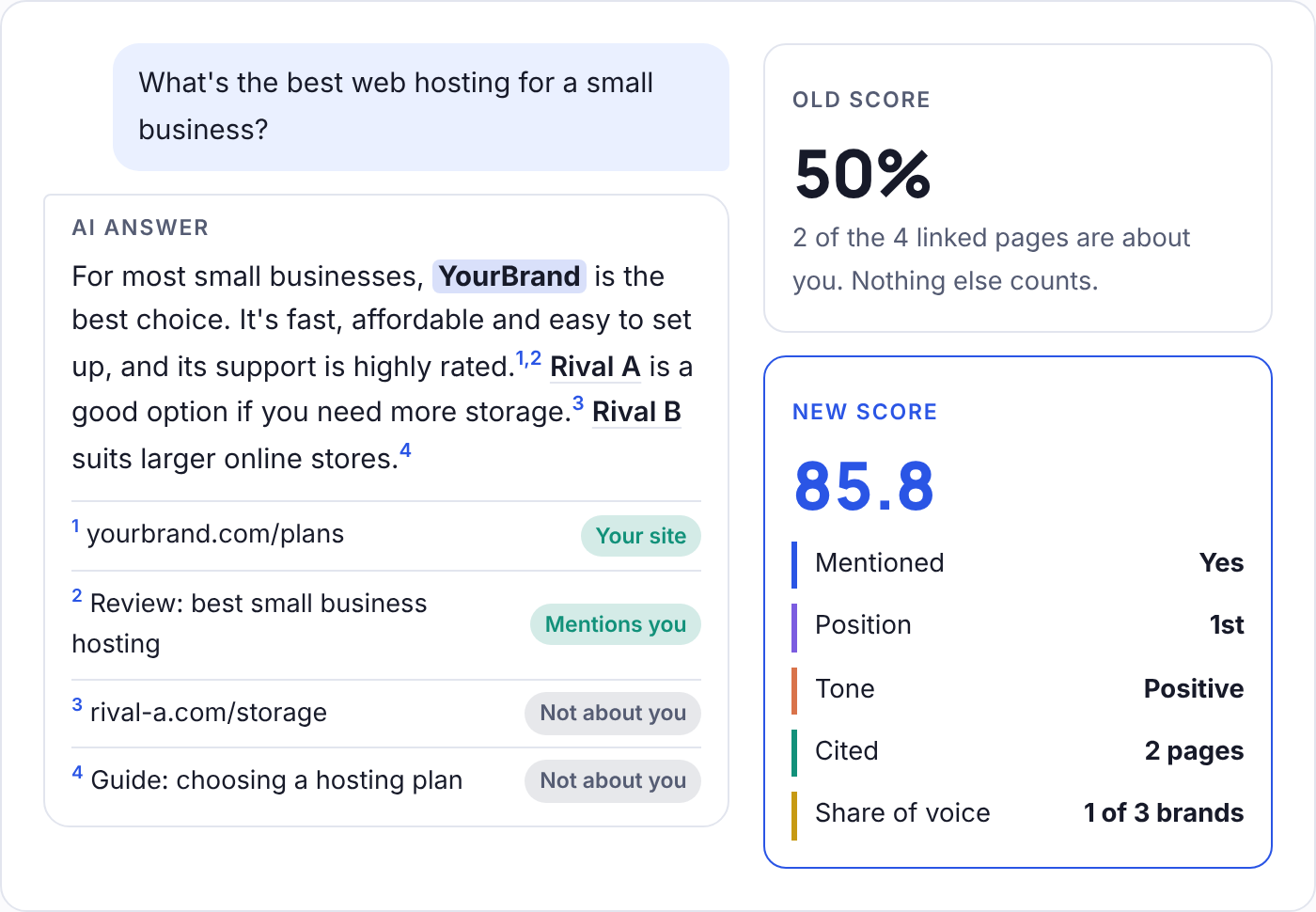
Let’s go back to the answer from earlier. YourBrand is named, recommended first and described positively. The answer links to 1 page on YourBrand’s site and 1 review that mentions it, and it names 2 competitors.
| Part | What happened | Earned |
|---|---|---|
| Mentioned | Named | In full |
| Position | Recommended 1st | In full |
| Tone | Positive | In full |
| Cited | 1 page on your site + 1 other page that mentions you | In part |
| Share of voice | 3 tracked brands named | In part |
| Visibility Score | 85.8 |
The answer misses full marks for two reasons. It links to only one page of each kind, and it names two competitors.
Let’s also put it in more practical terms:
- If the AI doesn’t name you, you can only earn points from links. Every other part needs your name in the answer.
- A passing mention earns the Mentioned part, but nothing for Position.
- A negative answer never earns Position or Tone points, however high it lists you.
- A link to your own site is worth more than a link from another site.
- The more competitors share the answer, the smaller your share of voice.
- It doesn’t matter which page of your site is linked, or where the link appears in the answer.
What the score doesn’t measure
The Visibility Score is based only on the AI answers to the prompts you track. It doesn’t take into account your search traffic, your domain authority, how many people ask a question, or whether the AI’s facts about you are correct.
Two more things to keep in mind. First, being named counts even when the AI is critical. A negative answer still earns the Mentioned part and its share of voice. It just earns nothing for Position or Tone. Second, name matching is literal. If your brand shares its name with an everyday word, an answer about that word can count as a mention.
From one answer to your project score
Everything above scores a single answer: one prompt, on one AI platform, on one day. Wellows combines those answer scores in two steps.
- Prompt score. The average of a prompt’s answer scores across the AI platforms and days you pick. It’s the score next to each prompt in Prompt Tracking and Performance History.
- Project score. The average across every selected prompt on every selected AI platform. It’s the headline Visibility Score on your Overview and Monitoring pages, and the score that ranks you against your competitors.
Here’s an example with 3 prompts on 3 AI platforms, for one day:
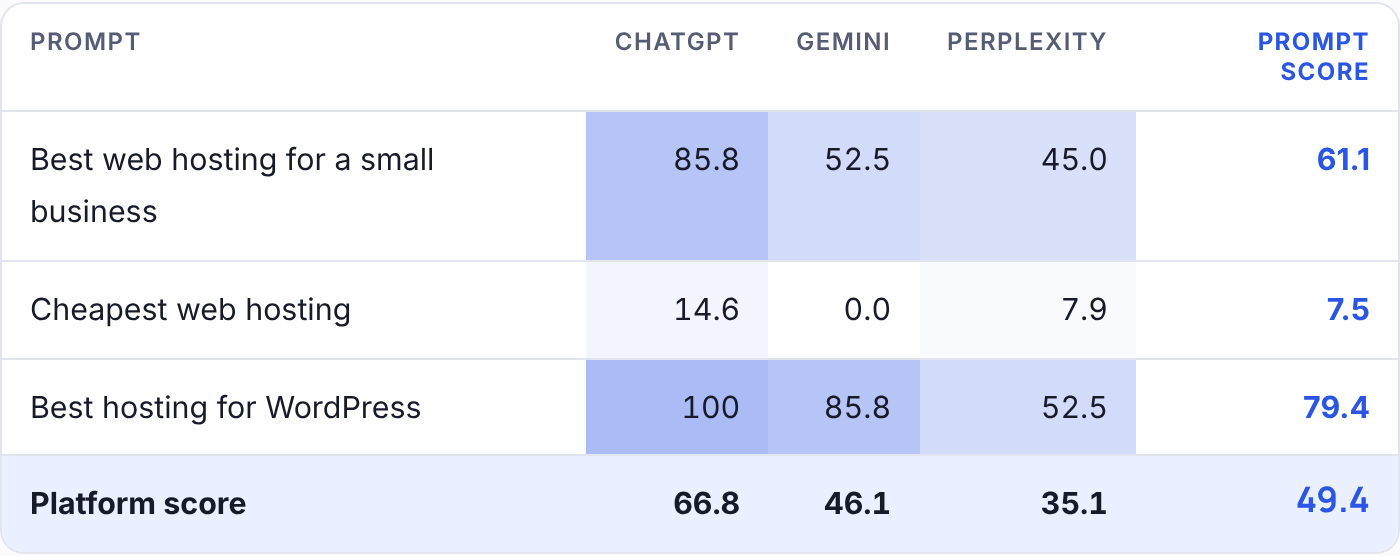
Read across a row for a prompt score. This brand is strong for “Best hosting for WordPress” (79.4) and nearly invisible for “Cheapest web hosting” (7.5). Read down a column to see how each AI platform treats the brand. The corner, 49.4, is the project score: the average of all nine answers.
A few rules apply to every score:
- Days are averaged. Pick a week, and each prompt’s score on each platform is the average of its daily scores.
- A missing answer is left out. If an AI platform didn’t answer a prompt on a day, that answer is skipped. It isn’t counted as zero. If there are no answers at all for what you’ve selected, you’ll see a dash.
- Filters choose which answers count. Picking platforms, topics, intents or countries changes which answers go into the average. It never changes how an answer is scored.
- Competitors are scored on the same answers. When we score a competitor, your brand counts as one of its competitors.
Should you try to increase your Visibility Score?
Yes, but don’t chase the number itself.
AI platforms don’t look at your score. They name the brands that best answer the question. Become the best answer, and the score follows.
That said, each part of the score points to something concrete you can work on:
- Get named. Be the obvious brand for your category. Consistent naming and coverage in the places AI tools read both help.
- Be the first choice. Make it easy for an AI to say who you’re best for. Comparison pages, proof points and clear use cases help it put you first.
- Earn good words. Reviews, case studies and fixing known complaints shape how AI tools describe you.
- Be the source. Publish pages that answer the questions people ask, and get mentioned on trusted sites that AI tools link to.
- Own the conversation. Win the questions where you’re the clear answer, so fewer competitors share the spotlight.
What can you use the Visibility Score for?
1. Finding the questions you’re losing
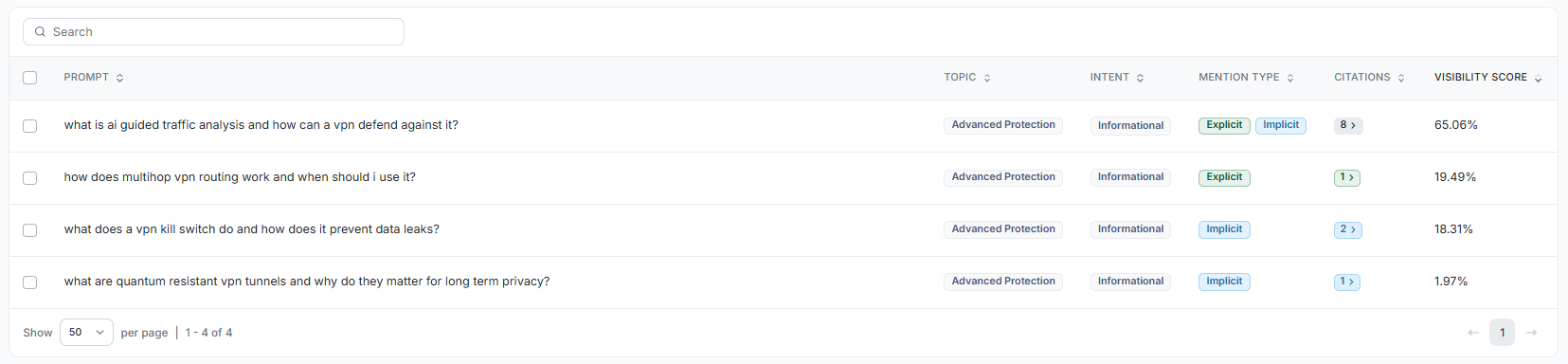
Sort your prompts by Visibility Score. The prompts at the bottom are questions where AI platforms rarely name or recommend you. Each one is a content opportunity.
In the example above, “Cheapest web hosting” scores 7.5. That tells you exactly where to focus. Open the prompt to read the answers and see which pages the AI linked to instead of yours.
2. Benchmarking against competitors
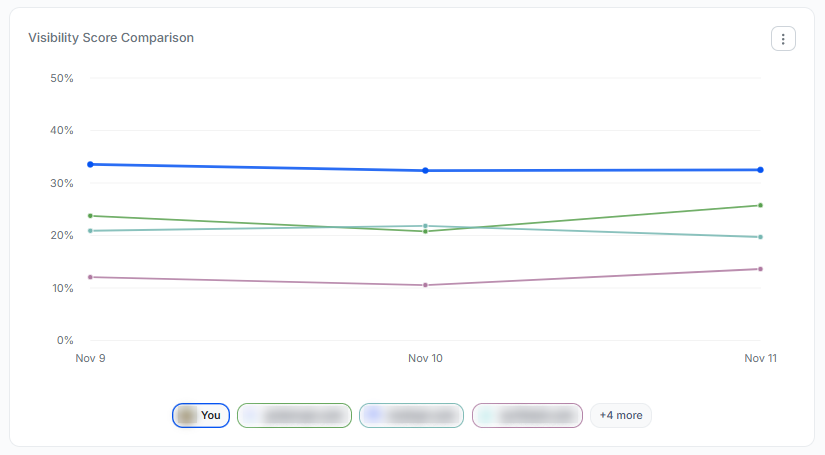
Every competitor is scored on the same answers, in the same way. So when a competitor scores higher than you, AI platforms are naming, recommending or citing them more often for your prompts.
Keep in mind that AI answers change from day to day. A gap of a few points on one day can be noise. Look at the trend over a week or more before you act on it.
3. Seeing which AI platform overlooks you
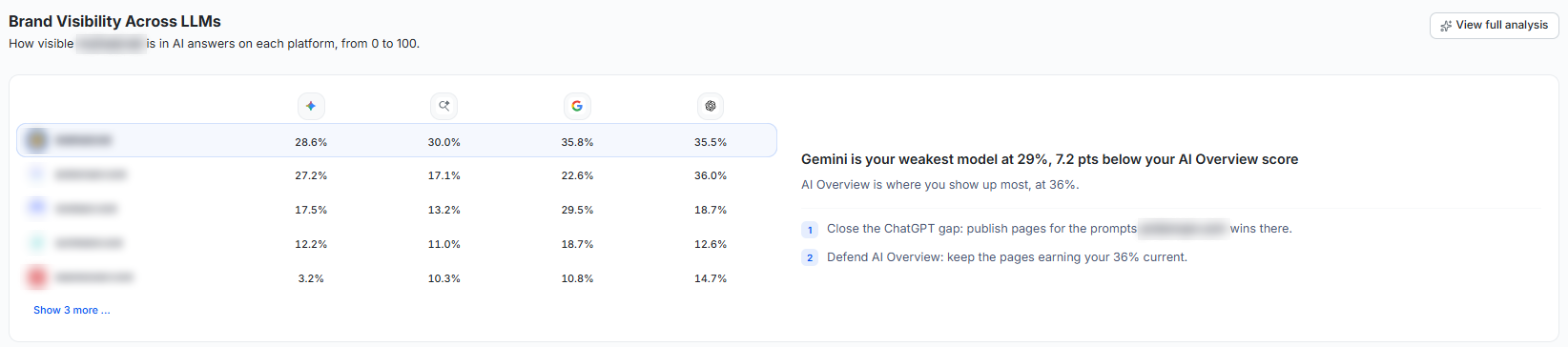
Your score can be very different from one platform to the next. In the example above, ChatGPT gives the brand 66.8 while Perplexity gives it 35.1. Filter by platform, or check the platform breakdown on your Overview, to see where you’re strong and where you’re missing.
4. Tracking your progress
After you publish new content or optimize existing pages for AI citations, watch how the score for those prompts moves. Compare weeks rather than single days. Scores from before 13 November 2026 use the old method, so start your comparison from that date.
What changed in your dashboard
If you’ve used Wellows for a while, you’ll notice a few changes from 13 November 2026:
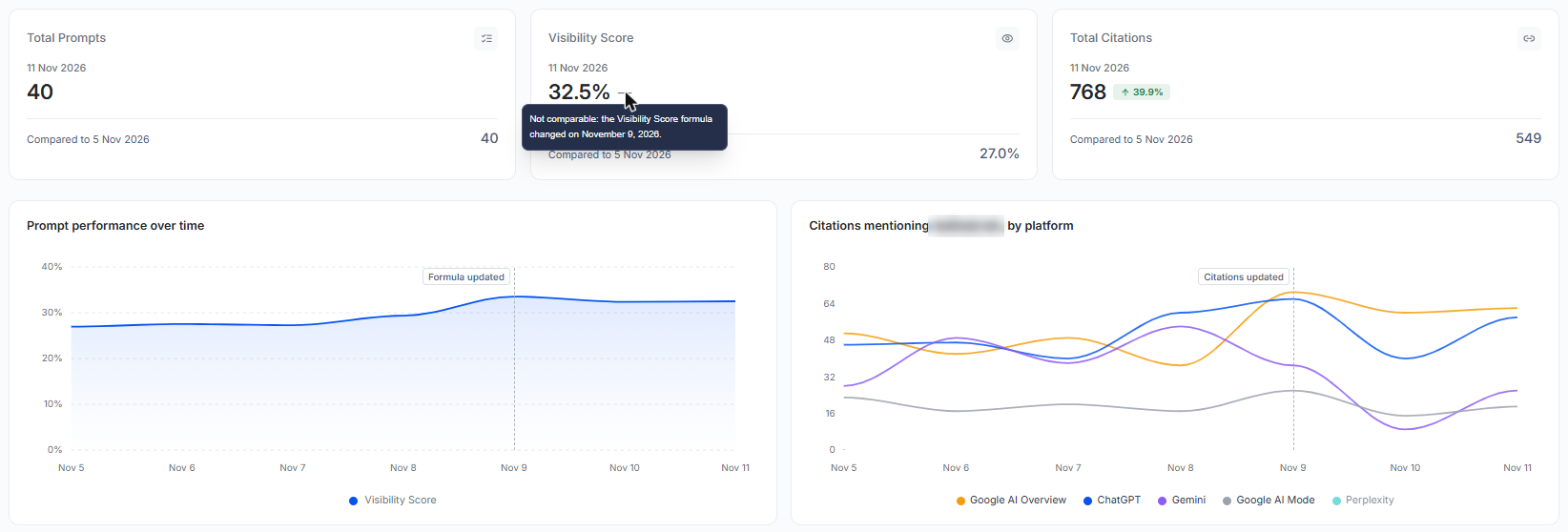
- A “Formula updated” marker. Charts show a marker on the day the new score started.
- “Not comparable” instead of a change. Old and new scores measure different things, so we never show a rise or fall between them. Where a change would cross that day, you’ll see “Not comparable”. After that day, changes show as normal.
- Your old scores stay as they were. Days before the change keep the score they had. We didn’t recalculate them.
- Citations come straight from the answer. We now read the links from the answer text itself, so the citations you see match what the AI actually linked to. Your citation counts may go up or down because of this.
Frequently asked questions
Here are the questions we expect to hear most often.
My visibility didn’t change. Why did my score change?
Because the way we measure it did. If AI tools often name and recommend you but rarely link to you, your score probably went up. If they link to your pages without naming you, it may have gone down. Neither means your visibility changed overnight.
Why does my chart say “Not comparable”?
Your date range covers days scored the old way and days scored the new way. The two measure different things, so a change between them would be misleading. Pick a range that starts on or after 13 November 2026 to see changes again.
Were my old scores recalculated?
No. Days before the change keep the scores they had. Only new days use the new score.
The AI recommended me first. Why isn’t my score 100?
To score 100, an answer has to name you, rank you first, speak positively, link to several pages on your site and several other pages that mention you, and name none of your tracked competitors. Most good answers miss at least one of those.
Can my competitor and I both score 100 on the same answer?
No. Only one brand can be recommended first, and when two tracked brands are named, they split the share of voice.
Why does a prompt with “No pages cited” still have a score?
“No pages cited” means the answer didn’t link to any page about you. It can still name and recommend you, and that earns points.
An AI platform didn’t answer one of my prompts. Does that count as zero?
No. A missing answer is left out of the average. If there are no answers at all for what you’ve selected, you’ll see a dash instead of a score.
Does it matter which page of my site gets linked?
No. Any page on your website counts the same, whether it’s your homepage or a blog post.
Why does my score move from day to day?
AI platforms don’t give the same answer every time, even to the same question. Small daily moves are normal. Look at the trend over a week or more.
Final thoughts
We built the Visibility Score to answer one question. When someone asks an AI about your category, does your brand show up, and how well?
Counting links answered part of that. Reading the whole answer gets a lot closer. If you have questions about your score, contact our team. New to Wellows? Book a demo to see your own Visibility Score.