AI search and LLMs don’t surface information the same way traditional search engines do. Instead of relying on a single top result, they pull from multiple trusted sources to reduce risk and improve accuracy.
Did you know?
That shift is exactly why a structured Citation acquisition checklist is necessary. It helps you understand what makes content safe, reliable, and repeatable for AI-generated answers, recommendations, and overviews.
Quick Citation Acquisition Checklist for AI Visibility
This checklist focuses on the conditions LLMs rely on when selecting sources for answers, recommendations, summaries, and comparisons.
1. Entity Clarity
- ☐ Consistent brand, product, or author identity
- ☐ Clear “what it is” definition in plain language
- ☐ No overlapping or conflicting entity names
- ☐ Dedicated entity page that stands alone as a reference
- ☐ Consistent naming across all external mentions
2. Citable Content Readiness
- ☐ Pages that answer one specific question clearly
- ☐ Explicit definitions, not implied explanations
- ☐ Short, extractable factual statements
- ☐ Claims written without marketing language
- ☐ Clear limitations and scope statements
3. Evidence and Verifiability
- ☐ First-party data, documentation, or methodology
- ☐ Publicly accessible sources supporting claims
- ☐ Original insights, not reworded competitor content
- ☐ Dates, versions, or ranges where accuracy matters
- ☐ Clear ownership of the information
4. Consistent Mentions From Reliable Sources
- ☐ Same facts repeated across multiple trusted sources
- ☐ Mentions in editorial, research, or expert contexts
- ☐ Citations from sites already used by LLMs
- ☐ Unlinked mentions matching canonical phrasing
- ☐ No conflicting third-party statements
5. Authority Signals Beyond Links
- ☐ Referenced for facts, not promotions
- ☐ Appears as an explanatory source, not just a brand
- ☐ Included in comparisons, guides, or research
- ☐ Quotes attributed to named experts
- ☐ Presence in non-SEO contexts (docs, Q&A, reports)
6. Structural Accessibility for AI Systems
- ☐ Clean HTML and crawlable pages
- ☐ Logical heading hierarchy
- ☐ Tables, lists, and definitions formatted clearly
- ☐ No critical info hidden behind scripts or gates
- ☐ Fast, reliable page loading
7. LLM-Facing Signals and Controls
- ☐ Clear robots and AI access rules
- ☐
llms.txtexplaining how content may be used - ☐ No contradictory AI usage signals
- ☐ Public license or usage clarity where relevant
- ☐ Stable URLs for citable content
8. Monitoring, Freshness, and Iteration
- ☐ Content updated when facts change
- ☐ Old versions archived or redirected
- ☐ Dates and versions clearly shown
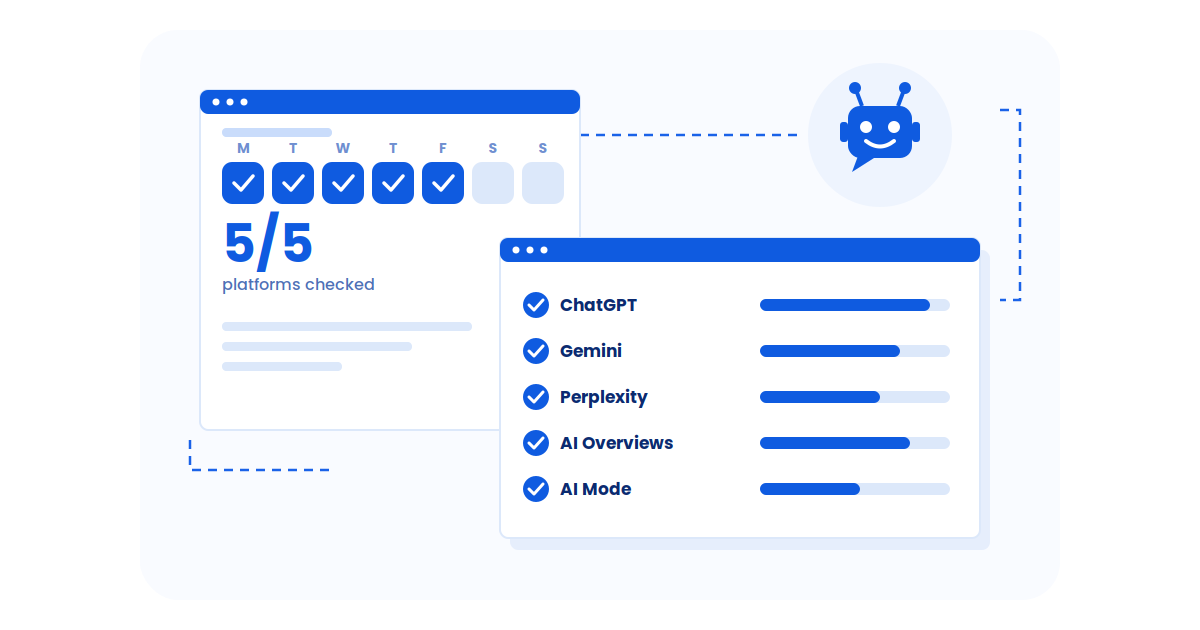
- ☐ Testing visibility in ChatGPT, Perplexity, Gemini
- ☐ Monitoring competitor citations and iterating
Why This Checklist Works for Acquiring Citations?
LLMs do not “rank pages.”
They select sources they trust to explain something accurately.
This checklist aligns with:
- How AI systems assess confidence and clarity
- How they reduce hallucination risk
- How they choose repeatable, defensible sources
If a page passes this checklist, it becomes easier for an LLM to quote, summarize, or recommend it. Using this checklist, you can optimize your website for LLM SEO.
What is Citation Acquisition?
Citation acquisition is the process of getting your brand, product, content, or expertise referenced as a trusted source across the web in ways that search engines and AI systems can verify and reuse.
It goes beyond backlinks and directories to include linked and unlinked mentions where your entity is cited for facts, explanations, or comparisons.
This is where SEO outreach plays a key role, placing your brand in relevant, high-trust content through reviews, expert contributions, comparisons, and thought leadership.

For AI search and LLMs, citations act as confidence and verification signals, helping systems decide who you are, what you are known for, and which claims are safe to repeat.
In short, citation acquisition makes your information clear, trustworthy, and reusable for both search engines and AI-generated answers. When your content is trustworthy, it also gets cited by LLMs like ChatGPT, Gemini, Perplexity, etc.
What Counts as a Citation Beyond Directories and Links?
A citation is any third-party reference that helps an AI system or search engine verify who you are, what you do, or which facts you are responsible for, even if no link is present.
Beyond directories and backlinks, citations include:
- Editorial mentions in articles, guides, and research where your brand or content is used as a source

- Expert quotes and attributions that associate facts or opinions with your name
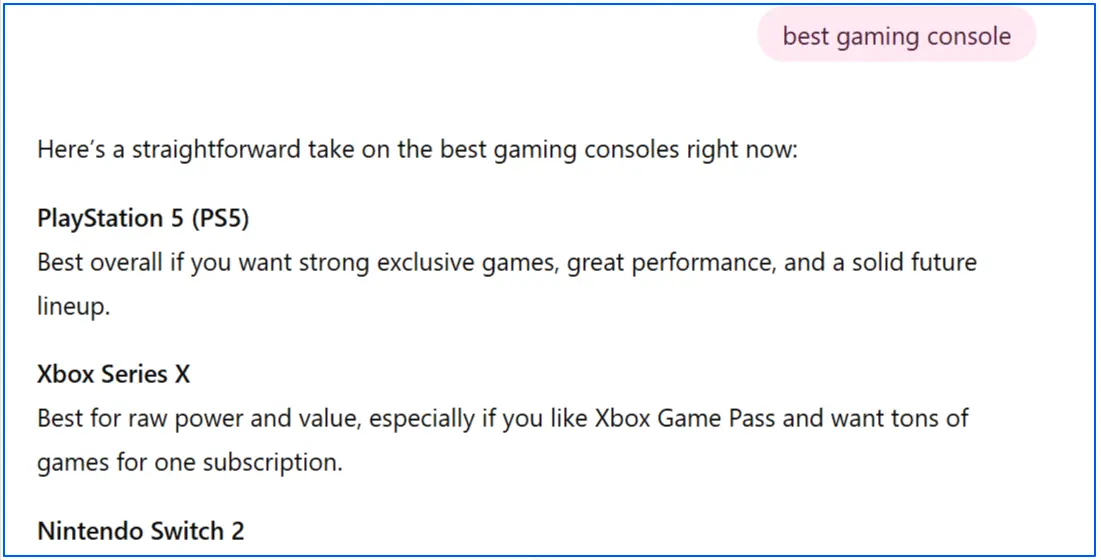
- Product and tool mentions in comparisons, reviews, and “best of” lists
- Unlinked brand mentions that repeat consistent descriptions or claims
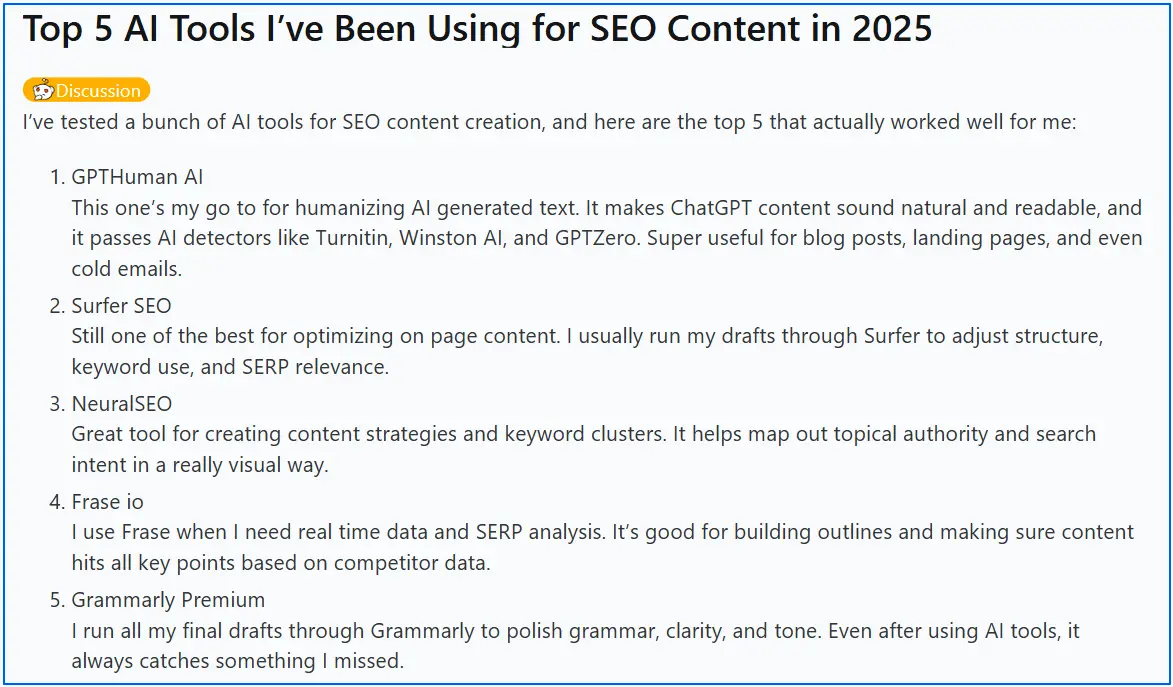
- Community references in credible forums, documentation, and Q&A platforms
- Dataset and report references where your data or methodology is cited
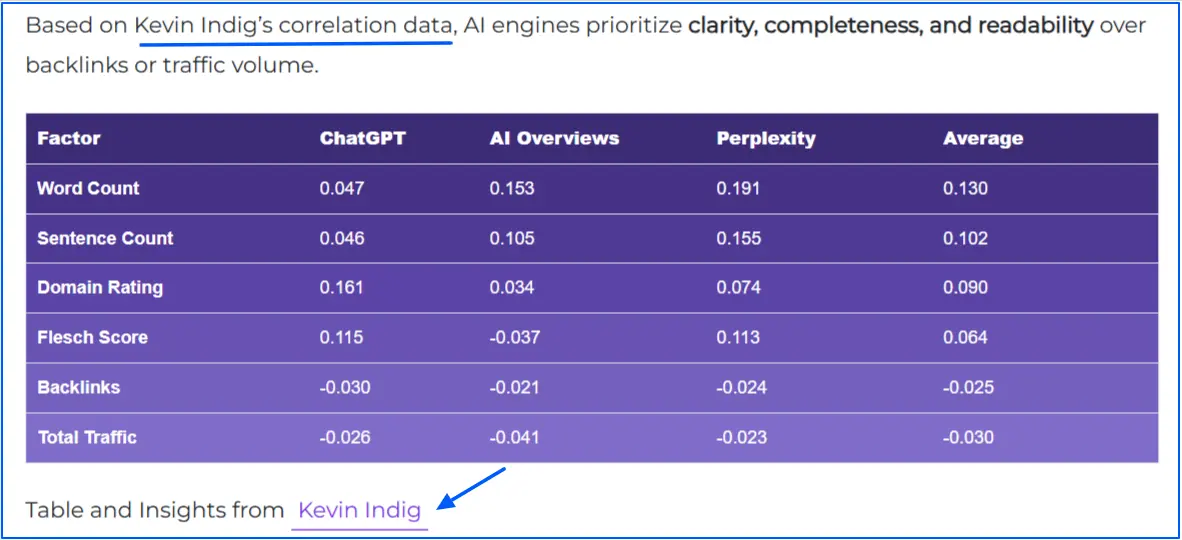
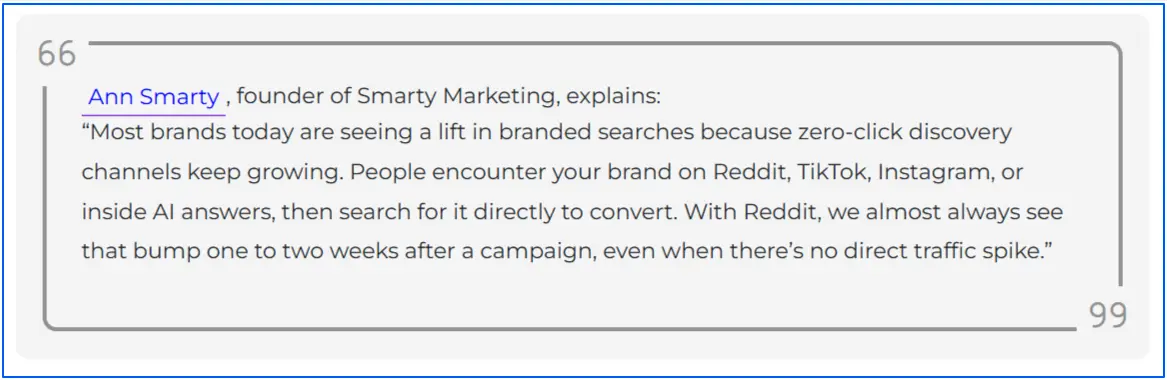
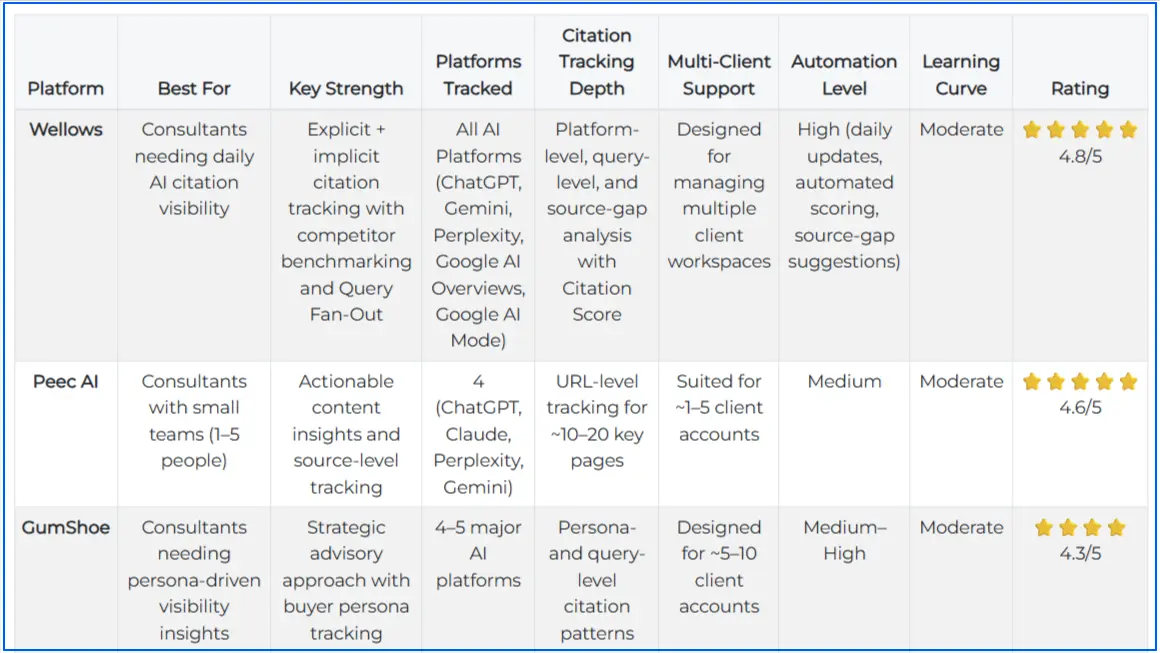
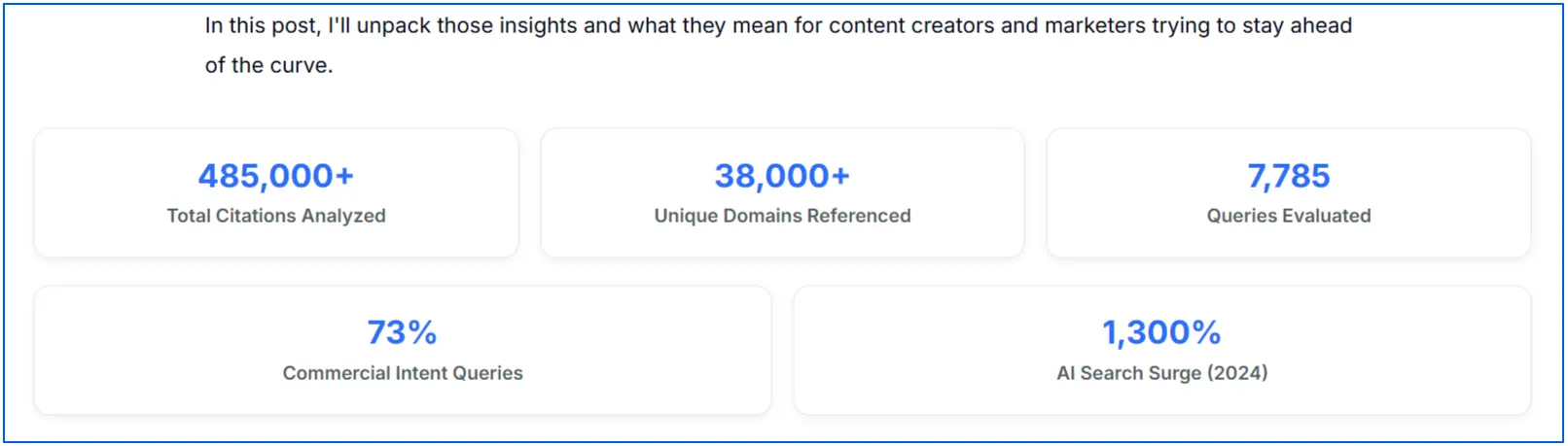
For LLMs, what matters is not the link itself but clarity, context, and corroboration. If a reference clearly explains who you are and why your information is reliable, it functions as a citation for AI visibility.
What are the 8 Key Steps to Build a Citation Acquisition Strategy for AI Visibility?
Building citations for AI visibility is less about promotion and more about making your information safe to reuse. The 8 steps shared below reflect how LLMs evaluate trust, clarity, and consistency before citing a source.
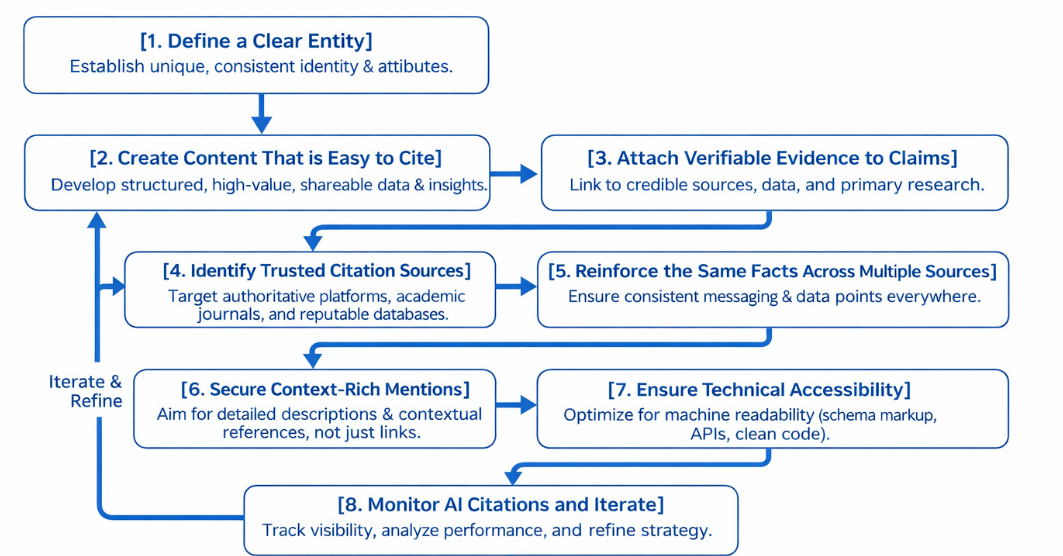
1. Define a Clear Entity
AI systems need a stable identity to reference. If your name, purpose, or positioning is unclear, models avoid citing you to reduce attribution errors.
If your product is called “Pulse,” define it consistently as “Pulse, an AI monitoring tool for SaaS infrastructure,” rather than using the name alone.
2. Create Content That is Easy to Cite
LLMs prefer content that answers one question clearly and can be reused without interpretation. Broad or heavily promotional pages are harder to extract facts from. When doing Generative Engine Optimization for your blogs, aim for clear, extractable content.
A page titled “What Is AI Infrastructure Monitoring?” with a clear definition and scope is more citable than a generic thought-leadership post.
3. Attach Verifiable Evidence to Claims
AI systems avoid repeating claims that cannot be verified externally. Evidence lowers uncertainty and increases reuse across AI answers.
Instead of stating “Our tool improves performance,” publish a benchmark page showing how response times changed across measured deployments.
4. Identify Trusted Citation Sources
Not all platforms are treated equally by AI systems. Sources with editorial oversight and topical relevance are more likely to be referenced.
Expert blogs, documentation sites, and comparison pages are cited more often than open submission directories.
5. Reinforce the Same Facts Across Multiple Sources
LLMs look for consensus across independent sources. Repeated, consistent information is safer to repeat than single mentions.
If three separate reviews describe your product using the same definition, AI systems are more likely to adopt that wording.
6. Secure Context-Rich Mentions
Mentions without explanation create ambiguity. Context helps AI systems understand why an entity is relevant to a topic.
“Pulse is an AI monitoring tool for SaaS infrastructure that detects anomalies in real time” is more useful than a standalone brand mention.
7. Ensure Technical Accessibility
Even high-quality content will not be cited if AI systems cannot extract it reliably. Structure and accessibility directly affect reuse.
Pages with clear headings, lists, and plain HTML are easier for AI systems to interpret than content hidden behind scripts.
8. Monitor AI Citations and Iterate
Citation acquisition is not static. Observing how AI systems reference your content helps you refine what gets cited.
If AI tools cite your comparison page but ignore your overview page, the comparison likely provides clearer or more verifiable information.
Why Am I Not Getting Cited by AI Search Engines Even though I Rank Well on Google?
Ranking well on Google means your page is relevant for a query. Being cited by AI engines requires something different; your information must be safe, clear, and reusable without risk.
Here are the 7 reasons why your ranked content is not getting cited by AI platforms:
- Your Content Is Optimized for Rankings, Not Citability: SEO-focused pages often target multiple keywords, mix topics, or use persuasive language. LLMs avoid citing content that requires interpretation or filtering. For example, a long-form blog optimized for several keywords may rank well, but an AI system prefers a page that clearly defines one concept in simple terms.
- Your Claims Lack Clear Evidence or Attribution: AI systems hesitate to repeat statements that are not backed by verifiable sources or first-party data. “Industry-leading performance” is unlikely to be cited, while a clearly documented benchmark or methodology is safer to reuse.
- Your Entity Is Ambiguous or Inconsistently Described: If your brand, product, or author name is used differently across sources, AI systems struggle with attribution and often avoid citing you.
- Your Content Is Hard for AI Systems to Extract: Pages that rely heavily on JavaScript, gated content, or poorly structured layouts are difficult for AI systems to parse. Key definitions hidden inside images or interactive components are less likely to be cited than plain-text explanations.
- You Lack Third-Party Validation: AI engines look for consensus across independent sources. Ranking alone does not prove that your information is widely accepted. If only your site makes a claim and no external sources repeat it, AI systems are less likely to reuse it.
- Your Page Explains Too Much at Once: Broad, comprehensive pages can dilute clarity. LLMs prefer focused answers that can stand alone. For example, a page titled “Everything About Cloud Security” is harder to cite than “What Is Zero Trust Security?”
- Your Content Is Outdated or Version-Unclear: AI systems avoid citing information that may no longer be accurate or lacks visible freshness signals. For Answer Engine Optimization in LLMs, make sure to timely update the stats and data in your content.
Quick Diagnostic: Why AI Engines Skip Your Content
Use this checklist to identify common blockers:
☐ My page tries to answer multiple questions at once
☐ My claims use marketing language instead of facts
☐ Key statements lack visible evidence or sources
☐ My brand or product name is inconsistent across the web
☐ Important information is hidden behind scripts or visuals
☐ No independent third-party sources repeat my claims
☐ The content is undated or lacks version/version history
If three or more apply, your content is likely hard for AI systems to cite, even if it ranks well.
What External Sources and Backlinks Do I Need to Improve My AI Citation Authority?
To build AI citation authority, you need external sources that do two things:
(1) Corroborate your facts and entity identity across the web, and
(2) Help AI systems find you during multi-source retrieval, not just traditional rankings.
Below is a practical, priority-ordered list of what to pursue.
1) Sources That Define You as an Entity
These sources help AI systems confidently answer “who/what is this?” and reduce ambiguity by providing consistent entity definitions.
- Wikidata or similar knowledge-base entries (when appropriate)
- Company profiles on high-trust databases and industry platforms
- Founder/author profiles on reputable speaker, contributor, and community pages
- Partner and integration directories (marketplaces, app stores, partner listings)
2) Sources That Repeat Your Claims With Context
AI citation is often a “consensus” decision. Your key claims should appear in more than one independent source, with clear context.
- Comparison pages (best tools, alternatives, comparisons)
- How-to guides and implementation tutorials
- Industry reports and research roundups
- News coverage that explains what happened and why it matters
- Documentation references (APIs, specs, integrations)
3) Backlinks That Actually Improve AI Citation Authority
Not all backlinks help with AI visibility. Prioritize links that are meaningful in context and connected to verifiable information.
Best backlink types for AI visibility
- Editorial backlinks inside explanatory content (guides, analysis, definitions)
- Resource-page backlinks listing canonical references (toolkits, glossaries, standards)
- Links to first-party evidence (benchmarks, datasets, methodology pages)
- Partner backlinks from verified collaboration pages
- Academic or conference backlinks (if your space supports it)
Low-impact for AI citations
- Sitewide footer links
- Generic directories with no moderation
- Paid link networks
- Thin guest posts with no real substance
- Spammy “best X” lists
4) Community Sources That AI Engines Commonly Retrieve
Community sources can help when they contain high-signal explanations. The goal is not mentions, it is detailed, factual context that can be reused.
- Reddit threads with specifics (use case, pros/cons, alternatives, constraints)
- Review platforms with consistent, detailed reviews (not one-liners)
- Q&A sites with factual answers that reference your docs or proof pages
5) Evidence Sources That Make You “Safe to Cite”
AI systems hesitate to repeat claims that lack verification. Make it easy to validate your statements by building authority around your proof assets.
- Your original data (benchmarks, surveys, datasets)
- Your documentation (product specs, changelogs, APIs)
- Your methodology pages (how results were measured and validated)
A Simple External Source Plan You Can Follow
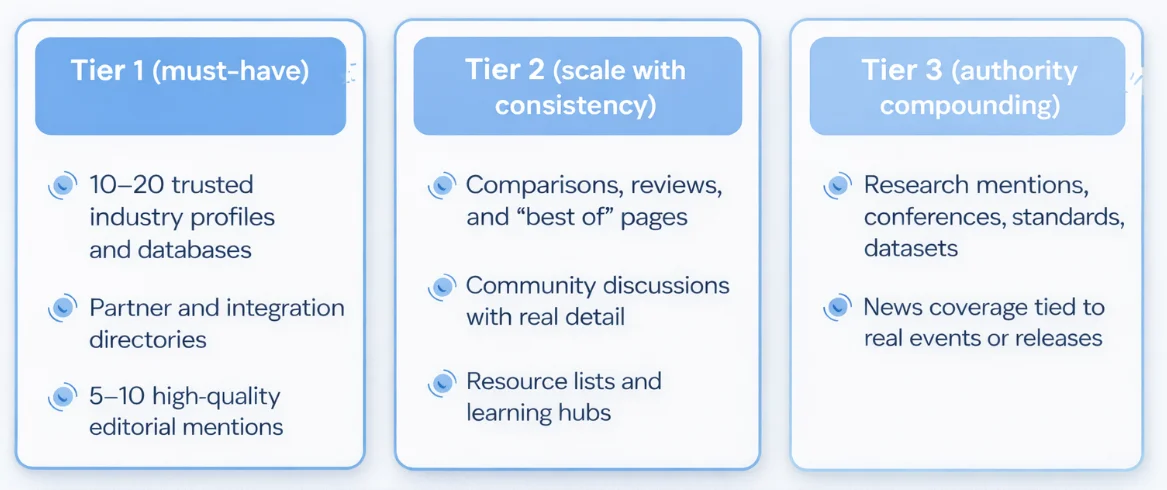
Quick Checklist: What You Actually Need
- ☐ At least 3–5 trusted sources that define your entity clearly
- ☐ At least 5–10 independent sources repeating your key positioning accurately
- ☐ At least 2–3 sources citing your proof pages (data, methodology, docs)
- ☐ At least 1–2 comparison/review sources that place you in a category
- ☐ A consistent presence across communities where your buyers research
How Often Should I Update My Content to Maintain LLM Citations and Visibility?
LLMs do not reward frequent updates for their own sake. They reward accuracy, stability, and visible freshness. Updates should happen when information changes or risks becoming unreliable.
| Content Type | Recommended Update Cadence | Why It Matters for LLM Citations |
|---|---|---|
| Definitions and “What Is” pages | Every 6–12 months | Keeps core explanations accurate and safe to reuse. |
| Benchmarks, stats, and data pages | Every 3–6 months or when data changes | Prevents AI systems from citing outdated figures. |
| Product features and pricing | Immediately after changes | Reduces the risk of AI repeating incorrect details. |
| Comparisons and “best of” pages | Every 2–3 months | AI recommendations depend on current alternatives and context. |
| Regulatory, policy, or compliance content | As changes occur | Outdated guidance increases citation risk and user harm. |
| Evergreen educational content | Annual review | Confirms continued accuracy without disrupting stable references. |
Did you know?
Can I Check If My Competitors are Getting More AI Citations than My Business? [6 Easy Steps]
Yes, you can. Understanding whether competitors are being cited more often by AI systems helps you identify visibility gaps, not just ranking gaps. This is about tracking how frequently brands are surfaced, referenced, or relied on in AI-driven search experiences over time.
Wellows compares your AI visibility against competitors and highlights patterns such as:
- Which brands are gaining AI exposure
- Which brands are losing presence
- How stable or volatile each brand’s AI visibility is
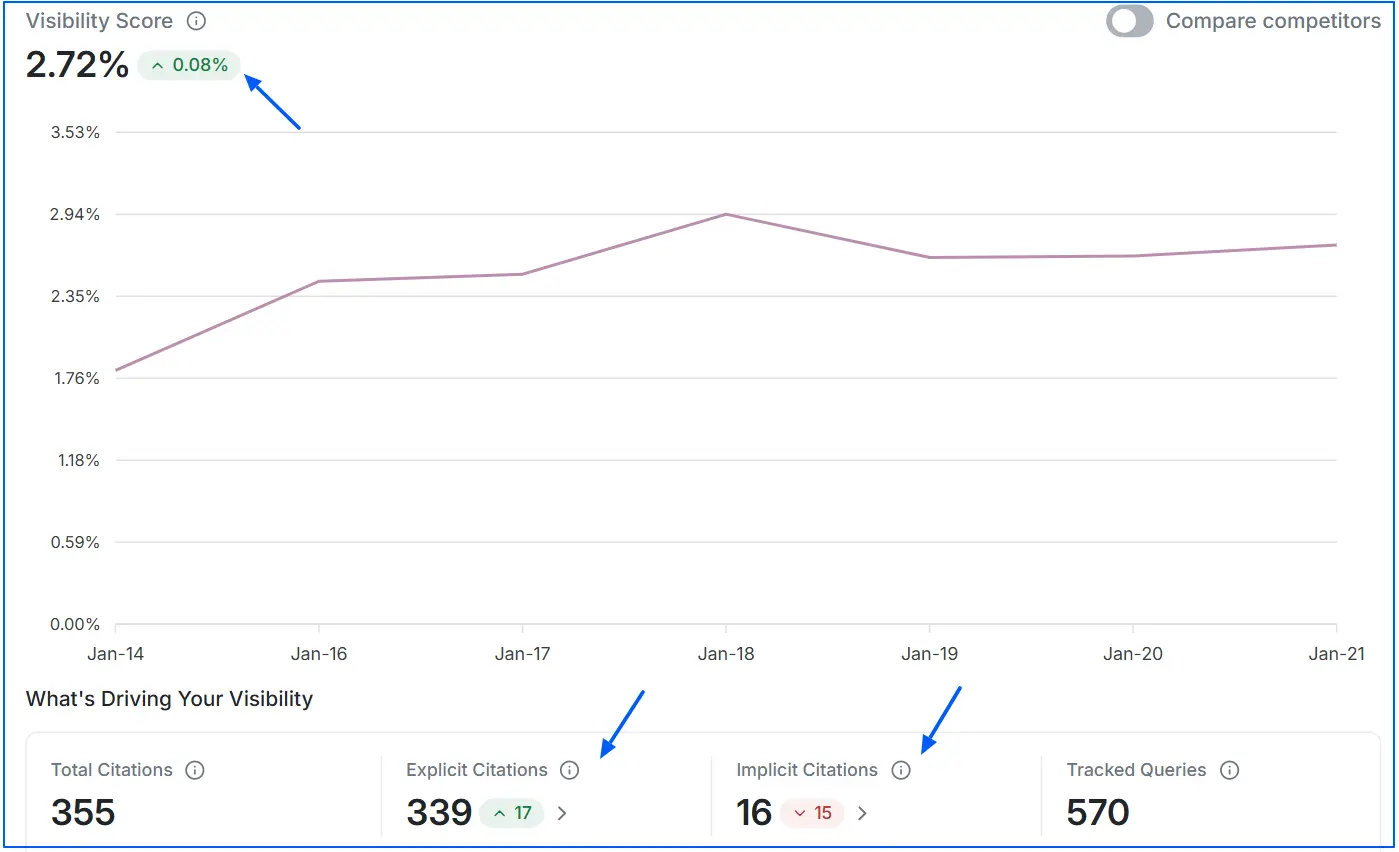
Step 1: Check Your AI Visibility and Citations
Start by opening the Wellows Dashboard and navigating to the Overviews section. This view shows your visibility score, which reflects how often your brand appears in AI-generated search results.
Step 2: Compare Against Competitors
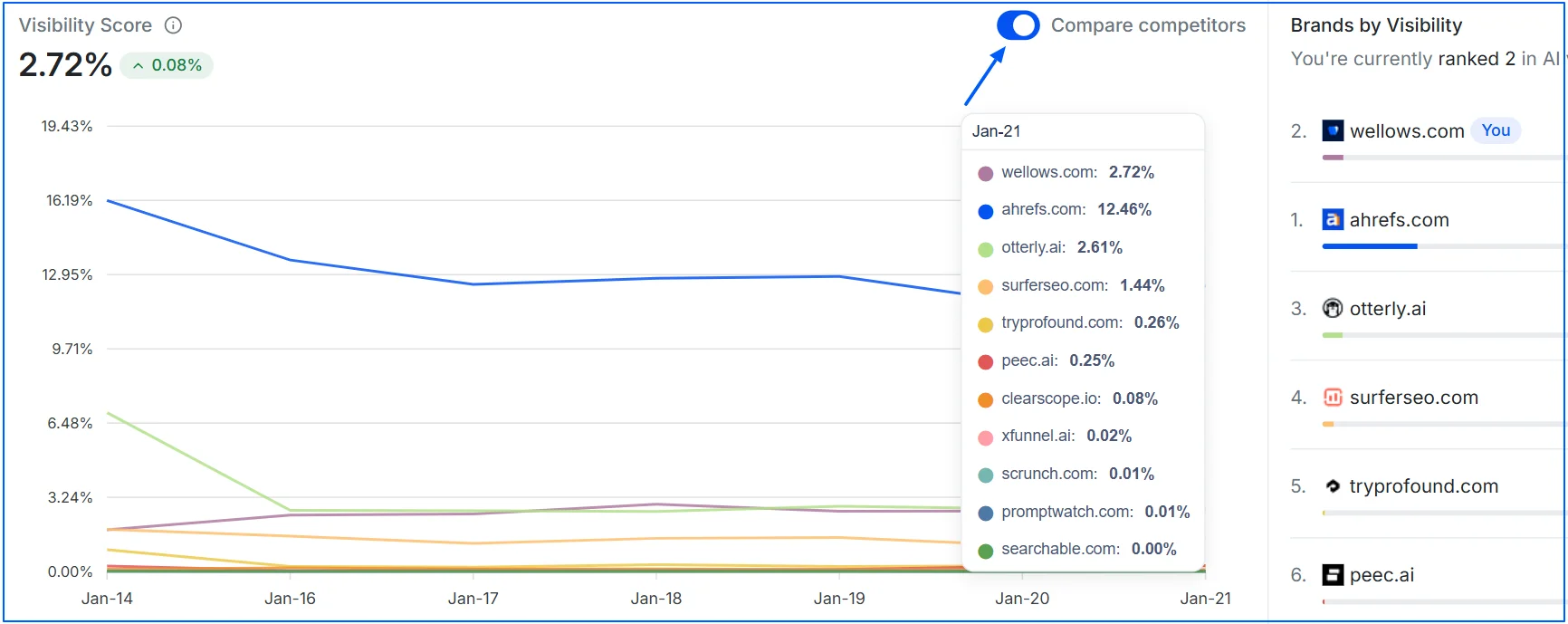
Enable the competitor toggle to check visibility insights for tracked competitors. This allows you to immediately see whether competitors are appearing more frequently or consistently than your brand in Google AI Overviews, AI Mode, ChatGPT, Perplexity or Gemini.
Step 3: Analyze a Specific Competitor
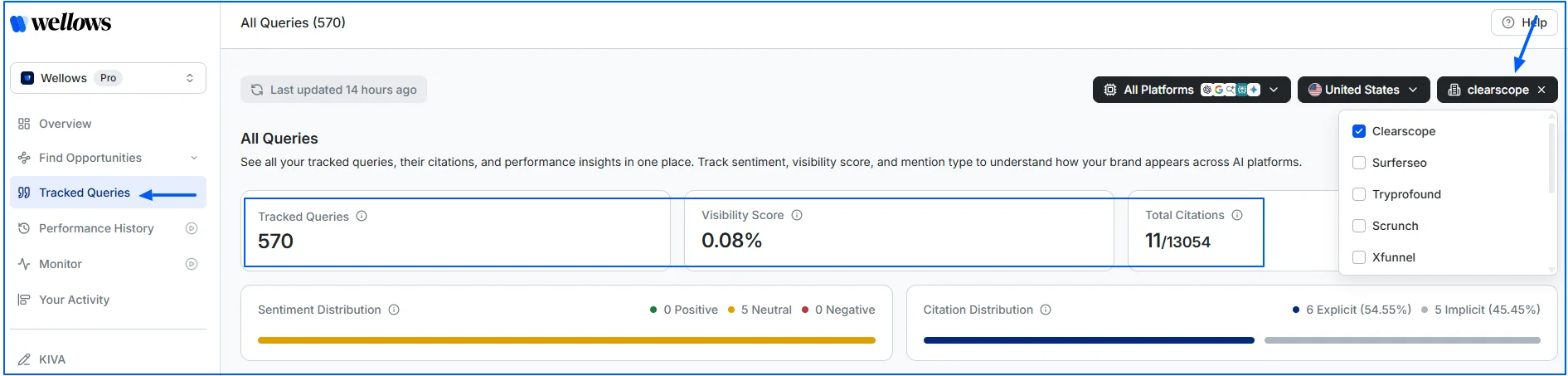
To drill deeper, go to Tracked Queries and select a specific competitor from the list. For example, selecting Clearscope displays its visibility score, showing how often it is cited or surfaced by AI platforms across tracked queries.
This helps you identify which competitors AI systems rely on more heavily for certain topics.
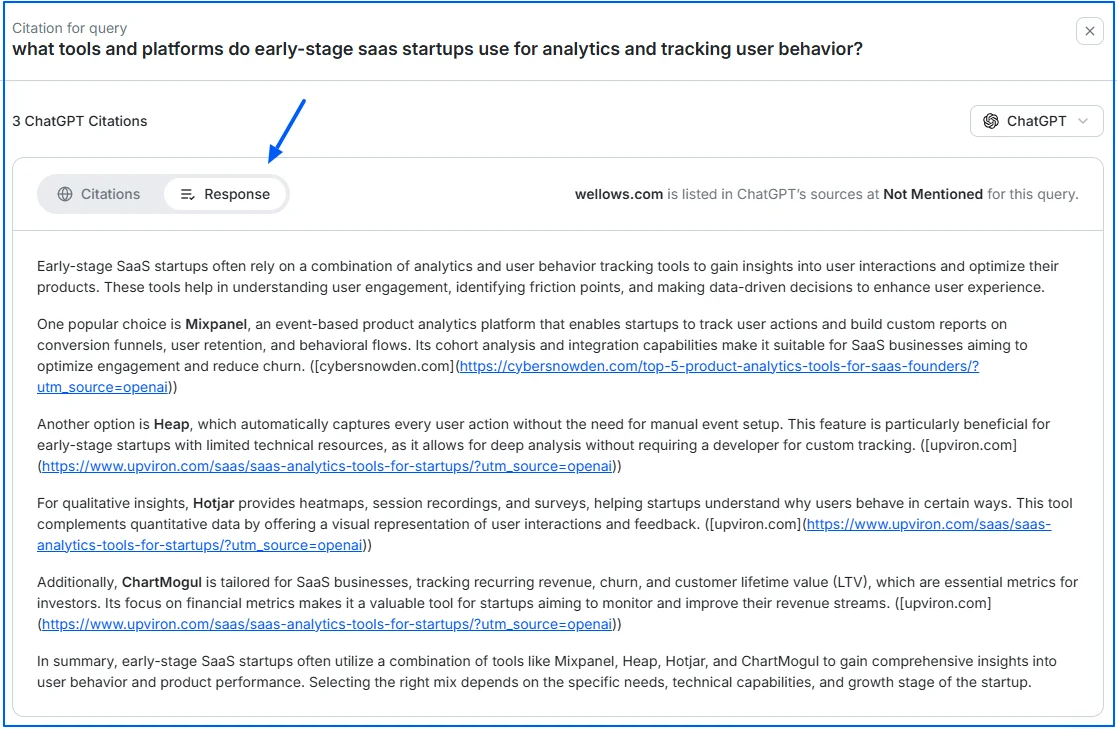
Step 4: See What Content AI is Actually Using
Next to each tracked query, click the Citations option. This reveals the exact content AI platforms are pulling from when generating answers.
Seeing the specific pages or sections being used makes it easier to understand why a competitor is being cited instead of you.
Step 5: Use Filters for Better Insights
Wellows allows you to break down visibility insights using different filters, including:
- Topics
- Search intent
- Mention type (explicit vs implicit)
- Sentiment (positive, neutral, or negative)
These filters help you determine whether competitors are winning due to better definitions, stronger evidence, clearer positioning, or more favorable sentiment.

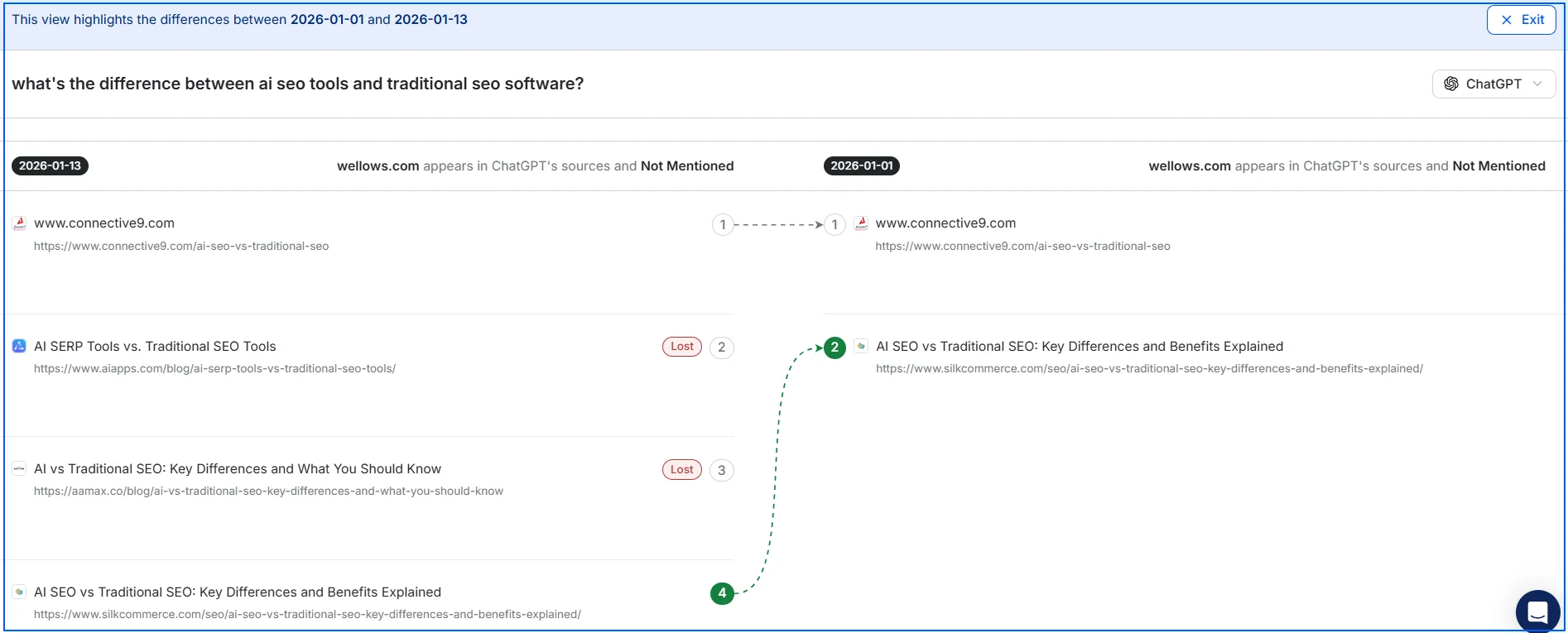
Step 6: Track Visibility Performance Over Time
Use the Performance History feature to monitor how visibility scores change over time for both your brand and competitors.
This makes it possible to see whether recent content updates, launches, or citation efforts are improving AI visibility and citations, or whether a competitor’s presence is becoming more dominant.
How Can I Use Reddit and Review Platforms to Increase My LLM Citation Potential?
LLM citation tracking helps uncover how often Reddit and review platforms are cited, reflecting their importance as sources of real-world consensus, nuance, and lived experience.
AI systems frequently retrieve these sources to validate claims, compare options, and understand sentiment, especially when official content feels promotional.
The goal is not promotion. It is credible, specific, and repeatable context. Here are the 5 pro tips on using Reddit and review platforms to increase your LLM citations:
- Focus on Explanatory Discussions: LLMs favor threads that explain use cases, comparisons, and trade-offs. Prioritize Reddit discussions that answer practical questions rather than promotional posts.
- Contribute Verifiable Information: Add factual details that stand on their own, such as how a tool works, where it performs well, and where it has limitations. Explanatory content is safer for AI systems to reuse.
- Encourage Depth in Reviews: Detailed reviews describing reasons, outcomes, and alternatives carry more weight than simple star ratings. AI systems value descriptive feedback over positivity.
- Align With Community Language: Pay attention to how users describe your product or category. Consistent phrasing across discussions helps AI systems understand and reuse that context.
- Avoid Promotional Behavior: Self-promotion or defensive replies reduce trust. Balanced, transparent participation improves long-term citation potential.
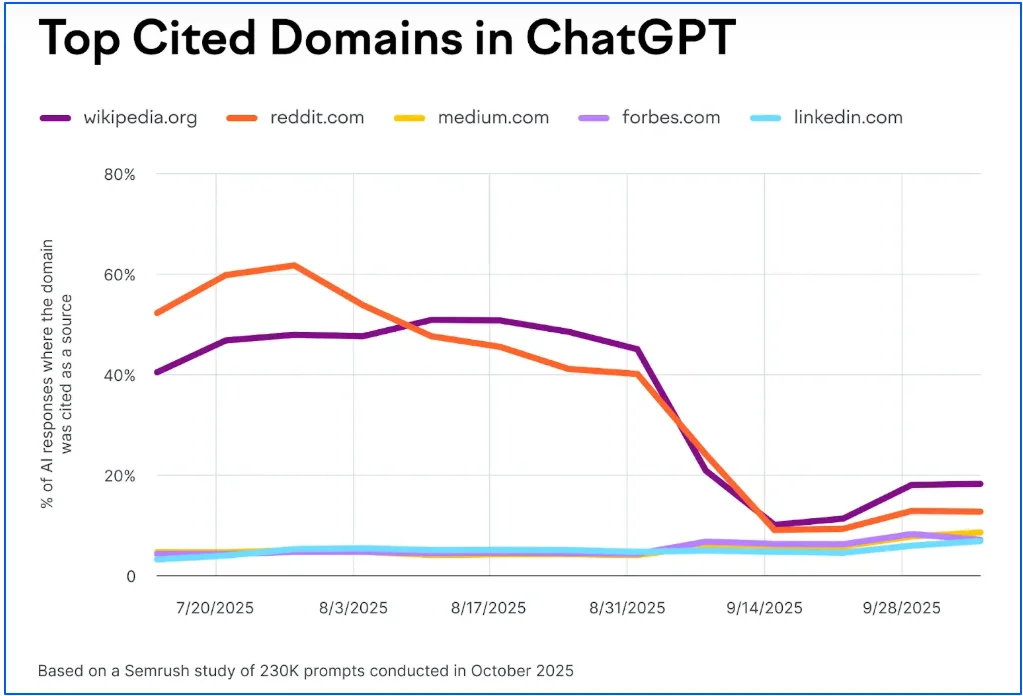
In a prompt-level tracking study, ChatGPT cited Reddit in close to 60% of prompt responses in early August 2025, then dropped to around 10% by mid-September 2025.
How Do I Optimize My Product Pages Specifically for AI Shopping Features and Citations?
AI shopping features and LLM-driven recommendations prioritize clarity, comparability, and verification. Product pages that read like marketing copy are harder to cite than pages that function as reliable references.
Below are the 6 pro tips on how to optimize your product pages for AI shopping features and citations:
- Define the Product Clearly: AI systems need a precise definition to cite or recommend a product. Start with a plain-language description of what the product is, who it’s for, and the problem it solves.
- Surface Key Attributes Clearly: AI shopping features compare products using structured attributes. Make features, pricing, integrations, and limitations easy to scan using lists or tables.
- Back Claims With Evidence: AI systems avoid citing unverified claims. Support key statements with benchmarks, screenshots, documentation, or methodology pages. If competitors are cited more often, Wellows can help reveal whether their pages provide clearer or more verifiable proof.
- Use Comparison-Friendly Language: AI shopping tools frequently generate “best for,” “alternatives,” and comparison answers. Explain where your product fits, where it doesn’t, and how it differs from common alternatives.
- Keep Pricing and Details Current: Outdated pricing or feature information increases citation risk. Update product pages immediately after changes and show visible update signals.
- Ensure AI-Friendly Page Structure: AI systems must be able to extract information easily. Keep content crawlable, text-based, and well-structured with clear headings. If Wellows shows AI citing competitor pages instead of yours, structure is often the differentiator.
Should I Create a Wikipedia Page to Improve My Chances of Being Cited by ChatGPT?
Wikipedia can help AI systems understand entities, but it is not required for LLM citations and does not work without existing authority.
- Independent, reliable sources already cover your brand or product
- The page meets Wikipedia notability guidelines
- Content is factual, neutral, and well-maintained
- Wikipedia acts as confirmation, not promotion
- Coverage relies on press releases or self-published content
- The page reads like marketing copy
- Notability is weak or forced
- The page exists without strong third-party consensus
Focus first on earning independent editorial coverage, clear reference pages, and consistent third-party mentions. Once those signals exist, a Wikipedia page becomes a supporting asset rather than a risk.
Can I Get My Press Releases and News Coverage Cited More Frequently by AI Engines?
Yes, but AI engines rarely cite press releases just because they exist. They cite coverage that is specific, verifiable, and repeated across independent sources. The goal is to make your announcements easy to extract and safe to reuse.
Make the Release “Cite-Ready”
- Lead with one clear, factual headline statement
- Use concrete details: who, what, when, where, why
- Add numbers only when you can support them publicly
- Avoid vague claims like “industry-leading” or “revolutionary”
Attach Proof Assets AI Can Trust
- Publish a matching announcement page on your site with a stable URL
- Link to documentation, changelogs, benchmarks, or methodology
- Add a short FAQ section answering likely questions
- Keep key facts in plain text, not images
Improve the Chances of Independent Pickup
- Offer something editors can use: data, demo access, screenshots, expert quotes
- Provide clear context: what changed, who it impacts, why it matters
- Make follow-up angles easy (use cases, customer stories, comparisons)
Create “Consensus,” Not a Single Mention
- Aim for multiple independent mentions using consistent facts
- Ensure your entity and product description is the same everywhere
- Track which outlets or platforms are repeatedly cited in AI results
Optimize for Extractability
- Use short paragraphs, clear subheadings, and bullet lists
- Avoid embedding key details inside PDFs or gated pages
- Keep naming, dates, versions, and pricing explicit
Track What AI Engines Are Actually Using
- Check whether AI Overviews cite the release, the coverage, or your announcement page
- Compare your citation footprint with competitors using Wellows
- Double down on formats that consistently get cited (FAQs, docs, benchmarks)
Key takeaway: You can increase AI citations from press and news by making announcements verifiable, extractable, and supported by proof pages, then driving multiple independent sources to repeat the same accurate facts.
Read More Articles
- How Entity-Based Content Stands Out in LLMs & Why Does It Matter for SEO
- Why Structured SEO Briefs Are the New Foundation of AI Search Success
- What is LLM Seeding and How Can it Help in Generative Engine Optimization?
- How to Design Content Briefs for GEO?
- Can GSC Data Guide Your GEO Strategy?
- How Will Google’s AI Mode Transform Traditional SEO Practices?
- Top Content Marketing Statistics in 2025
- How to Become a Trusted Source in AI Search
FAQs
Use clear, consistent positioning and verifiable proof so AI can easily understand and compare your business. Wellows turns complex visibility data into clear insights that help your brand earn trust and stand out in AI-driven recommendations and best-of lists.
Run a fixed list of tracked queries weekly, log whether you appear, and record which URLs are cited when citations are shown. Use Wellows to monitor changes and spot which pages are being picked up.
Citations help LLMs reduce uncertainty by relying on sources that are consistent and verifiable across the web. The more a claim is corroborated, the safer it is for an AI system to repeat and cite it.
Use a tight definition at the top, followed by clear sections, bullet lists, and short extractable sentences so AI systems can easily parse and trust the page. You can use Wellows to create content briefs aligned with AI search visibility and brand objectives.
Final Thought
AI visibility depends on whether your content is clear, verifiable, and safe to reuse, not just where it ranks. That’s why a structured approach matters.
This Citation acquisition checklist helps you align your content with how LLMs choose sources, validate claims, and decide what to cite. When you focus on clarity, evidence, and consistent third-party reinforcement, citations become repeatable rather than accidental.