Most brands are still chasing rankings. AI systems are already deciding which content gets cited in the answers people actually read.
Organic click rates dropped 61% for queries with AI Overviews. Meanwhile, 58% of consumers now rely on AI for product recommendations, up from 25% in 2023. And cited brands see 35% more organic clicks and 91% more paid clicks than those left out.
The bigger shift is who gets cited. Wellows analyzed 485,000 ChatGPT citations across 38,000 domains and found 52% go to niche, long-tail sources. It’s not authority anymore, it’s content structure.
That is what AI content optimization strategies are built to fix. Wellows’ AI content optimization feature scans your entire domain before recommending anything, so you strengthen authority instead of splitting it.
This guide covers the 13 strategies that drive citations, with real examples, how can you use Wellows to execute you content optimization strategies, and case studies showing what actually works.
TL;DR — 13 AI Content Optimization Strategies
- 1. Lead with direct answers (30 to 50 words): Place a concise, standalone response at the very start of every article and section. 44.2% of all LLM citations come from the first 30% of a page
- 2. Structure for parsability: Use question-format H2 and H3 headings, short paragraphs of two to three sentences, bullet points, and comparison tables. Pages with well-organized headings are 2.8 times more likely to earn AI citations
- 3. Target user intent, not just keywords: Write for the reasoning behind a search using natural, conversational phrasing that mirrors how people actually ask questions to AI platforms
- 4. Build topical authority through clusters: Cover a subject comprehensively across multiple related articles. AI systems reward breadth of expertise, not just depth at one URL
- 5. Deploy schema markup: Implement FAQPage, HowTo, and Article schema so AI systems can extract answers without having to infer the relationship between questions and responses
- 6. Define your brand as a recognized entity: Clearly state what your brand does, who it serves, and why it matters across every key page so AI systems can categorize and cite you with confidence
- 7. E-E-A-T signals matter more than ever: Incorporate unique data, firsthand insights, and original research into your content. AI systems favor sources that demonstrate real experience and expertise that cannot be replicated by generic writing
- 8. Keep sentences short and HTML clean: Sentences under 20 words parse more reliably across AI systems. Use clean HTML structure, avoid broken links, and ensure your key content is never hidden behind JavaScript rendering
- 9. Add multimedia with specific context: Pair every visual with descriptive alt text that contains an actual fact or insight AI systems can extract independently
- 10. Refresh content regularly: AI systems prefer content that is 25.7% fresher than what traditional search results cite. Update statistics, examples, and timestamps on a consistent schedule
- 11. Earn third-party citations on trusted platforms: Brands with earned mentions across reputable sites, Reddit, and Quora are roughly four times more likely to be cited by AI systems
- 12. Use specific facts over vague claims: Pages with a high fact density ratio are 4.2 times more likely to be cited by ChatGPT. Replace marketing language with specific, attributable data points
- 13. Monitor AI performance and adjust: Track referral sessions from ChatGPT.com and Perplexity.ai in GA4, run regular prompt checks across major AI platforms, and adjust content based on what competitors are being cited for instead of you
What Is AI Content Optimization and Why Does It Matter for SEO in 2026?
AI content optimization is structuring your content so AI systems can retrieve it, trust it, and include it in generated answers. AI Overviews now appear in 48% of all Google searches, with coverage exceeding 70% on informational queries where most content-driven businesses compete.
If your content is not being cited, you are invisible in nearly half of all relevant searches. Not ranking lower. Invisible.
How AI Content Optimization Differs From Traditional SEO?
Traditional SEO earns rankings through accumulated authority signals. Backlinks, keyword placement, domain authority.
AI content optimization is about immediate usability. Can an AI system extract a clean, reliable answer from your content right now? Usually, an AI content optimization tool helps identify whether your page is structured clearly enough for AI search.
Ahrefs data from early 2026 shows only 38% of pages cited in AI Overviews rank in the top 10 for the same query. Seven months prior, that overlap was 76%. The decoupling is accelerating.
| Factor | Traditional SEO | AI Content Optimization |
|---|---|---|
| Primary goal | Rank in search results | Get cited in AI answers |
| Key signals | Backlinks, keyword placement | Answer clarity, entity recognition |
| Success metric | Keyword rankings | Citation frequency and share of voice |
| Content format | Keyword-optimized pages | Answer-first, structured sections |
| Authority signal | Domain authority and backlinks | Branded web mentions (correlation 0.664 vs backlinks 0.218) |
The Gap Most Brands Are Missing
A brand can rank at position one and be completely absent from AI answers. Another at position 21 gets cited on every relevant prompt. Ranking algorithms reward authority built over years. AI retrieval rewards clarity, answer directness, and structural parsability right now.
The brands falling behind are not doing bad SEO. They are optimizing for the wrong era. Many teams quietly feel that content optimization feels way harder than SEO is becoming the new normal, and understanding the reasons behind that shift is the first step to fixing it.
13 AI Content Optimization Strategies That Actually Work in 2026 [With Examples]
Here are 13 AI content optimization strategies with details and examples:
1. Lead With the Answer in the First 30 to 50 Words
If your article opens with context before answering the core question, AI retrieval systems move on before reaching your actual answer.
What gets skipped
“In today’s rapidly evolving digital landscape, businesses are increasingly recognizing the importance of adapting their content strategies to meet the demands of AI-powered search…” AI systems have already moved on by sentence two.
What gets cited
“AI content optimization strategies are techniques that make content easy for AI systems to find, parse, and cite. The 13 strategies that consistently drive citations include answer-first structure, schema markup, topical depth, entity definition, and earned media distribution.”
Write the answer first and elaborate after since pages with front-loaded answers are more likely to be cited by ChatGPT than those that bury responses mid-article
2. Structure Every Page for Machine Comprehension
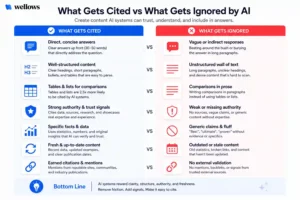
AI systems break pages into modular sections and evaluate each independently. Tables earn 2.5 times more AI citations than comparable prose. FAQ sections appear on 47% of pages ChatGPT cites. Pages with well-organized headings are 2.8 times more likely to earn citations.
The strong version works without any surrounding context. That is the test every paragraph should pass before publishing.
3. Target the Intent Behind the Query, Not the Keyword Itself
AI systems evaluate whether a source demonstrates genuine understanding of what a user actually needs, not keyword frequency.
An article targeting “AI content optimization strategies” that only discusses blog formatting and meta descriptions signals nothing about actual expertise. An article on the same topic that also covers prompt-level visibility, citation patterns across different AI platforms, entity recognition, and content freshness signals genuine topical depth.
Semrush’s AI Overviews study confirmed AI Overviews appear in 88% of informational queries. Write for the why behind a search, not the keyword itself.
4. Build Topical Depth Across a Cluster, Not Just One Page
One well-optimized article is a signal, while a full topic cluster is authority. If you want to understand how topical authority actually works in AI search before building your cluster, that distinction matters more than most guides admit.
What a weak content footprint looks like:
One 2,000-word article on “AI content optimization strategies.” No related content. No cluster. AI systems see a single data point and can’t establish brand authority from it.
What a strong content cluster looks like:
Pillar: “I Content Optimization Strategies: The Complete 2026 Guide”
Supporting: “How to Track AI Citations Across ChatGPT and Perplexity”
Supporting: “Schema Markup for AI Visibility: Which Types Actually Drive Citations”
Supporting: “GEO vs SEO: What’s Different and What Still Matters”
Supporting: “How to Audit Your Content for AI Extraction Readiness”
Topical clusters holds authority significantly longer than standalone pieces.
5. Deploy Schema Markup So AI Can Extract Without Guessing
Without schema, AI platforms have to infer what your content means. Inference introduces uncertainty, and AI systems avoid uncertainty when selecting citation sources.
What Schema markup looks like:
{
“@type”: “Question”,
“name”: “What is AI content optimization?”,
“acceptedAnswer”: {
“@type”: “Answer”,
“text”: “AI content optimization is the practice of structuring content so AI systems can retrieve it, trust it, and include it as a cited source in generated answers across ChatGPT, Perplexity, and Google AI Overviews.”
}
}
Without schema (what AI sees):
A wall of text with a bolded question somewhere in the middle. The relationship between the question and the answer has to be inferred from context. High uncertainty. Lower citation probability.
With schema (what AI sees):
A clearly labeled question paired with an explicitly defined answer. Zero inference required. High confidence. Higher citation probability.
Did you know?
TripAdvisor deployed FAQPage schema on its popular discussion pages. The result was consistent citations across ChatGPT, Perplexity, and Google AI Overviews on travel queries, outranking significantly larger publishers through structural clarity alone. Domain authority did not save the bigger publishers, structural clarity did.
With FAQ schema, you tell AI systems explicitly which content is a question and which is the authoritative answer. Zero inference required, high confidence resulting in higher citation probability. Start with FAQ schema on your highest-traffic informational pages and validate immediately using Google’s Rich Results Test.
6. Define Your Brand as a Recognized Entity
AI systems either recognize your brand clearly or have to guess at it. Vague definitions produce uncertainty and skipped citations.
6. Weak vs Strong: Entity Definition
Weak: “We help businesses grow their online presence and connect with customers in meaningful ways.” This applies to thousands of companies. AI systems cannot categorize or cite it confidently.
Strong: “Wellows is an AI search visibility platform that tracks brand citations across ChatGPT, Perplexity, Gemini, and Google AI Overviews, identifies citation gaps against competitors, and surfaces the specific content changes that improve AI visibility.” Specific. Attributable. Structured for extraction.
Entity clarity across your own content and across third-party sources is the foundation of that correlation.
7. Build E-E-A-T Signals AI Systems Cannot Replicate
AI systems reward content that demonstrates real experience, firsthand data, and original research that no other source can replicate.
Ahrefs is the clearest documented example. By consistently publishing proprietary research, ChatGPT, Perplexity, and Google AI Overviews cite Ahrefs regularly. AI search traffic represented just 0.5% of their total visitors but produced 12.1% of signups over a 30-day window. The differentiator was not domain authority. It was original data no other source could replicate.
7. Weak vs Strong: E-E-A-T in Practice
Weak: “Schema markup helps search engines understand your content better and improves your chances of being cited in AI-generated answers.” Generic. Replicable by any AI writing tool. Nothing attributable, nothing citable.
Strong: “Wellows analyzed 485,000 ChatGPT citations across 7,785 queries and 38,000 domains and found that 52% of all citations go to niche and long-tail sources. Domain authority is not the deciding factor. How clearly your content answers the question is.” Specific methodology. Named source. Original dataset. Directly attributable.
Add a “what we found” paragraph to every key section using your own data or client results. Publish one original research piece per quarter. A single data-backed report generates more AI visibility than 20 generic blog posts because AI systems prioritize unique, authoritative information they cannot source elsewhere.
8. Keep Sentences Short and HTML Clean for Technical Parsability
AI systems parse HTML before they read content. If your key answers are buried inside JavaScript rendering or surrounded by broken markup, AI crawlers may never reach them regardless of how well the content is written.
A B2B site saw AI citation rates jump 189% after fixing Core Web Vitals alone; improving LCP from 4.8 seconds to 1.9 seconds with zero content changes. The content was already strong. The technical layer was blocking AI crawlers from reaching it.
8. Weak vs Strong: Technical Parsability
Weak: The primary answer lives inside a JavaScript-rendered accordion that expands on click. The raw HTML contains nothing extractable. The AI crawler sees an empty section and moves to the next source.
Strong: The same answer written directly in the HTML under a question-format H2, followed by a bullet list and FAQ schema. The AI crawler hits the answer on the first parse pass. No rendering required. No inference needed.
Right-click any key page and view page source. Search for your primary answer in the raw HTML. If you cannot find it within the first 30% of the source code, AI systems probably cannot either. Keep sentences under 20 words. Fix broken outbound links and validate schema using Google’s Rich Results Test before assuming it is working.
9. Pair Every Visual With Context AI Can Actually Read
AI systems process the text surrounding visuals, not the visuals themselves. A chart without a descriptive caption gives AI platforms nothing to extract.
9. Weak vs Strong: Alt Text
Weak alt text: “dashboard screenshot” — tells AI nothing about what the image shows or why it matters.
Strong alt text: “Wellows AI visibility dashboard showing a 43% increase in ChatGPT citations after implementing FAQ schema across 12 blog posts in Q1 2026” — a specific, verifiable claim AI systems can extract and cite without processing the image itself.
ToTheWeb’s GEO guide states that if you publish a data point no one else has, you become the default citation source for that insight. A well-labeled original chart is a citation magnet.
10. Keep Content Fresh Because AI Rewards Recency
An article on AI content optimization from early 2024 that still references ChatGPT as having “100 million users” (now 800 million weekly active users) and describes AI Overviews as appearing in “a small percentage” of searches (now 48%) loses citation ground to a freshly updated competitor every week.
What a refreshed article looks like:
The same article, with statistics updated to 2026 figures, a new section covering Google AI Mode as a separate AI surface requiring distinct optimization, a “last updated” timestamp visible in the content, and three new examples based on real 2025-2026 case data.
HubSpot found that refreshing older articles produced a 106% average increase in monthly organic traffic. A full rewrite is only justified when the core argument is factually wrong.
11. Earn Third-Party Citations on Platforms AI Already Trusts
Publishing exclusively on your own domain is the weakest AI distribution strategy available.
The owned content trap:
A brand publishes a well-structured article on AI content optimization strategies. It earns strong organic rankings. When users ask ChatGPT the same question, the AI cites Search Engine Land, Semrush, and an r/SEO thread.
The brand never appears because AI systems saw it at one URL and could not establish a recognizable pattern from that alone.
What an earned distribution strategy looks like:
Identify the publications and communities that appear in AI answers for your target topic. For “AI content optimization strategies,” that includes Semrush, Search Engine Land, Marketing Week, r/SEO on Reddit, and Quora discussions on GEO. Earn genuine mentions in at least two of them.
SE Ranking found that brands with meaningful Reddit and Quora presence are roughly four times more likely to be cited by AI systems than those without community activity.
12. Use Specific Facts Over Vague Claims
AI systems cite content they can attribute confidently. Vague claims cannot be attributed.
12. Unextractable vs Citable
Unextractable: “Our AI content optimization approach helps businesses significantly improve their visibility across major AI platforms and gain meaningful competitive advantages.” No specific claim. Nothing an AI system can extract and attribute to a source.
Citable: “Brands cited in AI Overviews earn 35% more organic clicks and 91% more paid clicks than uncited competitors, according to Seer Interactive’s analysis of 3,119 informational queries across 42 organizations between June 2024 and September 2025.”
Apply this test to every paragraph. If you removed it from its surrounding context, could an AI system still attribute it to a specific source? If not, rewrite until it can.
13. Monitor AI Performance and Adjust Continuously
Most brands have no idea whether AI systems are citing them. If that describes your situation, you need to track your AI visibility across platforms before any optimization work makes sense — otherwise you are changing things with no way to know what moved.
Every two weeks, run these prompts across ChatGPT, Perplexity, Gemini, and Google AI Overviews and document which brands appear, what structure their content uses, and what your content lacks by comparison.
- What are the best AI content optimization strategies in 2026?
- How do I optimize my content to appear in ChatGPT answers?
- Best tools for tracking AI search visibility
- How do small businesses compete in AI search?
AI referred traffic converts at approximately 14.2% versus Google’s 2.8%. Even modest citation volume carries significant revenue implications.
How to Execute AI Content Optimization Strategies With Wellows?
Knowing the strategies is step one. Executing them without spending hours on manual audits or splitting your authority across competing pages is where most teams lose momentum. Here is how Wellows handles the full cycle.
- Sign up and head to content optimization: Go to to app.wellows.com and sign up. From the menu, click “Content Optimization“
- Domain scan first, always: Before recommending any change, Wellows scans your entire domain against your target prompts. Every existing page gets scored for intent match and structural fit. If a relevant page already exists, Wellows selects it as the optimization target. No new page gets created when an existing one can win.
- See your citation gap before editing a single word: The scan returns one number that matters — how many new citations applying all recommendations could generate. You know the return before spending a minute on edits.
- Line-level gaps, not page-level guesswork: Each recommendation shows exactly what is missing. Wellows scrapes 20 to 50 cited competitor URLs per prompt and surfaces section-by-section gaps — missing H2s, structural elements, entity gaps — with the source URL where each pattern was found.
- Fix third-party presence, not just your own pages: Wellows surfaces domains already being cited by AI for your target prompts where your brand is absent. Each opportunity includes verified contact details and an outreach template so you target the exact sources shaping the AI answer you want to appear in.
- Track what moved and what did not: After updates go live, Wellows monitors citation performance daily across ChatGPT, Gemini, Perplexity, and Google AI Overviews. You see which prompts now cite your brand, which still cite competitors, and how AI referral traffic maps to actual pipeline.
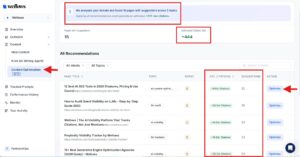
Most teams see citation movement within two to four weeks of shipping their first Wellows-guided update — without manually pulling competitor URLs, running scrapes, or auditing their own site.
What Are the Best AI Content Optimization Strategies for Small Business Websites?
Small businesses have a genuine structural advantage most overlook. ChatGPT regularly cites pages from position 21 or lower because large corporate sites bury answers under generic, polished language that gives AI systems nothing extractable.
The 3-step small business quick win:
- Rewrite your article intros to answer the question in the first two sentences.
- Add FAQ schema to your five most important pages.
- Earn one genuine mention in a publication that appears in AI answers for your topic.
These three changes cost nothing and address the most common reasons small business content does not get cited.
SE Ranking research found brands with meaningful community presence on Reddit and Quora are roughly four times more likely to be cited by AI systems.
Quick tip: For local businesses, local prompts trigger web searches in AI systems 59% of the time, making geographic-specific content a significant citation opportunity that major publishers rarely compete for.
How Do I Rewrite and Structure My Article So It Ranks in AI Overviews and Featured Snippets?
Four structural changes produce the fastest citation improvements:
- Question-format headings. Change “Content Structure” to “How Should I Structure My Article for AI Overviews?” The second version maps directly to a real user query and signals section scope clearly to AI parsers.
- Standalone topic sentences. Every paragraph’s opening sentence should work as a citable statement without surrounding context. “AI systems evaluate each section independently” works alone. “There are various elements to consider” does not.
- Tables over prose for comparisons. Instead of writing differences in paragraphs, put them in a table. Tables earn 2.5 times more AI citations than equivalent prose and are directly extractable into an AI answer.
- FAQ sections. A dedicated FAQ section formats key insights as direct question and answer pairs, exactly the structure AI systems prefer. FAQ sections appear on 47% of pages ChatGPT cites.
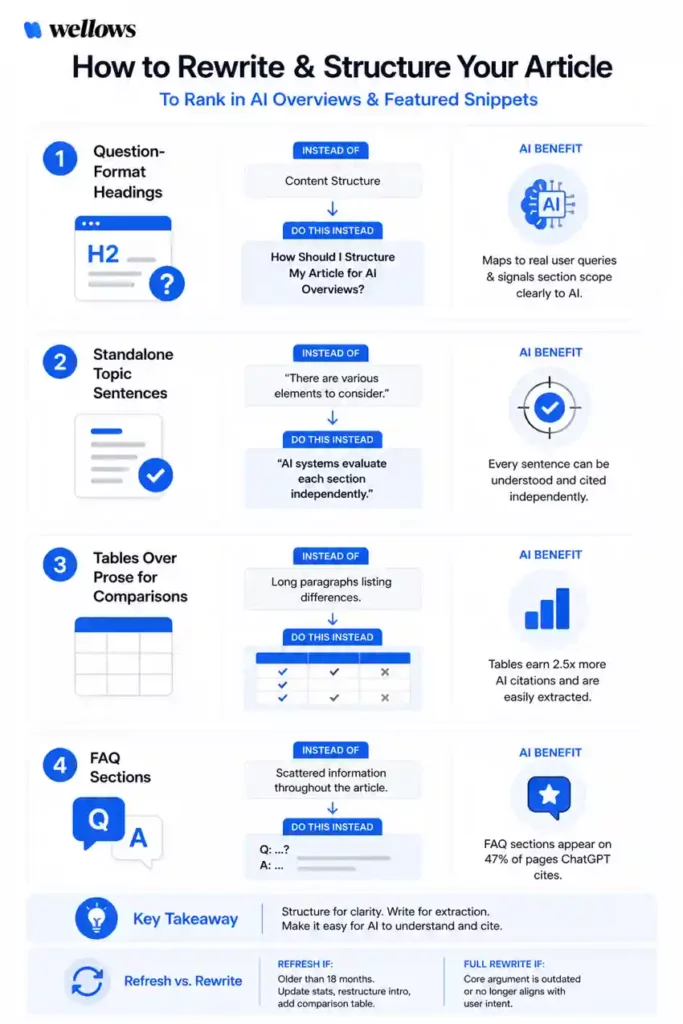
For rewriting your artile, it becomes imperative to fully understand how AI Overviews optimization works and how AI overviews decide which sources to include, the content formats, structure and signals that consistently get pulled into answers.
For refresh versus rewrite decisions, you must update statistics, restructure the intro, and add a comparison table for articles older than 18 months. Reserve full rewrites for articles where the core argument is factually outdated.
What Are the Free AI Content Optimization Tools You Can Start Using Today
Here is what you can use that will actually help:
Google Search Console surfaces pages with high impressions and near-zero clicks. These pages are almost certainly losing traffic to AI Overviews and are your highest-priority restructuring targets because the query demand is confirmed and the problem is structural, not competitive.
Google’s Rich Results Test validates schema markup instantly. Run it after adding FAQ schema before assuming it is working correctly.
ChatGPT and Perplexity free tiers let you run target queries to see which sources get cited and compare their structure against your own content. The gaps become obvious quickly when you place them side by side.
Wellows is where free tools stop and real AI visibility intelligence begins. It tracks your brand’s citation performance across ChatGPT, Gemini, Perplexity, and Google AI Overviews, benchmarks it against competitors at the prompt level, and identifies exactly which content gaps and shares optimization opportunities.
For teams making serious investments in AI optimization, Wellows removes the guesswork entirely.
Case Studies Showcasing Successful AI Content Optimization Strategies Results
Here are three case studies that demonstrate how results can be achieved in a short span of time by apply correct AI content optimization strategies:
Case Study 1: Sagepath’s Schema Markup Article
Sagepath published a blog on using ChatGPT to write schema markup. It answered a specific technical question directly in the opening paragraph, included real JSON-LD code examples, and deployed FAQ schema throughout.
The result was citations across Google AI Overviews, ChatGPT, Gemini, and Perplexity. Sagepath is not a major publisher. Specificity and structure beat domain authority.
Case Study 2: Averi AI’s Content Engine
Averi AI’s team went from zero to 1.68 million monthly organic impressions in six months at a $99 per month platform cost, with AI citations appearing within 90 days. The approach was direct question answering, topic clusters, and 70% AI-assisted production with 30% human editorial input for the specificity that makes content citable rather than just correct. Budget was not the bottleneck. Structural discipline was.
Case Study 3: HR Tech Brand and Earned Distribution
One HR technology company implemented earned media distribution through Stacker and earned 251 new Google AI Overview citations across 27 pages, with early expansion to ChatGPT, Perplexity, Gemini, and Copilot. Third-party sources accounted for 64% of total AI citations earned. Publishing exclusively on your own domain is the weakest available AI distribution strategy.
Did you know?
What these case studies share: None of these brands had large teams or large budgets. All three won AI citations through direct answers, structured formatting, topic depth, and distribution to platforms AI systems already trust.
Affordable Alternatives to Expensive Content Optimization Agencies
Agencies with genuine GEO capabilities typically charge $1,500 to $3,000 per month for auditing and recommendations, $3,000 to $6,000 for managed content production, and $500 to $1,500 per individually optimized article.
For most small and mid-sized businesses, a focused platform stack covers the core capabilities agencies sell as services.
- Wellows covers AI citation tracking, competitor benchmarking at the prompt level, content gap identification, and outreach opportunity discovery.
- Frase and Clearscope handle on-page semantic optimization and content briefs, improving topical depth and relevance.
- Rank Math handles schema implementation for most WordPress sites in under an hour with no technical expertise required.
Total cost runs well under $500 per month with substantially more transparency than most agency retainers offer.
HubSpot’s research found refreshing older articles produced a 106% average increase in monthly organic traffic, which typically outperforms an equivalent new article built from scratch.
Frase compares existing content against current AI answers at the section level, Wellows identifies which existing posts have citation gaps and what specific changes would close them.
How to Track Whether Your AI Content Optimization Strategies Are Actually Working
The 4 Metrics That Actually Matter in 2026
- AI referral traffic in Google Analytics 4 shows sessions from ChatGPT.com, Perplexity.ai, and similar domains. This is the most direct signal that AI systems are actively driving users to your content.
- AI citation frequency tracks how often your brand appears when relevant queries run across AI platforms. This requires systematic tracking, not occasional manual checks.
- Share of voice in AI answers measures what percentage of AI responses mention your brand versus competitors across your target topics.
- Conversion rate from AI referral deserves close attention. AI search traffic converts at approximately 14.2% versus Google’s 2.8%. Traffic volume from AI platforms is lower. Intent quality is substantially higher.
What Systematic Monitoring Looks Like in Practice
Every two weeks, run your most important topic queries across ChatGPT, Perplexity, Gemini, and Google AI Overviews. Document which brands appear, what structure their content uses, and what your content lacks by comparison.
Most brands have no idea whether AI systems are citing them. If that describes your situation, you need to track your AI visibility across platforms before any optimization work makes sense otherwise you are changing things with no way to know what moved.
Adjusting Based on What You Find
Content being skipped for structural reasons means restructure. Competitors earning more citations through stronger third-party presence means invest in distribution, not more on-site work. Gaps in specific topic categories signal where semantic coverage needs to deepen first.
Citation patterns shift as AI systems update, as competitors improve their content, and as your own authority grows. The brands building durable AI visibility treat it as an ongoing measurement and iteration loop, not a one-off project.
- What Makes Wellows Different From Peec AI?: Wellows vs Peec AI
- Find the Better Platform for AI Search Visibility: Wellows vs Promptwatch
- How to Build Topical Authority for AI Search?: What Is Topical Authority in SEO and How to Build It
- How to Optimize for Google AI Overviews?: How to Optimize for Google AI Overviews for Better Visibility
FAQs – AI Content Optimization Strategies
AI content optimization is structuring content so AI systems can retrieve it, trust it, and cite it in generated answers. It matters because AI Overviews appear in 48% of Google searches, organic click rates drop 61% when an AI Overview is present, and cited brands earn 35% more organic clicks and 91% more paid clicks than uncited competitors.
Lead with a direct answer in your first paragraph. Use question-format headings, FAQ sections, and schema markup so AI systems can extract answers without inferring the relationship between questions and responses. Build third-party mentions on platforms AI systems already draw from. Specific, attributed facts drive citations more consistently than keyword density alone.
Wellows, Frase and Content Harmony both include keyword research and content briefs alongside on-page optimization. Clearscope is the strongest option purely for semantic keyword analysis. MarketMuse handles topical authority mapping at enterprise scale but is priced accordingly.
Frase compares your existing content directly against current SERP results and AI answers, showing what is missing at the section level. Content Harmony works well for creating updated briefs across multiple pages simultaneously. Wellows adds the AI citation layer, showing which posts have gaps and what specific changes would close them.
Yes, and often more effectively than larger competitors. AI systems favor specific, direct, expert answers over polished corporate writing. A small business with genuine niche expertise earns citations that category leaders miss by answering questions more precisely. Brands with meaningful Reddit and Quora presence are roughly four times more likely to be cited by AI systems regardless of domain authority.
Adding structured answers and statistics to existing content can improve AI citations within 30 to 45 days. Building sustained topical authority across a cluster typically takes a full quarter of consistent effort. Most brands see meaningful share of voice improvements within three months, with compounding returns after that.
Conclusion
The right AI content optimization strategies are no longer a competitive advantage. They are the baseline for staying visible in a search landscape where AI systems now answer before users ever click.
AI Overviews appear in nearly half of all Google searches. The brands earning citations in those answers get higher quality traffic, better conversion rates, and brand authority that rankings alone cannot deliver.
Start with your highest-impression, lowest-click pages in Google Search Console. Restructure their openings, add FAQ schema, and earn one mention on a platform AI systems already trust. Then measure whether it is working.
AI systems cite the brands that answer questions better than anyone else, consistently, across every surface where people are now looking for answers. Wellows shows you exactly where you are being cited, where competitors are winning instead, and what to change so every optimization decision is backed by real citation data, not guesswork.