AI content optimization is the practice of using AI to make your content easier for both algorithms and people to find, understand, and act on. It is no longer a side workflow — it is the new center of gravity for content strategy.
The audience for your content has fundamentally expanded. For years, marketers optimized for human searchers and Google’s crawlers. Now, ChatGPT, Perplexity, Gemini, Claude, and Google’s AI Overviews are a second, equally important readership — they read your page, decide whether to cite it, and shape what millions of users see in a single AI-generated answer.
Brands cited in AI Overviews earn 35% more organic clicks and 91% more paid clicks than non-cited competitors.
This guide breaks down what AI content optimization actually means today, the techniques and tools that work in 2026, the mistakes that quietly waste budget, and the trends shaping where this is all going next.
TL;DR — AI Content Optimization in 2026
- What is AI content optimization?: The use of LLMs, retrieval data, and intent analysis to shape content so it ranks in traditional search and gets cited inside AI-generated answers from ChatGPT, Claude, Gemini, Perplexity, and Google AI Overviews.
- Why does it matter in 2026?: Wellows research across 2.67M citations, 642,979 queries, and 41 regions found that 67% of Google AI Overview citations reward five specific content formats — but only 2.1% of those citations carry a link. The citation often comes home as a name, not a click. Brands cited in AI Overviews still earn 35% more organic clicks and 91% more paid clicks than non-cited competitors.
- What's the fastest path to results?: Update high-authority existing pages before creating new ones. Lead with a direct two-sentence answer in the first 100 words (44.2% of LLM citations come from the first 30% of a text). Add FAQ and HowTo schema. Most teams see citation movement within 2–4 weeks.
- What's the biggest mistake?: Generating a new page when an existing one should be optimized. It splits authority, forces internal cannibalization, and makes two of your own pages compete for the same citation. Always scan the domain first.
- Which tool actually closes the loop?: Wellows is the only AI visibility platform built for end-to-end execution, not just tracking. It scans your entire domain to prevent cannibalization before recommending any change, runs line-level gap analysis from 20–50 cited competitor URLs per prompt and tracks citation across ChatGPT, Claude, Gemini, Perplexity, and Google AI Overviews in one workflow. Most teams see citation movement within 2–4 weeks of shipping their first Wellows-guided update.
Defining AI Content Optimization: What It Means Today
AI content optimization is the use of large language models, retrieval data, and intent analysis to shape content so it ranks in traditional search and gets cited inside AI-generated answers. It goes beyond keyword placement — it covers entity coverage, structural parsability, citation worthiness, and semantic depth.
In practice, AI content optimization shows up as:
- Rewriting an opening so an LLM can lift a clean two-sentence answer from it.
- Adding the entities, sub-topics, and comparison tables a model expects to see for a given query.
- Restructuring headings so AI parsers can identify where each topic begins and ends.
- Filling content gaps that competitors are already being cited for.
The shift is from “rank for a keyword” to “be the answer the AI quotes,” and that single change is largely why content optimization feels way harder than SEO for teams trained on ranking-first playbooks
Step-by-Step Guide to AI Content Optimization Techniques
A working AI content optimization system follows seven sequential steps. Skipping any of them is where most teams quietly lose ROI.
1. Set Goals and Identify Your Audience
Start by defining the business outcome (pipeline, signups, citations) and the audience segment behind it. AI-powered audience tools surface intent clusters and pain-point patterns far faster than survey-based research.
2. Audit Existing Content with AI
Before creating anything new, audit what you already have. AI can score every page on your domain by intent match, topical depth, structural compatibility, and entity coverage. This prevents the most common — and most expensive — mistake in content programs: publishing a new page when an older page on your site already deserves the optimization.
3. Optimize Keywords and Topics with AI Optimization Techniques
Move beyond search volume. AI clusters keywords by intent, identifies semantic gaps, and surfaces “hidden gems” — long-tail queries with low competition and strong AI citation potential. Cluster first, then rank by intent fit, not raw volume.
4. Refine Structure and Improve Readability Using AI Content Optimization
Format is now a ranking factor for AI. Short paragraphs, scannable bullets, clear subheads, and direct answers in the first 1–2 sentences make pages dramatically more citable. Research shows 44.2% of LLM citations come from the first 30% of a text — the intro carries disproportionate weight (Growth Memo, February 2026).
5. Optimize Metadata and Heading Structure with AI Content Optimization Software
Use AI to tighten title tags, meta descriptions, and H-tag hierarchies. Aim for titles between 50–80 characters with comparison or how-to framing — they consistently outperform generic phrasing in both AI and traditional search.
6. Add Supporting Visual Elements to Maximize AI Content Optimization
Images, diagrams, comparison tables, and FAQ blocks expand the surface area of citation. AI parsers favor structured visuals with clear alt text and tables that hold definitional or comparative data.
7. Test, Measure, and Iterate for Ongoing AI Content Optimization Success
AI search behavior is volatile. Reddit citation share dropped 23% in a single month between October and November 2025, and Perplexity’s Reddit citation share dropped 86% almost immediately after Reddit sued Perplexity. Citation graphs shift faster than content strategies, so weekly monitoring and A/B testing are non-negotiable.
How to Use Wellows for AI Content Optimization: A Step-by-Step Walkthrough
The seven-step framework above is the strategy. Wellows is what makes it executable — without a dedicated SEO team and without 40 hours of manual work per page.
Here is exactly what the ai content optimization workflow looks like inside the platform, click by click.
Step 1: Sign in (or start your 7-day free trial)
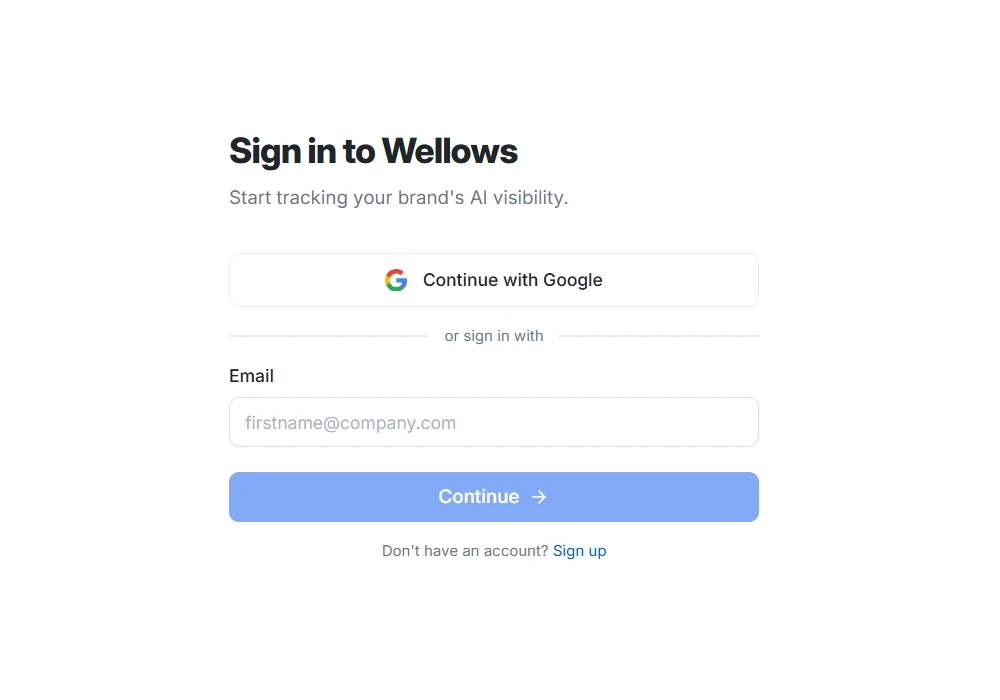
Head to app.wellows.com. If you already have an account, log in and pick the project you want to optimize.
If you are new to Wellows, sign up — every plan ships with a 7-day free trial at full feature access. No reduced trial mode, no usage caps, no “preview only” walls. You are working in the real product from minute one, with credit card required and no charges during the trial period.
Step 2: Open Content Optimization (Beta)
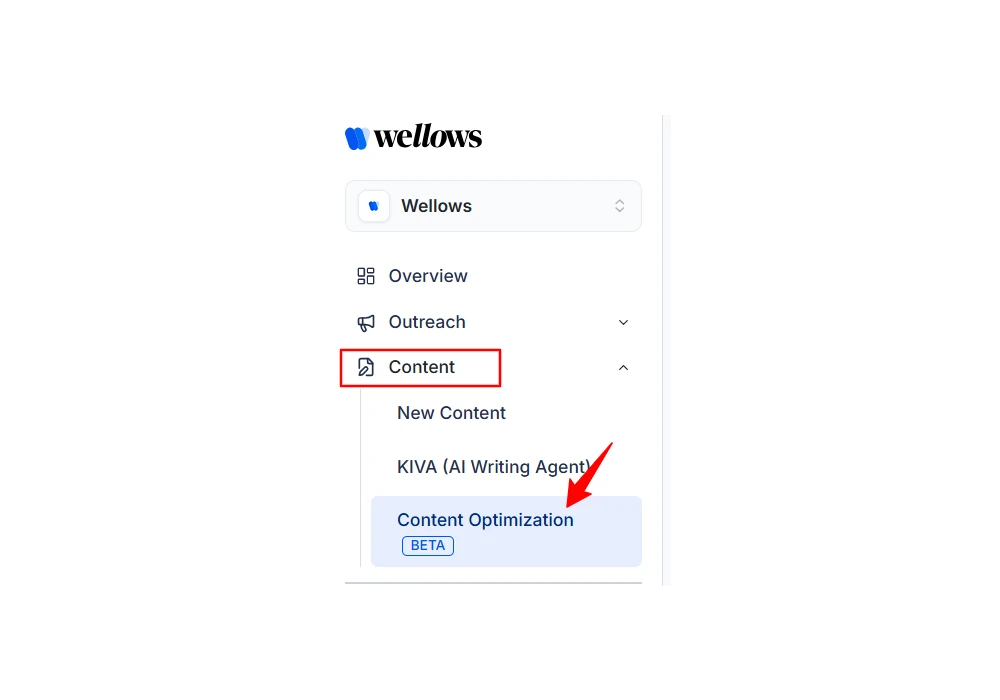
Once you are inside the dashboard, look at the left-hand navigation and click Content. The submenu expands, and you’ll see Content Optimization (Beta) sitting under it. Click in. This is where the entire optimization workflow lives — domain scan, gap analysis, internal linking, all in one surface.
Step 3: Click “Request Access”
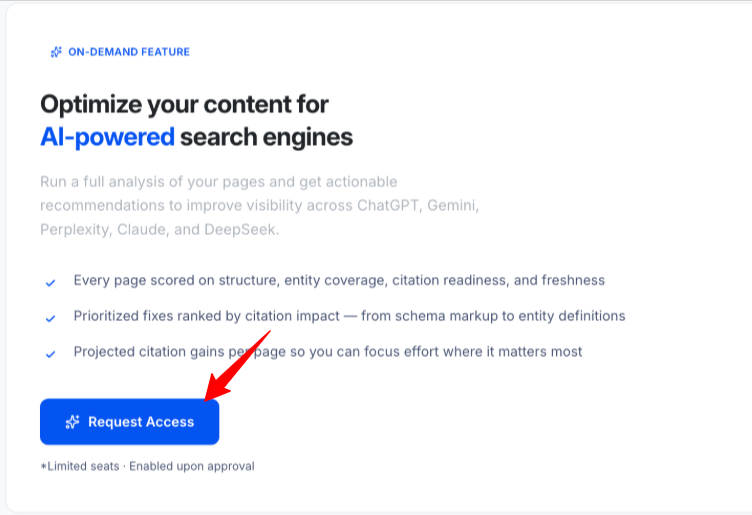
Content Optimization is currently an on-demand feature, so the first time you land in the module you will see a Request Access button at the top of the screen. Click it.
Wellows queues your workspace, and once approved, the module unlocks and the analysis kicks off against the prompts you have already selected for AI visibility.
Step 4: Let Wellows scan your domain — cannibalization-proof, with citation gain forecast

This is where the heavy lifting happens, and you do not have to lift a finger.
Wellows runs a site-wide scan against your selected prompts. Every page on your domain gets scored for intent match, structural fit, and topical depth.
When multiple of your existing pages are eligible to rank for the same prompt, an intent-and-relevance scoring layer picks the single page best positioned to win — and dims the rest. One prompt, one winning page. Always. No two pages of yours fighting for the same citation.
When the scan completes, the headline number you see at the top of the screen is the one that matters most:
That estimate is calculated using Wellows’ live citation tracking logic — so you know exactly what is at stake before you spend a minute editing a single page. If a prompt does not have any qualifying page on your domain, Wellows flags it as a new-content opportunity instead of forcing an optimization that won’t land.
Step 5: Browse your recommendations in the table
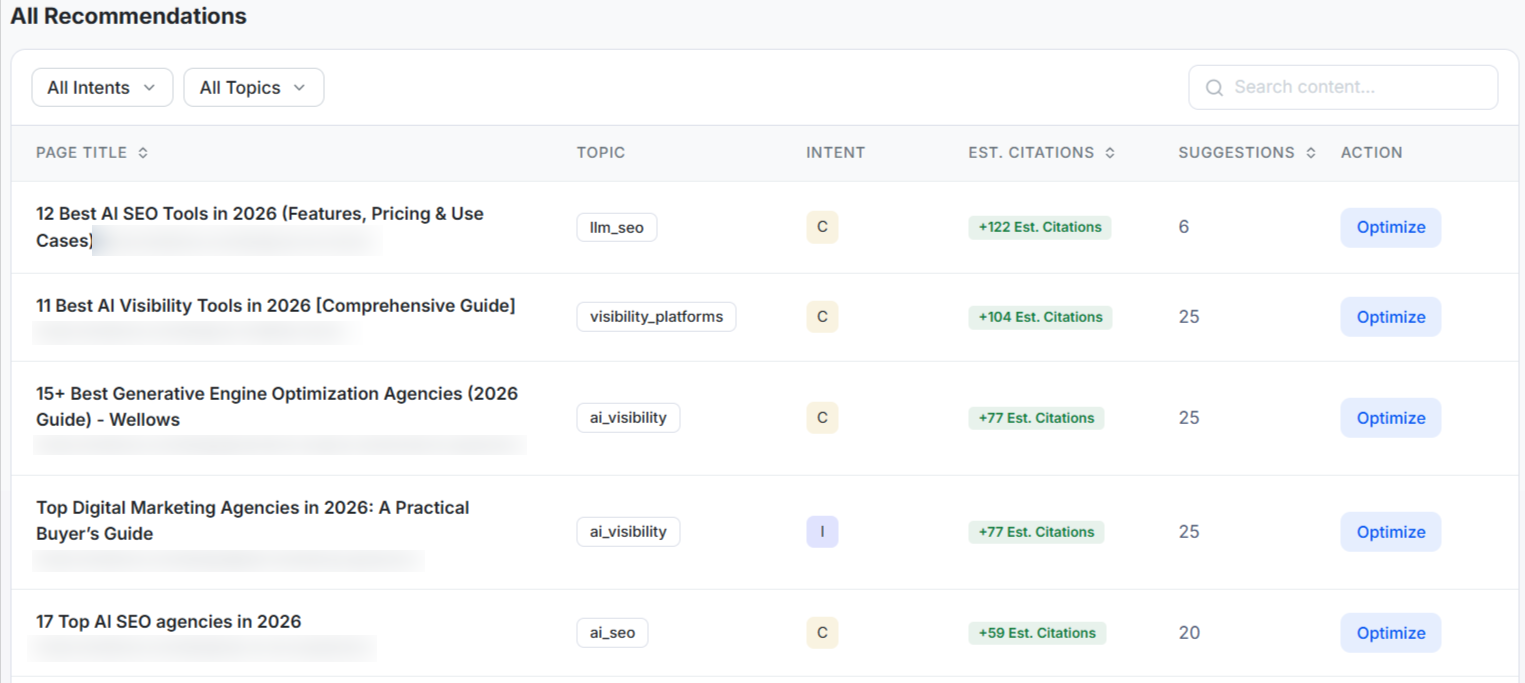
Recommendations appear in a clean tabular view. Each row is one optimization opportunity, showing:
- Title — a suggested page title based on the dominant SERP format for that prompt
- Topic — the topic cluster the prompt belongs to
- Intent — Commercial, Informational, Transactional, or Navigational (shown as a single letter: C / I / T / N)
- Est. Citations — projected mentions you’ll gain from optimizing this page (e.g., “+12 mentions”)
- Target Page — the canonical URL Wellows selected as the best candidate
- Status — Needs Improvement, Partially Completed, or Completed
- Action — the View Suggestions / Optimize button
You can slice the view however your team works. Filter by Intent type if you want to attack commercial pages first (the ones closest to revenue), or by Topic if you’re focused on a single content cluster this sprint. A status filter and search bar are right there in the header for fast triage.
Step 6: Sort by estimated citation gain — the smartest first move
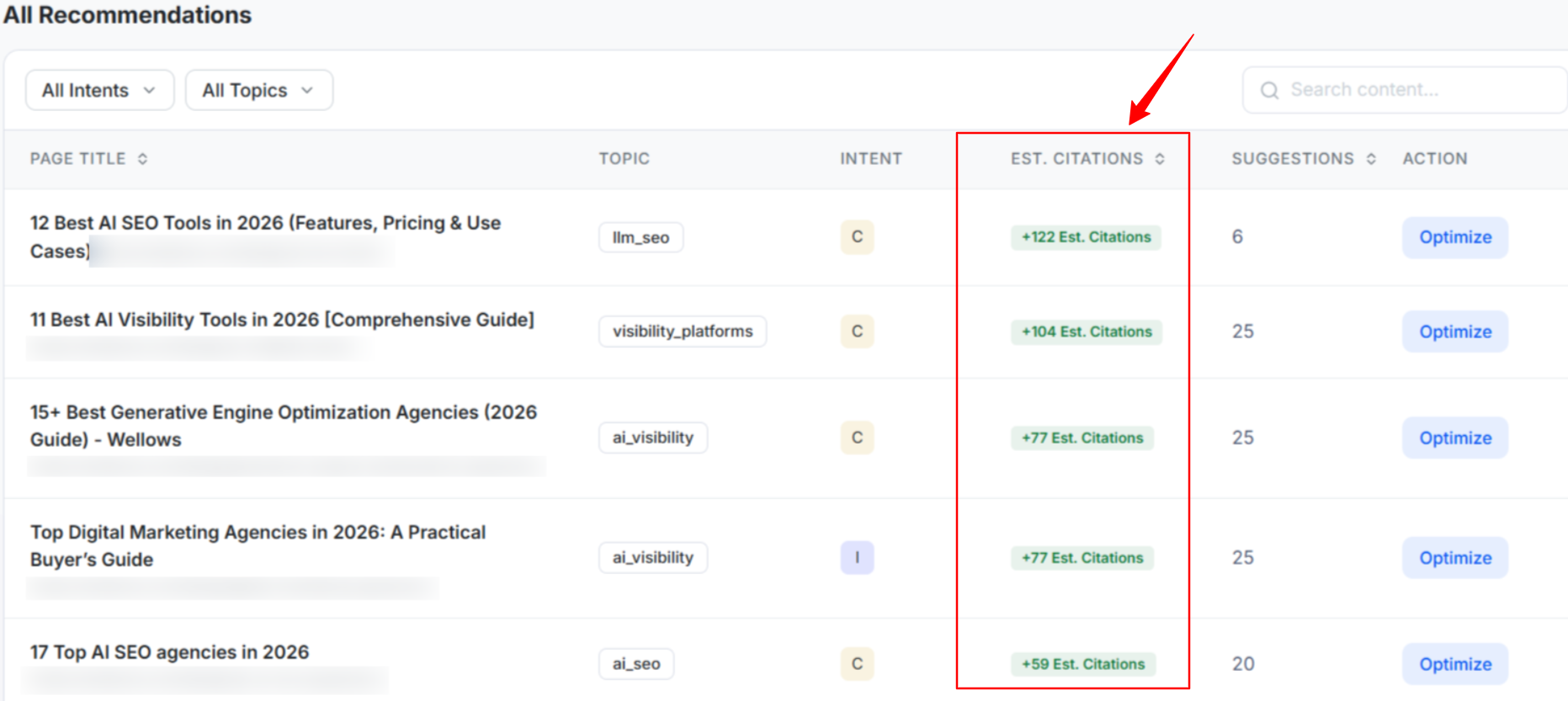
If you are not sure where to start, let the math decide. Sort the table by Estimated Citations in descending order.
The pages at the top of that list are the ones with the highest projected return — usually a mix of pages already ranking nearby in traditional search and pages with strong topical depth that just need targeted gap fixes.
Wellows already does this by default — the table sorts by Est. Citations descending out of the box — but it is worth re-verifying, because this single sort is the difference between a sprint that delivers compounding citation lift and one that gets stuck on low-impact edits.
The highest-leverage move on day one: ship the top three to five pages on this sorted list. That cluster alone usually captures the majority of the available lift across the domain.
Step 7: Click “Optimize” — full brief on one screen
Hit the Optimize button on any row and Wellows opens a full-page detail view with everything you need to ship the update. Four sections, all on one screen:
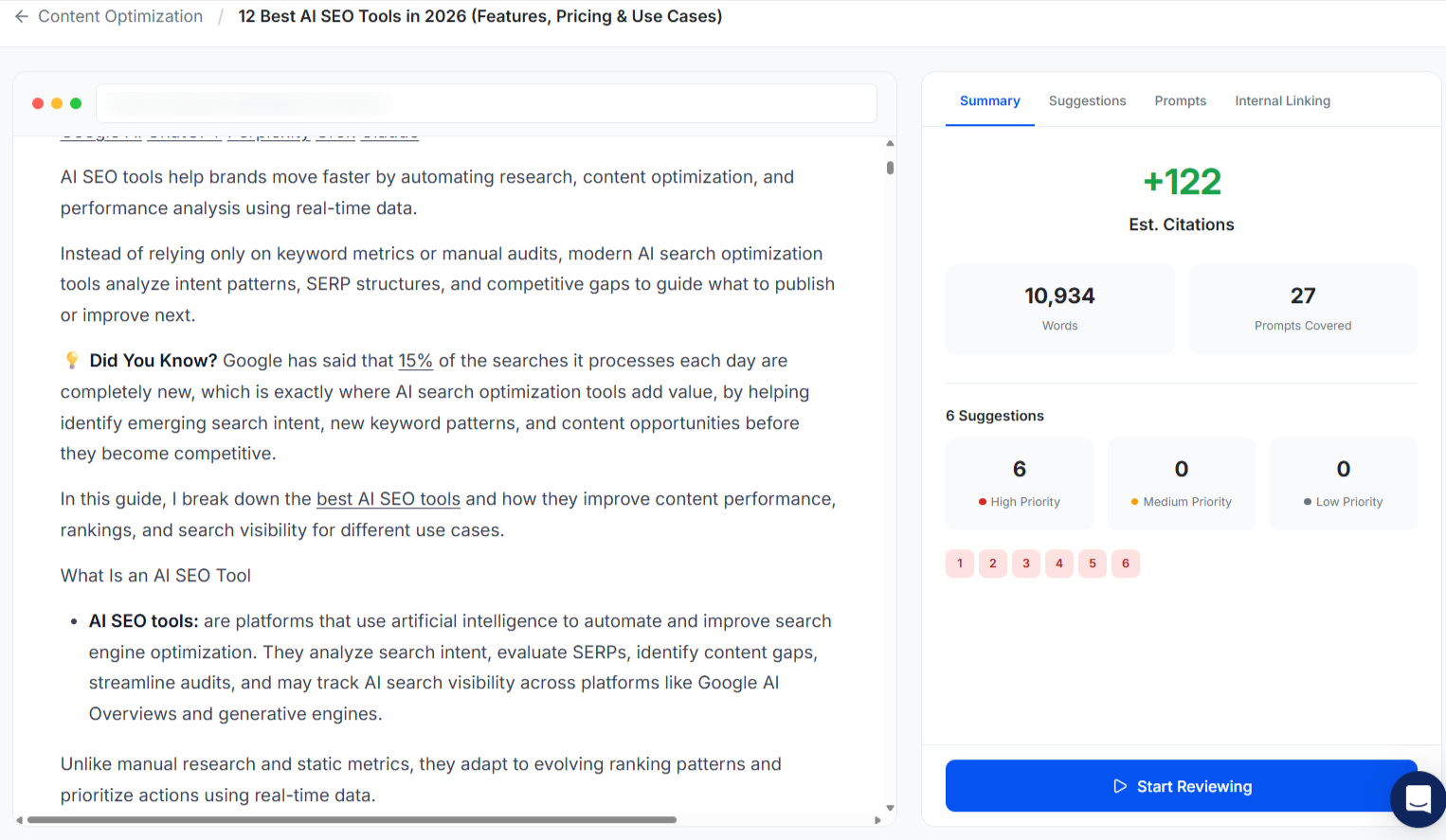
- Summary. Why this page qualifies, prompts it will cover, total estimated citations, dominant SERP intent, and page format. The business case in one block — paste it straight into a Slack thread when stakeholders ask why this page is in the queue.
- Suggestions (Gaps & Analysis). Line-level recommendations, not page-level guesswork. Missing H2 sections, structural enhancements (schema, tables, FAQ blocks), and recurring patterns Wellows decoded from the cited competitor set. Each gap shows the source URL where the pattern was found and the recommended placement on your page. No vague “go deeper on audits” — concrete edits like “add a 200-word H2 covering audit types, frequency, and tooling, placed as section three.”
- Prompts Covered. Every prompt this single optimization will earn citations for. It is almost always a cluster of related queries, not one — which is why a single well-optimized page can move multiple LLM citations at once.
- Internal Linking Map. Every supporting page on your domain that should link to this one, with recommended anchor text (3–5 words, natural, entity + modifier based) and a short context line explaining why each link strengthens the cluster. One click sends the linking checklist to your editorial workflow.
Top Benefits of AI Content Optimization
The impact of AI content optimization compounds across three layers — discovery, engagement, and conversion — each with measurable outcomes.
- Higher AI visibility. Content optimized for generative engines sees a 30–40% visibility lift in AI search results (Superlines, 2026).
- Better conversion. AI search traffic converts at roughly 4.4x the rate of standard organic visits (Semrush).
- Faster content production. AI shortens research, briefing, and drafting from days to hours, without sacrificing topical depth.
- Continuous improvement. AI tools detect content decay, ranking drops, and emerging topics earlier than manual audits.
- Cross-surface coverage. A single optimization pass can lift visibility across Google, ChatGPT, Perplexity, and Gemini simultaneously when done correctly.
How AI Content Optimization Transforms Marketing
AI is collapsing the distance between data and execution. Where a marketing team once needed an analyst, an SEO specialist, and a writer to ship one optimized page, AI now compresses that into a single workflow. Personalization, intent matching, and topic modeling all happen earlier in the process. The result: content programs that move faster, react to behavior data in near real-time, and spend less on the production overhead that used to define the channel.
Wellows vs. Profound vs. Peec.ai: Where Each Tool Fits
Most AEO platforms today fall into one of two camps: track-only tools that show you visibility data but leave execution to you, and enterprise dashboards that give analyst-grade reporting but assume you already have a writing and outreach team in place. Wellows occupies a different position — the only platform built around closing the full optimization loop in one workflow.
The pattern is clear: Profound and Peec.ai both solve the visibility-tracking problem well, but neither closes the gap between insight and execution.
6 Proven AI Optimization Techniques and Tools for Content
Six techniques separate teams that ship optimization theater from teams that ship measurable AI visibility. Each is grounded in what LLMs actually reward in 2026.
1. Uncover On-Page SEO Gaps with AI Search Optimization
On-page gap analysis is no longer about missing keywords — it is about missing entities, sub-topics, and structural elements that AI engines expect for a given query.
The strongest workflow looks like this: pull every URL currently being cited by ChatGPT, Perplexity, and Google AI Overviews for your target prompt, scrape their content, and decode what they share — depth, structure, entity density, and formatting patterns. Then compare your page line by line.
This is where line-level gap analysis beats page-level guesswork. If competitors discuss audit reports across three sections with examples, and your page mentions audits in a single line, that is a fixable gap. Generic AI-generated outlines will not catch this — you need actual competitor scrape data for the specific prompt you want visibility on.
Platforms like Wellows automate this entire loop, scraping 20–50 cited URLs per prompt and returning section-by-section recommendations on what to add, remove, or rewrite.
2. Optimize Metadata with AI Content Optimization Software
Metadata is still where most pages leak visibility. Title tags, meta descriptions, H1s, and structured data are how AI systems decide whether your content is worth retrieving in the first place — and small structural mistakes compound across thousands of impressions.
The high-leverage metadata moves in 2026:
- Title tags between 50–80 characters with the primary entity in the first 60% of the title. Comparison (“X vs Y”) and solution-oriented framing (“How to fix…”) consistently outperform generic phrasing because they mirror how users actually phrase questions to AI systems.
- Meta descriptions written as direct answers, not marketing teases. AI engines often surface meta content as part of their summary, so a clear answer doubles as a citation hook.
- H1 that matches the user’s intent verbatim, with H2s that map to the sub-questions a model would ask after reading the H1.
- FAQ schema and HowTo schema wherever the page format supports it. Structured data gives LLMs pre-chunked answers they can pull cleanly into responses.
- Open Graph and Twitter Card metadata kept consistent. AI systems crawl these for entity disambiguation, especially for brand pages.
The fastest way to do this at scale is with prompt-driven AI tooling that generates metadata variants from your existing on-page content and scores each against the cited competitor set. This is faster than manual rewrites and avoids the trap of generic, AI-flavored copy that all reads the same. The principle that should guide every metadata choice: write for the model’s first scan and the user’s first glance — they have the same standard now.
A tool worth flagging here: KIVA — Wellows’ built-in AI writing agent — generates metadata, briefs, and drafts using LLM insights, SERP data, LSI keywords, People Also Ask analysis, and community trends in a single pass, so the metadata is informed by the same data that drives ranking, not generated in isolation.
3. Surface Keyword Clusters and Related Queries Using AI Optimization Techniques
AI is dramatically better than humans at clustering — it sees semantic similarity that keyword tools miss. Feed an AI model your seed keyword plus your top three competitor URLs, and it will surface intent clusters, related questions, and topic gaps in seconds. The output is a content map, not a flat keyword list.
How to Find Related Queries with AI Optimization Techniques
Use a structured prompt like:
Cross-reference the output against actual SERP data and People Also Ask boxes. This catches queries that volume-based keyword tools systematically under-weight — the long-tail, conversational queries that drive disproportionate AI citation share.
The closer your prompt mirrors how a real user would phrase the query to ChatGPT, the better the output.
4. Identify Internal Linking Opportunities via AI Content Optimization
Internal linking is one of the most underused AI optimization levers. Strong internal linking helps LLMs understand topical clusters and trust a page faster — yet most sites still rely on manual linking decisions made years apart.
The AI-driven approach: prompt a model with your full sitemap and ask it to identify supporting pages on your domain that should link to each optimization target, with recommended anchor text. The output should be a table of source page → suggested anchor → context.
A side benefit worth noting: well-linked clusters help Google and LLMs both. The same internal links that boost your AI citation rate also lift traditional rankings.
Common AI Content Optimization Mistakes (and How to Avoid Them)
Most AI content optimization failures are not strategy failures — they are execution failures. The same five mistakes show up across teams of every size.
- Generating a new page when an existing one should be updated. This is the single most expensive mistake in AI content programs. It splits authority, creates internal cannibalization, and forces two pages to fight for the same citation. Always run a site-wide scan and an intent-and-relevance score on existing pages before approving any new content brief. If a relevant page exists, optimize it. If none exists, create.
- Trusting AI output without fact-checking. Roughly 9–15% of AI Overviews contain factually incorrect information. Anything an AI tool generates — stats, claims, attributions — needs human verification before publication. The reputational cost of one bad stat outweighs the production savings of skipping the check.
- Over-optimizing until the page reads like a bot. AI-generated content that reads as AI-generated content is a citation killer. LLMs are trained to recognize and discount generic, pattern-heavy text. Keep brand voice, point of view, and original research intact.
- Optimizing for one platform. Citation behavior varies up to 615x between AI platforms (Superlines, 2026). A page that wins on ChatGPT may be invisible on Gemini. Multi-platform tracking is mandatory, not optional.
- Treating AI optimization as a one-time project. AI Overview adoption grew 58% year over year by early 2026, and citation graphs shift weekly. Set-and-forget is the surest way to lose visibility you spent months earning. Weekly monitoring beats quarterly audits every time.
Best Practices for AI Content Optimization Success
The teams winning at AI content optimization in 2026 are doing the same handful of things consistently:
- Lead with a direct, two-sentence answer in the first 100 words. LLMs lift these chunks first.
- Format for parsability — short paragraphs, descriptive H2/H3 hierarchy, comparison tables, FAQ blocks.
- Match the prompt’s intent verbatim in your H1.
- Update before you create. Optimize existing assets before commissioning new ones.
- Build topical clusters — comparison pages, hub-and-spoke structures, and supporting content that link back to your core page.
- Refresh frequently. Pages updated within the last two months earn 28% more AI citations than older content.
- Monitor weekly. Track prompt-level position, cited-source changes, and AI referrer traffic.
Emerging AI Search Optimization Trends to Watch
Three shifts are reshaping AI content optimization in the next 12 months:
- Hyper-personalization. AI Mode’s conversational, multi-turn format means content needs to anticipate follow-up questions, not just answer the first one.
- Voice and conversational queries are taking a larger share of AI search volume, rewarding content written in natural-language Q&A patterns.
- Earned media as an AI signal. Distributing the same content across multiple publications can lift AI citations by up to 325% compared to publishing only on your own site (Stacker, 2025).
- Cannibalization-proof workflows. As content libraries mature, the cost of duplicate effort is rising. Tools that score every existing page before recommending a new one are becoming the new baseline.
AI Content Optimization FAQs
How do I optimize my content for AI?
Make your content easy for AI to parse. Use short paragraphs, clear H-tag hierarchy, and bullet or numbered lists. Answer the user’s primary question directly in the first 1–2 sentences. Add an FAQ block with structured data at the end. Match your H1 to the exact intent of the query you want visibility on.
How is AI content optimization different from traditional SEO?
Traditional SEO optimizes for ranked links — position 1 through 10 on a results page. AI content optimization targets the retrieval layer: the moment an LLM decides which sources to pull into its answer. It analyzes user behavior, intent patterns, entity coverage, sentiment, and structure. The two disciplines now overlap, but AI optimization’s scoring inputs are different — and broader.
What’s the difference between SEO and AEO in 2026?
SEO targets the ranked-link layer — positions 1 through 10 on a search results page. AEO (Answer Engine Optimization) targets the retrieval layer — the moment an LLM decides which sources to pull into its generated answer. The two now overlap heavily on technical fundamentals (structure, schema, entity coverage, internal linking), but AEO scores additional signals like citation worthiness, third-party mentions, and structural parsability for chunked retrieval. Most modern content programs run both as a single workflow, not two teams.
Does optimizing for AI search hurt my Google rankings?
No — done correctly, AI content optimization lifts both. The structural moves that earn AI citations (clear H-tag hierarchy, FAQ schema, direct two-sentence answers, internal linking from supporting pages) are the same signals Google’s ranking systems reward. Where teams get into trouble is when “AI optimization” turns into generic AI-generated rewrites with no original perspective. Keep brand voice, original research, and editorial judgment in the loop and you will see lift on both surfaces.
When does AI content optimization start showing measurable ROI?
Most teams see early citation wins within 2–4 weeks of shipping their first round of optimizations, with compounding lift over 8–12 weeks as topical clusters mature and internal links propagate.
The fastest results come from updating high-authority existing pages — not creating new ones — because LLMs already trust the URL.
ROI shows up as AI referrer traffic, citation share gains across ChatGPT, Perplexity, and Gemini, and conversion lift from AI-driven visits, which Semrush data puts at roughly 4.4x standard organic.
Which AI content optimization tactics deliver the fastest results?
Three tactics have the shortest time-to-result:
- Rewriting page intros to lead with a direct two-sentence answer in the first 100 words, since 44.2% of LLM citations come from the first 30% of a text
- Adding FAQ schema and HowTo schema to give LLMs pre-chunked answers they can lift cleanly
- Targeted internal linking from supporting pages with descriptive anchor text.
All three can be shipped in a single editorial sprint and tend to show citation movement within 2–4 weeks.
Is AI content optimization only for large companies?
No. AI tooling has dropped the cost of high-quality optimization dramatically. Solo creators and small teams can now run audits, generate briefs, and track citations across multiple LLMs at a fraction of what an enterprise SEO suite cost three years ago.
What are the risks of AI content optimization?
The main risks are over-optimization (content sounds robotic), factual errors in AI-generated drafts, content cannibalization from generating new pages instead of updating existing ones, and privacy/transparency concerns when using third-party AI tools on proprietary content. Mitigation is straightforward: keep human editorial judgment in the loop, verify every claim, and prioritize update-over-create workflows.
What is the best AI content optimization software?
The right tool depends on whether you need visibility tracking only, content generation only, or the full loop from gap detection through publishing which is why comparing the best AI content optimization tools by end-to-end capability matters more than feature checklists.
For the full loop, Wellows is the strongest choice — it is the only platform that scans your domain to prevent cannibalization before recommending any change, runs line-level gap analysis from 20–50 cited competitor URLs per prompt, generates publish-ready briefs through its KIVA writing agent, and tracks citation across ChatGPT, Perplexity, Gemini, Claude, and Google AI Overviews in one workflow.
If you only need one slice of the workflow, alternatives include Semrush AI Visibility Toolkit (visibility tracking), Ahrefs (traditional SEO data with AI overlays), and Profound (enterprise dashboards) — though each requires stitching together additional tools to cover the full optimization cycle.
What are some top AI search optimization techniques?
The highest-leverage techniques are: line-level gap analysis from cited competitors, prompt-driven keyword clustering, metadata rewrites with comparison framing, FAQ and HowTo schema implementation, internal linking from supporting cluster pages, and weekly multi-platform citation monitoring.
Final Thoughts
AI content optimization is no longer a marketing experiment — it is the channel where most discovery now happens. The brands that will win are not the ones publishing the most content.
They are the ones treating optimization as a continuous loop: scan what exists, find the gap, fix the right page, prove the lift, repeat.
The cost of getting this wrong is invisibility inside the answer your customer is reading right now. The cost of getting it right is a compounding citation footprint that earns trust and pipeline week over week. Start with what you already have on your site — that is almost always where the fastest wins live.