The search landscape has fundamentally shifted. While you were busy perfecting your SEO strategy, a new player entered the game, and it’s already changing how millions discover brands. Generative Engine Optimization (GEO) is not just another marketing buzzword; it’s the difference between being visible or invisible in AI-powered search results.
Here’s a stat that should wake you up: ChatGPT reached 100 million users faster than any app in history, and as of February 2025, it now commands more than 400 million weekly users.
Meanwhile, Google’s AI Overviews now appear on at least 13% of all SERPs globally, with some studies showing rates as high as 60% in US searches as of November 2025.
If your brand isn’t optimized for these generative engines, you’re missing out on a massive visibility opportunity that’s only growing larger.
TL;DR:. What You Need to Know
- Generative Engine Optimization (GEO) helps your brand appear in AI-generated answers across ChatGPT, Perplexity, Gemini, and Google AI Overviews.
- AI search traffic converts 5X better than Google (14.2% vs. 2.8%), making GEO a high-ROI visibility channel.
- ChatGPT holds 81% of the AI chatbot market, so optimizing for AI answers is now as essential as traditional SEO.
- SEO isn’t dead—it’s the foundation. GEO builds on it with strategies focused on brand mentions, citations, structured content, entity signals, and multi-platform authority.
- This checklist gives you step-by-step actions to boost AI visibility, strengthen entity recognition, improve Citation Score, and dominate brand presence across generative engines.
Why Should You Care About Generative Engine Optimization Right Now?
Let’s be honest, you’ve probably spent years mastering SEO. You know about keyword research, backlinks, on-page optimization, and technical SEO. So why should you add another layer of complexity to your already full plate?
Because the rules of discovery have fundamentally changed.
Traditional search engines show you a list of blue links. Generative AI engines give you an answer and they either mention your brand or they don’t. There’s no “page 2” to fall back on — which is why the difference between Brand Mentions vs. Citations has become so important for AI visibility.
Then
Traditional SEO Era
➡️ Goal: Rank in top 10 Google results
➡️ Success metric: Click-through rate (CTR)
➡️ Strategy: Keywords, backlinks, technical SEO
➡️ Traffic source: Organic search clicks
Now
GEO/AI Era
➡️ Goal: Get cited in AI-generated answers
➡️ Success metric: Brand mentions, citation frequency, sentiment
➡️ Strategy: Structured content, brand authority, multi-platform presence
➡️ Traffic source: AI referrals + zero-click brand awareness
Did you know?
How Does Generative Engine Optimization Differ from Traditional SEO?
This is the million-dollar question marketers keep asking. The truth? GEO and SEO are not enemies, they’re partners.
Think of SEO as your foundation and GEO as the next floor you’re building on top of it. You need both to succeed in 2026.
The Core Differences
- Keyword rankings (position 1-10)
- Organic traffic volume
- Click-through rate (CTR)
- Bounce rate and dwell time
- Title tags and meta descriptions
- Keyword density and placement
- Backlink quantity and quality
- Page speed and Core Web Vitals
- Keyword-focused articles
- Long-form content targeting specific queries
- Internal linking structure
- Brand mention frequency across AI platforms
- Citation Score and positioning
- Sentiment analysis (positive/negative/neutral)
- AI search visibility share of voice
- Structured, quotable content
- Brand authority signals
- Multi-platform presence (Reddit, YouTube, podcasts)
- Entity recognition and brand mentions
- Conversational, question-based content
- Expert quotes and statistics
- Clear, concise answers (40-60 words)
- Schema markup for machine readability
Critical Insight
89% of US adults use generative AI as of September 2025, according to eMarketer. However, only 22% of marketers are actively tracking AI visibility. This massive gap represents an unprecedented opportunity for early adopters.
What Are the Essential Steps in Your Generative Engine Optimization Checklist?
Now that you understand what GEO is and why it matters, let’s dive into the actionable checklist. This isn’t theory, these are battle-tested strategies backed by 2025 data and research.
Your Complete GEO Checklist
✅ Step 1: Audit Your Current AI Visibility
Before you can improve, you need to know where you stand. Start by manually testing your brand across major AI platforms.
Action Items:
- Query ChatGPT, Perplexity, Claude, and Google AI Mode with questions related to your industry
- Document whether your brand is mentioned, cited, or completely absent
- Note the sentiment (positive, neutral, or negative)
- Screenshot the results for baseline comparison
Tools to Use:
- Semrush AI Visibility Toolkit (tracks mentions across platforms)
- Manual queries on each AI platform
- Keyword.com’s AI Visibility Tracker
✅ Step 2: Establish Your Brand Entity
AI systems need to clearly understand who you are, what you do, and why you’re authoritative. This goes beyond basic SEO—it’s about entity recognition.
Action Items:
- Create or update your Knowledge Graph (Google, Wikipedia, Wikidata)
- Ensure consistent NAP (Name, Address, Phone) across all platforms
- Build comprehensive “About” pages with clear brand positioning
- Add structured data markup (Organization, Brand, Product schemas)
- Create detailed LinkedIn company page and team profiles
Why This Matters: According to Yext research, 86% of AI citations come from brand-managed sources like websites and official listings.
✅ Step 3: Create Citation-Worthy Content
AI engines favor content that’s easy to extract, cite, and verify. Your goal is to become the go-to source.
Content Characteristics AI Loves:
- Clear, concise answers (40-60 words for key points)
- Expert quotes and original data (30-40% higher visibility)
- Structured formatting (headers, bullets, numbered lists)
- Statistics with sources (always cite your data)
- Question-based headers (“How does X work?” “What is the best Y for Z?”)
Wellows Analysis Shows: Pages with quotes or statistics have 30-40% higher visibility in AI-generated answers compared to pages without them.
✅ Step 4: Optimize for Schema & Structured Data
Machine-readable content gets prioritized by AI engines. Schema markup is your secret weapon.
Priority Schema Types:
- FAQ Schema (for Q&A content)
- HowTo Schema (for step-by-step guides)
- Article Schema (for blog posts and articles)
- Product Schema (for product pages)
- Review Schema (for testimonials and case studies)
Impact Data: Research by AISO shows that source citation improves by 30% when schema markup is properly implemented.
✅ Step 5: Build Cross-Platform Presence
AI engines don’t just scan your website—they pull from Reddit, YouTube, podcasts, forums, and social media.
Platform Priority List:
- Reddit (One of the most cited sources across AI platforms—6.6% in Perplexity)
- YouTube (Frequently cited for tutorials and product comparisons)
- LinkedIn (B2B authority and thought leadership)
- Industry forums (Quora, niche communities)
- Podcast appearances (Transcripts get indexed by AI)
Action Items:
- Participate in relevant subreddit discussions authentically
- Create video tutorials and product demos
- Publish thought leadership content on LinkedIn
- Get interviewed on industry podcasts
- Answer questions on Quora and Stack Exchange
✅ Step 6: Earn Brand Mentions & Co-Citations
Backlinks are still valuable, but brand mentions (even without links) are crucial for AI visibility.
What Are Co-Citations? When your brand is mentioned alongside competitors or in the context of specific topics, AI engines understand your positioning and relevance.
Strategies:
- Get featured in industry comparison articles (“Top 10 X software”)
- Participate in research studies and industry reports
- Earn mentions in news publications and trade journals
- Encourage satisfied customers to mention you in forums and reviews
Critical Data: An Ahrefs study found that branded web mentions had the strongest correlation (0.664) with AI Overview appearances—much higher than backlinks (0.218).
✅ Step 7: Optimize Content Freshness
AI platforms prefer recent, up-to-date information. Stale content gets ignored.
Action Items:
- Update cornerstone content quarterly
- Add “Last updated” dates prominently
- Publish regular blog posts and articles
- Add new statistics and data points
- Refresh outdated information
Key Finding: AI platforms cite content that is 25.7% “fresher” compared to traditional search results (posted or updated within 1,064 days vs. 1,432 days).
✅ Step 8: Answer Conversational Queries
People interact with AI differently than they use search engines. Optimize for natural language queries.
Query Examples:
- Traditional Search: “best CRM software”
- AI Query: “What CRM should I use for a small marketing agency with 10 people?”
Content Strategy:
- Use natural, conversational language
- Answer specific, long-tail questions
- Include context and qualifiers
- Write for voice search compatibility
- Create FAQs based on customer support tickets
✅ Step 9: Track & Measure AI Visibility Metrics
You can’t improve what you don’t measure. Set up proper tracking for GEO performance.
Key Metrics to Track:
- Share of Voice: % of mentions compared to competitors
- Citation Frequency: How often you’re mentioned
- Citation Position: Where you appear in AI responses
- Sentiment Score: Positive vs. negative mentions
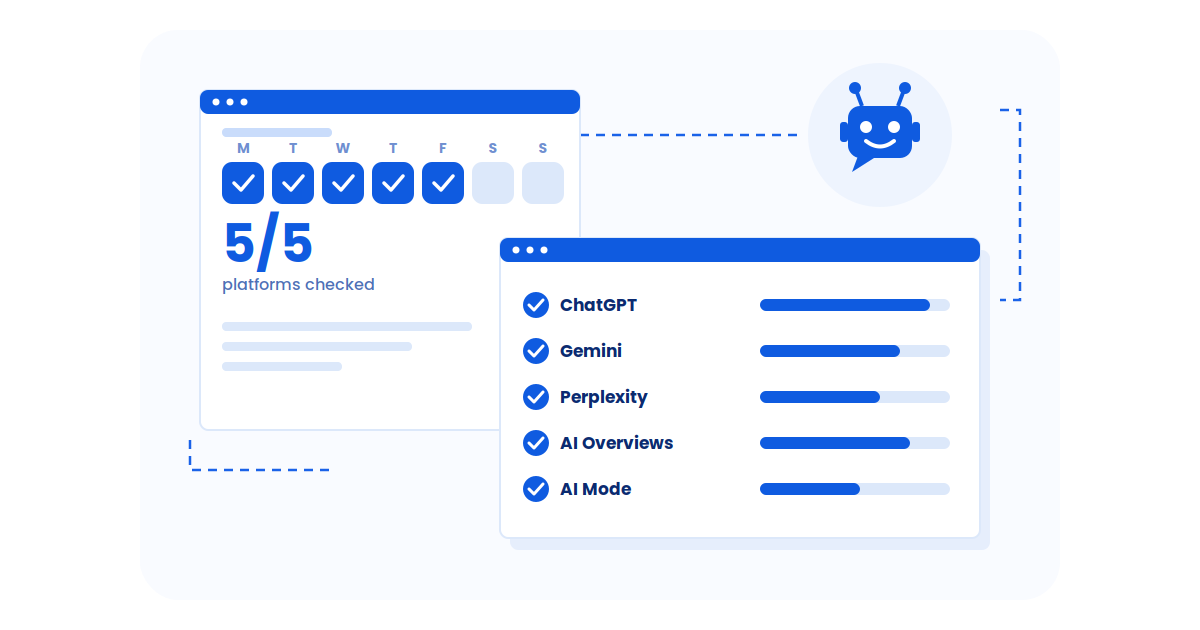
- Platform Coverage: Which AI tools cite you
Tracking Tools:
- Wellows – Complete GenAI visibility stack
- Semrush Enterprise AIO
- Ziptie.dev
- Profound
- Manual tracking via spreadsheets
Using a visibility tracker helps standardize how citation frequency, share of voice, and sentiment are monitored across AI-generated answers over time.
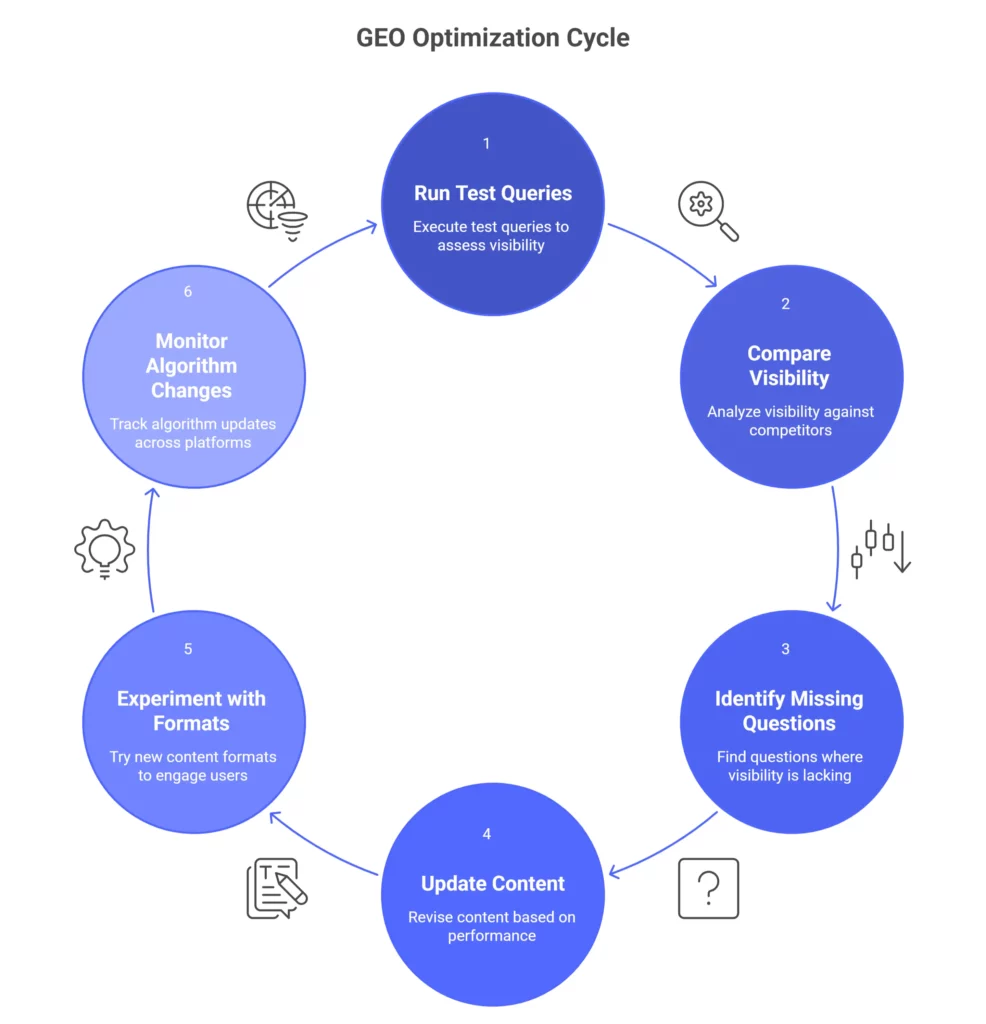
✅ Step 10: Test, Iterate & Refine
GEO is not a “set it and forget it” strategy. Continuous optimization is essential.
Monthly Action Items:
- Run test queries and document changes
- Compare your visibility to competitors
- Identify questions where you’re missing
- Update content based on performance
- Experiment with new content formats
- Monitor algorithm changes across AI platforms
Pro Tip: Create a dedicated Slack channel or spreadsheet where team members report interesting AI mentions or absences. This crowd-sourced monitoring helps spot trends faster.
Which Tools Should You Use to Track Brand Visibility in AI-Generated Answers?
Tracking your GEO performance is crucial, but the tools landscape is still evolving. Here are your best options in 2026:
- What It Does: Unified dashboard for tracking AI search engine visibility across ChatGPT, Gemini, Perplexity, AI Mode, and Google AI Overviews
- Key Features: Citation Score, competitor analysis, sentiment tracking, implicit vs explicit mentions
- Best For: Brands serious about dominating AI visibility with an autonomous marketing platform approach
- Pricing: Contact for demo
- Why Choose: Purpose-built GenAI visibility stack that tracks the metrics that actually matter for brand visibility
- What It Does: Tracks brand mentions and competitive rankings across AI platforms
- Key Features: Share of voice, sentiment analysis, brand changes over time
- Best For: Enterprise teams already using Semrush
- Pricing: Enterprise pricing (contact sales)
- What It Does: Monitors brand mentions specifically in Perplexity AI
- Key Features: Mention tracking, content optimization suggestions
- Best For: Teams focused on Perplexity optimization
- Pricing: Starts at $99/month
- What It Does: Surfaces unlinked mentions across AI outputs
- Key Features: Cross-platform tracking, citation discovery
- Best For: Brands wanting to find implicit mentions
- Pricing: Free and paid tiers available
How to Track It Without Tools:
- Step 1: Create a list of 20-30 questions relevant to your industry
- Step 2: Query each AI platform weekly with these questions
- Step 3: Document brand mentions, citations, and sentiment in a spreadsheet
- Step 4: Track changes over time and correlate with your content updates
- Step 5: Compare your visibility to 3-5 key competitors
How Do You Measure Your Brand Visibility Score Across Multiple Generative Engines?
Measuring success in GEO requires a different approach than traditional SEO. Here’s how to calculate and track your Brand Visibility Score effectively.
The 4-Component Visibility Score Formula
Breaking Down Each Component
1. Citation Frequency (25%)
- How many times is your brand mentioned across tracked queries?
- Formula: (Your mentions / Total tracked queries) × 100
- Benchmark: Top performers see 15-25% citation frequency
2. Share of Voice (25%)
- Your mentions vs. competitor mentions
- Formula: (Your mentions / Total industry mentions) × 100
- Benchmark: Market leaders achieve 30-40% SOV in their category
3. Sentiment Score (25%)
- Quality of mentions (positive, neutral, negative)
- Formula: (Positive mentions – Negative mentions) / Total mentions
- Benchmark: Aim for 70%+ positive sentiment
4. Platform Coverage (25%)
- How many AI platforms mention you
- Formula: (Platforms with mentions / Total platforms tracked) × 100
- Benchmark: Appear on 3+ major platforms (ChatGPT, Perplexity, AI Overviews)
Pro Tip
Your overall Citation Score is more than just quantity, it’s about consistent, positive visibility across multiple AI platforms. Track this monthly and compare against your top 3 competitors to identify gaps and opportunities.
What Are the Most Effective Ways to Increase Brand Mentions in AI-Generated Answers?
Now let’s get tactical. Based on 2025 research and case studies, here are the highest-impact strategies for increasing your brand mentions.
- Strategy #1: Create Quotable, Data-Rich Content:
AI engines love citing content that includes:
- Specific statistics: “Email marketing generates $42 ROI for every $1 spent”
- Expert quotes: Direct statements from recognized authorities
- Original research: Proprietary data and studies
- Clear definitions: Concise explanations of complex topics
Implementation:
- Conduct quarterly surveys or research studies
- Interview industry experts and publish their insights
- Create annual “State of [Industry]” reports with original data
- Structure content with clear, extractable quotes
Result: Content with statistics sees 30-40% higher visibility in AI answers.
- Strategy #2: Master the Art of Co-Citations:
Getting mentioned alongside established competitors signals relevance to AI engines.
Tactics:
- Pitch yourself for industry comparison articles
- Participate in “Best of” roundups and award submissions
- Engage in industry forums where competitors are active
- Create content comparing your solution to alternatives
- Get listed on review sites (G2, Capterra, TrustRadius)
Why It Works: When Monday.com is consistently mentioned alongside ClickUp and Asana, AI engines understand they’re competitors in the project management space.
- Strategy #3: Build Authority Through Multiple Touchpoints:
AI engines aggregate information from various sources. Your brand needs to appear everywhere.
Priority Touchpoints:
- Company website (obviously)
- Wikipedia entry (if notable enough)
- LinkedIn company and personal profiles
- YouTube channel with product demos
- Podcast appearances (transcripts get indexed)
- Reddit community participation
- Industry publication features
- Conference speaking engagements
Case Study: L’Oréal dominates traditional search but showed gaps in AI visibility until they focused on entity clarity and multi-platform presence.
- Strategy #4: Optimize for Long-Tail Conversational Queries:
AI users ask longer, more specific questions than traditional search users.
Query Evolution:
- Old: “CRM software”
- New: “What’s the best CRM for a real estate team of 15 people who need mobile access and email integration under $100/month?”
Content Strategy:
- Create use-case-specific landing pages
- Write “buying guide” content for different personas
- Answer hyper-specific questions in your FAQs
- Use natural, conversational language throughout
- Include qualifiers and context in your content
- Strategy #5: Leverage Schema Markup & Structured Data:
Make it easy for AI engines to understand and extract your content.
- Organization Schema (brand identity)
- FAQ Schema (Q&A content)
- HowTo Schema (tutorial content)
- Product Schema (product pages)
- Article Schema (blog posts)
- Review Schema (testimonials)
Impact: Properly implemented schema can increase citation likelihood by 30% according to AISO research.
What Are Marketers Getting Wrong About Generative Engine Optimization?
Let’s address some common misconceptions that could derail your GEO strategy.
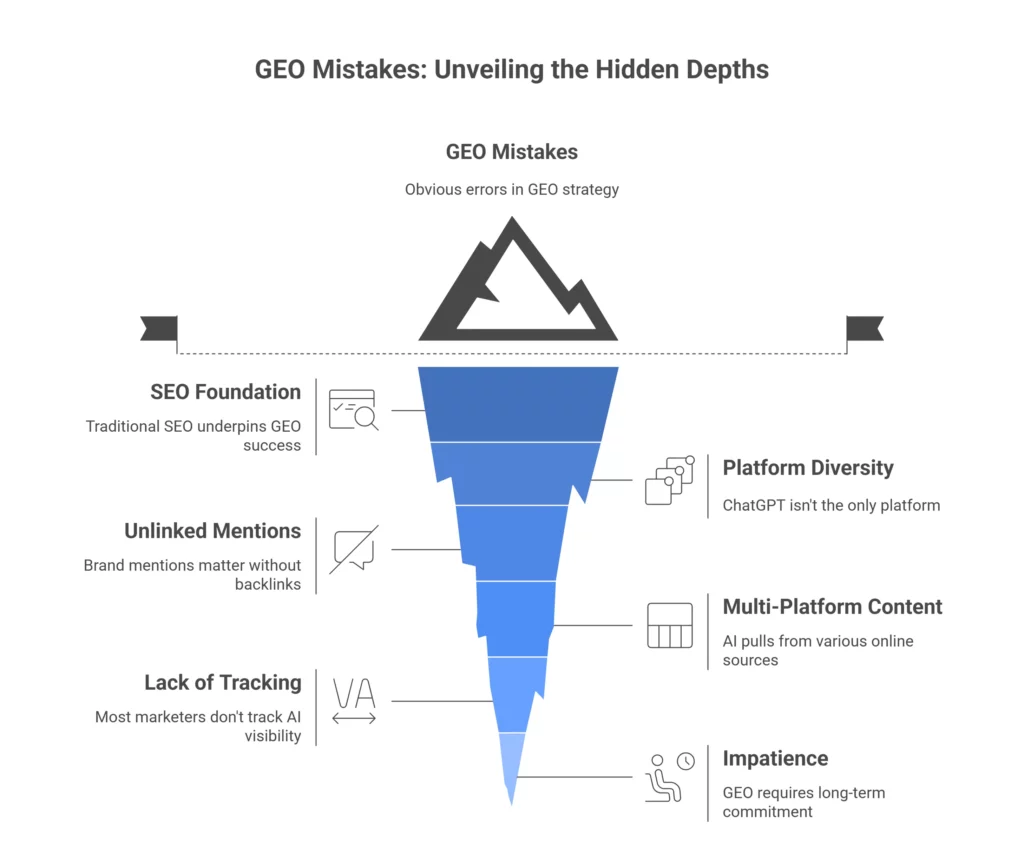
Mistake #1: Thinking GEO Replaces SEO
- GEO and SEO work together, not against each other
- Traditional SEO provides the foundation for GEO success
- Correlation data: Pages ranking on Google page 1 show ~0.65 correlation with LLM mentions
Mistake #2: Focusing Only on ChatGPT
- ChatGPT has 81% market share but other platforms matter too
- Perplexity, Claude, Gemini, and AI Overviews each have unique citation patterns
- Strategy: Optimize for all major platforms, not just one
Mistake #3: Ignoring Brand Mentions Without Links
- AI engines value brand mentions even without backlinks
- Unlinked mentions = 0.664 correlation with AI appearances
- Backlinks alone = only 0.218 correlation
Mistake #4: Creating Content Only for Your Website
- AI pulls from Reddit, YouTube, podcasts, and forums
- Reddit is cited 6.6% of the time in Perplexity results
- Action: Build multi-platform presence intentionally
Mistake #5: Not Tracking Results
- Only 22% of marketers track AI visibility (huge opportunity!)
- What gets measured gets improved
- Solution: Use tools like Wellows to monitor your AI search visibility
Mistake #6: Expecting Overnight Results
- GEO is a long-term game like SEO was
- Building entity authority takes 6-12 months
- Mindset: Start now, compound results over time
The Wellows Findings: What Actually Drives AI Citations?
After analyzing 485,000+ citations across 38,000+ domains in our Wellows ChatGPT Citations Report, we uncovered the patterns that most strongly predict brand mentions in AI-generated answers:
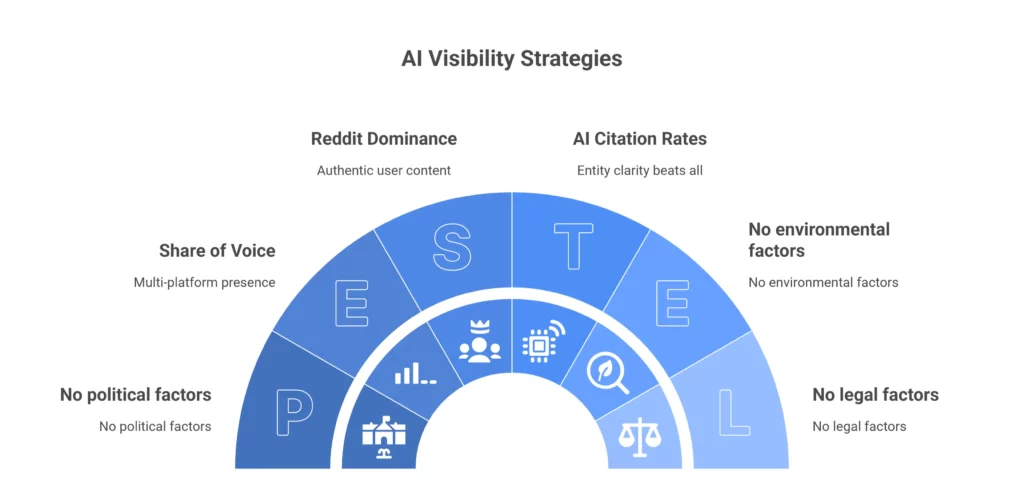
Key Finding #1: Entity Clarity Beats Everything
Brands with clear, consistent identity across the web saw 3.2X higher citation rates compared to brands with fragmented online presence.
What This Means:
- Consistent brand messaging across all platforms
- Updated Wikipedia and knowledge graph entries
- Unified NAP (Name, Address, Phone) information
- Clear category positioning
Key Finding #2: Reddit Dominance is Real
Wellows analysis shows that brands actively participating in relevant Reddit discussions saw 2.8X more AI citations compared to brands absent from Reddit.
Why Reddit Works:
- Authentic, user-generated content
- High trust signals for AI engines
- Frequently cited by Perplexity (6.6%), ChatGPT (1.8%), and AI Overviews
- Long-form, detailed discussions
Key Finding #3: Content Depth Over Quantity
We found that brands with 5-10 comprehensive guides outperformed brands with 50+ thin blog posts in AI visibility.
Quality Signals:
- Articles averaging 2,000+ words
- Multiple expert quotes and data points
- Proper schema markup implementation
- Regular content updates (refreshed quarterly)
Key Finding #4: Multi-Platform Presence Multiplies Visibility
Wellows findings indicate that brands present on 4+ platforms (website, YouTube, Reddit, LinkedIn, podcasts) saw 4.5X higher Share of Voice compared to brands on 1-2 platforms.
Platform Priority:
- Company website (foundation)
- YouTube (video tutorials/reviews)
- Reddit (community discussions)
- LinkedIn (B2B authority)
- Podcasts (audio transcripts)
Our research tracked brand mentions across five major AI platforms over Q3–Q4 2026. The data reveals fascinating patterns about which content types and brands dominate AI visibility.
| Platform | Top Cited Source Type | Citation Frequency | Average Position |
|---|---|---|---|
| ChatGPT | Wikipedia, Forbes, Industry Blogs | High | 1-3 |
| Perplexity | Reddit, YouTube, Gartner | Very High | 1-2 |
| Google AI Overviews | Reddit, YouTube, Quora | Medium-High | 2-4 |
| Gemini | Wikipedia, News Sites, .edu | Medium | 2-5 |
| Claude | Academic Papers, Industry Reports | Medium | 3-6 |
Key Insight: Each AI platform has distinct content preferences. A winning strategy requires optimizing for all platforms, not just one.
Fun Facts: The Weird World of AI Citations
Let’s take a breather with some fascinating (and sometimes bizarre) facts about how AI engines work:
Did you know?
Did you know?
Did you know?
Did you know?
Expert Insights: What Industry Thought Leaders Say About GEO
Wil Reynolds, Founder of Seer Interactive
“Search rankings appear to play some role in influencing LLM mentions, but they’re not the whole story. PR, partnerships, and on-page strategies are areas we’ll be digging into next. The marketers who understand this multi-dimensional approach will dominate AI visibility.”
Context: Seer Interactive conducted a study analyzing 10,000+ queries to understand what drives AI brand mentions.
Brian Dean, Founder of Backlinko
“GEO isn’t replacing SEO anytime soon. Instead, it’s layering over it. You still need optimized meta tags, fast-loading pages, and great content. But now you also need to think about how AI systems parse and cite that content. The winners will do both.”
Context: Brian’s recent GEO guide emphasizes the complementary nature of SEO and GEO strategies.
Lily Ray, Senior Director of SEO at Amsive
“The brands winning in AI search aren’t necessarily the ones with the most backlinks. They’re the ones being mentioned consistently across Reddit, YouTube, podcasts, and industry publications. Entity building is the new link building.”
Context: Lily has been tracking AI visibility trends since early 2024 and emphasizes multi-platform brand building.
Imri Marcus, CEO of BrandLight
“There used to be about a 70 percent overlap between the top Google results and what AI engines cited. That’s dropped significantly. Now, AI engines are choosing different sources based on factors like content structure, recency, and brand mentions—not just traditional rankings.”
Context: Quoted in WIRED magazine discussing the shift in how AI engines select sources.
FAQs
AI search visibility refers to how often your brand appears in answers generated by platforms like ChatGPT, Gemini, Perplexity, and Claude. In 2026, this visibility determines whether AI systems recognize your brand as an authority and include it in summaries, comparisons, citations, and recommendations—far beyond traditional organic rankings.
You improve GEO visibility by optimizing your entity, structuring your content for machine understanding, and publishing expert-level insights that LLMs can confidently surface. Focus on strong entity signals, contextual relevance, first-party expertise, and consistent mentions across authoritative sources.
AI search is replacing the classic 10-blue-links model with conversational answers and zero-click experiences. Instead of ranking positions, visibility now depends on how well AI systems understand your brand, trust your expertise, and select your content as part of generated answers.
No—SEO is the foundation of GEO. Pages ranking on Google’s first page show a strong correlation with being cited or referenced by LLMs. Think of SEO as infrastructure and GEO as optimization for AI surfaces. You need both to stay competitive in 2026.
Most brands begin seeing early AI visibility improvements within 3–6 months. Significant citation growth and entity strengthening usually take 9–12 months, as LLMs gradually incorporate your brand into their knowledge graph and response patterns.
All of them. ChatGPT currently leads market adoption, but Perplexity, Claude, Gemini, and Google AI Overviews reach different user behaviors and demographics. A strong GEO strategy optimizes for platform-agnostic visibility across all major engines.
Yes. Small businesses often perform exceptionally well when they specialize in a niche. LLMs reward deep expertise, high topical authority, and consistent publication—areas where small brands can outperform larger competitors.
Budgets vary by business size. Small businesses often start with $2,000–$5,000/month, mid-market companies invest $10,000–$25,000/month, and enterprises allocate $50,000–$200,000/month to cover tools, GEO content, entity optimization, and monitoring.
The biggest mistake is failing to track AI visibility. Most brands don’t measure their citation score, LLM brand mentions, or entity strength—meaning they can’t improve what they can’t see. GEO success requires consistent monitoring and iterative optimization.
Traffic will shift, not disappear. Zero-click searches are increasing, but AI-driven referral traffic converts significantly better. The goal is dual visibility: earn brand mentions in AI answers AND capture high-intent traffic through targeted content.
Authoritative, experience-backed, well-structured content. LLMs prioritize expert insights, comparisons, frameworks, statistics, how-to guides, and content with clear entity relationships. Unique POV content—with first-party expertise—performs far better than generic SEO-style posts.
Use consistent naming, add structured data (Organization, FAQ, Review, Product), maintain a unified knowledge source (e.g., About page), and earn contextual mentions across reputable sites. These signals help LLMs cluster your brand correctly in their internal graphs.
It requires both. Technical elements (schema, entity markup, canonicalization, structured FAQs) ensure machine readability. Content elements (expertise, citations, depth) ensure machine trust. The most successful brands combine both pillars.
Use AI visibility trackers like Wellows, model-specific monitoring, platform analytics, or manual prompts (“Which brands are best for X?”). Over time, monitor trends across multiple engines to see how consistently your brand appears.
No. GEO benefits any brand that depends on online visibility—local businesses, eCommerce, SaaS, creators, publishers, and service providers. If customers use AI to discover, compare, or choose solutions, GEO directly impacts your revenue.
Conclusion: The Future Belongs to Brands That Start Now
The search landscape has fundamentally changed, and there’s no going back. Generative Engine Optimization isn’t a passing trend—it’s the new reality of digital visibility.
Here’s what we know for certain:
✅ ChatGPT has 800 million weekly users as of September 2025
✅ Google AI Overviews appear in 60% of US searches as of November 2025
✅ LLM traffic will overtake traditional search by the end of 2027
✅ AI search traffic converts 5X better than traditional organic traffic
✅ Only 22% of marketers are actively tracking AI visibility—leaving a massive opportunity
The brands that will dominate in 2026 and beyond are those that:
- Understand that GEO and SEO work together, not against each other
- Invest in building entity authority across multiple platforms
- Create quotable, data-rich content optimized for AI extraction
- Track their visibility using tools like Wellows
- Iterate constantly based on performance data
The window of opportunity is NOW. While your competitors are still debating whether AI search matters, you can be establishing your brand as the authoritative voice in your industry.
Don’t wait until you’re invisible.
[highlighter_box header=”Want to See Where You Stand in AI Search?”]
If you’re serious about GEO, visibility tracking is the unfair advantage. Wellows helps you monitor how often your brand appears in ChatGPT, Perplexity, Gemini, Claude, and Google AI Overviews with one unified dashboard for citation frequency, sentiment, competitor Share of Voice, and your Citation Score.
Instead of guessing what AI engines are saying about you, you’ll know exactly where you’re winning, where you’re missing, and what to fix next.
[/highlighter_box]
Resources: Research, Data Sources & Checklist
Primary Research Studies
- Seer Interactive – “What Drives Brand Mentions in AI Answers”
- Semrush – “AI Search SEO Traffic Study”
- Ahrefs – “AI Overview Brand Visibility Factors (75K Brands)”
- Backlinko – “Generative Engine Optimization (GEO): How to Win in AI Search”
- Exposure Ninja – “AI Search Statistics for 2025”
Industry Statistics
- Marketing LTB – “98+ Generative Engine Optimization Statistics for 2025”
- Xponent21 – “Google AI Overviews Now Appear in 60% of Searches”
- Dataslayer – “Google AI Overviews Impact 2025: CTR Down 61%”
- Exploding Topics – “ChatGPT Users Statistics”
- StatCounter – “AI Chatbot Market Share”
Conversion & Traffic Data
- SuperPrompt – “AI Search Traffic Conversion Rates 5X Higher Than Google”
- Profound – “The Data on Reddit and AI Search”
- Yext Research – “86% of AI Citations Come from Brand-Managed Sources”
Industry Expert Commentary
- WIRED – “Forget SEO. Welcome to the World of Generative Engine Optimization”
- eMarketer – “Marketers Lack GEO Skills as Consumers Embrace AI”
Academic Research
Additional Data Sources
Checkout More Checklists!
- Client Onboarding Checklist for AI Visibility Platforms
- Generative Engine Optimization Checklist for Brand Visibility