Agencies are seeing the same pattern everywhere: traffic goes up, reports look great, but leads and revenue barely move, and that’s where AI Search Visibility for Agencies becomes the real advantage.
When that happens, the issue usually isn’t visibility, it’s intent. Simply put, traffic does not equal intent.
Search doesn’t work like it used to. People get answers directly in the SERP, skim AI summaries, and compare options across tools before they ever click. So rankings can look strong while real influence happens somewhere else.
That’s why agencies need to focus on where the brand is missing inside AI answers, SERP features, and high-intent searches that shape decisions. Tools like Wellows can make that gap-finding step repeatable.
SparkToro’s 2024 Zero-Click Search Study found that in the U.S., only about 360 clicks per 1,000 Google searches result in external website visits, meaning most searches end without a site visit (SparkToro, 2024).
With fewer clicks and more decisions happening upstream, agencies need a better way to spot GEO visibility gaps early by tracking intent, not just traffic.
- Traffic can rise while leads stall because traffic does not equal intent.
- AI summaries and SERP answers often satisfy intent before the click.
- Strong rankings can still mean weak influence at the decision stage.
- Agencies need to find gaps inside AI answers, SERP features, and high-intent queries.
- Tools like Wellows can make tracking those gaps repeatable across platforms.
If you’re a brand comparing providers for this type of gap analysis, top AI SEO agencies outlines who does it well and how to choose.
The Core Agency Problem, When Traffic Fails to Convert
For years, agencies sold rankings, clicks, and sessions as proof of success. But AI-powered search has changed how people discover and evaluate brands visibility.
- Informational searches are answered directly inside the SERP
- AI summaries reduce the need to click
- High-intent users research across multiple touchpoints before converting
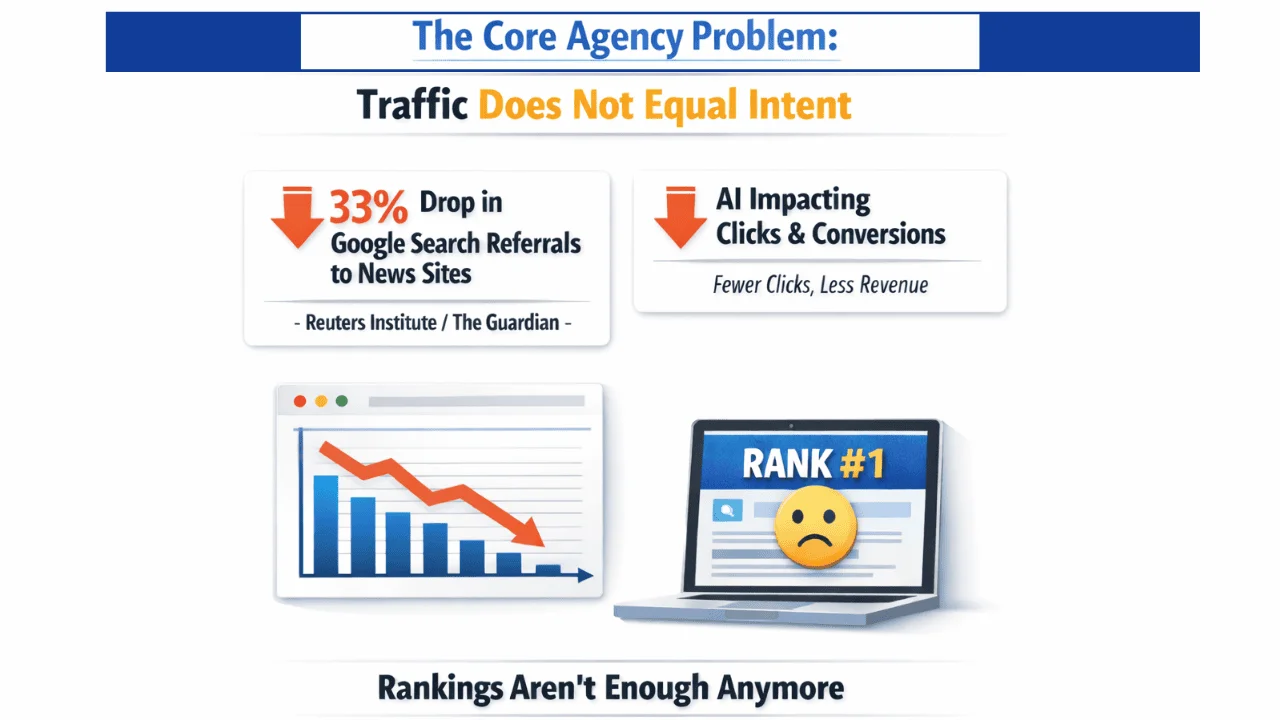
This is where agencies struggle. Traffic does not equal intent when the “visit” is no longer the main step between discovery and decision.
It’s not just theory, when fewer searches end in clicks, referral traffic drops even for sites that still “rank.”
Did you know?
That shift is also showing up in referral trends. A Reuters Institute analysis, reported by The Guardian, cited a 33% decline in Google search referrals to news sites, with further declines expected as AI summaries expand (The Guardian, 2026).
How Agencies Uncover Hidden AI Search Visibility Gaps Beyond Rankings
Ranking reports can still look strong while real visibility collapses, because AI layers now sit on top of the classic SERP. Brands can rank well and still be invisible at the moment decisions are formed.
Did you know?
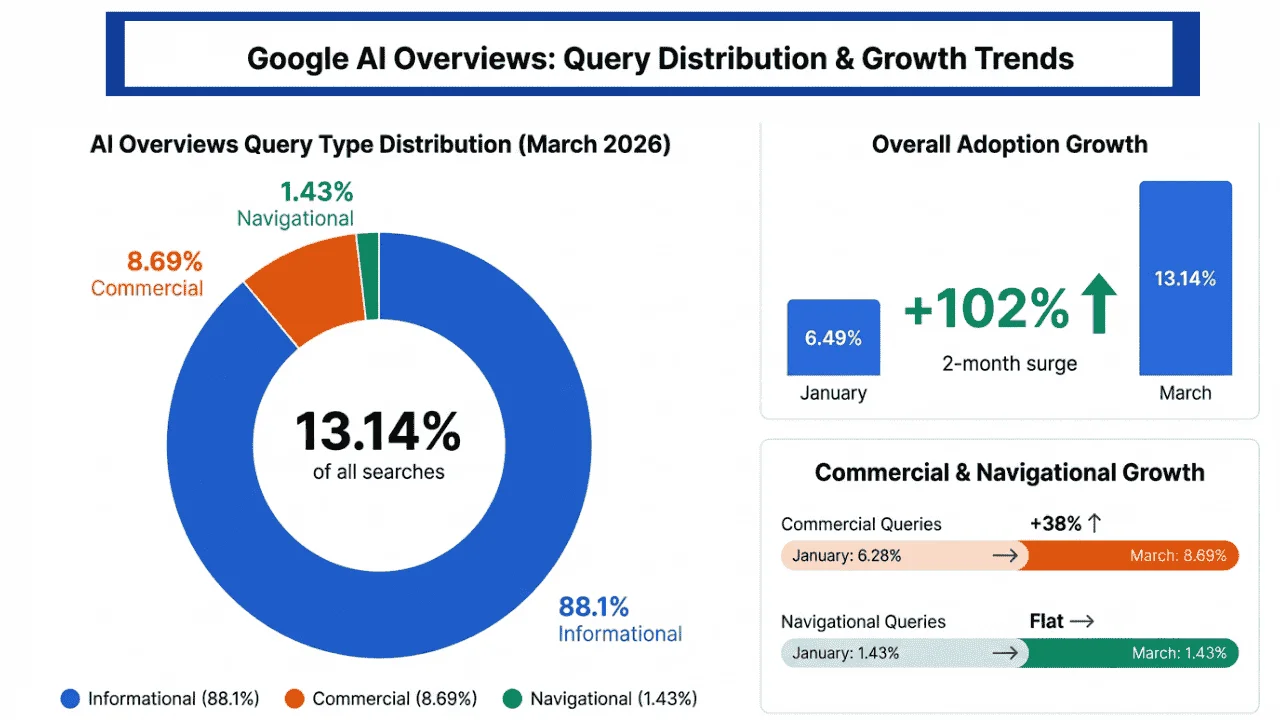
Google’s AI Overviews are a growing part of that shift. Search Engine Land reports that AI Overviews now appear on roughly 13% of searches, skewing heavily informational, with commercial and navigational queries increasing over time (Search Engine Land 2024).
At the same time, AI-powered search tools like ChatGPT, Perplexity, and Gemini are changing how users get answers. Instead of scanning ranked lists, users receive synthesized responses that often reference only a few trusted sources, leaving many brands out entirely.
This is why agencies are shifting away from rankings as the primary signal of success. When answers are delivered before the click, traffic does not equal intent. Visibility now depends on whether a brand is included in the answer itself.
To account for this, agencies deliverables checklist are expanding how they define and measure visibility:
- Presence inside AI answers , whether the brand is mentioned or cited in generative responses
- Topic-level authority , whether AI systems treat the brand as a trusted source for a given problem
- Intent coverage , whether the brand appears for evaluation, comparison, and purchase-stage queries, not just awareness topics
Research on AI retrieval behavior shows that models favor content that is clearly structured, authoritative, and easy to extract, reinforcing why traditional keyword optimization alone is no longer enough.
This is also where Wellows fits into the workflow. It helps agencies move beyond scattered screenshots and one-off checks by consistently identifying where brands are missing from AI answers, where competitors are being cited instead, and which gaps are blocking high-intent visibility.
How Agencies Find Hidden AI Search Visibility Gaps Through Deep Audits
One of the most reliable ways agencies uncover hidden AI search visibility gaps is through multi-layered audits, grounded in a technical SEO checklist for agencies, that show why visibility isn’t translating into outcomes across content, local presence, and measurement.
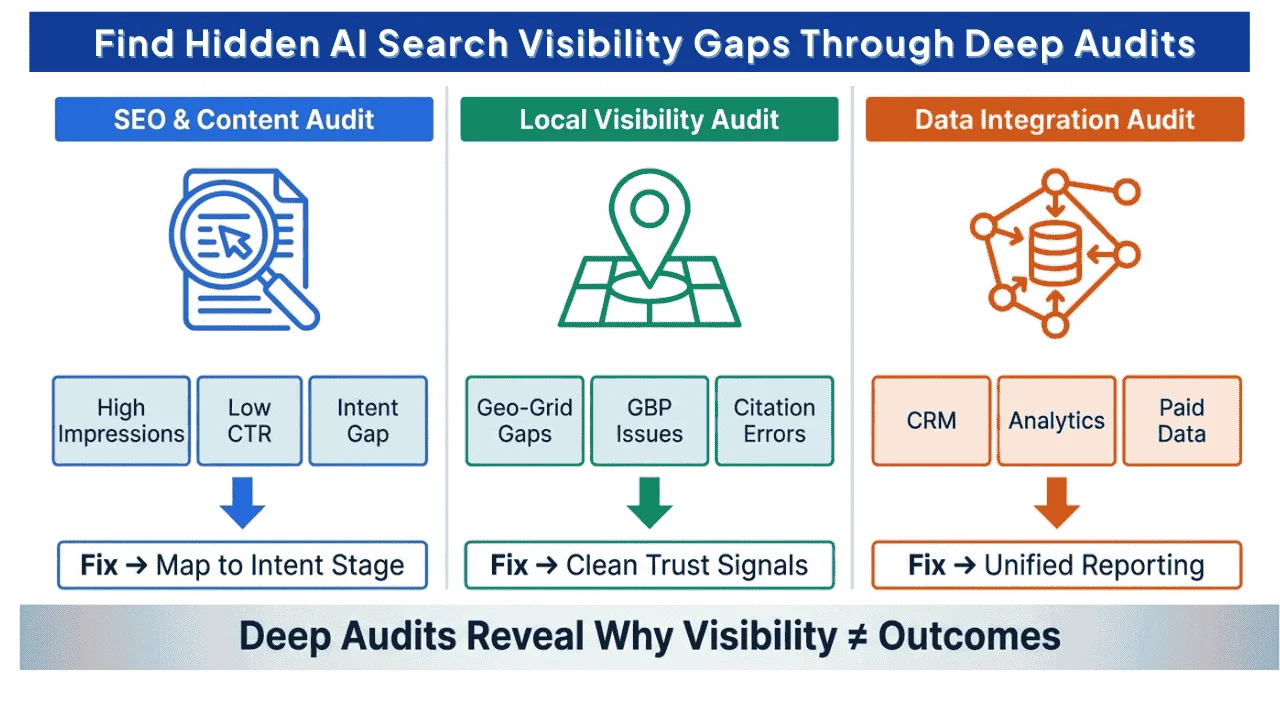
SEO & Content Audits
Start with Google Search Console to spot what rankings won’t show. Pages with high impressions but low CTR usually mean the snippet isn’t earning the click, the page doesn’t match intent, or SERP features are absorbing demand.
Compare competitors with Wellows, Ahrefs, or Semrush to find the topics and page types they win on, especially pricing, comparisons, and evaluation content.
Did you know?
Semrush’s AI Overviews research, based on analysis of over 10 million keywords, shows how visibility and click behavior shifts as generative answers appear more often in results (Search Engine Land, 2025).
Agency fix: map each priority page to one intent stage (informational, comparison, evaluation, purchase). Without that, traffic does not equal intent.
Local Visibility Audits
Use geo-grid reporting to see where visibility drops by neighborhood, not just by keyword. Most gaps come from inconsistent Google Business Profile fields, duplicate listings, or mismatched directory data.
Clean up GBP details and citations so AI and local search don’t skip the brand due to weak trust signals.
Data Integration & Reporting Audits
Visibility gaps hide when CRM, analytics, and paid data sit in separate tools. Integrate them to see what drives pipeline, where users drop off, and which pages assist conversions.
Standardize reporting and ownership so teams stay aligned on outcomes, not activity.
How to Run an AI Visibility Audit (And Find Competitor Citation Gaps)
AI visibility audits answer one question: When AI summarizes this topic, does it choose my client, or a competitor?
A practical audit workflow:
- 1) Select 20–50 money topics:
Start by choosing 20–50 topics that directly connect to revenue, such as core services, “best X,” “X vs Y,” pricing, alternatives, local intent (“near me”), and industry-specific searches (“for [industry]”). The goal is to focus on queries where visibility influences decisions, not just awareness.
- 2) Run the same topics across AI and search:
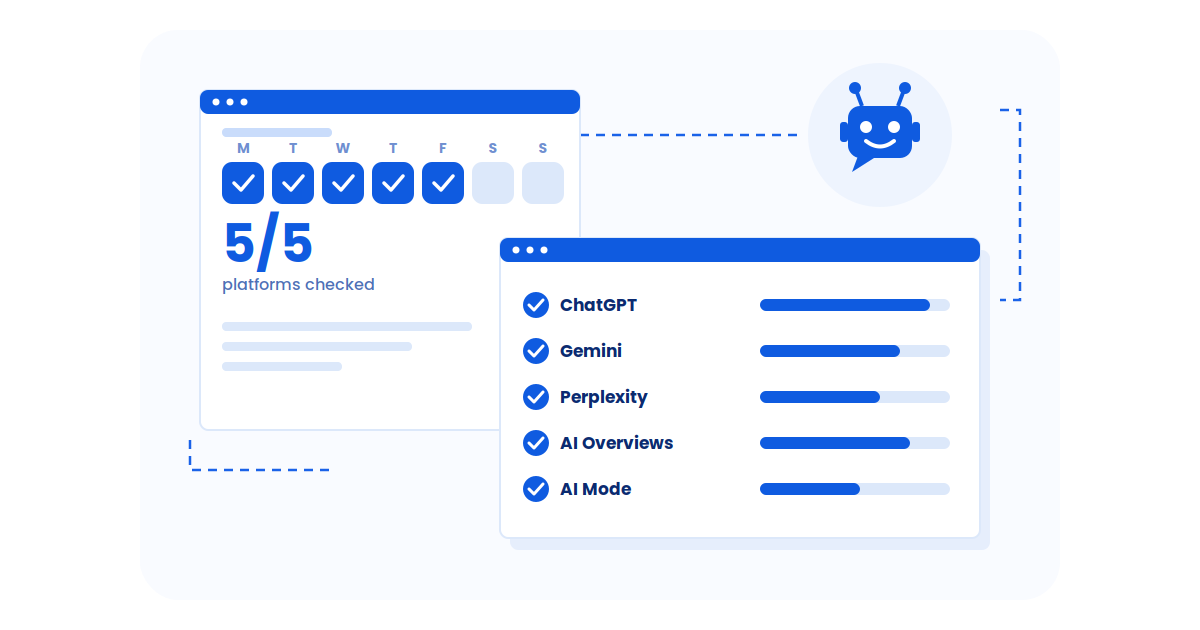
Next, test the exact same topic set across Google and AI tools. In Google, check whether AI Overviews appear for those queries. In ChatGPT, Gemini, and Perplexity, look at whether the client shows up in the response and whether the tools provide references or citations.
- 3) Log what the answers include:
For each query, record what the AI actually returns. Note whether your client is mentioned, whether competitors are mentioned, and which domains AI chooses to cite or link to. This creates a clear baseline of who is being trusted as the source.
For the ongoing version of this — turning a one-time audit into a daily monitor — how agencies monitor mention and citation movement in AI search walks through the explicit-vs-implicit split that keeps gap analysis live across the month.
- 4) Identify citation gaps:
Then, isolate the visibility gaps that matter most. The two biggest are when competitors are cited but your client is missing entirely, and when your client is mentioned but doesn’t receive a citation or link. These gaps often explain why visibility isn’t translating into demand.
- 5) Turn findings into actions:
Finally, convert each gap into a specific fix. That may mean creating or improving a page to match intent, strengthening entity signals, adding structured data, improving topical coverage, or building authority through credible third-party mentions. The outcome is a prioritized execution plan tied to real visibility loss.
Where Competitors Win AI Visibility And Where Your Client Is Missing
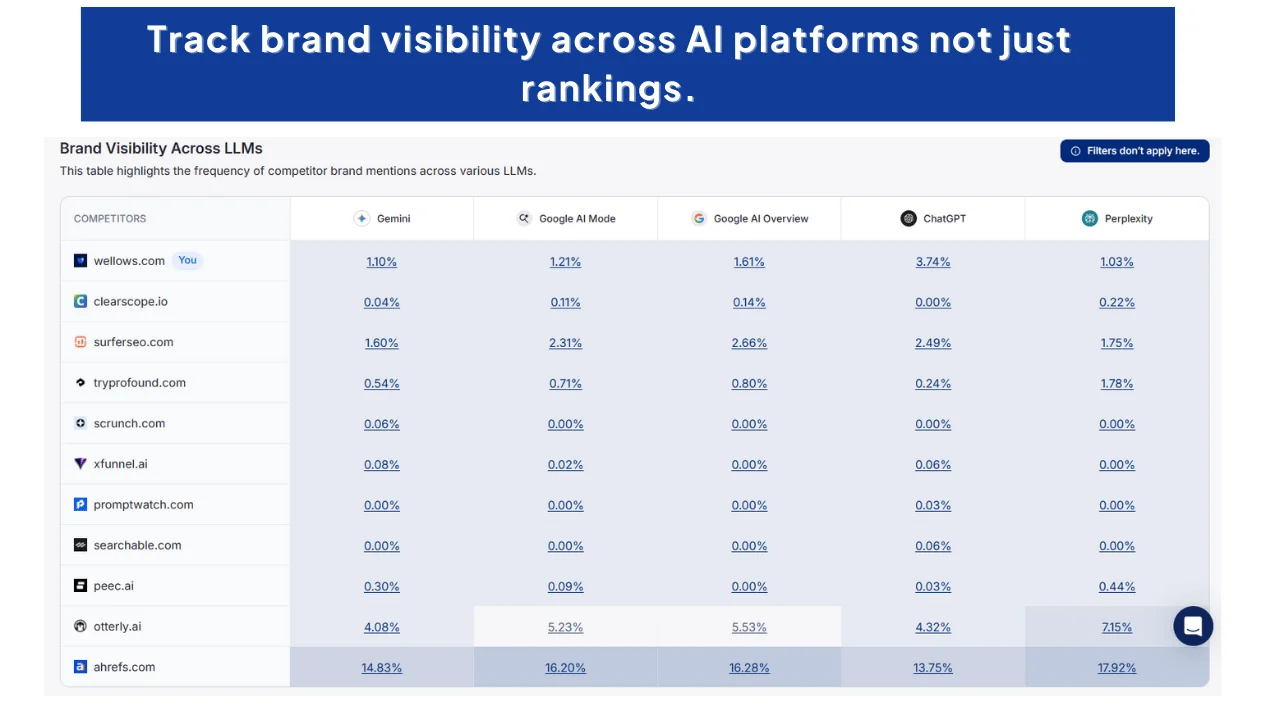 Where Wellows helps: it shows you, in one place, which competitors are winning AI visibility and citations, and exactly where your client is missing on the queries that matter most.
Instead of relying on screenshots or one-off checks, Wellows surfaces the audit outputs agencies need to act fast:
- Brands by Visibility: a competitor leaderboard that makes it obvious which domains are consistently getting picked by AI systems, so you can see who’s actually influencing decisions, not just who ranks.
- Brand Visibility Across LLMs: a side-by-side view across major AI surfaces (including Google’s AI experiences and LLM-based tools) so you can spot where your client is weak while competitors are strong.
- Top Cited Queries: a query-level view showing what’s being asked, whether your client is mentioned or cited, and which competitors are getting the citations when your client isn’t.
- Opportunity Lists: highlights explicit and implicit gaps, topics where competitors are visible and cited but your client is absent, so content planning starts with proven gaps, not assumptions.
The result: you don’t just know that visibility is dropping, you know where it’s dropping, who is taking the citations, and which queries to prioritize first.
Most agencies use a mix of Google Search for manual checks, Semrush for AI visibility research, and internal tracking in spreadsheets or dashboards.
The problem is operational: manual checks don’t scale, and spreadsheets don’t tell you which queries are triggering AI Overviews or who is getting cited when your client isn’t.
That’s where Wellows fits. It helps agencies spot missing AI Overviews coverage by tracking visibility at the query level and showing which competitors are getting cited on top queries, so you can move from “we think we’re missing something” to “we know exactly where the gap is.”
According to Wellows, the platform tracks queries, monitors brand and competitor visibility shifts, and uses a Citation Score to summarize verified citations across AI platforms, including Google AI Overviews.
How Agencies Track Share of AI Voice Across AI Search Engines
Share of AI voice measures how often your client appears in AI-generated answers compared to competitors across a defined set of high-intent queries. It’s a practical way to quantify “who AI is recommending” in your category.
Did you know?
How to track it: Build a query set per service line (for example: “best,” “vs,” “pricing,” “for [industry],” and “near me”). For each query, score visibility consistently:
2 if the client is cited/linked, 1 if the client is mentioned without a citation/link, and 0 if the client doesn’t appear. Then total the scores and compare them against competitors to see who dominates at the topic level.
With Wellows, agencies can automate much of this process. You add the client’s domain, define the query set you want to track, and monitor brand visibility across multiple LLMs over time, so you can see where the client appears, where competitors dominate, and which queries are driving (or blocking) AI visibility.
Did you know?
This matters because Gartner predicts that by 2026, traditional search engine volume will drop 25% as AI chatbots and virtual agents take share (Gartner, 2023).
In that environment, traffic does not equal intent, and share of AI voice becomes a clearer signal of competitive positioning.
Prompts Agencies Use to Test Visibility in ChatGPT, Gemini, and Perplexity
Use prompts that match real buying behavior, not generic informational searches. The goal is to trigger the same evaluation moments prospects use when they’re close to choosing a provider.
“Best [service] for [industry] companies with [constraint]”
“Compare [client] vs [competitor] for [use case]”
“What’s the typical price for [service] and who should I hire?”
“Top agencies for [service] in [city], include pros/cons”
For each prompt, record whether the client appears, whether the AI includes citations (and where they point), and which competitors show up repeatedly. This is one of the fastest ways to uncover hidden visibility gaps that never show up in Google Search Console.
Turning Visibility Gaps Into Revenue Opportunities
Finding gaps is only half the work. The value comes from turning “missing visibility” into actions that move pipeline and revenue.
Optimize for AI citations: Make key pages easy to extract and trust with clear positioning, proof, and structured information.
Build high-intent assets: Create the pages buyers actually use to decide, comparisons, pricing, alternatives, and “best for X”.
Strengthen trust signals: Reinforce credibility with reviews, case studies, and consistent entity/business data.
Report on influence + pipeline: Track citations, assisted conversions, and intent-stage visibility, not just sessions.
Why this matters:
Visibility gaps create revenue leakage. In other industries, the same “can’t-see-it, can’t-fix-it” problem shows up as measurable loss, like healthcare revenue-cycle teams estimating 3–5% of net patient revenue is lost annually due to inefficiencies tied to poor visibility (Currance, 2025).
For agencies, the equivalent is spending time on work that looks productive but doesn’t affect decisions. Internal misalignment makes that worse: Varicent reports most companies lose 6–15% of revenue to problems they already recognize but have normalized (Varicent, 2025).
And KPMG notes that over 50% of surveyed organizations still struggle with data silos that prevent a unified view of customers, driving missed cross-sell/upsell and churn (KPMG, 2025).
That’s how agencies turn the pain point, traffic does not equal intent, into a measurable system clients understand: find the gap, fix the visibility, and prove the impact in revenue terms.
Read More Articles
- Content Marketing Agencies: A Complete Guide 2026
- Top Content Marketing Statistics to Know This Year
- Reddit and AI Search Visibility: What Marketers Should Know
- AI Mistakes Marketers Should Avoid
- Readability Score in AI Content: Why It Matters
- Multi-Client AI Visibility Reporting Checklist for Agencies 2026
FAQs
Local AI answers rely on trusted business data. Fix inconsistent NAP, incorrect Google Business Profile fields, duplicate listings, and category/service mismatches so AI systems don’t skip or distrust the brand.
Track share of AI voice by location, local pack visibility (geo-grid), AI mentions/citations for local intent queries, GBP/directory consistency, and conversions from geo-intent pages.
Use a shared topic set (“best,” “vs,” “pricing,” “alternatives,” “near me”) and compare mentions/citations, sources AI uses, and the formats competitors win with.
Look for brand mentions without citations or citations pointing to third parties. Fix by publishing clearer source pages, improving schema, and adding original data AI can reference.
Audit pages for weak answer-first structure, missing entities, and lack of proof. Rewrite with clear summaries, comparisons, and scannable evidence so AI can extract and cite it.
Conclusion
Search has changed, and agencies can’t rely on rankings and traffic to explain performance anymore. In a world of AI summaries, zero-click results, and multi-platform research, traffic does not equal intent, and visibility only matters when it shows up at the decision stage.
That’s why how agencies find ai search visibility gaps is now a core growth skill, not a “nice-to-have.” When agencies measure presence inside AI answers, track competitor citations, and map visibility to high-intent queries, they stop optimizing for vanity metrics and start building influence that converts.
The agencies that win in the AI search era won’t be the ones chasing more traffic. They’ll be the ones who master how agencies find hidden AI search visibility gaps and turn those gaps into predictable revenue outcomes.