Finding the right queries to track in 2025 has become one of the biggest challenges in AI search. It often feels like working inside two search systems at the same time.
Google keywords on one side, and how to rank in chatgpt style conversational discovery on the other.
Across our work with SaaS companies, agencies, and local-first brands, we kept seeing the same pattern. Every visibility review paused at a single question:
“AI search is where buyers ask now, but which queries should we track?”
Some teams relied on old keyword lists. Others tested random prompts. Most were guessing. That guesswork reduced visibility in AI answers and made it difficult to measure real performance.
To stay visible, brands now need more than keywords. They must understand and track the real questions people ask AI systems and search engines.
These questions are conversational and intent-driven. They sit at the core of AI Search Visibility and Generative Engine Optimization (GEO).
In this blog, I share the process our team developed and refined with partners. It shows how we build a clear, trackable query list and turn it into content that AI engines can cite with confidence.
Why Traditional Keyword Research No Longer Works for GEO in 2026
Traditional keyword research was built for blue-link SEO. It focuses on short phrases, exact matches, and high-volume terms. This approach does not match how AI systems evaluate content today.
AI tools read full questions. They focus on intent and context, not isolated keywords. They pick sources that explain a topic clearly and support it with evidence.
This creates three main gaps in old keyword research:
- Keywords Hide Intent: Short phrases like “AI SEO tool” are unclear. A natural question like “Which AI SEO tool helps track citations in ChatGPT?” shows real decision intent.
- Zero-Click Answers Shift the Goal:Many searches now end inside AI Overviews or generative summaries. Visibility depends on being referenced in the answer, which makes understanding how AI selects sites to cite more important than ranking position.
- Volume Misleads Priorities: High-value GEO queries are often long and low-volume. They appear when AI tools choose which brands to mention.
AI systems prefer content that is clear, structured, and supported by context. Thin pages or keyword-heavy writing reduce your chance of appearing in AI answers.
Your keyword base still matters, but it must be clean and aligned with user intent. A simple way to check this foundation is to compare your structure and targeting with the principles in the keyword strategy integration for llm SEO checklist.
In 2026, keyword tools still offer background direction, but the main input for AI search engine visibility comes from the real questions people ask inside AI tools and local search.
How To Find The Right Queries For My Brand To Track For GEO
Now that GEO query intent is clear, the next step is to build a query list that reflects how people search in an AI-first and local-first environment.
Most teams use keyword exports that are too shallow for AI or rely on random prompt tests that do not cover real intent. A better approach is a structured query discovery process that combines real demand signals with natural question language.
This becomes more effective when aligned with the generative engine visibility factors that influence what AI systems pick, summarize, and cite.
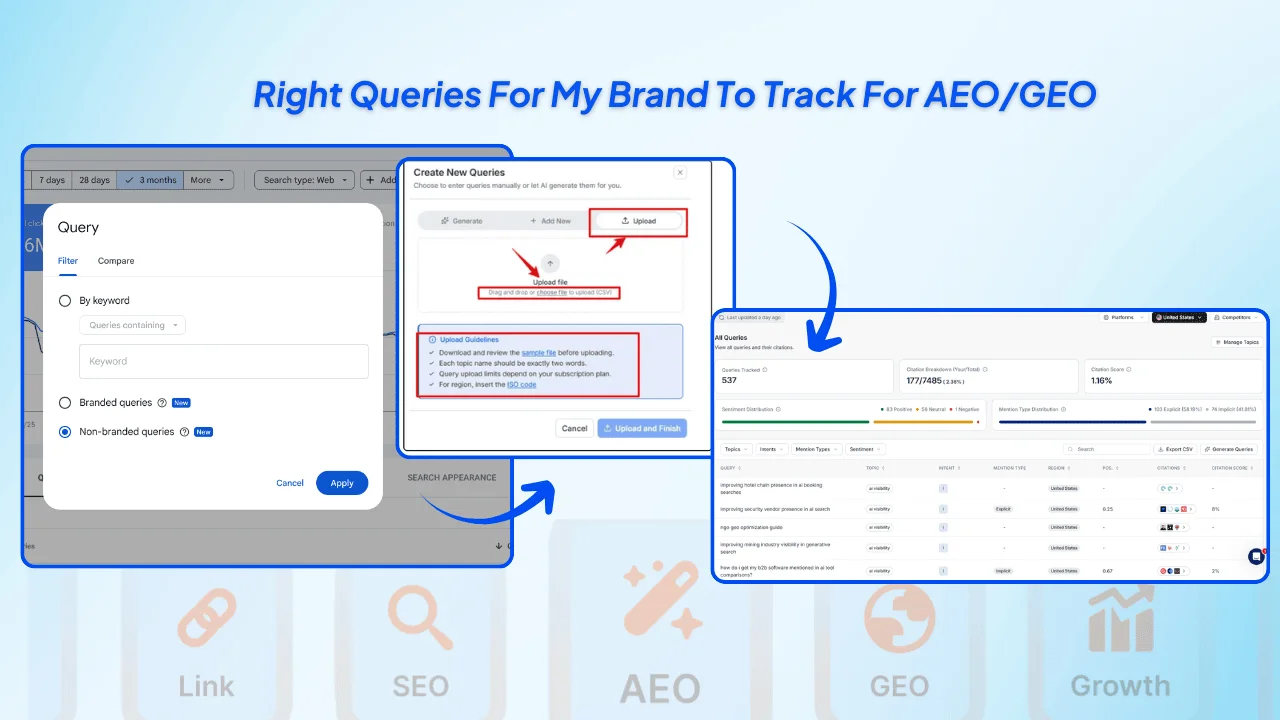
1. Use Google Search Console To Uncover Real Demand
Google Search Console is the most reliable first-party source because it shows which queries already connect users with your brand and category. In the Performance report, look for two patterns:
- Branded question prompts: examples include “YourBrand + feature,” “YourBrand + pricing,” or “YourBrand + best tool.” These reflect real buyer paths.
- High impressions with low CTR: these often appear in zero-click AI results or SERP answers. They signal strong AI visibility potential.
Partner teams often find strong GEO targets inside People Also Ask. These questions mirror follow-up intent in natural language. Capture the original phrasing and use the best ones as headings with direct, short, context-rich answers.
Once core questions are gathered, expand them using places where users describe needs in their own words:
- Question tools: Wellows, AnswerThePublic, Ahrefs “Questions,” and Keyword Planner.
- Communities: Reddit, Quora, and niche forums for natural phrasing.
- Internal signals: sales calls, support logs, and site search queries.
Tracking improves once queries are grouped by intent:
- GEO bucket: location and context terms such as “near me,” “in [city],” “open now,” and neighborhood names.
- GEO crossover bucket: location needs phrased like AI prompts, for example “What is the best agency in Chicago?” or “Where can I find a reliable analytics tool in Lahore?”
After building the list, success depends on generative visibility, not blue-link rankings. Accurate AI visibility measurement focuses on signals beyond traditional positions. Focus on:
- AI summary or overview capture rate
- Brand mention rate in AI answers
- Citation rate
- Local visibility for GEO prompts
- Zero-click impressions in GSC
This repeated challenge is why the next section explains a structured way to build a full GEO query list without guesswork. It also shows how teams shift from random prompts to measurable AI Search Visibility.
Who Should Track AI Search Queries for GEO in 2026
Tracking AI search queries for GEO is now a core visibility task, especially for teams responsible for how agencies deliver AI search visibility across generative answers, AI Overviews, and local discovery.
In partner conversations, one issue often appears. Brands lose visibility not because they lack content but because they are not tracking the right AI search queries.
This is why query tracking now sits beside classic SEO as a daily growth activity.
In most teams, this work fits naturally with digital marketing teams, SEO specialists, and visibility or data analysts. They understand search behavior, content performance, and the shifts inside AI answers. Their role is to watch how audiences phrase AI questions, check where the brand appears, and turn those insights into actions.
Tracking is especially important for startups, SaaS companies, agencies, and autonomous marketers that rely on discovery through AI answers, AI Overviews, and generative summaries. As Google expands AI Overviews, AI Overviews optimization becomes a direct factor in whether a brand is shown or skipped.
Here is a simple partner-style example:
- Startup: DataNest, a B2B SaaS analytics tool in a crowded market.
- John (CEO): checks presence by asking AI engines questions like “best tools” and “top solutions.”
- Areeba (Autonomous Marketer): manages SEO and AI visibility and needs persona-based AI queries to track citations correctly.
This is the type of situation where structured GEO query tracking creates a clear advantage. Modern visibility now happens inside AI conversations, not only on blue-link SERPs.
- LLM Query Builder (Free): Creates GEO-ready AI search queries linked to personas, intent types, pain points, and JTBD.
- Wellows Platform (Tracking + Optimization): Upload or generate queries, then track citation score, LLM presence, sentiment, and visibility gaps across major AI engines.
Teams that once tracked keywords and rankings can now use LLM citation tracking to monitor AI citations, brand mentions, and generative visibility in a single platform built for GEO.
The next section explains how the query list is generated and why this method removes the guesswork that teams face.
How Wellows LLM Query Builder Generates GEO Queries
When John notices DataNest missing from AI answers, Areeba does not guess prompts or pull keyword exports. Many partners describe the same moment. They know AI visibility matters, but they do not know which queries to track.
Instead of starting from zero, Areeba uses the Wellows LLM Query Builder. The tool focuses on one goal. It closes the query discovery gap that traditional research does not address in generative engine optimization.
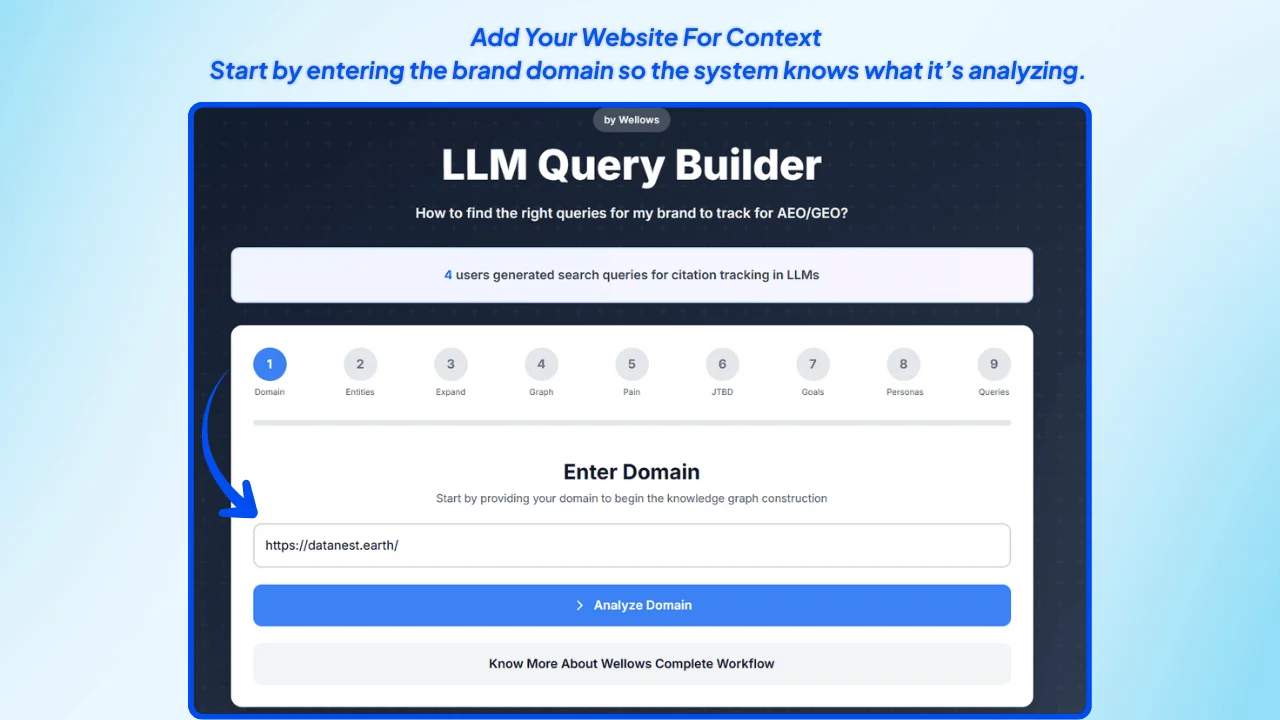
The process begins with real business context. Areeba enters the DataNest domain, and the system maps what the brand offers, who it serves, and how buyers describe these needs in AI search.
The tool then generates a structured set of conversational, geo-ready AI search queries that match natural questions people ask in ChatGPT, Perplexity, and Google AI Mode. The same query structures that influence how to rank in Perplexity and similar AI-first engines.
Each query links to a persona, a pain point, and an intent stage. This makes the list ready for citation tracking and content planning. The LLM Query Builder replaces random prompt tests with a complete, trackable GEO query strategy.
Did you know?
How the Tool Builds the Query List
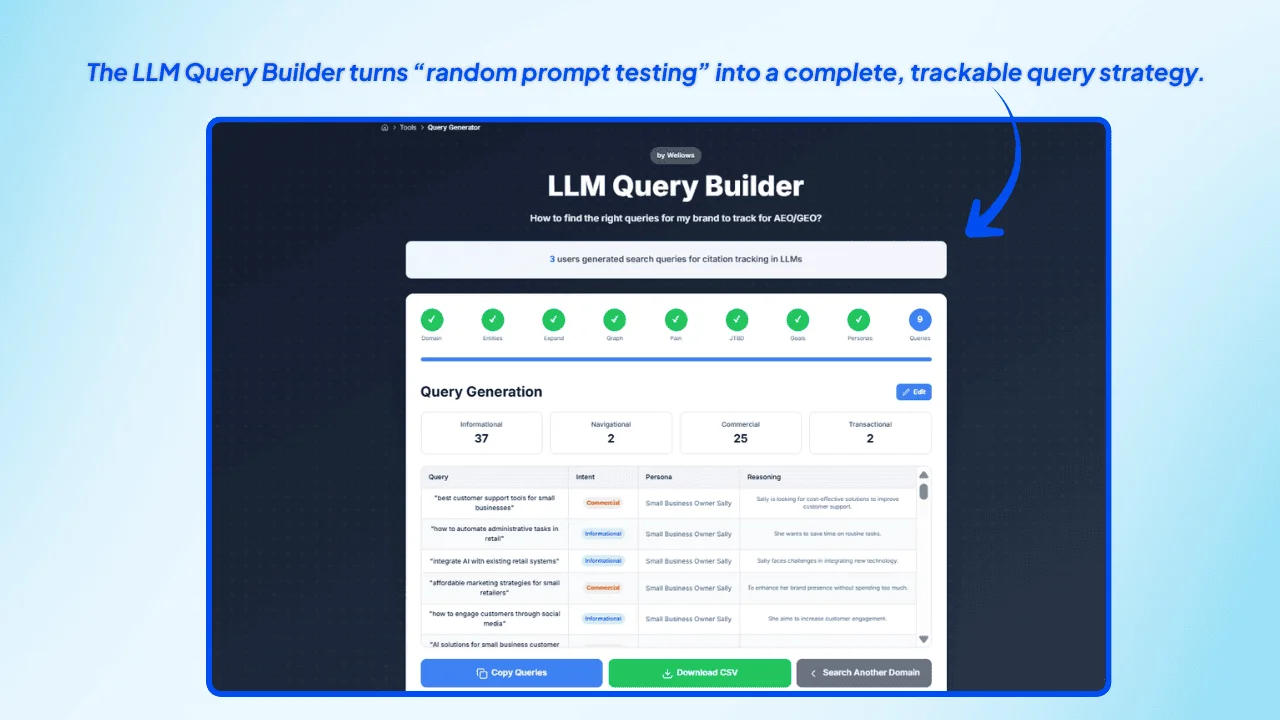
- Runs domain analysis to understand the brand’s semantic space and category position.
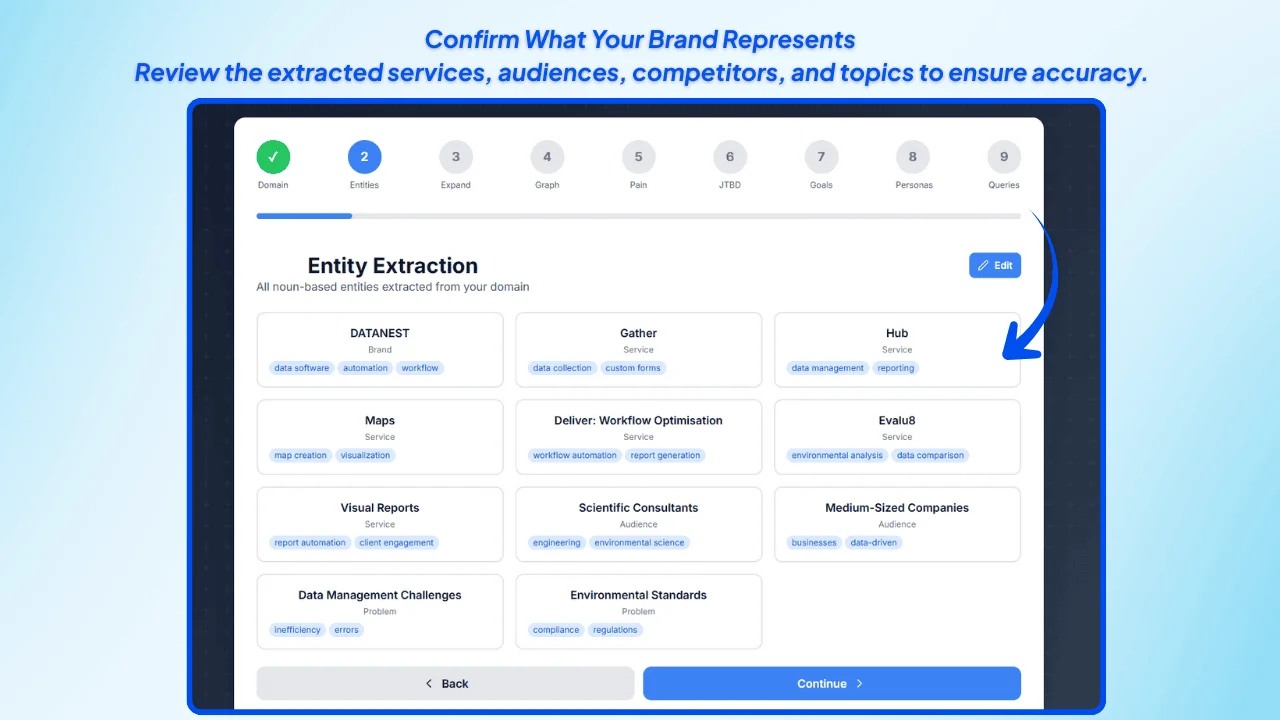
- Extracts and expands entities such as services, audiences, tools, competitors, and use cases.
- Builds a semantic knowledge graph that shows how these entities relate.
- Identifies pain points, JTBD, and goals that shape how users phrase AI questions.
- Creates editable personas so query outputs match real decision-makers.
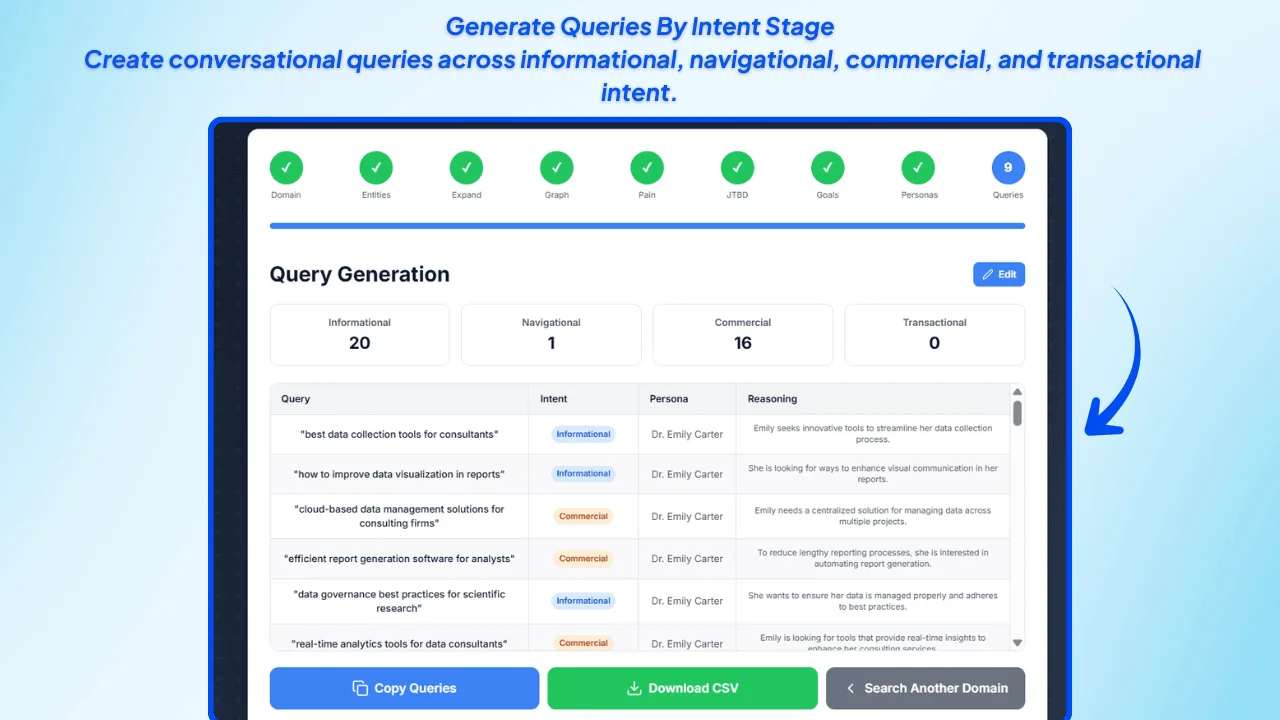
- Generates 40+ intent-tagged AI queries across Informational, Navigational, Commercial, and Transactional stages.
- Exports the full list as CSV so tracking can begin right away.
Why This Matters for GEO Tracking
Partners often stall because they track the wrong questions. AI search is semantic, and different personas ask in different ways. Citations appear only when a brand shows up across a full query space. This is why teams need to combine SEO and GEO instead of running them as separate tasks.
The builder captures this coverage automatically. Teams can measure visibility with confidence and know which gaps to fix next
How To Use Wellows LLM Query Builder Step By Step
In partner work, this is the step where most teams get stuck. The feedback is always the same. “We know AI visibility matters, but we do not know which queries to track or how to create them without guessing.”
Here is the workflow we guide partners through, using the same DataNest example. Once the tool opens, Areeba follows a simple path to turn the domain into a GEO-ready query list.
Enter the domain. Paste your website URL so the system understands your category and context.
Review and edit core entities. Check extracted services, audiences, competitors, and topics. Remove noise and add missing items.
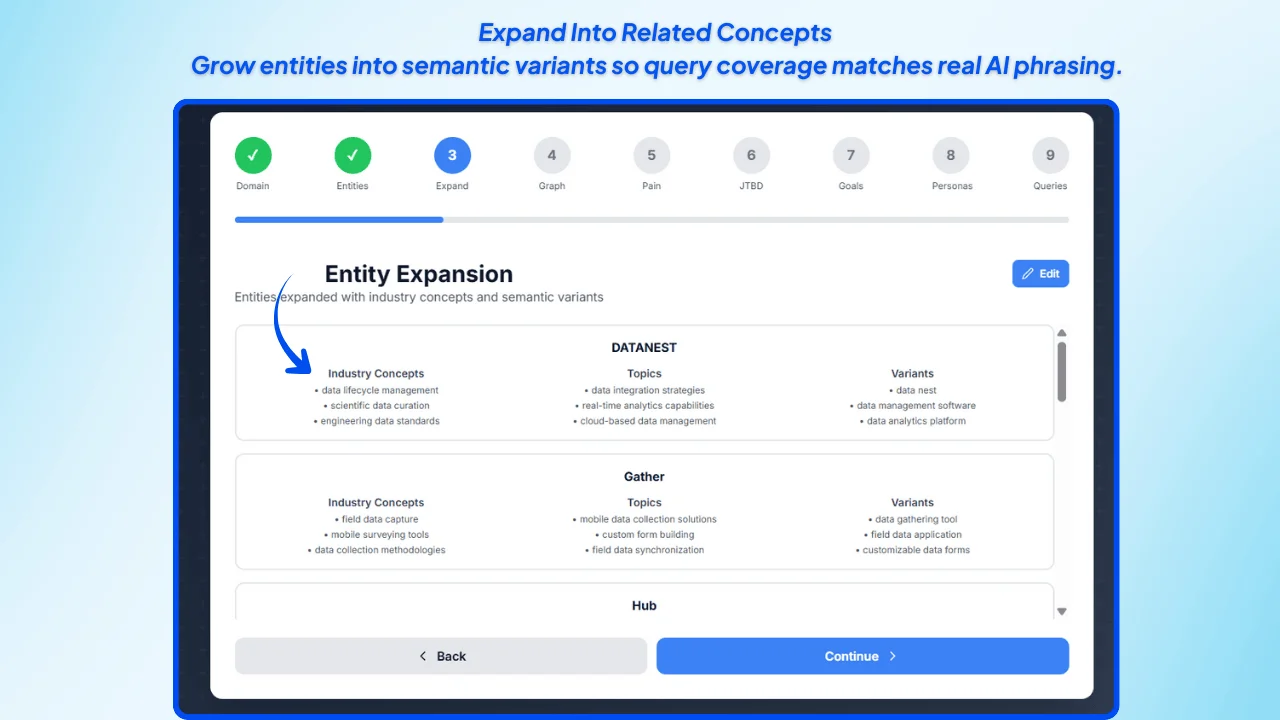
Expand entities for semantic coverage. Add close variants and related concepts so your queries match real AI phrasing.
Scan the knowledge graph. Review the map and correct relationships that do not reflect real audience flow.
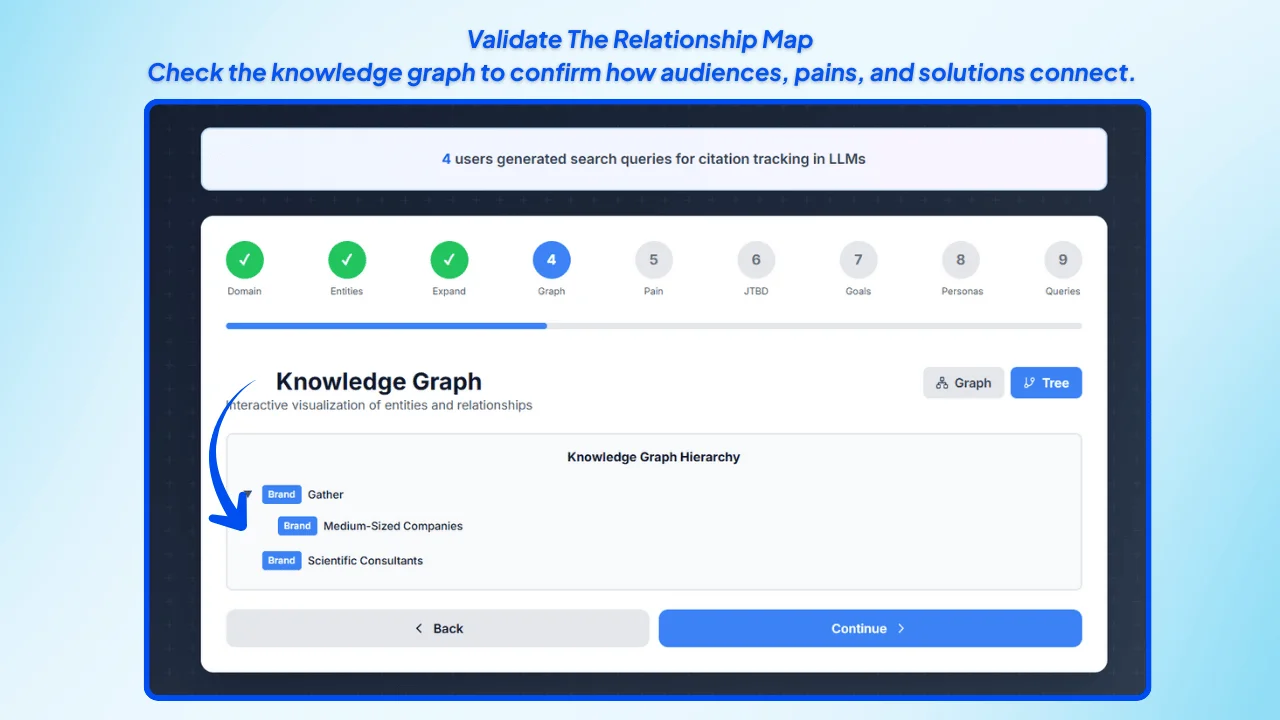
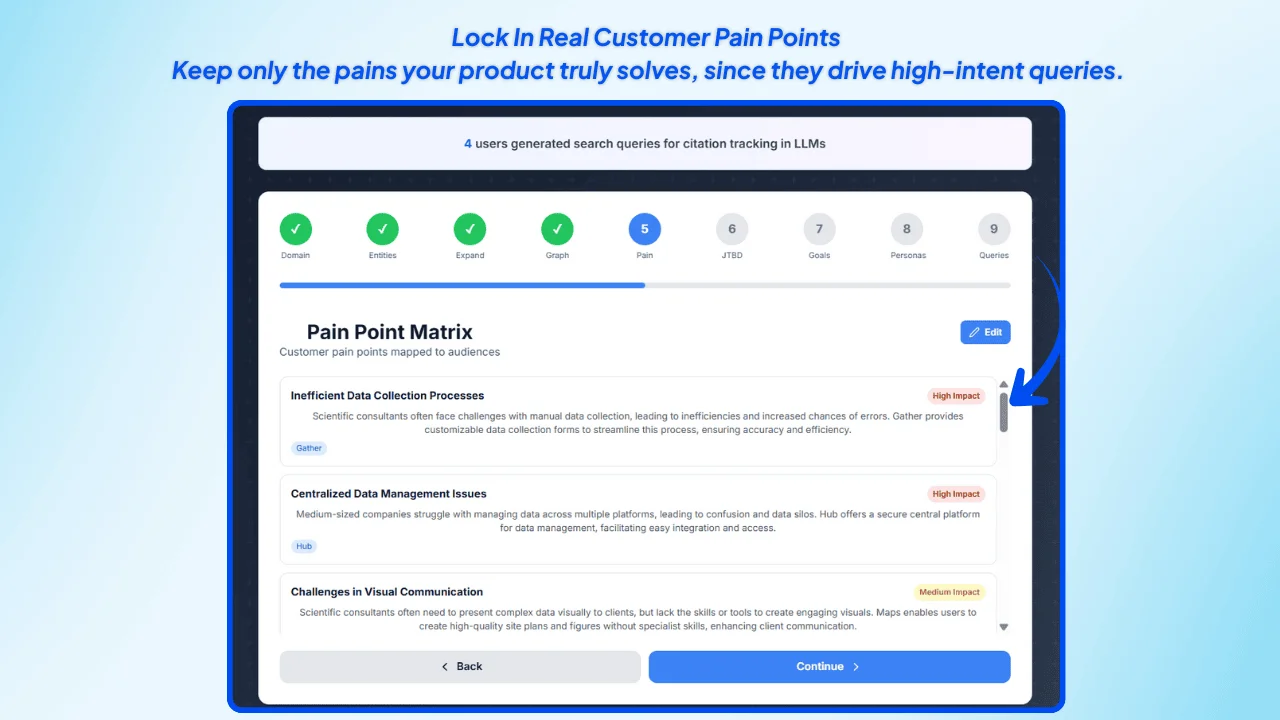
Confirm pain points. Keep only the pains your brand solves. These shape the strongest GEO prompts.
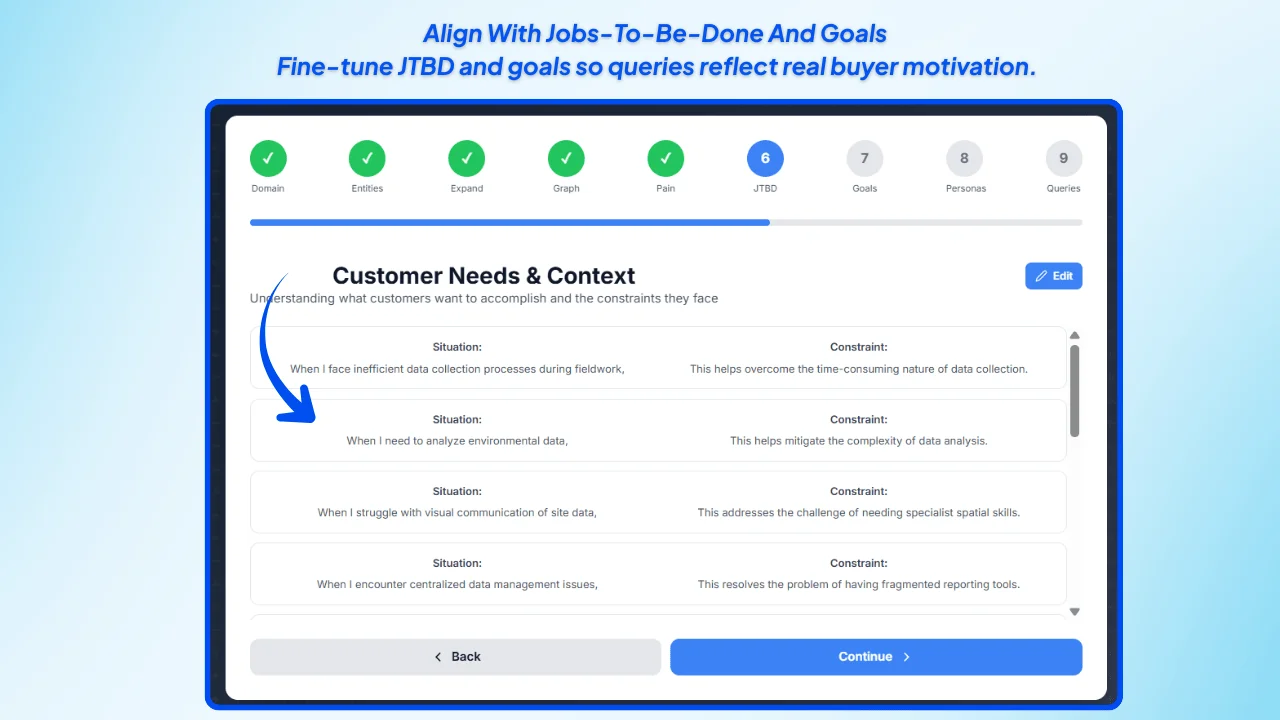
Validate JTBD and goals. Fine-tune jobs-to-be-done and audience goals so queries reflect real buyer motivation.
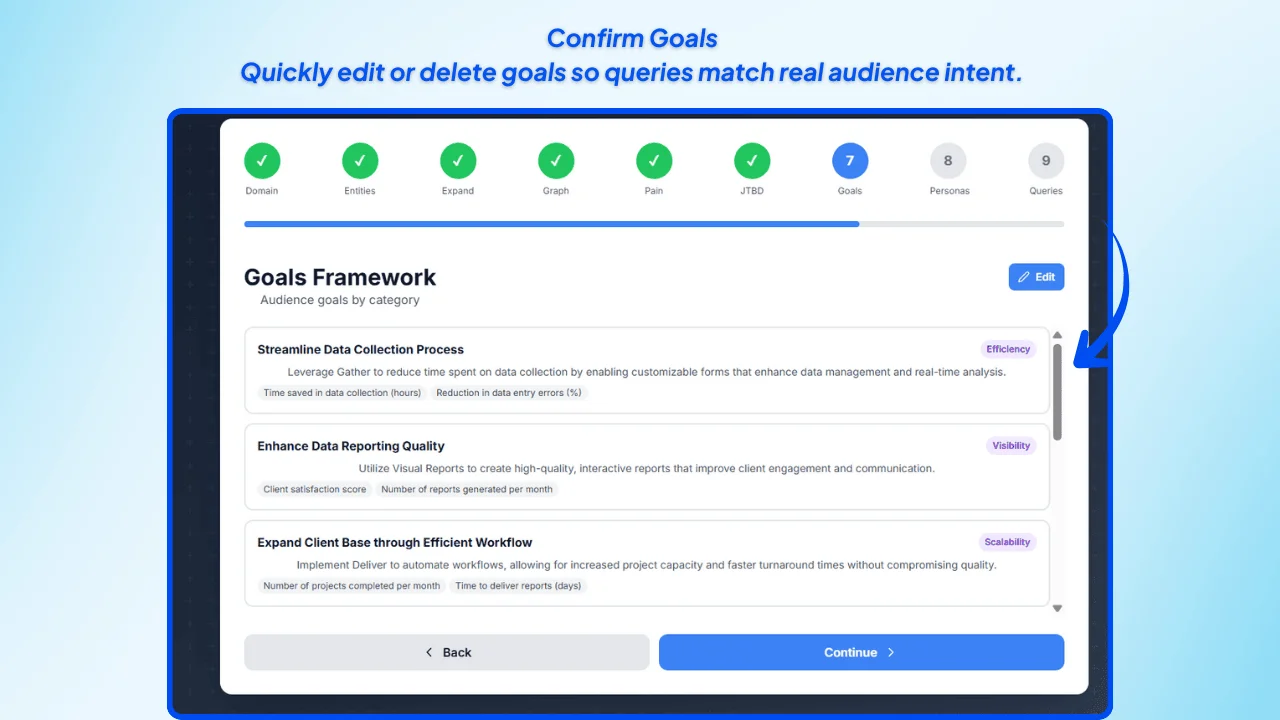
Confirm audience goals. Edit or remove goals by category. These influence the final query list.
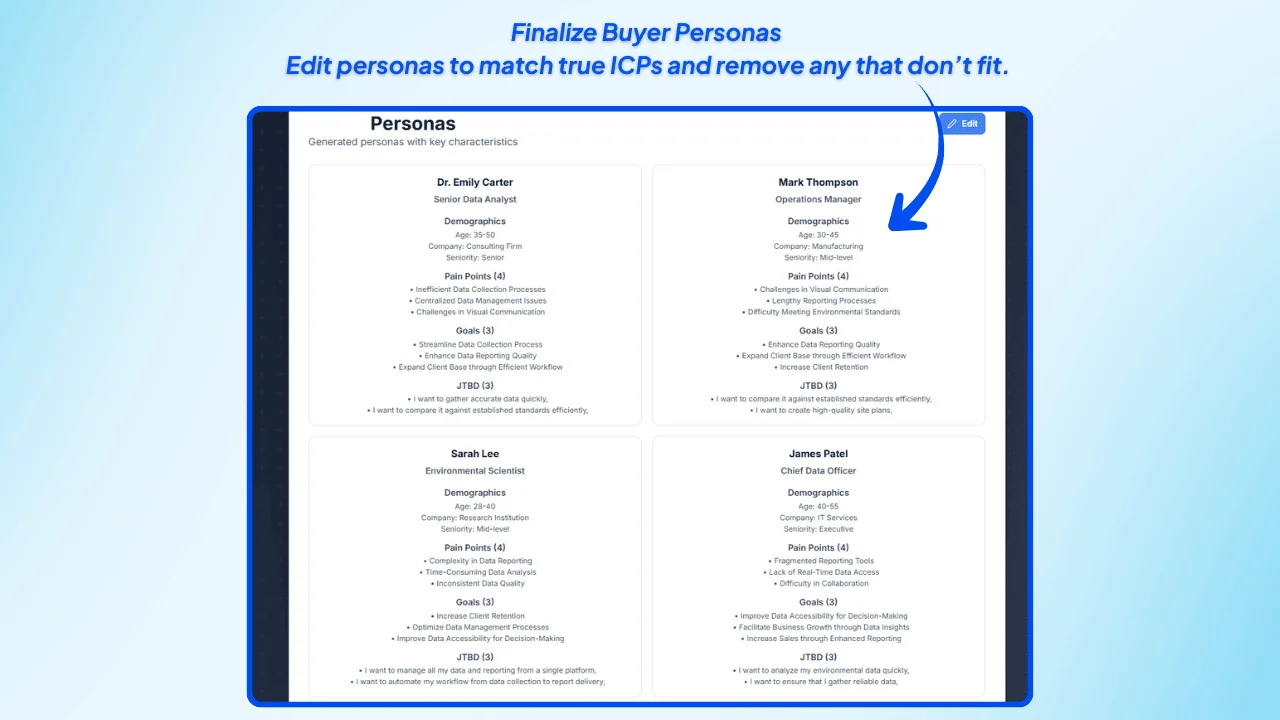
Refine personas. Rename personas to match your ICPs and remove any that do not fit. This keeps queries accurate and persona-based.
Generate queries by intent. Create conversational queries across Informational, Navigational, Commercial, and Transactional stages. Export the CSV and upload it for tracking.
This workflow replaces random prompt tests with a complete query list based on how buyers search. It shows John not only if DataNest appears in AI answers but where it is missing and which queries guide the next steps.
How Can I Find the Real Questions People Ask AI for GEO?
The strongest GEO query lists come from real conversations. The goal is to capture the original wording users already use. Generative engines reward natural language, clear intent, and context, not polished SEO phrases.
- Customer interaction data: Review sales calls, demos, and support tickets. These show the exact questions that block decisions.
- Search behavior data: Pull question-style queries from Google Search Console and internal site search. These reveal what users already associate with your brand or category.
- Live SERP questions: Use People Also Ask and related searches to capture follow-up intent that often matches AI-style phrasing.
- Community phrasing: Watch Reddit, Quora, and niche forums. AI answers often repeat the same language users use in these spaces.
- Question research tools: Use tools such as AnswerThePublic and AlsoAsked to expand discovery once core questions are identified.
- AI prompt testing: Ask ChatGPT, Perplexity, or Google AI Mode your core category questions and record the natural sub-questions they generate.
Once collected, split queries into three buckets: GEO queries (location or situational intent), generative crossover queries (local needs phrased like AI questions), and broader AI visibility queries (non-local prompts that still influence recommendations). This keeps tracking and content planning clean and organized.
After building the list, the next step is to track it across AI platforms. This is where the Wellows tracking feature helps.
How Wellows Collects and Tracks Queries
Wellows tracks how AI systems cite your brand across major platforms and highlights where visibility is strong or missing.
Step 1: Collect queries and citations across AI platforms.
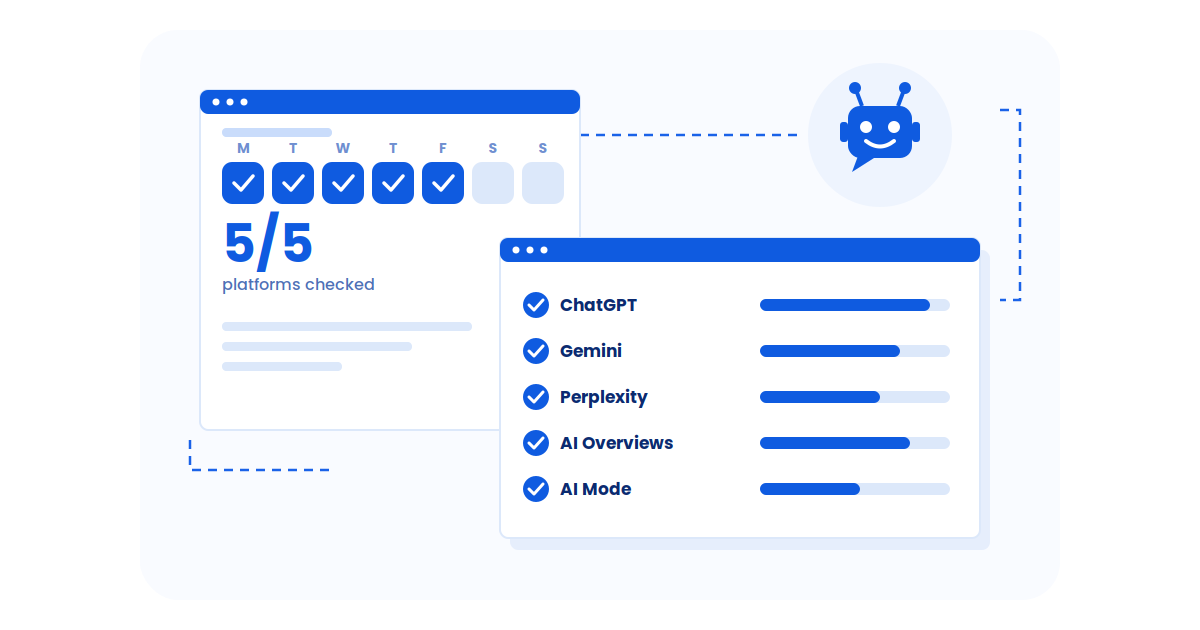
Wellows tracks your chosen queries and captures where your brand is cited across ChatGPT, Gemini, Perplexity, Google AI Overview, and AI Mode.
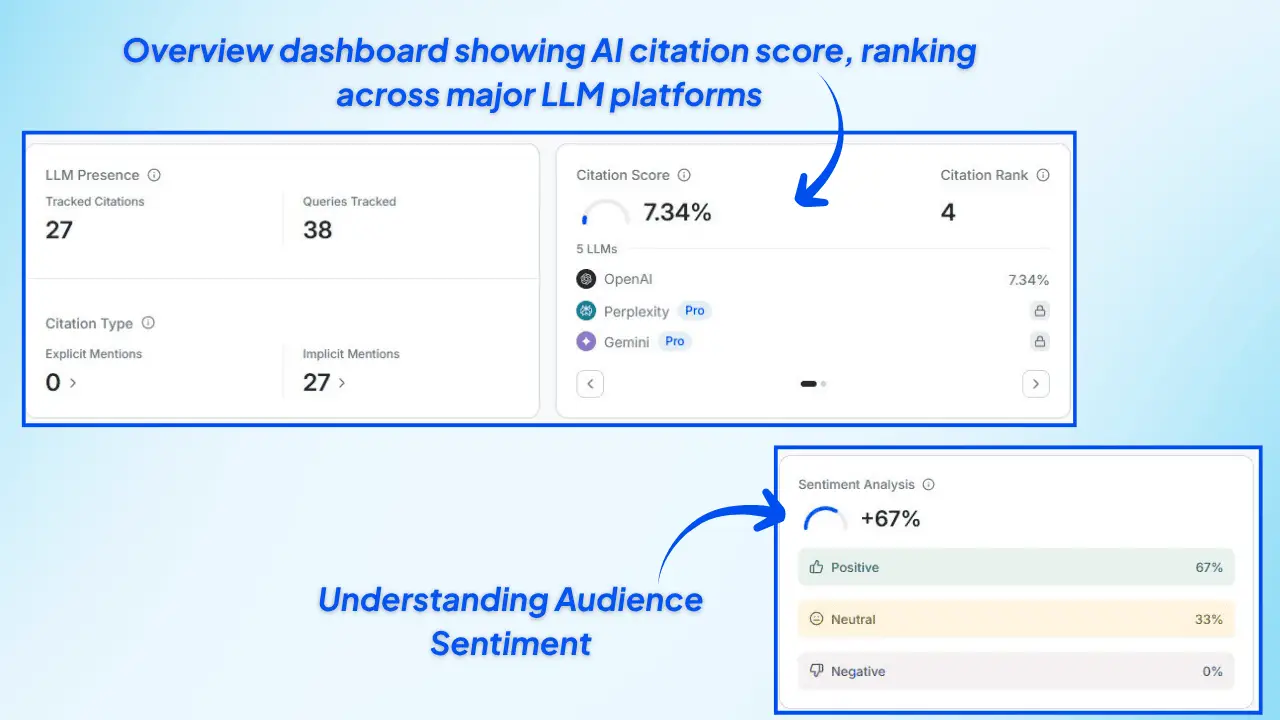
Step 2: Analyze visibility signals.
It measures mention type, sentiment, and frequency to show how AI systems present your brand.
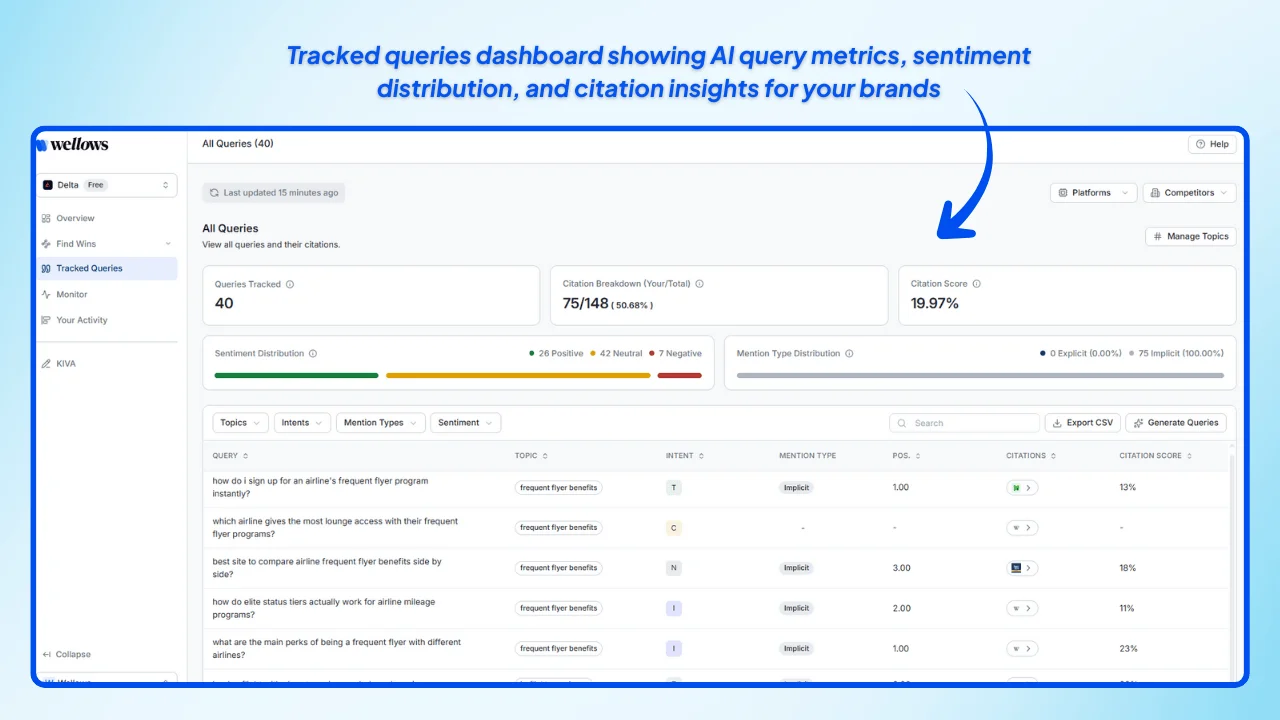
Step 3: Benchmark and improve performance.
Wellows highlights visibility gaps, missed mentions, and strong-performing queries so teams know what to strengthen or scale.
Tracking shows what works, what is missing, and which topics need content next. This turns your query list into a complete GEO visibility workflow.
How Do I Prioritize High-Intent GEO Queries?
Across partner campaigns, the biggest mistake is not missing queries. It is tracking too many low-intent ones. High-intent GEO queries sit closest to real decisions, so prioritization should follow intent patterns instead of raw volume.
This becomes more important when you understand how AI systems read local and situational intent through generative query understanding. If intent is misread, teams track prompts that never produce citations or conversions.
One strong seed prompt can also expand into many related buyer questions. This expansion is known as query fan-out. These clusters often hold the highest-intent GEO prompts, even when search volume is low.
Search Console now groups similar searches into AI-powered Query Groups. This helps you spot intent patterns quickly and review the exact questions inside each group.
Pick High-Impression, Low-CTR Questions
In the Performance report, filter for question-style prompts (how, what, best, near me) that have impressions but low clicks. These often indicate zero-click AI answers and strong visibility opportunities.
Layer Voice and Local Signals
Voice searches are longer, more conversational, and often local. Add spoken-style questions and “near me” or “in [city]” phrasing from SERPs, forums, and Google Business Profile insights to improve GEO coverage.
After shortlisting, track these priority prompts to see which ones already trigger mentions and which need new or improved content.
FAQs
Look for questions that signal clear goals: learning (“how/what/why”), comparing (“best/vs/top”), or acting (“near me/in [city]/open now”). Prioritize the ones closest to decision-making, then match each question to the right content type (FAQ, how-to, comparison, local landing page).
SEO keywords are often short phrases optimized for blue-link rankings. AI search queries are full, conversational questions optimized to be picked up inside generative answers and AI Overviews. In practice, SEO finds “terms,” while AI visibility work finds “exact questions people ask AI.”
The Bottom Line – How To Stay Visible With The Right Queries
In 2026, visibility is no longer about chasing isolated keywords. Across partner work in SaaS, agencies, and local-first brands, the same question keeps coming up:
“Which AI search queries should we track for AI Search Visibility and GEO, and how do we build that list without guessing?”
The answer is clear. Brands improve AI Search Visibility when they stop focusing on keywords and start focusing on the real questions people ask in AI tools and local search. Queries closest to action hold the most value. Clear answers increase the chances of being cited inside generative results.
- Collect real questions: pull from Search Console, PAA, communities, customer conversations, and AI prompting.
- Prioritize by intent: focus on prompts closest to decisions, not the ones with the most volume.
- Publish answer-first content: use the exact question as the heading, answer it clearly, then add context.
- Track citations over time: monitor mentions and gaps, then widen your semantic coverage as new questions appear.
This is how partners move from scattered query lists and random prompt tests to consistent AI Search Visibility across generative and local results.